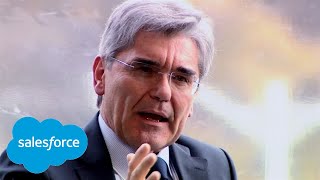
Transcript of a talk by Joe Kaeser (Siemens) discussing possible world outcomes in the next 10 years driven by rapid digital technology. Kaeser contrasts two divergent paths—an inclusive, peaceful completion of the fourth industrial revolution that raises global prosperity, or a fractured world with large-scale trade conflict and social unrest—arguing companies must serve society and that leaders must ensure net GDP growth so automation's gains do not create more losers than winners. He highlights risks from productivity gains displacing workers, cites Siemens headcounts (382,000 employees; ~30–32k software engineers), and notes the geopolitical influence of China’s One Belt One Road initiative. The talk calls on business and governments to include displaced workers in growth strategies.
Chapters
Look, I mean obviously I don't know what will happen in 10 years given the speed and the magnitude of change in both technology and the societal development. But I do believe in 10 years out now, given the speed we have on technology, which should be an enabler and not an outcome. Honestly, happiness is an outcome. Happiness is an outcome. It's a purpose to strive for. Technology should be an enabler to get there. I think in 10 years from now we either have the best society on the best planet ever built because we completed the fourth industrial revolution in a peaceful way, or we are going to have the biggest trade war ever experienced on this planet. Goes only either way. And the reason why it goes only either way is because it's going to be digital. The middlemen are being cut out because they are inefficient. Mediocracy is the natural target of the Internet because it cuts out the middleman. So either you win or you lose. So the question to us will be how are we going to take technology so that it's going to serve society? How do we create companies and leadership to serve society? And I do believe honestly, a company which does not serve society should not exist. It should not exist because it doesn't have a purpose. And that's what we need to figure out. We need to figure out a way that we can net net grow the world's prosperity, that we can NET NET GROW GDP. If we create 300,000 jobs by having the best, greatest platform of all time where you sell books and groceries and computers and people and what have you. If that 300,000 are net net is the best purpose you can potentially think of. If those net net, if those 300,000 additions on new jobs diminish 500,000 because you make the same stuff more effectively, then you have a problem. Because net net, there are going to be more losers than winners. And if there are going to be more losers than winners, we have a split society and those people are going to go on the street. And we not only have self driving cars, we have burning cars. We have 382,000 people in Siemens working for our customers day and night, give their best every morning when they get up to work. We have more people, we employ more people in Siemens than Microsoft, Apple, Google and Facebook together. Believe it or not, market cap is maybe a little different. So I have about 30,000 software engineers, 32,000 software engineers in the company. I don't need to tell them what's going to come and what needs to be done. They know that. But how about the other 350,000, what I want to tell them, what their job is tomorrow, what their families are going to do. We need to have answers for those people so that they are in for this. Together we create net, net growth in Africa, in China, in India, everywhere where people today don't have the lifestyle and the wealth and the good life as we have in the United States or in Europe or elsewhere. And if we don't get that one done, I tell you something latest. In 10 years from now, the China One Belt, One Road initiative is going to be the new World Trade Order, wto, whether we like it or not. Do you like it or not? They are going to shape the world because they have 1.3 billion people and the one belt on the road adds another one and a half billion to it. So it's three already out of seven, the developed economies. I mean, there's so much enthusiasm here in Davos, you know, never been that enthusiastic since 2000 or 2005, just before those bubbles were bursting. And the question is, you know, this is about America, it's about Europe. Everyone is great because everyone grows. But in the United States, Germany, France, Europe, they grow 1.6, 1.8%. And in part because, you know, a holiday falls on the weekend. That's what it is. Now, if you look at technology, I mean, productivity is 5, 10, 15, 25%. If I ate all my dog food, which I'm selling my customers in product life cycle management, in simulation, in automation, in modern healthcare, if I did that to my own factories tomorrow, I would have 70,000 people less, then I may make a billion more profit. That billion goes to the wealthiest people on this planet because those are the institutional shareholders. Is that inclusive of society? Absolutely not. So we need to find a way to take those millions and millions of people along who are going to be the losers if you don't help them to win. And that's the task of us here in this room, because we do have an answer. And if we didn't have an answer, it wouldn't bear because we all have, you know, sort of enough to make a good living for the time being. That's our task, business to society. Help them go along and narrow. We never close the gap and, and it shouldn't be closed because this would be Soviet Union and what have you, but narrow the gap between the haves and the have nots by leading the world to a net, net growth of gdp. If you only reallocate smartness, it's not going to cut it because those losers are going to be on the streets and tell us what we did wrong. And the governments need to take it on because they are dependent on majorities and not on the smartest one on the planet. That's what democracy is all about. That's the price we pay, and rightfully so.