Why Does Sustainability Matter? | The CIO Sustainability Imperative | Accenture & Salesforce
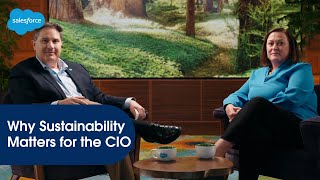
Juan Perez, Salesforce's CIO, and Penelope Pret from Accenture discuss how IT leaders can drive sustainability. They cover moving to public cloud, adopting serverless architectures, and reducing storage waste as concrete steps companies can take right now.
Chapters
Hello, everyone. My name is Juan Perez. I'm the Salesforce CIO from the Salesforce tower in Atlanta. Today we're going to be speaking about sustainability with a great colleague, Penelope Pret from Accenture.
It's a pleasure to be here, Juan.
Great to see you.
I've been with Accenture for 30 years and never made it inside this tower, so it's very nice to see the facility. Absolutely striking and I look forward to talking with you about sustainability.
To get us really started with our conversation today, wanted to get your perspectives, your views on Accenture's ESG strategy. Where do you see the company going with esg? Why is it important to the organization? How are you driving that strategy?
If you think about the last decade, the digital revolution has changed the way that the world works and lives. And we at Accenture believe that the sustainability agenda is going to have the same level of impact on all of us. And so it's important to shape at the outset what that agenda is going to look like as we think about the Accenture journey. We want to make sure that we marry our sustainability agenda up against our vision as a company, which, as you know, is to change the way the world works and lives by marrying human ingenuity and technology. So as we think through the sustainability agenda and all the things we can impact with our clients, with our customers, with our partners like you, we want to make sure to live true to those values while delivering both business value, but sustainable impact in the environment at large.
It's so important today, Penelope, for our IT professionals to be business oriented professionals too, to understand the business, to get close to the business. And when it comes to sustainability, there's no difference there. You have to be connected with the company's strategy when it comes to sustainability.
Right?
The closer you get to those strategies, the better you'll be positioned to drive technology solutions that can help the organization grow.
We want to embed sustainability in everything we do, in every relationship. Think about how profound that statement is when it comes to the myriad of technologies that live underneath basic things. How we connect with our customers, how we connect with our partners, how we communicate to the world, how we run our finances, how we do our human resources systems. All of these things in toto have to be addressed segment by segment to make sure that the way we think about our sustainability agenda at a macro level is reflected on how we choose to design from the bottom up.
The responsibility for sustainability actually resides across the entire enterprise. It's not just one individual, it's not the CEO. It's everyone across the entire organization.
As a cio, our job is to serve our companies by providing a technology landscape that powers up every aspect of our business. And the sustainability agenda is going to permeate every business process that we run as we think about how to shape out what we want to do in the space.
Where do you think we are in this journey to have technologies that can support companies become more sustainable?
The sustainability journey is still, for most of the world, young. The technology is nascent, it's evolving. We're all learning. And so what's exciting and fun is the opportunity for pairing really collaboratively with the businesses that this represents and the chance to go on a joint learning journey together. We're going to need some things from our partners and in particular from partners like Salesforce to help us along that journey. We're going to need flexibility because the journey is young and things will change. And the software that we choose in our backbones has to change with the journey. It has to be scalable. 500,000 people when I joined, we're over seven now. We've acquired 120 companies since I've been sitting in the chair. Growth is unparalleled right now. We have to be able to serve those scalability aspirations of our boards and our CEOs. And finally, data. You can have all the data in the world and be data poor. What you and I have to do is make our companies data rich by providing transparent data that's usable at the point of need. There's a couple of things Salesforce bring to the table that are particularly helpful. One is behavioral analytics. Your data is deep and it's rich and it's insightful. And we can look at the patterns of data produced by the behaviors of our people interacting with your systems and what they're doing to tell us things about how we're serving the sustainability agenda.
It's important to be data rich. Have data that actually helps you guide your decisions and the way that you manage your sustainability initiatives. No doubt about that.
The second thing that I would say is super helpful is the visualization layer. You guys have an incredibly rich and complex ux and it's very helpful in terms of the overall visualization that we can bring data to the point of the person's need in decision making. Your software does that particularly well. We're moving into a world where users have choices. They can configure their own environment. So we have to offer them visualizations that can occur at the point of need when they want to ask the question and that can be presented in a way that they find appealing. That is how you bind people into the journey. Get them to participate, get them to really heart and mind believe that they are contributing to the sustainability agenda. Then it becomes a closed loop of goodness, right? And continues on its own.
Specifically, what should we be recommending and telling our audience that that their teams should be doing to support sustainability initiatives in it?
Well, as CIOs, you and I know the first and most important step that we can take for our companies and have taken for both Salesforce and Accenture, is to maintain a position in the public cloud. Right. Getting out of data centers will produce the single biggest leap in your sustainability savings for an IT professional. But underneath that, there are multiple things we can do to continue the journey. We continually look at how we use server technology and move towards a serverless state. The less you have, the less you consume. We can think about how data is used, use only what you need, only when you need it. Don't have masses of storage that really aren't necessary. Rethink your archiving strategies. Right? And also, as CIOs, we have to teach our organizations to shift left in their thinking. And what I mean by that is whether we're doing customer development or configuring a product like Salesforce, there is an opportunity for the actual developer in the chair to get into the sustainability agenda to think about how to use key resources in a very controlled manner. But you have to build it into the methods that go into building the software or configuring the software. And that takes time and deliberation on the part of the CIO to figure out how to blend it into the methods and make it a sustainable part of a developer's life.
So the CIOs have a responsibility also to make sure that although perhaps the single unit cost of resources continues to go down exactly that we now take a different focus in making decisions and one that includes sustainability in the decisions we make as to how we use resources in general.
When you hear sustainability, a lot of people that you and I talk to, they think about carbon emissions, right? But the sustainability agenda is both broad and deep. It traverses everything, right? From the environment to society. And the ways that we're going to go about supporting each part of that agenda have to be unique and tailored to the business. It's a challenge, but I think one that CIOs like you and I are going to enjoy facing.
Well, Penelope, it's been just a true pleasure being here with you today. You know, in this discussion we had today, I left with a number of key takeaways that will definitely shape my own sustainability initiatives as I help my company's sustainability initiatives. You cannot do this alone. You need really strong partners to support you no matter what. The initiative is certainly in sustainability is key to have the right partners. And for me to see the type of relationship that we have built between Salesforce and Accenture is truly a pleasure to see.
I totally agree. And what's exciting about the sustainability journey right now is that we are still growing and learning. Technology is still evolving. The world is still evolving its thinking, and we have an opportunity as partners to figure out how to address that. Both for the betterment of our two companies, but for the betterment of the world at large. It's fun to be a cio.
So true. I agree. And for those of you watching today, I certainly encourage you to maintain the discussion on sustainability. You heard it today from Penelope. Sustainability is not a topic that should just stay within the boardroom. Sustainability is a topic that all of us are responsible for, and certainly CIOs are in a great position to drive the sustainability initiatives for our companies. Thank you.
We could talk all day and we're going to keep going.
Sam.









