Why International Marketing Is Your Growth Superpower | INBOUND 2023
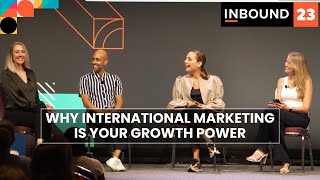
Panel session from HubSpot (INBOUND 2023) on international marketing strategy and team structure. Speakers (Suzy, Sunil Desai, Emmy Jonasson and others) describe how HubSpot scaled international marketing over five years, including an investment framework (a language × competency two-by-two), the use of international “champion” roles to bridge central and regional teams, importance of aligning objectives, early regional involvement, and broader definitions of localization beyond simple translation. Practical topics include channel ownership, SEO as a centralized specialist example, scalability via technology, and localization for both non-English and English-speaking markets.
Questions this video answers
17 years old.
About five marketers.
Well over 100 (international marketing team).
Over 180,000 customers from more than 120 countries.
Chapters
Thank you and welcome to the session. I like to think you're going to get a lot from today. I'm sure our leaders will agree with me when I say we're far from perfect at this, but we've been doing it for a while, and we think we've got some lessons to learn along the way. For context, if you didn't know Already, HubSpot is 17 years old. Five years ago, our international marketing team was just five. It's well over 100. Today, we have over 180,000 customers coming from more than 120 countries. So we're. We think we've got some experience to share with you today. And so with that, I'm actually gonna hand it over to our amazing leaders to introduce themselves. So, Suzy, starting with you, please tell us about your role at HubSpot. Importantly, where in the world you're based and what's covered within your remit and your role.
Absolutely. First, the most important part. I'm based in Stockholm, Sweden. That's in Europe, far up. And I'm responsible for our international marketing teams here at HubSpot, and I've been doing this for the past five years. Super excited to sit here today with you and this amazing panel and people that I work with on a daily basis.
I'm Sunil Desai. I lead the global brand and creative team here at HubSpot, and I live in Miami by way of a global pandemic. And I'm Emmy Jonasson. I lead our global inbound demand generation, and I'm based right here in Boston. So very short trip for me.
Amazing. Thank you, guys. Where I want to kick off is a bit selfishly, it's the question that I get asked the most when it comes to international marketing, which is very much around that. Well, how do you structure your team? How is global marketing organized? And Suzy, I want to start with you because you were our very first leader hired to look after and grow the international business five years ago at HubSpot. You have led us through some incredible transformations to. To a point where international is a significant part of the business. So curious to hear from you. What did international marketing look like at that time? As I said, we were only about 20 marketers then. But what have you implemented and how have you helped develop and build out the international organization?
Great question. To start off.
A big one.
A big one. A big one, yes. The interesting part in this also is I also get that question a lot. It's the frequently and by far the most asked question I get is like, how do you build your teams? How have you built scale within HubSpot and how have you been able to grow globally your business? But so when I joined five years ago, I was hired to take this on. So of course it's a topic very close to my heart. But in essence the way we'd been operating up until then, very successfully so was based on an inbound strategy which clearly, as I hope all of you know, it's about educating markets, adding value before you extract value, sharing valuable content in multiple channels all over the world. So it worked really well for us. But most of our international investments were based on localizing this, I would say working well, but very English focused program. So one of the first things I started thinking about when I joined was looking at like how relevant are we actually in market with these programs that we run? Are we really able to answer the questions our local customers have? Are we relevant and authentic for our customers? So we wanted to look at that. And in an inbound model, the way to think about investments usually is based on language. So the first thing we did was think about an investment framework for how to go international to make it easier for us to make these investments. Usually every year when we went into planning, we had debates on who do we put in what team, what competency is needed for what market, how specialized shall we be be in each market? So we built this framework, a two by two. The whole world can be simplified in a two by two. And you can see the one we use here. We looked at the world from a language perspective first. So you see here the vertical axe is how much of the programs we run do we localize? And when I say how much, I also mean what programs do we actually think about from the get go being created in market versus what are the programs we localize that are central but that we act activate in market. The other thing we looked at was the competency aspect of it. So is it a domain and a specialist competence that we need, or is it a regional expertise that is needed? So that is the horizontal axe and that articulates where a competency should sit. So naturally me representing the region, where we have in region are people and investments that are specialized on that market, that really understands the market, that is able to articulate the needs of the customers and partners in that specific market. While in a domain expertise you have a specialist competence optimized mostly for the volume of the market we are doing. But it doesn't take out the need for it to be in language, of course, but this is a very simplified approach and a framework we use to think about how we invest in market and we still use it today. So it's. It's working.
Yeah, no, it's fundamental. And I think you're going to hear our other speakers today touch on the two by two because it really became the model of how we make decisions about certain investments. So we're definitely going to hear more about it. But just to give an example of a specialized competence. Right. We're talking about SEO here as as one example. You need deep domain expertise here. That so we stuck that in the global team is ultimately what this model is telling us. But that doesn't mean you don't need regional input.
No.
So how do we think about bridging the gaps between regional and central teams even in areas where, you know there is mostly global or centralized team ownership?
Yeah, there are, there are ways of doing this. If we talk about aligning teams, the number one thing that is important for us or my recommendation to all of you looking to expand globally, as most of you raised your hand heading on that road, hitting on that road.
The.
Most important thing is to align on objectives. I think it's impossible to have separate teams and to have a central function and a regional function. If you work towards your own specific team goals. You need to ensure that you all align and roll up to the same objectives. Not only the marketing objectives of course, but the company objectives as a whole is extremely important. So that is a super strong bridge. It's aligning on those objectives. But also another thing that I think is really important if you own a and most of you raised your hand when you asked the question about whether you're in a central function is to ensure that you build in scalability from scratch. One of the things I did when I, when I started working for Housewives is I always constantly curiosity had the curious question not to provoke but to really make sure that our other leaders and their central owners understand that. Do you have the lens of international on when you're putting your program into market? I think it's really, really important. So align your objectives. Ensure you co create and build programs playbooks together. Don't come in last minute and say hey regional teams, I'm about to launch this amazing campaign. What do you think by the way? All images and all, it's a word play and good luck localizing it. So it's really about having that international lens on from the get go. Align the objectives and it's going to be a much smoother process.
I think Where a lot of brands trip over themselves is we need a headcount for every function in every region. Something you introduced to help bridge alignment here without just necessarily adding headcount and replicas was something called an international champion role. Yeah. That has been deemed extremely successful. I'm a big fan of our international champs, but maybe you could explain to people what is an international champion role? What purpose does it serve and how does that fit into our two by two model up here?
Yeah. So it's interesting because we started the champions 2018, the year I started. And the way we think about champions is if objectives is a good bridge to align teams, the champion is another good bridge. So the champion roles are roles that help educate central programs and central teams and central owners about the needs of the regional marketing team, or more so, the needs of the regional customers. But they also help take our central programs and our foundations international. So it's really the glue and the bridge and it works very well for us, especially in functions associated to more, you know, to marketing programs that are globally agnostic, such as, for example, our product, it looks the same all over the world. It's not specifically developed for a certain market. And in those areas we really agree upon, like this is the framework of our product. We have a product marketing champion that runs this for us. So it's super effective to have that bridge. So I highly recommend it.
Yeah. You'll hear many regional marketers say we wear so many hats and we might not be responsible for the website, but we need to have input on whether what is being done on the site works for us. And so we have an international channel for web as well.
Right.
And I think they are just so incredibly helpful in taking, taking that weight off of regional marketers by helping communicate. And most importantly, even if your teams are pretty good at bringing regional teams into decisions, my biggest complaint is that it's normally too late in the process.
Early involvement.
Yeah, yeah. We need earlier involvement to make sure that things happen that we don't then have to change further down the line. International champs help make sure regions have that input much, much earlier on. So I'm a big fan of them, obviously. Yeah.
And scalability comes. Technology is a big part of that as well. Building frameworks that actually work that you can actually take internationally Easy. Yeah.
So it's super important moving a little bit more into the specifics when it comes to execution. When people put marketers in region for the first time, one of the first activities I find they go about doing is localization. Localization I think has been sort of quite grossly had a narrow view. And when we typically talk about localization, we're really saying take an English asset and translate it into non English. So take it from your US website and make one for Japan, for example. This is a really limiting view because it doesn't consider localization among English speaking regions. Being in Australia, having been born in the uk, I appreciate that there are a lot of differences just between the us, UK and Australia. We're talking about the diversity that we want to see reflected. We're talking about humor. Australian humor is very different from the us but it's good humor. It's good, it's just different. It's all good and everything from humor and cultural references that we want to see.
Right.
And so localization is actually a far more complex and there's a trend, I think, where regional marketers are really seeing this as that next way to resonate with their audience. And then we did some research that further backs this up with LinkedIn where we found that the number one thing or priority for our APAC marketing leaders was to implement local strategies, which is fantastic on one hand, but it does create some challenging conversations around how much do we implement locally, how much do we localize, to what point are we not having impact with this anymore? And channel ownership comes up a lot. Right. And Emmy, you look after many of our core paid acquisition channels, so I was hoping you could talk to us a little bit more about how you think about international certain activities and channel ownership.
Yeah.
The first piece of advice I would give here when determining whether something should live in a central or regional team is to develop a framework that really works for your business. We use our two by two that Suzy just walked us through as a framework and it really helps guide us to answer exactly these kinds of questions to help get us out of this vicious cycle that we were in before of really agonizing over every single use case that was brought to us. Should this live in the central team? Should this live in the regional team? And so developing that framework really can help guide you in answering these questions. And for us, if you look at that two by two, recall that that we went over earlier, there was two points that we really anchored on and that was does a function need to have specialization or deep domain expertise, or does it need to have deep regional expertise? If a function needed deep regional expertise, we would keep that on a regional team. And if it required deep specialization or domain expertise, that's when we would centralize it. And we wanted to centralize specialized functions because we wanted to create centers of excellence where everybody who existed on this function was able to learn from other subject matter experts. So the function as a whole grew stronger and stronger over time. We also found that by centralizing people who worked on these specialized skills, it developed really clear career pathing for them. And then finally having all of the.









