World Tour Washington DC - Main Keynote | Salesforce
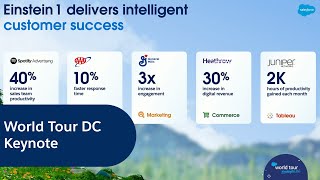
Keynote from Salesforce World Tour Washington DC presenting Einstein One, Data Cloud, and Einstein Copilot as an integrated AI + CRM platform for enterprises and public sector. Speakers emphasize trust, responsible and ethical AI, data unification (zero-copy mirroring), low-code automation, and customer success; customer examples include USAID (COMPASS CRM) and Turtle Bay Resort (personalization, revenue lift). The talk includes three demo chapters showing data ingestion, unified metadata, conversational copilots, and end-to-end automation with audit controls.
Chapters
Calling all trailblazers. Yes, there is magic in the air. Can you feel it? It's everywhere and in everything. And it's available to everyone. We are at the dawn of a new era where CRM, AI data and trust help you connect with customers in a whole new way. So everyone can be an Einstein where you can talk to your CRM and it can talk to you on a single platform with a 360 degree view of every customer. But we have to ask more of AI, don't we? Because if AI is the wild west.
Well, who's the sheriff around here?
Questions about governance and values, about trust and the safety of our data, about customer success. So AI's purpose is always clear, responsible innovation paired with ethical use. Committed to equality and mindful of our impact. Because when we get this right, and we will, the sky is the limit. We can make a world where AI does what AI does best, so we humans can do what we do best and continue to prove that business is the greatest platform for change. Welcome to the biggest AI event of the year where innovation meets inspiration meets entertainment. So raise your hands in the air because it is gonna be. Uh huh. Extraordinaire. Welcome to a whole new Salesforce.
Please welcome president and Chief Legal Officer Salesforce Sebastian Niles.
Good morning everyone. Welcome to World tour. You know, they gave me these sort of fancy shoes here, so I'm told I need to do an obligatory sort of moment, you know, here I, you know, promised everyone I would never wear sneakers at the day job. But you know, here we go. So look again, thank you for everyone, not only who's here in the room today, for the folks who I know who will be spending the entire day with us, but thanks to everyone who's tuning in online. Hi mom. Look what I also want to say, people come to D.C. from all over the world, from all over the country to be part of the decisions that are being made that shape our future. But for some of us, DC is home. Who's here from Maryland or Virginia or dc? So DC is especially special for me because I grew up from here. I went to college here, elementary school, high school. Think my co president of the computer club back in high school may be here. Thank you for joining college friends. But I highlight this because what we want for all of you today is what we hear from all of you customers and partners for so long, which is we want to help demystify what's happening in the industry. We want to help demystify where we and you are taking technology forward. And so yes. We have a day of inspiration, of insights, of innovation. But first, again, thank you, thank you, yes, to the events and marketing team, thank you to the customers, thank you to my MVPs, Thank you to the trailblazers. Right? And the most important thank you though is truly thank you to each and every one of you, each and every one of your organizations, your companies, your communities, for joining us to co create. Right, the future with each of you. So here we are, you know, at Salesforce again, it's a big world tour here in dc. Going to hear amazing customer stories, right, because we're putting our customers first, you know, about our values, customer success. There's incredible stories, you know, and impacts that you're going to hear today. Over 100 sessions. I am told that you're not going to be able to make every session because right now you can't exactly be in two places or three places at once yet. But that's why we have online streaming service. I hope you all take out your phone, download the events app, make your plan for the day. We have demos. Who likes demos? Right? People like demos. I understand over 70 demos, but really, again, thank you as well to the sponsors, over 30 sponsors, right, who are helping make this all come together. And again, the sponsors and the partners, they're here for you, just like they're here for us. So look, let's keep kind of moving forward here. Salesforce, you have made us incredibly successful and impactful. Yes, last year we were able to deliver $35 billion in revenue. We've guided to $38 billion in revenue this year. But what's really important is how we have been driving innovation, philanthropy and ethics. We've been reaching new heights of, yes, margins of other sort of sets of impacts. But most importantly, as we think of how we work with each and every one of you around philanthropy, ethics, high integrity and learning from you about what's the innovation that you need, what's the innovation that you deserve. And it's just been an incredible journey. And again, it's been so great having each of you partnering with us in that journey. I talked about values. How many of you, whether it's in your personal lives, your professional lives, or just generally put your own values at the center. And I want everyone's hand to go up because this is fundamental. It's fundamental. At Salesforce, when we were founded, we said we're going to put trust as our number one value and we're going to call it trust and we're going to mean that and how we're going to think about trust and technology again to solve problems. Customer success, right? We're successful when you're successful. And what do I always hear from each and every one of our customers? That our customers are successful when their stakeholders succeed, internal or external. And how we think about innovation, how we think about equality and sustainability. Right? Not just as concepts, but you'll hear more about how we use those values and how we develop and deploy our products and how we partner with each of you. And most fundamentally, at Salesforce, we respect your data. It's not our data. It's your data. Right? Our business model is not built that we're going to take your data and we're going to hear more about why that's so important. Look, the other element about Salesforce, as many of you know, is a fundamental idea that business can be the greatest platform for positive change. Right? That we each have a purpose beyond profit. And what's the purpose? To help solve the problems. Help solve the problems that may have not been solved for a long time. The problems of people, of planet, of government, of business. Right? And when we launched, not only did we say trust would be our number one value, we said, we're going to try to experiment with a new kind of philanthropy model, new kind of business model. And it was this one, one, one idea that 1% of our product, 1% of our time, 1% of our equity would go to giving back. So since that, again, thanks to the success that you have enabled, the success that you have accelerated over $700 million in giving our employees our trailblazers, almost 9 million volunteer hours. Why? Because we care. Why? Because this makes us all better. You know, last year we launched a new AI accelerator for nonprofits, right? AI accelerator for sort of broader sets of impact. Over 56,000 nonprofit higher education customers, you know, using our profits, using our products, you know, for free. That's how we take our profits and put them back into the community and put them back into each of you. Look, we also care again about the planet. We're net zero, how we're reducing our residual emissions, right? You know, about our carbon credits that are being part of that, too. We're nature positive. But what is so exciting about this, right? And many of you are your organizations are part of this. Over 18,000 other companies have partnered with us with this idea of let's all take the 1% pledge. And this is just very exciting and meaningful. Okay, so let's go back to the beginning, 1999. What was the big idea?
Right?
It was A big idea. But it was also a simple idea, which is how do we help customers connect with their customers in a whole new way? So let's ask the obvious question. Which of you try to put your customers at the center of everything you do? You don't have to raise your hand, but do you try? Do we try? Which of you put your constituents at the center of everything you do, internal or external? And that we would think about, how do we use technology? Not technology for technology's sake, not AI for AI's sake. Right. But to do exactly this with you in ways that are tailored to, customized and relevant. And again, it's been an incredible journey to become the number one CRM, the number one AI CRM. Those of you who follow Gartner, right, what they're saying, we're best in breed, best in suite, best in class, thanks to you and the feedback that we received. And part of the big Idea was the customer360. How do you get a single source of truth about your customers, about your constituents, about your policyholders, about your users, about the people that you're serving? Customer 360. And through this we said, let us work with our customers to build the most comprehensive, the most powerful, the most durable, the most meaningful single source of truth on the market. Because again, this matters. And these are not new problems or new opportunities. This is the same thing everyone we've been trying to do and how do we do it better, faster and more meaningful. Right. For many of you, this is actually your operating model. It's your operating system. Right. For public sector. Right. How do you do this in a secure environment, a compliant environment with government cloud. Right. Putting your constituents at the center, modernizing how you deliver your services. And what I'm really excited about are organizations that are really leading in rethinking how do we do this in putting constituents at the center, customers at the center, really excited, just one of those many organizations who are real trailblazers. Usaid. We're going to hear a little about usaid. Again, we're delighted they've chosen to partner with us around their customer360. And I'd actually ask my friend Michael, if you please come join me, you know, up here, private sector Engagement Hub. And you know, Michael would love if you can just, you know, talk to us, share with us a little bit about certainly usa. It's one of the most important organizations that are, that our country does have right around driving some very important goals. And I think what I'd ask you first, Michael, is so At Salesforce, we talk about trust, right? But what's really exciting is how USAID thinks and talks and lives and acts, you know, about trust. So maybe tell us a little bit of why is trust important? And also maybe everyone doesn't know about USAID so much.
Sure.
So tell us a little bit about that.
I'd be surprised if they did. But first of all, before I start, I mean, this is absolutely incredible. So thanks for having us here and thanks for giving us a chance to tell a little bit about our story at usaid. So, yeah, before I get to your trust question, for those of you that don't know, although we're in Washington and more people know us here than anywhere else, but we're, we are the United States Agency for International Development, the US Government's aid organization, Development Assistance Organization. Probably most of you know us most when there's an earthquake or a tsunami and you see USAID on the ground giving out food, we see it actually in Gaza, now, Ukraine, but we do that all around the world. But actually, the bigger part of what we do is development assistance, right? And so we have programs in 100 countries around the world. We're the world's largest bilateral donor as a result of being part of the U.S. government. And you can imagine in every one of those countries, we do all kinds of programming. Education, health programming, democracy and governance, food security, hundreds of programs with thousands and thousands of activities in each of those. Every country looks different because we shape our programming to the country context. And then beyond that, our tens of thousands of partners we work with all around the world every day. Right? And so from where I sit in the agency, we care about the private sector partners, right? Because these development problems, no matter what the country, no matter what the region, no matter what the problem set, they're too big. They're too big for USAID to do on its own, for the US Government to do on its own or all the donors combined, Right? And we need partners to get the resources to rise up to the level of the challenges we faced. Private sector is absolutely key to that. Our agency has talked about, there was a phrase in the video earlier about business is a solution to a lot of what we face. We believe that at usaid, and in fact, our policy says that, that if we're going to try to solve these problems, it has to be with and through the private sector as partners. And so anyway, that's what we think about all the time. We think about those partnerships. To get to your trust question, we had, you know, we think There's a lot of ways to think about trust. The way we think about it is we have a deficit, we have a lot of information all around the world, every one of those programs, every one of those partners, but it's all localized. If you're dealing with a partner, you know what you're doing with that partner, you know what the program looks like. You have the data for that, but you're not sharing it. And primarily you're not sharing it because we have the systems in place to share it. We have no enterprise wide system to actually have insight into every single program with every single partner. And so that has been a big problem for us for a long period of time. We're not alone in the government. I think you see that in a lot of places. And for a long period of time a lot of people have been complaining about this problem and possibly myself included in that. But now we're doing something about it, which brings me here today. But to get to the trust issue, you trust your information with your partner, but you know, it's only a little piece of the pie of your engagement, that partner. And there's a lot more information out there about how we're working with partners, what we're doing with that partners, what works best with that partners, what has failed in the past with that partner. And you're blind to all of that. Right. And so we're trying to solve for that through our first enterprise wide CRM system, but also the kind of the human ecosystem around that, because at the end of the day it's the people that is going to make the system work, not the system going to make the people work.
Yeah, look at that point about, it's about the technology intersecting with the humans, with the people with your goals, you know, your organization. Tell us a little bit though about compass, something I've been really excited about and I know so many are excited about, but help everyone understand. Talk to us about the COMPASS initiative and how that's starting to solve exactly the types of problems you're identifying.
So COMPASS is the name for our enterprise CRM system which we have been building for the last two years with Salesforce or on the Salesforce platform. I should say. It's going to be the first ever system in place for USAID at the enterprise level. It started two years ago. We were talking earlier. In government you tend to talk yourself out of solving big problems because one, no one solved them before you or you just think the problem's too large and the bureaucracy is too deep to ever Attack it. So what we did is my team and I, we got together two years ago and we said, you know what, Again, we've been complaining about this issue for literally 25 years since we started doing private sector engagement, like, let's do something about it. And so what we did is we actually scoped out the problem and scoped out the solution and sent up, because we're in government, right? So you got to send up approval memos up to your leadership. It was like a 56 page document that laid it all out and said, if you want to solve this problem, this is the solution, which at its heart is enterprise CRM solution. But again, it's a human ecosystem around that to make it work. We sent it up and to the great credit of our administrator, Samantha Power, she actually read all 56 pages of our document, marked it up, and then signed it and said, let's do it. Let's fix this problem at usaid. And so that set us off on this journey with Steampunk, who's our architect firm that's helping us think this out. Shout out to Steampunk and frankly, one of the best teams in all of government, I'm convinced, both in our CIO shop, but also in our technical shop. And it just started us on this journey of how to design this thing, really spending a lot of time with our customer base, which is our. We have our private sector partners, but internally it's all those people across all those programs around the world who are blind to everything else we're doing. And so we've been traveling around the world, talking to them, using a real human centered design approach to really understand what the need is and how people will use this across all those types of programs. And frankly, beyond private sector partners, we come at it from a private sector partner, but we have thousands of foundation partners, donor partners, NGO partners. And so we see this system being used for all of that, but we're starting focused on the private sector partners that we engage with.
It's a very inspiring story and reality. So tell us though, how do you see, and do you see technology continuing to be part of the transformation, Right. That you're driving and your team is driving, you know, at usaid. And do you have any calls to action, you know, for other leaders?
Sure. So, you know, this technology, a lot of what you're going to talk about today is AI. Everybody's talking about AI inside government, inside institutions. There's. Everybody's trying, everybody's excited by the potential. And I know we have a whole digital team that's trying to figure out actually how do you operationalize that and they can speak to that better. But we're excited about it because no matter what sector you're in, you start seeing applications of AI, it's just a matter of then how do you bring that in government. There's lots of policy, interagency policy discussions on what that looks like and how fast we can move. I also think though, if you think about technology, enterprise level solutions, which is what the CRM is, we too often think about solving my problem and my office and my program and what we've done is pull that back out at the enterprise level and trying to show the value of what a real enterprise level system looks like. And frankly, if we get that right, we also want to see that taken at a higher level, which is across the whole US government because no matter what level of what operating unit you're at, everybody's stove piping information. And so I think there is a real move to understanding and really appreciating enterprise wide systems and really forcing that rather than just doing bespoke systems at all these levels. In terms of a call to action, look, I would just say, you know, to, I would just say just do it, just do it. I mean that's what we did. We started talking ourselves out of doing it because we did the same thing everybody else did. Well, it's too expensive, the bureaucracy's too much. Well, we don't know much about the technology itself. It's too hard, it's going to take too long. And then we just said, you know what, we can set a memo up, right? And what we did. And so we just did it and we got the response and that set us on our way. You got to start somewhere. You got to convince your leadership to support it. I think you'll actually get a good result because the problem is so glaringly obvious. And for us it's been around for such a long time that people want solutions, they just don't want to hear what the problems are. And then as you do it, my other call to action advice is find people in your organization that are suffering from the same problem and get them on board. That memo that we sent up to our administrator, five assistant administrators signed off on that. All with different needs for a CRM type system. Beyond partnerships, beyond relationship management. They happily signed off on that because they saw it as a. So there are a lot of people out there that are suffering from the same issue or aligned issues and you gotta get them on board and then I would just say, you know, we are a technical office. We're not technology folks, right? We think about programming. We reached out and engaged our CIO's office and it has been absolutely fantastic engagement. I think it's very unique in our agency. Typically, you need a technology solution, you go tell your CIO shop to fix it. And of course, they're sitting there thinking, well, we need an owner of the system. And in our case for us, it was for the private sector to be able to say, look, we're here with you. Let's work together, right? We're equal partners in this. And our CIO shop has been with us every step of the way, the design, and they'll be with us every step of the way, implementation. And we not only got a better product, we got a faster product and just really proud of that partnership. So I would engage, there's break down those walls, reach out across agencies, go from program to operations. You're all in it together. And that's the way we've approached the solution.
It's amazing. Well, Michael, thank you not only for sharing with all of us here that journey and kind of what you're doing at usaid, but thank you to you and your team for making the choice to have the courage to let's solve the big problems and let's do it together as a team.
Absolutely. Thank you. Thanks.
You know, and I want to just highlight that, right, because the time to solve the big problems, right, is now. And the time to figure it out in a way where you're working with all stakeholders, right, is now. Because we hear a lot, and I'm going to talk about the AI revolution, but I want to say we hear a lot about generative AI, but what we don't hear enough about is each of you, the generative people that are going to ensure that this AI future is the one that you want, that you deserve, and the one that works, right, for your needs and meets your obligations to communities, to constituents, to regulators. And so we see kind of four waves, right, of AI, the predictive AI. You know, about 10 years ago at Salesforce, we had invested and built our own in house AI research team. You know, we launched Einstein, right, which was the first AI for CRM, right? Using Einstein to classify cases, right, to score leads, to kind of really help figure out how do you use predictive AI to help your work, help you do your work better, right? And then of course, the generative AI, you know, wave that we're all in AI now is, you know, helping craft Your emails summarizing, right, sort of your information. What we found actually most interesting, you know, we try to be customer zero for all of our items. The way that we've been using AI to, with just a simple prompt, using some natural language items that we've been sort of put together. The AI technology is now building workflows, right? So doing source code, right? So all these sort of critical items, right, Sort of, that you need. And then look, there's wave three. Wave three, some say is exciting, some say is a little bit sort of, you know, nerve rattling, autonomous and agents. And the idea with this wave three is that AI, it's not just a tool, it's not just a technology, it's almost a part of your team, it's almost itself, right? A set of solutions, autonomous agents, sort of type of sets of work, right, that you have to manage, that you have to define what is this going to mean again, so that your goals, your priorities, your stakeholders drive the right outcomes. And it's also, I would say again, it's sort of pretty exciting. And you'll hear more about how we're kind of developing and have been designing art, autonomous and agent AI, you know, for you. And then of course, the fourth wave, right? True artificial intelligence, right. Artificial general, right. Intelligence. Look, we're all in different ways, paths sort of on this journey. It's very important. AI meets you where you are, right? Technology partners meet you, right? You know, sort of where you are. And when we sort of step back, though, we're really excited at Salesforce about the potential and the reality about AI for enterprise, AI for business, AI for public sector. But what most of us had been kind of experiencing, kind of, you know, writ large is consumer AI. And as we know, like, what do you need for consumer AI to maybe not totally work, but at least be sort of widely adopted? Great user interfaces, great models and then all this public sort of data that's being kind of put together. But as many of you know, when you think of again, there's so many countless numbers of different user interfaces that you can choose. If you ever go onto hugging face, you see there's like 4,000 plus different models, right, that are coming up. And again, the data that the models trained themselves on, it's very wide kind of is it public facing data, is it Wikipedia, is it Reddit, is it newspapers, is it this? It's sort of all these sort of different items. Here's what we all know. Consumer AI is not consumer AI is not enterprise ready, it's not public sector. Ready? You wearing your employee hat? Look, I use consumer AI to help, you know, put together bedtime stories for my three daughters. Terrific. But it's not ready for you and your needs to satisfy your internal stakeholders and to bring, right, a new way of how you interact with your customers and constituents. So what does business AI need? It's got to be about trusted data, right? And it's different kinds though, right? Sort of data. And you heard about it, you heard about it from Michael, but you've been living it for so many years, right, in your own companies and your own organizations. Because the important data that you need for enterprise or public sector AI is within your organizations, but it's not really sort of totally clean. It's not very accessible. We have so much, I hear from so many customers about how all this data is just trapped, it's disconnected, right? And so part of this idea is if we're going to bring technology and AI in solutions that make sense for the private sector, for enterprise, for governments, we have to solve this problem. We have to connect the data in new ways. And that's not the only thing that we have to do. Because AI, in order for AI to work for business, we have to ask more of AI, ask more of the models and create the technology and the solutions. That's not the consumer AI version, but something fundamentally different. Putting trust at the center, figuring out how do you build AI solutions and technology solutions that keep in mind something that's always been pretty fundamental to enterprises and governments sharing models. You get to decide who has access to what and when. Right? Prioritizes security, safeguards, privacy, all these problems with the models around toxicity, right around hallucinations, you know, people have been using, right. Some of the different consumer AI features, you know, sort of with, you know, some other companies, you know, and the like, using these conversational tools to talk to their customers. Those conversations aren't always sort of going so well. So again, we have to work together to get a better solution because it's also disconnected from your CRM. And so what does that mean? It's disconnected from your customers, your data, your constituents, your priorities, your needs. So what we did at Salesforce again, 10 years ago, we built AI research lab. We'd launched Einstein, leader in predictive AI for CRM. And we said, let's look at all these real world problems, the challenges you each face that we face each and every day. And we said, let's try to build a solution. And that's why we were so excited and are so excited about what we were able to develop with the input and feedback and insights from so many of you. Einstein1 and this Einstein1 platform is the idea and the vision of what's a new form of AI and technology that works for business, that works for governments, that works for you. Integrating all of that data, taking all of. Yes. And you all love all the Salesforce apps. Well, why can't the Salesforce apps all work together on one integrated platform? Einstein one, what's the way in which we can, when we ask more of the models, how do we also make sure we're protecting your data, protecting you from some of the problems in the models? Einstein 1 Bringing all the data, all the capabilities, everything together using our unified integrated metadata frameworks that only Salesforce can deliver. And we're going to hear more about this, right? How do we do this in a way to make it intelligent, make it conversational, make it customizable, make it very open so that you're able to leverage, right, the broader sort of partner ecosystem, the broader app sort of ecosystem. How are we going to ensure we don't have trap data, trap value, trap success? How do we tackle these things again? And so much of this built with your input and your insights and your partnership so that we can. Right, tap that data, tap that success, tap that value to unlock it all. I want to also just highlight, I mentioned core values earlier and I said that we put them at the center just like so many of you, but we also take these core values and put them into how we think and develop and deploy products and design in all sort of an inclusive, sort of accessible way. You know, and we develop these tenants of trusted ethical and humane AI. You know, five years ago, we created an office, the Office of Ethical and Humane Use of Technology, to help also spearhead and advise on our responsible development deployment of AI. I have the honor of overseeing this Office of Ethical Humane Use and these sort of responsible AI sort of elements. And again, these fundamental elements. Your data is not our. We don't own your data. Right. That's yours. We want to have a system. Einstein 1. These are the principles. You control access to the data. It needs to be something that safeguards security, brings privacy right to the center in an environment that's compliant and secure. When we think of government cloud and sort of all these different needs, implements concepts of responsible AI globally. Right? And work we're doing with the White House, voluntary commitments and, you know, serving on different ethical AI councils, but fundamentally with trust and transparency at the center, because this is what we need, you know, we'll hear about more. There's a demo, there's sort of seminars and the like talking about trusted AI, but more importantly, the Einstein Trust layer. Just two quick points I want to hit about this. Another technology solution that we built to try to have this stuff be enterprise ready in a way that works, you know, for you. And just two items is again this idea of sometimes we figured out we have to protect our customers from the models. And so when you put in these prompts the instructions of how you're going to tell the model or tell the technology to do what you need it to do. Okay, we need to retrieve the right data from your customer base, your data, your solutions. This thing called dynamic grounding, which is how do we make the prompts, the outputs and the like make sense to you? Using what you only know best, your brand experience, your specific, your needs. And then data masking. You know what that basically is, you know who needs to have your most sensitive data? Your customer data, your pii? You do you know who doesn't need to have it? The models. And so we mask the data and we make sure sort of folks that are going sort of within this ecosystem, none of that sensitive data that goes into those third party models. And you'll get to choose which ones you use. If you want to use salesforce models, sort of up to you.
Right?
They can't retain that either. And then again, you know, thinking about audit trails so that there's a trail of what did you do and how. Because again, your regulators, your internal constituents and the like want to know what exactly is going on. So Einstein One, you're going to hear we have three chapters, three demos here from some of my amazing colleagues. Talk about how we are integrating this data in new ways that work for you, how we make it intelligent and conversational, how, how we make it customized and automated and tailored with that. Would love Parth Shah to join sort of me up here. I'm gonna go hang out. Sit over there. Expert in data.
Thanks, Sebastian.
My name is Parth Shah and I'm part of the product marketing team at Data Cloud. Like many of you, I've also been fascinated by AI. In fact, the other day I asked AI to put me a list of things to do on my next trip to Hawaii. And you know what it recommended? Cage diving with the sharks. Parth with sharks. Not going to happen. Especially after Jaws. But I can't blame AI because AI again doesn't have the right data to draw from. In fact, getting AI the right data is extremely hard because the data is siloed and spread all across the Enterprise. In fact, 8 out of 10 IT leaders believe that siloed data actually slows down digital transformation, like our transition to AI. But it's with this in mind, we created the Einstein One platform. As Sebastian just mentioned, it is one integrated platform that operates on a single unified metadata framework. This means that every app that we've built, every app that we've acquired, and every app that you have can all talk the same language. Metadata, in other words, gives us consistency, accuracy, completeness and interoperability around the data so that AI can become smarter, intelligent and more personalized. That's the promise of Einstein One. Now behind it is Data Cloud. Data Cloud is our most powerful data engine. Native to CRM, it unifies that trapped data and turns it into that metadata framework for you to activate on Einstein one. So how does it work? Well, Data Cloud can ingest data from anywhere, no matter where it sits and what type of data it is, including PDFs, emails, knowledge, articles, video, audio, data in your legacy systems. Modern I can go on and on, but once it brings all that data together, it unifies it, turns it into a Salesforce object, and then makes it available on that metadata framework for you to activate on AI, automations, Insights, or any of the unified CRM apps. In other words, what I'm trying to say is Data Cloud is how we get all of your data to talk the same language. Now, if you don't believe me, let's go to my favorite vacation spot in Hawaii and see how Turtle Bay uses Data Cloud to create personalized experiences.
Change is not the hurdle. Change is the remedy that allows us to win every day. And Salesforce is giving us the ability to change the industry. Turtle Bay is a beautiful, magnificent resort that sits on 1300 acres of dream landscape in the North Shore of oahu.
For over 50 years, Trotl Bay Resort.
Has been the largest employer here on the North Shore.
And so I take incredible pride in.
Being able to tell that story.
We're in the luxury environment, but to say luxury and to really communicate what luxury is, that's very difficult. Because all of us look at luxury differently.
Travelers today expect us to know who they are, and so making their experience here more personalized is really critical.
How do we make an easy shopping experience and merchandise that based on what their likes and affinities are? Trust was the most important thing. I needed a trusted source to secure my data. And Data Cloud was the differentiator and the perfect product to take that journey with Me CRM with AI and data powered by trust. That's the way forward for us. When sales is talking to service, that's giving the steward the ability to say, wow, this is really cool. Like, I'm actually having fun solving cases with AI auto responses.
I love using the Einstein One platform.
Because it gives me everything I need.
And all the guest details right at my fingertips.
We have all, all of these activities that we can see that they booked.
What the generative AI can now do.
Is they can take these activities and then automatically recommend other activities that they.
Know these guests will be interested in. So that way our associates have all.
The tools to really sell the guests on what experience they're wanting to do next.
The Einstein One platform is really redefining how hospitality can deliver to the consumer. For me to see where the customer journey happened prior to even being here, to their journey on site, to getting AI to tell me what the next best experience is that they should buy, that's luxury, that's what they want. And the return on investment happens. Day one. We've quadrupled our visitation to our website. Triple digit increase in conversion and acquisition, giving us 40% lift in top line revenue here at this hotel. Magic has happened along the way, far greater than I ever thought. The aloha here is so deep and so real. We're only as good as our culture, we're only as good as our people. Einstein One platform is helping us grow, augment the processes so that we can allow the employee to shine. In that regard, we're giving them the time to speak about their place that they love. It's our greatest currency here as a hotel. And people leave here saying, I will be back.
Hang on just a second. Because I'm slacking my boss to take a couple days off and go to Hawaii. Because Turtle Bay is creating the pinnacle of the guest experience and they're increasing their top line by 40%. How do they do it? Well, they're bringing in their guest management data that sits out in way along with their property management data from Oracle and then activating it across sales, service and marketing. And we're going to show you exactly how with their amazing demo drivers, John and Kristen, give it up for them. All right, so let's walk through the demo. We're going to show you two different demos here today. One is how Turtle Bay personalizes their guest experience using a unified view. And then number two, how they improve their business operations with insights. So it all starts with the guest, Jackie. Jackie is a first time visitor at Turtle Bay, which means Turtle Bay has to make sure they win her loyalty. But what we see here in Salesforce, we don't really have a lot of information on Jackie. Just her email, her name, and some marketing campaigns she's been in. But no real reason as to why she's here, what she loves at the resort, or what she's trying to celebrate. All of that data lives outside of Salesforce, making personalization and a nightmare. But not with Data Cloud. The first step in Data Cloud is to connect all of your data and create data streams. Use our many out of the box connectors that connect structured, unstructured, and even semi structured data, no matter where it lives, whether that's in Salesforce apps, modern apps, data lakes, and even data warehouses. Now, speaking of data warehouses, you can actually mirror that data directly into Salesforce Data Cloud without ever moving it. This is called zero copy, and it allows us to do three different things. One, it makes sure that your data stays compliant wherever it lives. And number two, it gets us away from building out those expensive and costly and expensive ETL pipelines. And then number three, it helps us extend the current data strategy that you have in place into Data Cloud. We don't stop there. We know a lot of public sector has a lot of legacy systems and custom systems. You can also bring that Data in using MuleSoft's AnyPoint platform, which is connected to Data Cloud. All right, so now that you've brought in all your data, what Data Cloud does next is it takes all of that data, looks at each data's schema and attributes, turns it into a common. It looks at a common data model, and then turns it into a Salesforce object that lives in the metadata framework for us to activate anywhere on the Einstein One point platform. Cool. Okay, so now we have connected the data and mapped it. Let's go back to that screen in Salesforce where Jackie's data lives. It's full of rich data, and it's telling us an even richer story about Jackie. Now, if we look in the middle, we can see her books experiences, as well as restaurant bookings. Up at the top, the booked experiences live out in Salesforce. My favorite one is surfing with the pups. Way better than diving with the sharks, I tell you. But all this data lives in Salesforce and is brought here on one screen. And if we scroll to the bottom, we can see all the restaurant reservations that she's made. Now, this data does not live in Salesforce. In fact, it lives in a data lake somewhere out there. And remember what I Said about zero copy. You can mirror that data directly in Salesforce without ever moving it. This is how we get a unified view. So that way whenever Jackie goes out and talks to Turtle based concierge, they know exactly what to recommend for her for dinner or the next experience. All right, cool. So we know how she's interacting with Turtle Bay. Is she happy though? On the left hand side we can see calculated insights. This is a multi dimensional analysis that's done by Data Cloud using that metadata object that I had described before. All of that is just mapped together in that metadata and we start to see that the CSAT score is great and lifetime value is also good. Now keep in mind that anytime your data changes, this automatically gets reflected up here because Data Cloud is active and taking in your real time data. All right, so we have an idea that she's having a good time at the resort, and the insights tell us that. But the real question is, is she going to be back at the resort? If we go all the way to the right, we can see her rebooking probability again calculated by Data Cloud. And the good news is she'll be back, but let's get her in a lot sooner. So as soon as she checks out, we can trigger an automated flow on the Einstein One platform, sending her a customized email recapping all of her experiences at the resort, along with a promotion urging her to come back a lot sooner. Pretty cool, right? All of this is possible because Data Cloud is deeply integrated within the Einstein One platform and we can activate it anywhere, wherever your CRM is. All right, so we've talked about the guest experience. It's been personalized, but I'd also mentioned that Turtle Bay also increases the revenue and they improve their business operations using insights. How so? Imagine for a second that you're the operations manager sitting by the pool on your lunch break and your manager slacks you and says, what's happening for the next quarter? Are revenues gonna be up or down? Instead of running all the way across the pool, which by the way is a safety hazard, wouldn't recommend it. You can just open up Tableau Pulse on your mobile phone. And then up at the top, AI automatically has generated a summary of the key metrics that we follow. In this case, the good news is that the experience booked over the next month is up or has remained unchanged, which is good. And then if we want to dive deeper, we can keep scrolling and we can start to look at other analytics. In this case, I want to see the occupancy rate for the upcoming Month kind of looks like it's down for the upcoming month. But before we dive into that, let's take a pause and appreciate how amazing this moment is. This operations manager, instead of running to his office behind a desktop, uploading an Excel sheet into a BI tool, trying to visualize and then analyze the insights on stale data, he has Tableau Pulse and Data Cloud together. Data Cloud brings in that data in real time, and then Tableau Pulse visualizes it absolutely beautifully. And all the insights that we get are never stale and up to date. This is how we can work by the pool pretty quickly. All right, so let's get back to the occupancy trend, because we don't want to keep the manager waiting. Right. And one of the ways that we can dive deeper into it is Tableau Pulse has a few questions that we can click on to dive deeper. And as we do that, we start to notice that the reason why this number is down is because there aren't enough corporate event bookings. Not a problem. Again, because Tableau Pulse is also on the Einstein One platform, we can send a slack message to our marketing team to create a personalized campaign to the corporate events team, asking them to make their next event with us. That's it. Everything is done. That's how you improve your business operations using analytics. I tell you, working at Turtle Bay is also pretty awesome. But hang on to that, because we're going to continue on this demo in the next few chapters. So as you can start to tell, Data Cloud is probably one of my favorite products to work on at Salesforce. And part of that is the amount of power that it has to bring in data from anywhere that trap data, unify it, and make it available on that metadata framework for us to activate on the Einstein One platform. Now, we know it takes a couple steps to get to where Turtle Bay is today. So if you're a sales or service customer and you have UE or ee, Data Cloud's already included, go try it out for yourself. And if you don't have Data Cloud, or if you don't have service or sales, scan the QR code and try it for yourself. Sebastian, I'm gonna go off to Hawaii. Back to you.
Thanks so much. So, look, you all just heard right, how the Einstein One platform, we're integrating data, we're unifying data. Might be Salesforce data, but actually the really interesting element. Right. Structured data, unstructured data, data that lives in other data lakes. Right. Investments you made.
Right.
Sort of in other areas. All this trap data brings it all together. The real magic though, once you've brought all this data together, what do we do with it? And so I'd love have John Moore come tell us all about how do you use take all that data together and make it intelligent and conversational.
Thank you, Sebastian. So listen, out of all these speakers, I'm the only one who's from here, Merlin. I don't live in Maryland. I live in Maryland, so I know DC Energy. All right, can I hear you all make some noise like I know D.C. maryland and Virginia can. And let World Tour know that we're in the building. Can I hear it? Can I hear it? Can I hear it a little bit more? Turn it up just a little bit more. Okay. All right, now that feels like World Tour dc and it's good to be back with you all today. So listen, we already heard that good AI requires good data, but really great AI has to understand your business and your mission at its most fundamental level. In order to be effective, AI really just needs to show up everywhere you are, be able to work everywhere you do. Right? It has to be able to touch every web page, every workflow. But bringing AI fully into the flow of work is no small task. Which is why we've been preparing for this moment since 2014. So over the past decade, we've been infusing AI into every single one of our core CRM applications, from Intelligent forecasting tools to self service bots for service and case management. The list is vast. And it's working. I mean, we're cranking out over a trillion predictions every single week. But the impact for our customers goes even deeper. Today, Einstein One is delivering intelligent customer success across every single industry that's inclusive of nonprofit higher education, public sector. And we're thinking beyond just the bottom line. We really do want every single one of your employees to be more successful. Which is why we're so excited. Get ready to clap. This is a clap of a moment. Okay? This is why we're so excited to say hello today to Einstein Copilot. This is your cue. Yes, indeed. It's such a moment because this is our conversational AI assistant. And it's rooted and grounded in your trusted customer data. This is high quality, trusted AI that is able to deliver for you on every front. It can generate content, it can automate tasks, it can answer questions, the whole nine. And what's most important is that all of this is happening in one unified experience. So think about it like this one copilot across every application. I wonder if you all can repeat after me. One copilot everywhere.
Everywhere.
I wish you'd say it with some authority. One copilot everywhere. Now we'll just work on the hand motions when I ask you to do it the next time. But it is one copilot and it's everywhere. And the reason it can do that is because is reading all the data and the metadata that's consolidated on our platform from your trusted sources to give you instant insights. And the best part about it is you can talk to Copilot in very natural human language just like you would talk to any other person. And this shows up everywhere in all the places that you work, like Slack. If you're serious about getting work done, if you're serious about productivity, you are serious about Slack. Slack is a game changer and it's helping every team to work more efficiently with capabilities like Slack AI. Which summarizes gathering all the conversations that are happening across your workspaces and innovations like sales elevate that allow you to connect your CRM data and take action on sales or maybe even contracting opportunities. So let's see how all of this comes to life. We're gonna go back over and visit our friends at Turtle Bay and see how Turtle Bay is using Einstein one in their day to day. I didn't mean for that to rhyme, but look at me dropping bars at World tour. So let me introduce you to somebody. This is Lee. He's a marketer. Shout out to my fellow marketers in the room. And because Lee is serious about his work, he starts his day in Slack and the first thing he pulls up is a Slack AI recap. Just think of it as a daily digest of all activity. Perfect way to stay on top of things. And because like so many of us in here, Lee really likes to understand the data behind the business. When he sees there's activity in the Occupancy Insights channel, he makes a beeline there and sees that one of his colleagues has already started servicing data from Tableau Pulse. So this gives the team the ability to work together for far more efficiently. As you can tell, this has already started some great conversation. The team is solutioning right away. In addition to interacting with his colleagues in real time, Lee has the opportunity here to tap into the power of Einstein Copilot to start connecting the dots. So the first thing Lee wants to understand is which activities are most popular with all of the corporate groups that they want to target. And so Copilot does a little thinking, comes up with this list and what's important about this is to understand that Copilot literally took unstructured data like survey results and conversations happening in Slack and structured data. This is the trusted data that comes out of data cloud, like booking rates for activities and service cases. Combines them all and gives you this insight. This is perfect for Lee. He goes ahead and shares this information with the team, and this empowers him to then go on, start building some campaign content around this. So how many marketers do I have in the room? Any hands? Just a few. Okay. Well, for the marketers in the room, we all know that one of the biggest parts of our job is to send the right message to the right people at the right time, right? So Lee hops into Einstein one Marketing to do just that. But the first thing he's encountered with is the dreaded blank page, which nobody wants to deal with, even if it is our job. However, just like in Slack, Lee can tap into Copilot and talk to a copilot in natural language just to get a first draft started. So we see Copilot cranking away. Could this be any more perfect? It's beautiful. Now, I know somebody said, yeah, well, I did that yesterday with a tool I found on the Internet and it even pulled in a cat video. Yes, I'm sure you were able to do that. But what's important and unique about this is this is pulling in proprietary information. It's drawing down from Turtle Bay's brand guidelines, relevant data from past campaigns to create a highly contextualized email. So Lee is now able to take the next step and enhance this by adding in some information about some of those experiences that we know that we love so much. So let's see. Yep, we got Lu Al's popped in there. And let's go ahead and add some contact information for sales to make sure that we're able to get people on their way once they get this email. That looks perfect. And now all Lee has to do is hit publish send and set his campaign live. And now he's got a ton of time to be able to focus on creating additional campaign content. Easy peasy, just like that. Now that this email has been sent off, let's check in with the sales team and see if this has drummed up any opportunities for us. Here we are in Einstein one Sales, and the seller home gives our sales folks the ability to see their business in one snapshot. This is our seller. Her name is Amy. So from this viewpoint, Amy can see her entire pipeline, her to dos and even her weekly goals in one place. And just Like Lee, she has the power of Copilot at her disposal to help her get her work done really quickly. First thing she wants to know is which opportunity should I focus on first? Copilot goes to work, pulls up an opportunity. But not just any old opportunity. It's our friend Jackie from the last demo, right? And the reason Jackie was pulled forward is because she had such an incredible experience on this personal family vacation. High customer satisfaction, no open cases, she's very highly likely to close. The reason Copilot knows to pull Jackie forward is because they have access to the metadata framework that all of this is built on. So Copilot understands the context of the question to deliver the best answer. So now that Amy knows which opportunity to work on and why, she wants to know what her next steps are. So what does she do? She asks Copilot, what do I do next? And Copilot comes up with a really fantastic action plan. Looks like the next action is to invite Jackie for an on site visit. At this juncture, sending out an email is a task that normally Amy would have to undertake herself. But given what we've experienced, what do you think she's going to do? If you guessed, ask Copilot. You're right. So Copilot gets to work drafting up that email. And because Copilot already knows so much about Jackie, she can put in all the context that we need. And all Amy has to do is review and send it off. Now, Amy has tons of time to be able to focus on her pipeline and get to work on all the other opportunities that she has lined up. Now, this is the at desk experience. We know that sales is often not at their desk. Most sales folks are on the go, or in Amy's case, around the resort. But even when she's away from her desk, she still has the tools she needs to get her job done. And because she is also very serious about work, she starts and ends her day in Slack. So here it is. It's the day of the visit. Jackie's on her way. Amy wants to get caught up on all the latest. And so she hops into the account channel to see what the conversation's been. Rather than reading every single message, she can use Slack to summarize that message. So just in one click, she's got this beautiful summary. She's all up to speed. Everything is set. At this point, she wants to move the opportunity from one stage to the next. Now, this view is sales elevate. Remember I talked about it at the top of my segment. This is where she's able to connect that Einstein One sales data and take action. This is where she'll move the opportunity. Before we do that, I want you to understand that there's a workflow that's going to kick off in the background. There's a Salesforce event trigger that will automatically create a brand new Slack channel once this opportunity is moved from qualification to proposal. So let's see that happen and then I'll give you a little more detail about the significance of it. There we are. Now we have our new channel notification. When we hop in, we see there's an automated welcome message that lets every new member of the channel understand how best to engage in this channel. It's even got an automatically generated event plan. And what's really impressive is that it extends the power of Slack beyond internal work groups because this pulls in the prospect. So in this instance, this is allowing the seller and their potential guests to collaborate in the same space. Long gone are the days of phone tag and keeping up with outdated versions of documents and slow emails. This is simple, it's secure, it's seamless, and it makes for a hassle free event plan planning experience. So fast forward. Of course, Jackie loved Turtle Bay because why wouldn't she? And we're celebrating. We're celebrating because we're going to be able to welcome the guests on site eventually. And what you're seeing here is just one example of how Turtle Bay, and really anyone in this room, can harness the power of Einstein one to drive employee productivity. This is not the last that we're hearing from Turtle Bay. There's one more demo coming to help us finish out their story. But what you just saw is not some futuristic vision. This is happening right now. We're working actively to bring Genai into every single one of our applications and our industry solutions. And Einstein One is making it all happen. So to help us understand a little bit more about what else is in store for all of us for the rest of the day, I'll turn it over to our host, Sebastian.
Thank you, John. So look, everyone just heard, right? How leveraging data, all of your data, integrating all of your data, lays the foundation for powering intelligence across the Einstein One platform. But wait, there's more. How do you automate it? How do you customize it? How do you tailor it to you? And for that, I'd love to welcome the incredible, the inspiring, the innovative Alice Steinglass.
Thank you, Sebastian. AI is clearly changing the way we work. But my favorite part of it is we're going to get rid of a lot of the repetition. Do you know that we spend 6, 62% of our time today on things that we do over and over and over again? And that's why we're building AI and automation directly into the Einstein One platform. Now, a lot of, you know, flow, you're using it today to orchestrate and deploy automations across your enterprise, across your apps. Now, with AI, we can use AI as part of those flows because it's not just repetition. If I was literally doing the same thing over and over and over again, then I could just automate it today. It's not quite that you're doing almost the same thing over and over and over again. And that's the power of AI and automation together, because it can, in real time, dynamically do almost the same thing, but personalized for every customer. So what does this look like? The best part of this is that you don't need to be a software developer to do it. And that's because we've built the Einstein One platform to support low code and no code. What does that mean? It means you can build custom apps and processes with clicks rather than code. It means you can customize and extend your copilot for your business. And it means you can join the over 20 million trailblazers who are building on this platform today. And if you need help, we're here to help you every step of the way. We have thousands of partners on the ISV, partners on AppExchange, and we've built some key partnerships that are going to help you out. So earlier you heard about Data Cloud. Maybe you're already building a data lake and you've built it on Snowflake or Databricks. If so, our partnerships with Google, with Amazon, with Databricks, with Snowflake, you can use that data with zero copy inside of Data Cloud. And we've got key partnerships with our AI with major AI providers like OpenAI, Anthropic and Cohere. And we've built tools to help you. We just announced the Einstein One studio and this allows you to build and customize how your AI works at your organization. We have Prompt Builder just going to let you create the prompts that you need grounded in your data. We have Copilot Builder which is going to allow you to customize your copilot to work the way you need it to work. We have Model Builder. I can create my own models and I can also, if you've already built a model, I can use that model as part of the einstein1. Platform. But you all don't want to hear me just talk about it. You want to see it in action. So please join me in welcoming at our demo desk. We've got Rusha and John here. Get a round of applause for them. Okay, we're going to head back to Turtle Bay and we've got our corporate guests. They are arriving, and when they show up, they're going to get a welcome message. Hey, Jackie, welcome to Turtle Bay. Now, that's not new. That's not AI. Turtle Bay has been sending that welcome message for over a year. But I want to show you how they do it. So what they do is when a guest arrives, they run a flow, and that flow is part of that flow. What you see here, there's a thing where they get the contact details. That's where they find out Jackie's name. Then they're going to go ahead and send an SMS via marketing API to welcome Jackie to Turtle Bay. But Turtle Bay is deeply personalized. It's a personalized experience. They want to do more to personalize this text message, and they can. And we're going to do that with AI. So to do that, we're going to head over to Prompt Builder. Now, Prompt Builder, this is basically a playground. This is where I can set up what do I want to do with the AI? What do I want it to generate? In this case, a text message. And what data do I want it to use from my organization to generate that text message? So writing a prompt is pretty simple. Just plain English. We're just going to say, hey, generate a text message welcoming our guest to Turtle Bay. But what guest? Who am I welcoming? I need to know who that guest is. This is right here. Here is the info about the guest. I'm going to go ahead and send in a data graph. What is a data graph? It's just a set of data directly connected to my CRM using all of that data from Data Cloud. And I get to choose what data I want to include as part of that guest profile. In this case, we just say, hey, plain English. Include my data graph. With my unified guest profile. It's not just the data. I can include flows as part of my prompt. So Turtle Bay has already existing a flow that recommends activities depending on who you are. So maybe if you're a corporate guest, they're like, come check out our luau. And if you're here with your family, why don't you come surfing in the middle of the day with puppies? I'm in. I'm in. I'm sold. Okay, so we're going to go ahead and include the results of that flow and look in one line. We're going to recommend one activity from the result of this flow that's an existing flow the Turtle Bay already has. We can pull that data right into the prompt. And then lastly, I want my brand. And I said, these are reusable prompts. I don't want every single rep at Turtle Bay to try to describe how to use the aloha spirit. I want to write it once. I want to write it once and I want it to show up for every single person. And so that's what we're doing right here. Now, this is a reusable prompt. I said this is a playground. This is a place where we can try this out. So let's test it. We're going to test it with Jackie here. And what you see on the left here is the data that we're sending into the LLM. And this is customizable. You can see we're breaking it out. This is that data from data cloud. You can play with it, you can try it, you can change it. It's not the right data. You're in control. And on the right we see a sample response. Play around with it. We get it right. And once it's good, this is the real power. I can roll this out for every guest as part of that welcome flow. So what does that mean? It means that when my guests show up, they're going to get a welcome text message. That's for them. It means that when my bride to be shows up, I can say, hey, why don't you check out a spa day? It means that when Jackie shows up, I can tell her about our gluten free selections at the restaurant because I know she's gluten free. And it means that family, we can recommend they go surfing with puppies. This is the power of AI embedded as part of your automations with data cloud and with control over your data. But there's more. We don't just want it automatic. You saw that copilot earlier. I want to control that copilot and I want to be able to customize how my copilot works for my team. So for this example, Roosh over here is now going to play the role of a concierge at Turtle Bay. And as an excellent concierge, she's going to check in, say, hey, which high value customers do I have checking in today and what are their arrival times? Now what's a high value Customer. How does Salesforce know how to give an answer to that question? It knows it because you've set it up with your metadata and your custom fields. So Turtle Bay has a concept of a high value customer. And because they've set that up in the past, we can answer that question right out of the box and we can know that the high value customers checking in today are Jackie, Ashley and Renan. And Jackie missed her flight. I don't know about you, but if I was flying from JFK to Hawaii and I miss my flight and I'm overnight, I'm going to show up hangry. And Rusha is an excellent concierge. So why don't you proactively give Jackie a $250 discount or meal credit. Meal credit. We're going to make her happy. We're going to solve the hangry problem. So copilot's working on this. It's understanding the request. Oh, I'm sorry, but I'm unable to do that. That's a good thing. That's a good thing. I don't know about you, but I don't want my copilot just deciding to go ahead and give credits here and there. Turtle Bay has a process for this. Turtle Bay has checks and balances. It needs to make sure that Rusia over here actually has permission to go issue a $250 credit. It needs to make sure that this is a high value customer that we can issue a credit for. And it's got more than one system. In fact, issuing a meal credit at Turtle Bay requires a call via MuleSoft to their ERP system to make sure the whole thing stays in sync. That is a process that we need to have control over. It's a deterministic process. That's not something that we need AI to create. I don't need it to invent that process. We know what that process is. And with the Einstein copilot, you're in control. You're in control of the capabilities of your copilot and we can teach it to use that process. So let's try it out. So we're going to head over to another playground. This is Copilot Builder. This is where I configure and create my copilot with the actions that I want it to be able to take. You can see here a bunch of standard actions. We have a whole bunch of actions that are there out of the box and there's going to be more coming every single month. That was things like what we just saw where we asked it about our upcoming customers or sorry, guests in this case. But here is the copilot action library. This is where I can add new capabilities. I can teach my copilot how to do new things. In this case I want to teach it about some existing flows that we have at Turtle Bay. I want to tell it how we go issue credits with all of the processes and checks in place. Right? And so we're going to go ahead and we're going to add those capabilities here into the copilot and then inside this playground I'm going to try it out, I'm going to test it and see how it works. So let's. Risha, can you give a credit again this time inside the playground? And we're going to give her $250 meal credit. And what is happening? First we're going and looking up who's Jackie and we're finding out that yeah, she is a high value customer. And then we're going to take that information and we're going to send it into this flow, this deterministic flow that TurtleBay controls that says here's what I need to check and we're going to go sync it to that ERP system via MuleSoft to make sure that everything is in sync. And then when we've done all that, we can go ahead and schedule that SMS message to let her know that she's got that meal credit. What does that mean? It makes Roosha's life easier because she can go ahead and offer that meal credit right from copilot. And it means that Jackie, when she shows up and she's hangry and she's tired and she finally gets to Hawaii after her layover, sees that they have met her or with a meal credit and that changes her perspective. That's how we make lifelong customers. That's how we truly know our customers. This is the power of the Einstein One platform with data cloud and this is the power of a trusted AI platform. Thank you. And back to you Sebastian.
Thank you. Alice Parth. John. Just incredible innovation. So look, the Einstein One platform though is for everyone, right? It's for every industry. We're democratizing access to data to the best technology to AI which means Einstein One platform is for public sector. I'm so honored today to announce over 20 new innovations for public sector, including one of my favorites, field service on government cloud, digital first mobile service, contractors, agencies, right in the secure, compliant, trusted environment that is so critical to bring CRM +AI + data + trust for constituents and public sector. Worldwide. Really exciting. Lots of sessions and demos to talk more about this. I think the other element, I just wanted, as we conclude here, I mentioned earlier that we hear a lot about generative AI, but we don't talk enough about generative people. Here you are. It's you, the trailblazers. Over 20 million global trailblazers. But we need more. You trailblazers are the ones that are going to take this AI future, the technology future, forward in a way that makes sense for your stakeholders, your constituents and your customers. And again, we are here to partner with you to help the sponsors, the partners, everyone here working together to ensure that everyone can be in Einstein. So hopefully you have your agenda planned for today at 1pm really hope you can come back here for the government keynote to talk even more about constituent relationship management and stakeholder success. It's also been, believe it or not, 10 years since we launched Government Cloud. So you know what that means, Cupcakes. And you guys get a good stretch. So, so much happening, so much exciting, you know, sort of stuff. You can also watch it on Salesforce plus because you might have day jobs and like, other things you need to do for, you know, a lot of people. And lastly, thank you. Okay. Thank you not just for spending time with us, but again, for partnering with us with your ideas, your people, your teams as we move forward on this journey. Please take out your phones. There's a survey. Salesforce, we love feedback. We need feedback. Helps us all be more successful. Helps you be more successful. And I think with that, have an amazing day.









