Balaji Srinivasan at Startup School 2013
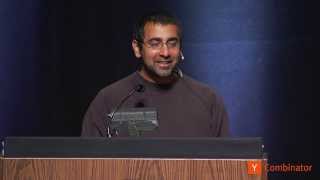
Balaji Srinivasan argues that exit, not voice, is how real change happens. He contrasts voting and complaints with forks, startups, and immigration, claiming Silicon Valley technologies like Bitcoin and 3D printing let people escape traditional power centers in Boston, New York, and DC.
I can talk about Y Combinator. I guess you guys all know about that. Let me introduce myself briefly while things are loading here. So my name is Balaji Srinivasan. There's actually 12 people with my same first and last name in the Bay Area alone. In fact, I randomly ran into another one of them at Stanford and founded a genomics company with them. So I go by my full initials BSS and I, I'm a Stanford lifer. I got my BSMS PhD at Stanford and in 2006 I started teaching computer science and statistics there. I left Stanford in early 2008 scandalizing the department to found a genomics company which has become very successful. Our name is Council and we test about 3% of all birds in the United States. I've also taught a MOOC at startup Stanford Edu, which has become quite successful. Successful. But I'm going to talk about something fairly different today, so can we go? Yes, works. Okay, so we're going to talk about today is something I'm calling Silicon Valley's ultimate exit. And so as motivation here, you know, it's a bit topical. Is the USA the Microsoft of nations? We can take this sort of thing and we can expand it. Code base is 230 years old, written in an obfuscated language system was shut down for two weeks straight. Systematic FUD on security issues, fairly ruthless treatment of key suppliers, generally favors its rich enterprise customers. But we still have to buy it. And you know, if we think about Microsoft itself, there's a great quote from Bill Gates in 1998. What displaced Microsoft? What, you know, what did he fear? It wasn't Oracle or anybody like that. What he feared were some guys in a garage who happened to be. Ultimately we found it was Larry and Sergey back in 1998. And the thing about what Larry and Sergey did is there's no way that they could have reformed Microsoft from the inside. At that time, Microsoft already had 26,000 employees joining his numbers. 26,000, 26,001. And then trying to push for 20% time or free lunches. They probably wouldn't have gone too far. So what they had to do was start their own company. They had to exit. And with success in that alternative, then Microsoft would imitate them. And this is actually related to a fundamental concept in political science, the concept of voice versus Exit. If a company or a country is in decline, you can try voice or you can try exit. Voice is basically changing the system from within, whereas exit is leaving to create a new system, a new startup, or to Join a competitor. Sometimes loyalty can modulate this, sometimes that's patriotism, which is voluntary, and sometimes it's lock in, which are involuntary barriers to exit. And we can think about this in the context of various examples and start to get a feel for this. So, you know, Voice in, you know, the context of open source would be a patch, Exit would be a fork. Voice in the context of a customer would be a complaint form, whereas Exit would be taking your business elsewhere. Voice in the context of a company, that's a turnaround plan. Exit is leaving to found a startup. And Voice in the context of a country is voting, while Exit is immigration. So up there, those two images on the left is the normal Rockwell painting on Voice on the right is actually my dad in the center and that's kind of a grass hut on the right hand side. So he grew up on a dirt floor in India and, and left because India was an economic basket case and there's no way that he could have voted to change things within his lifetime. So he left. And it turns out that while we talk a lot about Voice in the context of the US and talk about democracy, that's very important. But you know, we're not just a nation of immigrants, we're a nation of immigrants. We're shaped by both voice and exit. Starting with the Puritans, you know, they fled religious persecution, the American revolutionaries, which, you know, left England's orbit, you know, then we started moving west, leaving the east coast bureaucracy to go to the western nations later, late 1800s, Ellis island, people leaving pogroms, and in the 20th century fleeing Nazism and communism. And sometimes people didn't just come here for a better life, they came here to save their life. That's the, you know, airlift in at the end of Saigon. And it's not just the US that's shaped by exit. Silicon Valley itself is also shaped by exit. You can date it back to the founding of Fairchild Semiconductor with the Traitorous eight and the founding of Fairchild, the fact that non competes are not enforceable in California, and you know, the fact that VC funds disruption, not just turnaround, you know, the concept of forking and open source, you know, if you think about the back button, that is in some ways one of the cheapest ways to exit something. And of course the concept of startup itself, that right there, if you guys haven't seen, is one of Y Combinator's first ads. Larry and Sergey won't respect you in the morning. So the concept here is that exit is actually an extremely important force in Complement to voice. And it's something which is something that gives voice its strength. So in particular, it protects minority rights. In the upper left corner, for example, you can imagine two countries and country one is following policy A and country two following, following policy B, some minority is potentially interested in following policy B, but A is very stridently promulgated by the majority. However, there's some other country, maybe a smaller country, maybe another country that's actually quite into B. And so that person leaves and they're not necessarily super into B, but they think it might be interesting. Thus, B, question mark. And what happens is all the other guys in A see that people are actually leaving. They really care about this particular policy so much that they actually left. It could be a feature where people are leaving for a competitor. It could be a bug that you haven't fixed. So people fork the project and take it somewhere else. What happens is exit amplifies voice, right? So it's a crucial additional feature for democracy is to reduce the barrier to exit, to make democratic voice more powerful, more successful. And so a voice gains much more attention when people are leaving in droves. And you know, if I would bet that exit is a reason why half this audience is alive. Many of us have our ancestors who came from, you know, China, Vietnam, Korea, you know, Iran, places where there's war, famine, economic basket cases. Exit is something that I believe we need to preserve. And exit is what this talk is about. So exit is really a meta concept. It's about alternatives. It's a meta concept that subsumes competition, forking founding and physical immigration. It means giving people the tools to reduce influence of bad policies over their lives without getting involved in politics. The tools to peacefully opt out. And if you combine those three things, you know, this concept of the US is a Microsoft of nations. A quote from Gates and Hirschman's treatise. You get this concept of Silicon Valley's ultimate exit. Basically, I believe that the ability to reduce the importance of decisions made in D.C. in particular, without lobbying or sloganeering, it's actually going to become extremely important over the next 10 years. And you might ask why? What does this have to do with anything? So the reason why is that today it's Silicon Valley versus what I call the paper belt. There's four cities that used to run the United States in the post war era, okay, Boston with higher ed, New York City with Madison Avenue, you know, books, Wall street, newspapers, Los Angeles with movies, music, Hollywood, and of course DC with laws and regulations formally running the country. And so I called them The Paper Belt after the Rust belt of yore. And in the last 20 years, a new competitor to the Paper belt arose out of nowhere. Silicon Valley. And by accident, we're putting a horse head in all of their beds. We are becoming stronger than all of them combined. And to get a sense of this, you know, Silicon Valley is reinventing every industry in these cities. That that X up there is supposed to be a screenplay for the paper of LA. And LA is going to iTunes, BitTorrent, Netflix, Spotify, YouTube. That was really the first on the hit list starting in 99 with Napster New York, right alongside AdWords, Twitter, Blogger, Facebook, Kindle, Aereo. We're going after newspapers, we're going after Madison Avenue, we're going after book publishing, we're going after television. Aereo figured out how to put a solid seed antenna in a server farm so you don't have to pay any TV fees for over there recording. Recently, Boston was next in the gun sites, Khan Academy, Coursera, Udacity, and most interestingly, dc. And by dc, I'm using it as a metonym for just, you know, government regulation in general because it's not just dc, it includes local and state governments, Uber, Airbnb, Stripe Square and of course, you know, the big one, Bitcoin are all things that threaten the DC's power. It is not necessarily clear that the US government can ban something that it wants to ban anymore. And so because of this, it's something I call the paper jam. The backlash is beginning. Okay, you know, more jobs predicted for machines, not people. Job automation is a future unemployment crisis looming. Imprisoned by innovation as, you know, tech wealth explodes. Silicon Valley, you know, poverty spikes. They are basically going to try to blame the economy on Silicon Valley to say that it was the iPhone and Google that done did it not the bailouts, the bankruptcies and the bombings. And you know, this is something which we need to identify as false and we need to actively repudiate. So we must respond via voice. You know, the obvious counterargument is that the value reduces prices in the top. It's a little small, but that's a famous graph. You know, consumption spreads faster today that shows the absolutely exponential rise of technologies over the last century. You know, anything that is initially just the province of the 1%, whether it be computers or cell phones, quickly becomes the province of the 5% and the 10%. That MVP that barely works, that someone is willing to pay thousands and thousands of dollars for, allows you to fix the bugs, to get economies of scale to Bring it to the 10% and then 20% and the 50%, the middle class and, and then 99%. That's how we got cell phones from a toy for Wall street to something that's helping the poorest of the poor all over the world. Technology is about reducing prices. The bottom curve there is Moore's law and by contrast, the paper belt raises them. There's the tuition bubble and the mortgage bubble and the medical care bubble and too many bubbles to name. And so the argument that the valley is a problem is incoherent, but it's not going to be sufficient to respond via voice. We can make this argument, but the ultimate counter argument is actually exit. And not necessarily physical exit, but exit in a variety of different forms. What they're basically saying is, you know, rule by DC means people are going back to work. And emerging meme is that rule by us is ruled by terminators who are going to take all the jobs. Whereas we can say and we can argue, you know, DC's rule is more like, you know, a ruined building in Detroit and down right there is actually like a Google data center. Right. And so we can go back and forth verbally, but ultimately this is about counterfactuals. They have aircraft carriers. We don't actually want to fight them, wouldn't be smart. So we want to show what a society run by Silicon Valley would look like without actually affecting anyone who still really believes the paper belt is actually good. And that's where exit comes in. So what do I mean by this? What do I mean by Silicon Valley's ultimate exit? It basically means build an opt in society ultimately outside the us, run by technology. And this is actually where the valley is going. This is where we're going over the next 10 years. That's where mobile is going. It's not about a location based app, it's about making location completely irrelevant. So Larry Page, for example, wants to set aside a part of the world for unregulated experimentation. That's carefully phrased. He's not saying take away the laws in the U.S. he's if you like your country, you can keep it. Same with Mark Anderson, right? The world is going to see an explosion of countries in the years ahead. Double, triple, quadruple countries, right. Since the end of the Cold War, we've just been seeing them burst up in all kinds of places. And some of the best will have lessons for all the rest. Singapore's healthcare system is an example to the rest of the world. Estonia actually has digital parking meters. And all kinds of things. We can copy those things without necessarily taking the risk, let them take the risk, and then we can. You can copy them. It amplifies voice. So importantly, you don't have to fight a war to start a new company. Okay? You don't have to kill the former CEO in a duel. So a very important meta concept is to create peaceful ways to exit and start new countries. So two of the founders of PayPal, Peter Thiel, is into seasteading. Elon Musk wants to build a Mars colony. And you can scale it back too. You know, even on hacker news, just recently, within the, you know, realm of someone on startup number one versus startup number two, these guys just went and brought a private island. Just random. It's, you know, in the middle of Canada, it's freezing cold, there's sticks over there. It doesn't exactly look like Oahu. But the best part is this. The people who think this is weird, the people who sneer at the frontier, right, who hate technology, they won't follow you out there. Okay? That's the thing about, you know, exit is you can take as much or a little of it as you want. You don't have to actually go and get your own island. You can do the equivalent of dual booting or telecommuting. You can opt out to whatever level that you prefer, right? Simply, you know, going on to Reddit rather than, you know, watching television is a way of opting out. There is this entire digital world up here which we can jack our brains into and we can opt out. The paperbuilt may stop us from leaving. And that's actually what I think of as one of the most important things over the next 10 years is to use technology, especially mobile, to reduce the barriers to exit. With it, we can build a world run by software. Here's some examples. 3D printing will turn regulation to DRM. It'll be impossible to ban physical objects from medical devices to drones to cars. You can 3D print all these things. And there are entire three letter regulatory agencies that are just, you know, devoted to banning goods. With, you know, Bitcoin, you know, capital controls become packet filtering. It's impossible to do bail ins if everyone's on bitcoin to seize money, as they did in Cyprus or in Poland. With quantified self, medicine is going to become mobile. You're going to be able to measure yourself with telepresence. Your immigration policy is going to turn into your firewall. Double robotics is just the start. You know, any bots, these you know, robots that you can control remotely, moving them around like a Doom video game. Soon there'll be humanoid on their site and they're going to get pretty good. So you can be anywhere in the world walking around with a humanoid robot on their side and, you know, without paying a plane ticket. Drones warfare is going to become software, laws are going to become code, management via robotics is going to become automation and property rights are going to become a network effect. If you know about Bitcoin smart property. So technological details, these are topics for the next MOOC. You can sign up@coursera.org Course Startup. It'll be better the third time around, but that's what I think. You know, if you want to think big, if you want to think about things that are next, build technologies as minimal or as maximal as you want for what the next society looks like. It could be something as simple as allowing people, you know, the middle class to make tax shelters. You know, apps that allow people to travel and relocate better because it's a huge pain to move from city to city. Anything you can think of that reduces the barrier to exit, that reduces lock in. If we work together, we might be able to build something like this. Thanks.
More from Balaji



34 - Network State Conference 2025 - Fireside with Vitalik and Balaji on Zuzalu and d/acc

33 - Network State Conference 2025 - Fireside with Amjad Masad of Replit and Balaji





06 - Network State Conference 2024 - Fireside with Naval Ravikant and Balaji Srinivasan