Balaji Srinivasan - Securing the Network State | EDCON2023
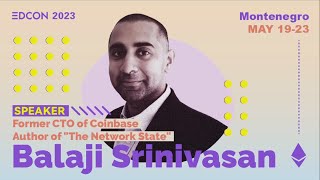
Balaji Srinivasan argues that digital communities need to protect their assets from seizure by tech companies and governments. Apple, Google, and Microsoft can freeze or seize user holdings. Solutions include building independent operating systems, securing friendly jurisdictions, and using offline signing and multisig wallets.
And you know, I, and I've, you know, I just wrote a book on starting new countries and, and so on. Obviously this is of interest to a lot of folks in the Ethereum community. Zuzulu just happened. And what I want to talk about is what it would actually take to make that real and a level of attack that really is very fundamental to what we're doing. And we haven't really fully considered it yet. So just as motivation, if you have a genuinely threatened state, it's going to seize assets. And one way of looking at this is look at gold, which was seized by the US in 1933. You look at the asset seizure of Russia, obviously after they invaded Ukraine. States are threatened, decided to seize assets. You see the asset freeze of Argentina in 2001, so called Coro. You see the asset freeze of Canada in 2022. And you may not agree with these things, but assets were frozen, assets were seized. And what's the relevance to Ethereum and to, you know, network states and so on and so forth? Well, basically, if you actually do want to have a truly sovereign kind of community, you need to be able to hold assets against threatened states. One way of seeing that visually is, you know, it's a very simple diagram. Let's say you've got a community and it holds some digital assets. If the state cannot seize your assets, it has to negotiate. It might have to sell you land for some Ethereum, for example. Okay. And you know, if that state has spent too much and it needs to eventually sell something, whether it's land or something else, it has to do a deal and then you stream some Ethereum to it or Bitcoin or some other asset. Right? So if the state can't seize your assets, your community can be sovereign and, and you can negotiate. But if the state can go around the side and just get your assets by backdooring them using perhaps some network vulnerabilities, then it can just take your Ethereum and you just capitulate. Your community doesn't actually have negotiating leverage. So this is really the fundamental question as to whether a community is actually sovereign or not. It is whether it can hold these digital assets and whether the state actually needs them. And you know, the thing is that just a level set on this, you know, if you went back to 2010 and even after the Arab Spring had happened and governments have been torn down by Twitter and so on, many people would still have thought it crazy to say that 10 years later, the most important political issue in the world would have been whether the US President could tweet for a few days. And so even today, even after El Salvador's adopted bitcoin as a national currency and Wyoming and Tennessee have their Dow laws, even today, after clearly crypto and bitcoin, all this are political issues, it's still considered pretty crazy to say, well, in five or 10 years, states will need digital currency to pay their bills. They won't be able to function if they don't have hard currency. And in such a world, that's what teaches taking crypto seriously means. It means that a desperate state will do anything to get its hands on hard currency, which is gold. It might be foreign fiat currencies, but it's also digital currencies. And if it can backdoor your digital assets, it will. This is what I mean by taking crypto really, truly seriously. If you can hold your assets, you can negotiate, and if you can't, you can't. So just to get a little bit more specific, what is the next level of attack? Okay, it's by Apple, Microsoft and Google. And it's not cyber terrorism, it's cyber war. Cyber terrorism is when some random hacker goes and gains access to your computer. It's an unlawful entry. Cyber war is when the lawful CEO of the company orders essentially an attack on some of their users, similar to what Apple, Microsoft and Google did to Russian users of their services after 2022. You know, the Ukrainian invasion, whether you agree with it or not, 140 million people had many of their digital assets simply seized, and hundreds of billions of dollars of fiat assets were seized. So both the people and the state, everything they had on foreign servers where Russians didn't have root, much of it was seized or frozen. And so, so that kind of attack is not unprecedented. And again, I'm not talking about like known attacks. There's obviously like DeFi hacks, 51%. These are things we think about. I'm not even talking about state sponsored attacks like by North Korea or something like that, because those can be persistent and nasty. But they're still fundamentally trying to fight you on an axis that you've thought about, which is, you know, can they break the cryptography that can they find a bug? What I'm really talking about are like operating system attacks, like backdoors by Apple, Google, Microsoft in particular, where they have, you know, they can push Software updates to macOS to iOS, to Android, to Chrome, to Windows. Can you really, you know, can you really defend against that? How would we defend against it? And just to show you that there's precedent for this, it's not totally crazy. For example, Apple actually decided not to do this device scanning thing, so called csam, like child porn or whatever. This imagery was something that they were going to scan every device to find this needle in a haystack. And they decided not to do it. But they published a whole technical spec showing how they would do it. Okay, Google actually did do something like this. They went and looked into somebody's Google Drive and they looked for particular content and took it down. And not even copyrighted material. It was like this, you know, stupid movie, you know, called plandemic. They took it down. Now, of course, one isn't endorsing plandemic or CSAM or something like that, but that's always how the stuff starts. It's like the Patriot act where they say it's only for terrorism, but then soon it's just being used to revoke, you know, your, your protections against unreasonable search and seizure. And everybody who goes through the airport is treated like a terrorist. So the device scanning by Apple, the drive scanning by Google, those are precedents where they show that they can run code on the files that are your files that you thought were your files. And, and they can freeze them or take them down or flag you in some way. And of course that could be applied private keys just give a few more precedents like this NSA planted backwards. And Cisco Products Snowden talked about this. Obviously we all know about the Tornado Cash, you know, protocol ban and you know, that just happened, that's ongoing. And again, it's not an endorsement of any particular service. I know Tornado Cash actually had another hack recently, but, but the protocol was banned. And then there's another example some of you might be familiar with, which is that a Huawei executive was arrested and under house arrest basically for like three years in Canada. And many people believe this not really a normal arrest. It was like a political thing, you know, where the US didn't like Huawei. And so, you know, perhaps for some reason, but basically this executive was caught in like a tug of war. And it, it was something where the normal kind of divisions between a company and a country and war and peace and so on start to break down. And so, you know, finally, anything that these companies are currently saying could easily be inverted. Twitter used to say that they were the free speech wing of the Free Speech Party before deplatforming and suspending and banning and censoring and so on and so forth. So, so whatever is in their terms of service now can't really be quoted because they could just do 180°U turn if it, if there's enough political pressure. So what do we do? Right, so I, I don't have all the answers. I'll give a few possibilities. Right. One answer is you go technologically full stack with an OS like ethos, and really in many ways, Ethereum is, you know, the forefront of operating systems research because it's got a compiler, it's got a developer environment, it's got its own language. It's actually like programming for Windows or iOS. We don't think of it that way usually, but Ethereum is like, you know, the forefront of OS research. It's obviously got, you know, many of the attributes of an operating system. You're writing programs for it that interoper with each other and it's a whole environment, a whole community. Right. Edcon is kind of like a developer conference just for that os. Okay. And of course, you know, other protocols, like, you know, Saga, you know, by Solana, is doing this. I think a full stack OS is a really good way to go. That's, that's a good answer. Another answer, it's not just technological, it's political. You know, you have friendly states that have no hack treaties. And what that means is they actually contemplate this kind of thing and they say in advance, if this is done, then we will do that. So for example, Texas has, you know, the right to hold Bitcoin shall not be infringed. This kind of stuff is now happening. And that's not just Texas. It's Wyoming with its Dow law and Tennessee with its Dow law and Dubai and all these other places that are pro crypto, pro pro Ethere and pro Bitcoin. And so these states, you might be able to have no hack treaties. But I don't know whether the answers are technological or political or both. I don't have all the answers, but I do think these are some of the questions that we need to start thinking about, which is sort of the next level of attack and to actually not think, oh, this is totally paranoid or something. Rather think, actually there's a lot of precedent for this already with the frozen Russian funds or the on device scanning. A lot of the pieces are in place for a really the thread and state to do this kind of thing. And so I think that's what we need to think about. That's how you'd actually secure the network state. That's how you build a sovereign community, one that actually can control its cryptocurrency if and only if it can do. So it can negotiate with Legacy State and if not, it can't. So questions at biology on Twitter and actually I've got a new thing@biologist.com if you guys want to go there. All right, I can take questions. Yeah.
Let us know if you have a question for Balaji. Balaji. I'll ask the first question. My name is Sky. I'm helping to organize Edcon and obviously everybody's very familiar with the 90 day Bitcoin to 1 million bet. In the last couple of weeks. I think some of, a lot of things have kind of developed and changed. Do you see the banking sector stability differently now than you did before or do you think it is just a microcosm of what's happening in global markets and economies?
Yeah, I think basically I don't know exactly when the collapse is going to hit and I mentioned that in the PIN tweet that I've got the top. But I do think that we're an end game now whether it's this debt ceiling crisis. You know, bank of America has a hundred billion dollars in unrealized losses alone. Their cvss are spiking. If you go and look at that. And that's like, you know, a quote, too big to fail bank. Just like Credit Suisse ostensibly a too big to fail bank. Essentially the Zombie economy since 2008, all the zeros that they printed are now coming up zero. And then when you look at them, they, they hide them and they push them over to somewhere else. It's a, it's a, know the, it's a bank term funding program or something else. They're trying to essentially hide the fact that in many ways the state is out of money. And it's, it's not just one thing. It's economic poly crisis, it's the banking crisis. But underneath that it's the bond crisis because the Fed sold assets that are devalued. It is, it's a student loan crisis that's about to restart. It is a credit card debt crisis. It is a commercial mortgage or commercial real estate crisis rather with you know, huge drops, San Francisco loan, like 75% markdowns. And each of these things are big enough to take down the economy. It's all, it's all a loan crisis. It's sovereign defaults. There's like, you know, half a dozen countries have just defaulted. It's all those things at the same time, on top of massive political conflict, on top of obviously the Ukraine war and the like, almost trillion dollars spent in Europe on energy on top of all these countries suddenly going to the Chinese sphere, whether it's not just Saudi and Iran, but France and Brazil and all, you know, all the Asian countries, all of those things at the same time. Meaning that, you know, and then you add obviously the internal political conflict in the U.S. all those things at the same time. The system just doesn't have enough hit points and I don't know when it's going to keel over, but it is. And you know, whether that's I, I talk about in the pin video whether it's months, years, decades, centuries, I think it's like 10% months, 70% years, 19% decades, 1% centuries. It's possible that 2024, the gigantic fight of the election, is what sets it off. But I think one shouldn't, like one shouldn't believe that this system, the current world order that we have, is going to endure very long. And Ray Dalio talks about this in Principles of the Changing World or totally different person, totally different vantage points of things. He's not a crypto guy, he's a tradfi guy. If you look at his thing, Principles of the Changing World or he thinks the same thing. Druckenmiller, another, you know, hedge fund billionaire, again, totally different perspective. He thinks the same thing. He's talked about how there's actually $200 trillion in unpaid debts by the US federal government and there just isn't enough money to pay for all these things. And now that's all coming to a head. You get, you go from zero interest rate policy to zero shared interest policy where the policy is based on zero shared interest between fighting tribes. So tldr though is I think that while this order is ending, folks in this room and folks in the Ethereum Committee are actually an important part of what comes next because I do believe, I mean you sort of need to simultaneously A not trust the current system, but B believe in high trust systems. Right. So centralization, decentralization, recentralization and rebuilding Hytra societies after what transpires, or it's about to transpire, I think is going to be really important. Let me pause there.
We've got some more questions up here. Hey, yeah, I was wondering, are you currently bullish on any nation states?
I am actually in the sense of, you know, when the, when the Roman Empire fell, it was actually just the Western Roman Empire that fell. You know, the, the Eastern Roman Empire basically continued the, the Byzantines and whatnot. And that's kind of like what I think is happening now where you have, you have a decentralized west and centralized East. So in a sense all the countries, to first order, all the countries that are prosperous 20th century are going to have tough times this century and vice versa, to first order. It's not exact like I'm not bullish on Cuba, North Korea or what have you, but I think the G7, the closer you are to essentially the Fed and the more you, you have a country or a company or a community that bought us Treasuries. Treasuries are the new toxic waste. If the last cycle was mortgages, you know, the AAA mortgages, the thing they thought were safe assets, were actually a deadly asset this cycle, it's treasuries, it's also mortgages, but it's, it's Treasuries in particular. So all these institutions, pension funds, insurance companies, have loaded up on mass amounts of Treasuries, often by law that are required under like Basel. They're, they're required, Basel iii. They're required to buy so called high quality liquid assets, of which Treasuries are like one easy way to satisfy the requirement. And so all these institutions, that's why you're seeing systemic issues. It's not a single bank problem, it's a central bank problem. So basically those countries, to answer your question, those countries that are the closest to, let's call it blue America, that are the most trusting of the Fed, trust the Fed, end up dead, okay? So those countries that are most trusting of the Fed are the ones that are the most screwed. And then you can go away from that in several different directions. You can go away from that to like red states, like Texas. You can go away from that to like El Salvador, like Bitcoin states. You can also go away from that to like India or China, which are their own poles. And in general, I think, you know, I'm bullish on the east broadly. I think we now actually have peace in the Middle East. You have, Saudi and Iran are at peace. You have Saudi and Yemen at peace. You have Assad being, you know, visiting Arab League. There might actually be peace in the Middle east for, for the first time in a long time. I'm bullish on like Dubai and Singapore. I'm actually bullish on El Salvador and those countries that emulate them in South America. I'm, I'm nominal. I shouldn't say bullish. I'm, I think red states in the US can survive. I think they might be even able to thrive depending on what moves they make. If they limit their exposure to Treasuries and things like that. And actually Eastern Europe, like places like Poland, if they can manage to stay out of conflict, I think are looking pretty, pretty good. It's kind of an inversion of the last century. Everybody who is socialist or communist or had a terrible 20th century is sort of done with that. And they just want to kind of build. I'm not saying everybody, but that's, that's a general, general trend. And then all the folks who were sort of born to riches, who inherited lots of wealth and didn't build it, three or four generations of being a rich country have sort of forgotten what it is to build wealth. Not all of them, obviously many of you in the audience haven't, but a lot but enough have that it might be their time of troubles. So roughly speaking, the farther away you are from a country that trusts the Fed, the, that's at least one predictor of how you know what you could be. That doesn't mean that you're bullish on North Korea obviously, but like to first serve. It's a prosperous country that's not heavily invested in US Treasuries and it actually is building stuff or selling commodities. That could be a country that's, that's more stable in what transpires.
Great. I think we have time for one more question. If you do. Balaji.
Great. Sure, of course.
Hey Balaji, I just got one question for you. So when actually Solana launched like a phone at that time we had lots of discussion. Even they have the operating system, but telecom probably stay like a big block for them. And also telecom companies are controlled by mostly the government. So I just kind of wonder if there are still lots of blocks beyond the operating system. Probably be the dapp, probably be the social app kind of thing. So we think we probably have to have a big event to push the paradigm change on this kind of field. So I just kind of wondering and also data privacy, it's a similar situation. Right. It's still sit in the smaller group. Most of people are not care about the privacy. So I just kind of wonder like what's your opinion about this? And do you have an idea what probably to be the big event to push that paradigm change happened.
Yep. So. So. Well, first, you know your point about, you know, also at the telco level. Yeah. There's like two operating systems in a phone. There's operating system and there's also like the, the baseband os, you know, which is quite complicated. That you know, that's. That I understand is actually potentially insecure which communicates with the, you know, the 5G towers and stuff. I think it's possible that Elon Starlink phone could do it. I think it's also possible that if it looks into it, there's, you know, some way that you can split keys or for example, you never form the full private key. Everything is sort of mandatory multisig for any assets above a certain level. So you just form the transaction and then you broadcast that. So you'd have to have like multiple devices to ever, you know, intercept what it is you're doing. The tricky part is all that security often comes at the price of user friendliness. So, so that's like maybe on the first prior question about at the, at the network level. The other thing is what is the big event? Well, I, I do think that, you know, something is going to happen where we're going to have, there's going to be a lot of money printing at some point in the not too distant future. And exactly when that happens, I don't know. But it's, you know, people have talked about the people's qe, right? What's the people's qe? The people's Quantitative easing. I don't know if you know this, but California for example, is recently sending thousand dollar checks to people to help them with inflation. Okay, if you think about that, right, they print the money to help you with, I mean California itself didn't print it, but it's like stimulus. You send the money to help people with inflation, which of course puts up prices. That is hair of the dog that bit you. So the people's QE would basically be something like that. Stimulus checks, direct deposit to people's accounts to help them fight inflation. And that's how you truly get on the loop, right? That's the, that's a hyperinflationary loop. And at that point then people will start moving into hard currency again. This has happened many times before in history. It's happened in Argentina, it's happened in Weimar Germany, it's happened in the Soviet Union. It's happened in lots of places. People just have the, the idea that it couldn't happen in the West. The point is that if and when something like that, you start seeing a real spike in the USD BTC or USD ETH or USD gold, which is different because central banks are buying that gold. Gold price can normally be game, but central banks are actually buying physical gold now. So that breaks through the gaming of the gold price. What they do is they buy puts and so on to keep the, they use derivatives to keep the price of gold within a region. People have, have hypothesized this, that the exchange stabilization fund does things like this. Point being though, that if and when the price of hard currency starts to rise and meaning especially cryptocurrency, but, but probably also gold, and I mean really rise, then you're going to see digital lockdown. You're going to see capital controls, you're going to see wage controls, probably price controls. You're going to see, you know, difficulty in withdrawing money from the country. This is already there in the uk there's people, you can look at this right now. It's like to get more than a few thousand dollars out, you have to go through some rigmarole. And there's various countries where they've made it hard to, to even buy cryptocurrency. And so trying to block the, the onboarding or they're trying to block the exits from the fiat system. So, and this is Operation Chokepoint in the US it's happening in several different places. So in a sense, that event is already happening. And you're not going to necessarily get like a government isn't going to tell you with a push notification, okay, we're trying to steal all your money. You'll just wake up one day and it'll be gone. Okay? And, and that's what happened, for example, to, in Cyprus with a bail lens. They were told, this is in 2013. They were told, oh, you know, the bank is fine, the bank is fine, the bank is fine. Keep your money in the bank. Oh, don't panic. Oh, blah, blah, it's gone, right? They basically locked the funds and people had to take a quote haircut. Those who were unfortunate enough to still have their money in the bank got like, you know, they got like 50% of it back or something like that. And they had no recourse because their government itself and their banks itself had screwed them. So what did the Cypriots do now? They've had, you know, money under mattresses, other kinds of things, but now even cash is being disallowed. And so in a sense, we're kind of in the middle of this event. You're not going to get an announcement. Maybe, maybe you'll get something like digital lockdown and they'll be announced. But maybe digital lockdown just comes as like 20 different measures and it's not announced as one undeniable thing like Covid. But you think about COVID lockdown when that, you know, when that happened, that happened about six weeks, January 20th. You were, you know, it was the first case in the US and for next five or six weeks you were called completely paranoid. Eight weeks, totally paranoid, lunatic for saying Covid was going to be an issue. After all, there were no cases in the US when you look at the official statistics, it later turned out that the FDA had been blocking the tests that would have let people find out that Covid was actually running rampant in the U.S. but how could you have known the official statistics say that there are any cases? And who are you to disprove the government, Right? So, so then after denying that it was ever going to happen, kaboom, you suddenly have lockdown. And the only people who could actually do anything are those who formed a thesis independent of what the official state was saying and moved before it was acknowledged. And because by the time it's acknowledged, you know, many countries you couldn't get into, they actually stopped renewing passports in the US for several months after that. You can go and look at that up. So, so the answer is, I don't know. I don't know if there's going to be an official event or something like that. I do think, however, that, you know, you don't necessarily want to make it exciting, right? As I mentioned in like the PIN video, like a trader too early is being wrong, but if you're preparing, hell is to seem too late. So with that said, I'm glad that we're starting to do things like ethos and saga, and I just hope it's in time to. To have something. Maybe it's at the protocol level, maybe it's a software thing. Maybe it's literally just buying a laptop and having it be offline always and making it really easy to sign on one computer and broadcast on another. Right? Like you show a QR code with a signed transaction on a laptop, then you scan it with your phone, and even if that phone is rooted, all it can do is broadcast the sign transaction so it can't actually seize the funds or see the private keys. There's various workarounds like this, but I think we need to start thinking about the problem.
Thanks so much, Balaji. Do you have any last thoughts for us before we we Conclude?
Yeah, just DM me at Biology got a new newsletter thing@buckology.com so go subscribe there if you, if you enjoyed this. And one thing I'll say is I'm very much a doomer optimist, right? In the sense that, yeah, maybe this world is ending, but the next world is beginning. Covid, for example, if you think about COVID three years after the start of COVID two things are true. First is, it's generally acknowledged to have infected 700 million people, killed 7 million people. A second life went on, okay? And in the same way, as bad as I think this economic collapse is that's coming, I mean, life went on after World War II and World War I. Life went on after all kinds of crazy things, right? And so I think it's going to be quite disruptive, but I also think that life goes on on the other side, and. And we have to, you know, sort of prepare for that and figure out, okay, what happens if the state truly finally fails. The same state that delivered Iraq in San Francisco and Syria and Covid and the money printing, and it's basically failed on everything over the last 20 years that it actually has that final failure. Okay, then what do we do next? And if we're prepared for that, that's not apathy. It's not panic. It's just calm preparation. And then you try to land on your feet, and you. You try and bet on Wisconsin.
So apologies Srinivasa, everybody.
Thanks, guys.
More from Balaji



34 - Network State Conference 2025 - Fireside with Vitalik and Balaji on Zuzalu and d/acc

33 - Network State Conference 2025 - Fireside with Amjad Masad of Replit and Balaji





06 - Network State Conference 2024 - Fireside with Naval Ravikant and Balaji Srinivasan