Balaji Srinivasan - The Network States of the Internet - TOKEN2049 Dubai 2025
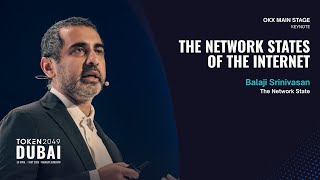
Balaji Srinivasan presents a vision for the next decades where global power splits among a Chinese physical superstate and a competing "Internet century" made of Internet-first network states. He contrasts the decline of American hegemony with China's industrial rise, argues the Internet is overtaking many state functions (mail, media, mobility, money, contracts, science, democracy), and proposes building networked, Internet-origin societies (startup-societies) — exemplified by his Network School (ns.com, fellowships/internships) — as a practical roadmap for crypto to take "land."
I'm going to talk today about the network states of the Internet. Like what comes after the network state singular. Then there's network states plural. And in many ways, it's a roadmap for the next 5, 10, 15 years for crypto as the cloud takes land. And the general concept that I want to establish today is, yes, the Internet is not a place, but there will be Internet places. So I wrote a book called the Network states@thenetworkstate.com and actually just recently opened up a school called network school@ns.com and we're doing global fellowship, so anybody from anywhere can apply. We'll also have internships and so on. So go apply@ns.com if you want to hear more about this stuff. Okay, so let me just kind of open with something to set the stage. Okay. American empire was real and it was spectacular. And everybody here who's into Bitcoin or cryptocurrency thinks about these kinds of things. But it's ending now. And because China is strong and Peter Zeihan is wrong, I have nothing against him, but he's wrong. Okay? And yet it won't solely be a Chinese century, it will also be an Internet century. And that's what crypto is about. That's what a lot of people in this room, everybody in this room, in some sense, is building. And the future is really, in my view, China versus the Internet. A billion person Chinese superstate and a thousand million person network states. And that doesn't have to be necessarily fully oppositional. That can be cooperation, competition, or what have you. But I think those are the two heirs to empire. And China inherits empire, but the Internet inherits American values. And from there we build the network states of the Internet. So let me kind of go in these three pieces. The American century, the Chinese century, and then the Internet century. So on the American century, basically, American empire was real and it was spectacular. There's this great book called Tomorrow the World. And essentially it actually documents the exact moment at which the US decided to become global number one. It was actually before 1945, it was after the fall of France. And the US realized that if it didn't go for empire, either the Germans or the Soviets would. And so it did. And so this book actually documents the exact moment that the US went for global number one. And of course, it has the headquarters of the UN and it has the global reserve currency. You just don't get to global number one by accident. And so it did. So it was really very, very impressive. Really the most Impressive empire of all time, but it is ending now. And one way of thinking about that is all the factions in the world like the Republicans are against the deep state, the Democrats are against the Trump administration, the tech guys are against a regulatory state, and China's against American hegemony. So all four arrows are pointing down. And the only thing keeping the current system in its current position is historical inertia. And that won't really last for too long. At the same time, America is sort of socially distant, creating blues and reds are in their own social networks. And economically with the tariffs, it's forcing people abroad. And all kinds of things are happening at the same time. And it's also ending as a hub for global business. Right. This is cross ideological. It's not just a left thing or a right thing. It's shooting CEOs, it's corrupting Delaware, it's the tariffs. And really, even in 2019, most GDP was already in Asia. That graph at the bottom shows the global geocenter of the world economy and actually went to Asia long ago. And so what that means is basically that global business is rerouting and it has to find a new spot because you can't bring in tourists or workers or skilled workers. Research funding is being cut. Lots of things are getting cut at the same time by left and right. But we're going to miss Uncle Sam when he's gone. In many people's lifetimes, the Soviet Union collapsed and lots of people who had Soviet identity regretted that and felt bad about that. And this is going to be a bigger hole in the emotional landscape. So who is discussor to Uncle Sam? Who are the heirs to American empire? I think China inherits a physical empire, but the Internet inherits American values. And so let me first establish that part. So the Chinese century. So we first need to understand what China is. Okay? And there's a guy named Peter Zeihan who's written all these books about how this is going to be the next American century. And America has great geography and so on and so forth, and that versus the reality of what China is in the physical world. For example, below is BYD has one factory that is the size of San Francisco, just cranking out cars, many of which you've probably ridden on the way here. Right. And so as a reality shill, I want to just kind of go through some stats to establish like what China is. And then from understanding what reality is, we can move forward. So for example, China is number one in trade. It's just about every country in the world primarily trades with China, except for Western Europe. And with the tariffs, that's going to change soon. China's number one steel went from 110 US steel production to 10X. China's number one in rail in about 10 years. It built out a national rail network, While California had $100 billion train that didn't even lay a single mile of track. China's number one in electricity. This is just vertical up and to the right. And it is doing that with solar and other things, but it's also doing it with nuclear. It is number one in nuclear. India is a distant but real number two on many of these graphs. The US is actually not even in the game in terms of new nuclear plants. China's number one in cars. It just went vertical on cars starting after the end of lockdown, Chinese lockdown in 2023 with BYD and Xiaomi. And Xiaomi was able to ship a car when Apple couldn't. Right. BYD is also out competing Tesla in neutral markets. So this is a new thing by China. They're not just copying anymore. They're, they're actually exceeding some of their American competitors. China's number one in ships, they have 200x US shipping capacity. That slide there is from the Pentagon and there's another slide that shows that the US military is made in China in the sense that Tomahawk missiles, JDAMs those parts. The vendors, vendors are Chinese suppliers. That's a, that's a report by Govini that was commissioned by the Pentagon. In addition to just being number one in shipbuilding capacity, they also now have the world's largest navy. They went vertical on this too, just like they went vertical on cars. Right. So this is something which is just like across the physical world this is happening. They're number one in cities. They have more than 100 cities, a million people, and the build out is actually remarkable. And they even have flying cars. Now there's a guy named Ishowspeed who streamed being in a ehang quadcopter, you know, flying car. And of course there's areas where they're not yet number one, but they're closing in quickly on planes, on chips and even on AI. They're at least very competitive with comac and with the, you know, with Huawei's chips and with the deepseek. And so there's no industry where you can just say, okay, they're just not going to be able to make it in the physical world, in my view. But once, you know, kind of what China's strong at, you need to, you know, if you're, if you're going to compete with China or you need to know what they're not strong at. And once we understand what China is, we understand what China is not. What China is not is. It's not the global Internet. It's not freedom of speech. It's not, you know, like the openness of the Internet. One way of thinking about it is China is Apple. It's like fully vertically integrated, but the Internet is Android. It's open and hackable and so on. At least Google has tried to make Android less so. But China is Windows in a sense, and the Internet is Linux. Right. And in particular, there's only one thing that has economic scale comparable to China, and that is the Internet. And the fact that Bitcoin is a currency on the Internet starts to give a thesis for what the opposite pole to China is. It's not just 70 million, you know, 77 million Trump voters in America. That's actually pretty small. But almost 7 billion Internet users is 100x a size. And that's actually much larger. Right? So now we come to the Internet century because that is actually an opposite pole. And, and that's something which is an opposing force to China, a balance, a yin and yang, not necessarily always negative. Obviously there's a Chinese Internet, but there's a global Internet too, an Anglophone Internet. So what do I mean by the Internet century? So this graph, you know, the growth of the Internet is actually the most important factor of our times. And it's under discussed, despite how important it obviously is. And one of the reasons for this is that, you know, every transaction, every communication you make nowadays is basically on the Internet. But there's still a few institutions that have not gone to the, the universities, the presidency, the currency, the military, but these are all gradually moving to the Internet. And so the world is becoming Internet first. And this is really an Internet century too, not simply a Chinese century. And when I say Internet first, what I mean is you start thinking not about the states, but about the networks. So for example, just as a show of hands, who here check their phones first thing in the morning? Okay. All right. Now who saluted their flags? Like probably relatively few people. Right? So what that means is you're kind of, you're on your social networks, your currency is at least partially, significantly, a cryptocurrency, a stateless thing. Your social networks and your messaging and so on, all those things are Internet first. You're not reliant necessarily on your state's postal service or Your state's currency or your state's flag. The reliance is less every single day. And that's what Internet first means. It's an alternative to being quote unquote, country First. It's also play on words as a technological strategy, as an alternative to or comparable to Mobile first, right? So Internet first is the actual scaled alternative to ultranationalism or ultrasocialism. It's internationalist and it's capitalist and it's basically all the people here. And so just to give some specific examples of what I mean by Internet first, right? The Internet is mail, right? The Internet, for example, took over the Functions of the U.S. postal Service and other postal services and now it delivers mail across borders quickly, cheaply, efficiently. And of course, there's messaging apps as well. Okay? The Internet is media, right? Social media has flip mainstream media and the legacy outlets which are either directly government funded like PBS or npr, or indirectly government funded via leaks from the government, those are just reduced to posters on the Internet alongside citizen journalists. The Internet is mobility, right? It's replaced not just taxis, but taxi medallions, right? When you think about Uber and Lyft, they're not just calling a car, you're calling a car regulator because they have star ratings and reviews for riders and drivers, and those reviews of riders in particular go cross border. And there's an information sharing that can never happen with a legacy taxi medallion where your Uber rating crosses borders. So these are cloud regulators, okay? Synchronous mobility. The Internet is Mars. Actually, SpaceX has outlaunched NASA. And how does SpaceX fund itself with things like Starlink, which are global Internet access, right? And so most of the launches are actually from the network, not the state. Now we start getting to the main event. The Internet is money, right? Bitcoin is replacing fiat around the world. It's increased by seven orders of magnitude if you count the $0.01 trades at the beginning since inception. And from a historical standpoint, that's just like going vertical in about 15 years, it's got one or two orders of magnitude to go. The interest is monetary policy too. It's not just money. Relative to the Fed's chaotic back and forth of the last 40 years, you have the smooth algorithmic monetary policy of Bitcoin and of cryptocurrency, which is programmatic. And here too, the network is superior to the state. The moment that Bitcoin was introduced, humans started flooding into that and leaving the state behind. If you plot USD versus btc, it just looks like this, right? The interest is contracts. So Delaware is out as a jurisdiction, firm, corporation. Lots of big companies have moved after the crazy rulings on Tesla and other companies. And what replaces that? Well, you know, the actual enforcer of contracts are smart contracts, right? A Bulgarian and a Brazilian and a Bangalorean can all have a smart contract that binds them with Ethereum or with Solana or when the smart contract chains. And that is superior to a state's contract law, right? So this is actually what's taking over the code based order from the rule based order. Okay. The Internet is also freedom, right? That's to say with tornado cash, with zcash, obviously there's court battles to be fought as well. I'm not saying the Internet's invincible, but it's winning. And the pressure. Privacy of encryption and zero knowledge. This would actually gives back the constitutional freedoms that the US promised but no longer really has, has in the same way, in terms of freedom of speech and especially freedom from, from search and seizure, meaning privacy. The Internet is also science. So this is both well underway and just beginning in terms of open access, in terms of decentralized science, in terms of reproducible research, in terms of public data sets, right? So Desai research hub, this is actually the decentralization of science out of centralized Western academia and to the Internet. And this is what's overcoming the collapse in faith in US higher education. The Internet is democracy. So all the Dao votes, right? Those are cryptographically verified on chain votes that you can trust and that you know are coming from, you know, actual people because they've got track records and balances and they're, you know, your name Eth or his name Saul, as distinct from fiat elections which have rising distrust. You can graph both these at the same time. People are moving to Internet elections and Internet democracy as opposed to state democracy, right? And finally the Internet is equality, right? Like, you know, you may be a second class citizen in the usa, but you're a first class citizen on the global Internet. That's what a peer to peer network means. It means in a sense, in a deep sense, we are all equal. You can choose the same contract law, the same monetary policy, the same identity system as somebody else, and you can transact with them regardless of where you were born. So it's genuine equality, but it's also genuine consent. You only join those groups that you've consented to join. You're only under the law that you've consented to abide by. And you can hedge between the Ethereum law or the Solana law, the Bitcoin Law, the this, that and the other law. You can hedge between them. Just like you can hop between states, you can hop between networks. And why is this really important? Because that means there's hope if, you know, if you're sympathetic, as I am to Western values, the Internet is heir to American values. It's kind of the libertarian or right of center values of freedom and money and contracts and capitalism, but it's also science, media equality, democracy, right? And so that's actually pretty, pretty interesting. It takes kind of both sides and it puts them together. Now at this point, people will say, you know, tech bro, you're hallucinating. You know, the Internet isn't a place, right? You know, you don't understand hard power, tech bro. Right? And of course, what I'd say is, actually, I understand hard power very well. China has it and the US doesn't anymore, right? And so against something like the Chinese drone armada, you have to actually think about Gandhi and nonviolence, and you have to think about other ways of basically protecting freedom. For example, no amount of violence can solve certain kinds of math problems. That's what encryption. That's what Bitcoin is, right? So you have to think about protecting these things in a different way, right? And Bitcoin has no armies, but it is stronger than armies because it can flip countries. And so while the Internet isn't a place, what we can say is the Internet isn't a place, but there are Internet places, okay? Think about these gigantic data centers, right? Think about this conference, right? Or think about, you know, Bitcoin becoming the legal tender of El Salvador, right? The Internet, just like, for example, you think about your favorite religion, right? That religion itself is not a place, but there are religious places, not just sites of worship, but countries that have that religion on the flag, right? And so in the same way, the Internet is not a place, but Internet values can essentially create places, okay? They can script people, they can organize people, they can crowdfund places like data centers, like conferences, like the bitcoin country of El Salvador, but also soon start societies and network states. When I say soon, I mean now. Because, for example, here's a directory of Internet places. This is a dashboard of aspiring network states. And the thing is, there's a lot of them, okay? This is happening, you know, the Ron Paul meme. It's happening. Jpg. Okay? So there's a lot of them. This is something which is happening. This is the next step for crypto. It's crypto in the physical world, okay? And one of the things I want to try to do is avoid crypto tribalism. I would like to have at least like a loose grouping of these. And that's how we kind of move towards what I call the network states of the Internet. And this is actually how the United States of America itself arose. There's this great video on YouTube starting in 1630, where it shows Virginia and Massachusetts. These were all essentially societies established on the frontier of that time, which was America. And they didn't actually really have that much to do with each other at the beginning. Right. Like, in a sense, you know, Virginia was the bro and Massachusetts was the tech. Eventually that became the tech bro. And that was what the US Was, okay? Like, Virginia was like a bro ish culture of drinking and horse riding. And Massachusetts was studying and that fusion happened, right? There's also Pennsylvania, there were other U.S. colonies. And the point is that over time, as you move forward, each of these colonies grew by itself, but they also grew collectively, just like crypto. Right? Crypto. The coins each increase in value, but the overall community also increase in value. And there's an overall market cap for the whole thing. And the economy has increased in size and the trading between the coins. There's both cooperation and competition. And this is literally how the United States arose. You can see the population, the lower right corner increases. And sometimes in this case, Virginia was the biggest, and then later you have Massachusetts, the biggest. And then you go forward a few more years and you have New York or something. The biggest new societies arise, new bars arise on the bar chart. They grow and they compete between each other. And this is a view. This is actually how the United States was born. It's a bunch of independent societies that grew and then eventually grouped together and. And they became United States, as opposed to independent states. And this is kind of a model for how the network states of the Internet could emerge, right? Basically, if you think about it, just like we have a version 3.0 in the form of Bitcoin, we went from gold to fiat to digital gold, right? We have version 3.0 where we go from the United Kingdom of England, Scotland, Wales and Northern Ireland, the United States of America, and then the network states of the Internet, right? A new birth of freedom. And we can do this just with Internet first technologies. You literally start a society, you network it with other societies, and then it just grows over time. And it can come from very modest beginnings. If you go back and look at that 1630 slide, like Massachusetts, Virginia, that started with like a few dozen, a few hundred people, these great things start from small things. Moreover, with the Internet, those small things can become big things very fast. If you think about how many years it took for WhatsApp to get to a billion users, for ChatGPT to get to a billion users. Networks can grow very, very quickly in this age once you get quote product, market fit. So you can start small, think big and we can actually build lots of sharp societies and then we can network them together over the next 10, 20, 30 years. So that's the version 3.0. And so what's next? Well, I wrote a book on startup societies and then I opened a startup society myself. Call it the Network School. This is opening day. Pretty cool shot. That's me and Brian Johnson there. And we're offering fellowships for people who want to come offering internships so you can go to ns.com and apply. So if you're interested in new societies, come to Network School. Thank you very much.
More from Balaji



34 - Network State Conference 2025 - Fireside with Vitalik and Balaji on Zuzalu and d/acc

33 - Network State Conference 2025 - Fireside with Amjad Masad of Replit and Balaji





06 - Network State Conference 2024 - Fireside with Naval Ravikant and Balaji Srinivasan