E1042 Balaji Srinivasan on Recode incident, techlash history, potential COVID-19 endgames & more
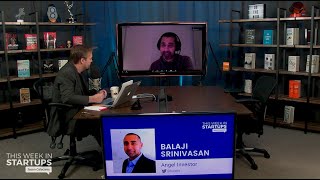
Balaji Srinivasan, a molecular diagnostics entrepreneur and former Coinbase CTO, explains why he sounded early alarms about COVID-19 starting with the Wuhan lockdown on January 23. He recounts a Recode reporter's outreach on February 7 and his public critique of the coverage, then discusses citizen journalism, decentralized media, and potential COVID-19 endgames like challenge trials and testing reform.
This Week in Startups is brought to you by Squarespace. Turn your idea into a new website. Go to squarespace.com for a free trial. When you're ready to launch, use offer Code Twist to save 10% off your first purchase of a website or domain front. Transform your corporate email into a multiplayer game so your team can increase customer experience and take action faster. Take 20% off your first year today by using the code Twist at signup and visit frontapp.com twist for more information. And Silicon Valley Bank. For over 35 years, Silicon Valley bank has been providing banking and financial solutions for every stage of the startup journey. Learn more at svb.com twist Silicon Valley Bank Ideas bank here.
All right, everybody, welcome to another episode of this week in Startups. We're recording this on April 2nd, and it's important that I say that because every day is blending into the next and I'm losing track of what day of the week it is, where I am, and how long this coronavirus outbreak pandemic is going to continue on. And early on, I was able to track this in, in January and February thanks to one of my followers and a friend of the show, Balaji Sri Navasan. Srinivasan. Balaji Srinivasan. I think I got it right. There is. And formerly I knew him because he was working at Coinbase and Andreessen Horowitz, he's an angel investor. He was on the pod back on episode 769. A lot of you loved that back in October of 2017. And he's one, you know, one of these smart investors, science folks on the Twitter. And he was taking this very seriously, talking about it and giving us a warning. And many of us who are watching on social media, specifically the Twitter, were watching these videos going, this seems pretty scary. What's going on in Wuhan. This does not seem normal. And Balaji was telling us it was not normal. And I saw a tweet, I'll pull it up here real quick. And it was this experience that I've had with what I call late stage journalists or late stage journalism. In other words, the end game of journalism kind of feels like we're in the final ending of journalism and something new will come out of this. But a journalist had DM'd him, slid into the DMs, which journalists do. And it's kind of just absolutely annoying when you're a person of note who gets quoted by the journalists to have every story seem to be spun or like you're being set up or like the context is gonna be missing, or they're doing a hit piece, or they're doing something that is just off the mark. And you wanna try to help that journalist. And so we got this email here. Hey, I am Sriran Jaffrey and I'm a reporter for Recode. We're doing a story about concerns about coronavirus in Silicon Valley, the Bay Area. We saw your tweets on the topic. Would you be available to chat more about this on a brief phone call? Please let me know right on this deadline. You can reach here and I'll just slide up. And Balaji says, hey, you're not covering technologies the Chinese are using to fight the virus, hardware implications of supply chain disruptions. What biotech is doing in terms of antiviral vaccines, which you are covering, is covering your tweets, right? I'm just going to ask you straight up. When you got that tweet from the Recode reporter, you kind of got that intuition. Welcome back to the pod. By the way, thanks for coming on. I know you're busy. I guess it's kind of a laugh, right? I know you're busy, but I'm more busy now than I've ever been with so many companies in trouble. But when you got that, first of all, are you doing okay? Family's okay? Friends okay?
Yes, fortunately, by Christ, Grace, I feel.
Like we have to ask each other. We're talking before the show that when you mentioned. When we ask each other, how are you doing, we actually, like, really. Care to hear the answer now?
Yep, that's right.
Yeah. So two questions to start us off here. Number one, what teed you off to this being such an important issue? How did you get on it so early in January? And then number two, when you got that. When you got that DM from the Recode reporter, what. What gave you that? What was your reaction to it?
Yeah, so, I mean, my background, I'm a molecular diagnostics guy. Before I got into crypto, I think a lot of people didn't know that, actually, because I hadn't been on Twitter while I was doing that. But that's actually my formal training is in biology, genomics, genetic circuits, bioinformatics, et cetera. And I taught that at Stanford and also founded a company based on that, sold a company based that for 375 on diagnostics. So all the stuff that's happening now with the FDA blocking tests and so on, that's an area that I have some background in. I've actually innovated. So to speak in that area. So I had some disciplinary expertise to bring to bear. And it was basically around the time that the lockdown of Wuhan was announced on January 23rd is when I'd sort of seen the virus in my peripheral vision then among a thousand other stories that you kind of read about or track. But the lockdown on January 23rd was an unfakable signal that this was incredibly serious because that was an unprecedented event. China's legitimacy, the state's legitimacy rests on delivering economic growth for its citizens, even if it doesn't have a political say. And so for it to sacrifice economic growth for something meant that this was an extraordinarily. Yeah, exactly, that's right. So knowing you didn't, you didn't have to be a, like a rocket scientist, you know, to, to realize, oh my God, you know, that's, these, these are not, they're not stupid people. Right? Like the, you know, the Chinese government has engineers in there, you know, people. There's a lot of things you can say about what they did. We'll talk about that with the censorship and so on. But they're not like dumb and self destructive and, or at least not, not in this way. Yeah, so, so that's, that's what kind of like flagged, oh my God, this is actually really serious. Then dug into the papers and started reading these papers and you know, they're, they're like horror stories. They're written in like the inverse of clickbait.
Right.
You know, so you hear about, you know, an A, like you'll hear about a patient and they've got a compassionate use prescription and oh, they had bilateral pneumonia. And basically what they're actually saying is okay, this healthy 35 year old, for example, the first case in the US was knocked to the ground by this illness, had basically no pre existing conditions, was brought to death's door and had to be saved by an experimental drug. That's a real headline that's not written like that in an academic journal. So that's what got me concerned. Then where's your second question? Please remind me.
Oh, and you get this DM from a journalist. And this is where I think the journalist kind of, I don't know, trivializing the issue or maybe not understanding the severity of it. I think actually when you look back on it historically was a really good moment for everybody because it led to you. Then when the story came out and it was in fact a link baiting story that kind of missed the point of this and the severity of it. You Then did a tweet storm where you said incredible. Last week I called out a journalist who I thought was writing a piece that would be a disservice to public health. It's a very measured language, by the way. Unfortunately, my concerns proved well founded. Recode virus piece ignores who and CDC gets the science wrong and focuses on handshakes. Here's a thread and you went through it and just took the piece apart bullet point by bullet point that has now 1300 retweets and 10,000 plus I think, likes. And I'm curious as to your thoughts on the journalist motivations. And then of course, after you did this sort of blow by blow taking apart why the story was wrong. I'm sure they did an incredible retraction and a mea coppa and explained to you exactly what they would do differently the next time. So take me through, you know, how they, the outreach and how they made up for these grave errors. And your thoughts when you first saw the piece of.
Yeah, so the outreach came on like February 7th. And by the way, this story is just symbolic, it's representative. There's hundreds of other stories that were like this, that were written at that time and then probably, I don't know, thousands, tens of thousands that you and I have seen over the course of our careers that are like this. But this one, it just sticks out for a few different reasons. Because on February 7th, I had basically now been kind of tweeting full time about the virus for like the last two weeks because China was at war. It was using drone delivery, it was doing thermal scans, it was having telemedical hospitals. It was basically throwing the full weight of the centralized Chinese state against this with every technology and policy that they could bring to bear. It was like a stunning kind of series of events and, and the videos that were getting out on social media, you know, from a fairly censored Chinese environment where of, you know, basically sci fi movie scenarios, people being welded in their homes, you know, people like body bags in, in on chairs, in hospitals, you know, crazy, crazy kind of events, people dropping dead in the street. So, so this was like this absolute, you know, like insane thing that was happening overseas. And there are a number of implications of this. Well, there could be shortages in the US There could be technologies where we could learn from the Chinese in terms of what they're doing. We could interview Chinese people and see what's happening here in case this comes to our borders. But what happened was on February 7th I got this outreach message and I could tell Immediately that just the way it was phrased. See, normally, as you're aware, and maybe not all of your audiences, but the story behind the story is more important than the story typically. And what corporate journalists do, and I'll come to the distinction in corporate journalists and citizen journalists, they will employ a technique which is called befriend and betray. And so they'll send a seemingly polite message, often one that butters you up and that flatters your preconceptions as they see them talking about, oh, you were ahead of this, or oh, you're an important person to talk to, et cetera. And then when the actual article comes out, you're knifed and then you're like, whoa, that wasn't what we talked about at all. They just use one or two quotes from a 30 minute interview and then they pull them out of context and use them to say whatever they intentionally originally intended to say. And so this one was actually a more to a layman looking at this, somebody who hadn't actually dealt with corporate journalists before, it seemed like a polite outreach. But the key there is, I'm talking about concerns in Silicon Valley about this. Okay, right. And the further context, right, Was that.
A little tip off? It's like, yeah, concerns in Silicon Valley, like, yeah, that's right.
Because so the further context, you kind of need the secret decoder ring to be able to figure this out. The further context was a recode runs a lot of negative pieces about tech. It's basically like a gossip column that masquerades as tech journalism. You don't read about the latest Bluetooth or post GIS releases or anything like that. It's not actually like a tech outlet in the sense of being savvy about technology. It's a gossip column because it only talks about the personalities of people. Oh my God, how rich they are, all this type of stuff. That's one, that's the outlet, and then two is the friends of this person. Or I shouldn't necessarily friends, let's say the social network of this person. For example, former RICO journalists like Mike Isaac or Teddy Schleifer, folks like that were very negative towards the idea that the virus was anything to pay attention to. You know, some of them were, you know, saying, oh, you know, like, like for example, Dan, I'll get his name wrong, but super Magadu on Twitter, I think Dan McMurdy, or I forget his last name, but he had been talking about supply chain, you know, issues related to this and was called a racist for his troubles. Which of Course, those supply chain issues are causing drug shortages now. Right, right. And so, so the second context was just like journalists on Twitter, tech journalists in particular are very contemptuous towards this and like, oh, paranoid.
Recently it's been very class warfare, VCs, out of touch VCs, narcissists, and you know, it's a serious topic and so you kind of get that sense that you're about to be knifed. When we get back from this quick break, I want to talk about the role of citizen journalists in this and then when you saw the story, what your response was. When we get back this week in startups. Want to turn your next idea into a new website? Then you could blog and publish content, sell products and services, promote your physical or online business, or just announce an event or a special project. Well, Squarespace is the answer, not just for me, but for you too. It provides beautiful and customizable templates that are so powerful that they do all the e commerce work you want to do as well. And you can buy domains there from over 200 extensions. You'll get great analytics, search engine optimization and free and secure hosting as well as their 247 award winning customer support. It's all optimized for mobile as well. So you don't have that janky website where you're trying to pinch and zoom? Nope. All the templates on Squarespace are gorgeous and they work no matter what device you're on. Here's a little demo of my associate, Presh. He's browsing the templates and he creates a site and he chooses a photography template because he wants to make a gorgeous superhuman wallpaper.com site to showcase superhuman inbox zero images and you can build it in just minutes and it looks gorgeous. Like you spent tens of thousands of dollars on your website with some fancy dancy agency consultant and designers, but nobody needs to know you just did it with Squarespace. So simple, so easy. Here's your call to action. Go to squarespace.com for a free trial and and when you're ready to launch, I want you to use the offer code twist, twist, twist. And you'll save 10% off your first purchase of a website or domain. Once Again, go to squarespace.com and build a gorgeous website with all that great functionality and use that promo code Twist to save 10% off your first purchase. Okay, let's get back to this amazing episode. Welcome back to this week in startups. Balaji Srinivasan is with us and he.
Is.
Formerly the CTO of Coinbase. You Knew him when he was adding Jason Horowitz, angel investor. You can follow him on the Twitter B A L A J I S if you want to get really smart really fast. So you know that this thing is going to be possibly, you know, you're going to get shanked by this story and they're going to make it about handshakes in Silicon Valley and how VCs are weird and don't want to shake hands.
Right.
Story comes out and did you wind up talking to the journalist you just passed?
No, no. And the thing is, the, the journalist themselves basically is acting on effectively cultural orders from the, you know, both, both Recode and Kara and Vox more generally. And then you know, the journalistic, the tech journalism establishment. So I didn't, I didn't engage. What I did was I basically called out the tweet. Yeah, I mean, because here's the thing, by the way, I as, again, I'm not sure your audience knows this. If you talk to a journalist under any circumstances, it's like talking to the police. Anything you say can and will be held against you.
Not only can and will, will. I think you just take the can out of it. It's just Will.
That's, that's right.
That's certainly how it feels as a subject.
Yeah, that's right. So here's the thing, though. You and I are citizens, not subjects. Right, Right. You know, the, the folks who are at these media companies, they, they aren't the police. You know, there wasn't, there's no license that they have. They don't have JDs or MDs. There's no government granted thing. They also don't have usually technical expertise, their, you know, their sense of, oh, we're here to hold you accountable, and so on. I never signed up for that. And I, and I frankly don't, don't, don't bend the knee or whatever to, to these folks because I think of them as employees of another corporation, namely a media corporation.
Right.
A media corporation that is often a direct competitor of tech companies for advertisers and influence. And so once you see them as just employees of another corporation. Well, you know, Google isn't giving interviews to, you know, a random person from Microsoft, you know, anytime soon. Right, right. Tell me, tell me about everything you're doing. Well, no thanks. You know, and, and if, you know, Coke went and attacked Pepsi on their blog, people would immediately be able to see through it that, well, okay, you're a competitor in the marketplace for some reason. And I think it's Going to become, it is becoming more obvious. None of the media outlets disclose their rampant conflict of interest, which is that they're selling ads to, you know, they're competing, for example, for Rolex ads or, you know, Mercedes ads. The New York Times runs all those kinds of ads. Okay. With Facebook. Right. And, you know, so they're competing on the back end, but even more importantly, they're. They're competing on the front end for influence. Right. For viewers, for time. Right.
Attention.
Yeah. And Jill Abramson acknowledges this in her book Merchants of Truths, former editor of the New York Times, she talks about how business imperatives help shape editorial judgment. Because a lot of journalists will deny this. They'll say, oh, there's a wall between.
Advertising firewall, the Chinese wall.
Yeah, yeah, that's right. Now, by the way, that exists, or at least existed for a long time at Google and Facebook and so on as well. There was a wall between the product side and the ad side where one wasn't meant to influence the other. I'm not sure if that's still present, but it was for a while. But the thing is, it's somewhat of a disingenuous answer because while reporters may not be out there pitching ads and they may not be conscious of all the back end stuff, they're certainly conscious of the fact that there's layoffs in the media industry and that it feels in general, with some exceptions, like NYT subscribers, it's on a kind of a secular downslope. And so they're very resentful and negative on that dimension. And that, I think, colors a lot of it. So it's like a declining industry for many folks, or at least they feel like it. And then, oh, these tech guys or whatever, they're the agents. We're essentially to blame for the decline of media.
Yes. And it's not, they're not wrong. I mean, if you look. They're not wrong. Craigslist gutted the classified business. The idea that you would advertise in the New York Times or Wall Street Journal or recode over Facebook or Twitter or Google, which would be much more effective. You know, in general, it doesn't mean you don't advertise in these other ones, but, you know, it's. These other networks have far more reach and they have better tools. So they, they are, they have been decimated by the tech industry, their advertising, subscriptions, businesses.
That's right. And so basically what they can't win in the market, they want to win in terms of PR. And so I basically bucket into three eras. 1995 to 2012 was sort of like the honeymoon period where for the most part, tech and journalism did fine together. And then after Obama's reelection, the sharp disjunction. If you go back to December 2012, there were still positive stories being written about how tech helped Obama get reelected and so on. I don't remember that. Like, of course.
Right, yeah. And there was an optimism about tech in the world. That's right. Massive optimism in that first era and a lot of optimism in the second.
Well, right. So then. So I think from 2013 to 2019, it was 2013. It's like a switch flipped where there's different mental models of it. You know, how some people, for example, will date World War II all the way back to, like, the invasion of Manchuria rather than invasion of Poland or whatever. You can date the tech lash arguably back to the death of Steve Jobs, because I think that he would have rather acquired the New York Times than let this I Economy series of articles come out, which was, oh, Foxconn, people are jumping off buildings, and so on. He didn't necessarily put the suicide rate into the background of what the overall Chinese suicide rate was, but that was like one of the first big negative stories. And I think that was in 2012, but it was before everything turned negative in 2013 and call that like a precursor to the tech lash. And so in 2013, that was like a switch flipped. And you started to get essentially folks in east coast media realizing that they could get clicks by attacking tech, number one. And number two, I think at a broader macro level, there were kind of four power stentors on the coasts. So there's Boston, which is academia, and you had LA with Hollywood, and you have New York with finance and advertising and media, and you had dc, which is the seat of government. And tech in San Francisco, in Silicon Valley was just another partner to those four. Until by about 2013, when, after Obama's reelection, tech is a member of the Democratic Coalition, people in these other groups, especially the press, realized, wait a second, Tech isn't like accepting its role as a junior partner anymore. It's coming for all the marvels. It is disrupting Hollywood. Right. And it's disrupting academia with MOOCs and so on. And it's not obeying all the regulations with Uber and Stripe and PayPal. And it's also obviously going after media. And basically it was a delayed reaction to kind of the 2009-2012 financial environment where tech was just eating so much. Right. And so basically, post 2013, it was okay, the backlash to technology taking all this territory and folks who couldn't win in the market would try to win the PR war by attacking the reputations of tech people and tech companies and so on. And again, I think of this as literally Coke versus Pepsi, because I don't think of them as having any moral high ground. It's basically old money versus new money.
Well, you know, in fairness to them, I think, you know, the, the original goal of journalism was to, you know, find the truth. And a lot of people who joined and signed up for it, I know I did when I was in the 90s and I was actually a journalist and had a publication, so can I reporter back in the day, you know, we were really trying to get to the truth, but, but we didn't have to contend with, we had a viable business. And so your business was viable. You really weren't struggling. And so you had this great, you know, you had advertising, the ad guys and the, and the gals would sell everything, you'd be fine. And then you, you could have a really good church and state. And then when the advertising got bad and went away and the, and all the, and the resources went away, you had to file too often, you know, and you didn't have fact checking and you were just so resource constrained, you couldn't actually put the quality product on the table you wanted. So not. It's almost like not only were you in a battle with the tech industry, but you're under resourced. Right. You're like insurgents. You don't really have the same firepower, you know, that. It's not like the New York Times has the money or the power of the influence to even do a lot of this journalism the way they used to.
And so, yeah, one could say necessity is a mother of hostility or necessity is a mother of defamation, basically, because. Exactly, exactly. You're right. Like, you know, when they were happier and wealthier than they could afford to be magnanimous or generous at times. Not that, you know, there weren't negative articles obviously written in the past or what have you, but they could afford to be magnanimous at times. And then once, once that was not the case. Well, they certainly weren't going to celebrate somebody's funding round when they're just being layoffs at their friend's, you know, journalism company or news organization. Right. You know, local journalism is, you know, kind of going out of business. And so, so just, you know, tech got a lot of that stick and it was all sublimated but it was very real. And these disclosures, by the way, were never, you know, had had any company had such a massive conflict of interest that they covered and had not disclosed. They had had a field day on it. Yeah, but their own enormous conflict of interest on every level. This is the same thing, by the way, with their articles. You know, many of these journalists basically pick fights on Twitter, yell at people, extremely rude, nasty, and then covered the same people without any disclosure in their articles and basically settled personal grudges.
That's a very weird thing. I almost feel like the journalists did themselves such a disservice by not acting magnanimous or classy on Twitter. And they just, you know, allowed anybody to go buck wild and say whatever they wanted on Twitter. And it just, it made it clear that they had picked a side. And that feels like another big mistake. You know, you used to be able to, in your mind, think the New York Times was kind of taking it down the middle. CNN was going to try to be down the middle. Maybe they were a little bit left. Wall Street Journal was trying to be down the middle. But with the success of Fox News, it feels like everybody just decided picking a side gets subscriptions and gets people to your tribe. And going down the middle means you don't get the left or the right. So. So how much of this has to do with Trump being elected? Is that the third stage of all this?
Yeah, so. Well, I mean, the thing is, there's actually a graph on Recode of all places, but it comes from a guy named Joe Hovdi H O V D E Actually, maybe you can. I don't know if you can pull up a terminal on your screen. Yeah, Nick, see if you can pull this up. Google Recode, Facebook sentiment analysis.
Recode, Facebook sentiment analysis.
Got it.
Yeah, he'll look for it, explain what it is while he gets it up.
Sure. It basically shows that what you and I are thinking is not all in our heads or whatever. That'll be another thing that often is done. Oh, what about this positive article? You're imagining that there's negative coverage at all. They'll do that. That's a frequent thing. They'll pull one article. What this does analyzes. Yeah, that's the one. And if you scroll down, this is actually. Recode is just reprinting an independent. Guys, that graph. If you zoom in on that graph. Nick, just zoom in if you can. Command plus. There you go. Let's take a look at this. Everything was fine up until 2012 and starting in 2013, you can see it start trending down and it goes from positive to neutral. Ish. By early 2015, way before Trump has come on the scene.
Yeah, and then Trump comes on the scene in the 2017 area and you see, boom, it goes super negative.
That's right. But, but the critical thing is it wasn't just Trump. It was definitely trending down before then. Okay, so, so this is, this is something, I mean Trump was only on the scene like May or June 2015, if I recall correctly. And, but you can see that it's already, you know, the 2015 coverage is already starting to veer sharply negative relative to where it was. At least it's around zero. Right. As opposed to just trashing them all the time constantly. What would often. By the way, the reason a graph like this is helpful is if you talk to a corporate journalist about this. And by the way, I want to make sure we use the term corporate journalists and citizen journalists. I'll come back to that for sure. Talk to a corporate journalist about this in. They'll quote like one positive story in like the early 2018 story or something to be like, well, see, there's a positive thing as well. So you have to actually use numbers like this as opposed to words because it's much harder for them to argue with numbers. I think that's a very, very important macro concept. And you know, you can try arguing with words and that that's useful.
You're arguing with words, with people who are trained in words. You gotta come at it with data and have any kind of chance at convincing them. When we get back from this quick break, I want to know how much of that Facebook is self inflicted wounds from Facebook, the Trump effect or the New York Times maybe becoming more far left woke and anti corporate. Where do you see this sentiment coming from? Because is it the same journalists writing those negative articles or did they replace the, the classic journalists in tech and in business with a new breed of journalists? When we get back on this week in startups, you crazy about efficiency like I am? Is your team drowning in emails? Are they missing messages and leaving your customers wanting more? Well, are you managing all of these through single player mode? It's time for you to integrate all of your conversations into one simple solution. That's team email. That's a universal inbox. That's front F R O N T. You can put the fire out with front. A better way to manage your work. Email front transforms your corporate email into a multiplayer game so your team can organize communication and take action. Faster. Front is a multi channel inbox with inline app mentions, message assignments and automation. This means everybody can work from one place and make sure nothing gets left through the cracks. With Front, your team can stay on top of email with group email addresses like Contact at or Support at or Sales at and you can respond faster to all of these critical messages as they come in, giving each of your customers or potential customers personalized customer experiences. Our portfolio company look is a talent marketplace for the fashion and entertainment industry and their secret CEO Zach runs his company on Front. By using Front, they've eliminated over 3,500 internal emails per month. He's also able to better manage team members workloads and he can jump in to help if somebody falls Behind. Join Shopify, HubSpot, Mailchimp and over 5,500 other businesses around the world that rely on front to manage their email. Take 20% off your first year by using the code TWIST at signup by visiting frontapp.com TWIST F R-O-N-T-A-P-P.com TWIST for more information. Thanks again to Front for supporting our company with great software and for supporting the podcast. Let's get back to this amazing episode. All right, welcome back to this week in stirrups. Hope everybody's okay and taking care of their families. We're having a wide ranging discussion about late stage journalism, corporate journalism versus citizen journalism, social media, the media business with Balaji, you know him, follow him on Twitter B A L A J I S. He is incredible at the Twitter. So when we look at that chart and we see the sentiment is totally flipped. The New York Times goes from being, you know, positive, you know, some critical stories here and there to being just almost universally seriously criticism, seriously criticizing Facebook. Do you correlate that with the journalists turning over there or journalists and the world feeling powerless against Trump being in office and taking it out on Facebook for being neutral and helping in their minds put Trump in office. How do you unpack all that? Because there's so many factors here.
There's a few different factors. One factor that I think is under discussed but important, Nick Kristof, who's a fairly honest guy at the New York Times, wrote a column, I think it's titled like the, you know, the columns you won't read or something like that came out a few months ago before the whole virus thing. But I think it was Q4. And he essentially said that the columns that he has that mentioned Trump get like, you know, far more page views than the ones that don't and you know, people have talked about the Trump bump for journalism and what have you. So part of it is, you know, this, this thing where, you know, clearly there's, there's a strong financial incentive for, for them to mention Trump constantly and so on. Trump personally.
Right.
Trump equals ratings. So it's like this kayfabi thing. Have you heard that term kfabi? No, tell me kfabi. This is actually like Eric Weinstein's thing on Twitter, if you know him. But basically, yeah, so like wwe, the World Wrestling Federation or whatever the E stands for now has fake wrestling matches, but they don't call them fake, they call them kayfabe, where it's actually fake. But everybody's supposed to like play their roles or whatever on both sides. Right. And so we sort of had this kayfabe wrestling match until pretty much after the impeachment this year. And then the virus is bringing people into reality. So we had this silly back and forth nonsense, Y, you know, basically social cold war between, you know, these different factions, which I tried to stay out of as much as possible because I think it's so stupid and we're seeing it in our country how stupid it is where because of that there's people cannot agree on the basic biology of a virus that's going to kill people. You know, but you know, and by the way, the, the so called conservative media has not done themselves any favors on this virus thing. I mean, I want to be clear about that. Right.
I mean, it's an incredible fail all around if we look at it. You had the right saying it's a hoax. This is just a continuation of Russia gate, the Ukraine gate, perfect memo. It's just all trying to get Trump out of office. And it's like, okay, wait a second. Under what circumstance would a virus be designed to take a presidential candidate out of office? You can't argue with this. And then the left is so hysterical about this, they can't even have a sensible discussion about the virus. Let's get back to this third role because you do have the left and the right who seem to have lost because of Trump derangement syndrome or Trump loyalism, any conception of reality. And then you have citizen journalists, people who are looking at the numbers, trying to have an intelligent conversation on Twitter about it, which I would put us into that sort of bucket. What do you see the role as citizen journalists versus the corporate journalists.
Yeah. So I have a piece coming out on this which maybe you can share with your audience after this. But we'd Love to. Yeah, basically. So the title is Decentralizing media. And the question is because, okay, you can go and criticize corporate journalists, work late stage journalist work on Twitter, and that is fine to do, but ultimately it is like, you know, complaining to a company that you don't like their product. At a certain point, you. You want to just go and build a better one. And how would you go about doing that?
And also when you do that, by the way, I just want to make a point. If you do that, then you're putting yourself into their crosshairs and their colleagues crosshairs. So when I defended you and used the term late stage journalism, I got Paul Graham, who doesn't give an F, which is what I. Why I love him. Like, he's just like, I'm just going to say I support Jason's position on your position. I had. For every person who publicly said like, right on, there were 50 who DM to me or texted me and said, I would never mix it up with those journalists. I would never bring it up. When I retweeted you, people were like, you're crazy, cuz they're gonna go after you now and they're gonna try to attack you and attack your companies. And it's a real thing, people, even if it's not true, people are scared. And I told this to Kara Swisher as well, who's. I. I consider us friends, colleagues. You know, I. You don't want to be in a world where people are actually scared to talk to you or think that you're going to do retribution, which I don't think Kara would ever do. But I do think there's some other journalists who like to circle the wagons and might actually take a swing at me or take a swing at you or whoever. Just because we challenged them on the subject.
Absolutely. I mean, like, there's no question that there is retaliation. And that retaliation is intentional, premeditated, and often passive aggressive, where what happens is there's a conflict along one axis. On Twitter or whatever, they'll try and hit a company on a. At a later time, on a different axis just to get them back for something. Right? Yeah. Actually, you know who's admitted this is, I think John Ronson in so you've been publicly shamed. You know, he mentions that there was. There was some. Some person who he'd had a conflict with, and so he followed him closely to see if he could get that guy for something else. Right.
Wow. It's like a dirty cop.
And so. Yeah, yeah, exactly. That's Right. And, and so that's really interesting because, you know, you start getting far away from the public interest there and going more to a personal grudge. And those two things are, of course, conflated. And then, of course, you know, like other things corporate journalists do, they'll. They will get a leak of information and then, you know, they'll hold it over your head and try to bargain with you and say, okay, give me more information or. Or else I'm going to put this out there and write a negative story. Right. And it's like negotiating with a terrorist who has basically stolen information. I mean, you know, when Aaron Swartz went and liberated information from MIT servers, he was prosecuted for his troubles. And, you know, Snowden as well, had he not gone and paired up with a journalist who has a license to print secrets, essentially for money, thanks to the pen, thanks. You know, the Pentagon Papers and the. The Watergate precedents and, you know, New York Times versus Sullivan and so on. Like, essentially, media companies have special powers where they can. They can do things that they can't be necessarily sued for defamation as easily. They can print secrets. So that's like actually a special privilege.
Yeah. Whistleblower. Yeah. And it's an important role.
Right, right, right. But. But here's the thing is that is not actually granted to a normal citizen.
No.
Right. So. So it's something which is asymmetric and even the term subject. Right. You know, I don't know if you remember this, but, you know, in Rome, people were citizens, and then once it became the Roman Empire, they were subjects. Right. You know, so subject has a dual meaning. The subject of a story, but also the subject in the sense of someone who is subject to a. To rule of some kind.
Right. Subjugated.
Subjugated, exactly. So I think that a bunch of these things are being reassessed. And I think that the goal is not just to criticize, though I think that is necessary. I think the goal has to be to build a different vision for what journalism is. And let me give a few riffs on that and a few thoughts. Okay, so there's really at least two major axes to this, and one is the social, and the second is the computational. So let me talk about the social part first. So I had a tweet storm on this, and I've got a longer article coming discussing it, but there's this concept I have, not just my concept, but the concept of a citizen journalist. Right. And a citizen journalist is somebody who actually has a day job and has expertise in some area. And frankly, that could be. For example, today I would really like to hear from a, you know, an Amazon delivery driver, right. Or, or somebody who has, you know, a nurse, somebody who has on the ground experience, who's not a professional writer. And because they're not a professional writer, because they're not a corporate journalist, their incentives are not primarily those of clickbait and page views and maintaining status within the journalist community, which is sort of like academia in the sense of, you know, it's kind of hard to leave academia and, and come back in. It's also kind of hard to leave journalism and come back in. You leave for PR or something like that, you're considered corrupt and selling out. Okay, so journalism is culturally centralized. Even if you start a new media company, I'll come back to that. If you start a new BuzzFeed or Vox or Vice, it'll eventually get pulled into the Brooklyn matrix because that's how the people you hire get Pulitzers and how they seem to advance in terms of getting props on Twitter and whatnot. So you need a different approach. You can't just start a new media company. The altern is to not have a media company, but to have every company be a media company. To not have a special class of corporate journalists, but for everyone to become a citizen journalist. Because we need information to guide our society, we need true facts. The issue is the disalignment of incentives that comes from having a separate and special media class. Now, the funny thing about this is there's surveys of journalists where they themselves admit this, like NY Mag did something several years ago, where they will actually all admit that the separateness of them is an issue, that they are not demographically representative of the US Let alone the world. And folks have talked about this. How many of them have trust funds? Many of them are actually from wealthy backgrounds, but they pretend that they're slumming it. I think Melissa K. Chan on Twitter talks about how to be a foreign correspondent. You need to have a trust fund or some money or something like that. And why?
Basically because you need to have the resources to be able to travel.
Yeah, exactly. Like, you know, it's here, I'll find the exact one. So, and it's interesting when you bring.
This up because they, they do have this kind of bubble that they're living in. And when you get that group think if you're in that bubble, you're going to do things like, you know, you're gonna have this group think where what percentage of the journalists writing for the New York Times hate Trump and voted for Trump. Right. So they just. And I'm not saying I'm a fan of Trump. Everybody knows I'm not. You just have to look at my Twitter handle. But you do get this group think where they just have no conception of how they're perceived. And that is really a weak spot. And they don't know how they're perceived by the subjects. The subjects are like, oh my God, these journalists don't know what they're talking about. I'm trying to help them. I spend 30 minutes on the phone, 45 minutes on the phone trying to educate them on the topic, and then they pull out two quotes and they barbecue me. And it's like, oh, that I had the good faith to get on the phone with you and spend 45 minutes and you didn't even have, you know, and I did that for you. Right. So here we go. I have the Melissa Chan quote. Want to be a foreign correspondent? Sure. As long as you have no college loans and can freelance for $200 an article for years. It's not impossible to make it on your own. But the secret is a lot of us come from at least an upper middle class background and don't like to talk about it. Yeah, I mean, I don't think that's wrong.
And then if you go down a little bit further, it's like, you know, journalists are becoming increasingly like artists, people who pretend they're slumming it when many have at least a healthy rainy day fund or a small apartment a distant aunt left them, you know, because industry is that unstable and crazy. Oh, right. Another way to be a journalist, if you're married and he or she happens to be a banker or a lawyer.
Right.
And then if you look at the second link that I sent the media on the media. Right. The, the interesting thing is, you know, when they talk about the biggest issue associated with media, the thing that, the thing that is the most legitimate issue is. So Number question number 12. Journalism's biggest blind spot on its coverage is groupthink. We draw from a limited pool of people who generally have a similar background in class. They're simply unable to see the perspective of people who are not like them and tend to drive out those who don' fit in.
It is interesting. Having been a journalist in New York, I can tell you it is its own group of people who have their own group think. And then when I moved out here, and then running inside, it's very hard to find, like, journalists who just want to take it down the middle and try to pursue truth. And we've had this ongoing discussion@inside.com. do we want journalists who, you know, have this kind of like super far left leaning, anti capitalist, you know, agenda, or do we want people who just want to report on the topic and it's like we just want to report on the topic as straight as possible. We're not actually looking to score points through virtual signaling on the media here.
Yeah, I think the issue with folks tipping to one side or the other, because you also have obviously, you know, the Fox, you know, thing. You have vox and you have fox. Right. So I think there's an interesting Z axis take on it, which is it comes from full time corporate journalism. So, you know, for example, the founding fathers had this concept of how a standing military was dangerous to the Republic because you'd have a separate praetorian class with, you know, arms that was well organized and that if it thought of itself as separate from the citizens, it would have, you know, incentives, it would always be tempted to take over, to abuse its power in different ways, et cetera.
Right, yeah, they'd be hawks. Right? They would be their own class.
They'd be their own class. Exactly. And you know, this is, that's something that has at least partially come to pass with the military industrial complex and also with politicians.
It's come to class. Right. Like also the founding fathers thought people would become politicians for one or two terms and then go back to whatever their jobs were.
That's exactly right. And so if a standing military is bad, the concept of a standing media, a media that is separate from and distinct from the people. So that leads to two different kinds of distortions. Either A, people think of themselves as the guardian democracy, or B, people dislike them as, quote, the enemy of the people. But I think the solution is to be neither guardian of the people nor their enemy, but just the people.
All right, when we get back from this quick break and final break, we're gonna go pull up that Intelligencia article from the New York Magazine of 113 journalists. Answer the question why they're so despised. When we get back on this week in Startups. Good teaser. Silicon Valley bank is built to move bold ideas forward faster. And for more than 35 years, Silicon Valley bank has helped startups go from the seed stage to the Series A stage and beyond. With that kind of experience, they know how fast the world of innovation, innovation can change. That's why they offer services that can expand with you at your pace. And if you're a startup, you're moving fast, right? That means insights, expert advice, and scalable solutions for each stage of the startup journey. They anticipate your needs before you do. Maybe that's why 69% of US venture capital backed companies with an IPO in 2019 chose to work with Silicon Valley Bank. Many of the my portfolio companies at launch love banking with svb. That includes Balloon and Thalamus takeoffs and look, just to name a few. So if you're a founder, potential founder, or just somebody with an idea and a whole lot of ambition, Silicon Valley bank has solutions that will help you get the support you need from the seed stage to the big stage. Visit svb.com twist to learn more Silicon Valley bank ideas. Bank here. Thanks again for supporting the pod. All right, Balaji's on the pod again. If you want to hear his first appearance, episode 769B A L A J I S on the Twitter, go follow him. He's got good things to say. Journalist's biggest blind spot in coverage is groupthink. We draw from a limited pool of people who generally have a similar background in class, simply aren't able to see the perspective of people who are not like them and tend to drive out those who won't fit in. These are the right responses will for ignorance and distaste for views that don't support our own the environment, how income inequality, racial inequality influence society, politics. Interesting.
Yeah, exactly. Covering strands of benefactors. There's not enough toughness then too much snar. This is useful because it's actually like kind of an internal admission and it's as representative a survey as one is going to get. And I think the issue that people have been stuck in is they've been stuck in this, you know, false dichotomy of, oh, you know, like journalism is bad. Oh, we need, you know, good journalism though. So we need to fund the same thing more. But a paradigmatically different approach is rather than having one journalist making, let's say, $100,000 a year, you have a hundred people who make $1,000 a year part time. They've got day jobs, but they have one or two or three articles a year and they make a thousand bucks from that. Yeah, and it's, it's kind of something which is like the substack model, for example.
Yeah.
And you essentially decentralize journalism and you make it a large enough class that it's harder for them to collude. And they actually are the citizenry who are popping up to speak their mind and they actually have domain knowledge when they do.
So you know what? It's already happened. If you look at podcasting, I think the reason podcasting has become so prominent is that people are looking at link baiting and they don't trust the media. Media's at an all time low. The picking of sides, the tribalism, it makes people just feel icky and they feel like it's just not healthy. And then when they listen to a Joe Rogan podcast and they watch him interview Bernie Sanders or whoever he happens to be interviewing for two hours or three hours, or you and I doing an hour and a half, you feel like, oh, I got a pretty good sense of what's going on here, or a better sense. And I can really let the person unpack what they're saying. And you as the subject, like, how do I misrepresent you in this podcast? I'd have to do some post production and really screw with the audio. And I always tell people we don't really. The only thing we'll ever take out of the audio is if you told us there was something you said that you regret and you reasonably don't want to be misunderstood. And we're like, yeah, we don't want you to be misunderstood. We'll. And that's happened twice in a thousand episodes. I think somebody said something they felt would be misconstrued. They made a joke about communism or something and they didn't want to be crass. No, it's a true story. It happened this year. And so I don't know. What do you think? You think podcasting is a reaction to this in some ways or a solution maybe?
Yeah. So I think actually podcasting is part of it. So let me give my kind of 10ish pointers. It may not actually add up to 10, let's say n pointers on. On how to decentralize media. So one of them is every company, a media company. And what I mean by that is we need to go from content marketing to full stack narrative. And the entire podcast thing that VCs have been doing is essentially the burgeoning of what I think of as the west coast media ecosystem, where it's not just text or audio, but it should soon become movies and everything. Basically tell your whole story. And there's a site which has like 110. 100. It's called. Gosh, what's the name of this site which is making videos? Wistia. W I S t. I know.
Wistia.
Yeah, yeah, yeah. So Wistia gives a good, I think a great example of what full stack narrative looks like. And full stack narrative is you do not have to go to somebody else for distribution. I mean, for example, Rachel Maddow doesn't appear on Laura Ingraham's show or vice versa. Right.
She has her own show.
They have their own show. Exactly. And so that's related to kind of premise number. So first, every company, a media company and related to that, build your own distribution to avoid distortion. You need basically, you know, for tech companies and for more, more broadly. But the companies we invest in, but just really true for any company, you know, 80, 90, 95% of your content is stuff that is related to your vision and your mission and stuff that people find useful. The next step after content marketing are videos that are helpful. All the type of stuff which kind of tech has already been doing, right? Yeah. But what is a new concept is that 5% of the time or 1% of the time you're going to get in a scrap where your company's reputation or brand is being attacked by often corporate journalists to benefit their own companies because they get page views, right. They, they put your name, which you've built up over the years into their headline and they get clicks and, and they can literally make money from that because they, anybody has right access to your reputation, they can debit from your reputation, whereas they can't debit from your bank account in the same way. So the, the distribution that you build up over years of providing useful content to your followers as a, as a company, you can in that 1% case be used to actually fight back because that's how you have, you know, a million or whatever million followers at that time. So every company, media company, build your own distribution to avoid distortion. Relate to this, you know, the tech industry we've talked about. Learn to code. You know, what comes after learn to code what. Learn to write, report, publish and direct.
Love it. Yeah. I mean if you think about it, and this is the great irony, the woman, Shirin Jeffrey, who is at record, I mean to, you know, pick on her in any way, I think she was like very new at her job at Rico, was just hired. She has 3,000 followers and you have close to 200,000. So it's not like she's doing you any favor by including you in her, you know, ridiculous article that people in, because the punchline, which we never got to in the beginning of the show was she said you predicted this article would be a hit piece and would be, would miss the mark. And it was. I forgot the exact title, but it was like, silicon Valley People are strange for shaking hands.
Yeah, it was funny because here's what I found remarkable about that. I called it out very publicly, right? In a way that's unusual. And. And it got a lot of flack for that from folks. I mean, some people support. It definitely wasn't like 99:1, but it was like 50, 50. Those people who, you know, had context and distrusted corporate journalists, corporate journalists themselves, and then folks who were in the middle who were like, hey, why are you being mean to this person? Or whatever, right? Because it's set up to be passive aggressive. It's set up to be deniable, right? That's actually art on their side. And there was a really hilarious exchange where, you know, I said this. This was going to be an article about handshakes on Sand Hill. And, you know, this woman, you know, Golden Gate Blonde on Twitter and Kara both denied it. And they said, oh, how do you that? Are you a psychic? And the article came out and it was, oh, no handshakes. You know how Silicon Valley is terrified and paranoid, right? And. And it was kind of amazing because they were on such autopilot, because here's what they could have done, right? What they could have done is they could have taken the criticism and either just shut the story down and done something else, or actually write the good story on the technologies the Chinese were using and, you know, the supply chain issues and all that type of stuff. And either of those would have made me look like I was paranoid or crazy, right? But instead, you know, they just, like, went down the middle in this kind of blind way, because what they're not used to is their subjects being not subjects, but citizens, citizen journalists, own and active participants who don't play along with it. You know, for example, I'll give you another quote. Let me see if I can find this.
Well, it was interesting because Kara Swisher responded to it, and what she said was, oh, please, with the dopey snark. She's doing a story, a full story. And we have discussed every one of these issues you raised in detail on Pivot. Try to keep up.
One thing I don't want to get lost in all this is this was the greatest crisis in modern American history, which is now obvious, right?
And.
And that was apparent. You know, what I was trying to say was, look, this is a public health emergency. The Mayo Clinic says a pandemic. CDC said the virus may take a foothold. All of these things now take On a completely new light six weeks later.
Yeah. February 14th. Just so people know it's like a lifetime ago and it's like six weeks ago at the same time.
That's right, exactly. So. So, you know, and, and the thing about it, the, the useful thing about this particular episode is a good chunk of the press has shapeshifted into. We were right all along. And you know, like, Fox News is bad now. Fox News has definitely screwed this up in many different ways. Okay. But there wasn't a second for. I mean, there's basically one person, I think Alexis Madrigal, who actually reckoned with this and is actually like a thoughtful person and he's actually an honest person who I encourage people to read him. He's actually also helping. He set up the COVID 19 tracking and so on. So there's definitely, you know pound not all journalists. Right. You know, but a lot of them just kind of pretended this never happened and have, you know, to use one of their favorite terms, gaslit people, which is, which is kind of this remarkable thing. And what they're leaning on and what they're relying upon is their distribution.
Yeah. And their brand. Right. And their supposed process. And I've asked her like two or three times on dm. You don't know this? I asked her at least twice on DM and two or three times on Twitter publicly. Hey, are you going to give us an update? And I said earlier in the first segment here, I'm sure she's done an update and they've done a mia copa and explained what they got wrong in that story. So have they even followed up with you or are they. Because that would be a. It would be such a credibility building experience for them to say, hey, you know what, we should have, you know, done this.
See, here's the issue is if I press that, then it looks like I'm pressing some triviality from the past when people are dying and so on and so forth. Right. However, if a tech company ever messed up in, in this way, they would be hounded. I mean, remember, you know, I had, I had another tweet on this, right. People are fired for just a joke. What is a penalty for Just the flu.
Yeah, right, right. Just the flu penalty should be like. Yeah. And so just so people know, the headline was no handshakes, please, in question marks. I mean, in quotes. The tech industry is terrified of the coronavirus. And it's like, really? Come on. Like. And she says in the story that you should. That, like, there's no. That, you know, the health officials are saying it's not that big of a deal.
Yeah, exactly. I mean like literally the story is official misinformation. It is riddled with quotes that are misleading, quotes that are selective. Like quoting some anonymous county official when national and international officials have said the opposite. And Wuhan is under lockdown saying that oh, it's fine to be in Beijing when Beijing had an outbreak. Like literally every paragraph had had falsehood. And not just falsehood, falsehood that was damaging to public health. As is now incredibly obvious. Like you know, clickbait helped cause lockdown. Right, right. The reason people are cowering in their homes is because the press failed as being a behavioral immune system, as being an early warning.
Crazy.
You know, it's actually insane. It's literally caused trillions of dollars in damage and thousands of lives dead. Yeah, I'm not saying this article alone, I'm just saying like you know, the entire thing, you know.
Let me ask you, since you do have some expertise here and I have you on the line, what is the end game for the coronavirus and this pandemic? We have a month of mandatory quarantine here in San Francisco. The numbers out of China people believe are fake. But Hong Kong and Japan, South Korea supposedly are going back and have normalized. The factories are refilled in China. Not sure if I believe that is this going to end in your estimation?
And when there's a huge, huge, huge error bars on this where literally the outcome can be different by multiple orders of magnitude depending on the choices people make at this time. Okay. And even, even, even still. So that want to preface it with that. So with that said, the US appears to be having a de facto let it rip strategy unfortunately where I don't know if you saw but you know, a week ago we were at about 100 new deaths per day and now we've crossed a thousand deaths per day. And the testing may not be keeping up. So it may just go past that to 10,000 deaths per day or more. We may not even see the numbers. And that may give people a false sense security because to, you know to scale testing to that level is non trivial. Right. You may start to see it as you've seen it in Italy and already seeing it in New York City in so called all cause mortality. Are you familiar with that term?
No. Explain.
As you can see on screen here, this is what a spike in all cause mortality looks like at the national level. If you scroll down, that is if you see that huge spike, that's the Spanish flu. In 1918. And you can see that that's very visible on the graph. You don't need special statistical analysis to pull it out. It's a huge spike in deaths relative to the general Trend in the 20th century. Right.
And so overall an infectious disease mortality rates have leveled off. Is the first one here. And we're showing just Spanish flu is just a major peak. I think it was 1918 or something like that.
Yeah.
And then we went crazy. And now the second link.
So that same spike is shown in a different way here. It's not a graph, but the table. If you click that table there, how many people are dying in Italy? So just zoom that, zoom in on that. Just a table that. There's an Italian engineer that I've been collaborating with and we came up with the idea for this chart and it's pretty bad. Basically what that ratio shows is the ratio of deaths in the current week in Italy to the same week the previous year.
Got it. So the number of deaths per week from the previous year is 4 to 8x.
That's right. That's scary. You know, that's crazy.
So you think they're greatly underestimating the number of deaths in Italy and that came out eventually.
Yeah. So we published this is a great example of citizen journalism. This was online for those who saw it and then it was written up in the Wall Street Journal several days later and it gave a lower ratio as 2x. It didn't include this table or graph or what have you. But yeah, deaths are actually being underestimated because it's now the virus is at a scale where it's causing a change in all cause mortality, which is frankly terrifying. It basically is. Is something where it's such a blip that it's all the people who are saying, oh, just the flu. Well, guess what? I think as of yesterday, the virus has gone to the scale where it is larger than any daily flu total has ever claimed. And it's one of those things where people are saying just the flu. They're comparing a constant or a rough constant to a variable or really to an exponential. It's like, it's like comparing a.
Yeah. A car that's standing still to a car that's going 100 miles an hour.
Yeah, yeah. Or to like a local restaurant's revenues to that of a startup.
Right.
Which if a startup succeeds, it can be like $3 billion in revenue in five years. And that local restaurant just does not have that upside. Typically they're not built for venture scale.
The flus that we saw before were just not capable of killing 1,000, 10,000, 100,000 people a day especially.
And they weren't going to go and scale from 1,000 to 10,000. It was more of a constant. It was a known quantity. It wasn't going to mutate to such an extent. Right, okay. So you asked what happens with this pandemic? I can give basically a couple of scenarios.
Give us the best case scenario and then give us the expected. And then give us the. Oh, my God.
All right, so bull, bear and bass. Right? Okay. So bull, base and bear. So the bull case is that there's some deus ex machina that comes into play. For example, masksforall co. If you just bring this up. Actually, I meant to plug this maskforall co. Yeah. So this is by my colleague Jeremy P. Howard, becoming a friend, who basically has put together this great website that is encouraging everybody. If you must go out, wear a mask. It can be an improvised mask. It can be a cloth mask made out of a T shirt. So this is something which is a deus ex machina. Not even, but an intervention rather, which is cheap, which is scalable, which has no downside, which is easy to understand, and that which has worked in the Czech Republic. People believe Austria has made it mandatory, and certainly it's been a big deal in Asia. So it's possible that if we can get this out there, this could reduce the degree of contagion. Okay. You know, if 50% of the population wear mirror masks, you know, only 50% of the infected ones, 80% wears, a mass outbreak can be stopped immediately. Holy cow.
This is incredible. And this is because. And I was having this conversation with my wife, and we've been trading roles back and forth. I don't know if you're having this in your personal life where you're not taking this serious enough. You're taking this too serious. And we were just having this debate of if it's airborne or not. And there seems to be a big debate about is it airborne. I think it's not about it being airborne. It's about you touching your mouth after you touch something, or if you're sick, you coughing and putting it on the table in front of you for the next person to touch. If everybody wore these goddamn masks, then anybody who has it, if they cough, it doesn't go all over the place. And that anybody who's using that mask, if they did touch the door handle for some insane reason, that if they touch door handles with a bare hand, they might not touch Their mouth and nose, they might only touch their eye.
Right, right. So here's the other thing, though. Airborne is a technical term where, you know, in the sense, can the virus be transmitted by a cough or a sneeze? Absolutely it can. That's droplets. Right. So those droplets are flying through the air. Airborne is like a more technical term which is like, you know, is it, is it born on the air? You know, is it like flying through the air even without, like a droplet? But absolutely. Masks protect you from spreading it to others. They stop you from touching your face. And I believe they will also protect. You know, it depends on the kind of mask, but they can prevent some viral particles from coming in. It's one of these completely common sense interventions that's cheap and scalable that of course, of course we haven't done.
You know, and it's so obvious. Japan has always done this. And they get through flu season and Japan is the most dense place in the world. And it's like. So they know something about what they're doing.
That's right. I mean, Japan is, you know, people think it's screwing up a bunch of stuff and it might actually have an outbreak, but it hasn't been extremely bad yet, despite very high population density and so on. Because people have this culture of wearing masks in public and washing hands and being sanitary. That's right. That's right. So I think, you know, if you can get people to wear masks, that could be something that could bring this temperature down considerably. It's also possible there's other kinds of things which I'll enumerate. Maybe some miracle drug is found which has high effect size. And by the way, it's often not just the drug, but it's the formulation and the dosing. And when you have it, like, do you have it early in the course of the illness? All those kinds of things matter, not just the drug itself. You can iterate on a drug just like you can iterate on a product. This is something people don't know.
Yeah.
So maybe there's some drug, maybe, you know, we get a vaccine. Well, this was not going to happen on a, on any short term timescale. But Mark Lipsich of Harvard has proposed something very, very important that your audience should also know about. I tweeted this. Very brave for him to publish this and he, he deserves our support. Okay. Essentially, he talked about a challenge trial. Do you know what that is?
No, explain.
So a challenge trial basically is you take healthy people, you give them an experimental vaccine, and then you actually have them exposed to the virus of a known dose in a controlled environment.
Got it.
Okay. And so this way you're not just doing like an observational study of who gets it or who doesn't out in the wild. Right. You're actually exposing them on purpose to a known viral load. And it's in a controlled environment. So if they get sick, they have the best hospital care and so on, they get paid for doing it, you know, they're volunteers, etc. And this could radically accelerate progress towards not just a vaccine, but trials of multiple different kinds of vaccines. Because you'd basically see whether the vaccine worked so you could get there.
Go ahead, let me unpack that. So now we're doing human trials on the vaccine. These people are opting into it and they're getting paid some large amount of money to do it. But this flies against everything that we think about in terms of individualism and classism. And you know, who would have to take this money to do it.
Yeah.
So these people would be heroes for doing it. And if you ask people to volunteer for this, especially if they were young people or on the younger side who were lower risk, this could be like incredible service. That would be the equivalent. It would probably be less dangerous than going into a war zone.
That's exactly right. I mean, basically the issue is America is now paying the risk averse premium. Right. You've heard the term the risk premium.
Yep.
After 50 years, you know, Peter Thiel was one of the, was the person really who pointed this out earlier and more loudly than anybody else. America for 50 years has become unable to innovate in the physical world because it's been unwilling to take physical risk, which means people, people can die in the physical world. You know, a building can collapse, a drug might not work, a vaccine might not work. But the issue is, is that if you don't take any physical risk for 50 years, you become unable to quickly innovate in the physical world. And then you start to try to solve a virus crisis with a trillion in stimulus. Right. Which is, which is not the right thing, you know, and the biology of it, that the virus is going to kill you otherwise. So the virus is sort of waking people up to the fact that if you don't take calculated physical risk along the way, an uncalculated physical risk will be imposed on you and then you're in trouble.
I'm trying to do a thought experiment here just on a morality basis. And I'm no Sam Harris, but I'm friends with Sam. If you were to put out there that how many people would you need to do these kind of trials to have a chance at finding something quicker? 10,000, 100,000, 1,000.
So I don't know the exact number. I think it'll depend upon like let's call it thousands. Let's probably in that range. That's right.
So I'm going to pick a number. 5,000. 5,000 people. And you give them a million dollars each. Pretty sure that's $5 billion. We though there are 5,000 people right now who would say infect me, give me the million dollars tax free. I would like to take that opportunity. And there are other people who are going to war as soldiers for 60,000 or 50,000 a year for 20 years and probably have a greater chance or being in a deep sea, you know, like people who are cleaning windows or whatever. So you're basically compressing the danger into one month and then giving them this big reward. It's dystopian and it's hard to talk about, but there's 5,000 people who would want to do that 100%.
So I don't think this is dystopian at all. In fact, I think it's actually, it's actually putting us back on a, on a positive course as the society. The dystopian course would be one where we don't take any physical risk at all. And then we're wiped out by something where, you know, you had to take physical risk in order to beat it. And what I mean by that is with, the only reason we have airplanes is there were test pilots. You know, they're folks willing to risk their lives. The only reason that we have anything in space is because folks risk their lives. And in some cases, like on the Challenger, they, they, they died. The only reason we have a US Military, again, people are willing to risk their lives. And today people are allowed to risk their lives for bungee jumping or skydiving. They're allowed to do those things. So they're allowed to do it for casual reasons, but somehow they're not allowed to do it for society or to make money or for both to help save the planet.
And because economics is there. But if you think about it, a lot of people are doing very dangerous things like playing football for millions of dollars a year and they're assured of getting brain damage. It's the perfect example.
That's right. That's right. So we're in this paradoxical spot where the less societally valuable the risk that is being taken, the More permissible. It is.
Right. Wingsuits. These people jump. Or actually Alex Honnold. Harnold, whatever his name is, who climbs, you know, climbs mountains without ropes. He free climbs. Right.
The base. The base jumping type stuff also. Right.
Yeah. It's just like people are doing this for the rush. They're getting paid in adrenaline for something that one out of every 500 people who does dies.
That's right. And other people have to clean up the mess. Typically. Right, yeah. And so this is something very different where. So let's call this the vaccine. The challenge trials I think are a really, really important thing that we should support because also here's the thing. Even for the person who's doing it, they could just have a personal risk adjusted calculus that they'd rather be of 1,000 people or 100,000 or 10,000. Actually it's in the range of 2,000 to 80,000. I looked at the site, the size of these, let's say it's like 50,000 people. Okay. Those folks are exposed to this and yes, the vaccine may not work. Yes they have a percentage chance of getting it, but they would be treated in a hospital setting which was optimized and set up for this. And they might actually have a better outcome than the alternative scenario of where the virus spreads through the population, crashes every hospital and then that person as well would not be able to get medical care. Right.
I mean when you think about it that way, it's almost like we have this invading alien species and we're like we're going to send some people up to the moon to fight them there before they get to Earth. And it's like, well, you can either wait here and get killed here and you can die on your knees or you can die on your feet and you can put up a fight. I mean, that's right. And can you imagine the snowflake reaction to even just hearing this concept? It's gonna short circuit people's brains. Right.
Well, so here's the funny thing is Mark's paper has gotten a good reception right now.
It has.
And I think that, you know, Jeff Lewis has mentioned this. I think the virus broke WOKE because it broke woke.
Yeah, for sure.
Right. Like real problems rather than fake problems, you know, are basically taking away clicks and frankly relevance from WOKE. After this it's hard to get, you know, too head up about a microaggression when there's a very macro aggression in the form of the virus. Right.
Species ending versus microaggressions really like the exact opposite ends of the spectrum.
Yeah, exactly. And this is not so, you know, I remember talking to somebody about this. This is not species ending in the sense of if you, you know, like scientific notation, 1e1e0, 1e1, and so on, like 10 to the 0, 10 to and so on. Right. Like 1e6 is a million. You're familiar with that, right? Y on that scale where 1e0 is 1 death and 1e10 is 10 billion deaths and the end of humanity. Yeah. This is not a 10, right. But it is potentially a six to an eight. Right. Which is like between a million to 100 million deaths, depending on, you know, where we, we, we catch it. Right. And it is, it is already, you know, looking at the latest, you know, tolls, it's already, I think, 100,000 deaths. Where's the numbers at today? It's 50,000 deaths. Okay. But let's say it's probably going to get to 100,000 deaths. Right. So it's already 1E5. It's between 1E4 and 1E5. So, yeah, it's not a 10, it's not the end of life on Earth, but it could very well be a six, a seven or an eight, which is a million to 100 million dead. And 100 million is a really bad scenario. But that's. If this just goes rampant in Africa and South America and other places that don't have great healthcare systems. Because if it's doing what it's doing in the US who the heck knows what it can do?
Let me do another politically incorrect exercise with you, please, Snowflakes, if you're listening, please cancel me so I can retire. I've been asking you guys, I'm going to be 50 in November trying to retire by 50, and the only way I'm going to get there is if you cancel me, because I'm going to keep going to work. But if I opened a chicken farm in upstate New York and, I don't know, two or three pandemics, just giant outbreaks occurred there, who's responsible?
Right? Yeah. So this is basically the question of China and the wet markets and should they shut them down and so on.
And so forth, and they shut them down last time and then they reopened them. So if I had this and I killed a bunch of people, I shut it down and then I reopened them. I reopened my chicken farm in upstate New York and kill more people. Who's responsible? Me. And are we allowed to talk about the fact that the Chinese have some responsibility here for these wet markets or no? Is that politically incorrect? Is that unfair?
No, I mean like, you know, it's certainly like a. Well, okay, here's how it. I saw a report recently that said that the wet markets had been allowed to reopen. But the thing is that I've seen so much incorrect reporting in other areas that I always take this stuff with a grain of salt and I want to see a second and a third and a fourth confirmation. Actually like a crypto concept. By the way, a transaction doesn't go through until you've seen multiple confirmations.
Well, I'm not even talking about now reopening. I'm talking about after SARS and all these other things have occurred.
Oh, oh, oh.
And there's been these like huge, like there's been this huge outcry because I did a search prior to 2019, people talking about wet markets and I went down the rabbit hole and I found all these people saying after SARS and the bird flu and all this stuff, hey, you got to shut these things down. This is way too dangerous to be killing pengalas. Is that the name of the animal?
Pangolins.
Pangolins, which I didn't even know this animal existed before this. Bats and all these other things. And they want to cut them up and butcher them live, which I understand. Listen, I've eaten sushi live. I've had, I've had all these like fresh things. I understand the like desire to have fresh cuisine, but it's too dangerous. It's too dangerous for these things to exist in the world. They don't just exist in China by the way, they're in Africa and other places.
Yeah, the zoonotic stuff.
This is the source of these outbreaks, correct?
Well, I mean that is certainly the hypothesis. Now you'd have to do so called molecular phylogenetics to really get at the root of it. Molecular phylogenics will basically reconstruct like an evolutionary tree that shows which viruses are related to which other ones. And there might be some archival work. Maybe, maybe it wasn't bats, for example, it was pangolins. That kind of stuff people can try and figure out. Yeah, but, but yeah, I think certainly as a precautionary measure those markets should be closed. And that's not just a public health measure, it's like a global health measure.
Yeah, it's just crazy that that is not even a topic right now.
Well, so, but I will give one asterisk on it, which is I think yes, there's a lot of stuff, a lot of people to blame on this. And I think, you know, China certainly, you know, shares some significant responsibility for this whole thing. However, you know, it's one of those things where, you know, the neighbor shouldn't have been playing with matches, but we need to put out the fire on our own house before going and yelling at the neighbor. Right?
For sure. Yeah.
Yeah. From a Focus standpoint, the. The other issue is, from a pragmatic standpoint, starting to fight with China when all the manufacturing is over there. Maybe this is already not.
Not the right time.
It's not the right time to do that. You know, like. And the problem is they're already doing things where they're blocking PPE exports to the US and, you know, it's just. Look, I think that China is a huge country. It's 1.4 billion people. And while I certainly don't agree with a lot of the things they do, I also want to recognize that they really did innovate a lot in terms of trying to stop this virus. And a lot of their medical workers were very brave and risked their lives to go and fight it. So it's a big country that's got internal diversity, just like the U.S. not everybody here agrees with every policy of the government and so on. So I want to also be careful to paint with a broad brush. There's a bunch of Chinese who are just as angry at their countrymen and country women for having these wet markets as, you know, people in the US Are mad at other people for not social distancing.
People also, I think, don't know the history of it, but HIV and aids, the leading thesis is that people eating chimp meat, which is called bush meat, which some people do, is that that's how it actually jumped into the human species.
Yeah, I've heard that hypothesis. I don't actually know the latest on it.
Yeah, I just know that was the. They knew it came from chimps and monkeys and chimps eating monkeys and then humans eating chimps. But the whole thing is. And what do you think about this mass testing and why we're not there yet? I mean, if you were talking about this in January, how come we're not? We don't have mass testing already online? And then if we could all just get tested every week and wear masks, which seems like we're, I don't know, 30 days away from being able to do. If we could all get tested within 30 days of masks, aren't we all going to just go back to work?
I don't think so. And the reason is that, well, okay, masks could help these vaccines because you know, just to recurse back up, you asked what's the bull case, the base case, the bear case. Right. So the bull case is we get interventions like A masks, right? Everybody wearing masks when they go out. B stay at home unless you have to go out. Right. C, maybe these challenge trials, we could accelerate things. D, scaling up tests. The problem is that scaling up tests, we need something paradigmatically different because it is something where to scale up tests. You're behind the exponential now. So it's not trivial to run these tests at large scale. So when you're talking, there's a big difference, as you know, between 100,000 tests a week, a million tests a week, 10 million tests a week. The virus doesn't care. It lives off the land. Right. It just uses your own body to just wreck your own body. But we don't have, I mean to scale that much testing capacity that quickly is actually non trivial. So a paradigmatically different approach would be something like diagnostic grade wearables where you just wear oura rings or things like that at all times. And that is just taking a lot of telemetry and uploading it. And there's already a lot of, you know, individual evidence that those kinds of things can, can predict the onset of this disease. Both individuals who've had the temperature, these. Yeah, exactly, it's the temperature, but it's also, you know, heart rate because things seems to attack the heart. Right. There's a bunch of subtle signals. Right. But in terms of things that could be rolled out, so just to recap, A, maybe, you know, people get masks out there, hopefully. B, maybe these challenge trials get a vaccine out faster. C, maybe there's a miracle drug. D, you know, we, we have some deus ex machina. For example, you have more natural cross immunity to the coronavirus than we thought because there's other coronaviruses. So maybe your antibodies bind to this one. I think it's shot in the dark, but Nobel laureate Michael Levitt has proposed.
That.
Or some, some factor we don't understand that makes it drop off. Maybe it does like, you know, doesn't do as well in the summer and that's enough to bring it down. That's, that's the bold case that there's some intervention that brings a virus down. Okay, what's the base case? I think the base case is even if the virus went away tomorrow, the economic devastation of the lockdown and frankly the crash of the healthcare system and the supply chain disruptions from overseas and the closing of borders pausing the economy like this. For many companies, it's like you tell somebody to hold their breath for 20 minutes and you come back, you're like, oh, here's all the oxygen you need. It doesn't work like that. You might get all the oxygen in the world. At the end of that, it doesn't matter. It's too late. Right?
Too late.
And so, like, essentially, we have faced. We're seeing total demand, destruction in much of the, what I call the want areas of the economy. Right. So the want areas are travel, entertainment, physical entertainment, at least concerts, events, restaurants, even everything that's a want, basically. You know, it often involves being around other groups of strangers. Movies and movies. Right, exactly. So those are just going to zero. Physical movies, physical movie theaters. And then the needs have dramatically risen, of which biomedicine is huge, number one. And then food and you know, just, just like basic. We're down the Maslow's hierarchy of needs. Right. You know, people. People are just talking survival in many ways. And so that itself is an enormous re. Billions of people have had their utility functions changed permanently. And so even if everything, quote, went back to work, people will be afraid to go to movie theaters or get on airplanes. It's just not going to like, snap back like that.
Yeah, I think it could be quick for people to have short memories. Like we had this thesis about people flying after 9, 11, and they came back quick. So it really depends on if we have that second wave. Right. And the chances of that are 100%.
I mean, like looking at all past, you know, who can never say 100%, but looking at past pandemics, I posted some of the graphs on this, but they do seem to come in waves. H1N1 came in waves. Spanish flu came in waves. It's not just a straight exponential. It peaks, it drops, people quote, get back to work, and then it comes back like a predator. Really, only a vaccine can really stop it. So I think the base case is, frankly, a generational rebuild. And the reason I say a generational rebuild is even though this is not an economic event alone, it's really a biological and physical event, Certainly it has economic ramifications. And if you look at the graph of the Great recession that took 10 years to come back, and there's a really good tweet which you might put up on screen. I'm going to find it by this guy who points out this is two weeks ago, by the way, March 18 said. So as best as I can tell this morning, we now have A pandemic crisis, a supply chain crisis, a demand crisis, a labor market crisis, an equity market crisis, an oil prices crisis, a brewing bond market crisis, a developing currency crisis, a potential housing market crisis.
Yeah. Anything left off the table there? I see you. Crisis. Yeah. Everything.
Yeah. Well, there's probably more. That's right. ICUs, drugs. Exactly. We haven't seen are things like. So the most scary things to me are the headlines like, and you come from a family of police. So I'd actually like to hear. Reverse the interview a little bit and hear your take on this.
Yeah, I know the headline. The striking Amazon workers and the police having 6% not show up for work are the ones that make me nervous if that's the headline that's about to pop up.
That's right. That's exactly right. And not just that, but also the aircraft carriers getting shut down. Right. So I mean the ramifications of that are tremendous because basically the virus is sinking our battleships, or at least it's putting them on shore, you know, and, and that's true not just for one aircraft carrier, but it's the entire US Navy. It's every nuclear submarine. Like, so if it's sickening police and if it's putting military personnel on shore and having them sitting in hotel rooms, shields are down in a way that they've never been before in society.
Almost makes you feel like this was a biological weapon designed to benefit somebody. Not that it's possible because you. I mean, let's, let's explore the absurd for a moment. Would there be any circumstance where this could potentially have been created by humans? I mean, it's obviously potentially possible, but did your, has your mind ever gone there for a moment when you heard China created this in a biolab? Is that even possible to create something like this in a biolab?
Okay, so I'm going to just send you a link just to post. Okay, this is from 2015.
So here we go. The scientist lab made coronavirus triggers debate the creation of chimeric. Am I pronouncing that correct?
SARS like virus has signed chimeric. So this, by the way, let me just give context on this. You're asking a question of is it possible. I'm only going to answer that question of is it possible from a scientific standpoint? Okay, I'm not speculating. I personally do not believe it was a bioweapon or anything like that. You ask is it possible to create a more deadly virus in a lab? As a scientist, that it is possible to do that. Okay, so this in, you know, 2015, basically. And you can see their update at the top. Okay. But you know, essentially it is possible that a more deadly virus could be created in the lab. And this is actually a study that is, you know, from 2015 being discussed. Controversial study, so called gain of function mutation that, you know, makes, made a virus possible.
It's been done.
It's been done. And you have people in the article saying things like, you know, a virus should pass. Urgent suit if a new virus escape. No one could predict the trajectory. These or NIH Director Francis Collins. These studies entail biosafety and biosecurity risk, which needs to be understood better. So those are, you know, like credible people who were saying gain of function research is dangerous. Now the reason that people are doing gain of function research is they want to understand how these things could become pathogenic. How could they could mutate. There's, there's, there's a genuine scientific rationale there, right. Which is you, you know, you could say, oh, hey, this thing isn't bad right now, but one base pair alteration, it could get really bad. So we need to design our vaccine for that, for example. That's one reason. Okay, so it's not, I want to be clear that it's not necessarily malicious work. It's just like, you know, it's sort of like playing with nuclear isotopes or radioisotopes. Right?
Yeah.
Don't do it well or just be really, really careful, you know, and it's, it's something where there are downsides. The second link that I sent is from the Bulletin of the Atomic Scientists. And again you asked just like, is it possible? I'm not talking about whether it's probable. So this is from the Bulletin, and this is a credible organization. Bulletin of the Atomic Scientists. You know, experts know the, they're basically folks who've been focusing on, you know, like tail risk type stuff. Right. Expert know coronavirus is not a bioweapon. They disagree on whether it could have leaked from a research lab. Right. And that summarizes the article. Okay. Now, you know, my personal belief is, I think that the, the, it is probably a zoonotic thing. Right.
They say here the experts agree that it isn't the product of human engineering and the ant eating pangolins, as we discussed previously, are potentially the source. Yeah.
But basically like the thing is the pangolin theory hasn't being. I mean, you know, you have to do like a bunch of archaeology essentially when everything is calmed down to figure it out. And China may not want you to ever do that archeology, you know, so, so, so you know who, like what, what I would say is, you asked me whether it was possible for this to be lab made. I showed you an article from 2015 that shows that it is possible to add gain of function to a coronavirus. And another thing from the Bulletin of the Atomic Scientists. But I want to be absolutely clear. I'm not saying it's a bioweapon. I'm not saying that China did or anything. I don't think we should start a fight with China. I think that that could be the absolute worst thing that the world needs at this point. And so. And I also think that, you know, for such an extraordinary claim, you'd need incredible evidence, which we do not have. And so even speculating about it or something is, you know, is not responsible. So that's why I just want to be clear about that. You asked me a possible question, I gave you a possible answer, but I don't think it's probable.
All right, well, this is a terrifying moment in time, but it feels to me like we will get through this and we'll be stronger before it. As we wrap up here, what is the lesson that humanity needs to learn coming out of this? So that when the next one comes and instead of having, you know, a bunch of people who are asymptomatic and a small number of people who, you know, die, what if it's the opposite, you know, and people, a lot of people are symptomatic and a lot of people die because there have been these kind of viruses, from what I understand, that could have a 30% death rate.
What do we learn here? Well, so what should we learn? Ideally, what should we learn? Yeah, so one thing is the 2000 and 20s are going to be the decade of biology. So essentially biotech has been operating for some time, but now I think biotech and tech merge because everybody now, I mean, just like after the financial crisis, you had a greater interest in finance because it affected you. I can't count the number of engineers, entrepreneurs, etcetera, Who've asked me for Intro to bioinformatics, intro to how to work with viral sequences, that type of stuff. And I think that this has already been there with things like health kit and Fitbit and whatnot, with wearables. It's like one angle of health. Also EHRs, EMRs. There have been areas of tech and biotech that have intersected, but I think they become. It becomes a major thing. And every tech VC gets into this number One, number two is I think that when we talk about the budgets moving over from wanting to need, the budgets for bio are going to be essentially unlimited this decade at the individual level, the corporate level, the government level, the defense budget level. And, you know, because this is not the last pandemic, one of the issues people are, have been talking about COVID 19 potentially becoming endemic, which is to say it recurs periodically in mutant form. So maybe you have Covid. Yeah, so Covid 22 and Covid 26 and so on. So we need to do is like, absolutely level up our bio, you know, our biomedical science, such that we're pulling technologies from 2030 or 2050 or 2100 into the present, like the Manhattan Project, so that we can, you know, for example, Joan, Iron Dome is the missile defense. Okay.
Oh, I do know, yeah. Missile defense, yes, of course, yeah.
So Israel, it built a missile defense system that moves at the speed of the missile. So, you know, the missile comes up and you don't have time for like a human to target it. You have to have an autonomous system that tracks the missile and as people say, hit hits a bullet with a bullet, you know, knocks the thing out of the sky. Right. And does so in a safe way that doesn't land on, you know, people and what have you. So it has to move at the speed of the missile. And what we are going to need is, you know, a pandemic defense system that moves at the speed of the virus. I actually talked about this in the context of what China would do. You know, I think this is going to be China's third Great Wall. Great Wall, great firewall, Great biowall of China where they're just scanning the population constantly. They're looking for these viral fires breaking out, somebody who has a high temperature because they've got temperature checks everywhere, you know, and then they quarantine that person. They probably quarantine maybe the people around them, but they stop it from becoming epidemic and they isolate them from their family and they just keep doing this. It's similar to Tomas Puyo's post the Hammer and the Dance. They managed to like knock the virus down such that it wasn't crashing the health care system. But they have to scan for it constantly until they can get a technology that they can vaccinate people and just, you know, stop it entirely.
Yeah. And then can't see that being abused in any way like some political rivals. Like, oh, yeah, no, no, we took this person because they were sick. We saw their biometrics and we arrested them and put them in jail because they went out with a temperature of 104.
That's exactly. So the problem with this is, you know, and I tweeted about this very early on because, you know, frankly, one of the reasons I was also thinking about this, beyond the incredible importance for public health, is the philosophical challenge it poses to, you know, like a pro freedom worldview. You know, because, you know, I tweet about this on February 3rd, I think it holds up fairly well. But you know, if the coronavirus goes pandemic and it seems it may, the extreme edge case becomes a new normal. It's every debate we've had on surveillance and deplatforming and centralization all accelerated, right? It's emergency powers for the state even more than terrorism or crime. And the way I think about it is, you know, sometimes, so there's A and there's B and then there's C. A would be okay, quarantine everybody, just let the state unleash, go after it. B is, hey, there's a lot of side effects to the unlimited government. You sure you want to give these people that much power? Because they're going to abuse it very quickly over time, you know, even if, even if it does solve the problem. And then C is, well, you know, we may have no option in both senses of the term. Both you as an individual are powerless to stop it and society has no option other than this kind of quarantine, you know, surveillance system. But you can't stop it from happening. What you can do is build a decentralized alternative to check their power. And I think what that's going to mean is the virus is accelerating both centralization and decentralization. Centralization in the sense of states are powering up where they can essentially imprison innocent people. That's what quarantine is of the form that Wuhan was, it's quarantining entire city. You know, 11 million people are exposed, considered exposed. Right? Squatting on scale is like the Soviet Union where you had an internal passport system to get between places that's coming. You're going to need proof of health to get into every building, to get into every company, to get into every country. It's in a sense, it's just an extension of vaccination certificates where you need that already to get into the US but it's like real time vaccination certificates. You need to present real time proof of health.
We're all going to be wearing like those wristbands you get at Disneyland with the RFID in them. It's going to be like, yeah, you want to get on the bus, you want to get on the subway? Sure. We're going to take your temperature and we need to see your biometrics, we're going to need to see your pass. You're going to have to have been tested.
That's right. Now one fortunate thing is that with crypto and with not just blockchain stuff, but also secure multi party computation, private jointed compute, there are technologies that will allow people to present proof of health without revealing other things about themselves.
Yeah, absolutely. And that would be. Yeah, perfect. It'd be amazing if the actual use case behind money store and transfer for crypto and smart contracts and blockchain and all of this wound up being proof of.
Not sick, proof of health. Exactly.
Proof of health.
And so that's, you know, it's in once the vaccine's out, it's your vaccination. If you don't have a vaccine, it's a serology test where it shows that you're already immune to at least this particular variant. And then you can go all the way back to did you have a fever check, you know, an hour ago. That's a lower quality test, but it's something so, so I think proof of health becomes a big thing. And if you can do private or privacy preserving proof of health, we may be able to preserve some of the norms of western civilization rather than being like under this constant surveillance thing. And I do think that, you know, I said centralization gets powered up by this, but I think decentralization also gets powered up in the sense that people have seen the FDA fail, they've seen the CDC fail. They have seen, you know, the press and the state at every level, city, state, federal level, fail. They've seen hospitals as valorous as doctors and nurses are. Many of them who are treating this on the front lines. You know, many of them also made the hospitals were not prepared or they're trying to prevent doctors from going out and speaking about people.
I think that's going to be the big thing that comes out of this is we start realizing we opt, we just optimized for optimization and speed and not for resiliency, not to be anti fragile, not to be redundant. And you know, we just got too obsessed with efficiency and taking out friction and not enough with yeah, you know, maybe we should put a spare tire in the car. Like you know how cars used to always have a spare tire and now it's like you don't need a spare tire it's like we need some fucking spare tires right about now.
You know, that's right. We're basically a leveraged society. Right. Where more upside came at the expense of more downside. Because yeah, like take that spare tire example. Yeah, you have less weight and in the base case you're spending less money on gas. But in the downside case, you're in a much worse situation and you multiply that across society in many, many different ways. I think that's, that's where we are. And then I think that's where we're going to have to fix because I.
Mean, just beds per citizen is. We're going to have to rethink that. You know, do we make drugs in this country anymore? Do we have manufacturing in this country anymore? We're really stress testing. You know, can America survive without China?
Well, yeah. So I think what's going to happen on this, the one thing that America does have, I mean, that's one thing, one of the things that America does have going for it is shale oil. Right. And it's got huge, you know, like fields in the middle of the country. So it can become energy and food self sufficient, which is good. It has the natural resources to do that. It's not an island. However, the rethink. So you mentioned like beds per citizen. I think we have to rethink a lot of things so that it's not beds at a hospital, but it's your bed at your home.
Yeah.
And we're pushing medicine to the individual. You're putting all this diagnostic stuff into the phone, by the way. This is actually something where the FDA helped cause this pandemic in many different ways. One way is the most obvious way that people know about where CDRH, the FDA's devices division, essentially blocked emergency use authorizations for tests during the crucial month of February such that we were flying blind. But there's other ways as well. Even more recently, they're blocking at home tests. So they're forcing people to essentially go to COVID 19 meetups, meaning hospitals. Yeah.
And stand.
And stand in a line. You want to stand in a COVID 19 test?
Yeah, no, we're going to test if you have it. If you didn't have it now you have it after coming to the waiting line and getting online.
That's exactly right. And, and it's basically a risk calculus that is simply divorced from reality because, you know, okay, yes, it's possible that you mess up sample collection at home, but if that happens, there's actually ways to detect it. For example, you have positive negative controls at the lab and you can detect if somebody didn't collect the sample there isn't human DNA on it. So it's like a unit test. Right. Prior to an integration test, you have pre flight checks before you just release a test to them and say you don't have it. Okay, so number one, they blocked the EUAs. Number two, they blocked the at home tests. Number three, this is more subtle but six, seven years ago, Apple was trying to do an Apple Watch that was actually bristling with more sensors.
Yeah.
And you know why they didn't do it?
Let me guess, the fda.
Exactly. And this was reported at the time in the Wall Street Journal. Okay. The FDA forced them to actually take out sensors and nerf the Apple watch. Because essentially what have happened is Apple becoming an FDA regulated business means that they're under so called design control and all this bureaucracy that people in tech would just lose their minds at. Design control basically means you have to round trip everything through Silver Spring, Maryland, which is where the FDA is, to make significant modifications to your device. Now of course the FDA has never shipped anything of the complexity of an Apple watch yet. They're being put in a supervisory role over something they don't understand. And you know, same with medical apps. They blocked a bunch of medical apps and whatnot. So they also fought personal genomics. That's the reason that we don't have a billion personal genomes now is the entire industry was attacked. You know, 23andMe was attacked.
Right. They couldn't give any recommendations. They kind of neutered the whole service.
They neutered the whole service. So these are just some of the things that are in diagnostics. And so had, you know, in the alternate universe where we had diagnostic grade variables, where we had personal genomes, where we had fast tests, where we had at home tests, this would be a much less serious thing because we have knowledge about it. You wouldn't have to have everybody at home because you would know where the green zones and the red zones were. You know, the green and red people, at least to a greater degree of confidence. Right. I'm not saying it's the only factor, but it's a major, major factor for sure.
I mean they have, they have that, they have that thermometer that tests and then uploads it to the cloud and they're starting to get an idea of where the things are breaking out already. Those should just be standard issue. We should make as part of the surplus, give every person a connected, thermometer for free and just.
That's exactly right.
Take your damn temperature.
And so the FDA helped cause this and, and they're. And they're continuing to. By the way, you know they're under finally pressure to, to approve drugs and, and to ship devices. Like they got the Abbott Labs kind of thing out there. But the Abbott Labs thing is good. It's just, it's just not at the scale that is necessary at home. Testing is going to be part of. But anyway, I think we're going to need to decentralize the FDA as well. Where you go to. There's a lot of pathways by the way outside the FDA that people don't know about like clia, like compounding pharmacies like right. To try like other countries like MDs can prescribe off label. So there's, there's paths around them in different ways and I think we're going to need to systematize that and allow governors at the state level to set up alternate regulatory pathways that take all these other things and kind of put them under one umbrella. Expanded. Right. To try. And the idea is you still have a regulator but it's the local state regulators. Let's say California State in collaboration with Stanford signs off on something.
Yeah, we could be much more aggressive because we know what we're doing and we want to take that risk for the reward. Back to the risk reward. If you want to go to the moon like somebody's got to put themselves on a tip of a giant bucket of kerosene and see what happens.
Exactly. And so I think what we get are let's say 10 different parallel regulatory regimes. It's let's say you know, the west coast or California has.
Yeah. Northeast California.
Northeast has Harvard. You know, Minnesota area has the Mayo Clinic. You know. Right.
Decentralized. And you get a couple of different experiments going. You see which one produces the best results.
Exactly. And now once you've got that, once you have even a relatively small amount of quote competition some of those regions will stake their, their way out as being the most entrepreneur friendly and with the you know, like most risk tolerant and others will take a more conservative approach. And so now you can actually have some, some degree of intelligence in the system where there's, there's frankly a control. Right. People talk about, you know, RCTs, randomized control trials for everything other than regulation itself.
Anyway, we got a wrap. We did two hours. I knew we would. This is incredible. Thanks for doing it. I'm going to have you back on the pod In a couple of weeks, I think, because we're going to need an update in 30 days from you. Everybody follow Balaji. He's B A L, A J, I, S. Thanks for coming on again and be safe, my friend.
You too, sir.
Okay, talk to you soon. Have a great night and thank you to all the frontline workers, and I mean everybody on the front line. Whether you're a janitor cleaning up at a hospital, a nurse, an ambulance driver, instacart, Uber Eats, grubhub, Uber drivers, bus drivers, anybody who's keeping those essential services going, we are in awe of you and the sacrifice and the risk you're taking. You're no different than those soldiers on the front lines as far as I'm concerned. And as far as we're concerned and we're in awe of you. And if you are listening to my voice and you are part of a privileged class that can listen to a podcast like this, like in startups, you can give a 10 or 20 or 30 or 50 or $100 tips, go ahead and start tipping those workers. If they're not going to get tips from Jeff Bezos and Amazon, please, Jeff, if you hear my voice, can you put tipping in Amazon Prime? Wouldn't that be great, Balaji? If I could just set a tip for Amazon prime deliverers of giving them 10 bucks or 20 bucks every time they bring me a box.
These folks should get hazard pay, basically double pay.
It's a no brainer. Yep, double their pay. We're also going to strike and then we got chaos. Okay, we'll see you all next time. Bye.
Bye.
More from Balaji



34 - Network State Conference 2025 - Fireside with Vitalik and Balaji on Zuzalu and d/acc

33 - Network State Conference 2025 - Fireside with Amjad Masad of Replit and Balaji





06 - Network State Conference 2024 - Fireside with Naval Ravikant and Balaji Srinivasan