Fireside Chat with Balaji Srinivasan (Coinbase)
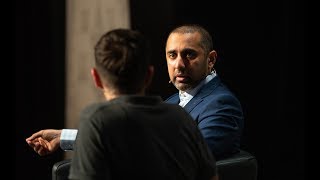
Balaji Srinivasan discusses joining Coinbase as CTO after Earn.com's acquisition at a $10M run-rate. He covers Coinbase's token listing framework, new products like Coinbase Custody, and his dual role balancing internal technology strategy with external blockchain education.
Questions this video answers
July 11, 2018.
About $10 million (run rate in GMV).
Mid-2015.
A "Digital Asset Evaluation Framework" (published the previous November, per the interview).
So the last time I saw you, you on stage at Tech Hunch Disrupt in San Francisco, right?
Last year, I think.
So the company you on stage with then was Earn.com, right?
Yep.
And now here we are. And you're Coinbase.
Yeah.
How did that Happen?
Coinbase bought Earn.com?
Oh, that's a pretty good answer. Okay, okay, that was a very quick. What. So can you tell us a bit more? Like what was the sort of price? What's the sort of purpose? Like how did that deal sort of come to be sure.
Yeah. So I have known Brian for a long time.
The CEO of Coinbase.
Yeah, CEO of Coinbase.
Sorry.
Brian Armstrong, the CEO of Coinbase for a long time. Since it was just Brian and Fred, like basically in not exactly a dorm room, but a small apartment thing in San Francisco and been talking to him for a while. I had taken over the predecessor to Earn, a company called 21 in mid-2015, turned it around and after a long series of events turned into Earn, which actually got to about a 10 million run rate in GMV prior to selling to Coinbase. And I think the reason that we sold many reasons, but one of the biggest is Earn is one of the first things I think is providing utility for crypto because you can pay people to reply to emails. And that's something where when married with Coinbase's large user base could be like a big deal.
And also they wanted to get you, right?
Sure, I think so.
Right. I mean, that's pretty much what you read if you read stories other than a TechCrunch. There are other media out there and they said one of the things they really wanted and I guess having been a company that's been around for some time has built a good user base, but they've always had issues, kind of talent wise, finding the right people. So I guess they wanted you to come in and be a CTO too, right?
Sure. I mean, like, you know, Coinbase has a lot of talented folks. That's how they got to where they are. I'm glad to contribute to that how I can.
Okay, great. So let's talk about what you do as the cto.
So yeah, there's both like kind of an external aspect and internal aspect. The external aspect is what we're doing here, like just giving talks and stuff like that. We're going to try and write up a bunch of content and put that out there as well. I think one thing about Blockchain is the educational aspect. Obviously there's no K through 12 on blockchain, there's almost no undergraduate education. There's some graduate education, but even that is not really structured. And yet it's going to become this huge thing that is revolutionizing the entire financial system. So we look at it as part of our role, is to develop educational content related to blockchain and deliver it in a bunch of different venues, at conferences, via blogs, all that type of stuff. So that's. Let's call that one part of the job. And the second part of the job is the internal role, which is to drive the future of technological change at Coinbase.
So the future of Coinbase. So I think Coinbase is an incredible company, right? You guys, I mean, I guess, are probably the biggest exchange outlet that does fiat to crypto. But I mean, talking to people who've been in crypto for some time, right, they get a bit frustrated because you guys only offer a certain number of tokens. Is it like four or five at this point? Right. Like you've got like Ethereum, Bitcoin and some others. Right. But it's mainly the big sort of names, Right? So I guess people that I've been talking to kind of curious what kind of tech are you guys doing? Because compared to others that are sort of out there, you guys have sort of taking a more cautious route perhaps, right?
Yeah. So a few thoughts on that. So one is it's hard to do something and make it easy and to do it at large scale and keep it secure and so on and so forth. That simple. You know, buy Bitcoin or buy Litecoin or what have you button. Actually, there's a lot of stuff happening under the hood and the complexity of it. You know, you have all these different banking services you're integrating with. All that type of stuff is happening. So let's call that one part of it. The second part of it is a good way to think about Coinbase is we are the interface. So if you folks are familiar with the Mullet, right, The mullet is a haircut, which is business in the front, party in the back.
Not know why I would have thought that you guys are.
Well, that's what we are.
I hear you out. Let's hear it. The mullet.
Yeah. So Coinbase is a mullet in the sense of we interface with banks and regulators and governments, so we have to have like an orderly kind of thing here. And then there's the whole crypto space. Right. And so it's like this ultimate mullet business. And so we have to maintain good relationships with both sides we need to maintain our licensure, we need to maintain our banking relationships, and we need to brief, you know, politicians and law enforcement and so on and all those kinds of things. But we also, of course, need to remain abreast of developments in cryptocurrency and blockchain and what have you. So there's a balancing act where you can err too much on one side or the other. And you know, in a sentence, like, our goal is to like mainstream cryptocurrency to mainstream blockchain, to build in the long term an open financial system. And that requires kind of maintaining good relationships with both sides. What that means is that we will probably never be the earliest adopter of a technology, but we will be early adopters. So Steve Jobs had this good line about trying to get technologies that are in their spring. And what that means is you don't try to take a technology right at inception, but you let it develop for a while, and when it's adolescence, when it's still got 50 years of life in front of it and a lot of growth in front of it, then you adopt it, then you bake it in and so on. And so that's kind of how we look at it. We take those technologies that have proven themselves a bit and then we integrate them and we mainstream them and we bring it to our huge user base.
Okay, so what's the kind of tech that you see out there now that you think that you guys can actually use?
So we've actually, we've talked about a few of these actually. So stuff we've announced, you know, obviously the EARN integration, we announced that, and we're going to be integrating that with our user base. And you know, paid email is something you do at large scale. We announced the Paradex acquisition. So those are the decentralized exchange relay that we acquired a while back. And we announced that we also have certain obvious kind of products that are filling holes but that are very important, like Coinbase Custody, which we just announced. And so that fills a big hole for folks who want to store large amounts of different kinds of cryptocurrencies. We got a broker dealer license recently and we announced that. And that actually is really interesting because it allows us to bring some of the benefits of blockchain to traditional equities markets potentially in the long run. For example, 24, 7 trading and chain of custody and all that type of stuff, fast settlement, all those kinds of things, you might be able to eventually, in the long term, bring them to traditional equities markets. So those are the kinds of things that we're thinking about working on.
What about other kinds of tokens?
Oh yeah, definitely.
ERC20.
Yeah. So a while back we announced that we're going to try and support many more ERC20 tokens. And also like about a month ago we announced we're supporting etc. Ethereum. Classic. Look for a lot of announcements over the months to come. Can't talk about anything specific right now.
So you might have more to add by the end of the year, like 6, 7, 10.
I can't say. Stay tuned. Subscribe to Coinbase on Chain.
Such a tease. But how do you keep those relationships that you talked about earlier, like with government, all those guys, and also do those other kinds of tokens? Because it seems like at the moment even those tokens aren't quite sure about their own position. Right. You've seen lots of ICOs where they don't do North America because they're just a bit unsure. So how do you take those projects that even themselves they're not sure and put them into your. Into your exchange?
So we published a Digital Asset Evaluation Framework last November, which is this huge PDF with all these different signals and factors.
A white paper for.
Yeah, a white paper. White papers, exactly. It's like the most meta white paper. So you can download that PDF and look at it and we've got all these different factors and we weight them against each other. And you know, one thing that's like an invariant that we won't be flexible on. You know, Coinbase is always going to be compliant with local law. Right. But local law varies, you know, there's, you know, like almost 200 countries in the world, depending on how you count, and they have highly varying attitudes towards blockchain and cryptocurrencies and tokens and so on. Bitcoin alone, in some countries it's a commodity, in other countries it's a currency, in some other countries it's property and so on. In the us it's kind of all those simultaneously depending on which agency you talk to. And so we want to be totally compliant with local law, but recognize that there's a lot of variance and diversity out there and then, you know, seek to use that as necessary.
So basically stuff that's legally like kind of looking okay for the US might pass through.
Yeah, well, it depends. I mean, if it's, you know, if there is a country that's given us the green light, there's no reason we shouldn't be able to.
And just, I mean, curious, like on when you're picking tokens, is there like a number of people, like a selection committee, or is there like one single person? Like how does that happen?
I'm not sure I can talk about. We're applying our digital asset framework, but we might be able to publish more.
Details on it because I noticed there have been a few cases and I guess even when you guys did etc, and you haven't even listed it yet and the price already went up. There's obviously a lot of responsibility behind that. Right. So you guys have. I'm just kind of curious whether there's a team of two people in an office somewhere that's looking through white papers or if it's like a committee of people or if it's just you or.
It'S not just me.
It's not just that.
Okay. But we want to actually try to make it as much of an algorithm as possible over time. And the reason is an algorithm is predictable and it's easy to evaluate and reproduce the results and so on and so forth. And that's a gradual process.
That sounds like more than six tokens by the end of the year. Then if it's an algorithm, who's into work with here?
Sure. Well, so you know, if you include, you know, we did announce that we're going to add a bunch of ERC20 tokens, so.
Yeah, but just not the actual ones.
Again, not the actual ones.
Okay, okay, that's fine, that's fine. So what about your own personal, personal background? Because I know you've been somebody in your sort of space who's been very, very, very, very vocal about bitcoin and about, you know, blockchain and other things. How did you first get into it? What was the first, first moment that you.
First moment I got into it, I think. So I had been thinking about what is the nature of money since the financial crisis and all the money printing and mortgage backed securities and so on. And I'd been looking, if You Google Fed M0 space graph, there's a graph that you can see which was from Fred, the Federal Reserve. I forget what the acronym stands for. It's basically their data repository. You can see that basically, you know, US monetary policy was kind of consistent, you know, consistent small level of inflation until 2008 when it just takes this vertical kind of thing like this where a huge amount of money is printed. And I looked at that for the longest time and like, you know, how do you short this? Because it was this disjunctive change in monetary policy. And so I was Looking at that in 2009 and 2010, you know, I like, you know, personally, you know, bought some gold or whatever. Then I came across, you know, the bitcoin white paper and I thought, wow, this is really interesting and technologically, you know, really novel. And then, you know, will it actually work in practice? And the reason that I really started to believe this thing had legs was after 2011 when there was a bubble and it went up and it came down, but it didn't go to zero.
Right.
It like kind of stabilized and then kept coming back up.
It went down to like you bought a ton more.
Right, well, so around that time is basically it was like, okay, this is going to, this is going to stick around. It's got legs, it's not just going to go to zero. And that was kind of a biddle year B U I d l year 2012. And we have these kind of bubble crash build kind of phases in crypto. We're in like the third or the fourth, depending on how you count. And that's kind of when I started.
To really get involved because I remember the first time I met you told me that you'd been in the back of Uber.
Oh, yeah.
And you were onboarding the Uber guys into Coinbase and you were giving them like a donation. Yeah, right. That show to the audience here, pretty interesting.
So. Well, I mean, like, I figured that Uber drivers talk to a lot of people, like maybe dozens, if not hundreds in a day. So for a long time, what I used to do is ask Uber drivers, hey, if you set up a Coinbase account, I will tip you like $10 of bitcoin right on the spot at the end of the ride. And I figured, okay, if I do that a thousand times, that is like an investment in the community. And obviously it's a tip for that driver, right? And he learns about something or she learns about something. And so I consider that like money well spent.
So you were onboarding people way before you even joined Coinbase?
That's right, yeah.
And I guess if it was 10 bucks then what's it going to be now? A thousand or something?
I don't know. I mean, if they hodl'd it.
So what do you see at the moment? So what? I mean, obviously crypto at the moment, as you said, there's ups and downs right at the moment. It seems like we're kind of on a down. Obviously the price has got very, very high end of last year, early this year, and now it's sort of created a bit and it hasn't really gone up yet. What's your take on the moment that we're at now?
Well, it's funny, there's a person who recently joined Coinbase and he tweeted a little while ago. He's like, his favorite thing is now every time when he wakes up in the morning, his wife turns him and says, what happened to the bitcoins yesterday? Why are they down? So it's kind of like that, right? But I think VCs have this concept of something has to grow into the valuation, right? Like you'll sometimes invest in a company or a startup based on its potential and you'll set a valuation which is probably ahead of what can be justified based on the raw numbers. But then that company grows into its valuation over time, right? So, for example, Stripe has done that wonderfully. Like it's raised at really high valuations, but then the next round, it's grown into it and it just keeps doing that. And I think crypto is sort of like that where it, it has these huge bubble phases and then it goes down for a while, for two years sometimes, and then it builds and builds. And I remember I sent a message to somebody in like mid 2016ish, and I remember saying, like Bitcoin, the blockchain space is ahead of where the progress is ahead of the price, right? Like it was not. It had been flat for the last X number of years, but the progress had been there. And I think once we feel that that progress is significantly ahead of the price, that's when I think it's likely to recover. But who knows?
So what does that mean? That means some of the stuff that we had earlier, like Sharding and Casper coming out, right?
This stuff, I mean, that's part of it. That's certainly infrastructural, but I mean, I think utility, real applications that people are actually using, if we can knock, what if we can scale earn like 10 or 100x, that starts to maybe get there. That's just one contributor. There's so many amazing projects that I'm seeing. Another thing I'm very bullish on are Ethereum games. So the idea here is that your swords and your potions and your weapons or whatever in a game would actually be represented by ERC721 based collectibles. And then when you beat somebody in the game, well, you win their loot and then that's actually sellable for actual real money. And so parents around the world are rejoicing because their kid sitting in the basement is actually now making money online. Their esports are actually revenue generating in a more direct way.
Yeah.
And I think that's going to take esports, which is already huge and growing and bigger than traditional sports by some measures, and just completely turbocharge it and really get it to another level. So I'm bullish on Ethereum games. I'm bullish also on what blockchain is doing in terms of core fundamentals. There's things that blockchain is obviously 10x better on. It is 10x better than gold. You can move bitcoin faster, lighter, cheaper than gold. It is 10x better than international wire transfers like with Ethereum you can move money in 17 seconds rather than 2, 3 days like Swift. It's 10x better than crowdfunding, which in 2015 was like 10 or $15 million you could do in a crowdfund and now you can do a billion dollars or $100 million. It's 10x better for, let's say incorporation of a new company because that usually takes two or three days in a new country, but you can do it in fractions of a second with a smart contract. And it's 10x better for something like wire transfers in terms of receiving addresses, because you can get a new bank account with a new receiving address in fractions of a second versus two to three days. So you combine all those 10xs, like moving large amounts of money, sending money across borders, crowdfunding, incorporation, new bank accounts, and you've improved these fundamental primitives and you made them programmable and automatable and that's going to yield a bunch of dividends. I think a lot of fintech companies are going to get blockchainified over time or new ones are going to arise affirm on the blockchain, PayPal, blockchain, etc. So I'm bullish about the medium term, but I think those things have to actually materialize and not just be hypothetical and think fluencer type things, but actually have to have real users and traction and then you're going to see the thing really start picking up again.
I'm just curious. So obviously at the moment you guys are very much fiat into crypto, but do you see a time where you guys might offer other kinds of services too? Obviously Earn is one of the first ones, right there be like Coinbase games or other kinds of things.
I think we've got a lot to bite off with just crypto itself and probably everything we do will have a dominating crypto component for a while because the space is so large, expanding so rapidly. I mean, you can't keep up on all the news. I remember back in 2012 or 2013, there was a time when you could have read every single bitcoin article and every single newspaper piece and PDF or whatever. And now you probably can't do that in one day.
Quite a lot now.
Yeah, yeah, that's right.
I try. So we're almost out of time, but I wanted to ask you about the fund. So you guys are one of a number of companies in the blockchain and crypto space that has an actual fund. Can you talk us through how big it is and how you plan to be out there using it?
So we're very active. I don't think we've disclosed fund size.
But you can say it now if you want.
But we write checks into, you know, all variety of companies, but especially things that are at the seed stage or early stage, because we're interested in supporting just the blockchain ecosystem more broadly. And so there's some things, you know, if it gives an immediate return, great. But there's other things that maybe would improve scaling or privacy or security or performance or some other aspect, and we're happy to fund that kind of stuff.
So it's not all about what the company can give to you. It's about growing the whole ecosystem. Pie, if you like the horrible phrase.
And fortunately, we're big enough to now start doing that kind of thing.
Yeah. Yeah. Okay. Well, I mean, I've got so many questions that I'd love to ask you, but unfortunately we're out of time. So thanks again for your time. Much appreciate it.
Thanks.
More from Balaji



34 - Network State Conference 2025 - Fireside with Vitalik and Balaji on Zuzalu and d/acc

33 - Network State Conference 2025 - Fireside with Amjad Masad of Replit and Balaji





06 - Network State Conference 2024 - Fireside with Naval Ravikant and Balaji Srinivasan