Long Conversation on Emergent Cities and Chaos 07 | Garance Choko and Balaji Srinivasan
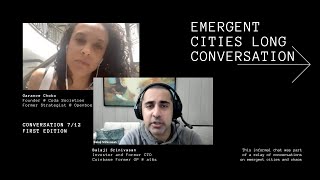
A conversational interview (Sept 6, 2020) between Banerjee and Balaji Srinivasan covering themes of online education (notably a 2013 MOOC with ~250k students), leveraging the internet to expand global economic opportunity via education-to-jobs pathways, and addressing inequality by investing in capacity-building rather than pure redistribution. The dialogue also touches on personal information diets and harms of social media, short- and medium-term worries about COVID-19 and potential civil conflict, and an aside about government UFO archives and why such revelations may not trigger broader narrative change.
Yes. Hello, Balaji.
Hi, how are you?
Hi. Yes, I'm well, I'm okay. I'm based in New York, so, like, my most honest, like, you know, answer can be that I'm okay. How are you doing and where are you, first of all?
Oh, I'm just at home. But I'm glad that you're safe.
Thank you.
Saw some of the news, so I understand, you know, that it's, you know, I know Pia and I know E. And you've been talking with Jonathan. You've got the floor.
I think that you get the floor. We got the floor, so let's share the floor. Okay. But, like, so are you in the US right now?
Yeah, well, so the. I am concerned about privacy and so on, so I don't really talk about that. Yeah, no, go ahead.
I see. No, but I would love to first of all, know how you're doing, of course, and also maybe get an understanding of what excites you today about the opportunities of emerging cities. I know it's a very broad question. It's a very broad question, but I think that for what I've seen and heard about your incredible work, that you're very much future forward and future oriented. And so I want to understand, like, you know, for us to discuss more about, like, how emerging cities, you know, are, like, an inspiration for you.
Well, yeah, sure. So one of the things I've been very interested in is online education for folks in the developing world. And I taught a MOOC course in 2013, which actually got like a quarter million students from all around the world, from Nigeria, from Brazil, Honduras, India, of course, and so on. That was seven years ago, and if I did another version of it today, probably would be larger. It really just showed me how much talent is out there that hasn't really been tapped and integrated into the global economy. That's something I've thought a lot about because for something like education, you can produce it for a fixed cost and distribute it at scale and increase a lot of people's human capital by doing so. It doesn't need to be a scarce resource. Looks like someone's got echo or something.
Yes. I'm sorry, I mean, like, you know, Covid. So I mean common areas. So I apologize for that.
No worries. No worries. So I think that we have, you know, thanks to the global Internet, now everybody's got a smartphone. We can use that and turn that into a university, which we've done somewhat with MOOCs. And the next step is to turn. Turn that into a jobs board. Where you can just instantly get a job and have skills matched to that. Just like you've got a personalized Twitter feed of things that are suited to your interests. You get tasks that are suited to your education and your skills. So if you know computer science or design or something like that, you get a feed of tasks. This is something I've been thinking about for a long time. But the point being that now anybody could earn from anywhere. If they are at all interested in getting the skill, they get it for free, and then they can start earning more money. So that's, that's something I think about where we can use the Internet as sort of a skyhook to lift folks up around the world. And, and then, you know, we can hopefully use that to achieve greater levels of global equality. So that's the kind of thing I think about.
Okay, wonderful. So, like, yes, you just mentioned, you know, like, that one of the principles that inspires your work is also around, like, it's around equality. And can I ask, like, in a more personal way, if you don't mind, like, what do you think has, like, triggered your interest in injustice and inequality?
Well, I think seeing, you know, the rise of China and India over the last 20, 30 or 40 years showed me how much human capacity was being held back by bad systems. And you can add to that much of Eastern Europe, much of Russia, and now in Africa, places like Rwanda are starting to do well, especially after their genocide. Paul Kagame, I think, has done a very good job. And so I've been very interested in how folks have, you know, basically built up a society from nothing. Just like you build up a company from nothing. How do you build up a country from nothing? And if we can give people the tools to achieve that, you know, they don't. We don't necessarily need to stop at, quote, equality. We can, we really want to do is have an incentive for them to surpass us. Yeah, and by that, what I mean. Yeah, leapfrog. And so what I mean by that specifically is if you have just as a thought experimenter, if you have $100 and there's someone who has $0, well, okay, you might give them $1, you might give them $2. Most people will stop before they give them $50. So it'll decelerate. If that person has $35 and you have 65, people may not give another 15 or whatever. Right. Because they're already somewhat close. And so if you're doing it through pure redistribution, there's some diminishing returns on just Pure charity. By contrast, if you invest in that person, well, then maybe by the end of. Goes from $100 and $0, you give them 20 bucks, they you invest in a business, and then maybe there's $400 to split between you two. Right. And you know, because there's been wealth creation. And so I think that's something I think a lot about is it's certainly equality in the sense of bringing folks up, treating them with respect, bringing them to a basic level. But we shouldn't even stop at that. We need to figure out how to incentivize folks to make people richer than themselves.
I completely agree. We're very much aligned on that. So wonderful. I was wondering, how do you incentivize individual to join your platform? What have been the mechanism that you put in place to ensure that individuals are adopting and, you know, adopting, integrating, and using your tools?
Well, so, you know, I'm not launching anything right now. I mean, I may be at some point, but at least today, I think in 2020, what you want to do is build an online community first that shares your values. And, you know, then the kind of the, the problems that they're trying to solve are obvious from just discussing with them. And then the tools that you build are things that they would use.
Yes. And are you looking at that in terms of, like. Because I'm anchoring my thinking and my question based on like, the educational platform that you've developed, right?
Yes.
Oh, yeah, yeah. That's. Why are you integrating that through, like, so what type of the medium is it, like through government? It is from the private sector, through schools. Like, how are you able to socialize?
I understand. So it was a, it was a Stanford course on coursera back in 2013, but I want to export it and then have it be standalone. It's been just something to be on my to do list for now six or seven years, and I need to do an update of it. So that's a short version.
Okay. And so in this time of uncertainty and chaos, how do you keep like, your, your hopes up? How do you keep, like, what keeps you innovating and creating and waking up every morning?
That's a good question. I think that too much social media is bad for the brain, you know, because it's. It's something where social media has sort of rediscovered the mainstream media prioritization algorithm. And it will put lots of things in front of you that are highly engaging, but maybe make people angry or sad or depressed or, or what have you so filtering that is Important though it's not always that easy to do. That's one. And it's kind of like, you know, more generally, I think your information diet needs to be as carefully curated as your food diet. In the same way that you want to eat healthy greens and vegetables and stuff like that, not just cookies, you know, you also want to actually plan for yourself what you're going to take in through your eyes and ears. Because you have only so many hours in the day and highly engaging sort of junk food from social media is, you know, I'm not saying have none of it. You know, obviously there's some serendipity or what have you, but if you make room for the math book that you've always wanted to learn or to learn a new language to budget for that explicitly so you have something which isn't giving you that immediate payoff of, oh, you know, like, you got me feedback on something. It's a longer term payoff. I think that's worthwhile to sort of budget that for oneself.
Yeah, I see. No. So self control and self preservation. Definitely. I really liked the prompt that Jonassan gave us and the poetic of it around like, given the current critical juncture, like, what are our. And what may be our future memories? Right. And so like, do you have some thought about that? Like, you know, it's a time that we will remember, right, in our lifetime, that generation, the future are going to remember in terms of like Covid. In terms of like, then again, you know, like the violence against people of color. All of these different crises, like together. And so like, yes, in terms of like future memories, what do you want to remember? Like this specific time and place as, you know, in 10 years when you look back, I know it's, you know, it's a philosophical question and you know, I don't necessarily have the answer to that as either, but it would be interesting to explore if you're game.
Yeah, yeah, I understand how to respond to that. Unfortunately, I'm very bearish about the near term future and even the medium term future from a civil conflict perspective. And the thing about the current time period is, for example, a month ago someone had this tweet which said, I'm calling it now. Coronavirus will be the story of 2020. And at the time, at the time it seemed okay, duh, you know, like everyone had been talking about only that for the last two months it dominated international headlines. Everyone was talking about social distancing and whatnot. It seemed like there was pretty much nothing else people were going to Think about for the next year or so and, you know, talks about a vaccine and drugs and what have you. And it seemed like the most obvious tweet. That's why it was kind of like a joke. Right. And somebody replied to it and said, I hope you're right, because I can't imagine what would sweep this off the headlines. And the problem is, of course, that COVID 19 is a virus. It doesn't care what's in the headlines or not. It, you know, we've sort of treated it as if something that's not in the news cycle is no longer a threat, but it is, and it really doesn't care what's in our heads. It will continue to attack our bodies regardless. So something I. Right. You know, and look, I just. In terms of concern for public health, I am concerned that we're going to see spikes coming in a few weeks. These are some very, very, very large crowds. It's like the total opposite of social distancing in many ways. And so, like, whatever control efforts we put in place at the cost of literally trillions of dollars in lockdown and so on and so forth, I mean, I hope it wasn't wasted, because that would be really terrible. You know, like, other countries have managed to get Covid under control and, you know, they've gotten their green zones together where they use the lockdowns to, you know, put testing regimes in place, tracing regimes in place. I'm bearish in the short term. You know, I. Yeah, I don't want to say, hey, I'm going to remember X or Y or Z, because it's almost as if we've entered something that's similar, frankly, I think, to like, World War I or World War II, which were four years of dislocating events where people didn't know when or how it was going to end. And I think that's kind of where we are now, where some dominoes are flipped. Yeah, exactly.
Yeah, No, I hear you. No, I was thinking, you know, as you were speaking, but I don't know if it's a topic that you want to get into, but, like, for, you know, the protest are, like, obviously needed because they are talking about racism being a public health issue as well and very much linked to Covid, and that the police and the law enforcement forces should be also ensuring that they're not making these protests unsafe through their practices as well. Anyway, so it's a longer conversation, so let's not necessarily, you know, get. Get into that rabbit hole at the moment. We can have it like offline. But yeah, I think that, you know what was interesting to me is that to your point again, like what happened in 2020, you know, and what, what is the headline? I think that what was very telling is the fact that like aliens finally like UFOs, you know, like we were. I've been like displayed.
That was cool. That was cool.
But no one cared. No one cared. So what does that say? You know, what does that say about like the current state of affair?
It's interesting because it's actually even more meta than that, which is. Do you know the National Archives in the UK actually released its own UFO archives several years ago? So you can, yeah, so you can Google.
Yeah.
UK government UFOs. So there's been official confirmed government evidence of UFOs, not even just this year, but for, for several years. And you can go click around all the archives. So, so your point is an even better one, that seemingly no one cared for not just a few weeks, but four years.
For four years. So it's just like, okay, so we care about it when it's like a fantasy for like science fiction, but when it's actually an actual reality, we are, you know, it's something that is like multi normalized. That's interesting.
So, yeah, I mean, like it's, it's actually a really good question. And I think the. What would happen when I would bring up, not that I did it too much, but when I would bring up the UK national, you know, Government Archives. And again, it's like nationalarchives.gov.uk or something like that. You can go check it out. Right?
Yeah.
When I bring that up to somebody, they would, they basically, first they'd say, ah, that's not real. You know, and then I'd show it to them. They'd be like, oh, that's fake. And then, then they'd look at the URL, it's like the national, you know, and they click it and. And then kind of, they just, you know, the next step wasn't clear and so they would just kind of go on with life because. Okay, what's the next implication? There, there wasn't crucially any existing narrative where this incoming event was a trigger for the next thing.
Yeah.
Right. And, and I see, you see what I'm saying?
So it's not, it's not domino effect. It's like, yes, it's like actually like just a fact and how do we deal with it? And it doesn't have like, it's not connected to like a whole system. So how does, like, ld. Yes. Connect to the economy or connect to health? Yes, that's right.
I'll give an example. Like, you know, just one very concrete example. American troops were stationed in South Korea for many years. I think they still are as a so called tripwire, where if North Korea invaded South Korea, then the presence of American troops would cause the US to defend South Korea. And so what that means is there's a preexisting narrative that was set up where if you saw the headline which was North Korea invade South Korea, then it's like a series of, you know, mousetraps. Have you seen a bunch of mousetraps laid out? And you drop it and go snap, snap, snap, snap, like that. Right. So that's, you know, you can get at least some sense of what the story is. If X, then Y. Right?
Yeah.
And so I think that UFOs don't fit into a story like that, or at least not a plausible one.
Yeah.
And so therefore it's just like a dead end for people. You need someone to say, okay, because we know this, then we do things. Yeah, No, I. Yeah, here's an example to me, which is, you know, because we know that we should, you know, fund research on it. Right. You know, or because we know that we should have, like books written on that stuff to try to surface the most important aspects. I'll give you, you know, it's funny on the ufo. Go ahead. Yeah.
I have been like signaled that we have to, like that I need to start the transition. But it means that you. But you do have the floor now that you can share with someone else. So if you are to start the conversation with like alien and UFOs, I think that you actually might create a night setup. So. But it was, it was a pleasure speaking with you, Banerjee. Like, really.
More from Balaji



34 - Network State Conference 2025 - Fireside with Vitalik and Balaji on Zuzalu and d/acc

33 - Network State Conference 2025 - Fireside with Amjad Masad of Replit and Balaji





06 - Network State Conference 2024 - Fireside with Naval Ravikant and Balaji Srinivasan