Long Conversation on Emergent Cities and Chaos 08 | Balaji Srinivasan and Pia Mancini
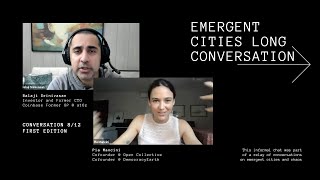
Balaji Srinivasan and Pia Mancini discuss how political organization could shift from nation-states to digital communities. Srinivasan describes his "network state" idea: online communities with virtual reality, currency, and smart contracts. Mancini sees crypto communities as sandboxes for testing new political systems.
Questions this video answers
Balaji Srinivasan and Pia Mancini
Hey. Hey. How are you?
Good.
Do you see me?
I'm not sure I do see you. Yeah.
Fantastic.
Yeah.
Nice to see you. How are you going?
Good, good, good. So you've got the floor. Am I supposed to be leading?
I think you are. But I also, I was hoping that we got a chance to chat about kind of the role of the cities, which is something that I think both you and me are super passionate about. And I guess I think one of the things that we both agree on is, and I'm sure there are many, but like a thing that we agree on is like the decaying role of the nation state as the main kind of political actor or how that is going to be transitioning into something else. And you've spoken a lot about the role of the cities, and especially in a world that is getting more and more digitalized and we are more and more mobile and we are able to move our funding on a key in our pocket or whatever, in a seed. So my question to you, or what I would like to chat about, is what do you think is the MVP of the state? Right? Like, if what. So we will still need to produce public goods at a scale that might be bigger than the city. And I think that in this transition, you know, there's no. It's never clear cut. Like one kind of system kind of starts winding down and another kind of system appears. But there is obviously a transition and an overlap. So what do you think is the MVP for that? Like, how do we. What is the minimum viable state that we want?
That's a great question. So I've actually got a book that I'm writing on this and I've got a talk which previews some of it. But the concept I have is something I call the network state. And the very shortest version is the minimum viable version of a state is an online community. And the reason I say that is we can actually go much farther with online communities than I think we have. For example, with virtual reality and virtual currency, both of which have now gotten to, as you're aware, with Ethereum and maybe if you used Oculus Quest, they've gone to a pretty good level. And one of the things I think a lot about 15 years ago, let's say 2006, 14 years ago, Facebook was a college social network and Twitter was people tweeting their breakfast. Fifteen years later, these are basically two of the most important platforms in the world where, you know, heads of state, national leaders, basically folks care a lot about whether they can write to the databases of These private corporations, which is actually very, very surprising. You know, it's not, it's just kind of amazing how powerful they've become. And what I, what I think a lot about is, okay, what's next from a technology standpoint? I think that just as you went from text based web pages to social networks, which were much richer and more engaging, or two dimensions and so on, I think we're going to go from social networks to digital economies, which are virtual reality plus virtual currency plus also smart contracts. So you can now have a full culture with laws and an economy and buildings in virtual reality. So you can have a dress rehearsal for a city where what you focus on is actually not the capital intensive stuff, but actually some of the stuff that's harder to work out, which are norms. You can basically practice living with people before you're living with them to make sure that you're aligned on the same culture and so on. And we've also already got precedents for this. For example, there's all these Reddit subcommittees, things like, you know, this is sort of a flip way of putting it, but the social network of, you know, called India produced curry, you know, Russam and so on. The social network of Japan produced sushi. Well, the social network of Reddit produced keto, you know, so there's like diets and foods that come out of social networks. Because a nation state and a social network are both groups of people. The difference is that the nation state is a group of people in a geographical area, and the social network is a group of people online in basically an area of interest or an area subgraph of the social network. So you put those together, you start having a network which has state consciousness. I think that's the next step.
Fascinating. You know, with Democracy Earth, one of the things that we think a lot or the way we see it, is almost like this sandbox of political innovation. And what I find particularly fascinating about crypto communities is that they can be these spaces where we practice what governance can look like, where we cannot. Because I've been in politics or working in politics all my life, and every time I talk about participatory politics or new spaces for civic participation or whatever, they're like, but how is gonna replace everything, democracy as we know it? I'm like, well, we need to learn how to do this. Like, we've spent thousands of years being told that we can't participate. It's not like we're going to flick a switch. And then we need to know how do we become active Citizens of our communities. Right. What does that. How do we learn what it means to make a decision and take responsibility as a society for that decision that we are collectively taking? I think that the learning process is. It's experiential, it's one that we need to live through. And so crypto communities, for me, and kind of part of the work we do with Democracy Earth has to do with how do we create these sandboxes of political innovation.
That's exactly right.
Yep. Right. And so, and crypto, because crypto communities in particular have something that is very interesting, that is so one of the, and you know this very well, but one of the pillars from the nation state, it's a shared, It's a common currency, Right. It's the ability of the nation state to say, you are going to transact in this currency that I am going to create. Crypto communities kind of share that they collectively create a currency that they decide to transact with. And so that creates, to your point of consciousness, a level of being part of that same collective. Right. And so you have, you have the currency, you have the tools, you have the. Some of the building blocks, right. Like the institutional kind of voting mechanism, smart contracts. So where do, what's, what's next? Like, for example, there's still an. I know that you've said in the past, and I agree, how the monopoly of violence enforced by the state was more useful in a time where your resources are physical and it's less, I guess, less of a threat in some way. In an era where the resources are digital and your assets are not. They can't extract those.
Yes, but we're still at like the, I mean, I shouldn't even say the 1%. We're still at like the 0.1% stage of that transition where, you know, every stock, every bond, every commodity, okay, maybe not 0.1%. We all have phones, right? We all have laptops and so on. But the crypto world has not fully taken over yet. I think it will. I think that the chaos period that is about to ensue that is already underway is going to mean that property that's hooked to the state and is going to be seen as riskier and it's going to go crypto, as is voting, as is a bunch of other things over the course of the 2000s. And I think the consequence of that will long term be good, but I think that the intermediate phase will be pretty wrenching and dislocative.
I agree, I think about how on earth are we Going to create these public goods with the tools that we have today. Right. Which are not, might not be the perfect tools, but they are what we have. And in a way that it's equitable or fair, that it's not deepening inequality, that is not deepening the divide that we are seeing. It's unclear to me how the transition is going to look like. So I don't know, what do you think it's.
Well, what I think is you need to have. So any society that has a leader of any kind is going to have necessarily some form of inequality, meaning a different word for it would be non sameness. Unless everybody is exactly the same on every dimension, there's going to be, quote, inequality. So the question is, how do you manage that? And a big part of it is if folks believe that the inequality resulted from a fair process where they had a chance, it's a different matter. For example, this is a trivial example. But if you have a bunch of folks who all line up on the same line of a race and they're running around the track and everybody runs, well, the starting place is very obvious. And then whoever won what, they ran faster. Right. And so, you know, in other areas, in, you know, when folks are playing, you know, like a baseball game or if you are singing or if you are modeling or if you are, you know, doing math. Right. These are domains where merit is easily measurable. You know, in the sense that, you know, it's easy to tell whether someone can do math or not. And the person who can do math, they didn't steal that from anybody. There was no trade involved. It was intrinsic to that person. Right. You know, they may have worked hard and studied and so on, but they didn't take the ability from somebody. And so thus, you know, when someone wins a Fields Medal, it's not like an envy. I mean, maybe people are like, oh, I should have won it, or something like that. But nobody thinks that that person, like, screwed their way to it. Or at least it's an uncommon sentiment. Right. Because the talent is there, the merit is obviously there.
As long as the winner is not a woman, then I bet there's more than one person that will say that.
You know, that's right. Yeah. And actually Mariam Mirzakhani won. And you're right, there's certainly like, you know, biases in, you know, who it's awarded to. But the question of, is that person good at math or is that person like, you know, like at the high level deserving of something is different. And, you know, the foot race is probably even a better example because it's like almost impossible to say whether somebody ran faster than the other. You'd have to handicap it. Right, so what's my point? My point is that I think a big part is not striving for equality of outcome necessarily, because equality of outcome would mean a leaderless society. And a leaderless society just, you know, it's never worked in the sense of just humans just form into leadership groups even, you know, under every system that's tried to eliminate them. So if you're gonna have leaders, how do you select them? And you know, one way of doing it is to aim for as egalitarian a process as possible. Do you know the concept of like cutting the cake and having the other person choose the slice? Are you familiar with that? Right, like some of. No. Okay, so like, if you want a fair cut of a cake, you get to cut, but the other person chooses their slice. Right.
For society, right?
Yeah, exactly. That's right. So I think there's a lot that can be done with that type of thing. Like provably fair decision making is actually in its infancy. It's being applied to poker games and things of that nature. But provable fairness, for example, with Bitcoin, where in theory anybody could have run it, Cryptocurrency has that kind of aspect to it where everybody can audit it. You can look at it. I mean, I'm not saying there aren't hijinks in crypto. We're human beings. So there's every possible edge case and weird thing that happens. Nevertheless, there's a sense that it's a social game that we're setting up with transparent rules and checkable things and we can kind of go through it. And I think that a couple of ideas towards this area that I've thought about. One thought is everybody who is graduating from school, rather than have, let's say four years of college or 12 years of high school, you give 11 years of high school, and last year you give them the funds to start a company, you know, whatever funds they would have otherwise used. And the reason for this is you treat that as like a capstone project, right? Everything that they've learned, it's actually now applied and they learn how to actually be CEO of their own company. It could be, frankly, like a sandwich shop. It could be a larger corporation, it could be something that's a solo single person lifestyle business. It could be anything. The point is though, that they. It's sort of like a, like a Y combinator. Style thing or like a business plan competition, they are competing to create wealth, you know, and given that they're all high school students, at least from the same, you know, school within a school, obviously between schools, there's gonna be differences. There starts to now be an appreciation for, okay, the relative impact of hard work versus luck and so on. You know, at Y Combinator, for example, the kids in. I shouldn't say kids, but let's say the people in those Y Combinator batches who sometimes are young but sometimes can be older, those folks have basically all the same starting places because they're all part of the same YC batch. They're all at least the same points in their company's life cycle where they're accepting this amount of funding for this percentage. And then the outcomes are just wildly, wildly different.
Anyway, let me crack on that a little bit because this is like one of the points that I was. So I did Y Combinator, and when I fundraised, like, there was clearly a difference because I was Latin American and I was a woman. There was like the, the. The approach VCs had with me, I know it was different for. Than the approach that they would have or how they would listen to someone that didn't look like me or didn't sound like me, right? All the way to one VC actually trying to, you know, go out with me when I was doing demo day. So, like, whole shebang of like crappy Silicon Valley experience now. So the question is still like, how do we build these public goods in a way that we are. That it's. We are really guaranteeing or trying to guarantee equal opportunity without these biases, because we can do it like Y Combinator style, but the biases are there.
I have an idea for you if you're interested. So first thing I'd say I'm very sorry to hear about that experience. It's really terrible. And I think that the way I think about YC is it is more fair than what came before, but we're still not at purely fair in a sense of Y Combinator, for its faults, has certainly opened up entrepreneurship to a much larger group of people. It's made it more accessible. All those things. I think we both agree, right? I think that one possible way for the next step is the pseudonymous economy. This is something I've thought a lot about. So essentially, pseudonyms have actually quietly become a very big thing in American society. For example, James Comey or Mitt Romney have both been found to be using pseudonyms on Twitter, assumed names which means that even folks who are fairly senior in society, it's percolated all the way through to the last adopters of technology, senior politicians and what have you, or relatively slow adopters. So that means that many people are comfortable with having some assumed names, a satoshi, like name online. Right. Or more than one. Right. Reddit also shows the pseudonyms are now a very, very big deal at scale. Okay, so with virtual reality, what you can do potentially is you can start separate. You don't even need VR for this. Right. But you can start separating out people's working name from their real name, from their speaking name. Okay. So, you know, for example, you tweet under one name, you earn under another, and you have a third, which is your official name, but only used in forms, and you treat your quote, real name like your Social Security number. You don't usually give it out. Right. And this is actually not that different from how people act online already. Lots of people, you know, Reddit, you don't use your real name on it. The culture is such a way that that's actually not. That's not done. Right.
When they do concert auditions.
Yeah, exactly. That's right.
For that same reason. Like, and it's.
That's right. No, that's right. Blind auditions are a great example. Another is something called ban the box, if you're familiar with that, which is like, don't ask about somebody's past conviction, if they've paid, if they're done their service or what have you. And, you know, you can't ask questions about marital status or things like that during the interview. So the natural conclusion to that is allow people to take digital certifications, use those to apply for a job where someone can't discriminate against them invidiously, and then they can earn under a pseudonym, and if they need to. By the way, a lot of technology is getting pretty advanced in terms of avatars, and I would say within a few years, we'll probably be able to do a zoom under an assumed avatar that looks completely human. Like, you'll be able to look like whatever you want to look like. Go ahead.
No, that's fascinating, especially because I think that a key piece of, like, world type of democracy has to do with how do we validate identity online, how do we validate humans online, and how do we kind of, how do we allow them to interface with the different communities using their own different identities? So.
Right. So I'm not saying it's a panacea, but I do think that something like this is one way of making it very hard to. I mean, if you've got 30 pseudonyms, you cannot tell any characteristics of the pseudonyms. You literally don't know. And if you don't have that information, you can only judge based off the information they've given you. And so that results in, I think, a more fair process, potentially. Right.
It's certainly something that we should experiment with at least, and know what happens. I think we are. We need to go into a transition to come, so.
Pleasure.
So, thank you.
Yes, it's great. Great meeting you again, Peter.
Yeah, same.
See ya.
Bye.
More from Balaji



34 - Network State Conference 2025 - Fireside with Vitalik and Balaji on Zuzalu and d/acc

33 - Network State Conference 2025 - Fireside with Amjad Masad of Replit and Balaji





06 - Network State Conference 2024 - Fireside with Naval Ravikant and Balaji Srinivasan