Spring 2019 Summit: Fireside Chat With Balaji Srinivasan
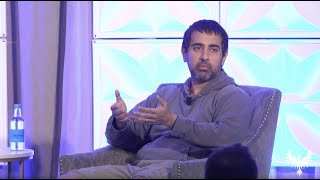
Balaji Srinivasan, then Coinbase CTO, talks about his path into Bitcoin after 2008 and Coinbase's role as the trusted center of crypto. He maps the crypto economy as nodes and verbs: buy, sell, send, receive, earn, store, use, and emerging ones like stake, lend, borrow, and predict.
I'd like to welcome Balaji Srinivasan, CTO of Coinbase, who's agreed to join us today. So, Balaji, why don't we kick off with your crypto origin story? It's almost like a superhero origin story. Sure, I'd love to hear what got you interested in the space, maybe some of your background before that, and what brought you to Coinbase.
Yeah, absolutely. So, you know, after the 2008 financial crisis, a lot of things that were previously constant became variable, right? Like in the sense of America's monetary policy, which had been relatively constant for a while, suddenly, you know, there's quantitative easing, There are a lot of things like this. And, you know, in computer science, you call this a leaky abstraction, right? Things were poking through where you just, you know, you'd never seen that before. So that got me interested in kind of the nature of money. And, you know, I, you know, I looked at the chart for the Fed's M0. If you guys have seen that M naught, if you go and Google that, you'll see that monetary policy up till the financial crisis was kind of aligned like this in terms of the amount of, you know, M0 out there, and then suddenly just went like vertical like this with a ton of money that was printed like total discontinuity with everything previous. And this was said to be, oh, that's just macroeconomic theory. Oh, you don't understand anything, or whatever. And I was like, maybe there's something that needs to be poked into here. So looked at things at the time, like gold, thought a lot about what is the fundamental unit of money. I actually think this is a whole separate kind of topic. I actually think you can argue that the true price of something is in J O U L E s joules, not J E W e L s, but joules, in the sense of the price of an iPhone is the energy required to assemble it out of the constituent elements from the ground. And you can talk about human civilization progressing. If you reduce the number of joules to assemble an object, a house becomes less expensive. In real terms, the amount of energy that goes into assembling it is less. So it's an interesting way of thinking about the true cost of something. And I actually think you could probably base a crypto on that. But these are the kinds of things I was coming at it from, like a physics or CS standpoint, just like writing up my own little notes to myself. I came across Bitcoin and I saw it in 2011 and it seemed interesting. And then Crashed all the way down to two bucks. And then what piqued my interest in 2012 was that it came back up, right? And very, very few things in technology come back up after, like going from $32 to like $2 or whatever, very few things come back like that. Friendster didn't come back. MySpace didn't come back. Things that die like that usually don't undie. So that really got me interested. And so by late 2012, I was really into Bitcoin and that began the start of my crypto journey.
And where were you before? Can you provide us some context? Sure. What primed you to recognize this? Because you were really early?
Yeah, yeah. So my quick background. So Stanford BSMS, PhD. I did my PhD work in computational genomics, Cisco reconstruction of genetic circuits. So it was like the intersection of a few different disciplines. I taught CS and stats at Stanford for a few years and then I started a genomics company and we recently sold it for $375 million. So successful company.
Congratulations.
Thanks. Yeah. And, and another thread on this alongside the quantitative easing stuff, is while founding that company and operating the company, I realized how regulated the economy was. When you're in academia, the worst thing that the state can do is not renew your grant. Oh, they didn't give me more money. So nsf, nih, et cetera, they just don't renew your grant. Whereas when you're operating in a regulated industry, if you are not compliant, you can be shut down, it can be just done, terminated, et cetera. And that was just not something that I really fully understood until actually doing that. And moreover, what started to happen in technology was you had Airbnb and Lyft and Uber and these other companies that were arising that showed, hey, maybe regulations that were written 100 years ago aren't necessarily appropriate for this time and place. Maybe they were relevant or appropriate or the right technology in the sense of regulated marketplace, regulations of technology in the 40s or the 50s. But today we've got. Everyone's got a mobile phone, information provision is local. Maybe you can revisit that. So that was another thread where crypto kind of challenges certain old concepts of how a currency, a marketplace, et cetera, should be regulated. So that was another big thread that led into this.
And so how did this all bring you to coinbase?
So after 2012, started to get into Bitcoin, at the time, not crypto, but in a big way, I became an angel investor. I taught a MOOC course with like 250,000 students, actually, that had A lot of bitcoin in it. I think one of the first like MOOCs or college courses that had bitcoin. And you know, I helped set up a bitcoin mining company that was initially very successful. It was one of the first data center mining companies and also joined Anderson Horowitz as a general partner and did a lot of our stuff, early stuff in crypto and biotech actually alongside Chris Dixon and Vijay Pandey and whatnot. Then in 2014, Bitcoin price crashed and the mining company that had been very successful became very not successful. And so then had big problems. And because I had helped set it up at the beginning, I had some feeling of responsibility or whatever towards it. So net is I took it over in mid-2015, turned that company around, very challenging situation. I wrote about it called the Turnaround, if you Google my name, the Turnaround biology, whatever, and turned that into Earn.com, and got earned to 10 million GMV run rate and actually profitability and sold out to Coinbase last year in April and joined the cto. So almost exactly a year ago.
Great. And so why don't we pivot to talking a little bit about Coinbase and kind of the story of Coinbase so far, where you think Coinbase is today and what the future of Coinbase really holds.
Yeah, so there have been, there's various hybrids. When you've got to look at something as new as crypto coming out, there's various hybrids that are being tried. For example, people have tried private blockchain. Right. That's a hybrid between the fiat system and the blockchain system that has not worked. But the big hybrid that has worked is, you know, buy bitcoin with fiat currency or buy crypto with fiat currency. That's a hybrid where it's like the scale and profitability of it is probably well in excess of what anybody envisioned. I think Satoshi probably originally envisioned the bitcoin economy kind of bootstrapping itself over here and didn't think about the exchanges and the exchange rate as being so important. But the exchanges let you do is they let you sort of dual boot. They let you be like a dual citizen of like the economy and the crypto economy. You don't have to go all in with 100% of your assets in the crypto economy to start, you can take 0.1% or what have you. And so you've turned this binary switch into this 20 or 30 year continuous process where crypto just accelerates like this. But at every point in the middle you're pricing, the uncertainty of it actually getting to 1.0, what Coinbase does, it sort of, it sort of facilitates that. It's like the first fiat crypto interface between fiat currency and cryptocurrency. And you can imagine if that was very profitable. There's other fiat crypto interfaces that could also be profitable, for example, fiat identity and crypto identity or possibly eventually fiat equities and crypto equities and so on. Right. And the exact right model has to be set up. It's not just enough to say take the fiat and take the crypto and combine them. But I think that's one of the things that Coinbase thinks a lot about.
And Coinbase has been adding new products and new functionality recently. Can you maybe give an overview of the various products and services that Coinbase provides today and perhaps what's most exciting to you in terms of the evolution of those products?
Sure. So we actually have like maybe we'll put out a blog post or something like this, but our thinking on this. So this term I've been using a fair bit like the crypto economy right up to this point, crypto economics, when people have talked about it, they talked about it in the context of like a blockchain's intrinsic incentive structures and the game theory of that and so on. Right. Take a slightly different vantage point. What do we think of. And then I'll define Coinbase's stuff. We think about it in terms of Coinbase being the trusted, safe and legal center of the crypto economy. And this is sort of a specialization and focusing of, you know, a more open financial system. And why is that? Like an open financial system includes a lot of stuff that Coinbase can't participate in by just nature of being, you know, a regulated entity. Right. You know, there's a lot of, you know, like Silk Road type marketplace or whatever, which we want to keep, you know, well away from. Right. There's, you know, there's wash trading, there's stuff like that out there, which we want to keep at a distance. We want to be is the trusted, safe and legal center of the crypto economy. And what does that mean going through those bits? Right. Trusted, meaning that the counterparties on Coinbase won't screw you. Right. They are good for the money when you execute a trade, they are well capitalized and they are legitimate actors. Safe, meaning that when you put funds on Coinbase, they're not going to get hacked. You can actually keep them on there and keep them on there with confidence for A long period of time. Legal, meaning that this is a different measure of safety. You know, it's not going to be like, you know, BTCE or something like that, which, you know, which gets shut down by the government. We put a lot of effort into regulatory compliance and so on. And the combination of trusted, safe and legal means you can now play long term games with long term actors on Coinbase. Right, because, you know, these are folks who, you know, you know, trust is actually valuable. It reduces transaction costs. Safety is valuable, you can keep your funds there. Legality is valuable. You can ensure that your funds are there for a while. So that's the bit of the crypto economy, a very large and we think profitable part of the crypto economy, the trusted, safe and legal portion. And what do we mean by the crypto economy? Let me be more specific. Visualize the crypto economy as a graph, much like a social network, except the edges have money on them. Okay, and so what are the nodes in this graph? They are individuals, of course, but they're also protocols, miners, crypto hedge funds, asset issuers, et cetera. Right, and what are the edges? Right, so the edges are crypto economic verbs, right? Actions, for example, buy, sell, send, receive, those are the basic Coinbase crypto economic verbs. But also now earn, spend, store and use. Right? With Coinbase earn, you can earn crypto. With Coinbase commerce, you can spend it. With Coinbase custody, you can store it. With Coinbase wallet, you can use it. And then there's new crypto economic verbs which we are potentially looking at over time, like lend and borrow, long and short, like prediction markets or derivatives. Predict or vote or stake. Right? These are things which are new crypto economic actions. And if you think about it, these verbs are the use cases, right? Everybody says, what are the use cases for crypto? Well, the use cases are borrow and lend, long and short. You start combining these together and you can borrow some crypto to buy some crypto to bet in a prediction market or what have you start concatenating and combining these use cases to get more and more sophisticated financial instruments. And the way we think about it is we are facilitating the trusted, safe and legal portion of the crypto economy. So we are allowing people these nouns, these actors to engage in these verbs, these actions. And that's like a pretty general way of thinking about all of Coinbase's products, enabling the trusted, safe and legal center of the crypto economy.
So that's really interesting. I want to go a little bit deeper there into some, some of the verbs Yep, Right. I think buy, sell, send, receive, that's very intuitive. Everyone can understand that pretty easily. But recently Coinbase announced support for staking out of your custody product. Right. And actually earlier today Kyle was giving a presentation and he talked about how staking enables a risk free yield, effectively crypto native risk free yield denominated in the asset that you're, that you're staking. Right. And so with all of these new verbs that are becoming available, like staking or actually borrowing, do you think, what do you think is the most exciting, like, what's the most near term opportunity that you think people really want to use versus, you know, there's a lot of things in the blockchain space that are really interesting in theory, but we're just not there yet.
Yep, yep, yep, that's right. So we have this internal document that I've written up other folks have contributed to, which we call proven and unproven. Right. And so the thing about the blockchain space is, in the same sentence, people can mention some things which are at 1 or 10 or even $100 billion scale with things that have basically like zero daily volume, Right? Like let's say derivatives and collectibles. Right. Crypto derivatives are at billions of dollars in notional volume traded per day. Crypto collectibles are at like sub 1 million, sometimes sub 100,000, depending on how you look at it. Right. And so there's like sometimes six or seven orders of magnitude or more difference in some of these things. And so it's actually useful because of the way public blockchains work. You can actually quantify some of this stuff to actually say, okay, what's working, what's not working, what's proven and unproven. Right? So that's one axis that you can use to kind of rank these things. I do want to quibble with your kind of upstream statement. Maybe our host Kyle will. So I don't think there's any such thing as a risk free yield. Right, I understand one can speak colloquially about it because the thing is that when you buy an asset that is yielding staking returns, well, of course there's the possibility of getting slashed and issues like that. But then even more fundamentally, your returns are denominated in that cryptocurrency, right? So you buy that crypto and then you get staking returns in that crypto. And so what you're taking is price risk, right? So if that price goes down, then you might get more of something. But if it's down 90%, you've got 5% more. You're still net in the negative. So now the counter argument to that is, well, that's just like mining in the sense of mining is sort of a way of going even longer on Bitcoin. Why not just buy it? Right? So I'm not arguing that staking is bad or anything, just I wouldn't call it risk free.
Yeah, it depends on how you denominate it.
How you denominate it. That's right. That's right. And then now, with that said, what's the most successful, exciting? I mean, one thing that, like, I tweeted this a while back, you know, I think it's, you know, it's a winter for price, but the summer for innovation, right. Maybe, maybe it's starting to thaw in terms of price. We'll see. Right. It's hard for me to pick the most exciting because, like, you know, for example, all the privacy coin stuff is working, right? Snarks, darks, bulletproofs, you know, the sapling deployment for zcash, you know, grin coming out there, et cetera. You know, the defi stuff is working, right? Like you have this graph of eth locked and defi. If you Google Mike McDonald's thing and you've got lending, you've got derivatives, you've got prediction markets, you've got compound with interest, all this stuff you can use in Coinbase Wallet. Also, all these chains which were kind of in development for a long time are all starting to launch this year. Right. And you've got a bunch of these launches coming up. You've got basically the whole derivatives sector is quite large and you're starting to see a lot of these things working at the same time. So hard for me to pick something that's most exciting. We just want to be a platform where you can do all of those things and then combine them and concatenate them and compose them as you see fit.
Yeah, I think the composability is really interesting. I want to stay on this heuristic or this framework of having these nodes and edges, and the edges are verbs. And so as we think about an open financial system or a decentralized financial system, what are some of the verbs that exist in the traditional centralized system that don't yet exist in the open financial system that you think will eventually transition over because it's better this way?
Well, so that's a great question. Actually, this gets me to sort of a second definition of the crypto economy. Right. So the first definition is like a structural definition of a graph of nodes and edges, right? The second definition is to define the crypto economy in contrast to the fiat economy, right? So if, you know, if you visualize like just a Gaussian, a bell curve, right, the fiat economy is, you know, the middle class person, you know, buying a cup of coffee in the first world with a credit card. Crypto does not help with that problem, right? Buying a cup of coffee with crypto is like the new Linux on the desktop. It's something which will, it might eventually work in the sense of Android, actually 20 years later became a desktop Linux of a sort. But I don't think it's going to work in the terms that people think. So the fiat economy, actually credit cards, wire transfers actually work reasonably well for this kind of middle class subset of folks. What the crypto economy is is the other extremes. It's a complement, right? So on one end it is the power users of money, the developers, the investors, the kind of folks who need to move a million dollars around the world in less than a minute to participate in ico, who want to write a smart contract, who want to automate the sending and receiving of huge amounts of money, right? Fintech developers, folks like that. And so the power users of money, they're into crypto, the crypto economy for the 10x opportunity, for the upside. And then on the other side you've got the marginalized, the unbanked, the deep platformed, even the devices, like non human things. And what's in common among these folks is all they want is just a bank account. They just want to claw on, hold on to something by their fingernails. And that actually also maps to devices, where devices choose, just want a bank account. Just getting one is a huge step up from them, from nothing. So these people, these entities, folks in Venezuela and so on, they're into crypto out of necessity. And so you've got this one group like the power users and developers are into it for the opportunity, these others are into it for the necessity. Then you have actors like Binance, which are both at the same time, right? They're both the power user of money and they're basically unbanked and kind of like on the run from governments or whatever, right? So they kind of exist in this superposition of states, much respect to what they've built and so on. That's another way of thinking about the crypto economy. It's the extremes as a complement to the fiat economy. So this leads us to then your original question, which is what is a crypto economy uniquely enabled the fiat Economy does not. Well, I think everything that the developer or the power user of money wants to do is where the thing starts to build out. So moving gigantic flows of money. For example, automating ma, if you've ever done an M and A, it's actually a huge pain. Like all this wire transfer information you need to collect, all these people you need to pay out, you have to calculate the waterfall, it's in a spreadsheet, blah, blah, blah, and 15 different preference stacks, all that stuff. Boom. You could just once you can automate that. Well, once you automate something, you can do much more of it, right? You could, you imagine programmatically buying and selling companies, right? Other kinds of things which are in the nearer term you can start, and this is already happening, start composing defi instruments to get sophisticated kinds of contracts. And you could of course do this in the FIAT world, but it'd be, you know, this legalese combined with that legalese combined with that one and that kind of broke down with like mortgage securitization and so on. People like lose the plot, they lose the paper trail. It's not as precise, it's not computational, right? But once a computer's handling all of those execution details, yeah, your code might be wrong, but in theory you can now compose and get some very complex functionality. And we've seen that of course with SAS, right? Like the entire SaaS world, the API world, your modern website has 15 different APIs. They're using Stripe, they're using Twilio, they're using all this stuff, right? So composability, I think, is a very big new thing in crypto that really wasn't there or won't be there to the system. Same extent in Fiat and the third are things that are due to the hundred billion dollar reduction in upfront costs. So what do I mean by that? Ten years ago it was considered insane to say you're starting a new currency. Some would say VC would look at you, you've got four eyes and be like, you're going to go to the IMF and the World bank, you're going to tell them, I'm going to xbt. It's this new thing and it's deflationary, right? And they've just like bash you with their copy of Econ 101 and be like, no. You know, Krugman has said it is impossible, right? Like, and so, you know, that would just never happen, right? And so instead, you know, Satoshi figured out a different method on the Internet and now literally, you know, Five years later, a college dropout created an international digital currency, right? So the threshold went from like basically winning an election or war or revolution down to somebody from their dorm room could create an international currency that's like 100 billion or a trillion dollar drop in the cost of innovation in currencies, macroeconomics, et cetera. And it's not just for currencies. This is also true, for example, what Vail is doing with prediction markets opening now, they're outside the US you can't access them from the US but being able to open a derivative or prediction market on anything I think has implications that people don't even think of. For example, right now, traditional derivatives are all about betting on the price of something. Typically. Well, what's interesting is the Internet is highly quantifiable. And so you have, for example, graphs of people's Twitter followers or graphs of the compete compeat.com like the relative traffic of different sites or app Annie, the number of downloads of something. And so what's interesting is with prediction markets, in theory, if you are good at forecasting the direction of the Internet, you can monetize any Internet trend. If you can find a counterparty, right? Let's say there's some open source project that's taking off, right? If people don't think it's going to take off and you do, you can say, well, this is going to have 10,000 GitHub stars a year from now. And your counterparty takes the other side of that argument. Boom, you just found a way to monetize the popularity of open source. If you can find a skeptic, if you've got a website where you weren't able to buy its stock, but you do think it's going to go up and somebody's skeptical about it, oh, this Facebook thing, it's just a fad, it's just a bubble, never going to take off. Well, you could say, well, I think it's going to be in the top 10 on the Alexa rankings, Alexa.com or whatever you in the next five years. And that's a very digital, quantifiable thing. You're using Alexa.com effectively as like the Oracle. And I think it's Alexa.com, amazon's Alexa thing, not the speaker, but their other confusingly named service. So the Alexa rankings, you can say, look, I bet it's going to be in the top 10 over here. And your counterparty says, no, I don't think so. It's going to crash and burn or whatever. And so this is super interesting where it allows anybody who's good at forecasting the future, so long as they can find a counterparty, to be able to monetize that ability. Right. So prediction markets, derivatives and everything. And what is the innovation there? The innovation there is being able to open up a prediction market without any permission required from anybody. Right. Now, of course, it's on the Internet, and there may be only, like, I don't know, five out of 100 countries that consider it legal, but that's five. Right. You know, we're starting somewhere. Yeah, exactly. So that's a type of thing which I think the crypto economy enables that the fiat economy has not.
Yeah. I think one of the strengths of blockchain technology, and I think this is actually like the key fundamental thing, is that it brings markets to new frontiers.
Yep.
I think we were talking about this in the opening remarks. Right. And I shared some fundamental beliefs that we have at multicoin, which. Which is, one, we think that technology innovation drives humanity forward. Two, we think that markets are the best system that we have come up with to drive technology innovation and incentivize technology innovation. And then three, why we're interested in blockchain is because we think that permissionless markets are larger and more liquid and therefore more effective.
Yep.
Right. And so what are some of the other, like. I think prediction markets are really interesting because it's kind of like this abstract layer where you can make a market on literally anything you want. But are there other types of markets or other industries that you think markets can be brought to to really help open them up and help increase the efficiency of innovation there?
Yeah. So, like, actually, literally six years ago, I probably republished a bunch of this stuff. You know, so one of. One of the things I've thought about for a long time is that crypto turns every Soviet bread line into an American supermarket. So that's to say replacing every queue with a market or a priority queue. And there's lots and lots of queues and wait lists on the Internet. For example, your iTunes download queue, your computer, should you want that file faster, could pay to jump to the front of the queue. And what that does, it gives more money for Apple, which eventually lets them have more bandwidth and more download bandwidth and so on. Right. And in general, any resource that is allocated by a wait list or a queue, for example, your email inbox, these are sorted in chronological order. What if they were sorted in the order of how much people paid? Or like packet prioritization, we talk about voip and Quality of service guarantees. You can imagine these things actually starting to bid with each other and eventually, and this is like 10 or 20 years out, you've got self driving cars on the highway and they could bid with each other to kind of pass and pay to pass. Right. Start bringing it to the physical world. Right. So that's one of many examples. Anything that can be priced or monetized or traded will be. And one of the things that kind of relates to this, so one is queues and so on. The second is actually all of these two sided marketplaces that exist on the Internet right now. So these are, you know, like Uber, like Airbnb, like eBay, OpenTable, smaller one, but you know, right. All these two sided marketplaces could be eventually you could rip the top off of them and turn it into an order book. Right. And a tradable order book which is like this is the price. You know, here's the buyers of rides and here's the sellers of rides and you know, you introduce into not just the, you know, the rider and the driver, you have the speculator in this market who is betting on what the demand curves and so on are going to be like. Right. And one way of thinking about that is if you look at a P2P lending thing like Lending club. Well, there is something like Bitfinex has this thing, a funding book which is a generalization of a typical price order book. A typical price order book. What you've got is you've got buy orders on this side and then sell orders on this. And it makes like a V like that. And the x axis is price and the Y axis is quantity at that price. Right. Okay. So Bitfinex has this thing, this funding book where the X axis is actually the interest rate. And so the buy orders are, I want to borrow this amount of money at this interest rate, like 13bps or whatever, $1,000. And then the other folks who want to sell are the lenders. I want to lend out $15,000 at, you know, 14 bimps. Right. And then where the, you know, the demand for the loan, the guy who will pay the highest price for the loan and where the supply for the loan, the guy who will lend it out at the lowest price, where they meet, that's the market. And then of course it's not just like a one time buy, sell transaction. There's still those logistics of how those payments occur, the duration of the loan, all those characteristics. But now what you've started to do is turn other kinds of marketplaces besides just like the crypto buy sell into order books and it's almost like you rip the top off the lending club and you take the nice UX and all that stuff and just turn it into an order book. And so I think that's a big other kind of thing that'll happen. Lots of these two sided marketplaces will get order books on them and that'll be considered like a power user way to interact with the system and make money on the system.
So I like this phrasing of you take the top off of the marketplace, you're removing the rent seeking middleman.
Yeah. Or even just the ux. Right. Because one of the things is like when I say take the top off of it, like we take sort of for granted in crypto is that there's a large group of people who have now been trained in looking at an interface like Coinbase Pro. Right. And you know, Coinbase Pro is, I think it's a good interface, but it's an interface for power users. You have to understand like candlestick charts and this thing is flashing at you which is like all the trades over here, what's a limit order and a stop order, a market order. That's kind of complicated and yet millions of people have learned how to do that. We have trained millions of people in this thing and it's probably already crossed the number of people who've used a Bloomberg terminal by a lot. Just like for example, the number of publishers was actually a relatively small set of people in let's say 1990. And now everybody worldwide is a publisher, Everybody worldwide is a journalist. Everybody worldwide can publish to an audience. We are training millions and millions and millions of people in these tools of finance. And that's what I mean by rip. The top off is these folks are now almost like command line users of money. They're like boom, the order book. I see the matrix, I understand the price and quantities. And they understand it's not just buying an orange for $1.59. One orange is $1.59. You pay a market order, you want to buy 10 million oranges. Well you start actually getting into the order book, like how are prices discovered? So once enough people are trained in that way, then you can have this sort of programmatic interface where they're not seeing all the UX niceness and so on of let's say a lending club, they're actually seeing the order book itself.
And then how do you introduce the simplicity back that's necessary for the average user? Because I think this is a really interesting process that's going to play out. I agree with you completely that we're going to see more markets and proliferation of markets in places where they haven't existed before.
Yep.
Right. But then at the end of the day, it needs to be something that, you know, like my mom can use.
Absolutely. Right.
In order to get mass adoption. And so how do you see the incentives working, you know, given that these protocols don't have marketing budgets, they don't have CEOs, they don't have KPIs that they're trying to hit.
Right.
Like, how do you see the incentive system to go and then bring the simplicity back in?
So, okay, so two things will let me quibble one of your points, which is they don't have CEOs and marketing budgets. Many of them actually do. Right. Because they're kind of like at the initial spot en route to being fully decentralized. And what's interesting is actually it's a good mental exercise to say, okay, who would I get like a marketing spend for this coin? And then you can kind of see like, degree of decentralization based on that. Right. And the thinking is that the smart ones want to actually use their marketing budget to decentralize the coin. Get a bunch of developers, get a bunch of miners, get a bunch of users, and then start reducing their own kind of role. But to your point about UX and simplicity of use. Two thoughts on that. So in the long term, I do think that just like the Internet enabled lots and lots of people to have sophisticated power user access things, right. Stack Overflow and GitHub, you know, like the terminal and the command line. And so it also actually, because things became programmable, it allowed these sophisticated users to build extremely simple interfaces. Right. Twitter may be the simplest publishing interface ever devised. It's far simpler than movable type and you know, the, not the company, but like the actual printing press type stuff, you need more expertise to operate that than you do to operate Twitter. You need more expertise to operate a film camera with developing the film and not exposing it and so on. Then you do need to operate Instagram. So eventually the programmability and sophistication for the power user allows them to build tools that are ridiculously simple. So I think those two go hand in hand. And that's like a long term kind of thing. With that said, in the short term, I think we sort of, at least during this period, overstate the extent to which we need to appeal to like new users. Right. And the reason I say that is you know, the baby boom of crypto was 2017, the last one, right. Tens of millions of people got into the space and now like, you know, the average, you know, crypto age of those folks, not their, not their, like physical age as a human, not like they're 40 or 30 or 20, but their crypto age, like from the time they got into crypto, has creeped up quite a lot. Right now, these folks are more sophisticated, they're in the game. They know what Lambo and Hodl are. They're experts. Okay, I'm kidding. But at least they're more expert. And maybe they go from saying, hey, what kind of bitcoin should I buy? Which is like what an outsider to the space will say to, okay, there's bitcoin, there's Ethereum, they know other currencies or whatever. And so as their sophistication level rises, I actually think you want to sort of double down on enabling all the defi stuff and the privacy coins and the prediction markets and all that type of stuff. Because what the sophisticated actors do in this cycle will get the nice UX around it, it'll become usable, and that's going to drive the next upcycle. Just like in the 2013-2016 window, this sophisticated actors started getting into Ethereum and smart contracts and ICOs and so on. And that was a big part of what drove the next cycle, of course, along with bitcoin as well.
I think that makes a lot of sense. And so how do you see Coinbase's role in the industry in helping make that transition happen and helping make that transition happen more quickly? Obviously, Coinbase has a lot of power in the industry and very trusted brand has a lot of resources. And so I think Coinbase is uniquely positioned to help make this transition happen. So how do you think about that?
Internally mantra is sort of like add assets, verbs, nouns, banks, countries. Right, so assets obvious. Right, Verbs. Where I just talked about the crypto economic actions that are enabled frequently by those assets, like staking, like voting, like predicting, buy, sell, send receipts of long shorts, store use. So add assets, add verbs, add nouns, which is to say, get the various kinds of entities in the crypto economy on our platform and anybody who's had problems onboarding into Coinbase or what have you, we have now like a strike team just focused on that. Right. So if you're a crypto hedge fund or you're an asset issuer, you're a miner, you're a blockchain company of any kind, we want to open an account for you. We also want to start, you know, giving you special services that start meeting your needs. Right. For example, a lot of people want to store both their fiat and crypto with us, right? Because they've got hybrid models. So now with the usdc, we can do that. Right? So we can hold all of your funds. Right? So add assets, add verbs, add nouns, add banks, add countries. That's self explanatory, basically just kind of expand globally and serve all of the users of the crypto economy and recognize that this is this world historical thing. We can do a lot, and we're doing a lot, I think, for America and the west and then hopefully more of the rest of the world. But crypto takes its own sweet time on some of these things, right? And so we do these things, we prepare, we serve our existing customers and we make the difficult things become usable. Right. For example, with staking and voting, making those usable and easy to use in our interfaces. And then as sophisticated actors get comfortable with it and we've nailed it for them, well, they can evangelize all of their friends in the next run up.
Got it. So I want to open it up for Q and A from the audience. If you guys have any questions, please.
We're observing a strong conglomerate effect in the exchange ecosystems. How do you think about the synergy when designing several products at one once? Are teams more siloed or more integrated?
Yeah, great question. I mean, I think Coinbase really tries to operate as one team and not be siloed. So you kind of want to have like an internal network effect of verbs, right. Where the different functions that we're enabling kind of help each other.
Anyone else.
What do you think needs to happen for people to earn crypto as an on ramp of value to start occurring at scale? That's a great question. So, well, with Coinbase, Earn, you know, so Earn got acquired by Coinbase last year. We recently announced that we have actually now we have north of $200 million worth of cryptocurrency that we are giving out through Coinbase Earn. So I think getting to nine figures is pretty important, right?
It's very impressive.
Yeah, yeah. So basically that's you just go to coinbase.com earn, you can sign up for that. We've got some big announcements on that coming more over the next couple weeks, like international expansion and even faster getting on. But I think once we've gotten something like where, let's say the majority of Coinbase users have earned crypto, I think it started to arrive as a New method of getting there. And just to talk about earning a little bit more in the long term, what you'd like to do is have something where anywhere there's a phone, there's a job. So just like you can scroll down your Twitter feed and find somebody to fight with, we'll let you scroll down your feed of tasks and find something that suits your particular talents, dispositions and available time. Right. You know, you're in the airport. Okay, I've got 20 minutes to kill. Maybe I will fill out this survey because they're looking for a biotech executive's opinion or oh, I've only got two minutes, but this person's paying me 20 bucks to just give them some advice on something. Right. And so the idea would be with crypto we could enable micro consulting where anyone, anywhere, could employ anybody else at any time for any amount of money. Money, right. And that's like a long term kind of vision, right. Where you have this kind of very fluid digital economy of labor. I think part of how we get there is all of these asset issuers, asset developers are sitting on large pools of funds and they want to go and get users to actually use these cryptos. Right. So we've done with Coinbase, Earn is, you know, as our first large sender of tasks. We have all of these asset issuers lined up who are educating their users. So you learn crypto while you earn about crypto and so you can watch videos, for example, on Zcash or 0x or BAT or Stellar or these other things, and you learn how those cryptos are used and you earn some of them and you kind of use them.
Yeah, the Bat thing is really interesting because yesterday they launched Brave ads, which allows you to earn crypto just by browsing the web, which I think earning crypto is a very powerful user onboarding mechanism because not everyone wants to just invest.
Exactly. And in fact, actually I look at it as the first, I don't know, 10 to 100,000 users. 100,000 is kind of on the high end mined crypto. Right. And then you kind of got from 100,000 to 10 million by buying. And I think you get from like 10 million to like a billion by earning because you don't need a credit card, you don't need a bank account. Anybody on any device can do it. It can scale internationally. You can pay people for everything from answering emails to solving captchas, filling out surveys, all types of stuff. So I do think that's going to be a huge part of the next run Up.
A couple more in the Telegram Group from Mark. Would Coinbase consider trading stocks on its platform? That way retail users could trade crypto and equities on one platform.
No comment on that.
Okay, next one from the Telegram group from James. How does Coinbase think about enabling all of its users to interact with web3? Are there key areas that they want to abstract away?
Yeah, so we have something called Coinbase Wallet, maybe a little bit confusingly named, but it's actually a separate app from the main Coinbase app which gives like full web3 interaction and functionality. Lots of the DeFi and DApp developers are aware of it. So that's like our main thing right now that allows full Web3 functionality. We may probably will do more in the future. Excellent.
And then I got one more from Brian on Telegram Group. What does Coinbase think about the Lightning Network? Is it an opportunity for Coinbase to earn fees and, and provide liquidity for their users?
I think I'll skip that one too.
I think we have a question right here.
Yeah. If you look out five years, what would you say are the one or two products or roles that are really coinbases to lose? So ones where you think you're very well positioned to dominate those areas in five years? Well, you know, and that you want to pursue. Right, because that's the intersection of this. That's a great question. I mean like, I hate to call to name anything like that. And the reason is like, you know, the tech industry is littered with the bones of companies that thought that, you know, they had won and so on, the yahoos and the myspaces and the in some ways actually like the IBMs or whatever. And so I don't want to be complacent in any way. I think everything is possible to lose and everything's possible to win. It's still very early industry.
I think we have time for one last question.
Victor asks and prefaces by saying friendly question. Coinbase has a Google rating of 1 1.9 stars with 175 reviews. What is Coinbase's go to market strategy to attract non crypto users?
Oh well, so that thing I think is due to like folks who lost money on Bitcoin, like gave negative reviews on Google, which is not something that's within our control. So what was the second half of the question?
What's Coinbase's go to market strategy to attract non crypto users?
We don't have a go to market strategy to attract non crypto users. Like you mean people, are you saying? I mean Coinbase is a crypto company. Are you saying new users? Is that what you're saying? Sure. Okay, so I think that like, you know, the crypto boom was obviously the most reproducible, like the most scalable but non reproducible customer acquisition strategy. Right now we're actually focusing on more is taking all the sophisticated stuff that's happening in the crypto economy, packaging it, making it easy to use for the existing users with the expectation that once it's like staking, voting. All this stuff is one click and easy to use. You can open a CDP or engage in a prediction market, you can send a shielded transaction or open up a new smart contract, maybe even do issuance or what have you. Once all that stuff is one click in a nice package interface and we have served all the existing sophisticated users, that itself will open up new things and that will bring the new people in. So it's like serve the existing users, make all this new stuff happening easy to use and then that will lead to the next step up.
Well, thank you so much for joining us, really appreciate it and thank you everybody.
It.
More from Balaji



34 - Network State Conference 2025 - Fireside with Vitalik and Balaji on Zuzalu and d/acc

33 - Network State Conference 2025 - Fireside with Amjad Masad of Replit and Balaji





06 - Network State Conference 2024 - Fireside with Naval Ravikant and Balaji Srinivasan