"The Blockchain Means Global Equality of Opportunity" at Founders Embassy's Borderless Summit 2018
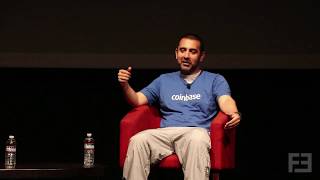
Balaji Srinivasan argues blockchain creates global economic opportunity by moving crypto from investment to utility. He describes Coinbase as the fiat-to-blockchain bridge, personal tokens as alternative financing, and "Earn" as a way to build blockchain-first social networks that pay users. He advises extending runway by relocating to cheaper countries.
What's up, everybody? How are we doing? Pretty good. We're doing good. Please give a round of applause. Welcome Biology. Welcome yourselves. So, but first we get started. Before we get started, there's a little bit of a congratulations in order. I don't know if you guys have been following Biology's May, May and early June, but it's been pretty significant. Not one, but two acquisitions, almost half a billion dollars in exits. And we sort of joke overnight success 10 years in the making. Council started, you know, almost 10 years ago or over 10 years ago. And earn which sold to sold to Coinbase. So now you're the CTO of Coinbase. Talk about what's Coinbase's mission right now and what's your focus within that broader mission?
Yeah, sure. So I think a great way to think about Coinbase is it's the interface, right? It's interface between the legacy banking system and kind of this blockchain future. And similar to actually like AOL in the early days in a way where, you know, it's interface between legacy phone lines and this Internet future. But we're talking about the interest in banking and crypto. We think of it as like, you know, the classical mullet business, you know, business in the front and party in the back. And what that means is we need to maintain good relationships with banks and regulators and politicians to maintain our fiat rails. And we also need to be on the cutting edge of crypto and blockchain to make sure we're abreast of that. And so there's a kind of duality to the business. And while I spend time on both sides, certainly my focus is more on the crypto side, making sure that that end of the business is working. One of our biggest focuses that we've talked about is trying to push crypto from the investment phase into the utility phase. So lots and lots of people have bought crypto and have made money on it, having it go up. But the next phase is now that millions of people around the world value this. You can actually use it as a payment rail. And that's actually kind of an important point.
Yeah. So 20 million Coinbase accounts. How many Coinbase accounts are there?
I think we stopped publishing the exact number. You need scientific notation.
How do we get orders of magnitude more people using crypto?
Right. So great question. So, you know, we want to go from where we are to like a billion users. Right. And how do we get a billion people onto the blockchain? Well, what's interesting about that is, you know, if you think about what Facebook did, they sent a billion people over about eight years. And if you just think about what the signup service would be required to do that, it's about four people every second for eight years, right? It's about, you know, 320,000 a day times, you know that per year over, over, over that period of time. And so simply, you know, a signup service taking four requests per second is actually a pretty high traffic web service. And if you now multiply that by, you know, all the other stuff you need to do on the site and all the stuff, all the traffic on the blockchain, that's going to be a very non trivial technical feat. What it also means is actually that even in three years from now, the vast majority of people in the world will, even if the growth rate is totally vertical, the vast majority of people world will still be being introduced to crypto. So a huge part of it is going to be education and onboarding and that's going to continue for the foreseeable future.
So with Earn, you were trying to do a few things, but one of those things was create a parallel economy where people can get paid. Two was create the infrastructure for the machine payable web. Talk about how partnering with Coinbase allows you to achieve your broader vision with what you're trying to do with earn.
Yeah, sure. So basically, you know, we think that there is room for a new generation of social networks which I call kind of blockchain first social networks. Critically, the idea is not to try to decentralize everything at once. I think going full blockchain in 2018 is hard to do. Instead, think of the blockchain as a second kind of back end service that provides your users with A balances and B private keys and thus the ability to encrypt messages and you know, sign contracts and all that type of stuff. And if you have that as an augmentation to an existing social network with its postgres database and ability to serve up images and what have you, you've got something quite powerful because you can go from a social network where people just poke and like and tweet at each other to something where they're actually earning money, right? They're completing tasks, they're applying to emails and getting paid and so on. And so that's kind of this next generation of social networks. And Earn was actually doing quite well with profitable business, making millions of dollars in revenue simply because lots of businesses want to pay to reach people. Right? Like, you know, people will definitely pay to get a reply to an email to get a survey completed, etc. With Coinbase's user base, you know, we have like many millions of users and the idea will be to put those two together so now we can have millions of people completing tasks and getting paid for earning cryptocurrency. The reason I think this is interesting is in the three to five year window, what we'd love to do is take all these people around the world who have smartphones and not just give them information, but give them income. They open the Earn app, they've got a list of tasks and those tasks are personalized to them. And if you can program, then you can get a JavaScript task, or if you're a lawyer, you get a legal task and so on. And just like the Twitter feed, you never run out of tasks that you can do and you can just earn money from anywhere. That's where we want to be in like five years.
Yep. And you gave a couple talks over the past couple years. One of them is called Silicon Valley's Ultimate Exit. The other was called the Network State, sort of building upon a few ideas. But one of them was this broader concept of there isn't enough exit in terms of where we live and governments and cities should be competing over the best talent so that they're offering better services so that we're having more experiments. Similar to Amazon had a lot of cities in the US competing over who gets Amazon's HQ or Special Economic Zones. Talked about in China. Talk about what you were trying to do achieve with those talks and what's the next iteration of that talk in 2018?
Yeah, good question. So the concept of competitive government is certainly not something that's novel to me or to anything like that. Insofar as there is a novel aspect to this. It's kind of thinking about, okay, how does new technology actually make competitive government possible? There's a few observations. One is that mobile is making us more mobile and law is a function of latitude and longitude. That is to say, your XY location determines the local and then the state and the federal overlays that apply to you and that constrain or incentivize your behavior. So if laws function of latitude and longitude and mobiles make us more mobile, it's becoming easier to change your latitude and longitude and thus easier to change the law under which you live. Right. That's like an interesting combination of two obvious observations that lead to a non obvious observation, which is the cost of changing your law, your governing law is decreasing rapidly because you can just Use a smartphone and you can call an Uber and get an Airbnb, and all your books are in the cloud and your music's in the cloud, and you're just more mobile as an individual. Your friends are in the cloud. That's an underappreciated aspect of social networks. The penalty for moving is less because many of your friends, you don't even actually know where they live anymore, but you're still friends with them on Facebook or on Snapchat or whatever. So that's kind of one aspect of it, is this increased mobility is increasing the ability for people to exit, and that's making a lot of the ideas around competitive government, they've been around for decades, newly relevant. I think the second aspect is the stuff you can do in place. So not necessarily physically moving, but I think there's three technologies that are going to be converging over the next 10 years or so, which are social networks, blockchain, and VR. So social networks with blockchain is what we just talked about, which are social networks that you can actually go and earn money in. Right? And I think that's the next five years. So earn is one variation on that. Steemit's another variation, and I think there's going to be others. And these will use a blockchain in different ways. Some will pay people for generating content, some will pay people for replies and completing tasks like we're doing. Some of them will pay people to. Or use more of the encryption features to be pseudonymous. The other leg of it is social networks plus VR. You're seeing some of that already with VRChat, right? Basically, VR communities that are kind of like MMORPGs, which have been around for 15 years, very immersive, except kind of addressing a different audience. And I think eventually all three of those technologies come together maybe in 10 years. I think five years would be the very earliest. And when you get social networks plus blockchain plus VR, that's what I call like a digital economy, right? And a digital economy is something where you can put on your next generation VR headset and you can actually work there, right? That's your morning compute, your morning commute is your morning compute, right? And you just boom, you go into this VR world and you're earning digital currency for doing digital work. And more and more work is already becoming digital. It's not just programmers and designers and so on, but legal work is all electronic, right? A lot of medical work is fundamentally about returning a diagnosis or returning instructions given inputs. Even things like Construction work are turning into instructions to drones and things like that. So more and more work will become digital. More and more people will go into these digital economies. And that's really amazing because that means you don't necessarily need a visa, you just need to be able to log in to that, you know, that, that digital economy. And so if you want a borderless world, that's where it gets to. Right? But I do believe that, you know, that login service, you know, you're not going to let in every single person into that login service. It's going to be, you know, if they're a bad actor, you will ban them or whatever, but it will be much more flexible. You'll have, quote, visas to thousands of these virtual countries, these digital economies, and that's what you'll be able to earn.
And let's say more about how identity is going to look like, because when we say pseudonymous, people automatically assume anonymous and assume that there's going to be no accountability. So talk about where's the balance there between freedom, between accountability and how's that going to work in these social networks?
Great question. So there's a huge difference between anonymous, pseudonymous and like full real name, right? And a full real name is like a global identifier. That's an identifier of identifiers. It links you across everything. You can plug it into a database and pull your Social Security information and your current address and tax stuff and employment history and all that type of stuff. So it's like a primary key in the database, but a pseudonym, whereas a completely anonymous identity has no metadata whatsoever, a pseudonym is intermediate, where you have some track record, you have some posting history, and with cryptocurrency, you might have some earning history or you might have a stake associated with it. So you could imagine, for example, a Twitter, like a v2 Twitter, or a crypto Twitter, where everybody had to stake like a dollar. And if you behave badly, someone wouldn't just be able to block you, but they could burn your dollar, right? And now that would be something that wouldn't necessarily benefit them and they wouldn't do it for just a random reason. But what it would mean is that people would actually be polite because their pseudonymous identities were tied to like a dollar. And there'd be a cost for actually going and just screaming at someone on.
The Internet, imagining YouTube comments.
Oh, my God. Yeah. So, like, the thing is, you know, this is not a completely unheard of concept. Vcontact in Russia actually charged like $1 for people to get signed up. And that was immensely useful in terms of just making people behave better. Right. Like a slight amount of skin in the game made people behave better.
Yeah. So we're at the Borderless Summit. I want to talk both on the Mac, how it affects macro trends, but also people's personal careers. And one of the things we talked about in the past is your ideas concept. Where in the past 10, 15 years someone like Y Combinator has said, move to San Francisco, start a company and raise venture. And now in a new world, in some ways, one of your thesis is you can live anywhere or move away. It's cheaper. You don't have to start a company, work remotely and save money. Preserve your Runway. Talk more about that thesis and what that means for entrepreneurs and operators.
Yeah. And so to be clear, I have a lot of respect for Y Combinator and PG and everything they've done, but in the same way that like, you know, your tech stack in 2005, you know, might have been Java based or whatever, and now it's not, it's going to be, you know, like something different. Right. In the same way, some of the things that were true then are no longer as true now. Right, Right. You don't need to come to Sand Hill anymore to raise capital. You can do it via ICOs. That's very new. You don't need to live in the United States to have a good standard of living. Many countries around the world, especially in Asia, have dramatically improved over the last 10, 20 years in terms of standard of living. And just as a show of hands, who here has rent as their number one expense? Okay, most of you are actually wrong. Tax is probably your actual number one expense, but rent is probably your number two. And it is much, much, much easier to chop your living expenses, your rent and your burn rate to 1/5 to 20% or 10% of what they currently are than to increase your net worth by 10x. Right. So moving overseas to a place like Kuala Lumpur or some inexpensive locale that still has fast Internet, there's companies like this Nomad List. There's a company that I founded, we found, we sold it a couple of years ago called Teleport, that are search engines for location which allow you to take your current lifestyle and find the location around the world that best suits you, which also reduces your cost of living. If you can do that, if you can move overseas and now cut your burn rate by 5x. I think the most important metric for an individual is your personal Runway, which is your savings divided by your Burn rate. Everybody thinks about the top line, but very, very few people think about the bottom line, which they actually have more control over. And now that we're in this era of remote work and mobile, and a lot of folks here are software engineers or designers or somebody who can work internationally. If you're just starting out, what I'd advise you to do is go get a job at Google or Facebook or Coinbase or what have you, have a good salary or what have you kick butt, at least for the first year, and then consider maybe turning down the promotion and. And instead asking, hey, you know, I've shown myself to be a responsible person. I've shown myself to kick butt. Let me move overseas so that I can keep the same salary, but I can bank, you know, 40, 50, 60% more per year. Right. Then in a couple of years, you've got years of personal Runway, because you've just cut your expenses so much that if you've got, you know, 30k a year expenditure and you've got 100,000 savings, you've got three years. So you don't need angel financing, you can just bootstrap the business yourself, own 100% of the equity. So I think that's a really interesting strategy that's newly possible in 2018 that hasn't been possible before.
Let's zoom out a bit more macro. How are governments viewing blockchain and crypto right now? How should they be viewing it? How's the US viewing it? How's China viewing it? And for you guys, as the forefront of bringing crypto to the world, how do you think about the role of government?
Yeah, so I think there's been a huge, frankly, positive shift over the last five years where there's not a day that goes by where some government official or bank or politician doesn't make some comment, pro or con, on blockchain technology. But if you zoom out for a second, what are Bill Gates and Warren Buffett and Jamie Dimon and Christine Lagarde and Ben Bernanke and all these people, what are they talking about? They're talking about blockchain. They're not talking about, I don't know, something else. They're not talking about disappearing photos or what have you. They're talking about blockchain. And so that means that this thing that started on an Internet forum, one pseudonymous person or group 10 years ago, has shaken the world with just the power of an idea and the power of the execution of that through software. And the world is moving in the direction of the blockchain if you zoom out and you look at, okay, what does the last five, ten years look like? Well, I mean, we've got something where heads of state in Malta and Bermuda are doing meetings with blockchain companies. We've got something where the head of the IMF has given a whole speech about how blockchain is like an important corrective to central banks and whatnot. And the reason I think that's interesting is, yes, there's pro and con comments, but for every con, there's a pro, right? For every Jamie Dimon, there's a Lloyd Blankfein who's saying positive things about blockchain. So that, at a high level, is very important, because if 100% of the world's governments and institutions and so on were aligned against blockchain, it'd be difficult. But it's not 100%. In fact, 50% are probably. And so long as everybody doesn't stop it, it's going to flourish in those regions, those areas, those institutions that do support it. And so I think it's going to break through.
But just for a second, there's some smart people, Warren Buffett, Bill Gates, recently thrown shade. What are they not? What are they not seeing or where are their points justified or how do.
You think about that? So, you know, obviously, super smart people. Buffett has said, for example, that he doesn't understand technology companies and that he was wrong on Amazon and so on. Right? Bill Gates, a different matter. But, you know, even Bill Gates, like, you know, Google was out there, right? You know, like there are things that they missed at Microsoft and super smart people, lots of respect for them. But, you know, it doesn't actually matter if they're critical because the blockchain just kind of keeps going. Right? You know, one thing I will mention in terms of government resistance, I feel actually pretty confident on this point now, because early last year, you know, China was, you know, or Chinese exchanges were most of the volume, most of the mining was in China. You know, people thought, well, if there was a huge crackdown by the Chinese government, blockchain would be in big trouble. That actually did happen, right? China took a pretty hard swing at the blockchain last year. Exchanges were shuttered. Mining was encouraged to move overseas. You know, a lot of people were seriously inconvenienced. But, you know, like Nietzsche said, it did not kill the blockchain, it made it stronger. Price went up like more than 10x for both Bitcoin and Ethereum. The entire ICO boom happened, right? And that was probably you know, certainly the government of the largest country by population in the world, and certainly one of the most technically sophisticated and frankly aggressive in terms of what they're willing to do in terms of Internet filtering and privacy monitoring and all that type of stuff. They took the hard swing of the blockchain sub 20x. Right. And so I think like that's kind of the trial run. I do think there's at least one thing that we have not yet encountered, which, which we may encounter at some point, which is partition tolerance. You know, you could imagine a great firewall actually starting to try to block packets, you know, at Port 8003, which is a bitcoin port, or other ports. And if you really start doing deep packet filtering, there's a predator prey kind of aspect to it. There's a possibility that mining extends a blockchain within China, but transactions are happening outside it, and then it'll be a peekaboo effect where you may not be able to see those transactions. There might be a partition. So I think partition tolerant blockchains are an important thing to research, to kind of guard against that. That's like kind of the last man to beat in terms of, of government challenges. But I actually feel pretty good about it because anything short of that, we've kind of already survived and we're going to do well.
Cool. So you're a history buff. Yeah, we talk about Chinese history, Russian history, French history. Which historical period do you think right now is most analogous to something we're thinking about right now as it relates to cryptos, relates to technology, as it relates to innovation?
Yeah, I think 1800's America in reverse. Say more about that. Okay, so I think of like 1950 as peak centralization. So you have one telephone company and you have two superpowers and you have three television stations. And then if you move forward and backwards in time, things get more decentralized. So if you move forwards in time from 1950, you get cable television, and then you get the Internet frontier opening in 1991. Basically commercial Internet traffic became legal then. If you move backwards in time almost exactly 100 years earlier, 1890 is when the frontier closed. And if you move forward 20 years from 1990, you get to 2010. The era we're in now where you have all of these wealthy folks who made money in the Internet era, all this radically fast innovation where you had bare field, bare service before, now you've got something move backwards in time from 1890, you get a similar era where you have Rockefeller and you have Carnegie and You have all these tycoons nowadays called robber barons, but at the time called captains of industry who built railroads and who built basically kind of the west in America. And you go a little bit further back and you get to the time of private banking. So Business Insider has this whole thing on the free banking era where banks would issue their own scrip and it's kind of similar to what we're in now. Right. And So I think 1800s America kind of moving backwards in time starts to be a good parallel for our current era where things get more and more decentralized. Then you get to 1700America, then things get interesting.
What can we learn from? I know you're fascinated by China by both its in some ways radical free market zones, but also sort of heavy state control. There's. Where are sort of the misconceptions about, about China that we have in the west and what can we learn from?
Yes. So I mean like you know, obviously China has its pros and cons, but I think, you know, the. So one of the biggest is the Chinese are actually much more innovative than people give them credit for, especially today. They've kind of ascended the value chain and they are just like Japan had certain areas that they became very internationally competitive in automobiles and consumer electronics and other kinds of stuff. China has chosen certain domains like drones with DGI and genomics with dgi. And actually in a weird way, blockchain Xi Jinping actually just made some positive comments on it. There's certainly a lot of Chinese leaders in this space space. Even if the Chinese government is kind of of two minds and quasi attacking it and certainly AI which they're all in on. And one thing that's really interesting is the asymmetric nature of it. Where Chinese entrepreneurs read TechCrunch, they're hyper aware of everything going on in the US and US entrepreneurs do not go and look@8btc.com and they don't read Chinese blogs and whatnot. So it's very asymmetric where this group is aware of all the ideas from here, but but not vice versa. I think you know, better translation stuff might change that. I think the blockchain is really interesting because for the first time I'm seeing a lot of seed stage interaction between Chinese capitalists and Chinese entrepreneurs and American and Western ones. And we'll see what happens.
Another idea you've been really fascinated by, a lot of people are fascinated by is tokens and tokens is set. A lot of people just confuse tokens and ICOs. It doesn't necessarily have to be for raising money, but just for incenting aligning incentives within a network. One sub idea you've talked about is personal tokens. Talk a little bit about that or any other ideas related to tokens that are really fascinating you right now.
Sure. So like, you know, if you take a company, right, you've got different ways to finance it. Two of those ways, certainly not all, but two of those ways are debt financing and equity financing. Debt financing, you take, you know, a loan and you take a loan of a million dollars and then you have to pay back 1.2 million or 1.3 million over a period of time. That works. If you're a cash flow business, you're generating cash. Conversely, equity financing, you don't take a loan, you sell a percentage of your capital structure your cap table and you don't have to pay it back in cash. Instead if you're bought, then the early investor gets some of those proceeds in the same way. Right now the way that people are funding a lot of their lives is with student loans and you know, 30 year mortgage, which are just two forms of debt financing. Right. What if we could bring equity style financing down to the level of the individual where you know, if you rather than taking on like a student loan at age 18, when people don't know what's really what their future is, instead, you know, based on their SATs and their GPA and all the other stuff they'd submit to college, you can imagine people would issue a perfect personal token and then buyers of that personal token would sort of bet that this person will achieve things in their life and they'll get a return on that. There's various ways to accomplish that. For example, if you sell a personal token and you sell 20% of it, then you commit to having 20% of your equity of any company that you go in put into this pool and then it's returned back to the folks who backed you initially. Various ways to structure it. The tricky part is of course going to be how do you make sure that that person actually pays their money into that crypto account and doesn't renege on it. But there's probably reputational services that could take that into account. And the cool thing about this is you wouldn't have a lifetime of debt when you get out of college and you're a young person. Instead you'd have a different way to finance your life. There's selfipo.com is like you're the one who sent that link. We've been Talking about this for a while. So it's kind of our first cut at the concept.
Totally. So let's summarize. How does blockchain best enable global equality for people out there in India or wherever listening, how should they be thinking about it as a way to directly improve their life? And on a macro sense, although like all technology, we're aligned that it's overall net positive. What are some of the trade offs that we make in this process and how can we correct against them a little bit?
How should we be thinking about that? Sure. I think what blockchain means is what technology means. It means more upside and more downside. Right. Cryptocurrency, it's like the Unix of money. You can move millions of dollars with a keystroke or you can room dash RF your entire fortune. I think on balance it's going to be positive because what we'll do is all those failure modes, we can usually use technology to fix those. For example, you can have backup keys or multisig, so you can't just delete all your own keys, but someone else could help you restore them. So I think on balance it's going to be positive, but in the short term it's going to be more upside, more downside.
And I think what people often don't realize how important hyper liquidity is and what that means. Can you share more about the benefits of really liquidity, liquid markets?
Yeah, sure. So. Well, I mean, if you compare like American versus European options in traditional financial markets, the difference between the two is due to the fact that one of them, you can exit at any time over the time to maturity, whereas the other one, you have to wait until the end to exit. And the fact that you can get out of the position somewhere in between versus at the end that you have, that liquidity does itself have a premium, have a value that you can assign to it. So there is a liquidity premium. And anything that can be tokenized eventually will be simply because of that liquidity premium. The ability to, you know, sell your position or get back in within, you know, like months or a year rather than 10 years is a very big deal. Now obviously that has to be done in a way that's compliant with local regulations and what have you. But there will be at least some governments that adopt that kind of mentality and those are the ones that are going to attract the next Wall street based on the blockchain.
Awesome. Well, that's all our time for today. Please give a round of applause for Balaji and thank you for coming over. Just real quick. I'm Erictoy Hornberg and VillageGlobal PC Balaji. Where can people find you online and what's upcoming for you and Coinbase?
Sure, yeah. I mean Twitter. Com Balaji S. I don't post in there too much. But also blog Coinbase.
Com. Awesome. Another round of applause. Thank you. Thank you, sir.
More from Balaji



34 - Network State Conference 2025 - Fireside with Vitalik and Balaji on Zuzalu and d/acc

33 - Network State Conference 2025 - Fireside with Amjad Masad of Replit and Balaji





06 - Network State Conference 2024 - Fireside with Naval Ravikant and Balaji Srinivasan