The FDA Has Blood on its Hands? | Balaji Srinivasan | TRUTH Podcast #59
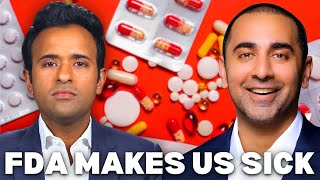
A long-form interview (TRUTH Podcast #59) between Vic and Balaji Srinivasan (recorded Aug 2024). Balaji outlines his background (Stanford degrees in EE and chemical engineering; computational genomics; founded a clinical genomics company sold for $375M; early biotech and crypto investor; a16z partner; CTO of Coinbase; author and online educator). He was offered the FDA deputy commissioner role in late 2016 but declined. The conversation centers on deep critique of the FDA and the wider regulatory/administrative state: claims that regulation (illustrated by "Eroom's law") has massively increased drug-development costs (thousand-fold), that FDA culture prioritizes avoiding blame (e.g., Thalidomide legacy) producing false-negative bias (blocking beneficial drugs) and that advisory committees can be wielded to justify pre-decided outcomes. They discuss the MDMA-based PTSD therapy rejection (FDA cited functional unblinding due to euphoria), "right-to-try" laws and exit routes (LDTs, off-label prescribing, medical tourism), harmonization (export of US rules globally), and broader strategy for weakening regulatory power via competing jurisdictions, social media, crypto, and incremental "island-hopping" reforms. The episode also touches on political strategy (inside vs outside approaches), culture of bureaucracies, and examples like ACT UP/HIV activism and Dallas Buyers Club. Balaji states he is 44. The tone is critical, reformist, and strategic.
Questions this video answers
Late 2016 (call from Teal in December 2016)
All right, I'm been looking forward to this conversation for a while. This is a conversation with a guy who I first heard of when he was rumored to be in the running for head of the FDA under Trump in his first term, which caught my attention because I was in biotech back then. And the more I got to know about him, the more I realized that, you know, we had some similarities in our. Not only our backgrounds, but our paths and some of our interests, even if we have different views at times. Balaji Srinivasan. Welcome to the podcast, man.
Good to be here, Vic. So I think this will be the.
Longest, certainly the longest conversation we've had. We've only started really speaking, even over the course of the last year or year and a half. But I've known about you indirectly through folks in Silicon Valley, all of whom point to you as some type of Oracle figure, which got me intrigued by you. But tell me what got you, you know, potentially at least, whether you were considering it or not, I don't know, although I'd be interested. Were you actually considering being head of the fda, but what got you to the point of even being in the running to be head of the FDA and more generally? Maybe a little bit of background for the listeners who may not be as familiar with your background as most of Silicon Valley is.
Sure. So, you know, first I want to say game. Recognized game. I. I think there's a lot of mutual respect between us. I actually think we have very similar backgrounds. I think both, you know, born to Indian immigrant parents who, you know, believe in the American dream. You know, I went to the West Coast. I think you went to school on the East Coast. Also actually had a biotech background. Very briefly. I got my B.S. Ms. Ph.D. at Stanford in electrical engineering, Ms. in chemical engineering. Then I taught computer science and stats there for a few years. In with a specialty in like computational genomics and bioinformatics, founded a genomics company like genome sequencing, like clinical genomics. Teal actually was an investor through Founders Fund. And so that's how I got to know them. That was later sold for 375 million. I became an angel investor, early investor in a lot of biotech, but also crypto and other software stuff. Also even actually government innovation, open Gov. I'm not sure if you know that that was recently sold for a few billion dollars. Became a partner at Anderson Horowitz, largest VC firm in the world. Then CTO of Coinbase, largest American crypto exchange. And then recently, I didn't know you.
Were the CTO of Coinbase.
Oh yeah. Oh wow. I was CTO of Coinbase. Interesting. So did a few things and then most recently best selling author and Twitter personality. And so very similar career track to you actually in many ways. Also finance, biotech, authoring, social media and in a sense politics. But, but you know, from the same Indian immigrant background, but parallel paths with you. I think more, slightly more of an east coast institutionalist path and me maybe more of a west coast path but with a lot of similarities. Yeah.
Cool. And your, your parents, what did they do when they came to this country? Actually it was interesting to physicians, both of them.
Yeah. Cool. So anyway, my, my father grew up in a very poor village and so on and so forth and so came out to the US for opportunities. So that was a big part of it.
We, we definitely share that in, in common. My father was in a, from a rural village in Kerala, southern India. Probably not far from where your father came from.
Not far from mine, judging from your last name. Yes, yes. So we're from Tamil Nadu, but basically, you know, nearby. Yeah. So were you considering actually becoming the.
Head of the fda?
So the FDA thing. Right.
Was that actually a serious thing?
So, so context of that was. So I had that biotech background. Right. But I'd also actually written a bunch of lectures. I taught a class in 2013 actually here, I'll put up the URL. And there was some good stuff in it. Basically it was a course. Part of it was a bitcoin crowdfunding site and that was actually relatively early in cryptocurrency. That was 2013, when Bitcoin is in single digits. But another huge part of it was about the regulatory state because even back, even back then. So you know, I, I, I taught this with my friend Vijay Pandey who later became the head of A six and Z Bio. I, I, I recruited him there and that's like a multi billion dollar thing that invests in a lot of biotech stuff. And so we had an interest in basically educating people from around the world for free. And one of the things that I learned in my time in biotech and you also, I'm sure learned this is the degree to which the regulatory state holds back innovation. And, and that understates it. Right. We're talking about thousand x, you know, ratios in terms of cost, in terms of the quality of healthc care people could get. People don't understand the scale of it. Right. I can show graphs like this thing called Arum's Law that you might be familiar with. Do, do you know what that is? Have you heard that term rooms? Oh, okay, so a Room's law is this amazing graph which shows that basically.
Oh, it's like the backward of, it's the backwards of Moore's Law.
Yeah, that's right.
E rooms. The. Okay, yeah, right, right.
That's right. And it, and it shows that despite all the technological progress we've had in computers, some force has been not just holding it back, but reversing it in, in drug development, which is part of the reason that drugs have gotten so expensive. Eram's law is Moore's Law spelled backwards. If you go and search that, you'll see that the cost of drug development has actually increased by multiple version magnitude, like more than a thousand X since the advent of the fda.
Sure.
Which is part of the reason that everything is so expensive. That's just one very quantifiable metric. But lots of other things in healthcare have just risen through the roof at the same time. You know, the cost of all the information has dropped through the floor. Something is broken there. And I, and I can, you know, again, tell the details, but net. Net is. I wrote a series of lectures at the Stanford course at 250,000 students. And it was online and a bunch of venture capitalists saw it and like Keith Roy saw it and you know, at Founders Fund and other, other folks are mutual friends of ours and I, and I think, you know, other folks at Founders Fund, including Teal, saw it. And so basically all of that, plus the fact that I actually built a biotech company was what led to the whole FDA thing in late 2016. And the thing is, I was at the time turning around crypto company and, and you know, I had a loyalty to my investors and, and people there. I eventually successfully turned around, sold Coinbase. And so the call from Teal came in late 2016, like December 2016. And so, you know, net Net without, you know, I don't want to like, quote, kiss and tell or whatever.
Yeah, whatever.
But yeah, net. Net, you know, I, I could have been number two at fda. I was offered deputy commissioner, but I ultimately decided not to do that and for a variety of reasons. But I think that gets back to, you know, you and I have a lot of similarities, but I think I'm on the margins. I'm more Mr. Outside and you're more Mr. Inside, which is fine. They're complementary strategies. Right. You kind of need both. Like, you know, for example, Google couldn't have reformed Microsoft by, you know, having Sergey and Larry join Microsoft at the beginning. But by building something amazing on the outside, they sort of forced Microsoft to reform. Yeah, right.
Well, and even, even in the national sense, I mean, you're, you're talking to me from Singapore.
Right?
And I think you're very.
That's right.
I'm very much a pro nation person and you're more of a post nation person. Which will, which will, which we should talk about that.
Yes, absolutely.
You know, which will actually come back to just. And the FDA piece of this, because this is actually related. There's just a couple of things going on in the news that are actually relevant to things that you and I are talking about right now. There was a recent FDA rejection of a therapy that had achieved on its own self described terms, two successful phase three studies, an MDMA based therapy for a condition known as of course ptsd. You'll be familiar with Post Traumatic Stress disorder. And they went through and they designed the phase three trials exactly as it appears. The FDA told them to design the trials, but it came before and it relates to exactly the rise of bureaucracy. One of these things that's called an advisory committee. The FDA frequently holds these advisory committees where they have experts that supposedly opine on the data and tell them, you know, what they should or shouldn't do. The FDA is not bound by the recommendations, usually follows them, sometimes doesn't. Interesting as well. Now, in my experience, and I've seen the industry evolve for a long time, I was a biotech investor, as you know, I built companies in the industry. What the FDA actually does is they'll often just use these advisory committees as a cover for what they otherwise want to do.
What they actually want to do.
Yeah, they actually want to do. And the whole thing is, the whole thing is stacked from the beginning. So I'm not, I did not. I'm a big believer in being driven by hard facts. I have sat in the Hilton Hotel, in places like Maryland, in the middle of nowhere, outside of Washington D.C. for eight hour versions of these. I'd be sitting in the front row of these advisory committees taking detailed notes. I mean, that was the level in which I was immersed in this industry. And so I did not do that, admittedly for this most recent advisory committee. But it smells a lot like a situation where the FDA served up what they call their briefing document to the advisory committee, which the advisory committee then opines on. Think of themselves as a bunch of experts who are actually just being wielded as pawns by the fda. I've seen that happen before and it smells Like a situation where that might have happened here, where the advisory committee then recommended against the approval of this drug, which is exactly what the FDA came around to do. I view that as a bit of a travesty for a number of reasons. First of all, there's patients suffering from PTSD with very few options. But the basis for denying this approval was particularly fascinating biology. And you'll be at a level where you can easily follow this. So they say the trial was functionally unblinded. So usually the way you're supposed to do this is you have placebo, you have the drug, patients don't know which one you're getting, so that the therapeutic effect is actually a real effect rather than a placebo effect, where the patient believes they're getting the drug, but they're not actually getting the drug, they're getting placebo. If they're blinded, the patient doesn't know which one. And then you look at the trial, the end of the trial, what they call the end point, that's the time at which the final measures are taken and see how the drug could perform relative to placebo. The FDA claimed here that actually the patients knew whether they were on drug or placebo, but not because the trial was misconducted, but because certain of the patients experienced euphoria, which is a side effect, so called side effect at least of MDMA based therapy. And therefore patients would know whether they were on drug or placebo and therefore could have a placebo effect that could have driven their treatment of ptsd. And completely ignoring the possibility that the euphoria was part of the very mechanistic behavior of the drug that might have had an impact on actually treating PTSD itself, which is part of the hypothesis.
In the first place of using an.
MDMA based therapy for the treatment of ptsd. And worst of all, the FDA would have predicted this. Anybody knowledgeable at the FDA around the development of this program would have known that was going to be a side effect of an MDMA based therapy for PTSD before they agreed on a phase three protocol that, to your point on Eroom's law, added tens if not hundreds of millions of dollars in development costs to a program like this one. And yet all the public reads, I read the articles on this, even the so called scientific press, which at least in the world of biotech is a joke, actually just reports this saying that there were certain trial irregularities because it's just a functional. It was an unblinding issue. So it's not an issue relating to costs and benefits of the therapy. But it's just that the trial might have been unblinded along the way, as though there was somebody who was actually peeking behind the veil and telling patients whether they were on drug or placebo. That's what the public is left with without knowing that this alleged unblinding was a functional unblinding relating to the actual therapeutic properties of the investigational drug, which the FDA knew about and signed off on before they got cold feet and probably served up to an advisory committee a bunch of briefing documents that got that committee to be the ones that said, hey, it's just the experts that told us we shouldn't approve this, therefore we're not a lot of detail there. But it does lift the curtain on how this bureaucratic machine operates. That's also just a really long way of saying, dude, I'm pretty pissed at you for not taking that job as deputy commissioner. Okay? Because we need people who are willing to cut through, through that otherwise smoke of bureaucratic techno talk, which is actually just a normative agenda often masquerading in the guise of technocracy and scientific expertise. And I just think this, I think it was Lyco's therapeutic. I have no, no connection to that company, no vested interest in it. Actually, I think that if J and J, by the way, which got esketamine approved for depression, the ketamine derivative for ketamine. Really? Ketamine, period. Basically, Eskimony is just a. Just one of the enantiomers of ketamine. They got it approved for depression on far thinner data than I believe this company had for its MDMA based therapy for ptsd. If this had been J and J, likely the same sponsor, playing the managerial game the way that larger pharma companies do, I have high degree of confidence that this would be an approved drug right now, but it's not. But anyway, a little bit of a rant on the news of the week and I just shared the details because I know you weren't necessarily following this particular case, but I thought it's an interesting validation, as you see on an almost monthly basis with the FDA of this unelected bureaucracy impeding innovation and really foisting cost onto a health care system that actually could use a step in the other direction rather than in the direction that drives up more health costs.
First of all, I love this and we should probably do, like, how much time you got? We should do a biotech podcast or something at some point because I actually feel we could kind of, okay, knock the ball Back and forth for hours and hours. But let me, let me give quick version.
And the public deserves to know it.
Absolutely.
Because it's not just technical mumbo jumbo, Tuck. It's. It's in the details that you actually see how corrupt the system really is.
Absolutely. And I actually think with, you know, if we, I don't know if we prepared and we did 20 hours on this and went through a bunch of issues with you, your knowledge on the therapeutic side and maybe mine on the other side, but let me, let me give my quick reactions on this specific. Right. Okay. So there's kind of like three sort of separate prongs there. Okay. There's like FDA's behavior itself and just what it is as an organization. There's how we should test drugs in the abstract if FDA didn't exist. And then there's also like, what the, you know, whether I should have taken the thing in 2016 and, and what have you. Right. Let me deal with these in a, you know, just different order. Right. So, you know, have you ever had, you know, the scenario of you've got a jar of peanut butter and you unscrewed a bit, but you can't fully open it, but you hand it to someone else and you loosened it for them, you know, and it's like a relay race or what have you, or vice versa. Okay. Yeah. Okay. So I think, you know, or for example, In World War II, like the, you know, Americans versus Japanese, there's an island hopping campaign where they took certain islands in a particular sequence and they couldn't have just gone straight to the home islands, they had to do them in a certain order in the same way. I don't believe that a frontal assault on FDA in 2016 would have been feasible. I think the entire country and world had to go through the last eight years. And what happened over that time? Well, first there was the true build out of social media and then Elon taking over X, which actually gave a media that's upstream of FDA and actually can do investigations into fda, which is completely new. That's within the last two years and it's still having its consequences being felt. Number two is, I think you had to have many people in technology and finance both make billions of dollars in regulated spaces, specifically Uber, Airbnb, Crypto, Fintech. Right. And to some extent biotech. And then also see many more billions of dollars thwarted and destroyed by arbitrary acts of regulators which gave a financial interest both upside and downside for really paying attention to the details of regulation. Whereas before 2010, it was really taboo to even question whether a regulator could be bad. Right. Third, you had to see, I think, you know, I almost. I gave a talk 10 years ago where I identified the Island Helping campaign. In fact, and I think it started with local digital. For example, Google going after Google News and various establishment strongholds getting disrupted. Local digital. Then you have local physical, which is Uber versus taxi regulations. Airbnb versus hotel regulations is going after physical things. Taxis, hotels, but they're locally regulated. Then you have, you have federal digital, which is crypto, Bitcoin versus the sec. And that's an ongoing battle now. And then after that is won and we're on the cusp of winning that, hopefully, knock on wood, in some ways, we have won parts of it where Bitcoin ETF has been approved. Eth ETF has been approved. Even Kamala Harris is signaling Harris for crypto, even though that's a lie. That is the. Gosh, there's a saying, the tribute that vice pays to virtue, Right?
Yep, exactly.
That shows that at least they have to give lip service to it. In the same way the Democratic People's Republic of North Korea has to pretend it's democratic. Right, Understood. Okay, Right. And so then it's a mark, it's a marker of.
At least it's a milestone.
It's a milestone. At least it's a milestone. At least they need to fake it. You know, they know that they can't declare anti crypto army because that's a vote and money loser for them. Okay, so so then the next level, and we're also fighting that, by the way, on social media. So the federal digital is versus the AI ban. It's on the social media bans. These are new regulatory agencies are trying to stand up. Right. And the final frontier is federal physical. And I think actually drugs will come first, and then energy and transportation are the very hardest and they're last. And the reason for that is drugs can be, you know, food drugs, biotech, that can be reduced to individual my body, my choice type arguments. Right. Whereas the energy and transportation, if it blows up, then it affects people in an area. So you need to.
Actually, let's just start with the my drugs, my body, my choice. Right?
Yeah, sure.
In some ways, this, this externality effect or the effects on other people is a confounding variable that they use as a smokescreen to identify something that obviously they were doing anyway. Because the my body, my choice is.
It's very selectively applied. My body, my choice is. Go ahead.
It's first order. Right? So that's an easy, easy place to smoke out what I think is going on here. It's a kind of.
So here's.
Here's what, here's. Let's just use the FD as a case study example. It wasn't exactly what I was planning to go deep with you on today, but it doesn't matter. We can talk again another time and go deep on this today. So I think people miss this who are share our antipathy towards the administrative state, miss the culture of that administrative state at the fda. The people at the FDA do not believe they are there to exert surreptitious harm on the everyday citizen. In fact, it's the opposite of that. They believe that they are there to care for everyday citizens in ways that people could not be trusted to on their own. It is a form of the nanny state. And in part we get into these discussions about the nanny state. We're usually talking about the entitlement state, the LBJ post LBJ Great Society, the welfare state, payments to individuals for welfare and Medicare. That's what people usually think about when they mean the nanny state. And that is certainly an important nanny state that I believe needs to be, over the long run dismantled in the United States States. But the regulatory state is actually a subset of the nanny state as well, designed to limit the choices that individuals are able to make, not for even the benefit of the government or the governmental actors who implement it, but for the supposed benefit of the very people who are being limited in the choices that they're able to make.
Right.
That's, I think, the conceit at the heart of the regulatory state. And so, you know, you laid out a path and I think what I call a series of elegant excuses which may be grounded in truth of why we couldn't have begun.
I've got more. I've got more.
But get to the full frontal assault. Okay. You laid the groundwork and the reasons why we haven't done it so far, but how do we actually dismantle this beast?
Excellent.
And where are we in the island hopping?
Excellent question. So I do believe in 2024 it is now feasible to do it. Okay. And so thank you.
That's the part I want to get to.
Yes. How do we do it? Right. So the most important thing I think is, you know, Ron Paul wrote a book and the Fed, and I love Ron Paul and that's a great book, but it wasn't feasible to just end the Fed. You also needed to invent bitcoin because you needed to have an alternative that was a technologically, socially, you know, know, incentive aligned, better alternative that got enough people to its banner under many circumstances to actually fight and replace the existing system. And I think that is the big thing that the technologist worldview, the founder worldview has that the conservative worldview usually doesn't, which is you actually have to somehow build the alternative and then replace the existing system. And for example, as hard as that is even for a government agency, Elon built SpaceX and he's essentially replaced NASA. Right. And yeah, so to your point, and then let me get to the strategy on it, the one of the things I talked about in this lecture from 10 years ago is FDA. And you know, they, they omit the, the. Right, they don't call themselves the fda, they call themselves fda. Right, yeah, fda.
It's actually one of these like obnoxious ticks, even conceits and ticks.
Yeah, it's just, just, it's, it's funny, it just tells me, you know, the.
Inside baseball of this.
Right, right, right, exactly. That's right. So FDA and SEC and FAA, they're set up for a very 20th century environment where as you say, their whole conceit is they're protecting you from yourself. So FDA is set up to go and regulate Pfizer and Mark, and SEC is set up to regulate Goldman and Morgan and FAA is set up to regulate Boeing and Airbus. But what FDA is not set up to do is regulate a million biohackers or all taking their own health into their own hands. Right, right. And SEC is not set up to go after a million crypto holders who all want to take their own risks. And FAA is not set up to go after a million drone hobbyists. Right. So those assertions of individual liberties which the Internet has enabled in all three of those cases. Right. And others I could name are what put the lie to the idea that the regulator is protecting you. They're just protecting you from your own benefit. Right? Yeah. And because they prove the existence of.
What an alternative looks like.
Exactly. That's right. And so we can see what the SEC is protecting. Protecting you from getting wealthy. We will now soon see the FDA is protecting you from getting healthy.
I actually like that framing quite a bit.
Okay, so they're protecting it.
I mean, I mean even, even when I think about that, that particular example of the SEC is protecting you from getting wealthy. It's just a very specific case when I started roivent. So this is the biopharmaceutical firm I founded back in 2014. I first started, as many people do, with the friends and family round. I did not go. It's funny, your framing of the inside versus outside. I think that actually comes full circle several times around.
Sure.
I think we're starting the biotech company. The actual normal way to go is actually just this series, fill in the blank. A, B, C Venture capital treadmill, which actually views very much the inside. I took what I thought was an outside path to building a biotech company.
But we're both in the grand scheme framings.
Yeah, I was just kidding around. Yeah. But I think, I think, but I think it's interesting on this. I started with the friends and family round, a bunch of people who had gone to college. I'd worked at hedge fund. I wasn't born into any kind of wealth but had achieved enough money to put my own money into the company, put millions of my own into the seed round, and had many other friends who by the time they were seven or so years, by that point, 2014. Yes. Seven or so years out of college, a good number of them had achieved financial success and were able to invest, you know, in the company as well. One of my friends who was one of my roommates for two years really wanted to do it. He didn't know the first thing about biotech, but he knew about me. And he said, okay, if you're starting this company and you're going in on it, I want to put for him. He wanted to put, I think something on the order of $100,000 into it. But he wasn't a lot of money for him.
He wasn't a credit investor.
That's the thing. That's the thing. So the credit investor laws out on.
Regulation 50X, something like that. Oh, yeah.
I mean, I mean he would be millions of dollars, millions of dollars. His hundred thousand dollars would be today, you know, I have to do the math. But like multiple millions of dollars.
But he could have legally gone and put all that into. He could have put that into lotto tickets and he could have put that into Vegas.
Yeah, he could.
Exactly right.
This is the ultimate irony is he wanted to bet on a friend who he knew and he had a better investment thesis than any other hedge fund that later came in to future rounds had. Right. They didn't know me. And the number one predictor factor of the success of a business in an early stage, I believe at least is going to be the entrepreneur who's behind it. And he had what in the investment world you'd call investment Alpha. He had a unique insight that if you want to frame it in the terms of technical, professional investing, he had exactly the thing that every investment firm aspires to, a deep understanding of what that business was or wasn't going to do in a way that was uncorrelated with the market. And yet he wasn't allowed to act on his own unique alpha and insight lost out. The SEC and the relevant regulations in the securities laws protected him from getting wealthy. And I do think that that is the ultimate case against the administrative state is that not that they're hurting the people who they are trying to regulate, but they're hurting the very people who they allegedly care to protect in the process. Oh yeah, and, and that's exactly what we see with the FDA as well. I mean, look at how many patients are suffering with PTSD that aren't going to have access to a therapy that they want access to. That a company in this particular case, I think it's debatable whether they should have to go through this type of elaborate multi phase three testing. Say what you will, you have to get two phase three studies approved, not because the statute says so, but because the FDA says so, which is bizarre. Adds about 30% extra to the cost of the development of any drug. But this company jumped through both those hoops and the FDA decides at the end that patients who want it and the company is willing to sell it, that's gone through the hoops that the FDA identified, still isn't able to sell that to patients. They're, as you put it, you know, now, now protecting people from becoming healthy.
Well, so it actually goes very deep. And one of the biggest things is, I think at this stage in the life cycle of this whole bureaucracy and this regime, I think it's a mistake to say that they mean to do well, they mean to do well for themselves. And what I mean by that is not financially, because money is not everybody's incentive. Somebody who is senior at FDA cares about power much more than money. And what I mean by that is, for example, somebody who's an academic and they give up a career in, you know, industry, they care about status, right, More than money. So money is not the only axis along which people can sacrifice. Some people want status, some people want power. And there's this great book by Daniel Carpenter called Reputation and Power. Have you, have you read it or heard of it?
No.
Okay. Worth reading. And the reason for it is Carpenter is a basically a pro regulatory state liberal, but to his credit, he includes enough Unexpurgated quotes from the executives that he interviews that you can sort of get the real story through the quotes. Okay. It's a little bit like, you know, imagine like a. In the Vietnam War when hostages were being interviewed on, on TV and they would blink like, I'm being captured like that. And you could decode it through the Morse code. Right. You can see from the quotes that Carpenter has. Like he talks to Earl Raab, who is the CEO of Genentech, and Earl Raab says, you know, the FDA owns you body and soul. They will, they own the entire industry. When they told me to fire an executive, I fired the executive. They basically are the number one gatekeeper. Once you realize this and you hear from the executives what it actually is to operate under fda, then you realize, oh, like the entire pharmaceutical industry was basically gelded for like 70 years. And what isn't like that is tech. What isn't like that is finance. And so our DNA kind of coming back in is a completely new species that they haven't seen in literally generations, which is like sort of the headstrong, self confident executive.
Right.
So I want to, I want to actually, the MDMA thing actually has like three really interesting branch points to go through. I just want to kind of touch on each of them. There's at least three areas we can touch on, which are the fda, just what drug approval should be, and the regulatory state. Right. So first, let's talk about the ideal world where FDA doesn't exist. Okay. So we have a new jurisdiction, whether it's on Mars or it's in a new network state, like a new country we founded or something like that. Okay. I think the first thing is to go back into history and learn about Banting and Best. Okay. And you may have heard of them, Banting and Best. They came up with the idea for insulin in like, I think it's 1921. And then they tested it on dogs and then on themselves and then on willing patients by 1922. And then they had scale production for the entire North American continent and the Nobel Prize by 1923. Okay. So that was like a time when pharma moved at the speed of software. You can check my dates on that, but that's very close, I think. Right. I can. Let me actually double check that because I. No, no, no, no.
Yeah, we'll leave it to people to do with the caveat. I love your precision, man.
Fine. I'm pretty sure that's right. But you know, people can double check. The point is that they were not doing the phase 1, 2, 3, 4, you know, that whole rigmarole is treated as if it was S and P orbitals. I know it's a technical reference, but that's, you know, from chemistry. Right. Like the phase 1, 2, 3 and 4 are treated as if they're like fundamentally man made.
It's not nature made.
Exactly, that's right. These are not fundamental constants of nature. They are bureaucratic hurdles imposed by man and they should only be there if their benefits exceed their costs. But the thing is, if you go back to how all of these drugs, like you know, that banting and best types developed, all the grandfathered drugs that FDA included as a list is a bunch of drugs. If you go back a lot of small molecules that FDA basically said, okay, they're fine because they were in wide use before the, you know, the, the Pure Food and Drugs act or the various acts that powered up fda. There's a bunch of grandfather drugs before that point. They were not tested with double blind placebo controlled trials. They were tested iteratively. And the reason I want to emphasize this is fda. Today's FDA minimizes side effect size. It does not maximize effect size. And that's a huge difference because minimizing side effect size, even if that's even true, by the way, because it sometimes pushes it into something where you've got really terrible drugs in other ways. What they are scared of is, you know, their incentive structure is basically threefold.
First they don't get hauled in front of Congress.
Exactly. That's right. So first of all you can be blamed their entire industry culture or the entire agency culture is shaped by thalidomide. And, and the number one thing you can be is which for people's benefit.
Is this is a drug that was previously approved, that had, was associated with birth defects, was later removed from the market. But Europe actually was much later to the punch than the United States. And the fact that the FDA stopped us harm relative to what had been seen in Europe is this classic example that every time somebody brings up a debate about the fda, the first thing you're going to hear is thalidomide. And some guy is going to get up on a high horse and talk about that for about two hours and bore you to.
Exactly. Now here's the thing. When you actually dig into the details, Kelsey actually was just holding back all drugs and she suspected thalidomide of having neurological issues, not teratological issues. Yeah, exactly. Okay. So it was just something where it's like, if you think about it as a binary classifier, it was very happenstance, actually.
I'm glad you know the history of this. It was. Is this sort of example that they happen to be quote, unquote, right for the wrong reasons Anyway?
Yes.
If you dig into it, should not give you any confidence about the FDA's ability to actually put predict what is or isn't going to be wrong in the first place. It's what Hayek called the fatal conceit.
That's right.
And I think that the FDA suffers from it.
Now, here's the thing. In tech, we actually have a analytical framework that you're also probably familiar with the false positive and false negative rates, right?
Yeah, of course.
I mean, this is. Yeah, okay. And so if you think of a regulator as a, quote, binary classifier, and this might be a little bit technical for people in the audience, but let me explain. Let's say you have a bunch of widgets coming on an assembly line, okay. And you test them. You want to see which of those widgets are good. Okay. Which are bad. But your test might itself be off. And so you might say that something is bad when it's good or good when it's bad. So all four possibilities are there. It's good, and your test says it's good. It's good. Your test says it's bad. It's bad, and your test is good and it's bad. And your test says it's bad. The problem is the FDA is not benchmarked on its true positive, true negative, false positive, and false negative rates. It needs to actually be externally benchmarked on that. And how do you do that? Go ahead. This is related to the problem of go ahead, go.
The most interesting thing about your observation there is actually your point about the incentive structures is that they are heavily incented to protect themselves against being exposed for a case where a drug has an unintended side effect that they didn't spot because they don't participate in the upside of a positive drug that has a massive effect. But they occasionally face the personal, often very personal downside of approving a drug that had an unintended side effect. That's what their incentive structure is. But actually, just to that point, I think it's a great point you made. And I think your point about the false positives and false negatives and where the incentives lie bolsters that. Actually, in the few instances, though, where a company has taken it into its hand to publicly make sure that they create the same risk structure for those FDA officials being hauled in front of Congress for why they didn't approve a drug, that patients were dying from a disease or suffering from a disease that otherwise wasn't being treated, cured, or addressed. They then respond to that incentive structure in the other direction.
Exactly.
Because it was the incentive structure of the bureaucracy all along. Not some type of fixed point philosophy that was the right way for deciding whether or not drugs made it to market.
That's exactly right. And that's like ACT up, for example, in the late 80s. Right. Because. Because that was actually something that pointed in the opposite direction for the history for people who don't know about this. Essentially, HIV AIDS was then sweeping the gay community. And there's actually a movie that's been made on this called Dallas Buyers Club, which I recommend people watch. It's pretty good movie. It's a pretty good movie. It's actually an extreme in an era.
Of not very good movies. It's a pretty good movie.
Yeah, yeah. It's. It's. It's like. It's not a date movie. I would, I would.
Probably not.
Yeah, probably not. Not, not. You know, but it's. It's a good. Depends on your date. You know, it depends on your date. Like, it's a. You know, it'd be a good sign.
If it were a good date movie for you.
For your. It depends. Yes. So it depends on the kind of date. That's true. But let's just say, though, it's a very informative and educational movie and it's actually as a meta. Meta point. It's unusual because one of very few examples in Hollywood where you have a regulator or a bureaucrat or an NGO or a journalist, who's the bad guy? I can count on, like, one hand, right? Like Ghostbusters. Usually.
They're the heroes. Oh, my gosh. I mean, what was the obnoxious movie most recently? The Civil War movie. I actually went in to watch. Oh, God.
Oh, my God. Yeah, yeah.
Oh, my God.
It was an old golden.
Watch this.
I did watch it. Go, give me your thoughts. I'll give you my thoughts. Go.
Oh, we just walked into. We went to a movie theater. And I rarely do this. I rarely go to movie theater. But having gone into the movie theater, we walked out about 20 minutes in because it didn't get into the underlying content of it all. It was just like a glorified lionization of the journalists as the person who's actually going to save the country, when in fact the journalists at issue are nothing more than a artificially de. I's you know, deified version of a New York Times reporter today.
Yeah. Well, it's funny, that movie was an unintentional own goal in, in my view because actually it revealed that the journalists were actually not neutral, but literally on one side where they were the ones who, I mean, they were literally taking like a Gore shot of the president shot at the end or whatever. Right. It was clearly wish fulfillment. And they were. Go ahead.
Yeah, it was projection. It was, it's. You could almost see the thirst of what they want right now in the country.
That's right. And they, they projected themselves as, oh, they're the diverse and multiracial, you know, journalists or whatever, against the evil white guys in the, you know, military and the Republicans or it was, it was very obviously that they didn't have the courage to actually, you know, show it be red versus blue. The reason they made it California and Texas is to make it seem like, oh, it was a president who was above democracy. So even Texas broke away. You know, the same kind of trick they always try to pull and.
Exactly.
It was garbage here in reality, as you probably, you know, your viewers are probably aware, like for example, Latinos have moved 41 points towards Trump. It was like 62, 26 in 2020. Biden, it's like 39, 34 towards Trump last I looked at. Right. And you know, other demographic groups have moved this way. So even the, I don't believe it's. It legitimates someone to have a particular minority group vote for them, but Democrats do. Yeah. And so that has been, you know, removed. Anyway, coming back at the stack. So go back.
Yeah, come back to Dallas Buyers Club. And then I actually want to. Actually reminded me of a topic I want to hit with you, which is what, what the heck is going on in the uk?
Sure, we'll come back to that.
Wrap this point, then we'll go to the uk.
Good, good, good. Okay. So basically the thing about Dallas Buyers Club is it depicted a scenario where the regulator is a bad guy. Why is it bad? Why are they the bad guy? Because they were denying life saving drugs to people with HIV that were on death's door. People with HIV AIDS on death's door. And they were going to die anyway, so why not let them take an experimental drug? And in fact there were people who had, you can Google this, but if I die, bury my body on the steps of the fda, right. Like those kinds of T shirts and stuff. And I, I think somebody should make a movie about this called fdoa. F Dead on arrival. FDA Dead on arrival. Right. Where essentially every drug that FDA has approved really has the same story as the HIV AIDS debacle. The difference is that the. The victims are typically not unionized in the same way. Right. With social media, though, they could be. Okay. And what I mean by that is every time you've got a drug that is approved and then afterwards you see a decline in morbidity and mortality. Well, there was a previous time when that drug manufacturer submitted it and during that period of when it was in queue to be approved, that delta in morbidity and mortality is all on the head of fda, of course. Right.
That literally is blood. That. That is, you could. You could argue is a form of.
Blood on your hands. Exactly. That's right.
During just the review period. Just the review period alone.
Just the review period.
That's actually an unassailable argument because you could say that the time before that they would say, well, no, no, no, because uncertainty. And so you can't measure that against the fact that there was protective failures. But just the review period alone is blood on the hand of the fda. I think it's actually a very fair framing.
Yes. I'll continue on that point just for a second. Yeah. So this is what Alex Tabarrock and others have called drug lag. Okay. They've got some good papers on this, and I thought about a way for how you'd humanize this. What you do is you put up Google Ads for people who are Googling that symptom or that condition or what have you, and often they'll have a relative or somebody who passed away during that period. Okay. When it was in review, but the drug wasn't available. And then you try to interview as many of those people as possible while they're still around, and you put their stories together. And now you've humanized that statistic where you actually have somebody whose life would have been saved if they could get.
That experimental drug that would like sort of. I think that would like, sort of work. Here's my attitude towards, like, a lot of you, your proposed solutions. Balaji is they're smart, they're intelligent to almost like a fault. Right. I think you are drawn to. You're not asking me for.
Sure, sure. Give me your critique and I'll give you my critique. Go, go.
But, but. And this is not just of this particular solution, but I think a lot of the form of your solutions in which they emerge, which I find fascinating. I'm talking to you because I find you incredibly smart and fascinating and bold, but I think the form of a lot of your solutions, I think you could even say some about the relationship between holding the Fed accountable with bitcoin. I agree with everything you said, but you put too much on the shoulders of bitcoin to solve the world's problems. You put too much on the shoulders of the Google Ads here to solve the world's problems. You put too much on the shoulders of the idea of the existence of nation state alternatives to somehow fix the existence of actually what exists within the nation state. But anyway, on the point of the Google Ad point, you humanize the story. The bureaucracy is actually very good at this, right? Even J. Edgar Hoover's FBI, and I think the FDA shares this in common too, is actually very good at its own pr. It's one of the things they master the most. So they'll bring back the thalidomide story times 10 in a way that the decentralized mechanism finds much tougher to compete with in a world at least in which people, yes, it is a post elon Twitter and beginning of decentralized world, but still one in which the native human instinct is still to trust that which is centralized. That's why the mainstream media still has such a main impact on the direction of elections. And even in a world of social media that might be different 40 years from now than today, but that's where we are today. I want to actually bring up the counterargument to what you and I both say.
Can I poke, Can I poke for a second? Can I just poke for a second?
No, because I mostly wanted to criticize you without giving you a chance to go ahead. Good respond to that. And I want to say one thing about the fda.
All I'd say is I, I love lots of stuff you do. I would just say where you round things to 51, I'm, I'll round, you know, 51, 49. I'll round them the other way, right?
Say, I know that.
Right? We won't reform the, the Fed without Bitcoin. We won't be able to reform the media without social media and we won't be able to reform, in my view, the FDA without competing jurisdictions and exit. And let me just.
I agree with all of those things. Yeah, I agree with all those things. As you said, it's the same point. You're just rounding it, putting your emphasis in a slightly different place where my.
Focus has been and it's, it's complimentary, right? Like that's why, you know, I will just, you know, by disposition and personality I'm Mr. Outside. And then you can take those and you can point at them. You can say, this is working. We need to, you know, adopt it. Like, for example, what, you know, President Trump just did, where he said, hey, you know, let's not sell our Bitcoin, and so on. That was a good outside, inside kind of thing where, you know, two arms kind of work in a. In a different way. One thing I just want to say, by the way, on how to actually reform the FDA mechanistically. Okay.
Yeah.
I think the crucial thing is you have to build alternative centers of power. You may know this, but maybe your viewers don't. You know the concept of harmonization, of course. Okay. So viewers may not know this, but if you Google FDA harmonization, FAA harmonization, SEC harmonization. What the US Government wants to do is they want to take their laws that some unelected bureaucrat in Silver Spring, Maryland, wrote, tenured, you know, after two years, you don't know their name, but they want to take their. Their rules, their regulations, and export them to the whole world in much the same way. Let's say a small country in Eastern Europe might use. Let's say a small company uses Facebook login rather than building their own login, a small country might use FDA regulation rather than building their own regulation. And this is called harmonization. Right. And the reason. Those countries.
And the US Bureaucracy loves it, by the way.
The US Bureaucracy loves it. And actually, big companies, you know, Pfizer and Merck also love it because they get their approval in the US and then they can just export it everywhere because they're all backwards compatible. Right. And so there's a rationale for why government and business work together on trying to smooth out the whole world and make it just.
It's also that the EU gets to free ride on the US by the way. Yes, because then they can claim that the incremental cost of getting approved in Europe was lower, therefore the price and the reimbursement of the drug in Europe is lower. So there's a lot of just.
There's a lot of things around the. That's right, yeah. So now, however, thanks to the fact that the reputation of the regulatory state is just cratering among a critical mass of tech and finance guys, both here and in the rest of the world. The SEC thing, just. Just seeing Gensler, the way the bureaucracy lies has never been more obvious to a larger group of billionaires than what SEC is doing. Right. All these tech founders, all these millionaires, all these venture capitalists, people who control large pools of capital as well as people who don't control large capital, but are founding the next big thing, are all seeing how the SEC lies and they can extrapolate that to FDA and everybody else. Okay, so what does that mean concretely? How do you beat fda? You have to have. For, for example, you take the existing exit paths. There's like right. To try laws which actually Trump just talked about with the, on the, on the podcast he just did with Elon or the, the Twitter spaces, rather X spaces. So. Right to try laws which allow you to opt out of FDA at the state level. There's. Right, there's.
Yeah. I want to say a word about this though, because this actually just goes into the story about you shed light on an important aspect of the FDA bureaucracy.
The.
Let me just use that to shed far more light. So that's one of the, considered to be one of the checks. Right. President Trump signed into law the right to try legislation as well at the federal level, which gives you the what it sounds like, right to try something even if the FDA has not approved it, especially for serious or life threatening conditions. That's a particularly sympathetic case. Here's the dirty little secret in the farm industry. Okay? There's an old adage, anybody in the farm industry, as long as they're convinced they're not gonna be recorded in a conversation like this one that you and.
I are having, they don't wanna cross the FDA by using those.
We'll tell you. Yes, they tell you there's a message in the foreign. It's called FDA never forgets.
Yes.
People say that. Oh, regulatory guys have FDA never forgets. And they're right about that because the FDA hates the existence of the right to try legislation.
Yes.
They lobbied against it when President Trump wanted to pass it. So any company that makes its drug available to a patient knows they're gonna face the wrath of the FDA even on another prison product that they bring before that same fda. Yes, that is how this game is played. So the law is defenestrated in its impact.
The FDA is a jealous God that wants no others before it. Right.
It's literally which means that passing these other laws that sidestep them, whether it's the fda, we could talk about other agencies as well. Is an incomplete solution at best, counterproductive at worst, because it appeases the public to make you think you have the option when you don't. Dismantling the bureaucracy is the only correct answer.
Okay, so I, I half agree and I half disagree. And here's why you are competing systems.
As well, of course.
Yeah, yeah. So, so there's, there's right to try laws for, for pharmaceuticals. There's LDT regulations which you know, allow.
For laboratory developed tests for people.
Laboratory developed tests. Those allow for clinical labs that are outside of the so called 510k pathway. You don't have to get an FDA approved device. You can go through HHS in different pathway for a while. I haven't tracked it recently, but there were compounding pharmaceutical laws, right. Where you could have a pharmacist go and mix two drugs together and call it a new drug. Right. And FDA tried to crack down on that and I'm not sure where the status of that was, but that was the third exit pathway. A fourth example, a big one is off label prescription. And this is something where because ama, the doctors have a strong enough lobbying group, they managed to preserve that right for doctors. But what FDA does, it cracks down on the poor pharma repeated who cannot even hand a doctor a paper that says drug A could be used for purpose B. Because if so that's off label marketing and go directly to jail. And in fact there are some, you know, people who are, who are jail for this kind of thing and there's a whole free speech, you know, case about it and so on, if you recall that. And so the point is that those are like four examples and there's more I can probably think of that are. The fifth is medical tourism like traveling outside like Kobe, going to Germany for stem cell treatment. Right? So those are five examples of exit, right. To try ldt, the compounding pharmaceuticals if it's still open. The, the off little prescription and medical tourism that are always over outside FDA jurisdiction where you're getting better treatments. Right. And what those do is they show the presence of an alternative and they start to build. I mean you have a lot of venture backed companies in some of these areas, right? Once you can make financial, financial returns there, you start taking that aperture, you start widening it into a tunnel. And now there's a reason for it to exist and you got daylight and.
You just crank it open, right? That's a different, that's right, different road. And it's very different than going through the front door and just taking, instead of taking the little ply and, and to the open door crack and cracking it open, right? You take a jackhammer to the bureau bureaucratic apparatus itself and just start going which is, which is wiring president.
True, true, true, true. And, and I'm glad you're doing successful.
And so. And so. And so you can make.
You're young and you'll do. You'll do. You know, we're both, I think I've got a little gray hair, but we're both reasonably young.
How old are you?
Me, I'm 44, but I, I'm not actually as gray as I look. I just have the beard right now. I'm actually. Thank you.
Thank you, thank you. Well, you know, so, so this is, let's just close on this because. Okay. A. If you're cool with it, I want to talk to you again in a different conversation about the UK about, about the future of the nation state, about competing views on nationalism on your post National Vision. Let's save that for, for next conversation. Do it justice because we spent a lot of time on the fda, which I think was fun, actually.
Yeah. Yeah. No, it's great.
Talk to somebody who has. Knows as much as you do to be able to dive into this, you know, kind of conversation we had. But on the administrative state, I actually see a, a fissure in the conservative movement right now in our respective commitments to even taking on the regulatory state. So, so right now it's, it's an interesting moment on the right. I mean, it's the easy thing. We can, we, you and I are probably on the same side of this. We could bash a lot of the left. We, you know, I've done that different.
I consider myself a centrist, by the way. I'm, I'm very much a. Whatever. Yeah.
I mean, I think what is a right or what is a left?
Everybody is to the right of the far left, left. So keep going. Yeah.
We could bash Kamala Harris and Tim Wallace. That's too easy.
That's too easy. Yeah.
But I think what's more interesting is there's a debate on the right now is should we succeed in winning the election? Let's say it's Republicans in the United States. Is the right approach to restaff those bureaucracies with people who have a conservative outlook, or is the right answer to actually focus on just shutting down, permanently dismantling and defenestrating those bureaucracies? And I come down on the latter side. I think that this has deep implications for what you think about the role of the government should be in setting what you might think of as industrial policy. Right. It still requires a bureaucracy or decision maker to be able to decide which industries are or are in favor. It has implications even for the debates around immigration and some other issues that I think the right is grappling with. But at the core of, I think the future direction of the American right certainly is what is our level of commitment to actually dismantling that federal bureaucracy versus reconstituting it. And I think that that's something that hasn't yet quite percolated to the surface, but is brewing, is really brewing with, I think, some vigor, a debate beneath the surface that'll define the future direction of the Republican Party. And in closing, I know somebody who's just a deep thinker. I'd love your perspective on. Certainly what I see is that brewing debate ahead.
Totally. So I actually do need to show a figure just to anchor this. Okay. Okay. Even if, if your, your viewers, I can, can see this. So basically you see this graph which shows the organizations that have donated to Biden in 2020 versus those to Trump. All. Everything is blue. And the only things at the bottom, NYPD and the Marines are just slightly red. You see that there's like red specks.
At the bottom, specs at the bottom. These giant blue bubbles.
Yes.
At the top.
Yes, that's right. This is then a different graph which is showing GDP in 2020. And I can get into why. But in 2020, Biden counties had 71% of GDP. Trump counties only at 29. And that's exacerbated, that's, that's amplified since 2020. It might be 75, 25 now, like a three to one advantage for blue in terms of GDP. There's an even more strong advantage in academia. I've got another graph even better than this one, but I can show you it's like something like between 60 to 90% of professors in various disciplines are, are blue, and then 95 of journalists are blue. So what that means is that the power level of blue is extremely high in the U.S. they control the U.S. institutions, they control most of the money, they control academia and they control media. There are some prominent, you know, red or like red gray defectors, tech libertarians and so on. There's Acman and, and obviously Elon and others. But in terms of those are like heroes. Those are like your top guys in terms of just the bulk of the, the troops, so to speak. Right. The, the power level in society, blue just significantly outnumbers if you stack up the two quote groups who can impose whose will on the other. Right. So, so then that gets to, you know, your capabilities influence your strategy. A startup has to have a different strategy than, than Google. Right? You can't, you can't, you can't run an overdog strategy as an underdog, nor vice versa. So, yeah, I think the first thing is Republicans need to think of themselves realistically as extreme underdogs. And it's actually remarkable. It's insane in some ways that they can contend with for the presidency and have some control of the Supreme Court and whatnot, because all Democrats do on every level. And this is a whole talk we could go through. The blue business model is to take control of some government agency and funnel it the money to Democrats. Example, the homeless industrial complex. They basically have the budgets. Go ahead.
That's a good description. I'm writing that one down, too. Yep. Continue. The homeless industrial complex.
Yeah, so. So the homeless industrial complex. Right. Basically, is something where they are. One graph will. Will show that if you've never seen this graph before in San Francisco, that the budget for dealing with the homeless goes up and to the right as the number of homeless goes up and to the right. And the reason for that is that's what they're paid for. They're paid to actually make the problem worse. And so more homeless, more budget for homeless. And so once you, like, see this, you see it everywhere. Remember the California trains? The $100 billion California train. Totally. The whole point of that was to steal money.
You become.
Go ahead.
Addicted to the very problem you want to solve, and you have a vested interest in its continued existence.
That's exactly right. And so, like, when you see this, I'll just show you one more graph, and then I'll just only talk it through. Okay, but look at this one. All right, when you see this, take a look at this. Look at this. Okay. Department of Homelessness budget went from 200 million in 2016 to 1.1 billion by 2021. But the SF homeless population also skyrocketed during that time, and this is probably an undercount. Okay, that's right.
Of course, their justification is that they'll need it to be able to catch up, as opposed to even positing the possibility of a causal relationship in the other direction.
That's right. You and I also are both businessmen. If you had a business that went from 200 million to $1.1 billion and in five years. That's an. That's an incredible rate of growth at that scale. Right. This is. Right. This is a business model. You would scale out everywhere.
Yeah.
And that's what they did.
That's funny.
Okay, so once you see. Go ahead.
We're. We're.
We're.
I think unfortunately, for. At least. Unfortunately for me out of time today. I want to pick this up. Let's pick this up. In the next few weeks where we talked, we laid the. We foregrounded, I think, some of the elements where we mostly agree on the administrative state. I'd love to talk a little bit more about our competing visions on solutions.
Sure.
And not just to the administrative state, but to the problem, even of the dilemma of what the modern nation actually represents. We can even weave some of our observations of what's going on in the UK into that. But I love that you are somebody who is smart, unafraid, and outside of the usual partisan boxes that. Or boxes in general that people try to put you into. And, you know, I just say keep that up. We need more of that in our discourse. And, you know, as long as. As long as you're up for it, you're welcome on this podcast anytime. But let's definitely schedule in a couple of weeks a continuation of. Of the chat that we just began today.
Excellent. Ditto. Same to you. Let's do it.
Yeah. Good seeing you, man.
Thanks.
More from Balaji



34 - Network State Conference 2025 - Fireside with Vitalik and Balaji on Zuzalu and d/acc

33 - Network State Conference 2025 - Fireside with Amjad Masad of Replit and Balaji





06 - Network State Conference 2024 - Fireside with Naval Ravikant and Balaji Srinivasan