The UNBELIEVABLE future of India, China & USA | Famous Investor Balaji Srinivasan Shares his Vision
Interview with Balaji Srinivasan arguing the post‑war American global order is ending and two heirs will emerge: China (physical industrial/military power) and the Internet (decentralized crypto/’network‑state’ power). Covers China’s industrial/military scale and supply‑chain integration, the Internet as money/contract/governance (bitcoin, smart contracts, DAOs), network‑state theory, India’s strategic role, AI/drones and cryptography as constraints, and practical recommendations for India and creators.
Balaji, thank you so much for having me here and thank you so much for your time.
Good to be here.
My first question to you is, what do you think is the problem with the way the world works right now?
So, short answer is it's centered around post war institutions that are ending and we're going to need to figure out what comes after that. And I think what comes after that is China versus the Internet. And let me explain in a little more detail. So at the Beginning of the 20th century, Europe was the center of the world. And the US and Russia were considered sort of quasi barbarian things that were on the outskirts of Europe, like geographically, but also culturally and so on and so forth. They had these large expanses, you know, they were not as cultured as Europe. Right. And then what happened was these things had such a growth rate in many sense of the term, that by the mid 20th century. So there's a famous quote, let me show you this, by Alexis de Tocqueville. And so this is from 1835. Okay. Yeah. So there at the present time, two great nations in the world which start from different points but seem to tend towards the same end. I allude to the Russians and the Americans. Both of them have grown up unnoticed. And whilst the attention of mankind was directed elsewhere, they've suddenly placed themselves in the front front rank among the nations. And the world learned their existence and their greatness at almost the same time. Right. So 100 years before the Cold War, he predicted, he said all other nations seem to have reached their natural limits and they've only to maintain their power. And then he basically says, towards the end, the principal instrument of the former is freedom, of the latter, servitude. Their starting point is different and their course are not the same. Yet each of them seems marked out by the will of heaven to sway the destinies of half the globe. 110 years before the Cold War. Right. Why is that? Because he was almost like an angel investor projecting growth rates out and he saw these populations were increasing. These were just giant countries and other things were happening. They were building things on. Okay, what's the point? By the mid 20th century, Europe had just completely collapsed and literally gotten split between the US and Russia, which became the ussr, like in the literal sense, down the middle West Germany and East Germany, the Cold War Iron Curtain and so on and so forth. Right. So what I think is about to happen over the next, I don't know, five, ten years sooner, maybe later, is that history is running in reverse. And today the world we grew up in America, was the center of the world. And by that what I mean is the center of a global empire. It has 750 military bases worldwide. It has ships everywhere, planes everywhere, tanks, all kinds of places. And Germany in Japan, in South Korea, Diego Garcia, all over the world. Right? And it also has diplomatic relations everywhere with, you know, all kinds of structures from the United nations, wto. All these things are set up indirectly or directly by Americans. Even 20 heads of state were trained at Harvard Kennedy School of Government alone. And the headquarters of the UN is in New York. And you have, you know, obviously Wall street and you have the reserve currency, most importantly, and so on and so forth. The center of the global empire is in America, just like the center of the world was in a sense in Europe in the early 20th century. But that's collapsing now. And I think just like the, you know, the old world was split between the US and ussr, the US is going to be split between China and the Internet. Those are the two forces that are growing, right? And I can show graph after graph, chart after chart on this, but very briefly, Democrats are probably going to side with Chinese Communists and Republicans are going to become Bitcoin maximalists. And so that's like CCP and btc, total control and total anarchy, right? Now these are kind of polls, like extreme polls that define things. And then you can form intermediates, like thesis, antithesis, synthesis, like what's in the middle of total control and total anarchy. India may be one of the intermediates. The uae, Singapore, El Salvador, lots of tech, Switzerland, intermediate states, maybe network states, startup societies and so on and so forth. Right? But this is, I think, in a sense it's not just the new, you know, capitalism versus Communism. It is capitalism versus communism. Because again, BTC is like ultra techno Internet capitalism. And what is China? It is literally communism, right? Or Internet communism. Right? And Internet era communism is different than the previous era of communism because in many ways a lot of the arguments against communism in the 20th century. Hayek, who won the Nobel Prize, brilliant man, talked about the calculation problem, how you couldn't calculate everything and therefore central planning didn't work. But now with compute, maybe you can. And China's built this giant central planning infrastructure based in part on compute, right? So even if morally, I think freedom is good, we can't just rely on the old arguments against it, right? Because the calculation problem may not be actually a limitation anymore. I can get to other examples on that, for example, sidecar versus Uber, but we can come back to that point. So coming back up to the top. The problem is that the world is architected around something that is failing. And the two alternatives are in China or on chain. Right. So China versus Internet. Basically China has become this just global hub of commerce. It has ships in every port. It has 200x of shipbuilding capacity of the U.S. i'll show graph after graph in a second. Okay. And people think that Red America MAGA and so on and so forth can be an alternative to China that can stand up and just need to re industrialize like we did in the past. As I'll show numerically that's unlikely to happen. For example, there's only 77 million MAGA Trump voters versus 1.4 billion Chinese. They're outnumbered 20 to 1 on that order. Right, okay, great. So.
The red MAGA is not sufficient.
Exactly. That's like 1% of the world, right? There's 8 billion people in the world. But the Internet is the one thing that is economic scale comparable to China. Follow? That's right. And Indians are a very significant part, growing part of the Internet. And by the Internet I mean in particular the Anglophone Internet, English speaking Internet. Right. So I can show a bunch of graphs and, and charts to put flesh on this. Let me, let me pause there, get your thoughts actually.
So the last part of what you said, which is that on the Internet cost of producing anything is close, as close to zero as it can be. My thesis with what I do is very similar and aligned with that, which is that the 40% of the free Internet mass, the Anglophone free Internet mass, is Indian. And Indians don't necessarily have a seat at the discourse table, which is what I'm trying to create with these conversations.
That's right. That's right.
And so if it is going to be on chain versus China, I think Indians and India will have a large part to play on the Internet for it.
Absolutely right. That's right.
I think it's a little bit of a stretch for me and maybe for my viewers as well to extrapolate from America as a failing empire center to, to China and on chain, like how did you make the leap logically from the US is possibly failing. And then the other options are China or the Internet.
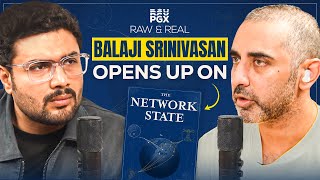
Okay, so let me show you a bunch of graphs. Right, Here we go. The network states the Internet. The Internet is not a place, but there will be, there will be Internet places. And so I wrote this book called Network State. Right. And we, we've opened network school over here to take some of the ideas from the book and turn them into reality. Because there's theory and then there's practice, right? Okay, so let me give the thesis of the whole thing. Right? American empire was real and it was spectacular, but it's ending now because China is strong and Zeihan is wrong. Okay, Join this guy, Peter Zeihan. I have no idea, okay? He's somebody who I have no personal beef with everybody. He writes a bunch of books about how China's gonna collapse and America's gonna withdraw from the world, but the rest of the world is gonna be totally done without America and so on and so forth. Okay, fine. China is strong. Zion is wrong because he identifies lots of the correct axes but has the sign wrong. For example, he thought the US Is going to be able to navally blockade China. Actually, China's navally blockading the US Where China's proxy Iran has its proxy, the Houthis, that have successfully blockaded America in.
The Middle east coast.
In the Middle East. That's right. So because China's strong, as I is wrong, it will be in part, a Chinese century, but it won't solely be a Chinese century. It will also be an Internet century. And the future is China versus the Internet. Those are the two heirs to American empire. China inherits the physical empire, but the Internet inherits American values. And from them, we build the network states of the Internet. Okay, so let me explain. All right, so first, the American century. Okay, so when I say American empire was real and it was spectacular, there's actually a very good book called Tomorrow the World, which puts a finger on the exact moment when the US decided to become an empire. Right? It was actually 1939, 1940. See, up till that point, the conventional wisdom has been among Americans, let the British run an empire that's expensive, that's troublesome, and so on. Let them do all that stuff. We're just going to build up our strength at home. However, after the fall of France in 1939 at the hands of Nazis, a bunch of Americans realized, wait a second, if we don't build an empire, the Nazis will, or maybe the Soviets will, and. And then they're going to blockade us with sea lanes, all this kind of stuff, right? So you realize actually, you know, there's no, if we don't play for number one, someone else will get the crown. So a bunch of intentional decisions were taken at that point to actually gear America into something it had not been before, which is global empire. Okay, so the reason for that, by the way, is obviously, you don't become global number one in every Category by accident, right?
No you don't.
Right, you don't. Right.
So.
So there's a bunch of Americans who are in this weird mental state where they're like America's global number one and all this stuff. And oh, by the way, we didn't mean to do that. It just kind of happened. Do you know what I mean? Right, right, right. So clearly there was intent by at least some people to set a bunch of institutions there. For example, with the un you know, it's set up in such a way that yes, everybody has a vote, but there's a five Security Council members. And oh, by the way, it's in New York City. So guess what? They can have all kinds of surveillance apparatus. They can monitor a camera, photograph everybody going there, blah blah, blah. So they have a backdoor into the un, Right? Okay, so American empire was real and was spectacular. And from 1991 to the present day, the US was basically the most dominant empire of all time, right? And the largest military. And this is when the left and the right of America worked together well, because the left did the diplomacy because it's really hard. But if you've ever gotten 10 people to sign something, right? Then imagine how hard it is to get 10 companies to sign something. Now imagine how hard it is to get 10 countries to sign something. And now imagine how hard it is to get every country in the world to sign something. That was the skill of American diplomats to get like global consensus on things like, you know, WTO or the un, like getting all these people to sign on the line that was dotted non trivial, okay? Very underrated. And once you start thinking about diplomacy in terms of business negotiation and then when that broke down, of course they had their powerful military, right? So they had know they'd punch them until they signed.
Right, right, okay. Or they threatened them until they signed.
Yeah, yeah, exactly, that's right. And, and you know, to be clear, I think on balance the US was better than the USSR during this period, right? When you look at West Germany versus East Germany, when you look at South Korea versus North Korea, when you look at Cuba, you know, or Chile versus Cuba, like I'm not saying every single thing the US did during this period was good, but on balance American aligned things did better. They were capitalists, they were doing well. Okay? So America was just completely unmatched in history, especially post 1991, okay? So American empire is ending. Now one way of thinking about it is four of the most important factions, which are Red America, Blue America, Tech America and China all want the end of the current post war order. Why? Red America is against the deep state. Right. Blue America opposes the Trump administration. Tech America is against the regulatory state, and China opposes US Hegemony. Okay, so all four. Are you a math guy, Physics guy?
Well, I'm. Enough.
A little bit. Okay, sure. So if you remember like vectors, like force diagrams, Right, Right. So, you know, if you take this object, right, which is like the current US structure, all four forces are pointed down in a way that hasn't happened in our lifetime. It's kind of like a solar eclipse or something. Like everything is aligned in a way. Right. So the only thing that's keeping US Institutions in their current state is just their historical legacy. Legacy, right, that's right. So the forces are pointed down, so the dynamics will be down. Right, got it. Moreover, the US is already socially disintegrated. This is from 2017. It showed that, you know, Twitter had partitioned where blues only talked to blues and reds only talk to reds. And now, eight years later, it's actually completely fragmented. You know, when. When Elon took over X, you know, Twitter is now over, right? And so what do you have? You have, on the right, you have X and you have Gab and Truth and so on and so forth. And on the left, you have Blue sky and Mastodon and Threads and TikTok, right? And then you have crypto networks like Farcaster and Nostr and Lens. So it's a Tower of Babel moment where Twitter is just fragmented. And now there's a bunch of ideologically different Twitters, right? And what that means is that, I mean, you got millions of people on these networks, right? They are speaking English, but they're not talking to each other. It's like in Korea, there is no Korea. There's only North Korea and South Korea. So there is no America. There's only Blue America and Red America. They have different words, they have different premises. Everything they're thinking about is just different. And so what happens is when you have that level of digital separation, digital partition, that is going to get printed out in the physical world. And for example, Democrats going and firebombing Teslas, right? That kind of stuff, right? That is something where they don't consider themselves part of the same tribe anymore, right? That is tribal warfare, reprisals. And of course, you know, the old world saw this. This is what, you know, the 20th century was like for India in many ways, right? Partition, all this kind of stuff. That is the kind of thing that's in. That's coming to America. Okay. And the one way of thinking about this is anything that's important, it happens on the Internet first and then it gets printed out in the physical world. For example, you do a Google Doc, you print it, right. Or you have a Flipkart or Amazon order and you hit, in a sense, print. And you print it out to your front door, right. Or you have like a ride sharing ride and then you hit print in a sense, and it comes. The car comes to your front door. Right? So things happen on the Internet first nowadays, and then they get printed out in the physical world. So this level of cognitive social separation, the only thing that's keeping them together, together right now is the dollar. Because, for example, I can show the graphs, you know, what percentage of Democrats marry Republicans.
I think under 10%, it's 4%.
Yeah, right, right. So that is something that it's no longer like a political dilemma. That is when ideology becomes biology in one generation. Right?
No, it's an ideological separation like nothing I've seen in India. Yes, I went out on dates in America and if I as much as mentioned that I would vote for Trump as a joke, the date's over. Yes, that's a very interesting thing. It almost never seems to happen anywhere else and.
No, that's right. So basically that is in the process of like, it is digital secession, it's social secession and so on. This is what predates these groups breaking up, Right. Physically breaking up. Now the problem is it's fractal. It's like Yugoslavia or the Balkans. It's not something where you have a clearly delineated, easy blue and red area where that's 99%, 99%, probably, by the way, had it been to that point, they would have come to, like, organized blows long before this. It'll be more like partition where there was. It was just a mess. And you're going to have blues going to blue states and reds going to red states. And this giant mess, this is already happening. Right. Okay. So the thing is that A, these four forces are aligned against the order. B, the people have broken up. Right. And C, after the tariffs, 190 countries are seeking alternatives to American empire. Right. The thing about this, though is it's not just ending in, in the internal sense, also ending as a hub for global business. For example, Delaware, which had generations of reputation for stability, that's just going away. Companies are just pulling out of Delaware. Right. And once you've pulled out of that, well, kind of the whole thing is up for grabs. Right. Like where, where will things get incorporated. And I think the answer is eventually going to be in China or on chain. Right. Because a truly stable, you know, corporate entity would be something that has smart contracts on chain. Then you can just move it between jurisdictions. Just like when you move from place to place, your cryptocurrency remains intact, your email remains intact, your laptop remains intact. Anything that's digital is actually robust in a way. The physical isn't. Right. And of course China will have its own recipe. I'll come back to that. Right. So the point is though that if you add up across ideologies, in America, they're shooting CEOs, they're bombing Teslas, unrealized cap gains tax are getting proposed in. You know, that was very. Those are serious proposal by Biden's, they're abolishing the police, they're blocking all the student, tourist and worker visas, they're slashing research funding, they've corrupted Delaware, they've imposed these unprecedented tariffs. When you add all that up across ideologies, America doesn't want to be an empire anymore. It doesn't want to be the center. You may think it's in its interest for it to not be an empire, but it's basically cutting off foreign talent, it's cutting off foreign trade, it is breaking up internally, socially, it's not one thing. It's like 20 things that I just mentioned. Right, okay. And so this is actually something which is a function of the fact that the world economy has moved back to Asia. Okay. So this is a very important graph. It shows that for thousands of years the center of the world economy is basically in Eurasia. And what that means, it's like an average of historical Japan and China and India and the Middle east and Europe and so on and so forth, just using approximations for where their historical capitals were. Okay. Then with the Industrial Revolution, for hundreds of years it moved out to Europe and then America and 1950 was, was peak America, peak West, peak centralization, where everybody else was bombed out or they were under socialism, communism, Eastern Europe, like Japan had gotten nuked. Everybody was just in ruins. And that is a moment that all these post war order institutions were set up when America was at its absolute zenith of all time. Right. So that's a very unnatural state of the world where everybody else is in ruins and only America is left standing. Right. Then that persisted for a few decades and, and then after 1991, the US was still, I mean, even more super powerful because, you know, the Soviet Union fell in. But that was the true peak right after 1991, like a rubber band snapping, the world economy came rocketing back to Eurasia. Right. Because of China, but also because of the rise of Southeast Asia, rise of India. You know, India started liberalizing around that time. Everybody stopped basically hitting themselves in the head with socialism and communism. Right. So all these countries that had been socialist and communist in the, in the 20th century, like Vietnam, like, you know, like India and so on, suddenly became capitalist. So they started producing. Then conversely, many of the countries that were capitalists, like Western Europe and the US Basically just became degenerate. Right. They just were so wealthy they forgot how to build wealth. Not everybody, but certainly a large fraction of the population, the non Internet people disproportionately became, you know, they weren't building things from scratch anymore. They weren't feeling the pain of building. Right. They were inheriting something that they hadn't built. Okay, so the again, not all non people, blah, blah, not all Americans, but a good chunk of them essentially took the wealth for granted. Right. And you can see this even more in Western Europe in some ways. Right. Okay, so the point is that wealth has already rocketed back out over here. This is an enormous change. This took thousands of years. This happened over hundreds of years. This happened in tens of years. Most GDP is in Asia. Most millionaires are in Asia or Eurasia. Especially the number one and number two destinations for gold millionaires are Dubai and Singapore. Right. And on and on. Right. The world economy's actually come back out every year. So what's happening here with the end of American empire is actually a lagging indicator. Right. And the issue is Americans think that by rights the world should be centered in the U.S. they'll often say, oh, you know, in 1950, a guy who's a high school graduate, he could have a wife and a house and it was fine and so on. And that was true for a tiny percentage of the world. Because a Polish guy who is like a really smart and hardworking guy was a slave under communism. Right. Or a really smart Japanese guy being nuked because his crazy government had gotten into this giant war. Right. So the rest of the world was artificially rat stunted. Yeah, exactly. That's right. That's not to say anything bad about the US but it's just that there was an advantage where that high school graduate was in the one environment that hadn't been destroyed. That's not the natural state of the world. Right. So now the world is coming back to the natural state, which is much more balanced. Right. Okay. So that means the US Is really, in a sense, already ended as a hub for global business. But it's. Everything's kind of gotten moved out. Like, the manufacturing gotten moved out, and the commerce has been moved to the cloud. And now the physical thing is kind of getting shut down. Okay. But the thing is about this, we will miss Uncle Sam when he's gone. Okay? Okay. And there's this great book called Everything Was Forever until there's no More, on the last Soviet generation, right?
And.
And this is about what the end of the USSR felt like. And if you read this, even skim it, you'll be like, wow, this feels a lot like what's happening in America. For example, they had a term that was similar to fake news, right? They had. Because what happened was, at the end of the Soviet Union, Gorbachev implemented glasnost and perestroika, like free speech and freer markets. And so everybody started complaining, and now you started seeing how bad the existing system was. And so the equivalent of that is Internet free speech is social media, and Internet free markets is cryptocurrency. That's the glasnost and perestroika of the modern era. And the thing about this is the Soviet Union had no way to announce that it was on its last legs until really the last few months. Right. Even March 1991, there was a vote that was held for an all Union referendum to keep the Soviet Union together. And they thought they had a majority vote, but there are a few places like Estonia, that said no. And then the Soviet Union broke up, like, six months, nine months later. Yeah, that's right. Mid September, right after. After an attempted coup. Point is, we're going to miss Uncle Sam when he's gone. Nothing I'm saying here is like, oh, my God, you know, America is a great. Was a great country, but we now need the version 3.0. There's Britain, there's America, and then there'll be the Internet, as I'll get to. Right. But first, let me talk about what's the other part of what's coming, which is the Chinese century. Okay, so who is the successor to Uncle Sam? Right. Who are the heirs to American empire? China inherits the physical empire, but the Internet inherits American values. Okay, so let's talk about that second part, the Chinese century. So we need to first understand, like, what China is. Okay, Now, Indians. Actually, you know, a lot of the stuff I'm gonna say is kind of obvious to Indians, but a lot of Americans I understand, their ego is hit by the rise of China. They think, oh, we gave everything to China. And they tend to really underrate China. And they've always got kind of a lagging indicator on it. Not everybody again, but a lot of people. And I understand where that comes from, but just let's be completely realistic about what the state of the world is. People say, oh, my God, you're a China shill. I'm a reality shill. Right, Reality shill. Okay, okay, Right. So first of what China is. Because even if you want to compete with China, you need to understand what it is. Right? So there's this set of books by this guy, Peter Zeihan, and he basically makes his case, which I think is wrong, is China's collapsing and the US Is going to win by default. You don't have to do anything. And you could actually, you know, you can read this and people will be convinced that, oh, it's just got all this geography and the Mississippi river is going to protect America from a sovereign debt crisis and so on and so forth. Right. But to just calibrate on reality, China is just the. The most physically formidable state in the world by far. Right. For example, this is one BYD factory. Right. It is larger than San Francisco. Wow. Okay.
Just one BYD factory.
Just one. And there's actually a clip that we can play that shows an overflight, like a drone of this O. By contrast, Elon, who's amazing, can't even build a sign in San Francisco. Right. Because he had to actually move out. Right. So that is a level to which the American regulatory state holds things back. And China, for its many faults, does allow its companies on net to build. Right, Right. So let me just go through just a bunch of graphs and charts to calibrate. Right? So first, China is number one in global trade. Okay. It went from basically just trading with like, you know, Central African, Central Asian countries in the year, you know, 2000, becoming the number one trade partner of everyone in the world. Now, the thing is, the one, the few places it didn't have scooped up yet were like Western Europe, you know, Canada, Mexico. These are the places that Trump is imposing these tariffs. Right. And understand why. But still, what that's going to do is they're encouraging the EU and Canada and Mexico to align with China for trade. Right? Okay. And China's number one in steel, it went from less than 110 US steel production to more than 10x and became the number one steel producer in the whole world. Right. China's number one in rail from 2008 to 2020, they built a national high speed rail network over the same period. California's $100 billion rail project didn't lay a single line of track. Okay, China's number one electricity. Look, that flippening happened right in 2010. Boom. And just gone up like this. This by the way, all the stuff about will AI save us? And so and so forth. Look, there's a lot of amazing things about AI but as actually people have started to recognize AI is electricity constrained and China is not electricity constrained and America is. So the big data centers can only be built to a certain point in the U.S. the other big thing is that China has the hardware stack. So all the humanoid robots it is again, maybe Elon can pull it off. He is the greatest of all time. But China's just scaled. They're so good at being second movers that they will crank out the widgets and so on at a very low price for these humanoids. Right. So and that's a physical manifestation of AI. So the point is China's number one electricity, they're number one in nuclear. Right. Look at all the plants they're building over here. Actually to India's credit, India and Russia, the RIC of BRICs, they're actually doing fairly well. The US has been stuck now. Trump is just unblocking this now with nuclear. You know, he's just talking about this. There's some good that's happening there. But the US is would have to, you know, plus also that would actually, actually have to happen and actually get built. Right, right. You need the physical execution to make it happen. That's non trivial. Right. So but China's way ahead on nuclear power, right? China's number one in cars. Okay. This is a really big deal because right after the pandemic, China essentially ascended to flip. Germany, Japan, Apple and Tesla. Okay, Germany and Japan. Here, here they are on the chart. These are. Those guys are. No, they're no slouches. No, no, no, yeah, these are, these are, you know, countries that have had multi generational reputations for being world class in manufacturing. Right. Extreme attention to detail. You know, they ship things at massive scale. You know, Toyota, Mercedes, Benz. These are really good companies. It's very hard to do what they do. The advent of electric cars disrupted them because. And self driving for a variety of reasons. One of them is that all the pieces of software that were in a traditional car weren't talking to each other. But a new car is basically like one software stack completely.
Number one.
And number two is the old combustion engines were the most complicated Part of a car. But now with the new electric cars, it's a battery that. It's really like a big battery on wheels. And so it's not easy to make. It's still hard. But some of the guts get changed. And so some of the old. It's a little bit like going from, you know, newspapers that were printed out to digital. Right. It changes the entire supply chain. Now you've got a newspaper that's trucks and ink and so on and so forth and has to make this shift. And a new startup doesn't have to do that. Right. So that technological disruption gave an advantage. But then China capitalized on it. Right. And Apple could not make a car, but Xiaomi did. Right. BYD is outselling even Tesla. Right. So China just came out of nowhere and owned this very complicated market of cars. With BYD and Xiaomi. Right. And other Chinese manufacturers, China's down number one in ships. Okay. This is slide from the US Navy that shows that China has 200x America shipbuilding capacity. Wow. Okay. And there's a Secretary of the Navy. We can show that clip. That one Chinese shipyard makes more ships than the entire US Navy, the entire US Combined. Okay. And there's a Raytheon CEO who. Or the Raytheon CEO a few years ago who said, actually, you know, yeah, we could pull our stuff out of Russia. We can't pull out of China. We can't decouple. Right. And I can show another graph which shows the US Military itself is made in China. Like the famous US Armaments, like the Tomahawk missile. There is a study by. Commissioned by the Pentagon, $400 million study by Govini that shows that the supply chains for the US Military come from China. Actually, you know, let me show you those. Wow.
So at this point, even the US Military, which offers it the sovereignty that it has, is undecupable from the Chinese manufacturing empire.
That's exactly right. The US Military is made in China.
It's like the dollar being printed in China.
Yeah. Because of course, you know, the thing is that people think that, for example, the, the. That the military is like a different thing than the domestic supply chain, but actually the military is often a subset of the domestic supply chain because you. Except in places like North Korea or something. You know, your scale, most of the time you're at peace. Right. So most of the time you're making cars for peace rather than tanks for war. Right.
So.
So the scale of your peacetime economy constrains the scale of your wartime economy.
Right.
That's a really important concept. It's not like a separate supply chain. Right, right.
It's the same unit that will manufacture the tanks later.
Yeah, exactly. That's right. So let me show you the same.
Steel will be co opted for your missiles later.
That's right. And that's what America was mid 20th century because it had all of that stuff. Right. So here, let me just show you three clips.
And it was accelerated by the wartime economy of the forties for manufacturing more things, whether that be microwaves and radio waves and those things.
Right? That's right. That's right. So let me just show you some clips here. Ready? And we can.
Okay, Anshul, attach these clips later, right?
Yeah. One shipyard has more capacity than all of our shipyards combined. But it is a reality, which means they have 13 shipyards. In some cases their shipyard has more capacity. One shipyard has more capacity than all of our shipyards combined. Wow. One shipyard is more capacity than all of our shipyards combined.
Wow.
Okay, let me show you a few more. Here is the CEO of Raytheon. Important for the American people to understand is the relationship with China. We have to find a way to get along. There is a co dependency, whether it's rare earth metals, whether it's pharmaceutical precursors, $500 billion of trade comes from China to the US every single year. So while we talk about pulling supply chain out of China and resourcing out of China, I would tell you it's very impractical. We've been de risking for a couple of years making sure that we have second sources for critical componentry. But unlike Russia, where we pulled out two weeks after the invasion last year, we shut down our factories, we pulled our people out and we completely cut off any contact with our Russian customers. We can't do that with China. Too big, too important and too necessary to the US economy. By the way, that's not just any person who's saying that Raytheon is one of the so called Primes, like the big, you know, like the big tech companies. There's like Apple, Google and so, so there's Primes which are the big US military, you know, defense manufacturers, Raytheon, Boeing and so on and so forth. So for him to say that is essentially acknowledging this. The US military is made in China. Right. So let me zoom in on this guy. So basically this shows you see the Tomahawk missile, famous US Armament, Right. When you go to the supplier, supplier, it's like Hangzhou Fishery Co. And Bolts Ltd. Or whatever. Right. And so this is something which is not like a small thing. Like, you know, all these famous US Armaments. And of course, you kind of know this. Like, you know, even many Trump hats, for example, are made in China. And that study comes from the. Go ahead.
No, I was just. If MAGA hats are made in China, that's like. That's like an irony in itself.
It is an irony. Right? I know, and I feel bad for them, you know, like. But it's also something where it's funny that Chinese, they'll just make a baka on something. They'll make the MAGA hats. Who cares, right? But here, this is actually from this, you know, from. From the Pentagon. And it shows Chinese suppliers and US supply chains just went completely vertical starting after 2010. Right. And that, you know, Chinese semiconductors and critical military platforms. I mean, look, there's. There's. There's people who are working on trying to fix this and so on and so forth. We just need to understand where the world is, right? Maybe where the world can be. But first, where the world is.
Right.
The world is. The fact is the US Military is made in China, right? Which means it is impossible. And I'll show you one more. Ready?
Yeah.
So. Okay, so take a look at this.
Do I know this gentleman?
This is the Secretary of Defense, the current Secretary of Defense, Pete Hegset. All of its war games against China, we lose every time inside the Pentagon. War games. We know what our real capabilities. You see, we didn't even get to this part of the war on warriors. I mean, the military industrial complex. The way we procure weapons systems. You know, we're always. The Way our system works, the way our bureaucratic system works, where the speed of weapons procurement works. We're always a decade behind in fighting the last war, whereas China, there. We have a.
We have.
You know, what did Rumsfeld say? You go to the war of the army. You have. We have the army. China's building an army specifically dedicated to defeating the United States of America. That is, that is their strategic outset. Take hypersonic missiles. So if our whole. Our whole power projection platform is aircraft carriers and the ability to project power that way strategically around the globe. And yeah, we have a nuclear triad and all that, but a big part of it. And if, you know, 15 hypersonic missiles can take out our 10 aircraft carriers in the first 20 minutes of a conflict, all of its war games against China.
I see what you mean.
Okay, so just to tell you who I'm quoting there, right? That's the current Secretary of defense under. Under Trump. That is the former Secretary of the Navy under Biden two years ago. That's the Raytheon CEO and that's a Pentagon itself.
Right. Okay, so you're citing official sources.
I'm citing the official sources. This is a dod, right. So like, you know, that's something which is, you know, called admission against interest or what have you. Right. And now to be clear, in a sense you only have a war if both parties think they can win. If one party doesn't think they can win, then usually there isn't a fight. Right? Yeah.
There's a negotiation.
There's a negotiation. That's right. So in a sense it is good that the Secretary of Defense is cognizant of the fact that Chinese hypersonics are set up to sink US Aircraft carrier. This is the same sort of standoff missile thing that India, Pakistan was doing recently. And also that Russia and Ukraine long range missiles are changing, you know, what war is and battle is. But so it's good that they're aware of it. But this hasn't been like priced in, in the world. Like people have not yet taken on board that China is now the military superpower of the world.
Got it. People haven't realized that at all. They haven't still fight between USSR and the usa.
Yeah, yeah, yeah. They still, they still like, you know, it's similar to not pricing in that Russia has won in Ukraine. Right. That kind of like that's happened. Let me actually show you a few more graphs. Okay, so China's number one ships, right. It has now the world's largest navy. Again, when China turns it on, just like with, with cars, it just went boom, flip the U.S. okay. And then you'll always hear some cope, which is like, well, they don't yet have the same number of aircraft carriers as us. But that is something that is just cope. Right.
It's the five years away from it. If they try to manufacture, if they.
Try to, they can. But the thing is also, that's also not the right metric. It's like saying Netflix doesn't have as many stores as Blockbuster. Sure, yeah. They're doing something paradigmatically different. Right. So maybe you don't need aircraft carriers in the same way. Or they're like drone aircraft carriers or something else. Right. Aircraft carriers may be actually sitting ducks in the era of hypersonics and what have you. Right. So China has a world's largest navy. China's also number one in cities. It has 113 cities with over a million people bigger than SF and so on and so forth. Right, right. And unless you've actually traveled there and seen it, it's actually really remarkable what they've got there. You know, in Shenzhen you have drone delivery is routine. Right. Self driving is routine. All this stuff is routine, you know, sidewalk delivery, robots, routine. Routine. Right. So they are ahead, they're head by a lot. Right. And they've just really turned it on Again. There's lots of stuff that's bad about China. The problem is at this point people are like, oh my God, you love China so much. I'm gonna critique them in a second. Okay. But point is, I'm just a reality shill. Right. Okay. China even now has flying cars. Right. Did you see the Ishowspeed stream? You know, a few weeks ago, months ago.
I didn't expect you would quote Ishowspeed, but no, I did not see Ishowspeed Speed.
Okay. So I'm not big Ishow speed guy, but I'm a big tech guy. And so this was him in a flying car in China, Right.
Whoa, that's wild. So it's basically a human sized drone, right?
That's exactly right. Now here's the thing about this. I actually showed this. Here, let me show you something. I put this up.
We live in a strange world where we quote the Raythan CEO and Aisha Speed in the same conversation.
Yeah, it's funny.
He's a cultural force, no doubt.
Yes, he is. He is.
I think he recently met the president of Albania. Right. And I mean it, it tells you how different generations are at this point. Whoa. This is a very scary video. This is a very scary video.
Yeah, I know.
This changes everything.
Yeah. So we want. So basically, you know the Peter Thiel quote, we wanted flying cars, we got 140 characters.
Yes.
So I just did a little remix of that. We wanted flying cars, but we got them with Chinese characters because in the US regulations prevented this from happening. Right. Where's my flying Car? Is this really good book by J. Stores Hall? Okay, where's my flying Car? That documents exactly when certain set of decisions were made that pushed all innovation. In the 1970s, any energy intensive innovation was essentially prohibited. And that's why I pushed everything into computers.
Yes.
Right. So 100% of the innovation, not 100%, but like most of the innovation was in non energy intensive areas. Right. Because the physical world was so highly regulated and this was short term risk aversion that led to long term catastrophic risk. Because now China's so ahead physically. Right. People thought, oh yeah, oh, someone could fall off a plane or if it crashed or whatever. It was always some downside scenario, risk scenario that led people to avoid the physical world. Risk. Right, right. Okay. So just to simplify for a couple.
Sometime in the 70s, the rate of progress in information technology started far superseding physical technology. And so you saw a lot of stuff happening on screen, on the Internet and with information, not so much with manufacturing, not so much with innovation in the physical space.
That's exactly right. That's right. And so here is the stream, by the way. Now the thing about this is this went out to whatever millions of people are on his stream and it showed them that like, China's not a third world country anymore, right?
Whoa. It's, it's basically like a helicopter, but I'm assuming it's a lot cheaper to operate.
Well, that's thing, it's an autonomous, it's a remote controlled helicopter.
Wait, so there's no driver in here?
No, he's just sitting. Yeah.
And somebody's operating from the ground below.
Or it's self driving. That's right.
Whoa. That changes everything.
Yes. Because most people don't have the skill to pilot helicopter.
I mean, in wars you could drop payloads using this.
Of course. Sure.
I want to mute this so we are more audible. But like this reduces the cost of war to just the hardware you need.
So this is what's happening. Ukraine, if you follow the Ukraine conflict, what's going on with the drones there? For example, they've got all kinds of different scales of drones, but short answer, yes. Right. So what that also means, by the way, is that physical borders and digital borders will need to coincide because if somebody can script drones in your territory, they can do things to you. Yeah, yeah, yeah, Right. So you can't fly a plane if.
There are drones that easily accessible.
That's right. So if you look at this, right, Basically, I guess 38 million views or something crazy like this. Right. So this is something that's broadcasting what China actually is today and it's ahead. The US is not able to do this. Right. And so the, the point is that in various areas they're ahead. Now when I posted the thing about, you know, flying cars, people would say biology. It's not a flying car. It doesn't have wings. It's not a flying car. It doesn't have wheels. Right. It is not a flying car. It can't go long distances. And I was like, again, this is similar to saying, oh, you know, Netflix doesn't have the number of stories that blockbuster Does, Right. It is being stuck in an old paradigm and not thinking, okay, well, DJI did drones. And therefore China's hardware ecosystem has a lot of experience with quadcopters and all the control theory required to balance them and so on. And now actually that's all reinforcement learning. And in the same way that an iPad is a scaled up iPhone. Right. This is like a scaled up DJI drone. Okay. And, and it achieves the function of a flying car, which is you as an individual get from point A to point B in the air without going on land. Does it matter if it's a copter versus wings? In my view, no. What about the wheels thing? Well, there's some models actually they're developing that also have wheels, but even that doesn't actually matter. And the reason is that the. What matters is they can actually get a lot of experience now doing a thousand, ten thousand, one hundred thousand, a million rides within Chinese cities. They're calling this the low altitude economy. Again, Uber was on this, they were working on this years ago. And the US government and the regulators and the media all attacked Uber. And so, so this is why this stuff isn't happening in America, because the state attacked the tech guys and stopped them from doing. I can see this over and over again. Why, why did DGI not happen in the U.S. because the FAA went after consumer drones and stopped them. Right. The regulatory state, because it can't take calculated risk. It is only about reducing some negative headline rather than taking calculated risk because of that. That's why the US has gotten held back. That's why nuclear has gotten held back. That's why flying cars, that's why drones, all this stuff's got. And India should not repeat those mistakes. Right? India, Indians should not repeat those mistakes. We should figure out special economic zones where we can actually do these experiments and people can opt into the physical risk that's there because no risk, no reward. Risk aversion is reward aversion. All right, so China even now is flying cars and the remaining areas, planes, chips, even AI, Boeing has huge problems, as we know. Right, right. And comac, which is China's airplane, is because of the Trump sanctions or tariffs. China and the EU get closer and closer. China will get probably European approval, three to six years. Chip makers, you know, they're catching up. I mean, the entire thing is like the CEOs of the four major, or at least let's say four of the major chip makers. So TSMC and now Intel, AMD, Lisa Su, and of course Nvidia are All of Chinese ancestry. And the Chinese diaspora is 60 million people. Okay. But that's less than 5% of China, which has 1.4 billion people. Right, right. So the entire premise that like China culturally could never figure out chips when its diaspora is really, really good at chips was an incorrect premise. Basically the entire thought that like challenged China to a race of cloning, a technology that already works for national pride, and to really get really good at quantum mechanics. This is like challenging Italians to a pizza making contest or something like that. This was like right up their alley. Had instead the fight been over whether China can make its case in English. Right. That's not a core competency for them. So this confrontation on chips was a very poorly thought out kind of thing where people. What the US did when it tried to sanction China on chips is actually forced China's chip ecosystem to vertically integrate in a way they'd never integrated before. Right. And then third is in terms of AI, again, you know, with deep seek open source AI, one of the things that that is likely to happen. I published this article a few months ago and I think this is very likely. So have you heard the term, I think it's again, a cope term. Overproduction. AI overproduction. Right. So basically over the next, when Deep SEQ came out, you know, Deep Seq, Roughly, Yes. Okay. It was an open source Chinese AI model that also showed you its internal train of thought. Right. So it's actually really remarkable because you could see it thinking before it gave you the answer. And the thought process actually just as interesting as the answer.
Right, right.
So. And it was open source, fully open source, anybody could download it, run it, et cetera. The hosted version was lightly censored. And I would compare. This is a little bit, you know, I think it's funny, but Chinese censorship is a little bit like Japanese pixelation. Okay. So you kind of know what's there. And so it's different than how some Americans think about it. Right. It's not like you can't find it or what have you. It's. It's like for propriety purposes in public, you censor it or whatever. Right. So what DeepSeq did was something interesting where they had a model that would, if you asked about Chinese history or something like that, it would print the whole thing out and then there'd be a very dumb. It would give you a flash of it. So it showed you that it knew what it was thinking about. And there'd be a very dumb second layer model that would then blank it out after it gave you a flash of it.
So the censorship is a second step, as opposed to censoring it in the first go itself.
Exactly. And so it was an intentionally dumb second step where anybody who saw that would read between the lines and say, oh, if I download this, run this on my own, I can get the uncensored version.
Right.
Okay, got it. So they. So that's actually censorship in China is more subtle than people think. Right. Basically, what the Chinese government wants to do is they want to prevent groups from unionizing in public. That's a danger to the Communist Party. But basically you can kind of do what you want so long as, you know you're not like grouping together. Right. Again, I'm not saying it's good, I'm just saying that it works differently and understanding the operational mechanics is how it is important. Right, okay. Right. So AI overproduction, basically just to give some premises. First, China noticed deep seats release knocked a trill off of US tech market caps. Right. It recovered, but still it was a big surprise. Second, their core competency is exporting physical stuff, not software. They do have TikTok and so on, but for the most part it's physical goods. Right. Third, their other core competency is exporting things at such massive scale. Like the cars graph that I showed that all legacy producers are bankrupted and then China maybe later can hike prices, but basically they dunk them underwater with like, really this is key thing. It's not the cope is that it's just cheap China crap. Maybe that's what it was in the 90s and 2000s. Now it's inexpensive and very high quality and it can win in an open marketplace. Byd, these are not bad cars. Right. So it's like complete Cope to still say that they suck. Right. That's just Cope because. And I just say nope to Cope and just like, let's market to market, let's understand where we are in terms of reality and let's figure out how to win from there. Because if you rely on Cope, you're not going to get anywhere. Right? Right. So basically all foreign products are. Producers are bankrupt. Right. Okay. So China is well aware that it lacks global prestige as a copycat. Deep Seq was this huge thing for China where everybody, even when it didn't make sense, they were like adopting Deep Seq. But the point is that local officials in local places Deep Seq, because it's open source, anybody could adopt it anywhere very, very quickly. It's not even an API, it's like open models Right. And then finally you put all these together like the founder deep segment with not just Xi but also the number two in China, Li Qiang and so on. So what China sees is with open source AI models, they can hit US tech companies, boost their prestige, help its internal economy and take the margins out of AI software. And instead where they make the money is they export AI enabled hardware. Right? Like robot dogs and smart cameras, Smart drones, like a fridge that can talk to you and a fridge that's your nutritionist and so on and so forth. All of that is going to come, right? I think of it as like the, the garden of intelligent things, right? You have all kinds of devices, like basically like dogs and cats around your house, except they're effectively robots or devices of different kinds. Right? So embedded AI in everything. Intelligence becomes super cheap in this way. Right. And so this is something where the reason I bring that up is people will say, oh well, the US sell has advantaged an AI. I'm like, I don't know if that's going to exist in the next, in a four year window because it's quite possible that China open sources AI undercuts US hosted AI and then that either hits US tech company market caps or also possible, the US already has bans on Deepseek at the hosted level. Okay, but it might ban Deepseek at the open source level. And they might say this is CCP technology, it's got CCP coefficients, it'll brainwash our kids, we don't want it. And so it's fine, I understand that. But that means that it'll be harder to use cutting edge models in America if deep sea quality models get shipped. Because they're going to do it not just for chat, but probably for computer vision, images, robotics, everything. Because they saw how impactful the first one was. Right?
Okay, so America is going to be closed off to the global AI space in that way.
Right. And they already, yeah, the thing is cutting off foreign students. You know, there's a graph which can see if I can find like essentially top AI researchers into the US it went negative. So let's see here. Basically there was a graph which showed that USAI researchers are no longer coming to the US.
And instead go to China.
Well, they're, they're staying in China. I mean, you know, like if you, if you knock out Chinese and Indians out of us like engineering, right. That's, that's like more than 50%, sometimes more than 70%, depending on whether it's like, you know, electrical engineering department or a tech company and so on and so forth. Like that's, that's a very large percentage of tech talent. It's not 100%, but it's a lot. I was trying to find this graph which shows like AI.
I feel like even how strong a university Shingha and the likes are is understated in America.
Yes.
They don't understand the level of innovation that those universities are capable of.
Yes, that's right. And I think actually I'll show some graphs on that too. So here we go. Where did it go? Where's the AI researchers? They basically. I'll see if I can find this graph later. Maybe you can look it up.
Yeah, you could just.
Yeah, so see if you can find it. But basically what it shows, I'll just describe it visually and then you can maybe look for it afterwards. It is a graph that shows. Looks like this, right? It shows net immigration into the US of top AI researchers. And then even before Trump Admin, it had gone to net zero. Okay. I can show other, other graphs of the millionaire migration map, for example.
So where millionaires are migrating to Dubai and Singapore, overall places.
That's right. So basically in 2019, okay, the millionaire migration, basically the US was still number one. Okay?
Right.
And but today. So after 2020 and BLM and so on and so forth, now it's something where it has flipped. So here, let me show you this.
So the social instability that comes with the American package is what is flipping millionaires to move to Dubai.
And it's both pushing a pull. Right. But here we go. So this is 2019, okay, right. So at that point, the US was still number one in sourcing global millionaires on net plus 10,000. After the pandemic and the riots and all this kind of stuff, by 2022, the USA dropped 85% h, okay? And the UAE and Singapore and actually Australia and so on were picking up, right? And became becoming number one, number two. And now by 2024, the US recovered. Let's scroll down here. This is 2023, the USA recovered slightly, right. But still it's pulling in less millionaires than these tiny countries that are 1 50th or 1 60th its size. Right. And now in what with the new quote reforms to the EB5 visa and whatnot, it's just very hard for capital to get into the US so 2025 will show dropping off even further. Right? So capital, Global capital is already deciding to go elsewhere other than the U.S. right. And now talent can't get into the U.S. because of the cutoff of student visas and skilled worker visas and so on and so forth. So when capital and talent are both not allowed to enter the US and also foreign trade can't enter the US because whether you export or import. Right? So talent, trade, capital, they're cutting them off one by one. These pieces of this global empire. Right. When you start to see it in its totality, again, I'm not just talking about one thing. I'm talking about the summation of a bunch of things. Right. The US is basically abandoning the empire. And the physical part, as I said, is going to China. Okay, now with all of this, right. Let us understand what China is not. Okay? Okay. So just completely dominant in the physical world, right. To a level that people don't appreciate. But China is not the Internet. Okay? Right. The thing about this century, I think, is it will not be a symmetric conflict like US vs USSR that was tank for tank, plane for plane of a physical ideological hybrid versus another physical ideological hybrid. Like, you know, capitalism and communism had both the ideology and. Right. China is highly physical and it's not really seeking to export ideology in quite the same way as I'll get to. But in many ways it's like Apple and the Internet's like Android. China's software in the sense of its. Its network and its state only work on its nation. So its network is like the Chinese firewall and the Chinese apps. The state is like the Chinese party state that works on the Han Chinese nation.
Right.
But it's like a software stack that doesn't really work outside.
And they're not interested in exporting it.
They're not interested in exporting it. In fact, they actually want to keep it. Almost like a proprietary stack for China. The pieces they do export are the surveillance stack. Right. So, so like America will sell weapons to countries to blow things up outside. China will sell a surveillance tact to countries to maintain order in their definition of it internally. So even they'll sell it to whether it's a meritocratic country or a kleptocratic country like Venezuela. So Venezuela, you know, they're, you know, I should say leader, dictator would not be able to control the country otherwise. But with this Chinese tech stack, they can, which is bad.
So is it like, what, face recognition and that kind of stuff?
Everything.
Everything. So surveillance stacks are a Chinese specialty.
Yeah. So it's like, it's like facial recognition. It's the cameras, it's drones. It is also the software to knit together all that surveillance imagery, blah, blah, blah, there's 15 different things.
Right, got it, got it.
So the opposite of that. Sorry, the opposite of that is the free Internet. Okay? So the global Internet is the opposite of China because its core strengths, free speech, free markets, free movement, all this kind of stuff, are opposite of China's control. Right. And in particular, China is not bitcoin. BTC represents, in a real sense the opposite of CCP and BTC will. So it's, you know, it's funny, you know, how much the US dollar has depreciated against BTC since inception.
Quite a bit, because I think it started at pennies and now is worth $100,000.
That's right.
Maybe a 10 million times inflation for the almost.
You're almost exactly right. It's 100 million. And the reason is it started at 0.1 cent. Right, right. That was the first recorded price. Right. So from 0.1 cent to $100,000, you're, you know, you're more in the ballpark than almost anybody else. Right. Because most people think it started like a dollar. So the fact that the US dollar has depreciated 100 million x against Bitcoin, it just has to go one more 10x. Right. Once Bitcoin's at a million, and I do think that will happen. Just the question is just when at $100,000 per bitcoin, everybody's happy. At a million dollars for bitcoin, a lot of people are scared because that means the transition to a new global economic order. Right. It basically means the retirement of fiat currency. There's a symbolic aspect to that, right. As to what that means and what what that represents then is something. Actually bitcoin is attractive to Chinese people in a way that the US no longer is. Right. Because lots of Chinese people, for example, let's say you're a company in China, there's some province, there's some local, you know, governor or what have you. They will often treat a company as like a local piggy bank. They'll say, you know what, you're going to give me a loan to deal with, you know, this or that, you know, things for the government level. And maybe I'll pay you back later. Right? Because they can just do that, right. That's, you know, they just have root access over everything. So having money that's outside the state's control is something that Chinese people do want. They don't necessarily want it in America anymore because US dollars can get frozen, so on. But what bitcoin represents is, is the opposite of Chinese communism. In that sense. Right, so.
So let me just get this straight. You're saying because the CCP has access to everybody's bank accounts, all Chinese companies might be mandated to loan out money and such. Chinese companies are interested in owning funds that are not in control of China and America is not the place they want to do it. So BTC becomes this obvious haven to.
Store currency, the global safe haven. That's right. And then more generally, as I'll get to blockchains give you smart contracts that are outside the Chinese government or outside any government, and they give you a sense of rule of law and rule of code that is not US centric, but that is the heir to the US which is the Internet. So let me get to that. Right, right.
Just one more second. So what I'm understanding is also the opposite of the CCP controlled Chinese state, which is communist in some form and controlled capitalist in some form, but at the core, centralized, is the bitcoin crypto Internet universe, which is an heir to the American values of free speech, free market, free trade, but is not the American state and so does not carry the weight of the American state and politics and sort of American civil conflict with it. That's right.
Now, the civil conflict will be a part of this. That is to say, in the sense that this will play out in North America. Democrats aligning with communists, Republicans will become bitcoin maximalists. And you're already kind of seeing that happening in this. You know, for example, you see Gavin Newsom like this kind of thing. So Democrats, Communists, Republicans.
Max, Gavin Newsom is the governor of California.
Yes, right. Yes, that's right.
So which is a blue state for my Indian audience.
That's right.
So it's a Democratic.
That's right. So Gavin Newsom, you know, did this whole thing with G. Right. This was in 2023. Right. And you know, you can go and read this article. Only Newsom can go to Shine China. Right. And basically Gavin Newsom, you know, he went to China and he said he's willing to be China's long term stable and strong partner.
Got it. It sounds very odd to the Indian ear. Yeah, yeah.
Right. So basically the reason is that Newsom, you know, Democrats, more likely than Republicans, say US and China can cooperate on key issues. You know, there's these articles like, by Democrats that say China was correct on free speech. Control of free speech. Right.
New York Times. I'm not surprised.
Even worse, right?
I'm not surprised.
Yes. So now, by the way, Democrats and communists work together in history. Now the Difference is this time the Communists would be in the leadership seat and the Democrats would be subsidiary. Right, right. So the thing about this is, you know, Xi understands, you know, the U.S. enough. Right. By the way, back in the 80s, Democrats proposed a tie up with the Soviets. Right. So the Democratic Communist thing has gone back very far. Right. And in a deep sense, the big difference is I had this one liner that I thought was good. Essentially, if Republicans want to be part of the most powerful nation, Democrats want to be part of the most powerful state. Okay. So Democrats are wired differently from Republicans. Republicans want to be part of like a tight knit community that organically scales from baseball and hot dogs to aircraft carriers and world domination. Democrats are fine with becoming senior administrators of a multicultural, multi ethnic and multinational global empire. The conflict in the 2000s, early 2000s, between Democrats and Communists was who would administer this global empire now that Democrats have lost that, they're folding into China. And so I showed you the Newsom one, but I'll show you some others. So, for example, I'll give you a.
Thought on that in the meanwhile.
Go ahead. Yes.
I have told my American friends time and again that the right signal on China is to be received from India because India is a territorial neighbor to China. So we almost have a sixth sense to what China is doing that America does not, because it's so far away very often. And you know, there are rumors going around for quite some time that the Canadian Parliament is infiltrated with Chinese money, for instance, which is very similar to the Democratic model of running a country. They're very liberal in that way. And not just that, but there might be some European states that are filtering in Chinese money. And so there's a very real danger of shadow Chinese ideological occupation in these Western nations that I don't think America has woken up to yet.
Yeah. So I think. Well, they have now. So they're definitely doing a lot on anti China stuff and whatnot in the US I'd argue they're even taking it to the point of like the 240% tariffs and so on and so forth. Right. So I think there's a smart way of dealing with it and there's a dumb way of dealing with it. Right. The smart way of dealing with it is to recognize, you know, for example, you analyze your supply chain and you say we want these specific things to be nationally sovereign. And so therefore we're going to allocate capital towards that and even produce at a loss, because you need that. And the dumb way is to say tariffs and everything, including French, you know, wine and Canadian maple syrup and whatnot.
Right.
If the issue is China, then deal with China, not tariff on everybody or whatever. Anyway.
Right.
So. And even with subversion or surveillance, like if Chinese Americans are a big percentage of like AI researchers, do you want to alienate them? Probably not. You know, or, or maybe, maybe they're doing that and, and they just want to take the hit on that. Who the hell knows? Right. But I think it's a hard problem to solve. Right. The reason is that China's economic clout is growing to such an extent that it's hard to do business without them. Right, but the Internet is the alternative.
But you also can't bully them with tariffs at all.
You can't. That's right. They're too strong. Right.
They are the stronger party from the supply chain side of things.
That's exactly right. That's right. And. And they have only 16% of their revenue goes to the U.S. this is the thing is the U.S. needs China much more than China needs the U.S. right. So let me show you that.
And so it would be very natural for the United States to consider de risking themselves from China by occupying other supply chain networks.
Yeah, but they don't have the local, the domestic productive capacity anymore.
No, they don't. And the demographic dividend, the fertility rate keeps falling. So your population gets replaced over a period of time.
Yes, but that's a longer term thing. I can talk about that. So let me show you with other countries. Okay, so this is here, this just to quantify it. Right. This is China's exports by region as of three years ago, and the US was down to like 16%. So they were prepared for like, China was caught by surprise by the trade war in 2015. They're not caught by surprise. They're completely prepared for it. Right. So, so essentially the idea that one can physically beat China, I don't think is right. So let me talk about how you can at least balance China, not necessarily beat China.
And is this where the idea of the network state comes?
Exactly, that's right. So, all right, so the Internet century.
Right.
Okay. Now the thing is that the single most important force in the entire world, and still underestimated, is the global Internet. Because what do you do when you wake up first thing in the morning?
Go on to my Instagram and look for Facebook notifications.
Okay. That's right.
That's the answer.
That's right. You check your phone. Right. Or even if you're going and working out, you're your You've got your Fitbit, you've got your Apple watch you play your music. Play your music. Exactly. That's right. And if you've got like some sleep monitoring thing or something like that, you're on the Internet 24 hours a day, right? If you have an AI agent, it's 24 hours a day plus because they're doing work for you. Right. And in a, in a real sense, you know, my ideology, how I think about things is Internet first, okay? And one way of thinking about this is like the rise of the global Internet is similar to the rise of China. It's kind of over the similar kind of time frame. Right. Especially post 1991 boom. Both. Right. And the rise of global Internet. The key moment was 1991. The NSF Acceptable Use Policy was repealed because that meant only academics could be running basically websites and so on and so forth. After 1991, commercial traffic was allowed on the Internet. Dot coms in our modern sense were allowed. That was a regulation. This is the regulatory status to get to that shift of that regulation is what led to Google and Facebook and so on. The reason that they only wanted to keep an educational military network in the 80s, they said if we allow commercial traffic on the Internet, there's going to be malware and porn and scams and so on. And they were right. Okay, yeah, yeah, right. But, but we also got all these amazing dot coms. And so obviously I think the benefit was worth the cost. Okay? So now every transaction, every communication is basically online. I mean, you know, and that was not the case when probably you were a child, right? You actually use physical cash, so you probably had physical mails at some point. Right? Now nobody writes letters. It's all email. Okay? But despite the fact that 99% of transactions and communications are online, we still don't think of the world in Internet first terms. And the reason for that is there's still some institutions that have not been remodeled as Internet first. For example, the presidency, the currency, the militaries, the universities, the equities, these still have fiat or offline components. But even still, the President is tweeting all the time, right. The military is drones. Right. The currency is becoming cryptocurrency. The equities are, you know, like as I'll get to cryptos, for example, the now the number four stock market in the world will come the number one. So only, only nyse, NASDAQ and Shenzhen are bigger than crypto. Right? And that's going to change soon. And you know, the universities, those are Declining very rapidly. American universities and. And again, the answer, the future is on in China or on channel show. Let me show you Chinese universities. You mentioned Tsinghua. Right. I didn't actually show this. So basically.
I don't think Indians understand how difficult it is to get into Xingua.
It's hard.
Probably the hardest university exam in the world.
Yeah, it's very hard. Yeah.
Harder than Harvard or IITs or any of them.
There's many graphs that look like this, okay. Where China's flipped in research papers and so on and so forth. Right. And the thing is that for a long time, you know, this was. Oh, it was citation fakery and so and so forth. And no doubt that's, that's rampant. But it's also something where there's a lot of material science, a lot of, you know, physical engineering work, where the only people who are doing this at scale are the Chinese. Right?
Right.
So they're publishing real papers on real things on mining, manufacturing and so on. And if this was just in isolation without seeing their physical plant, you might be able to discount it and say it's all citation gaming. But when you see their physical plant, it makes a lot of sense. So in many ways this is what I mean by China is like one heir to the American empire. Lots of ways that the 20th century America worked will work within China. Right. Like but just. But better. For example, they're building cars, but better. They're building ships, but better. And at larger scale, they're doing academic research that looks like a 20th century US university, but within China and so on and so forth. Right. Okay. So they're basically taking over pieces of that recognizable pieces. Now let's talk about the Internet century. So this is the single most important force in the entire world. Still underestimated. There's still layers that operate primarily offline, but that's going to change. That's why my doctrine is not country first per se, but it's Internet first. Got it. And the reason is that that's both the technological idea like mobile first and it's a political one like country first. So people will say I'm a mobile first developer or AI first. I think about something, the first thing I think about with an app is what the AI angle is on it or the mobile angle. So the Internet first lens on anything says what is the Internet first version of mail, the Internet first version of cars, Internet first version of even a refrigerator or, you know, of a camera. Right. The Internet first version of something of also an institution. What does it look like for a university? What does it look like for a stock market? Right. This is a lens that you can apply to anything and say, what is the Internet first version of it? And you can even apply it to a country because the nation or state, first version, I should say is geography based, whereas the Internet first version is community based. Right. So you start not with the, you know, billions of square kilometers around the world and you don't take the land, you start with the 8 billion people in the world and you start with the minds and those are grouped into communities. Right. Okay. So this is also the scaled alternative to both nationalism and socialism because internationalism and capitalism. Right. So let me. Let's see some examples. Okay, so the Internet is male. Right. We saw within our lifetimes, the US Postal service was replaced by, you know, Gmail and a lot. Right. And also messaging apps and so on. So that delivers mail internationally for free, more efficiently. Right, right. The Internet is media. Okay. So you have, you know, social media has now basically replaced mainstream media. And this is actually some of it's directly government funded, like BBC or npr. Right. The rest of it is indirectly government funded because they get leaks from the U.S. government. Right. And that gives them their headline and that's how they sell newspapers. Okay.
They have access that they get charged for.
They used to have access. Now they're being locked out of the government, which is correct.
Now citizen journalism has taken over.
That's exactly right. So now these guys have been reduced to being posters on social media. Right. So this is Internet first.
They're kind of like the official. They will confirm or deny some of the stuff that might start as rumors on social media.
Yes, but. But they themselves start a lot of fake rumors and we debunk them.
Yeah, and also they pick up a lot of the stuff that Twitter first shows. Yeah, yeah. So it's Twitter first and then onto news channels as opposed to the other way around.
That's it.
I agree.
That's right. So the intern is mobility. Right. C took over taxi regulation, hotel regulation from government regulators. Ride sharing and room sharing apps are transnational cloud regulators of global marketplaces. So what that means is who's the real regulator? Well, it's the star rating in the app, not really the tax. And this is happening in real time. This is happening every six months or something like that. And then also lots of kids, they want a phone rather than a driver's license. Why? Because that's actually your true driver's license. If you've got access to the app, then you can you know, get from point A to point B. Whereas a driver's license is less, you know, less mandatory than that. Right. Or it's a different, different way of getting, getting around. Right.
These medallions were worth millions of dollars.
Yes. And they just got crushed.
Yeah. Crushed because of Uber.
That's right.
Right. Yeah.
The truth is Mars, okay, so NASA is being replaced by SpaceX. And how is SpaceX funding its missions to Mars? With Starlink.
Right.
With the Internet, literally the global Internet is bootstrapping us to space. Right.
Okay.
The Internet is money. Bitcoin is taking over from fiat. Right, Right. And the Internet is monetary policy. Bitcoin's monetary policy is taking over. This is the Fed where jacks interest rates up and down and up and down. And this, this is supposed to be like the solution to some equation, but it's actually just completely political and committee based and so on. They're not doing math, they're not doing control theory. They're trying to steer an economy with like one parameter, with lagging indicators. It's a complete nonsense. Right, right. Future historians will look back on this like what the Fed is as like looking at entrails or something. It's like, it's crazy because what happens is downstream of this, every hedge fund manager, everybody does all these calculations, all their spreadsheets, and at the top level they just make up the numbers. I think 0.25% feels good today. And I'll do a hike like that. Slowly like that. Okay. There are no dashboards on what their implications are.
By contrast, just so that I explain people, what you're showing me. This is, I'm assuming, interest rate graphs.
Yes.
Right. And this is part of the monetary or fiscal policy of a country, depending on what country. And so you're saying that the Fed just jacks up or brings them down on instinct, depending on what the circumstances.
Let me show you that.
And that produces a lot of variability as opposed to some kind of Internet based model that is decentralized enough to gather information and make sense of it, compute and so on, and then provide. That's right, a policy recommendation. Right. So that it's insufficient information in the physical world, but on the Internet you're saying that it's not.
That's right. So exactly. So let me show you. This is somewhat technical, but imagine so. One of my friends talked about control theory. This is one of my friends at Sequoia. Right. And so I was like, imagine trying to control a highly multivariate system, meaning lots of variables, by adjusting a single parameter the interest rate with a committee vote, with the feedback delay measured in months, while the characteristic time of the system is in seconds. So what the Fed is doing is it's like steering a car by mail.
Yeah. Right, yes. Sending a physical postcard to move a car.
Correct? Right, that's right. So the characteristic time, you have to react in fractions of a second. But if you have to wait days or weeks for that physical mail to get back to you, obviously this is completely mismatched to the timescale of the problem. Right. And that's what the Fed is. And just to show you that it's set on the basis of fields, here's an article from the WSJ where it actually admits it. Richard and Fed President. If I had woken up Tuesday morning or Wednesday morning and felt like.
So it's instinct, it's.
There's. They're literally just surfing Twitter, reading the news and then adjusting rates based on how they feel. Right. Committee vote.
And at this point, sources are unclear. So felt like, could be really different from reality.
That's right. And so they, like this is something where, whether it's a, you know, it's. It's actually crazy when you think about it. It's as retarded as you can imagine. Right. They wake up, scroll the newsfeed and push a button to make rates gyrate.
And that changes the economy on a global.
The global economy. That's right. And the difference, by the way, when you go from 1.25% to 1.5%, that's much bigger than the difference between 4.75% and 5% in a ratio term. It's like, you know, it's like a relatively.
It's about 1617 of the whole.
Yeah, yeah, yeah, exactly. That's right. Versus, you know, but they still are. They talk about it as if it was like a 0.25 hike or. There's no math. They're not doing math on what the implications of what they're doing are. Right. They're not looking at all these bank loans and seeing how this is destroyed. They have no dashboards.
Right.
It'd be the equivalent. I can't even express it. When we were running Coinbase and when running these large Internet companies, you do all kinds of experiments before you change a parameter system wide, especially something which is as big a deal as an interest rate. They have no data. They have no real time data, for example.
Okay, so they're not dashboarding and simulating it at all.
No, yeah, yeah. They're Just, they're just like. And the thing about this, again, all this stuff was set up in the 20th century. It wasn't Internet first.
Right, yes.
What does Internet first monetary policy look like? It looks like the Bitcoin issuance schedule where this is not an interest rate. Exactly. Or it's not interest rate at all, but it is what amount of Bitcoin is issued when. Right, Right. So.
So this is an algorithm that controls inflation and pricing, correct? Yes.
So this is algorithmic though, rather than chaotic. Right, okay. It's a different way of controlling inflation that's at a very high level. Right, okay.
Yes.
So the interest is also contract law, remember we talked about, exists from Delaware. Right. So Ethereum and Solana are now global fare code based order to replace the rules based order. Right?
Yes.
And in fact I actually wrote an article on this a few years ago with Parak Khanna.
I think it's a very interesting difference between rule based order and code based order.
Yes, that's right. Because the big thing is that for India and Indians, and I'll come back to this point, that is something where you may be a second class citizen in America, but you're a first class citizen on the Internet. Yes, Right, Right. So because that'll give you the same monetary policy, smart contracts. Right. So the 21st century doesn't belong China, the United States, it belongs to the Internet. Create protocol politics. Right. Create power politics. So I wrote this article on this and in particular this key point. Rule of law is coming, rule of code.
Right, Right.
So after three decades of bombings, invasion, sanctions, surveillance, the US can no longer credibly claim to be the impartial arbiter of a rules based international order. Of course China can't claim to be one either. Right? Right. But the goal is desirable. Small countries prefer some kind of order rather than being at the mercy of one power that gives international rule of law only lip service. And another power, China, that doesn't even do that.
Right? Yes.
Right.
So it's worse and worst.
Yeah, yeah, yeah, yeah.
Number, number, exactly.
That's right. So what you want is something that binds people. That, that is a power above the state and that is the network.
And that is not tied to an ideological alignment of one state over the other. Exactly.
So cryptography, mathematics, that's neutral, Right? That's global. That's the alternative to the Chinese state is the international network.
So in your view, the Internet and the crypto world is an abstraction of the good parts of America, put on cloud that probably can counterbalance this controlled Capitalistic rise of China.
That's exactly right.
That's the thesis. Then now I understand it. Got it.
That's right. And in the same way that the US itself was an upgrade over Britain. Right, right. Britain had a lot of good things, but it had kings and it had, you know, like all this. And the US kind of swapped that out and said, okay, we're going to have the egalitarianism of the Magna Carta and the capitalism of the uk. We're going to make it more, you know, both more equal and more capitalist. Right. Both more progressive and more libertarian. And they brought in lots of people of European descent and, and from other places. And that's how they built this great country. Right. However, that model is reaching end of life because I think as you go from common law to constitution, that works. You know, common law worked for the British, the constitution worked for Americans. Now the constitution is basically being abrogated in many ways. For example, protections against search and seizure. The fourth Amendment has been abrogated by the NSA and the tsa, which will search you or search your goods everywhere, all kinds of things like that. Right. So now what restores those rights is the V3, the Internet. Right, right, got it. Okay. So, so for example, the Internet is freedom. The NSA can try to search you, but with zero knowledge proofs or zcash, you can just send transactions privately. You can have privacy on the Internet again. Right, The Internet science. Now this is both well underway and just getting started. Okay, but open source public data sets, decentralized science, reproducible research, confidence in US higher ed, that's collapsing. But the alternative to it, one part of it again will be in China, which is something that looks like 20th century academia, like Shingua and stuff. Exactly, that looks like that, but better. Right, but the other alternative will be desai. Right. Decentralized science. Right.
The world doing science decentralized.
That looks like the 1800s and 1700s where there's independent researchers which actually were some of the most innovative.
The inventors. The inventors which are no longer like around as such.
Yes, that's right. So the institutional, the institutional model will be the Chinese model. The individual model will be the Internet model. Okay, okay.
Yeah.
So the trend is actually also democracy. Why? Because fiat democracy in the US is, I mean like again, India is actually doing a great job on this. You know, they count all their votes in one day. I'll come back to that. I think India will become the world's leading democracy in the same way that China becomes the world's leading communism. Okay, I'll come back to that point. But basically fiat democracy in the us, distrust in elections, the votes aren't verified, there's no voter id, all this kind of stuff. Right, Right. But on chain it's working. There's these things called daos. Right. And if you go to something like, you know, snapshot.org or Vodagora, so look at all these daos and like, look at these. There's 370 proposals and so people will go and they'll take a vote to reduce the Dow. Right? Right. All of this is. These are controlling millions and millions and millions and millions of dollars. Right. And the votes are happening on chain using the same kind of thing you can use to send one bitcoin you can use to send one vote. Right. And the same thing you can use to count how many bitcoin you can use to count votes.
Right.
Okay. So that technology can be used for essentially binding on chain votes or plebiscites. Right. That can be audited. And you can see all these people were human or what have you. Right. Okay. So that means that actually just in the same way that with tech we reclaim free speech, we can and should reclaim democracy. Okay, I know there's folks on the right, center, right, who have gotten. Democracy is not something that people say a lot of good things about in the west nowadays. Democrats are disillusioned with democracy because Trump won twice. So they're turning towards Chinese communism or the violent anarchism of the Luigi left. Republicans are disillusioned with it. But I think there's actually still something good there, which is the consent of the governed and the Internet. First version of democracy combines voting with a ballot, but also voting with a feed and voting with the wallet. For example, do you know, Elon, Starbase, Texas?
Yeah, I know about the star base in Texas, yes.
So, so did you see the vote that they held?
No, I don't know about the vote.
Okay. This is very important actually. So, so Starbase voted 97% to basically incorporate as a town. So that's because moving to Starbase is voting with your feet.
Right, okay, got it.
Building up Starbase is voting with your wallet. Okay.
So you put the money there and.
Then incorporating Starbase is voting with your ballot. So you combine feet, wallet, ballot, and now everybody there is there because they're aligned.
Got it.
Okay. That's the future of democracy. Not a two party system, but a thousand city system. You move to the city that shares your values and now you don't have all this internal Conflict and arguing. The argument is beforehand before you pick which city you're going to. Right, okay. And so, you know, this is how you know Elon can win democratically. He just needs to combine it with migration. Right, Right.
So immigration into the starbase.
Correct? Exactly. That's right. So basically, one way of putting it is democracy is about the denominator.
Got it? Yes.
Right. Like what are you taking the vote over? Okay, if they're six, four and six against, you're at 50. 50. If there's 212 for and only six against, you're at 97% majority. Right. And the key thing is if you have a bunch of people who agree, who all move somewhere. Right. The frontier is a filter. Right. By moving to the frontier, you can have a new jurisdiction where all the people who don't agree with you won't move with you. And now you've changed the denominator and democracy works again. That's a really deep point. Right. And it's being made possible again, because with tech our mobility is increased because you've got mobile phones, you've got the Internet and so and so forth. And our mobility of capital has increased. Right? So now people can move away from people they disagree with and reestablish communities where people agree with each other again. And then once they agree, they can build things. And they might, by the way, you might have a vegan community and a carnivore community that believe in very different things, but. And they're both incompatible with each other, but they're better than McDonald's food, for example. Right.
Okay.
All right. So coming back.
So can I ask a couple of questions? So my sense is that the reason why nation states that are backed by borders and then currency and then armies and then ideology and history, right? The reason they work is because of the unchangeable nature of it. So no matter what part of the world I go in or you go in, you are of Indian descent. I am Indian, yes. Right. And it doesn't change. Now, in a network state model, where, say, I believe in Bitcoin maximalism and I am in Balaji's network state, which is in Malaysia or Singapore or whatever, and tomorrow I have a disagreement. Because, you see, for a thing to exist, there has to be sufficient countertrend to it. It exists in opposition to something standalone. After a certain while, it starts to decay and the opposition is created internally. And so say I, I become disillusioned and I become the opposition. And Balaji and I are in a conversation and I'm saying I don't know about bitcoin maximalism anymore. I'm more of a minimalist or a mesomist, so on and so forth, but.
I'm not a bitcoin maximalist. I'm giving you an example.
Yes. And so now I want to move away.
Yes.
As an Indian, when I move to the uk, I'm still an Indian in the UK and sort of the legacy carries on, and with it the identity carries on. But in a network state model where there's a thousand cities as far as democracy is concerned, then I can change my identity all the time. There's too much fluidity. And that fluidity dynamics between protocols have to be managed very carefully because I feel like that is where most of the action, most of the friction, most of the violence will occur. And then the second thing is you have to offer, say, the vegan and the carnivore community, if they exist, one in Austin, the other in Houston. You have to have sufficient intermingling for there to be balances in those communities. Or. Or the risk of radicalization only increases. So radicalism is enhanced by echo chambers. And there could be a point if I'm part of the right wing or left wing Uzbeki conversation, for instance, and I stay in that conversation, in that network, stay too long, that I could be motivated against other cities or other groups. How are you preventing a collapse into tribalism? This sounds very much like a Mad Max possibility. There's a possibility scope for ending up in technologically enabled tribalism with a network stage.
So let's talk about that. Right, so there's like several. Several different points to respond to there.
Yes.
So the first is that the collapse into tribalism is happening in America.
Agreed.
That's already there. Right. So one way to think about it is the world. There's like unbundling and then rebundling. For example, you unbundle a record into MP3s and you rebundle it into Spotify playlists.
Yes.
Or you unbundle a newspaper into articles and you rebundle it into Twitter feeds. Okay.
Yes.
And so what's happened is the US and the west more generally has gotten unbundled into all these fighting tribes, and now we are going to need to rebundle into something that looks probably different. Right. Not just in the US but any place. The more dependent a country is on the US and US institutions, the worse off it's going to be. Right. Because each of those is like, for example, if you're dependent on US Universities, you're dependent on US visas, you're dependent on the US military, like Ukraine, you're dependent on US rule of law like Delaware. Each of those things is just collapsing underneath your feet. Right. And especially ultimately if you're dependent on the US dollar and financial system that's just going to go to zero relative to Bitcoin. Like it's already depreciated 100 million x. Right. So that's similar to like the fall of the Soviet Union when it just broke into all these different tribes. But it's going to be an even bigger deal. Okay, so how do we restore order on the other side of that? I don't actually look at what I'm doing or what we're doing as causing tech tribalism. I see it as turning tribes into organized kinds of things that can have diplomatic relations with each other. Right. This is more the cure for tribalism than the acceleration of it.
Okay, I'll believe you on that. That's no problem.
So this is actually like, you know, Fukuyama talks about the origins of political order and how people go from tribes to states that have organization. And as I'll get to, one of the things, for example that I'm doing towards this is we have the network State conference. We have all of these people who have these incipient starved societies around the world and then they start aligning on common principles the right to exit. Right. The concept of self determination, crypto as a universal currency. So there's, there's a set of things where that vegan and carnivore community can agree to disagree and they can have, because they both like bitcoin, they both like cryptography, they both agree that they should each have their own communities. They agree on the right to exit. Right. They may even have some kind of passport reciprocity. And you know, like Vegan and Carver are interesting because they genuinely, really deeply believe. Right. But let's say it was a Sanskrit immersion community and the Latin immersion community. So like in just like Israel revived Hebrew. That's a cool. Those are two kinds of communities. Right? Right. Those would be communities where you could definitely imagine passport reciprocity where you'd want people, they might spend a year learning Sanskrit than a year learning Latin because they want to understand the Indo European, you know, overall civilization. So that doesn't necessarily mean that these communities are going to fight with each other. Right. They could just say, hey, you know, it's like sometimes you're in France and sometimes you're in Japan and these are really great cultures. And awesome. And, and there's a. And I want both those to be intact and in their own way and they're unique and I can visit them and then I can go back to my home culture or whatever. Right. So, you know, one way I think about it is so that, that's one part of it, the rebundling aspect. This is bringing back order to something that's about to just plunge into chaos. Most people, as I said, you know, all these graphs that I showed you start to see my worldview. Right. Like there's a lot of things that have not been mark to market, like how strong China is, how weak the US military is. I haven't even gotten to the US currency and so on, which I'll show 15 graphs. Right. So people are still in this cope state of thinking the US exists. It's not. Doesn't exist. That's to say it's held together. It's the disunited states. Right. Like, you know, Korea doesn't exist. There's only North Korea and South Korea. America doesn't exist. There's only blue America and red America got it. Right. So like that is something which is, it's just, it hasn't been mark to market. It's like, it's like Biden, you know, Biden was senile and everybody knew it.
Yeah.
And then one fine day, just mark to market like this. And in fact, here's how that looks on a graph, by the way.
Yeah. It was the day he announced that he's not running for president or something again.
No, that was when you're right, that's when it went to zero.
Right.
But it was, it was before that when he had the debate.
Oh, right, yeah, yeah. That's when the Democrats disengaged with Biden on the president.
And by the way, you know, the funny thing is this is less than a year ago.
Yeah, right, right.
Like, like events move so fast.
Right, right, right, right, right.
That, that Biden was still, you know, hadn't dropped out a year ago. This is like only 10 months ago. Right. So look at this. This is what I call digital death. Everybody knew that Biden was senile for years before this point. And then this is what the mark to market looks like. Right, Right. So you have to act when you know something that is true before everybody acknowledges it to be true. And then it just suddenly becomes conventional wisdom. Right. This is how FTX collapses, how SVB died. These things are now digital death like this. Right. And it just crystallizes and all just happens at the Same time. This is a weird.
It's a belief bubble that eventually bursts, Correct? Kind of.
Right, that's right. That's right. So let me come back to the intranet point and let me show you some more graphs.
I just want to drive us back to the question I was asking. There was a two pronged question. One is that the movement between. Actually, I have three questions, and all these exist in sort of. It's like possible negative feedback on the concept. Right. So I have three. One is there will have to be a migration protocol between network states that allows for the least amount of friction and the possibility to do it without resorting to the distrust problem. The distrust problem, in my view, is that if there are several units that coordinate with each other over something so simple as sharing minimum resources, in this case, which is belief.
Right.
One distrustful actor throws the entire system into chaos. So, for instance, if the three of us are sitting around with two slices of pizza and we decide to share it equally, if I take one slice fast enough, you will have to take the other slice and he will be left without the third one. Right. So there is the distrust problem between several actors that might. That might also occur, which is to say if the carnivore community decides to cheat the system, the vegan community, the Japanese immersion community, the Latin, all of them will have to do that. Well.
Yes. Okay, so a few thoughts. First is crypto is actually really, really good at handling this kind of thing. This is. This is. Crypto's core competency is handling like bitcoin mining or staking and so on, all these protocols. Think about this exact type of thing, defectors and whatnot, at the core level. That's why. That's why the system works. I want to return to something else you said, though, and then let me come back to this translation. So one thing you said is whether you or I are somewhere, We're Indian. Right. However, that itself is actually a new thing. Here's why. If you think of genetics as hardware and ideology is software. Okay.
Yeah.
Right. So there's different ideologies that can run on the same biology. So until pretty recently in history, in historical times. Where are you from in India?
I'm from New Delhi.
Okay, Right. And I'm from Tamil Nadu. Right. Historically, we would not have both spoken English. We would not both say. You would have identified yourself as. Are you Gujarati or.
No, I'm from Uttar Pradesh.
Uttar Pradesh. Okay, fine. All right. So. So I identify as Tamilian. Right. Okay, fine. So we wouldn't necessarily identify as Indian. Right. Like that is a civilizational level thing where Indians became more unified at the software level with the. It's even called the Indian Union. Right, right, right. If you look at historically what India was, it was driven by language and all these other different things and all these little, you know, sub tribes and so on. Right. And so at the software level, we were able to put together a concept of India and now that really does exist. Now people marry across this, travel across. They don't even think about it. Right. But that was not completely genetics. That was also in part software. Software was able to take. It's like taking a bunch of hard drives and linking them together and you can store a file and you don't necessarily know which hard drive it's on. Right.
So it's a system of hard drives.
It's a system of hard drives. That's right. So. And that's how cloud storage works, for example. Right. So that's like e pluribus unum. And you know, the thing is, the US did this where they took all the Europeans, you know, up until 1965, it was mostly Europeans and they had a softer layer on top, the Constitution and so on, and they took people who had fought tooth and nail in the old world, French and Germans, Poles, Brits, et cetera, and they put them together into like American. Okay, so you know, another example, this is Islam. Right. It has lots of different ethnic groups from around the world. Right. And. But they're all part of the Ummah. Like at a software level, they're kind of unified. Right. So software is actually pretty powerful in this sense. Right. When I say software, I mean ideology, I mean belief and so on.
Yep.
And in a real sense, I think China versus the Internet is. China has the model of hardware where it's the Han Nation, China's model of hardware, the Han Nation and the Internet is software. And so between those, you're going to have things that are like partly hardware, partly software. Where, for example, let's take the Basques or the Catalonians, they were interested in network state because they're an ethnic group in Spain that doesn't have their own linguistic region to the extent that they want it. Right. So that's a group which is. It's not exactly hardware, not exactly software, but it's certainly something where they want their own community. And one guy, for example, I think for this Catalonian paper said, look, rather than giving up or trying to overthrow the Spanish government, what if we take this third option that Balaji is talking about with the network State. And just like the Irish, there's more Irish outside Ireland. We find some other place around the world and we can build the Catalonian place there that we preserve the language.
Interesting, got it.
Interesting.
Right, so decouple yourself from the geography, keep the ideology, the software alive.
That's right, yes, exactly. And this is something where obviously many people have chosen this in history. Right. As I said, there's more Irish in America. The Puritans came to America. Obviously lots of Indians have gone overseas. Going diasporic is a legitimate choice. Right, but let me just finish this off and let me come back to you. So the Internet is democracy and most importantly the Internet is equality. So an immigrant may be a second class citizen in America, but their first class is of the global Internet. That's what a peer to peer network means. We are peers, we have the equal opt in access to fair monetary policy, contract law, property rights, identity, all nodes equal. So that means there's hope. The Internet is heir to American values. It's all the libertarian values of freedom, money, contracts and capitalism, but it's actually all the progressive values of science and media and equality and democracy in their non corrupted forms. It's been so long since we've seen the non corrupted forms that people now they, a lot of people on the right will just roll their eyes when they hear these words. And I understand why, because you know, for example, during the pandemic science meant masks don't work before they do. Right, yeah, yeah, yeah. I understand why all.
There's an erosion of trust with these institutions. Agreed, agreed.
But these words do have, there is a baby with that bathwater, there's something good there and we can rebuild that with the Internet. Right, got it. So now at this point, what people say, the criticism I thought you were going to make, which interesting is the Internet isn't a place. Biology tech, bro, you know, you don't understand the hard power in the real world. And people will often visualize something like this, some guy who's waving his hands and it's all in an imaginary virtual world. Right. But my counterargument is the Internet isn't a place, but there are Internet places. Like Christianity isn't a place, but there are Christian places. Exactly, that's right. So there's churches, there's cathedrals, and there's many countries that have.
There's Vatican.
There's a Vatican. That's right. And there's countries that have the cross and the flag and so on. Right. Similar with Islam. Right. Similarly with other ideologies. Right. And so while the Internet is in a place, there are Internet places, there's data centers, there's tech conferences. El Salvador is a bitcoin country. Right. These would not exist at all. And this wouldn't exist in its current form without the Internet. Right, Right. So that concept of an Internet place, we actually have a directory of them and there's now lots of them. These are all the aspiring network states of the Internet. Right. And in fact, I can show you this live if you go to go to ns.com dashboard, the network states of the Internet. Right. An open source database of startup society is now tracking 117 communities globally. Okay. Just look at how many of these there are. Every single one of these is wanted to sell. Now look what's going to come of all these tbd. But this reminds me a lot of early cryptocurrency because have you ever seen the website coinmarketcap.com no, but I, I'm.
Assuming it's talking about market caps for coins, right?
Good guess. Yes.
Well, I am alive on my feet right now.
That's right. But so here CoinMarketCap is a very, very popular website. In fact, actually in 2017 it flipped the Wall Street Journal for page views. Huh, Right.
Okay.
Why? Yeah, because crypto is the global stock market.
Got it.
And what is the Wall Street Journal? The Wall Street Journal used to be something where you could get it and you'd say the price of Johnson and Johnson stock closed at $12.03. It was like the official price quote.
Right.
So CoinMarketCap was set up when Bitcoin had just hit like 100 something dollars and it had all of these little coins. Litecoin is the only one that survives today. PP coin, neemcoin, feather coin, blah blah, blah, Right? All these little small cap coins, like a few hundred thousand dollars. Right. Now today, just to contrast, coinmarketcap.com bitcoin is at $2 trillion, right? So everything is up, you know, I mean like the number 10 coin, you know, or you know like this is like an $11 billion market cap coin, whereas the number 10 over here was like a million dollars. Right? So that's like not a thousand, it's like a 10,000x increase. Right? So what is going on in my view, with the network states of the Internet will be like that, right? We will have a lot of startup societies around the world and in 10 or 15 years they will be hundreds of thousands or millions of people in many of these societies. Because you can build, I'll show you, you can build them. In actually, here's how they look, right? This is what a network state looks like. So I wrote this book, the network State. Just make this abstract concept clear. This is what a network state looks like. It is essentially a. Oops, it's a physical social network. Okay, so here is. So this is a network state with 1,729,314 people. And it's got nodes all around the world. And each of those nodes are places where people have crowdfunded territory, like essentially real estate developments that they've crowdfunded together. And they're Now Networked by WhatsApp and Cryptocurrency and video chat and so on and so forth. And the annual income and square meters. This is now on par with the legacy nation state.
Sure.
Right, right. So if Bitcoin is a decentralized currency, a network state's a decentralized country. Country. Just like you've got all the bitcoin mining data centers everywhere, you have all the network state nodes everywhere. Right? And to see how that looks in terms of its emergence path, you can have somebody, for example. So this is my theory as of 2022, and I'll show you how it differs now. But you could have one guy, for example, start in Japan, then he has a few people in India, works together, starts scaling up, right? And by the way, that's 1729, like the Ramanujan number, 1729, PI. It's funny. I think it's funny. Okay, so basically you see the buildings, they're taking over, get more and more progressively sophisticated. Then they get a subdivision, Then they can get skyscrapers and so on. Right? Because with even 10,000 people, you actually can get quite a lot of real estate, right? And the Internet has mind crushing scale, right? So when you and I, when you post on YouTube, when I post on Twitter, there's this really great visual from lime of crowd sizes. Okay, let me show you this. Basically, the Internet is so big, right? So this is what, like 50 people looks like 100. 150. And actually that's 250 and so on. Right. And as you go all the way down, right, this is what a stadium of 100,000 people looks like. And this is like 180,000 people. Okay. Now before I tweet, I usually look at this and you kind of imagine yourself going to the micron. Oh, say, you know, in the middle of a stadium. But it's like six of these.
Yeah.
Or like 10 of these for your YouTube channel. That is the sea of humanity that you are Communicating with. Right, right. So the Internet has this mind crushing scale up over here. We just haven't materialized into the physical world. Right. And you know one, so that's what network states do is they take your huge online community and they start materializing the physical world. Right. The main difference versus the theory of 2022 and the practice of 2025 is we are basically starting out with one big node and then decentralizing. Just like Uber starts in one city and then it decentralizes and so on and so forth. Right. And we actually have quite a few aspiring network state startup societies around the world. For example, there's Zuzulu, you know, may not call itself a network state, but it's in part inspired by it. That's, that's Vitalix. And then Don't Die is Brian. Is Brian's. Exactly. So these are all going to arise, right, because they're ideological communities that are Internet first, cloud first, land last, but not land never. It's coming back and then I'll show you some more stuff. So I said there's going to be a, there's going to be a lot of these Internet places, okay. And that's actually also how the USA rose. Okay. Basically the USA started as a bunch of non United States, in fact just colonies. They just were only. The only thing they had in common is the American frontier. Right. They went out to America but the Puritans and the Virginians were so different culturally. Right. The Puritans were like religious fundamentalists and so on. The Virginians like to drink and gamble, ride horses. That was actually, that became the tech and the bro. The tech bro was America because Massachusetts was the tech, like Massachusetts of technology. They were into studying, learning and so on. And the, the Virginian was the bro, the muscular military man and so on and so forth. And that combination is what made America amazing when it was amazing. Right. But anyway, before they combined they were just independent colonies. And look, their populations were so, so small in the thousands or hundreds of people that add up to a few thousand people and then over time. But this is still 100 plus years before the American Revolution. It's like, you know, their populations are increasing, right? And then furthermore they increase further. New states come online and so on. This is how you can exactly imagine the emergence of the network states of the Internet. Each of them has a population, they have some competition and some cooperation. The competition is states compete between themselves for people, but they cooperate because they're building the overall population of the whole thing similar to how coins compete for Trades between each other. They're like, you know, are you trading out of Ethereum into Solana or vice versa? Right. But overall, the coin market cap, as it increases, boosts the entire space. Got it. Makes sense. Got it. Okay, so that's a version 3.0. The United Kingdom of England, Scotland, Wales and Northern Ireland. The United States of America and the network states of the Internet.
Got it.
The Internet can take the torch from America. Like America took the torch from Britain. Just like at the very, very beginning, I said, you know, the fall of France, those Americans saw it happening and they were, they were happy with the British Empire, but it was losing. So I see my friends in, in the us they're losing to China. They are like, physically, you know, Right. And they don't have the numbers, in many sense of the term. All the numbers I showed, like, the US military is made in China. And so like. And I even got into the financial stuff. Right. So unfortunately, it's like the fall of France. We're about to experience that and we need a theory for what is on the other side now in all of this. I haven't mentioned Indians that much. Right. But Indians will be a big part of this. And they're like a new surge upward of DNA. Like, for example, you saw the nuclear stuff on many, many graphs. China's far and away number one. But India is a real and significant number two.
In view of all of what you've told me, how do you think of India today? What is India doing? Right. And how can it play to win?
Okay, great. So I think India and Indians should play to win win, meaning, you know, the US and China are playing to win, where there's a winner and a loser. And as, as much as possible, India should play to win win, which is to say, for example, open source, where it's taking its software and then other countries can just adopt it. It should use neutral rules. For example, with cryptocurrency that protects Indians abroad, where Indians at home, yes, they've got the Indian government. Indians abroad don't. But cryptocurrency offers neutral rule of law. It offers smart contracts, all this kind of stuff. It offers identity. India should promote a neutral Internet abroad, especially because again, that means Indians can do business with and communicate with anybody in the world. And in general, the way I think about India is I'm moderately bullish on India, but extremely bullish on Indians. So moderately bush in India. India. You know, there's the saying, India surprises both the pessimists and optimists, or India Disappoints both the pessimists and optimists. Right?
Yes.
And so sometimes it is two steps forward, one step back. But I have to say on balance it's forward recently. Right. Like the difference between India today and the India of my youth, which was like dirt and flies and cows. And so it's like radically different. And one of the things India should also do is India should become a media superpower. And India is becoming a media superpower. Indians abroad are already quite good at media. You're pretty good. You know, we're pretty good. Right, exactly. And we have a multi thousand year history of arguing. Right.
And arguing fairly well.
Arguing well, I think so.
That's right.
Interesting arguments.
It's a strength.
It's a. Yeah, it's a strength. It's a culture in the act. Right. So it turns out that that's actually know the upstream of any good video is the script, the storyline. Right. So Indians can write storylines and Indians can start actually broadcasting to the whole world. And we're equals on the Internet. So my view is what should India do? India should embrace the Internet. It should think of itself as Internet first. It should certainly guard its sovereignty and so on and so forth. Yes. But it should have a balance between state and network. Like if China is the total state and Bitcoin is a total network, India should have a balance between those two, between freedom and order and so on and so forth. And I think it can be that. Right.
It's very interesting. You know, my hypothesis with what I'm doing over a 10 year window is that 40% of the English speaking free Internet is Indian and Indians don't have a seat at the discourse table with the world.
That's right.
India first discourse channel. Even a Joe Rogan, who I highly admire, is American interest first and I understand that. But if 40% of the Internet mass is Indian, why is there no India first discourse channel?
Well, I think that's because, for example, you know, if you take a table, probably this table, do we think of this table as a Chinese table? No, we actually think of it as just a table and it happens to be made in China. But it's globally competitive, right? Yep. As opposed to, let's say, I know, kung pao chicken or red envelopes. That is culturally Chinese. Right. So we distinguish between those things that are culturally Chinese and those things that are globally competitive that happen to be made in China. Right. So I think the actual bar for where Indians should go is they should make globally competitive media, finance, software, legal, et Cetera, products that just happen to be made in India. Right. Or by Indians. Right, right. And that's distinct from, you know, Saris wrote the dosas, you know, which is all great. Right. But that's specifically Indian. And the reason is that stuff appeals to Indians. But the Internet is global. Right. So as you kind of think about things, you think, okay, would this be interesting to somebody in Sweden? Is this interesting to somebody in Brazil and somebody in Japan? And if you take an Internet first mentality, then you will be global and then, you know, maybe it'll be a remark or two that you make at times about India or what have you, but you're providing value to the rest of the world by being Internet first. This is what I mean by playing to win. Win. Right, right. So you can cover all kinds of things, whether it's technology, whether it's sports, whether it's this, that or the other. And you cover them in a global way where it's interesting to people from all countries. But then as a function of doing that and doing that extremely well, the prestige of India and Indians rises because we're doing things at a global level. Right, right. For example, there's a, there's a friend of mine who's thinking about doing like an Indian Nobel Prize. And I said, don't do that. And the reason is that's just sort of accepting the frame that there's a Nobel Prize and then there is a subset. There's a subset, exactly. It's like, you know, instead, for example, perhaps do an open source prize that doesn't exist yet globally. That's a prestigious thing that institutions of the west aren't recognizing. But it's Internet first, it's open space. And then maybe you hold a ceremony in Bangalore.
So you were saying, don't import the global standard into a micro Indian standard. Take the Indian skill and create global standard products. Exactly. And so make in India for the world. And that's going to bring prestige to India and Indians. It'll also allow for us to be able to hold soft strength or hard strength to then negotiate for a neutral Internet, neutral business practices for India to have a seat at the table in that way.
That's exactly right. That's right. And I can give another cultural precedent. If China is 10x Germany, India is like 10x Israel. Okay. And so obviously people have made this kind of analogy, but let me go into a little bit depth. So what is China? China is non English speaking, manufacturing Goliath military force under one leader. Right. With territorial issues nearby.
Right.
Right. They want an Anschluss just like Germany with Austria. Right. They're playing for number one or number two in every physical technological category. And they have a beef with the Anglo American order.
Got it?
Yes.
Okay.
Whereas India is like 10x Israel. Right. Finance, media, law, medicine, technology, computer science, so on. And historically less on manufacturing. But here's where that analogy works again. After 1945, the Jewish community realized they couldn't just be diasporic, they needed to build a strong state. And so they went from scholars and merchants to farmers and soldiers, and they butched up in Israel. Right, right. And so they actually became, you know, they, they approached war in a very high IQ way, right. With like the Mossad and so on and so forth. They approach farming in a very high IQ way with Netafim, for example. Yeah, the kibbutz. But then those became like agritech companies. Yes, like Netafim, like. Right, yeah. So in the same way, India is now starting to add some muscle. Right. So, you know, for example, the military is actually not totally bad anymore. Right. And India's actually starting to get okay at manufacturing like steel and stuff like that. India's starting to compensate for its weak points, right. Where historically it had constantly been invaded and you know, nonviolence and so on. And of course there's a role for nonviolence and I believe in Gandhi and all that kind of stuff. Right. That is an important piece of our history and culture. But sometimes there's guys who only understand violence also.
Right? Right. Yeah, yeah, yeah, yeah.
So, you know, like those guys who are hitting you, you have to sometimes hit them back.
Your default is nonviolence. But violence as a non violent strategy.
As a deterrence, violence has a non violent strategy.
Exactly. Right.
So India is butching up. Right. And this is the challenge for Indians, I think over the next 10 years, basically, as you rise enough people are like, oh yeah, great, you know, and then you hit a certain point where you're rising too much and then there's a lot of pushback. Yep, yes, exactly. So China rose for a long time. And then 2015 with Trump saying, China, China, China, he was seeing they're rising too much. It wasn't, they wouldn't happen anymore. Red, America was getting beat by China. Then starting in 2020, Blue America started to get beat by China. And then by today, now even tech America is starting to get beat by China with the AI and, and you know, drones and so on. Okay, so like the pushback in 2015 started to get very harsh. Right. And China Was there were, there were tariffs and sanctions imposed. There were, you know, like chip bans and so on. Everything that could be done where the US tried to cut off market access, etc. Access to China and you know, China could have lost. Right. But what they did was they went and found markets outside the US Right. They went and built up their own stuff. And just over 10 years, they basically have one. Right. And you know, like all the graphs that we, you know, just went through right now. But I'm not saying China is. I know this is, this is sort of like a battle in progress, but think of me as describing, I don't know, the Battle of Waterloo or something like that. I'm just saying whether it's good or bad, they won. They won. Right. Okay. All right, so now 2025 to 2035, the new thing is going to be Indians proving ourselves on the Internet. Right. Because in 2024, for the first time ever, I saw True. I'm not saying in a, you know, wokes will call everything racist. Wokes will say if that, if, if you add nasty racism, actual racism is now there against Indians on the Internet. Right.
Which is a symptom of the fact that the world thinks they need to push back on the Indian mass.
Exactly. Because Indians are just like the Chinese rising too much. Right. Except the difference is, again, to go back to this, China is. China was air gapped. It was its own thing. It has its own Galapagos Islands, Internet and so on and so forth. India is integrated.
Yes.
Indians are part of the entire Anglo American world. Right.
It's not isolated.
It's not isolated. Right. So Indians are CEOs, Indians are founders. Indians are, you know, like presidential candidates. Suddenly Indians are very prominent in many levels of, of Western society, even American society. Right. And, and, and too prominent, maybe too visible.
Yeah.
And it's no longer just tech cto. That's by the classic, you know, the classic Indian role because it didn't exist beforehand. Right. So that there's no. It's kind of like electric cars for, for. Or, or it's like leapfrogging, Right. Where you go from landline straight to mobile or no landlines. Right, Right. So the CTO rule didn't even exist. And so Indians just did really well on that. That's a. You know. Right. So now the resistance to the Chinese state, there's similar resistance for the next 10 years for the Indian network. Right, Got it. Now what. What should we as a group do? Right. So first is to be clear, I don't Identify only as Indian. I'm also into bitcoin, I'm into tech, and so on and so forth. Right. But when you're attacked on one dimension, you have to defend on that dimension, right? That's just how things are. Right. And so what does it mean to defend on that dimension? I actually don't think the 20th century, late 20th century strategy of whining like wokes works anymore. No one has any sympathy for anything. All the sympathy has gone away. Right. So Instead, the early 20th and late 19th century of what the Jewish community did, basically, they added aesthetics, they added muscle, Right. Essentially just be so damn good that they can't they just. Exactly. That's right. Like people were anti Semitic, but they had to accept that Einstein was a genius, that Feynman was a genius. Right? So they might be anti Indian, but like, this guy is like our best AI engineer. This guy is amazing, right? So they exclude you from companies with H1B visas. Fine. We go to other places. We go to Dubai. We set up what we're doing at network school, for example. And again, network school is for everybody, but it is for Indians just like it is for everybody. And just that alone, giving an equal shot will give an opportunity, right? So the global market for talent is opening up all kinds of digital nomad things around there. And one argument that you'll often hear is, well, if you're so great, why don't you build up India? Well, first is India is getting built up, right? I post videos of Internet, of the airports, Internet infrastructure, highways. Everything's improving very rapidly, right? Just like people have an outdated view of China, they have an outdated view of India. It is improving rapidly. The way I'd put it is California is fractally getting worse and India is fractally getting better. Okay? For example, when I see something in San Francisco and it's new, it's usually like a homeless encampment or something like that next to some beautiful building. Whereas in India, when I see something that's new, it's like an Apple store next to some like ugly older building. Right?
Right.
So California is fractally. So this way you can always find good and bad in each place, but the trend in California is down and the trend in India is up. Okay? And these will eventually, in my view, converge because, for example, so this is a big one that's going to happen, okay? As I said, India becomes a media superpower. So all kinds of American media, you know, like, they fought super hard over the last 10, 15 years against tech because the Internet disrupted them. And now of course AI is just yet another huge airstrike and they're unionizing to try to stop AI within their companies and so on and so forth. But the crypto first, AI first Internet first Indian creator is going to do very well on the Internet and that's going to apply to law, to medicine, to media, to finance, and so on and so forth. Because let's say for example that you have a US lawyer and they're at 200k, you have an Indian who's at $2,000 and the actual equilibrium price of the AI is like $20,000 a year. That's a 10x for the Indian, but a 1 10x for the blue American. Yeah, right, right, right. So today you're seeing anti Indian racism from red Americans, tomorrow you're going to see it from blue Americans. Got it right. Because you'll take their elitism. Well, a lot of their jobs are basically due to essentially license. Yeah. Licensure in the U.S. right. Like you have a JD, you have an MD, you have this kind of stuff. But like with AI, you can do that from overseas, you can do that over an Internet connection. Right. And a lot of smart Indians who are now acculturated in the English Internet, they speak language fluently and they're hungry and they will do a job cheaper and better. And this is labor competition that blue America will just lose their mind. Like there's going to be extreme levels of anti Indian racism comparable to like it's not even. We're just getting started, unfortunately.
Fortunately. So what I'm understanding is unfortunately, unfortunately. Well, yeah, sure, I mean the emotional side, but what it just means is that the market cap for Indian labor and Indian talent is increasing. And what I'm understanding is Indians out competed red America on service provision and like picking up phone calls for customer service. But with AI, with crypto and whatever, the intelligence leap is so high that we can also out compete the sort of elite or the sort of intelligent knowledge processing work that happens in America.
Yeah, it's kind of like that. What it is is essentially like just like with electric cars, the disruptive technological shock that happened meant that incumbents had all this cost structure that wasn't optimized for that. Simply having the ability to start new things that are AI first, crypto first, Internet first media will itself be disruptive because you have these, this cost structure. It's like going Internet first rather than having trucks and printing presses and so on and so forth. That's all an old legacy cost structure. Which is very hard to shut down because there's people in your company that are employed by it and so on and so forth. Right. So just that window alone and the fact that you've got. One of the things that people really don't fully appreciate, but that you and I appreciate is, you know, when abroad, the Indian diaspora has done extremely well. Yeah. Really, really well.
Right, right.
But there's only a tiny fraction of Indians who went abroad now all Indians are online. And so for the last eight years, basically since roughly Reliance Geo started taking off in 2017, this is, by the way, one of the most undercovered stories. Just like globally.
Yes.
Yeah. America doesn't understand how China got rich. They just know that they're, you know, big. So they don't. People have not realized that a billion Indians got online because of Reliance Geo. Roughly a billion. I don't know the exact number. It's in that order. Right.
6,700 million.
Fine, fine. Right. So with all those Indians coming online now, they're lurking on Instagram, lurking on YouTube, they're getting acculturated, and they type without an accent. You might speak. Right.
Very interesting.
Yeah. Type without an accent. And of course, with AI, you can generate stuff without an accent. Right. And so that means they're actually culturally competitive. Right. So now you go from, you know, a few. There are only 7 million Indian Americans. Right, Right. But how many? They're like, you know, highest income in education and so on of any group in the U.S. that's why some of the backlash is starting. Very similar to the backlash against the Jewish community. How many more at that ability level are there in India? Even if it's only 5%, that's 70 million people at that level. That's what I mean. Like a shock that's like if China's 10x Germany, India's like 10x Israel. Right. So you have, let's say, tens of millions of people, maybe on the order of 70 million. I think it's on that order. Maybe more, maybe less, that are at the IQ and ability level of the Indian Americans. That's a massive global labor shock that's about to hit. Right, Right. So like the. One of the. I mean, as I said, there's like six or seven different responses. Right. First, just be so damn good. Right. Second, bulk up in terms of military strength and so on at home. Third, build media outlets that happen to be. That are global but happen to be run by an Indian.
Yes.
Okay, so you're giving global value. Right. Fourth, play to win. Win. Always think about the other guy's win on a deal. Right. Understand their incentive structure. How did they get to a win? And everybody's favorite topic is, you know. Well, not everybody, but most people favorite topic is themselves. So ask how can that other guy get to a win? And start with that. Don't just say India's playing a win. Figure out how to win. Win with everybody if you can. Okay, then next I'd say, you know, the thing about smart contracts and crypto is India historically has had the license, Raj. It's had corruption and so on and so forth. Crypto actually makes it very hard. I mean, yes, there's scams and so on in crypto, but in a sense it's a binding contract across borders. Right. So it's actually very good for building trust in global commerce. Originating from India. Indians. Right. Next, I think an important thing is, you know, the guy from Silicon Valley, hbo, Dinesh, Kumail Nanjanani.
Oh, yeah, sure.
Yeah, of course, yeah. You know how he got like, just super jacked, huh?
Yeah, Right, right, right, right.
So I think, you know, a similar kind of transformation, if you've ever been to Israel, like the, the so called sabra, like the native born Israel, they're in really good shape, Right. So they went from sort of this, you know, diasporic, you know, population that wasn't really focused on aesthetics to both Hollywood and Israel in different but complimentary ways. Focus on aesthetics, Right. So that should be a major, major, major, major goal for India and Indians. Right. And I think the vector of getting there is Brian Johnson style. You know, Indians are good at medicine and they're good at software. Right? So like ultra Human, for example, is like glucose monitoring. I see what you. Right, so come in from that angle and then also from the media angle. Right, right. And you know, to become a good creator, you want to be in good shape. Right? So it's, it's lifting, it's, it's diet, it's medicine, it's all this kind of stuff, right? Protein, Right. And you can do vegetarian versions of protein and so on. It can be culturally compatible, just like, you know, kosher or whatever. There's, there's different versions of that, but like a focus on aesthetics, right? Because in many ways the thing is like I don't like the right wing, you know, American racism and so on and so forth. But there is one small silver lining to it, which is it's basically saying get better. For example, it's saying your, your streets, you know, have poop, you know. Okay, well actually modi's done a lot on sanitation. In fact, San Francisco has more poop on its streets now in many ways than Bangalore. You can show the poop map of San Francisco.
Fresh poop for sure.
Yeah, exactly. Right? That's right. So, like, I feel many parts of India are cleaner. Let's say it's getting fractally better than California.
Right, Right, right.
But like, the answer to that criticism is just get better. Right? Like if you know another example of this, this is a more radical example. Like if you look at genetics, Indians are, they have less fast switch muscle fiber, they have, you know, less muscle mass in general, they have more susceptibility to diabetes. They, that's why, you know, I would, I would think, and I have to see the papers on this, but I remember reading this somewhere, maybe I'm wrong, but that Indians are more optimized for long periods without food. Yeah, like starvation kinds of things. Right? So muscle mass is expensive, so therefore they just have less muscle mass on average. Okay, fine. So that's why at the Olympics, Indians currently are non competitive. Right, Fine. Guess what? We're funding the Enhanced Games. Okay? So Aaron d' Souza also happens to be of Indian descent. Okay. But again, this is a global product, it's not an Indian product. But guess what? We're good at medicine. We're good at genetics. We're good at chess. We're good at chess, Right? Yeah. But here's the thing with the enhanced games, like the genetic engineered Indian could be a completely different thing.
I see what you mean.
Okay. And now here's the thing, by the way, when it comes to genetics, like take for example, height, okay? People are okay with limb lengthening surgeries or hgh, like human growth hormone. Human growth hormone as chemistry. But they're like against genetic altering of this. But genetics and biochemistry are the same thing. And in fact, in many areas, you can point to the surgical version, the biochemical version, and then the genetic version. And the genetic version is actually sometimes the easiest one to do conceptually because you're just fixing it in hardware rather than constant doses of a chemical over here. Right. You can even argue Big Pharma wants to keep you hooked on the doses of the chemistry rather than just fixing the underlying genetics. Right? And with CRISPR, with CAS9, some of these systems now are actually curing and flipping single base pair alterations in living humans. Right? Okay, So I think this entire area will be a huge area. India has biotech, it has pharmaceuticals, it has its own generic industry. And that's actually why I was able to ship its own vaccine. Right. And so this area will be a big area for Indian self improvement. Right. Biotech, human self improvement, basically the Brian Johnson style of doing things.
I get it.
Yeah.
Right.
And that also merges with the media part to improve aesthetics. Right. So infrastructure, it's aesthetics, it's muscle, it's military. It's basically just being good on a lot of dimensions. And then, of course, maybe one of the most important is being founders and CEOs and leaders. Right. So just, you know, the thing about, you know, the argument against, for example, Vivek. Right. So Vivek, you know, I'm friendly with Vivek, but in late 2024, there was this explosion of hate towards Vivek for basically saying you should tell the truth. Yeah. For telling the truth. We can ask it. Go ahead.
The best description of what I found about what Vivek said was somebody said, vivek talk to white Americans, like white Americans talk to black Americans.
Okay, Right, right, right. There's some truth to that. So here's the thing. So we'll put the Vivek tweet on screen. Okay. This tweet, because it had 125 million views, does deserve to be analyzed.
Right.
Like, 125 million views is a lot for like a YouTube video. Right. For a tweet that's. That's a lot. A lot. Like Elon's tweets don't get that much. Right. So this clearly struck a chord. Okay. And. And here are a few. There's like 10 different angles on this. Most tweets, I don't think are worth analyzing a long time later. The first thing is, I think, because Vake talked about Saved by the Bell and so on and so forth, that was actually the last functional era of American culture. So many people had a nostalgic kind of thing on Saved by the Bell, had he instead said, which I think he would also agree with, that he was against OnlyFans. MeToo. Yeah. And you know, that kind of culture.
Generation that comes from American ladies, well.
That'S actually the modern American culture that does need to study. Right. Saved by the Bell, you might argue, okay, they slacked off, but they got the job done in the 90s, 2000s culture isn't like that. Right. It's just slacking degeneracy. Right. So first is the baseline should have been 2020. Fine. Okay. But the deeper points are in. By late 2024, for the first time ever. And I saw this not just on, on X, but also among private group chats and so on, there was a critical mass of what I consider fairly smart white Americans. For the first time ever, they were thinking of or talking about the world as their competition, not their market. Now, you know, there's a photo of Bezos with his, like, arms folded in a confident way, looking over mission control, right? That was the kind of white American guys that I grew up with, right? They, like, until 2024, every conversation I'd ever had in, like, a tech conference room was, okay, how do we expand into Brazil? How do we expand into Japan? And so the world was the market for. For tech, right? For the first time in 2024, I started seeing people thinking they could not win a game of global techno capitalism, which is the game America created, right? America created the game of global techno capitalism. For example, harmonization, US Regulations from the fda, faa, sec, exported everywhere. That's why there's like, a Hungarian fda, right? The US Went and set up cognates in these other countries. That's why McDonald's and Starbucks are global multinationals. That's why the US military is everywhere. That's why all these trade deals are everywhere. The US Set up this game of global techno capitalism. And an analogy would be, let's take the game of basketball, right? That was invented by James Naismith. And, you know, obviously they invented the game, but they found that other people were really good at the game, like African Americans or Serbians. Right?
Like, it's like cricket was invented by the Brits, but the Indians are better like that.
Yeah, right, Right, So. So. Exactly, right? So. So the thing is, global techno capitalism, the Americans were just the best for a very long period of time. And just they. They just kind of assumed they would always win. And so, but now they found that a lot of Chinese and a lot of Indians are as good or better right? Right now. And of course, there's Chinese Americans, Indian Americans. These are not disjoint sets, okay? But the point being that suddenly they're against, or some of them are against this because they're losing this battle if they can't. You know, they want to overturn the chessboard, but they built this entire thing, right? And their entire business model comes off of monetizing this global financial empire that they built, right? So that's the second angle on the Vivek tweet. All right? A third angle is I've seen calls to murder that got far less opprobrium than Revek's call to study. Right, okay. Like, I mean, literally. Yeah, yeah.
Yeah, yeah.
No, no. People are less outraged about this than a call to study. And I mean. I mean, the deep outrage over this, like, people were really. You don't get 125 million views. People just. They were just livid over this, right? And they'd yawn at a call to murder. Why is that? Right. It's because on some level, they knew he was right. Right. Because he's talking about tech jobs, right? How do you get a tech job? It's not about just being like, you know, yes, you. You know, lifting weights is good, but, you know, train weights. You know, you can lift weights, but also train weights. Right? Train weights, meaning training weights of an AI model. To even understand what an AI model is, right, you need to understand, you know, gradients, you understand probability. Like, you just need to hit the books. You need the tech part of the tech, bro, not just the bro part. Right? And so the concept of you have to study to retain your position was. People got so mad about this because I think a lot of them felt, I've been working so hard, I'm not making any money now these guys are telling me I have to work harder. I have to become like a grind. I have to give up my life and so and so forth. There's like this sense of real fear that they'd have to work harder and so and so forth. Okay?
Plus, it's symptomatic of the same pushback that Indians are receiving. It's because it's said by a brown man that it. It deserved the response it got.
That's right. Then there's another lens on it, which is basically, Vivek hit an important window, which is Elon uncensored Twitter in late 2022, right? And Vivek really hit the scene early 2023. And basically he was saying all the stuff that a white guy to his right would not be able to say, but because he's eloquent and brown and so on. Then all of these leftists were flummoxed because he's just saying, like, merit is good. You know, there's only two genders. Just like really obvious stuff, right? That people would get attacked to his right. And the guys on his right loved him for this because he was saying what they couldn't say, right? And so he was really great. I mean, he did a lot of other things, but he was great in that role. But then after the election, 2024, he was no longer needed in that role because the left had been culturally defeated to such a point. Now the Right Felt they could just say it themselves directly, number one. And number two, and this is underappreciated in early December 2024, all kinds of leftists, tens of millions of leftists, left, X for blue sky. Right. So that meant is the political spectrum on X. Well, it went from left, center and right to just center and right, Right. So thus the argument for merit became the left of the spectrum.
The Overton shifted.
The overton shifted over 40 points.
Right.
Where that argument for merit would have been perceived as even right of center had he said almost the same thing three months earlier. But because all the far left has said, left now is an argument between the center and the right. Okay, got it, got it. So that's why the tone of it was completely different. Right. And so that's why it's like a Rorschach thing where there's several different things, configurations that happen at the same time. And then the deepest part though is that essentially there was almost like a. You see this also in India with Rahul Gandhi, for example, right? He's a foreigner, he's not one of us, and so on and so forth. And I understand where that comes from. Many countries have something like that, you know, where there's a reaction to someone, why are you qualified to be our leader? Right. You're on of our blood. And so it's fine. And so that was actually the deepest reaction. The deepest reaction was the right was saying, we built America and we didn't need you guys here. And you guys came here, you're our guest, right? So why do you think you can run the place? Right. Okay, now the thing about this is that lens on things is the 250 year lens, right? It's saying, you know, a certain group. Well, here's why. All right, something that's founded 250 years ago, the United States, America. Yeah, no Indians there. Right, okay, fine. But something that was founded 250 days ago, like a tech startup, for example, Elon's Xai or something like that. Maybe it's 250 days, maybe it was. Maybe it's, you know, a thousand days. Okay, but you know, like three years. But it's not that, not that old. Anything that's founded recently has a lot of Indians got it. Right. Yeah. And so these old institutions are all failing. Anything new that's getting booted up is going to have. And one way of putting it is the MAGA perspective is very different than the tech perspective on this. The MAGA perspective is thinking about US institutions and what have You. And they're clinging onto things that they know are dissolving, but they're clinging onto them in part because of that. Whereas everybody in tech is used to companies that got set up recently where Indians, Chinese people, other people are peers. They could be your founder, they could be an investor, CEO, executive. They're not guests, they're founders, they're the venture capitalists, they're capitalizing the company, they're the platform owners, and so on, so forth. We're peers and equals on the Internet. Were guests in America at the deepest level.
I follow.
So that was actually the sort of immune system reaction on the right to this right. And by the left will be say, oh, my God, the right's so racist. In this case, the right actually is racist. The left also doesn't want to the tech guys running things. And that's also a demographic difference where as much as they call tech white, white, white, white, white, white, white, they're far wider than we are. Right, right. Like tech is majority Asian, Indian and so and so forth. And the paper belt of the Salzburgers and. And so on and so forth, they're all white. Right. So like, whereas tech has, it has Zuck and it has, you know, Indians and has Chinese. Sundar. Satya. Exactly. Is people from all over. Whereas, you know, the, the, the paper belt, legacy paper is actually far wider than we are. So they called us white when, you know, not that I think white is an insult, but they did. Right. So that was also an implicit thing where they were mad that they were being replaced. They. They frame it more in class terms. These guys frame more in race terms. But both were mad they're being replaced. Okay.
Okay.
So anyway, that, that was, that was my exegesis of the victory.
Right. Yeah. I have, I have another question. I know.
And even replace. Not even replaced. Competed with. Right. Even if they still have a role in the new world, which they do, just the fact that there's now fair competition, they're super, super mad about it. So it's an adaptive state. Go ahead.
I have another question. I know you think that the value of cryptocurrency and crypto as a network is understated. Do you also think that artificial intelligence and its dangers are understated?
Ah, great question. Okay, so I think killer AI is already here and it's called drones. Okay, okay, okay. That's what killer AI is. It's drones. It's robots. Like basically the future of war warfare is starcraft. Okay. Where you play starcraft.
I kind of have an idea.
Yeah, it's like real time strategy games where these things are moving around a map and shooting each other. And so that's the future of warfare, right? Basically those are bots that are smashing other bots and so on and so forth. We're kind of already there with Ukraine or whatever. Okay, that theater is, is like this. So that's what killer AI in my view, actually looks like. And the thing is, every country is pursuing killer AI because they have militaries, right? So that is distinct from image generators and chatbots and so and so forth. Once you realize this is the actual thing that's going to kill you, all the paranoia in my view, about like, oh my God, this AI is going to persuade you to do something. You have to prompt an AI, right? So you're ultimately kicking off the whole interaction. Truly agentic AI, at least currently, and there may be some technological breakthrough. Truly agentic AI doesn't exist. It's only amplified intelligence or it's prompted. Like the prompt is what kicks off the whole thing. Even if you have a long ring AI agent, you're prompting it to do something. And one way to think about it is if you have. Imagine you have a spacecraft, a really fast spacecraft, you still have to point it in a specific direction. A specific direction. You have your phi and your psi, you have your two angles, right? And that's two parameters, right? A prompt is way more than two parameters because every character, let's say you even just had ASCII or what have you, right? You just have, you know, let's say the 26 characters, A to Z capitalization and so on. Every single thing would be at a minimum. You know, two characters is 26 squared, right? Four characters is 26 to the fourth. It's actually way more than just X. There's spaces, exclamation marks. So. And so. Yeah, yeah, yeah, yeah. So prompt is a very high dimensional vector that's telling that spacecraft where to go. And so unit is really fast. It has to be told where to go and then has to be told to go somewhere else. And so that path through space is what the prompt is, right? So, so what that means is that like, at least right now we don't have truly autonomous intelligence, right? And actually another model, and this, I think this is funny, okay? Another way of thinking about what AI's impact on the world is. AI is Asians and Indians. What do I mean by that? Well, of course, engineers, okay, A good chunk of engineers. But it's also. Imagine if you dropped a billion industrial robots and a billion remote workers onto the world. Okay. That would be similar to the labor shock of China and India respectively.
I see.
Okay. So that looks like the world we already have, but even more so. Okay. It is something where crucially they're still, they're prompted to do things. Right. The key question is will they achieve like an intelligence of their own and so on. And certainly there's aspects of how they speak and so on and so forth that look like that. But the fact that they're prompted means I think it's quite possible that in a few years time we're actually so good about making sure we can shut down AI What I mean by that is there's no computer that's yet being developed that doesn't have an off switch. The one exception you could argue are decentralized cryptocurrencies. Right, but they do have an off switch. If all the people who were invested in that coin turn it off, then they turn it off. Right. So you have a human computer symbiotic kind of thing. Right. Where it's decentralized insofar as you've got a lot decentralized doesn't mean invincible. It means the humans are keeping it on. Right.
Okay.
So up to this point there hasn't been a computer we've invented that doesn't have in some sense an off switch. I think we're going to get so good at making sure that we have that off switch. For example, private keys are going to be how we control the drones. You know why? With crypto private keys, because that's the only back end that can't get hacked. Right. This is actually one of China's biggest national security weaknesses that India should actually focus on. Is that China's anti crypto at the state level, I mean, at Hong Kong they're somewhat friendly to it, but crypto's only back in. Bitcoin is not being hacked. Ethereum is not being hacked, Salon is not being hacked, whereas lots of other computer systems are. So any really important code like the control plane for the drones should go on chain, right?
For now it's not. So it's hackable, Correct?
That's right. Eventually the same technology that secures a trillion dollars in Bitcoin can secure your fleet of drones. Right? And that's actually something where you know if it's hacked because there's a, there's a billion dollar bug bounty on it every day. Right? Okay. So the point is that is the kind of thing where AI can't get a hold of that it can't synthesize private keys technologically. It can't. AI can do things that are probabilistic. It's not good at things that are deterministic. For example, it can't do algebra well. Right. And it can't in particular do cryptography. So crypto is almost like a force field cage around AI. It's the thing AI can't do.
Very interesting.
Okay, so you can bound and constrain AI with cryptography. You can actually also bound and constrain it with some other things like turbulence or chaos. Right. There's certain things that you can prove mathematically that, like the, the, like a flow of a, of a fluid. Right. AI cannot predict it out beyond a certain number of timestamps given finite precision arithmetic. Right. So turbulence, chaos, cryptography, these are things that bound AI. Another thing that bounds. AI are adversarial, time varying systems. So I mean by that is, for example, the rules of a game of chess are constant over time. So AI can learn inputs and outputs. The labeling of a cat, you know, of an image as a cat, that's constant over time. Okay, so AI can learn that labeling. But a trade that you're making in the markets, if AI learns to do a given trade and the system evolves such that that trade is now losing money, it's going to lose money.
So if the context changes, the pattern recognition doesn't work.
Exactly. So the more time varying and also the more adversarial the environment is, that's going to be harder for AI to do. Well, and even if it's adversarial, the other guy will also have an AI. Right. So markets and politics are areas that AIs are not good at. Markets and media. Media is kind of like politics. You have to sense the environment. As a human, you're saying, okay, this will work today, but it wouldn't work in 2020. Think about the extent to which that has shifted today. Right. So all of those things constrain AI in an important way. So just to recap, AI doesn't have physical sensors and actuators without the drones and robots. That's what real killer AI is. Every country is doing that anyway. The image generators and text generators aren't really a threat. They're actually just like a tool. And in fact, you generally have to use them with other tools. They speed you up. They're really magical, but they don't do the whole job for you. The impact of AI in many ways is like dropping a billion industrial robots and remote workers. So it Kind of looks like the rise of China and India, which is within scope. It's not like completely unprecedented in human history. It's just like more of what we already got. The prompting is still the input to things. So it's not purely agentic. And AI is constrained mathematically by cryptography, turbulence, chaos. And it's constrained logistically by markets and politics. For all these reasons. Yeah. That's why I think the killer AI thing is understated and overstated. It's understated because they don't realize drones are already here. But it's overstated in terms of chatbots.
I have another question. What is one conspiracy theory you think to be true that the world does not realize?
Ah, the Plunge Protection Team.
What's that?
So the Fed basically in the 90s, admitted that they would intervene to prop up US markets. Why does the US stock market keep going up? It is in my view, and there's a lot of evidence for this, but it has been publicly acknowledged in one clean package. Maybe not yet. The reason US stock markets keep going up is that the Fed keeps both directly and indirectly printing money to buy stocks to keep prices up.
Got it.
Okay.
Right.
And this is actually upward redistribution of wealth because you are, when you inflate everybody is. Inflation is dilution. Let's say you print 10% more currency, everybody's diluted down by that amount and then you're using it to buy stocks. So it's diluting everybody down to bid up stocks and equities. Okay. Now bitcoin is the counter to all of this craziness. Okay. But this is something where people who say, oh, always better in America because the stock market keeps going up don't really understand what's happening. That a lot of that growth is not real growth.
It is essentially counter diluted by the American dollar.
Correct? Exactly. That's right. And also it's something which can't continue forever because the Fed just can't keep printing like this. Right. The 2008 bailout was a class example where they did intervene to prop up, for example, mortgage backed securities by purchasing them directly. And Greenspan has talked about the Plunge Protection Team. But this is, I think, something where anybody who thinks the US is a rich country is wrong. And the reason is it's in massive debt, it has these huge internal divisions, its military is actually significantly weaker, it can't make things domestically. And the only thing it has is this financialized economy which can be mark to market very rapidly. Just like the Biden kind of thing. Right.
So the bust will come very quickly.
The bust, it can come very quickly.
Yeah.
That's the thing that. Whereas China's factories can't be marked to zero. Right, right. You can mark a currency to zero much faster than a factor. A factory still exists. Right.
The production capacity, all of that still exists.
That's right. So the world then, post America, hard power is China and hard money is bitcoin.
Got it.
And those are the two poles. Those are the things that don't get zeroed out. The factories remain, the cryptocurrency remains, and then lots of other things get zeroed out.
I have another question. What is one truth about human behavior or psychology you believe in that the world's not caught on to?
I think that now that we have the metaphor of prompting, you can kind of. Or that not metaphor, whatever the concept of prompting, you can backport that. Where people would deny, you know, even before, before 2022. I'm very fixated on specific word choices. Right. I'll give you an example. There's a friend of mine, you know, who's a European and he, you know, said, oh, I saw, you know, that rant the other day. And what do you mean by rant? He's like. And he posted like a blog post. And I was like, oh. Because he's European and English, second language, he had heard blog posts referred to as rants. And sometimes they are, but that's got a pejorative connotation. Right. And so the neutral con, that wasn't a rant, it was just like a normal blog post, but it was a long blog post. So he thought rant meant long blog post. Okay. And so it's like a misuse of a word. But then sometimes, you know, you can have just a tonal shift. Right. Like, like Russell Conjugation talks about this. Sometimes people will shift the tone of word with prompting. With AI, you can see instantly and provably that the tone of a word results in a different thing. If you say it was really sunny outside versus it was sweltering outside in the first one, it'll say, oh yeah, that's great, it's pleasant. It's pleasant. Right. And the second one will say, oh, that sucks. I'm so sorry for you. Yeah, right, yes. So like, I mean, obviously the substitution of one word can do something like that to an AI. And I think the non obvious thing is you should set up your life to prompt yourself in the way that you want. Perfect.
Makes sense.
The posters in your home, the background of your screen phone.
Oh, yeah.
Your information diet is as important as your physical diet. Right. Like, if you are what you eat, you are what you read. Oh, 100% you think what you read. Right. So your information diet is what you're prompting yourself with all the time. So if you're prompting yourself with positive things, and I don't mean necessarily Pollyanna. Right, but, you know, Pollyanna means just positive for the sake of it.
Yeah. Right.
But if you think consciously about your information diet, then you get prompted in the right way. It's the subconscious. It really does matter. Right, right. It's. And so I think that's something that's underappreciated.
No. As a matter of fact, I'm glad this got validated. My phone wallpaper describes the current state of my psychological affairs in that way. So for now, it says, fall into your obsession. Follow God. And it's a photo of a tiger. And what I'm doing is all the blockers I've had in terms of fear and uncertainty related to work, I am prompting myself to move along those directions. Last year, it was much more substantial and goal oriented. I want this many views, this many subscribers, this is the revenue amount I want to cross this year. And so I do this as a phase. Right. As soon as I feel like I'm without fear, as far as delving into unknown territory is concerned, I'll have a new goal and it'll appear on my wallpaper. Because you look at it so many times, it has to unconsciously impact the way you behave around the world.
Right.
And so the posters in your room, I got a new poster recently which said it is not about career. Career is second priority. The first priority is committing to the bit. And as a media man, it's so important to commit to the bit. Right. And so it's in these ways that I prompt myself is a very good, very good answer.
Method podcasting.
Yeah.
You know, method acting.
Yeah. Right.
Like method podcasting.
Yeah. You have to commit to the character you are.
I'll say one thing, which is my version, my phone, what I do for my phone wallpaper, I put the three priorities that I have as just single words, usually in that order. Right. So, for example, when I was at Coinbase, I had, like, assets, usdc, Earn, and I'd wake up. And so at the time I joined Coinbase, there are only four assets on Coinbase. Bitcoin, Ethereum, Bitcoin, Cash and Litecoin. Right, Right. And there's no facility. There's only actually two crypto engineers, and there's no facility to add more coins and assets. It was like a very special case thing. There's no stable coins, none of that stuff. Right. And so the very adding assets. What I do is when I wake up in the morning, the first thing I do is I would message a bunch of people on this and I check on the status. Let's say there's 17 people from lawyers to engineers to this to that and so on working. Because it's a very cross functional thing. It hits everything from front end, back end, legal, cold storage, whatever, whatever. Right. So I, we'd have like bi weekly meetings. I'd hit every single person in the morning. So I kept state. And then I'd have 24 hour, every 24 hours I have a check in with them, including Saturdays and Sundays. Okay. And so I, then what would happen is sometimes someone would say, oh biology, I need you to negotiate this contract. Oh biology, I need you to, you know, unblock us on this data. I need this resource, that resource. So then maybe the first four hours of my day were spent on this and then, or sometimes the entire day if I, if it was only four hours then I would devote attention to the second thing and then maybe that took again hit a bunch of other different people and so on. That takes six hours. And then if I have time, I can move the third thing forward.
Right.
So every day I'm always moving the first thing forward. Sometimes I can also move the second thing forward. And sometimes, sometimes I can move the third thing forward. And usually you can't do more than that. Right, right. And by doing that I would. That's how I achieve the big things.
That's great advice.
And then the small things, they'll fall into that. But this way you're like, I always do the most important thing first each day and then the second most important, then the third most important if I have time. And then I'm always prompted to return to those. So this one I work on the seven days a week, four days a week, two days a week.
Got it. Tell the people listening to this about the network school, your philosophy. I feel like you've kind of 0 to 1 edit already and I think the larger distance of a 1 to 100 is still to go. So tell us about it. And if somebody, if you want to throw out an invite to the people listening, feel free.
Yeah, yeah. So people should go to ns.com and apply to Network School if you like what I'm talking about. Network school is solving several different problems at the same time. But you can think of it as if you're interested in new communities. It's a startup society that bootstraps. Bootstraps other startup societies. So if you're interested in learning AI, crypto tech and so and so forth, it is an attempt at. Everything's an experiment, right. At an Internet first school. Right. One that is actually founded on the principles of the Internet. In the same way that, you know, Harvard was actually founded to build the Massachusetts Bay Colony or the land grant colleges in the Midwest were founded to build up the Midwest. Like A and M stands for agricultural and mechanical where Stanford helped build up Silicon Valley. The network school is to build up the Internet. Right. And Indians are welcome. 99% of the world can get here. Right. We have people from more than 100 countries and this is, I think the third kind of thing. There's Internet companies, Internet currencies, and now we have Internet communities. Right. So go and apply dentist.com and what kind of person should come here? If you're a remote worker, we have society as a service. We have pretty good food, coffee, you know, golf spots. I think facilities are pretty good, right?
Yeah, I agree.
It's pretty five star. Yeah, I think it's pretty good, right? Yeah, yeah. And then, you know, it's, it's. I still think of it as frontier, not fancy. Because we're building, we're building something great. We're not coming to something great. Let's say we're improving it every day, you know what I mean? So it'll be sawing, hammering, paint, whatever, all this kind of stuff. But that's actually fulfilling because we're basically taking over this, you know, abandoned, abandoned apartments, abandoned city and so on and so forth and building it up and then we'll expand around the world. Okay. So A, if you're a remote worker, you should come. B, if you are interested in starting new communities, if you're like a tech founder and so on and so forth, you should come and visit and see if you're into health, like depending on what kind of, you know, if you want biotech, if you want to do, you know, startups like this, we're gonna be funding a bunch of startups like this. So you have fellowships and stuff for founders. Right. So there's different kinds of people who should come. But if you're into tech and you're in the Asia area, but global, but especially Asia, then you should definitely come, come check it out.
Got it.
And apply online@ns.com right.
Well, I think we've been talking for a Very long time and we've got more talking to do. Thank you so much for hosting us here. I have a very strong feeling because listening to you talk, I realize a lot of proto ideas I've been working on myself in my vision space. As a matter of fact, just being here, one of the greatest things that happened to me is I felt more confident in the way I come up with my vision. It's such a. People here talk in such macros and in such broad strokes and there is such a optimistic delusion about their own abilities that it powers you. And I mean this. Yeah. I don't mean this in a. In a demeaning way. I feel like a lot of the ideas I've been working on, a lot of the proto thoughts I've had, have found a lot of shape here. And so my feeling is like, what.
Give me, can you give?
Well, for instance, I kept saying that 40% of the Internet mass is Indian and they deserve a seat on the table. And you've, you've done it, right. The fact that I am much, much, much more bullish on Indians and moderately bullish on India, I hadn't given language to it. Well, I am a couple of degrees further along convinced that the American empire is having its Rome moment. Yeah. I still feel like Americans are very paranoid about it way more than they should be. This part of conversation, it's lasted 50 years and it's still not come to come to fruition. But there might be some truths to it in the way you are expressing it. The Internet first world is a very interesting idea. I wonder if it's frontier or fancy. I think I'll make up my mind on it as we go along, but I think I'll consolidate my thoughts further and text you. I was going to tell you this afterwards also. I'll text you about what I think and I think we'll have some alignment in what we're trying to build as well. And I'd appreciate you telling me what you think about it.
Great. Awesome.
Thank you so much for your time. This has been an absolute pleasure. Yeah.
More from Balaji



34 - Network State Conference 2025 - Fireside with Vitalik and Balaji on Zuzalu and d/acc

33 - Network State Conference 2025 - Fireside with Amjad Masad of Replit and Balaji





06 - Network State Conference 2024 - Fireside with Naval Ravikant and Balaji Srinivasan