Token Summit II - The Tokenization of Earn.com with Balaji Srinivasan
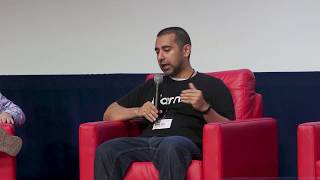
Panel interview (Dec 2017) with Balaji Srinivasan and Fred Ehrsam covering Earn.com and the "earnable" token. Balaji explains the "idea maze" concept and situates Earn.com's design in crypto history: moving from mining (earning for computation) and purchasing tokens (capital) toward earning tokens for labor. Earn.com is not running an ICO; it issues ERC-20 tokens to users for actions like verification, completing tasks, onboarding/referrals. They implement a growth incentive where each time the user base doubles the token reward halves (early users receive more). Discussion also covers Bitcoin as "digital gold," centralization risks from concentrated Chinese mining, tradeoffs between proof-of-work and proof-of-stake, current Earn.com use cases (paid-email outreach, market research, paid installs), and a plan for progressive decentralization (federating user data via paid installs/paid OAuth, eventual migration to decentralized storage). answers[ {"question":"Is Earn.com's token an ERC-20 token?","answer":"Yes — the earnable token is launched as an ERC-20 token."}, {"question":"How does Earn.com distribute tokens (ICO or other)?","answer":"Not an ICO — tokens are distributed for labor (signup, verification, completing tasks, onboarding/referrals)."}, {"question":"What incentive rule ties token rewards to user growth?","answer":"Every time the Earn.com user base doubles, the token reward halves (early users receive larger allocations)."}, {"question":"When/where was this interview recorded?","answer":"December 2017, Token Summit II (YouTube video)."} ]
Let's see if this works. All right. Good, good. Yep.
Cool. So you came up with the concept of the idea maze, right. Which I think is especially important in the blockchain world because there's so many ideas happening so quickly and so much to learn. So why don't you take us down your own kind of personal idea maze in this space that's led you to where you are now with Earn.com?
Yeah, sure. So the idea maze, for those of you who aren't familiar with the concept. So the basic concept is you might have a business plan like, hey, let's do music on the Internet. There's many permutations of that. Are you doing it like a Napster kind of thing? Are you trying to do it like a Spotify type of thing? Are you doing it like a YouTube type of thing where you're doing music videos, not just music. And the various permutations, some of them lead to failure modes and others lead to large exits, like in the case of YouTube. And it's not completely obvious at the beginning, you might have a broad concept of let's do music, but the details really do matter, and some doors open and some don't. Over the last couple of years, prior to the rise of Ethereum and the whole token space, the main things that worked in crypto were A, Chinese mining and B exchanges. And now we've got a larger set of things that are starting to work. But that's kind of like the history. And of course, just holding Bitcoin itself up until early this year and holding Ethereum now, it's now possible for those folks who've been working on applications or had application engineers for a while to actually make those things work. Which brings us to what we're doing with Earn.com so now we've got pretty good traction. We're growing quickly. And the idea is that you can now get digital currency by replying to emails, completing tasks. And if this gets to very large scale, then the idea is that first you mined Bitcoin and you earned it for computation, and then you bought tokens for capital, and now you can earn digital currency for labor. So it's like a third way of issuance. And actually you had a kind of a quote on this like a year and a half ago or something, which I thought was good.
Yeah. So I mentioned at the start, kind of we all have our own personal bias. I'm definitely biased to this product as a user, but also as someone who's just thought that there's kind of a certain segment of people in the world that want to buy and sell digital currencies, but perhaps an even broader segment of people kind of globally that want to earn. And so you've kind of had this product, right, for about a year now with just bitcoin. And now you're tokenizing. So talk a little bit about that. And specifically I think, like, why tokenize? I think a lot of people in the room, possibly, and even myself for a while thought it was just about bitcoin, right. And didn't necessarily see a world where there's thousands of potential tokens. But it's becoming increasingly clear that we.
May see a world like that.
But why specifically for your product, do you think?
Yeah, so why for us? And then why in general? So we actually, if you go to earn.com token, you can kind of look at the white paper. It's up there, it's about 70 pages, so you'll finish in a few minutes. But basically we're not doing an ico. So we're not selling, you know, tokens to the public for capital. Instead what we're doing is we are, rather than distributing tokens for capital, we're distributing them for labor. So by signing up, by getting verified, by completing tasks, by onboarding others, by referring senders of tasks to the network, we issue you tokens for doing those things. And as the network grows in scale, you're now a stakeholder in the network. And this is sort of similar to people who said, hey, what if Facebook could have given half of its value to its users? You know, that would have been quite a lot of money that I would have given to folks. And you know, technically it wasn't possible to do that for many years because you had international users, you had difficulties associated with that. But if what we're doing works, it'll then be a new way to bootstrap and scale social networks and two sided marketplaces. And so then that's a use case for tokens, which is not raising capital, but actually customer and sender acquisition, which is interesting. So that's what we're doing with the earnable token. And that's why we call it the earnable token, because it's earnable. And then more generally in terms of the space at large, yes, for a long time, folks, Brian Armstrong, myself, others were basically very pro bitcoin. We're still pro bitcoin. But I think it was really around late 2015, early 2016, when it became clear that the scaling issue was not just a few months kind of thing, but that it represented a deep philosophical split that was going to endure for some time. And I think what that did was it basically roughly resulted in one coin, one application. Right. So I think Bitcoin is a lock as a digital gold in an interesting sense. Actually the fee issue may contribute to that because the more bitcoin that becomes unspendable. So something like 57% of balances are unspendable in Bitcoin because the fees are too high. I've seen a stat on that. And you know, that varies because fees go up and down and there's periods where those balances might actually be spendable. But let's say there's some percentage that's unspendable. Paradoxically, that takes supply off the marketplace and actually increases the price. And so for those folks who are, you know, like into bitcoin as a digital gold, that's good. Another thing it does is it discourages you from just sending a transaction in a short period of time. Instead you really want to think about whether you want to do a bitcoin transaction and then you time it, you know, four days in advance or what have you. And you wouldn't want to do it in in time fashion. So then that means you've got a very high time preference. You're willing to send it only after a lot of judiciousness, a lot of consideration, not right now. So discourages impulse purchases. For those reasons, Bitcoin becomes a lock as digital gold. But other applications move to other coins.
And I think before you've had some pretty provocative thoughts on kind of China and particularly Chinese mining and that kind of impacting other coins, other consensus mechanisms, things like that. What are some thoughts there? And has that kind of impacted your decision to kind of move a bit away from Bitcoin for Earn.com?
Yeah, sure. So I took over the company in mid 2015 and around that time Chinese mining was really, really scaling. And I have a lot of respect for what they did over there. It's economically possible to do things in China that are basically not possible in other countries. And I think that actually the demonization of some of them has gone way overboard. I don't think Jihan is a bad person or anything like that. I don't think the blockstream guys are bad either, for what that's worth. But with respect to the Chinese mining situation, just due to the fact that there's certain economic factors that make them basically the world beaters, you have concentrated a lot of mining power in basically One country, and that country, China has shown a willingness to go and shut off protocols and shut off applications. Like Facebook is blocked and shut and you know, Google is blocked in China. And they have the sophistication and they have the will at the firewall level to go and introdite packets and so on. They've got this doctrine of so called Internet sovereignty which says anything you view on the Internet within China is ultimately subject to their jurisdiction. Every packet that crosses their borders is like a physical packet that crosses their borders. They assert the right to like a customs agency, intradite that. And so I think, you know, especially given the shutdown of all Bitcoin and you know, token exchanges in China this year, it's quite possible, maybe even likely that at some point they're going to go and mess with mining there. Right. That could be nationalizing it. It could mean acquiring the miners, it could mean directing them to do malicious mining, it could mean many different kinds of things. But I do think that's one of the probably top three vulnerabilities I think of for the space now. It's possible for them maybe to open up mining overseas, but that's something that's a large capital investment, it's not flexible. That brings us to things like proof of stake, if you jump into that. Yeah.
So what are your thoughts on kind of Ethereum proof of stake? And it's an interesting kind of topic because what I found, as I'm sure you have, is kind of in the early days of Ethereum, a lot of the smartest Distributed systems PhDs in the world as well as a lot of the kind of die hard bitcoin developers thought that proof of stake basically wasn't possible. Right. But there's been a lot of progress on Casper on Ethereum and Tendermint and some other proof of stake systems. And especially in a world where proof of work mining is potentially dominated by certain countries, it seems an opportunity could be opened up for proof of stake. So what are your thoughts there?
Yeah, so I had a write up a few months ago on quantifying decentralization. And the idea is that when people talk about whether a system is decentralized, there's different subsystems that they look at. For example, Bitcoin or Ethereum you can look at, okay, how many miners are there, how many different countries are they in, how many exchanges are there, how many different countries are the exchanges in, how many wallets are there and nodes and so on and so forth. And often what you'll see is people rhetorically I've got examples of these. They'll say, oh, it's not decentralized because mining's only in one country, or Ethereum's not decentralized because Vitalik basically controls it, or X or. Yeah, and so in a sense, if any subsystem is centralized, that's a choke point. And then the system becomes centralized. And I don't think it's a coincidence that if you look within Bitcoin, the two, arguably, at least by this metric, this modified Gini coefficient kind of thing that I published, at least by that metric, or things that are related to it, the two most centralized systems in Bitcoin are the ones that have been going to war with each other, the core developers and the miners. So it would be hard for nodes or for Holders to go to war with each other because it'd just be a melee of everybody shooting at each other and no one knows who each other is. Right. So you can only even have that conflict if you've got, you know, centralized kinds of kinds of pieces. But with proof of stake, what's interesting about that is rather than having all the decision making concentrated geographically in one place, it's distributed throughout the world. That's the advantage of it. The disadvantage of it is, you know, there's the whole state grinding thing, which, you know, folks like who are working on Casper have been working on. And there's also the fact that unlike proof of work, to my knowledge, there isn't an algorithm you can just apply to a proof of stake chain that will say, okay, this is the longest proof of work chain in the absence of reference to a third party. And by that what I mean is you can actually download the Bitcoin blockchain and you can look at every block and you can calculate roughly how much hashing went into that. And that gives you an absolute ruler in terms of the difficulty embedded in the chain. Whereas if each block is approved by just a certain number of holders, there's no external computational metric, there's no external ruler that you can apply. So that means potentially there's vectors where it could be more subject to attack. So I don't argue that one is better than the other in all cases. I'd say that for this kind of attack, like a nation state based attack, proof of stake may be better. For another kind of attack, proof of stake may be worse. And I'm happy to see different kinds of approaches being applied.
Got it. So maybe Moving back to Earn.com and specifically the earnable token. So you're Launching this as an ERC20 token, is that right?
Right.
Maybe talk a little bit about how you're driving usage of the product or driving kind of distributing tokens to drive usage of the product.
Right.
Because as you mentioned, this is not an ico. I think most people in the ecosystem that are launching new projects right now are kind of optimizing for all this interest in tokens by raising a lot of cash. Right. And Bitcoin didn't raise cash.
Right.
Bitcoin kind of launched a system and had an incentives kind of mechanism and distributed coins and bootstrapped it that way. And so maybe talk a little bit about exactly how you're doing that and some of the things you're thinking about.
So raising capital, it's not a bad thing. Ethereum did the first ICO. They raised 25. At the time, it was considered enormous amount of money and whatnot, and they very well with that. But what we're doing is something where it's been talked about a lot, but I don't think people have actually implemented it, to my knowledge, which is every time the user base of earn.com doubles the token reward halves. Okay, so what that means is that you have a strong incentive to just go and sign up immediately and get your earnable tokens, because in the event that the thing actually works and we double many times, you will have a very large stake in the network relative to folks who are later on. It's as if, for example, if you take Facebook, if Facebook had split its equity with all of its users, Then that'd be 2 billion users, 250 billion divided among 2 billion users, $125 for every man, woman and child on Facebook. But in practice, it wouldn't have split it equally. It would have wanted to have given the first 10,000 and 100,000 and million and 10 million people more than the billionth user, because these folks contributed more to the network effect. And now tokens aren't equity. But what this does, though, is when you're building up a network, you can actually allow people to get a piece of it early on, not in exchange for capital, but in exchange for labor, such that if the thing becomes of a large size, then just by clicking a few buttons early in 2018 or late in 2017, they've got something that's of great utility in the future.
So do you think we're going to see in 2018 more thinking about kind of this approach as opposed to the massive kind of cash grab up front to fund product development?
If you Take the pie chart for token distribution if what we're doing works and we'll probably know that by like late Q1 or Q2 or thereabouts. So right now the system is based on Bitcoin. You can go and sign up for it and we're going to flip a switch and we're already having people in the beta to flip you over to tokens, so you can mess around with that and you'll be grandfathered. So depending on the order in which you sign up, then you go and get your tokens. So we'll know if it works probably by mid next year, we'll be able to see it. And I think if you take the pie chart of any given token, you've got 100% at the beginning. And people I think will allocate some fraction of it for selling in an ico, some fraction for maybe an airdrop, some Fraction for an Earn.com style bootstrapping and so on and so forth. Right. So each of these are new ways of kind of using like the pool, in addition to the traditional ways of, you know, like allowing it to be mined or what have you got it?
And in terms of how the products are being used right now, you know, like what are some use cases? Email is the obvious one. Lists maybe talk a little bit about kind of. You've got lots of users right now and lots of traction. So talk a little bit about that.
Yeah. So if you see us on Twitter, a lot of folks tweeting about how they've been making money and the fundamental. So kinds of pitches or things you'll see on there. So for users they have wanted to. One of the most popular queries for a long time has been make money online. But there have been very sketchy sites that allow that. But it's an eternal human desire to make money online for senders. Actually, many companies want to send mass cold emails. And if you Google the term like buy email lists, that's a very popular desire as well. But people usually don't want their emails sold because they don't get any cut of that and there's no consent associated with that. So if you put those two desires together, make money online and buy email lists, you actually have a match made in heaven where you're selling something that is not that dear to you. Right. You're basically selling a minute or so of your time, but it's extremely valuable to the person on their side. So the kinds of groups that are using it. So certainly lots of tokens. So I don't know, close to a billion dollars worth of tokens have sent out messages, blasted folks on our list, because we've got lots of crypto people. So that's a major application, folks doing market research. So large consulting firms and advisory firms that you've heard of send out things to go and talk to 500 biotech executives and then pull that and turn that into a report that they can then go and resell and they get response in 24 hours. Or if you're a salesperson, you go and you blast out to a thousand engineers and you say, hey, are you using containers in production? And let's say, I don't know, 170 of them say yes. You then retarget them with a specific request for an appointment or something like that. So that gives you some of the examples. Basically, you can send an email that includes like a survey or task, get people to complete that, and then retarget based on that. So it allows some interesting kinds of things.
Got it. Okay, so last question. We've got a few minutes left. One kind of thing people might say about this type of token approach is, well, it's centralized, right? It's not really decentralized. And I know you have some thoughts there on kind of how you're building towards decentralization over time. So how do you think about that?
Yeah, yeah. So I think that trying to jump immediately towards full decentralization is challenging. You have to do what I think of as progressive decentralization. And so, for example, even like Ethereum last year with the dao, there are issues with being fully decentralized. They needed to actually make a change. And the fact that the system was centralized enough to allow them to make that change allowed that to happen. Similarly, in the early days of Bitcoin, there were many kinds of hard, forky type things. There's a bug that allowed people to coin a lot of Bitcoin, and because it was basically a small group of developers, they could effectively push a change through. So I think in the early days of a system, it's relatively hard for it to be fully decentralized from the beginning, because decentralized would mean immutable, and immutable means you can never adapt it or change it. With that said, what our plan is for decentralizing over time is one of the tasks when you're blasting these emails or tasks to users. One of the tasks you can send is a pay to install type task. Right? So if you've got a mobile application, you can get tens, hundreds of thousands of installations by just clicking a button and blasting out to lots of earned.com users and asking them to hey, install your iOS app and install your Android app. And the thing about that is it's very similar to a very successful ad format that's run on Facebook for a long time, which is paid to install the app, with one critical difference, which is the person on the other side gets paid to install it, right? Not just Facebook. So the reason that's related to decentralization is every time pay to install is run, that fraction of users, let's say 40,000 users, say yes to that. You've just now effectively copied 40,000 users out of the database into your own database, which partially federates the database. And you can replicate that where it's not just pay to install, but like a paid oauth, where again, out of let's say 100,000 people, 30,000 will grant you permissions and you can blast them with a task that says, hey, can you try out my app and grant me these permissions to your data? Right? So by doing something like that, any developer with sufficient capital and consent can then just get hundreds of thousands of users just by sending out tasks@earn.com and that will federate the database. And then over time, we might be able to move to something which is fully decentralized, like potentially like an IPFS or filecoin type, you know, relational type data store, on top of which we have a relational database. But one thing I would just say is that it's not that easy to decentralize a user database as opposed to a transaction database. Bitcoin and Ethereum are both transaction databases. User databases are different, qualitatively different.
So, got it. Okay, that was fun. Thanks.
More from Balaji



34 - Network State Conference 2025 - Fireside with Vitalik and Balaji on Zuzalu and d/acc

33 - Network State Conference 2025 - Fireside with Amjad Masad of Replit and Balaji





06 - Network State Conference 2024 - Fireside with Naval Ravikant and Balaji Srinivasan