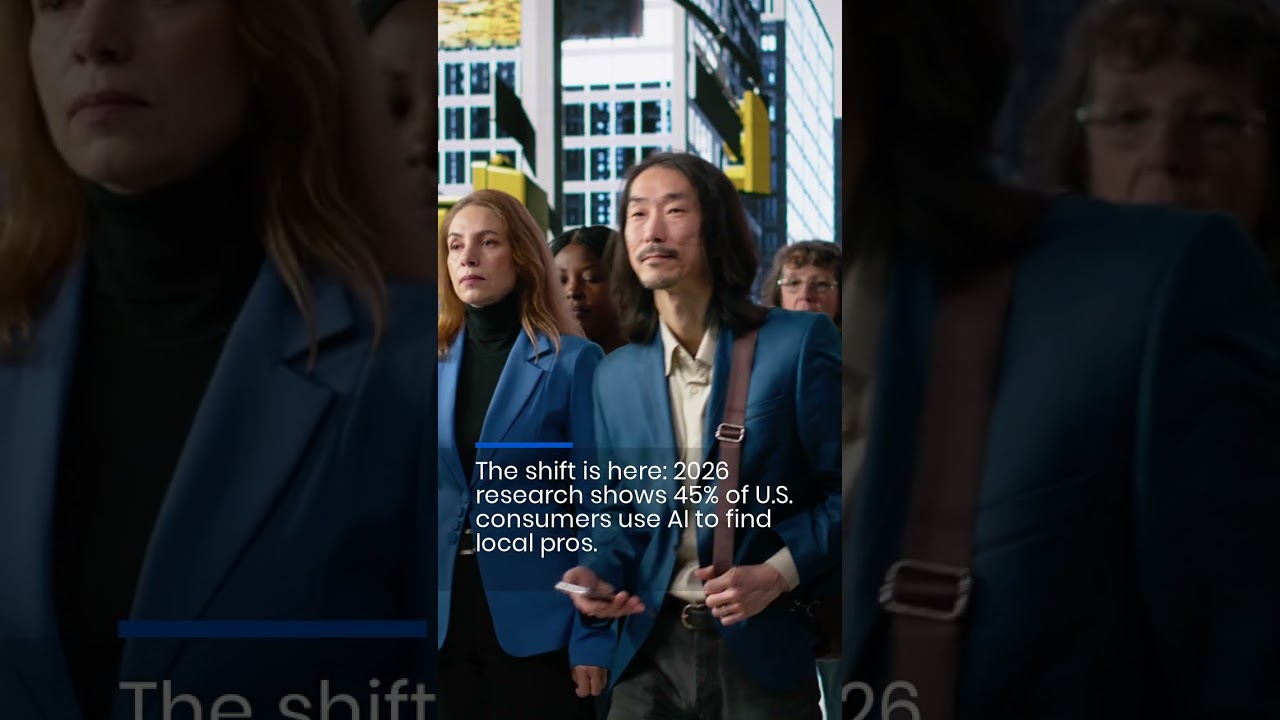
In this presentation Barbara Drady explains that the way consumers discover local businesses has shifted from traditional search to AI-driven recommendations. She cites data showing that roughly 98.8% of local businesses are invisible to AI, while over 45% of consumers now use AI to find services and 60% of queries are answered directly by AI (zero‑click). Because AI only recommends one to three brands per query, businesses that lack AI trust signals lose traffic and revenue, with click‑through rates dropping 61% on AI‑generated overviews. Drady outlines how AI decides whom to recommend: it first evaluates trust (experience, expertise, authority) and then semantic relevance, requiring clear, structured, conversational content. Inconsistent data, vague content, slow sites, and lack of off‑site authority (media mentions, brand longevity, owner visibility) erode trust. She contrasts an optimized Business A with a poorly represented Business B to illustrate the impact. The talk concludes that AI visibility is built on a technical foundation, content clarity, off‑site authority, and personal expertise; a weakness in any area nullifies the others. With nearly 99% of competitors invisible, businesses that address these factors can capture a large share of AI‑driven customer discovery.
Chapters
The way customers find businesses has fundamentally changed. This is about more than just Google. Right now, a shocking 98.8% of local businesses are completely invisible inside AI recommendations. This is because the starting point for discovery has moved. More than 45% of consumers now use AI to find a local service. At the same time, traditional search volume is dropping, declining by 25% and more as users turn to AI for answers. If you're invisible to AI, You are becoming invisible to customers. We'll show you why this is happening and what it means for you. So what happens when customers ask AI instead of searching? The entire field of opportunity changes. First, AI creates zero-click experiences. Around 60% of searches are now answered directly by AI, meaning no click to your site. Even if you are considered, the space is incredibly limited. AI platforms typically recommend only 1 to 3 brands per query. The result is a fierce competition for a few top spots. Being left out means you aren't just losing traffic; you are losing revenue. We have the data. Businesses not prepared for AI see huge traffic losses, with click-through rates dropping 61% on queries with AI overviews. The consequences are clear, but the cause is less obvious. So, how does an AI decide who gets seen and who gets ignored? The primary answer is trust. AI must trust you before it recommends you. It measures this using signals for experience, expertise, and authority. After trust, AI needs to understand context. This is semantic search. It's about the meaning behind a query, requiring you to explain and answer topics completely. To feed semantic understanding, Your information must be clear and structured. Vague content makes you a risky recommendation. The need for clarity extends everywhere. Inconsistent data across your website and business profiles destroys an AI's trust in your reliability. Because users ask AI questions, your content must provide direct answers. This means writing for conversational queries, not just keywords. So AI visibility isn't magic. It's about being a trustworthy, consistent, and clear source of answers. But what does this look like in practice? Look at the other side. What happens when you are visible to AI? Amazon's recommendation engine is responsible for 35% of the company's total sales. Now, let's revisit those huge traffic losses. Imagine 2 businesses. Business A is optimized. Business B has inconsistent online data and vague content. When a user asks AI for a solution they both offer, the AI cannot verify Business B. It trusts and recommends Business A, leaving B with nothing. This is also about user experience. If users click on your site and leave because it's slow or confusing, AI learns you are a low-value result. Given these mechanics, is your business currently built to be trusted and recommended by AI? Because there are even deeper factors at play. AI systems have a built-in bias, They inherently favor established brands because longevity and media mentions are trust signals new companies lack. This means your presence off your website is now just as important. Third-party mentions and press act as external validation that you are a real entity. Here's a factor most businesses miss: the visibility of the owner. Their personal credibility multiplies the company's trustworthiness to an AI. For new companies, this creates a difficult cycle. You need visibility to build authority, but AI gives visibility to those who already have authority. We've seen the user shift, the AI's mechanics, and the hidden biases. Now, let's connect these pieces to see the complete picture. Recall the AI's bias for established brands. The owner's personal visibility is a powerful shortcut. It borrows trust from other platforms for your business. Let's return to the 98.8% of invisible local businesses. They are unseen because they often lack the offsite signals and consistent data that build AI trust. The rise of the zero-click experience is a roadmap. It tells us that becoming the direct, quotable answer through conversational content is how you win. AI visibility is the sum of your technical foundation, content clarity, offsite authority, and human expertise. A weakness in one area negates the others. The evidence is here. The customer's path to purchase now starts with AI. The assertion is a reality: invisible to AI means invisible to customers. While nearly 99% of competitors are invisible, this presents a huge opportunity for those who act. Understanding how AI sees is the new advantage. This isn't about gaming an algorithm; It's about becoming a better, clearer, more authoritative source of information. What helps AI helps your customers. The most important question today is not, how do I rank on Google? But, am I visible to AI? Your future growth depends on the answer.