All themes and symbolism in "Animal farm" (1954) explained
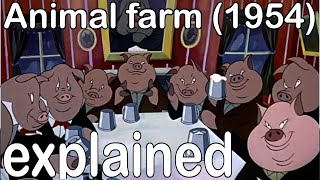
A narrated YouTube explainer (by Barkus Luckey) that analyzes themes and symbolism in George Orwell’s Animal Farm with primary focus on the 1954 animated adaptation, comparing film scenes to events and figures from Russian/Soviet history (Tsarist Russia, 1917 Revolution, Bolsheviks, Stalin/Trotsky, WWII) and ending with discussion of the film’s intended message and propaganda context.
Chapters
Animal Farm is a book. You might have heard about it. It's a pretty famous one. It was written by George Orwell who also wrote 1984. It was released right as World War II was coming to a close and later there would be two movies based on it, one animated movie from nine years later and another movie which was live action and made in 1999. I haven't seen that one, so I'll say nothing about it. Though as I've heard the story goes on for a bit longer. On the surface it's a book about animals that grow tired of humans taking off them with without giving back, which then rebel and create their own farm which eventually becomes just as bad. However, at this point pretty much everyone knows that it's a thinly veiled retelling of the story of the Soviet Union. Remember that in the 50s when this was written, the Soviet Union was only around for 20 years or so and most people, including Orwell, knew what happened because they lived during it. So the usual story is that Orwell wanted to tell the peoples of the world that communism sounds really good in theory but but that in practice it always returns to the same system it was before. There are problems with this analysis among them that it's quite shallow, but apparently the CIA didn't think so because they helped sponsor the animated movie as anti communist propaganda and apparently the book is still required reading in schools in the US or something like that. The US teachers of course tend to stick with this rather obvious surface level explanation that everything moves back to how it was, but it doesn't have to be interpreted that way. It could also be seen as anti authoritarian. Many claim that Orwell himself was a socialist and that he couldn't have been anti communist because of that. It seems that his beliefs depend on what definition of socialism you are using. It doesn't seem like he was a fan of revolution, but he wanted healthcare and apparently in America that makes you a communist. But that's not the point of this video. The point is to explain the real life parallels the book was based on one by one. Please note, I will mainly talk about the 1954 movie, though I have read the book and I will mention some parts from it when I feel like it's an important change. That being said, let's go. We start off with a narrator explaining that the Mana farm is not doing well. It used to be a good farm, but the farmer Mr. Jones changed and now he treats his animals badly and that the farm is in a bad state because of it. This Makes the animals unhappy. And this is our first parallel. The farm is supposed to be the Russian Empire, around 1900. Once great, like during the reign of Peter the Great, but now not as much. And. And the ruler at the time, Tsar Nicholas ii, was widely seen as an incompetent and bad ruler. For example, he lost the Russo Japanese war, refused to give the new parliament any power, and oversaw multiple human rights violations. Like when he ordered his army to shoot into a crowd of peaceful protesters. The enemies are supposed to be, in the Marxist sense, the working class. They are the ones who work by producing things in opposition to Farmer Jones, who doesn't work and just takes the things the animals produce as his. If you are familiar with Marxism, this is quite an obvious parallel to bourgeoisie and proletariat. The animals are unhappy and assemble at a big meeting, the first meeting of all animals. We are told this could be a reference to the first Internationale, where the working classes of the world met for the first time. But there isn't much to go on. There we learn that this hawk is the oldest and wisest of the animals. He called the meeting and he tells them about their condition. How the eggs the hens produce are taken from them, how the horse will not live to retire once he becomes weak, and how the pigs will be slaughtered. He asks them if this is just and if it has to be this way, and he says no. He explains that the humans produce nothing, yet they take it all. He tells them of his dream. A world without humans, where things made by animals are only used by animals, where they are not slaughtered or stolen from. The farm is rich enough in grain for all of them to be fed, but the greedy farmer keeps it all to sell for a profit. He says they must remove the farmer and create a better farm for all. He also explains that they must be watchful, that they may never become like the farmer, that they must always be friends and never enemies of each other. This is called foreshadowing in the book. He gives them some commandments at this point, but they only show up later in the movie. The pig then dies in front of everyone. Pretty dramatic. This pig represents multiple people at once, but it's closest to Karl Marx. You know, the guy who spent his entire time pointing out how the working classes were stolen from, how a better word would be possible, even though he knew he wouldn't live. Live to see it. That one. The hawk could also more widely describe Marxism in general, the entire philosophy that is only concerned with informing people about their condition. If you want to Learn more about Marxism. Click that link here. Anyway, because of the hawk, the enemies now know of their condition and the idea that a betta farm is possible is planted in their heads. A short time later, the farmer forgets to feed the animals and they break into the food store. And when he threatens them with the whip, they start a revolution and chase him off. This is probably a reference to the fact that the driving force behind the Russian Revolution in 1917 under Lenin was hunger. The Tsar was busy spending lots of money on his army to fight in World War I and his people had to go hungry. So they overthrew the monarchy in the same way their animals are overthrowing the farmer. The farmer then flees from the farm for a short time and comes back with a group of fellow farmers who want to take the farm back. This is the Russian Civil War. Right after the Russian revolutionaries who were called Bolsheviks took power, the Tsar and his armies fought a civil war to keep the country in the hands of the feudal landowners and capitalists. Matter of fact, four nations also sent support. They were Japan, France, the US and the uk. So those friends the farmer is bringing along are fellow capitalist countries that seek to suppress the working class of Russia. Again, the book actually makes this point by telling us that the reason the other farmers fight on Joes side is because they are afraid that their animals might revolt as well. After a brief battle, the animals are victorious, the revolution is protected and the humans are fleeing. But all is not well. A pig, Snowball. Remember that one? It represents an important person was hurt and the dog was killed in the fight, leaving young puppies which need to be cared for. This pretty obviously represents the death of the Civil War and the orphans left by them. After the Civil War, 19 million people were dead and depending on who you listen to, there were between 2 and 10 million orphans. So it makes sense for this movie to acknowledge that the animals then destroy things that remind them of the farmer. That's the butcher's knife, the whips and the axe used to kill the chickens and so on. All of those things are then burned. This probably represents the destruction of Tsarism. After the Civil War, all over Russia statues and monuments to monarchy were torn down and a city named after a tsar, Petrograd. Nowadays St. Petersburg was renamed to Leningrad after the leader of the revolution, Vladimir Lenin. The enemies then inspected the house of Mr. Jones. They are careful about it and they agree that the house is no place for them. The house could represent different things, but I believe it's the powerful Russian state in general. After the Revolution. Many revolutionaries swore never to abuse power like that, never to centralize the state like the Tsar did, and never to take advantage of positions of power. You will see more about why. I think that in a bit. For now, just take it that the house represents the bad things about Mr. Jones, as well as bad things a centralized state is capable of. We then see another pig, Napoleon, take the new orphaned puppies to a secluded place, apparently without the other animals noticing it. In the book, he just tells everyone he is caring for them and they believe him. I don't know why the movie Napoleon had to do it in secret, but whatever. This probably represents the way the Bolsheviks took care of the orphans in Russia. Remember, there were many of them and they were taken care of by the state, or more accurately, the Bolshevik party. That will be important later as well. The animals then write down their laws, most notably four legs good, two legs bad, and all animals are equal. In the book, they got these laws from the old hawk who died earlier. The pig writing down the laws is Snowball, and I think it's time to talk about what the pigs represent. Earlier we learned that the pigs were the smartest of the animals and that they are the ones who led the revolution. The book makes this more clear by even telling us that the other animals are too stupid to even learn to read while the pigs manage to learn it. So the pigs represent the Bolshevik party, and initially that sounds really patronizing to the rest of the Russian population. He's always seriously stating that the Russian populace was so stupid. Yes, he is an answer to say this, but he was kind of right. Only about 20% of the population could even read, and education standards were pretty low. So it's not a stretch to say that the Bolsheviks were were smarter than most of the Russian population. Smart, meaning educated. In this context, there are two individual pigs we care, Snowball and Napoleon. Snowball is the leader of the revolution and Napoleon is high up there as well. And since the pigs are the Bolsheviks, it's pretty easy to conclude that Snowball is supposed to be Vladimir Lenin, the leader of the Russian Revolution, and Napoleon is supposed to be Stalin, the successor to Lenin. This will be more obvious later. The animals then go back to work now, free from the exploitation of Mr. Jones. And we can see they are led by pigs in every step, much like the Bolsheviks who took power in order to lead the working class into a better future. That's what Leninism is about, after all. Snowball instructs the animals how to work better, and we are told that the Animals are more motivated and stronger than before, which increases the productiveness of the farm. And yes, after the revolution, the output of the industry increased a lot as workers were more motivated. Now that they had won, we see that the farm is prospering. Now that Jones is gone, the food stores are full and the fields are well maintained. With the hirestan, the animals meet up to declare resolutions for the future. We also learn that it's always pigs that suggest resolutions. In the book, we learn that while everyone is allowed to suggest things, the other animals can't think of anything, so they always agree with the pigs. This again is a parallel to the fact that the Russian populace didn't have the education needed to take part in the government. At this point, Snowball talks about wanting to spread the animal revolution to more farms, to liberate all animals from their oppression. And this could of course be generic Marxist talk about the workers of the world uniting. Or it could tell us that Snowball is not just Lenin. Snowball is a mix of Lenin and a whole lot of other Bolshevik leaders, most notably Trotsky. Trotsky was big on starting revolutions everywhere. Snowball sends birds to tell the animals of the world about the animal farm to spread their ideas of the revolution. We see animals ignoring them. We see animals being scared of them. And we learn that animals who are having a bad time are listening to them. This represents how the working classes saw the revolution in Russia. Some were scared by such a change. Some didn't think it was going to work. But the ones who were having a bad time were inspired to start their own revolutions. Snowball then begins the education of the animals. In the same way the Bolsheviks started educating the Russian people, he has varying success. Some animals are smarter than others. I have no evidence of this. But it is possible that Orwell thought that some people are just too stupid to ever be educated. If he meant that, I have to say I disagree with that. We see Snowball and Napoleon both making plans for the future. Snowball tries to fix the power problems of the farm. And we see Napoleon watching him as he is doing it. During winter, there are hard times at the farm and Snowball tells everyone about his new plan. He says at first they will have to work harder to build a windmill, but because of the electricity it provides, they will be better off eventually. He promises them a three day work week. Napoleon opposes his idea and says it's not possible. And when the other animals agree with Snowball, Napoleon calls the dogs he took care of before to hunt down and kill Snowball and This is why I don't think Snowball is just Lenin. Because Lenin was not killed by Stalin. Trotsky was. And of course, we've established before, the dogs are the orphans of the civil war. What happened was that Napoleon trained them to be loyal to him, not to the revolution, but to him personally. And this is not quite accurate to reality. The orphans of the civil war weren't taught to be loyal to Stalin and they were taught to be loyal to the party itself, not the revolution, to the party. And when Lenin died, Stalin took control over the party and used those new loyal party members on his side, among other things, for assassinating Trotsky. Press F. By the way, I've tried talking my way around it, but it's pretty obvious that Orwell was pro Lenin and anti Stalin. I'll talk more about that in the conclusion. Just know that the movie very much tries to make Napoleon look pretty bad. Napoleon then makes a speech condemning Snowball and saying Snowball wanted to bring Farmer Jones back. This probably represents the fact that leftists keep calling each other counter revolutionaries. Napoleon then abolishes the meetings and says that he will make their decisions. I have done loads of research and there is nothing to show that this is accurate. The Soviet Union had meetings of the people since the revolution. It was known as the Congress of Soviets and it was an assembly of local representatives of the people of the Soviet Union, that being representatives who were sent out by Soviets. A Soviet was a workers council. For example, all fishers in Leningrad would be part of the Leningrad Fisher Soviet and they would send representatives to the Congress of Soviets which then made laws. Matter of fact, the Congress was the only body in the USSR able to make laws. From the movie, you'd assume that evil Stalin just ended the democratic meetings of the Congress and seized power for himself. But that's not true. The Congress of Soviets was in power until 1936, which is 14 years after Stalin took power. And even then its functions were from then on performed by the Supreme Soviet of the Soviet Union, which was elected just as well and was the only power in the state that was allowed to make laws. So the movie showing Napoleon Stalin seizing power and making laws on his own seems to be based on nothing. It just didn't happen that way. I'm not saying that the structure of the Soviet state was optimal, by the way. I'm just saying it wasn't a dictatorship. There is a video to be made on this. Where was I? Oh yeah. Napoleon seizes power and abolishes the meetings when the enemies protest he shows them Snowball's plan and says it's his own. The plan, by the way, represents the first five Year Plan as well as other economic plans. The Bolsheviks told the Soviet people to work hard, so they may have to work less hard in the future. Promises like the three day work week were made at this time. By the way. The fact that Napoleon presents Snowball's plan as his own is probably a reference to the fact that the five year Plan was more of a Trotsky idea than a Stalin idea, which was taken by Stalin and presented as his own visionary plan. Say what you want about Stalin, but he knew how to make himself look good. The animals agree to build the windmill and construction starts. We see the pigs overseeing the work with the other animals working. We also see Baxter the horse, who we are told is the strongest animal of them all. The animals have to work long shifts with little food, while the pigs get no hard work and lots of food. Baxter is working overtime a lot. The movie makes a point to show us how important his work is. We then see that the pigs are sleeping in the farmer's house, which breaks one of the commandments. But when the other enemies go to check, they see that the laws have been changed. The book is actually smarter about this because in the book the enemies can't read and they are not smart enough to remember all commandments. So we when someone raises an objection, the pigs simply say that they must be remembering it wrong. We can see the first signs of Orwell's anti Bolshevism here. This is supposed to show that the Soviet government became more like the tsarist government it sought to replace. I'll tell you what I think about that at the end of the video. For now, I'll just interpret what Orwell meant, not what I think is accurate to reality. A trader comes to Animal Farm to trade with the pigs. They agree and inform the animals that they will now trade with the outside world. Not for gain, of course, but for. Well, they don't actually say. The hens are then informed that their eggs will be traded and that they must give them up. This is a reference to the Soviet Union opening up trade with the rest of the world. Until then, when a Soviet worker had worked, they could know that the fruit of their labor would go to the state which served the people and indirectly towards the revolution. But when trade was opened up, suddenly the work of Soviet workers could be used to increase the profits of foreign capitalists. This was seen as a mistake by many leftists and some would go as far as to say that Stalin sold out the Soviet working class. The chickens start a rebellion against the pigs. They deliberately destroy some of the food in store and they fight the pigs when they come to take their eggs. The pigs then call the dogs to destroy the uprising. The chickens lose quickly and they are all sentenced to death for acting against the revolution. I don't think this represents a single act of rebellion against the Bolsheviks. I think it represents the small ways in which some workers oppose the government. Like by working the bare minimum rather than actual rebellions. There were anti Soviet rebellions which ended similarly. Gronstadt comes to mind. But that didn't happen under Stalin, but under Lenin. The execution of the chickens is supposed to represent the increase in bloodshed in the Soviet Union. Stalin didn't tolerate counter revolutionary activity and the death penalty was used for such crimes. Napoleon then asks which animals are also on the side of the rebellion and and they are all put to death as well. I think this is supposed to show how Orwell thought that Stalin used intimidation to scare the people into being loyal. When the animals sing to mourn the dead, Napoleon says that the revolution is complete and that singing that song is now forbidden. This is pretty random as the song has not appeared in the movie at all. They have been humming, but that's not a song. Basically, in the book, the hawk at the beginning teaches them a song called Beasts of England, which is about how all animals of England as well as every other land, will liberate themselves. Throughout the book, Napoleon slowly phases the song out in favor of a new song which is about the greatness of Animal Farm. He never prohibits it, he just phases it out. I am telling you this because that's a lot closer to reality. During Marxist times, the main revolutionary song was the Internationale, a song that has sex in pretty much every language and which is about the workers uniting and overthrowing the state they have to live in. At the start of the Soviet Union. The Russian version of the Internationale was, was the official anthem and it was sung all the time, reminding the people that the revolution must be spread. But when Stalin came to power and the idea of socialism in one country became more popular, the anthem was changed in favor of the Soviet anthem we all know and love today. And the Internationale was sung less and less in favor of the anthem. This can also be seen as a sign of the Bolsheviks moving from a goal of global revolution to one of maintaining the socialist revolution they had. Then we see other farmers getting jealous of the money the farm is making and and deciding to kick the animals out. They refuse to accept the help of farmer Jones this time and they leave him in the tavern. He gets explosives anyway and sneaks to the farm. The animals are well prepared this time and they ambush the humans. We see Napoleon hiding and many animals, including Baxter getting injured in the fight. Eventually the animals fight off the humans again. During the fight, the windmill was destroyed. Now I'll let you guess what this represents. Here are the it was a capitalist army that attacked the Soviet Union in a large scale war in order to remove the Bolsheviks and return capitalism to Russia. It's World War II. It's the German invasion of Soviet Russia. We usually think about the Nazis in terms of their anti Semitism, but in the Soviet Union they were more famous for their anti communism. Nazis always spoke about Jewish Bolshevism and how it was destroying Europe and Germany and how socialism was a plot by the Jews and so on. So from a Soviet point of view, the Nazi invasion of the USSR was not just a war of genocide and conquest, but an attempt of a capitalist government to destroy the Russian Revolution again. And that was one of the expressed goals of the fascist leadership. If you are wondering why I am saying that fascists are capitalist, please watch this video of mine where I go into detail about that. After the battle we see Napoleon give himself a medal despite the fact that he didn't do any fighting. This is probably a reference to the fact that stuff Stalin was awarded many medals despite the fact that he literally didn't talk to anyone in the initial weeks after the invasion. The rest of the government had to guess what to do since Stalin wasn't giving orders at this time. Though to be fair to tankies, the real Stalin then successfully led the counter attack and defeated fascism. It's just that this movie is pretty biased against Napoleon. After the fight, the farm is in ruins, animals are injured or dead and the windmill is gone. This represents the state of ruin the Soviet Union was in after the Second World War. The industry was destroyed by the Germans and around 27 million people had lost their lives. The animals rebuilt the farm again. Baxter working hard despite his injury. We learn that the pigs are not needed to supervise anymore, so they just sit around all day. I'm pretty sure Orwell is trying to say that the Bolsheviks had outlived their usefulness after the Second World War. As the enemies rebuilt, Baxter becomes weaker but no less determined and one day tragedy strikes and he is injured heavily. The other animals expect Baxter to get a retirement for his hard works. The pigs have other plans. One day later, what seems to be an ambulance arrives and picks up Baxter. Only they notice it's not an ambulance. It's a death wagon from the glue factory. In the book, the animals don't know what it is because, again, they cannot read. But in the movie, they know. While watching this scene, I was wondering who would put a scene like that in a children's movie. And then I remembered it's from the 50s. They didn't know about childhood trauma yet. And then I wondered what happened to the poor people who saw this as kids. What kind of broken people would be produced by such traumatizing scenes? And then I noticed it's boomers. The years check out. The people who saw traumatizing things like these in their childhood were the boomers of today. And honestly, that explains so much. Anyway, Epic says that Baxter died naturally and that he wanted them to work hard and honor Napoleon. We can tell the pig is lying. This scene is not supposed to literally represent something that happened in the Soviet Union. I think it's supposed to be another instance of the evil pigs betraying the revolution and selling out the working class. I mean, the animals. We then skip ahead some years, and it's important to mention that Orwald was predicting the future at this point while he was writing, the Soviet Union was still in World War II, so everything that came after the second battle with the humans, he seemed guessing how the Soviet Union was going to act. We see that the pigs build a wall to keep their people in. That could be a reference to the Iron Curtain because it doesn't appear in the book since, again, that hadn't happened when Orwell was writing, but it appears in the movie, which was made after the Iron Curtain as a concept existed. So it's probably a reference to that. We learn that outwardly the farm was doing better, but that the animals were no better off than they were under Jones, with the exception of the pigs, who were much better off. We also see that Napoleon put images of himself everywhere. This is a basic critique of state socialism and state social the workers are not immediately better off than under capitalism, and the government becomes the new capitalists. This is a thing you hear a lot. I have some issues with it. More about that later. We can then see the pigs walking on two legs, wearing suits and acting like humans. This is again supposed to represent that the Bolsheviks supposedly became like capitalists. We can see that the pigs updated the commandment to all elements are equal, but some are more equal than others. And this is where the book ends, with the pigs becoming the New humans and the animals no better off. The pigs are said to be indistinguishable from humans at the end. And there the book ends. But not the movie. In the movie, the animals of Animal Farm, as well as the animals of the whole world, unite together to overthrow the pigs. Again, this is either a prediction of the future or a way to give the children's movie a happy ending. So that's it. That's the movie. Let's now talk about the message it's supposed to send. The surface level seems to be that communist ideas sound good in theory, but in praxis end up just as bad, if not worse, as before. This certainly is the interpretation American English teachers expect, and it seems to be the one the CIA used before funding it. But I don't think that's it. I don't think that Orwell tried to show us that socialism is worse than capitalism because if he wanted to do that, he would have shown the farmers in a better light. It's not a story of greedy animals removing their good leader in hopes of installing a better one who then turns out to be worse. It's the story of abused, hopeful animals who want to live in a better world. So there is obviously more to it than don't try socialism. Because Orwell goes out of his way to show that the farmer who represents capitalism is a bad person and an unfit ruler. Yes, he shows the pigs to be bad rulers as well, but. But I don't think he meant to imply that since the pigs are bad, they should get the farmer back. Among libertarian and anarchist leftists, the message is interpreted as opposition to authoritarianism. Since the pigs took the positions of power from the farmer, they became like the farmer since the position the farmer is in makes them make similar decisions. So the message an anarchist would hear would be that we must be careful to destroy these positions so this cannot happen again. In the movie. That would mean destroying the house and removing the positions of leadership. It is possible that Orwell tried to warn leftists of authoritarianism and that he wished for a more libertarian revolution. And among tankies, that's the small, committed group of people who think that we should learn things from the Soviet Union and that it was a good attempt at socialism. Among them. The interpretation is quite different because to them it's just a one sided capitalist propaganda piece. And there is some evidence to support this. After all, it was funded by the CIA and it goes out of its way to make Stalin look bad. From the beginning it shows him kidnapping the puppies and it shows him as a coward and it straight up makes up things he never did, like when Napoleon prohibits the singing of the song and when he abolishes the Supreme Soviet. There is some outright misinterpretation of reality in this movie. You can take this to show that it's an anti Soviet propaganda piece from the 50s, or you can take this to mean that it's trying harder to tell a story than to be accurate. I could tell you my interpretation of the movie, but I'm sure someone would yell at me, so I'm not going to. I just say that state socialism is not the same as capitalism. I don't have time to elaborate on that because if I did, this video would never get done. I'll make a video about that at some point, trust me. I'll just say I was very surprised by the extremely high amount of historical references in a movie and that's about all I had to say. Thanks for watching. Why not leave a Like to show your appreciation and a sub to see more content of mine. I would like to say special thanks to my Patreons for making me make videos. And an extra Special thanks to arianjpatton and Genericist77 for your generous donations.
More from Barkus










Tim Ferriss: How to Learn Better & Create Your Best Future | Huberman Lab Podcast
