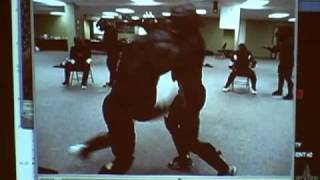
Tony Blauer demonstrates how instinctive protective reactions blend with tactical training during an attack. He uses the ASAP model to show that the attacker controls your initial response, so training must teach you to adapt and re-engage across primal, protective, and tactical phases.
Chapters
Now watch this. You miss an evolution where if the guy messes up, he still gets dropped because that punch will come around and clock him in the brachial. But what you'll see if you study this stuff is this. We've taken a primary initiation attack. We put guys in gear so they know there's penalty and, and there's danger if they don't pull off the move. The role player has his choice of what to do. Verbal is included in there. Remember the sucker punch drill and the origin of this whole system. Got a non violent posture with the officer on the right trying to talk the guy down. He gets up here, he doesn't know if it's going to be a tackle, a gun grab or a haymaker. Now watch this here. So this is just training, right? So it's choreography, it's all bullshit, right? Watch what happens to Sean Blair on the right. Sean's 165 pounds. Tom is 230. He jacks the punch. Look at Shawn's shoulders, what's starting to happen? Total flinch. But he's not flinching primally in the pure sense of just covering. He's engaging the guy protectively. But what you need to understand is this. When I say it's organic because it's physiology, it's all of everything. It's all three included together. This moment here is primal. This moment, that moment right there where his hand's getting in the turtle. Whoa. The hand's coming out as protective. Those two phases are a blend of an instinctive survival mechanism with the protective territorial protectiveness of get this danger away from me. This is where training kicks in. Watch this. Tom, can you see the energy of the role player? Something I always tell people. This is, hey, go pull out all of your self defense videos you bought over the years and watch them again. And only watch the role player. Call me up or send me an email. Tell me what you learned, okay? Because now watch Sean's hands. When Tom's forearm outweighing him by over 60 pounds, collides. Clink. Look at his arm. And now watch Sean's legs. Watch his axis go back there and his legs go back. But now he engages the guy right here outside 90 open hand cork screws him to the ground. Boom. He's on top of him where he can pump knees or slam a forearm into his throat. Tow. What were you going to say about asap?
One of the most important things about that ASAP model that trainers should be familiar with is that you don't get to pick as the good guy, whether you're going to be primal, protective, or tactical. Because remember, who controls the fight? The bad guy does. And that's very empowering. Because if you know that if the bad guy is really fast and explosive, a primal response may result, but you're still in that fight. You can continue to fight without going into that, you know, without slowing down your reaction time. You know that this is okay. Same thing with protective or tactical. Knowing that and understanding that will help you get back into the fight a lot sooner.
Does that make sense? That's totally different than the conventional training model that said, you will do this when he does that. That was the first demo that I did where you're saying, my complex motor skill will intercept your complex motor skill, even though you're starting first. And I'm defying all logic, reason, and physics.