Crew AUIS - Session 8 of 12 QualityMind Bootcamp
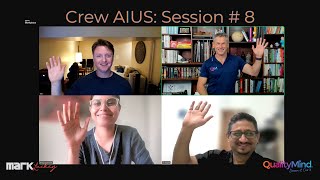
Barkus Luckey leads the eighth session of QualityMind bootcamp with Ken, Kalpak, and Mimi. They do resonant breathing, write letters to their future selves, and discuss app engagement and the mid-program slump. The focus is on pushing through discomfort and celebrating small wins.
Chapters
Today's session. So without further ado as I do that one, welcome to session eight of our 12 week transformation boot camp. Now this week as I touched on in our little prep materials is a little bit more relaxed and free flowing. And by that I mean it's going to be a bit more about sharing and how much everyone is willing to, to sort of put themselves out there and I guess let their guard down a little bit and see how we sort of go with this letter to future self part which is the main focus on what we are working on today. So quick look at the agenda which you would have seen in the prep notes, very slight modification to the agenda. New breathing technique. We're going to try for a bit of a laugh because I got quite interested in the different science around some of the breathing techniques, went down a little bit of a rabbit hole and discovered some work by Andrew Huberman who if I'm honest to date I hadn't heard a lot of reputable comments about what Mr. Huberman or Dr. Huberman had done. But the research around breathing techniques compared to meditation was absolutely fantastic. So then as per usual, we're going to go through the habit reports letter to future self exercise which is going to involve a little bit of group or one on ones in the work in the breakout rooms, then the usual sort of finish off and moving into the new sections. So this one here is a bit of a random one. So I've always been quite into box breathing and in amongst box breathing and in amongst all these controlled breathing techniques there's lots of different schools of thought and one of the ones that's come out that seems to have for the moment at least some really good scientific rigor around it is resonant breathing. And the basics of box breathing, just to recap is that in for four, hold for four, out for four, hold, hold on, empty for four, resonant breathing is in for three, breath falls out for seven or in for four, breath falls out for six. Normally somewhere around 10 seconds. As long as the exhalation is stronger, is longer than the inhalation, works really well. But then I've discovered this one which I'd sort of forgotten about. And before we go into it, have you, any of you got a dog or Ken, you've got a dog? Karl Park, Mimi, have you got dogs? Okay. Have you ever noticed that towards the end of the day your dog's had a play and it's sort of relaxing and it lies down next to you and it sort of goes and it takes his double breath.
Yeah.
And then it sort of shuffles and then falls asleep. So the notion around this breathing exercise that we're going to do now for the next five minutes is just that. So if you. To draw a picture of it, it's sort of infer 1. Then you take a little. So there's no holding. It's sort of in. In a little wall and then out slowly for sort of a rhythm. And we're going to try that. The reason we're going to try that is so it's in through the nose, out through the mouth. Any of you have done yoga? There's. I think it's a pranayama around this where they. Cyclic sign, you know, sort of. And they sort of get everyone in the, you know, be like lion breath, which always made me feel a bit weird. But we're going to give this one a go if you are already. So I'll play it from my computer. I'll give you the link to give this one a try. So it is going to be better if you sit yourself down and get nice and comfy. Once you hear the soundtrack coming on, if you can just pop your hands up for me to let you know that you have heard it. When Ken's got his chair. Culpep, Mimi. You're both comfortable and sitting. When you hear this start, give me the hands up and I'll. I can't put myself on mute because you won't hear it, but let's see how we go.
I'm not hearing anything.
Nope.
No, no. Music's coming through.
Can you hear the. That's always annoying. Let's try this. No.
A little bit.
Okay, so it's quite. Sorry. Why did it work last week? I don't know. Why do these things work? Share sound. How about I click on that? That'll work. I'm sure I did this last time. All right, let's try again. So can you all hear that?
Yep. Yep.
Good. All right, we'll start. Okay. Everyone can hear.
Great.
Okay, so you can hear him going. Excellent. Let's go. See you in a few minutes. See how you go. It's, It's, it's. It's. It's. How did you all find that one.
Interesting second breath always made me feel like I was actually feeling up the top of the lungs as well. Like, I did get the full breath in, but then that little extra one just. I could feel it expand a little more up here.
Interesting. How.
How did you other guys go in yoga? Actually, this one, I don't Know the name of it. But this particular exercise they related to a child or, or a person crying. So if you notice when we are at the end of the crying, that's when we sob and that, that actually helps you relax. You are at the end of your crying stage. Right. And you are actually relaxing. Your body is relaxing. So this particular breathing exercise is related to that particular part of the phase of crying.
Wow.
There you go. Interesting one. We'll have to do some more reading on that. And Mimi, how did you go?
I had some. Is quite relaxing and can you hear me?
Yeah.
And like, you know, I, I tend to, when I'm doing pranayam, I'm. I'm doing breathing exercises. I tend to hold my breath like near the top of the lungs and while I'm holding out. So I added that in between and it was quite relaxing as well. Just for two couple of seconds. Yeah, yeah.
I.
Thank you. I found it. I found the. No, I'm going to, I'm going to have to make a different track. So I found the, the sound a little distracting. I haven't done a full cycle with that. Like Ken, it took me a while to sort of work out the how far to, you know, first time that. How deep do you go for it?
Right.
Then when I, before I did that I found myself hyperventilating a little bit and getting a bit light headed.
Yep.
Right there at the. Close to the end.
But my heart rate now. Is below 60 and I'm standing up. That's fascinating. There you go. So even if these things don't work, the reason I introduced it is because it's a bit of fun to try the different things. I think. So there you go. All right, let us continue on with today's. Unless anyone else had anything else to share on that one? No. Alrighty. So a little bit of a recap here. You can all see the screen. Okay.
Cool.
For some reason my screens decided not to show me all of you. But anyway, we'll work through that. It's not a problem. So the Q map we had for last week which was mostly around the meditations. Don't worry about the high res images. We wanted to share some images in the group. I think we got some good ones. Mimi, did you share an image in the group?
No, no, it was. The last one was track one and like after that I haven't posted anything.
All right, that's all right. Bit of fun. So the whole idea of that is it's just, I think as Rohini did for Ken, you know especially because Indian culture is so different to certainly the Western culture that I've experienced. It's really nice to sort of put in perspective. And that lightning strike that I showed you all on the weekend, we've never seen anything like that. Half an hour of just the most madness lightning half an hour later was finished. It was quite crazy. Now reason I put this one in here is relevant to the whole sort of eight week journey, what we've been talking about over the past weeks. So this is our app hits and our app impacts for week six. So this is not the current stats, this is week six and I think apart from Mimi who was away and not connecting, everyone had really great numbers and great engagement. Now you can see where this is going. This is this week. Rohini and calpac have dropped off quite a bit on their impacts which I found surprising because in the context of what we're doing now is really the challenging time and in hours the time when we need to be doing the work and engaging. So I guess without Rohini being here in calpac, if you don't, I hope you don't mind me putting you on the spot. How come there's a bit of a fallback for you in this week? Do you think.
So? I think the fallback came in terms of any physical activities that was specifically through the, through the weekdays and the thought shopping dropped for me this time for the last week. So most of the, most of the time was focused on the work.
And.
Then didn't focus on the thought shopping per se. That's the, that's the only reason. But yeah, meditation and all, that's, that's pretty much going regularly.
Okay.
So I think if you remember me talking week six, we spoke about this is where people fall off. Stick at it is my encouragement to you all. This week and last week is going to be the weeks that feel like the biggest pain in the ass to do with work. This is the day you don't want to train. This is when it feels annoying because the benefits aren't as obvious. All I can do is say to you all, you've come this far, keep putting in the work because right now is the most important couple of weeks because it's right about now that you've got to get yourself back over the edge and really engaged to really launch yourself forward because the launching forward is really consolidating into our day to day practice. The things that we've learned to put in. I can't make you do it. I can't tell you what to do, I can only encourage you, but ultimately you are all accountable to yourselves. And so my encouragement is give it a crack. Really, really make the time, make the effort and you will see the results from this point forward. Yeah, same for you, Mimi. I want to see more photographs, so.
Yes.
All right, let's keep on going. So the next bit we get into here, which for me is really interesting, is this notion of the body of work. So just confirming, you guys can all see that on the screen at the moment.
I don't see anything shared.
Yeah, I'm really, I'm. I'm having a tech day at the moment. The joys. Let's try that. There we go. Now you can see it. So the body of work. So these are the words, the documents, however you like to look at it. So we all know our vision and our inspiration statement. It's the one that gets us up out of the morning. It's the one that kicks our ass along when we need the real positive reinforcement that is going on. The reason Robin Sharma is making an appearance there, having just read his book, is because Big Robin is the one who put me in touch with the anti hero scenario. And that is the one where you can either feel the weight of effort, which is measured in grams, or the weight of regret, which is measured in tons. And the anti hero scenario doesn't often make an appearance inside anything. Health and wellness and positive motivation because everyone avoids talking about anything at all negative. But the reality the world is, every now and then we do need to kick up the ass. And this antihero scenario where we basically say I will not have regret and I am not having regret because I'm doing the work. And then by literally painting the picture of what the regret looks like before we experience is designed to scare us into action. So if you like, the vision is the carrot, the antihero scenario is the stick. And it's combined, they give us that dual purpose motivation. But the little exercise that I hope that you've all engaged in is around the future letter. And so this becomes a bit about the how. How even if I'm not, I'm feeling a bit inspired or I'm not feeling scared enough and it's relevant about now is, okay, well what do I do? How do I re. Engage with my goals? How do I get myself motivated? Who do I listen to? And this is the one where I've had you. Hopefully I've, I've done a bit more on my letter to future self. Culpac and Mimi, did you guys Both have a go at this. Yep. Excellent. Fantastic. Okay, so we've got a couple of options here, which I'm more than happy to work about. And the first one is we can either go into breakout rooms and do this, which is two by two, or given that there's only three of you here, would you prefer to stay as a group and have a discussion? So hands up for all staying together.
Yeah.
Bingo. That makes it easy. Fantastic. All right, so what we're going to have a discussion with, with the three of you is generally speaking, what worked or what you get out of it, what didn't. And that is often which parts did you find yourself being pushed back on? The next part is then what did you learn or what were the insights or what surprised you, if anything. And then looking at it in the context of the vision. Does your vision change as a result of this exercise and the antihero notion of how does that balance back and forth for you when you look at positive versus negative, positive pull versus negative push and that notion of regret? So I will cease the share and ask if anyone would like to start off before I begin poking you all about. So first of all, who found it a bit awkward to start?
Yeah.
Mimi. Mimi and calpac did not. Okay.
So no, no, no, I, I found it hard.
It's extremely hard to exit.
It's a bit weird to.
Yes.
To think about it likewise and compare it to what we are doing right now versus what we are expecting. It's. It brings out your thoughts. Exactly what Ken also mentioned at the start of this meeting. So yeah, it, it makes you thinking what you are exactly doing right now. Are you. Are you right? Wrong. How, how to make yourself right now also is, is the thought which is provoked.
Interesting look. Great insight, Kalpak. Thank you, Mimi. Weird.
And I. So I did, I did have to like, you know, listen to the limiting self belief meditation before starting off with this journey. Yes. Yeah. So and then like, you know, it helped me write a lot actually not a lot. I made it little bit crisp because like, you know, if I keep on writing, I like, I'll never stop. So I had to make it shorter. I had to make it shorter. But then, yes, like, you know, triggered some of my thoughts also like, you know, which way I have never imagined. And yes, like that has been quite an exercise.
Fantastic. And yeah, thank you. Thanks for the share. Now we'll come back to it for the moment. So Ken, how about you? How did you overcome that awkwardness of it to engage with the exercise?
Well, I Almost had to come at it backwards. Right? In the sense of saying, believe it or not, I actually wrote two letters because the first one I had to write was more a letter from myself from the future. And I think that helped put a little per. You know, a little, you know, perspective on the vision statement, you know, kind of more articulating what I wanted to do and then looking at that, kind of going through that and then coming back and saying, all right, if I was gonna, you know, now I'm gonna write something to myself, what can I be honest about? Or. Or what can I be brutally honest about with myself that helps, you know, that future person kind of understand what we were going through. Right. You know, like, if I'm, you know, if I can, you know, pick this up in two or three years and I can read it to myself, would I have written the same future letter?
Right.
You know, or something? Because, like, coming out of backwards almost helped me saying, like, that's my vision. I want to kind of write myself. Like, I've, you know, I've achieved some of those things. But then I came back and said, well, let me talk about kind of how I'm feeling now and some of the struggles that I'm really up against that are, you know, getting in the way of the vision or really challenging, you know, that kind of vision.
So it's.
You know, I might have done double the homework, but it did help a little bit of perspective for me to kind of start there and then come back to the. All right, now these are the things that are absolutely just kicking your ass at the moment.
Excellent. Excellent. And you've raised a really. First of all, three of you, thank you for sharing those thoughts, because it is. Vision is great because you can dream. Fear is easy to define. This one, though, takes a bit of skill and comfort with the awkwardness of the exercise. But if it's got two of you thinking and it's got Mimi worrying that she was going to write 17 pages of notes in response, then in some respects, maybe it's done its job, as we'll find out in a moment. So, Kalpak, would you be comfortable sharing maybe some of the impact are the insights that you drew out of this process?
Yeah, I'll just open up my notes. So, insights in the process. What do you can please explain. So what should I share?
What was your. What did you either learn or what surprised you or freaked you out or what perspective changed from the exercise? Yeah, so emotions. What came out?
Yeah, yeah, yeah. So I got it. So now I think with this particular understanding or, or as I mentioned, the thought provoked and it gave me a more insight that I should be more healthy than what I am right now. And this is not only for myself, I need to be healthy, but it, it like the health is for being healthy and fit is for my family also is what gave me as an insight because if you have to think for about the future then I, right now I'm the, I'm the means. What I can say the most, the most weight I have gained right now is I'm at that particular stage. So I have to be healthy and fit is what came as an output of this particular writing. I would say that was the main, the main output of this exercise for me at least.
Good share, good share. And I think you've tapped into something really fascinating that a lot of people don't get. And I think I might have shared with you the story of someone that I was mentoring and coaching from New Zealand. Had I shared that one with you guys before there? So this guy, mid late 30s, had sold out of a business. I quite liked him, but when I was coaching him he wanted to get fitter and be more connected. And then he just sort of said, you know what Mark I really like? And he, and he sold his business. So in his car in his garage he's got a McLaren F1 and a Nissan GTR race spec car. A million Australian dollars worth of cars, US$700,000 worth of cars, which is a lot of wealth for New Zealand, a lot of wealth. So plus everything else he's got. And he just went, you know what? Marco can't be asked, really goes, I've earned good money, sold a business, I love my fast cars. You know what else I love? I love going out for a couple of lunches a week with clients. Good steak, good red wine, you know, hanging out, really enjoying it. That's what I love doing. I can't really be bothered getting fit it. I'll just die young, who cares? I'll just enjoy it instead of all right. And he said, what do you think of that? And he was sort of challenging me. And I said, well if that's true to you, that's great, that's your journey. And you know, if live fast, die young, leave a fat corpse. Because he was stacking on the weight 30 or 40 kilograms over. And I said, you know, so when you die young, because you will leading that lifestyle, what will your wife tell your kids? And he went, what? I said, well, if you go like this, you will die because you cannot hit 110kg at my height without increasing heart attack, stroke, Alzheimer's, cardiovascular disease, depression, systemic inflammation, type 2 diabetes, which then amplifies all of those things. And he went, what, what do you mean? And I said, well, you're going to die and your wife's gonna have to explain to the kids that you just like red wine and steak. And then suddenly he understood that his life extended beyond the physical body that he was in. And it really, it upset him. And he got very angry at me for a little bit, but then he expanded out to understand we all have people relying on us. And I think the tone of your.
Voice, that's exactly what I was trying to say. But I, I think you put it in a better way. But yeah, that was the whole thing which got, which, which provoked this thought process.
And how was the, the feelings for you when you tapped into that, Calpak?
The feelings were, I think, like I, I, I, I was thinking, like, I shouldn't be helpless. Like, like if I work right now, what I'm thinking after five years, uh, for this, like, whatever I have written in this particular letter is what I can achieve. I shouldn't be, I shouldn't waste the current time which I have. It should not be only work, work, work, or, or focus on only one certain thing. You should focus on other things also. And that's where if what I'm writing in this letter five years down the line is, is what you can achieve it properly, then.
Yeah, fantastic. It sounds quite impactful on you. Sounds like it knocked you about a little bit.
Yeah, yeah, it, it was, it writing on a Saturday night. So I think took out some time, took out, sat alone and then wrote it. Otherwise, like, you cannot think it with the kids around and the workaround. Yeah.
Oh, look, really appreciate you feeling comfortable sharing at that level. So thank you enormously, Calpak. That's, that's fantastic. Can I get this sense you've had a similar feeling? Would you like to expand for us on that one?
Yeah, I think, you know, that.
The.
Insights for me were, you know, I think more of kind of like the, you know, where I'm at kind of almost like in the adversity struggle point. Like, you know, it's like having gone through some of the events I've gone through this year, you know, it's insightful as I've kind of, you know, writing down some of the challenges to say, you know, but as I would finish the challenge, my next statement would always be, yeah, but you're you're taking care of this or you're like, it was always something counter to the adversity that you're already doing that is helping, right? And, and reinforcing. It's like, as we figure out what this is, keep that going, right? Health or, you know, meditations or. Or, you know, figuring out, you know. Mark, you and I have discussed some of my triggers, like, some of, you know, my anger triggers or things that, you know, cause, you know, stress in my relationships. And it's. That kind of insight for me was really just saying the reality of, you know, I've got. I've got work to do, right? But I can't. But I keep reminding myself to never shy away from it, that I'm, you know, I'm reaffirming that it's worth going to the next phase. Yeah.
Fantastic. Oh, thank you very much, Ken. That's. That's pretty cool. Mimi, over to you. What would you like to add on to that one?
So, like, in a while I was writing, like, you know, the. The important, like, you know, the important facts that, well, I would want to see like, you know, in five years down the line or maybe like, you know, like, like, you know, I'm always rushing. So in two years. So, so. So when I was like, you know, actually jotting down then it made me realize that I need to like, you know, be like you always say that, be more granular. Yes. You have, like, you know, you have to have a vision which is like, from a top level, but you also need to have a. Have something like, you know, to work towards it. Make it. Make things more granular. Make it like, you know, look more microscopic so that each step, like, you know, that you accomplish, you need to celebrate each step. So. So yes, while I was writing it, I have. I realized that, okay, how far I have come and how little things that I have, like. And I haven't. I haven't celebrated any of the little things that I have accomplished so far. And yes, like, you know, it met me like I felt a sense of. Deep sense of like, you know, gratitude overflowing. That. Yes, like, you know, I have come this far. And yes, there's a. There's. I mean, it's. There's way to go, but actually to cherish each minute, like, you know, each small details that you are accomplish. Accomplishing each day. So that is the one small thing that I've noticed while I was writing my journey from a future self. Yes.
Okay.
Like, you know. Yeah.
Yeah.
Thanks, Mimi. That's Great Kak. I'll throw to you. Did you hear similar themes between what Mimi and Ken were saying? Whilst they use very different words, could you hear some similarities in what they were mentioning there?
I would say sort of, yeah. Sort of like means. I don't know the exact words I would say but yeah the feelings are the same for everyone. When I believe while writing this and while thinking about it.
Yeah.
But for me I think it was. It was more sort of a. Since you have taken up this topic of fear, it was also the fear which I can, I can see or we. Which I can also envision and like since I have the time to correct it now. So that's where I think like you, you. You have a fear and you get some time to correct it right now itself. If, if you want to what you have envisioned or what you have written for your future then you have to act now. Is what was the mean output for me.
The stark reality of where you're at. I mean we can tell ourselves in small drips and dreads but when you write it all out and you look at that and say oh my God, that's you know and it, it may feel bleak but you know, you know at least you know from. For me it's like well things always can look that but I choose to look more optimistically at life or I choose to say I'm not going to settle and let that be my life or you know, to the point of the anti hero story it's like yeah f that you know, because you know it's not to say if, if that became true the, the worst of all futures has happened but it's just like, but to me like that antihero stories like now I'm just. I've dug so far down that yeah there's still a way up but man it's just going to be that much harder. Right. And as I'm looking at these things it's like I think to your point called pack it's like stop digging, you know, look for where the sunshine is and then go that way. Right. You know, or find the ways that will help you get there.
Yeah, yeah. I. The first again some really good add ins for me there Both the thing that I heard both similar but in different perspectives from what both Mimi and Ken were saying was sort of that notion of celebrating the small wins is an acknowledgement that you've come some way and similar with you can. If you're writing the letter and you sort of. Well but each time I raised a Thing I could see that I was already, you know, countering that or aware of that or addressing that is the same thing, but viewed through both a positive and a negative mindset, through lack of a better series of words, that one of them is going, oh, we'll celebrate the joys. And the other one is, well, I'm already working at that, which is a small step away from celebrating the joy from it. And the. The change in that is around the language and the mindset. How do I look at this? And the change in the mindset that I say with that as well. It's not fixed yet. And Carol Dweck, who writes the book Growth Mindset, says that yet is the most powerful world in the English language. Because I can't do that yet. And the moment we say yet, it creates an opportunity. If we say, no, it's done. If we sort of say, how I can't do that yet opens, how could I do that? And then the mind releases and becomes more creative. And in that regard, you know, it's a. I think the exercise for you, Ken, has done a good job because whilst I appreciate you digging through quite a bit in the one on ones and so on, it really is great to sort of say, well, hell, you know, imagine what it'd be like trying to work through this blind to a lot of unknown unknowns hanging around there. Whereas if you're saying it's not that many unknown unknowns anymore, I know them all and they're bleak, well, you are. And then you go, yeah, I'm working on them. It's actually staggering because you're in the game and you're in the game at a time when you really want your energy to be up because you've got family stuff you want to do, you've got the work stuff you want to do, you've got the living you want to do. And so you're on the path. It's just uncomfortable. This is uncomfortable, this exercise. But then the next part of it, and you're going to know this. So compare that inspirational letter to self. That's nice and is. It's great. I think it's a great and inspiring thing. But we are wired to detect predators. We are wired to detect fear and threat. That's what this DNA that we are running. You know, we're running hardware that is 40,000 years old and we've tried to make it digital and live in this modern world, but we complain at a ratio of 10 to 1. We are scared of things and it is fear and Discomfort that motivates action more than anything else. You know, it's just that is just our human selves. You know, we don't bother fixing something unless it's broken. And we mostly only know it's broken by time. The symptoms which have been trailing the actions catch up with us, you know. So results are the trail are the lagging outcome of our habits or our previous work if that makes sense. So if you're in the mix at the moment, so if you're in the mix at the moment for all this, there's a few ways to look at it old you version one is trying to hang on because that's what you know. Secondly, having gone through a company merger and doing the work around the merger, one of the things they say that when two companies merges it's chaotic. You've got school thought A, school thought B. It should be done this way. It could be done this way. We use this system. We use this system. Here's how we set all of those things that go in the merger. And if you come in and you suddenly start off and go we're going to do it that way, that way, that way, that way, that way, that way, get on merger over and start working. Most of the opportunity of the merger is lost. And the the reading that I did suggested that the longer the organizations can proactively and positively stay in the merger mayhem, the more they get out of it because the more they dig up and then they start creating organizational problem solving happens habits which helps create the new identity for the company. So if you're creating a new company or a new self organization then it's comfortably standing there going it's a bit chaotic here and there's a lot of rain but I'm not going to get hurt. You know this is really uncomfortable feeling the wind blow and the storm and everything. But I'm aware of the storm. I can see the rain, I can see the thunder. I know where I need protection. I know what's not going to hurt me. And so then leaning into that, you know is where our development goes because we only this is where we grow from. So yeah, uncomfortable but this is where the growth comes from. Hence my little flower picture that I put up there. Did anyone. I'll go back around before we move on. Mimi, did you have any other sort of having heard that reflections from the others that you might like to add into the conversation.
So yes, like you know like work is like Alpak said that work is not the only thing that you should be Worrying about. There are other minute details in life that you should cherish.
Yeah.
So. So, like, you know, each moment. So you should be grateful that, yes, you are waking up to the sun, sunshine, like Ken mentioned. And there is one thing that I would like to add that I always like, you know, while I was writing this, I. The one thing which I have really overcome, like, you know, having that fear, like, which Kalpak mentioned, but I have this fear of losing out of opportunities.
Yes.
So. So that is when I was, like, you know, mentioning it. I have overcome that, and it is like, you know, it is a great achievement of overcoming this particular fear. So, yes, like, you know, from a future perspective. So, yes, that's why, like. And I mentioned that I kept writing and it never stopped. And, like, you know, to what all I could have achieved and I have achieved already.
Fantastic. Good one, Kalpak. Anything more to add in there?
I think no, nothing. But cherishing little movements is what. I'll also take up a piece of something which Bagesh, you mentioned, so I'll add it to my letter if I can edit it a bit.
Oh, you. You can edit your. And, you know, work in progress. We're all work in progress. You know, we. We update our goals. You know, we update our progress as we go along, so. Absolutely fantastic. And Ken, anything else you'd like to reflect on there?
No, I mean, like I said at the beginning, it was. It was kind of a choker moment, a little bit, you know, in. In writing it. But, you know, time gives us perspective. And then the more I get time as I read it and read it again, it. It's not as stingy or. It's not as. It's not as tough.
Yeah.
Nothing like quite like holding the mirror up to ourselves, is it? That's really cool. All right. Fantastic. It's. So that was. I actually stepped outside of the Quality Mind curriculum to do that drill. And the reason being was, first of all, because we're in the phase that we're in. You're nearing, you know, we're now two thirds of the way through. But also I think it's good to come away feeling positive and encouraged and energized from these sessions. But it's also really good to be made to think deep and hard sometimes and to develop that skill of confronting our own discomfort. But also then I think maybe the one word that I'll add to it is it. Or the thing not to add to it is there's no shame in vulnerability, and there's. Even with ourselves there's no shame in acknowledging to ourselves that there's things we can change or want to change and having the courage to kind of undertake something that's uncomfortable, unfamiliar, and a bit weird. I really applaud you all, you know, for having a go. I kind of am sorry that it was uncomfortable and confronting for you, but if that's a growth opportunity, then it's, you know, it's kind of achieved the set aim. So I cannot thank you all enough for, you know, really having a. A, you know, a great crack at it. That was fantastic. So thank you. Very good. So wins and challenges. I think we've done wins and challenges quite nicely within that one. Ken, you're up on my screen at the moment. Could I ask you to kick off rewards and recognitions for me, please, this week?
Yeah, I really kind of like the way, you know, Bagashi kind of described her experience because I. I had. I had the same moment where I realized I could have probably written about four more pages than what I did. And I. I decided to put a finer point to the end of the letter to kind of. But I. I definitely understand that kind of perspective if it's. But if that's. I'd also say if that's something that gives you, you know, more fuel to help yourself, you know, as Mark says, write as much as you need. So that's inspiring.
Thank you. Thank you.
Mimi, who would you like to nominate?
So I would like to nominate Ken here because throughout the month, throughout, like, you know, each week, I mean, I have always seen, like, you know, him growing in the app, like in the charts, and he never have, like, you know, not even for a single day or for a week. He has, like, you know, lost out on any opportunity in, like, you know, say, journaling it or meditating or, like, you know, doing each an activity which the app mentions. So hats off to him. Like, you know, we. I'm like, you know, I am always falling like, you know, a step back and like, you know, pushing myself through and again a step back. But he has always made sure that is there, and he's really working this out up. So heads up to. You can. Thank you.
Nice. And Calpak. Yeah.
I'll just copy paste what Bageshwar mentioned, and that's what it would be for Ken. And I think. I think two votes for you just to. For you to also cheer up. I think you sound too low today.
So.
A winning moment for you while closing your day.
Thank you. I appreciate it. All I just say is never challenge a Gamer to a point system. That's all I'm.
Good work.
Fantastic.
Fantastic.
All right guys, well I will shortly send through for you in this week's in the. Sorry. In the. In the app group the QMAP for this week. It's a continuation of all things meditation and everything else. So just keep up. You know your great work so far everyone, because I think it's going really, really well. As always, fantastic to share this time with you. I'm really grateful that you had an absolute crack at this exercise as always. Before we go though, I'm going to need you to all wave for me and look at the camera and give me a big old smile. Come on, calpac, give me a wave. He's not listening. There we go. Let me just check. First of all, I got that in because God knows every other week I record the wrongs.
There we.
Nice smiles this time, guys. Well done. Ken, did you want to. I'll stop recording just there and thank you all very much. So make sure you all send me your goals after we have our one on ones. Great suggestion for your journals. When you do your goals each day from our one on ones, put them in the journal app. Today I did this. Today I did this. Three journal entries, super easy all reconnect, recharge, power on through. Next week's session is actually it's fascinating. A lot of the emphasis as I'll, I'll come into is about when we feel sad, we're worried about the past. When we feel anxious, we are worried about the future. The only time for happiness is now, now. And we'll we focus on that a bit. So it does lift a little bit next week but I think every now and then it's good to be scared off. So I will.
More from Barkus










Tim Ferriss: How to Learn Better & Create Your Best Future | Huberman Lab Podcast
