KAMA Chat 1 : Getting Things Done
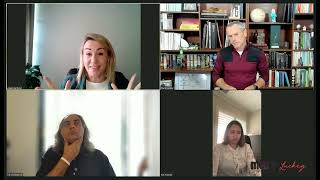
Barkus Luckey, Aditya Jheenwala, Kay, and Adele discuss how to set and achieve goals. They compare structured checklists with values-driven approaches like Adele's 5A framework: Awareness, Acknowledgment, Alignment, Activation, Actualization. The core tension: whether you need specific targets or just clear direction and purpose.
Chapters
G' day everyone. Earlier this year I had a zoom call with some colleagues about all things business in the modern day. The chat flowed nicely, we went down some rabbit holes and we decided to produce some concise edits on some specific themes. So a longer video will follow. But this one is about all things goals, planning, vision and getting things done for both the individual and the corporation. Included in the call was fellow TEDx.
Speaker Artie so I am Aditya Aditya Jheenwala and I live in Pune in India. Well, my mission is bringing the entrepreneurial mindset into education and into business systems. And I have been working with young people and with young entrepreneurs as a coach for the last 11 years.
And secondly was Kay, who I met through the executive connection.
So I do this executive business coaching as well as sit on board. Help entrepreneurs create businesses that are beyond them because often they get caught up in building, being in the business, working with a philosophy called succession thinking.
And finally, fellow Quality mind mentor Adele.
What I term a conscious living empowerment coach. I work with progressive businesses, leaders, entrepreneurs, bridge the gap, the gap between the B and the do in business and life.
Got any questions? Throw them in the chat window below and we'll get back to you with some answers. How do we go about getting things done? And I already know we've got a few different opinions around this one. So I'm very much the traditional goal setter. I write down what needs to be done, I prioritize it, I put boxes and ticks all over my pages and as I go along through the day, I tick them off and it works nicely for me until it doesn't and then I don't know what to do with my goal setting techniques. And then I found the whole stoic philosophy around the bookends of the day. Set the goals, review the day at the end and you know, see how it went, worked out what worked, worked, worked out what didn't, and then put it all in place. But you've got a pretty different view of this very structured goal setting. Adele.
I find everybody's quite unique. We're all different and, and you know, a lot of the time we've got people out there training people how to do things based on what's worked for them. So for me, when I'm working with people I've got like a little 5A framework that I use. So for me it's about awareness of who we are, what we want in life. Then it's about acknowledgment, so acknowledging perhaps where the gaps are where the limitations are. Also understanding that lot of the limitations we have are self imposed. Then it's about alignment, okay? So we've got to find alignment with, you know, the thoughts, the behaviors, the beliefs, the ideas of that are in alignment with who we want to be. Then I go into activation and this is where we start taking action. Aligned, inspired action. Because I find a lot of times people are taking action without being aligned with what they want, where they want to go. It's misguided. It's. It's not coming from the why. And then we go into actualization, right? That's when we actualize the life that we desire. And it's all underpinned by choice. Choice is foundational because at every one of those stages it's a choice. And choice is really important because the choices that we make today shape the future for each person to find that space for them sitting on the side.
Kay, what do you see as a difference or the conflict between what Adele and I have both put forward?
If I'm honest, I sit in both camps, right? There's a scientific approach to, hey, there's a step by step approach to doing this thing. There it's triggers and stimulants and, and results that happen versus Adele's take, who are you? And you know, what motivates you? And there's. Each one of us have a different DNA goals in the way you go about achieving those goals are going to be based on your kind of the dynamics of you, right. Versus the scientific framework of everybody follows the same thing and let's go do this and we'll all achieve the same. It's like a bit of a continuum, right? The flight and scale. Which side of the scale do you need some days and which side of the scale do you need on other days? But I think you need a combination of both. And that's how I work with my clients when I talk about goal setting.
Adi, you've got magic.
But I think what Adele and Kay have spoken about in terms of goals and these two different ways of thinking, I look at it as there's directions and there's goals. Goals are more specific and, you know, smart and all that. But I've seen many times in my life difficult to set goals. I feel you can set goals when you're already moving in a direction. So I know like I'm moving in a coaching direction or I'm building an education business, then it becomes easy to set goals. But sometimes we don't know the direction. So I feel with Adele spoke About in terms of finding out who I am and where am I going and which direction am I moving in? I think sometimes that's more important than goal setting because once the direction becomes clear, what kind of impact do I want to create? How much money do I want to make, what kind of life I want? So I feel that once the direction starts becoming clear, it becomes easy to set goals. Okay. To not have those specific goals. From.
From day one, I'm hearing a bit of similarity between you talking about the direction we go in before we set the goals, which. Del, is that similar to what you were touching on?
I mean, I personally don't always love the word goal. And I think for some people, it's quite difficult because a goal is something you have to achieve. Like, if you think about football, like, you've got to hit the goal, otherwise it's a no. And for some people, that's quite distracting. So for me, it's often about, like, the intention, like, what is it that you want? And like, you, like, the attention can shift. For some people, it works really well. Like for you, Mark, and I know I've got a lot of clients who need to know, okay, right, this is what I'm going to do. These are the steps. One, two, three. But I do find a lot more people. There needs to be a little bit more fluidity there. And, you know, it is also important to remember that words itself have an impact. Goals for some people, you know, become quite terrifying because it means I've got to hit it, because if I don't hit it, I've missed. Whereas if there's an intention or a kind of flow, you can. You can shift with it. So.
And I would happily admit that I would aim for perfection every day, but really comfortable knowing I would never hit it, because I always felt that if I aimed for excellent, I might in fact be very good. When we're talking about vision or direction or where we're going or what we're trying to achieve, is it kind of the same thing in different ways, or am I maybe misunderstanding the whole setting, the vision and the direction?
Same thing. I think there's also perception, your perception. And so I think with the framework that I use, it's really about finding that place that fits for you. So even like Kay's mentioned, where on that scale works for you, I like to have flexibility in there. For example, when I get to the, you know, activation thing, some people might be pretty clear. They might get to activation straight away. I know what steps I'm going to Take. It's aligned, it's inspired. I think we're all saying the same thing. The beach balls, you know those big round beach balls that you had that had the colors the kids used to play with, so they all got a different stripe.
So before they just played with their phones non stop. Is that when they used muscles to, to play? Right.
But if I blew that ball up now and we each standing in a corner and I was like, what color is your beach ball? And K's like, well, mine's red and yours is blue. And because we took a different stripe, like it doesn't take away from the beach ball. Like it has all those colors. It's just the perspective.
Right. Kay, if you were coaching business or entrepreneurs on goal setting and structuring and strategic plans and so on, what sort of model do you give them to look at?
Oh my God. I go way back, way back to the why you can't set goals. Goals just give you a focus.
Right.
Of what you're focusing on next is something to focus you. But the whole point of goals is they set in the context of a why, where is. We said purpose. Purpose is just one thing, but there's a underlying motive, something you're wanting to grow, grow or change that fuels the goal. I think that's where I go first and when I want to go to the business. Strategic plans and things like that with leaders, you know, what is the purpose of this particular organization? What does this organization look like in terms of the people that sit in there, the behaviors that it operates by, the dynamics in terms of how you organize the work. Right. And all of those things help shape goals within the business. Whether it's team level goals, business goals and the values are the thing and the why shape personal goals? It's a bigger conversation and it happens at many levels. When I do the work, it's not a one session thing that we do. When it comes to goals. It's probably about three separate workshops.
Yeah, right. Sounds like you're just trying to maximize your charging rate. So I'll have to get some notes. That's fantastic.
More from Barkus










Tim Ferriss: How to Learn Better & Create Your Best Future | Huberman Lab Podcast
