QM Session 1 Intro - Mark Luckey
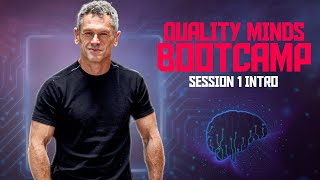
Mark Luckey introduces the Quality Mind boot camp, a three-month program with weekly Zoom sessions and daily micro-tasks (7-30 minutes) designed to build lasting habits. The five-star model covers evaluation, habit-building, clearing the mind, dreaming, and living it, with emphasis on action-focused goals over outcomes.
Questions this video answers
Three months (12 sessions).
Zoom.
Between 7 and 30 minutes per day.
June 2024.
Chapters
Hi there. Mark Luckey here and congratulations for signing up for your Quality Mind boot camp. My role today in preparation for your first session is just to get you ready and to explain a little bit to you about how the program works, the and what to expect. In our first session, we go through a bit of boring stuff, the usual terms and conditions and some of the administration just to make sure that we're all on the same page on what to expect from the program. All of our sessions, group sessions, as well as the one on one sessions are run on Zoom. So just some basic things that have worked really well in our workshops before. On Zoom, be aware of where your mute button is. If possible, use a PC and have it gallery side by side with the presentation or speaker. So side by side with the presentation to get the full view of what's going on. As a coach, I love it when the people in the groups have their cameras on because it gives us a bit of energy back. So please, we encourage you to have your camera on and mute yourself, maybe while we're running a session, just to avoid any background noises getting through on the call. And I say this with all seriousness, avoid burgers during a Zoom call. Drinks are fine. I learned the hard way once in an investment pitch early on, assuming that if we were in speaker presentation mode, where someone else was showing their slides, that no one else could see me eat and I was wrong and I was hungry and it might have been messy. I've learned there from experience. What I would recommend that you do have though, is have a great notepad and pen devoted to your Quality Mind course. Just something a little bit special as a record, because you'll find most people end up really treasuring this as a bit of a record of what they've done. So you've gotten this far, you've registered in a course, you're getting ready to go, you get out ready, what you put in, you are doing this for yourself. Immerse yourself, give it a crack, and do everything possible to maximize your chance of getting the benefits which are there and which are meaningful and substantial. Our role as a coach is to give you the best chance to do the best work for yourself. So get into it. You can see here some of the amazing before and after results that we've seen from many of the clients that have gone through the program. Significant improvements in just a few weeks in the core areas that lead to improvements in their quality mind. Also in the first class, we get into the Quality Mind five star model, which, if you like, is sort of the five stages of progression through benefiting or feeling the benefit from developing new habits. First of all is evaluation and building awareness. And then we go through the process of starting to build up some new habits. Then the next phase is we clear our mind and make room for the new you, which we then go into a dream phase. Yeah, it sounds esoteric, but literally clear your mind and open up your potential to dream about what you could really be. And then of course the last part, and that's what's great about this program, is the living it, the doing it, the becoming. So it's an amazing program. You'll love it. There's quite a bit in this first session that we normally have in a group about change and the challenge of taking change on. There is a lot about habits in Quality Mind. So Quality Mind, at its core is all about retraining ourselves with new habits that are better and replace old habits that aren't serving us. So we'll go through a bit of the trans theoretical model of change, what goes into building habits and how long it takes to get them all sunk in. Because the best version of ourselves, the new you, version 2, is the one whose habits are upgraded. Because habits are things we do without thinking about them. And this is something that's really intrinsic to the program structure that we run with Quality Minds is it runs long enough to to embed new habits and behaviors and level ourselves up as opposed to maybe doing some of the shorter forms of reading books or seminars or even shorter workshops. This is long enough to implement meaningful change. So I really encourage you to have a look at what's involved in creating habits and that transtheoretical model of change if you get a chance. Now, the role of the app by now you should have already received a link for the app and and the role of the app is to keep us connected. Now, there's been a lot of technology developed and a lot of people are a bit app fatigued when it comes to wellness. The quality in irondap is very light on if you think about the Once a week we catch up. We have one hour out of 168 hours together in a group. And if you've got one on one program, a little bit more time there. The app is what keeps us connected for between seven and 30 minutes a day. Little thought shops, meditations, small exercises, and it keeps the change process front of mind. So the app is there to connect us and to just help us build the habits and behaviors as we go along. It's non Intrusive. It's pretty good fun and it will help you develop more analog habits as you move on in life afterwards. For those of you who are taking what I think is an amazing step and also including the one to one package to go alongside the Quality Minds group package is we are working on a wellness goals framework, which is pretty exciting stuff. What I think is great about doing the one on one on top of the main group is it gives a chance to share all of the information, but the one on one to really hone it to what each individual wants to get out of the program. I'd encourage you to have a look at one of the other videos in the library at the moment, which is done in June 2024 where I filmed at Be well, which is a health club. And I talk a lot about change and some of the habits and what makes change hard and how it works in detail. There the wellness goal is, and one of the most important aspects of goal setting is to have a vision. Because the vision or the why helps us determine the more granular detail of what we're hoping to get out of a program like this. And the more specific you can be in what you want to achieve in undertaking this work, the more the likelihood that you will achieve that. You'll notice that we do talk a fair bit about goals in wellness, where the program we're walking through a lot more about our activities and what they have in common is that in the wellness coaching framework, when we're talking about goals, we are talking about achieving actions over outcomes. And that's because we can control our actions, but we can't control our outcomes. So for example, rather than saying someone might want to lose 5kg in weight, we might say, well that's great, but how about instead you say, I will eat like this, I will exercise like this, and I will do these other things to help support a healthier mind and body. And so the goals that we talk about in the wellness structure are always about the things we are going to do. And in wellness we talk about the three different layers. And the main high level thing is the vision. And the vision is what motivates us and inspires us and gives us that charge when we think about what our vision of our life might be like. And the vision is the why, the connection, the emotional framework that just fires us up on the days that we can't be bothered. The Quality Mind program runs for three months or 12 sessions. And that's the same as the one on one coaching where we look at three monthly goals. And the idea of these three monthly goals is that unlike the vision off in the future, the three monthly goals are a set period of time where we try and achieve some things, to be doing some things in three months that we aren't doing now, that would be a step towards that broader vision. And then the idea being, should you progress, you reevaluate at three months and see what you do beyond there. So these three monthly goals are the how what can I do? How can I get there to that vision one day? And then like every week when we have quality minds, we have the one on one calls and we work with weekly goals. And the weekly goals are what can I do right now to achieve that goal? And a great way to get this all underway now is to start thinking about and dreaming about the vision, who you would love to be and what you would love to be doing, whether it be in six months, two years, or five years, and start building that vision and dream. Because once you have that idea, you've got a much greater chance of working out what you need to do next. This is one of my favorite parts or favorite analogies in the whole wellness framework is that we talk about eating good food for a healthy body. The same goes where the fuel for a quality mind is high quality thoughts. So that's what builds a quality mind. So building habitual, positive and constructive and motivating thought processes is right at the key of everything we do. And you'll often hear us talk as coaches about the importance of language. Now, to be fair, a lot of people find this confronting at first, that it feels very nitpicky the way some coaches, including myself, can pick up on language. But the key is to just keep fueling our mind with the right words and the right sentence, because that is what fuels us from the inside out. So we'll get to more of that in the in the first few classes. So with all of that, I once again congratulate you for taking a big first step for signing up. And if I can give you one final piece of advice, just go for it. This program works, embrace it and do something amazing for yourself. Look forward to seeing you in session one.
More from Barkus










Tim Ferriss: How to Learn Better & Create Your Best Future | Huberman Lab Podcast
