The Mental Fitness Survival Guide for Uncertain Times - Mark Luckey - TedxSpeaker
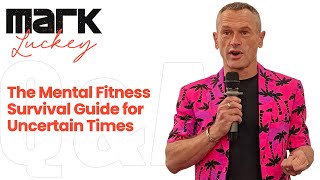
Mark Luckey delivers a TEDx-style talk on building mental fitness to cope with uncertainty. He emphasizes emotional regulation (preparation through stress exposure like ice baths and in-the-moment techniques such as box breathing), focusing on what is controllable (Stoic 'zones'), maintaining social connections for mental resilience, and taking small actionable steps to build momentum and habits.
Chapters
In some respects, the world is always uncertain. I don't know if the world is any crazier, more dangerous or uncertain than it was 20 years ago, 30 years ago, or 100 years ago. But we certainly hear a lot more of the bad news these days because of the constant media cycle. But genuinely speaking, couple of wars going on, the AI revolution, shifting economies, global geopolitical things changing around the world. And so it does make people feel uncertain. And when we don't have certainty, we're not sure what to do next. And so uncertainty means we're banging the thoughts around in our mind. And that can get a bit of an echo chamber of negativity, because without the action, we sort of can't release that pressure. And I'd been speaking to a lot of people who were unsure about their jobs and unsure about what's next and what's next and what's next. And that uncertainty can be dealt with. And part of that is building resilience, building mental fitness, finding some calm in the storm, and just, generally speaking, day by day, building up the skills to look for the opportunity in the chaos. And so something I feel very strongly about, because the feeling of chaos only exists up here. We've, generally speaking, always got choices on how we can move forward. Emotional regulation is essential as part of an overall mental fitness package because it's the ability not to react hardcore in the moment of a surprise or a change, or let's call it an unwelcome development in life. So I guess the first part is preparing for those moments. And the preparing for the moments can be literally everything from exercise, working yourself hard, or getting into an ice bath. And these are things that I do a lot of. And ice baths are uncomfortable because I'm willingly putting myself in there. But I also know that not only does it benefit my body and I recover faster for more karate training or Spartan training, but it actually mentally strengthens me to willingly do something that's tough. So over time, that stress transferral and the resilience it builds can be used elsewhere. And there's no two ways about it. In the moment. If we find ourselves freaking out, whether it's after a meeting and we've got another one to go in, or a kid's pushing our buttons is something like box breathing or controlled breathing techniques. You don't need equipment. You just need to have the presence of mind to find some time and space. Whether you put your time, take your shoes off, put your feet in the grass, rub your denim jeans for the texture, or just make sure, you're stimulating your senses a bit and locking yourself into the moment. Breathe in for three, out for seven. When we breathe in, that activates the sympathetic nervous system or call it fight or flight. When we breathe out, it's the parasympathetic nervous system, or rest and recover. So this fast in, slow out 10 of these and you're going to feel chilled out pretty quickly. Because all of these practices in all of these philosophies are incredibly simple to do, but it's building the skill and remembering when to activate them. So in uncertain times, it can feel like everything is out of control. So if you add a word in there, which is everything is out of my control, that can feel really destabilizing. But then what it is is, sort of, well, there's no point worrying about the weather, it's no point worrying about who wins the presidential election, or no point worrying about the shares and their price in the stock market, because I can't affect those things. So if we can get to that point of how much am I worrying about that I can't control, we can come to the point of saying, well, anything I am worrying about that's out of my control to act upon is a waste of time and energy. So then it's sort of, well, what can I focus on? Japanese saying Aragamama with things as they are, what needs to be done? So we look back at, okay, what can I do right now? What is in my control that I can think about, make a decision, act upon and move in the right direction. And sometimes it can be as simple as simply cleaning my desk to clear the mind to start the job. It might be right now I'm going to go and have a break and refresh and work out next. Or it might be, actually, I have got other jobs I can do at the moment. While I don't know what to do elsewhere, I'm going to get on with doing those. So it's really about what the Stoics said is Zone one and Zone two. Zone one are the things we can control. Zone two is everything else. By focusing our thoughts and energies here, this is how we can make progress in uncertain times. Hugely important to have relationships around you. And in fact, this is one of the things that I worry about with the whole work from home, particularly those that work from home the whole time. So really quick on the neuroscience. Let's say I'm talking to my daughter in person. Let's say we're either arguing or, or having a great time, whatever that as we're talking to one another in the same room. Our brains light up in response to different stimulus and triggers. And often they light up in the same sort of way or the same sort of pattern. If we have the same conversation over zoom or teams or Skype or something, the brain doesn't light up the same. The engagement is not the same. So I do fundamentally have a problem with this whole online community forum will make you feel part of something. It will if it's hybridized and it involves real personal contact at the other side. Because we need to have people around us. The most drastic example, older men who live by themselves, generally speaking, die about a decade younger than those that live in a relationship. I think from a mental perspective as well, that if we are around other people and laughing and sharing joy, that's awesome. We can have purpose. You look at the blue zones across Japan and they continue having purpose and involvement and sharing, sharing. And that's why they live so long in those areas. And I think by our thoughts being challenged, it sort of keeps us regulated. Whereas I look at people particularly aged and are living by themselves without a lot of interaction with family, they start to form very rigid views about the world because it becomes an echo chamber and they stop challenging themselves or allowing themselves to be challenged. And so mental fitness, fitness, part of that is about being challenged, challenging body, challenging mind, being challenged in those aspects, to build the muscles in both of those different areas. So if we're only having our own thoughts, we don't actually challenge ourselves. We don't question ourselves. And so as a result, as well as the whole support network of someone touching you and asking if you're okay, giving you a hug and triggering all that oxytocin, the importance is to have a bit of a tussle and to engage in life and engage with people. And they that in turn keeps us mentally active. What's the smallest step they can take? Today is any small step, because what is most important is the doing. And I look at this in three layers, that there is information about everything out there at our fingertips all of the time, but we don't know it until we do it. So. So you know you're not earning a black belt by playing Mortal Kombat online. You earn a black belt by going out and you start with a white belt and it gets black with blood, sweat and tears of effort and endeavor. So what the most important thing is to do is to simply start and to do something. And when we coach people and we get to the end of the goal setting process. And I'll say to them, so, you know, what's your goal for the day? Blah, blah, blah. And we get to the end and it's sort of, what are you going to do right now? What's something you can do the moment you hang up the phone? Now, it could be they do a minute box breathing. It could be they do three minutes journaling. As long as they do something, it's the start of building momentum. Because building momentum can become a habit, then we maintain momentum, which means for less effort, we're still pressing forward. So put simply, find something and do it, and that's the way you'll start feeling great.
More from Barkus










Tim Ferriss: How to Learn Better & Create Your Best Future | Huberman Lab Podcast
