Fully Collaborative Data Workspace with Hex's Barry McCardel
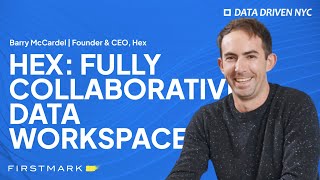
Hex co-founder Barry McCardel discusses why data teams need a collaborative workspace. The platform lets analysts, data scientists, and business users work together in SQL and Python with a reactive compute engine that handles state management. Hex raised $52M in Series B funding and now has over 150 teams using it, including Persen Pharmaceuticals.
Chapters
You are the co-founder and CEO of Hex. Hex is a collaborative data workspace for teams that brings everyone together to explore, analyze, and share. The company was founded in 2019, and you raised a total of $73.5 million in venture capital to date. Including most recently a $52 million Series B that was just announced a few days ago. So congratulations on that. So let's start from the top. Why does the world need a collaborative workspace for data teams? What's the big problem that you are working on solving?
Yeah, thanks for having me on and thanks for asking. So I've been working in data effectively my whole career. Like I started as a consultant doing, well, I started in undergrad really doing a bunch of stuff. Like I was writing R scripts and all this research stuff before data science was even like a thing really. And then was doing like unholy things in Excel as a consultant. And then I was at Palantir for 5 years where I sort of got exposure all across a bunch of different technical things. And then I worked really closely with our data team at my last company. And I like all along the way basically observed the same set of problems. And in essence, Hex is meant to solve those. So the first thing we really set out on and the thing that was like really acute problem that we wanted to solve was around the ability to share work. And it's this very common thing. And we saw it up close at our last company we were at, which is, you have like data analysts and data scientists and just people working with data all over the business doing like really interesting, awesome things. They're going in, they're asking and answering questions, they're driving insight. And then like the actual ability to share and publish that throughout the organization is kind of awful. Like it's really a disaster. You have people like screenshotting charts out of Jupyter Notebooks and pasting them in Google Docs. You have people like exporting a CSV from a BI tool so they can build like the right pivot in this other thing and then put that in a deck. And then you have like, people, you know, hacking together scripts to try to build a, like a pipeline to put the forecast in the warehouse so you can look at it in the BI tool. And it's like, was this huge mess. And so we started really focusing on that problem. The initial thing we were focused on was sort of how can you help data scientists who are working in something like a Jupyter Notebook, take that and share it with, with others in a way that's interactive and useful and usable. And as we started getting into that, like we realized like the, The pain was really much deeper than that. And it was actually like people were just frustrated with the whole stack. You have individuals jumping around between tools, depending on whether they're using SQL or Python or no-code. You've got teams really unable to collaborate. The whole versioning and real-time collaboration story for all this is just a mess. It's very sort of regressive compared to tools in other spaces, like Figma or Google Docs. And then there's just an amount of overhead and pain to getting these tools up and running anyway, that is actually really hard. Like there's a very classic experience where you'll see what, like a new data scientist will join it. Like the first 2 weeks are really just about like getting all the right packages installed locally in their Jupyter environment. And then like making sure that's synced up with the— and like you wind up with this overhead that is both very frustrating for the people who are doing these workflows, but also prevents a lot of people from accessing. And so. Back to your question, like, Hex is really meant to be, um, uh, 3 big things. It's an amazing collaborative environment for being able to, uh, do analysis and data science. It's got a notebook UI that is just absolute magic. I'll show that to you in a bit. It's very, very easy to take your work and share it and publish it as an interactive data app that anyone can use. And then that, uh, work is then kept and organized in what we call a knowledge library, which makes it very easy for anyone else in the organization to discover and benefit from the work that the data team has been doing. So, you know, mission-wise, that's really what we're about. And, um, and, and we built the product that really sort of addresses that end-to-end. Great.
And it's, um, by definition meant to be very, uh, inclusive, right? So it's data scientists, data analysts, it's business people as well. Like, you have an expression, uh, that I read somewhere which I really liked, which was the Analytically technical.
Analytically technical. Yeah. It's, it's interesting. Cause you think about like what some of the big changes that have happened in the last few years, you see this explosion in people who are data literate. They're even, I would call them somewhat technical. And like, there's more people who know Python. Sure. There's a lot more people who know SQL and a lot of people have either learned SQL on the job or coming out of undergrad with that skillset. There's also this like much bigger population of people that I would argue are like technical in their own way, which is like, if you're an Excel power user and you're writing like deeply nested functions or VBA or even just, you know, some, some pivot tables or IFS, you are basically writing code. I would argue you are writing code, you are technical in some way. And I think traditional data science and analytics tools have actually been kind of a high tower, like they're, they're difficult for these people to access. And so one of the things that's really interesting for us, uh, when we see it, our customers is like, we have a lot of users. In fact, most of our customers, most of the users are mostly writing SQL, and that is very different than what you might think of when you think of like a notebook environment, which is traditionally very associated with Python and quote-unquote data science. But Hex makes it very easy to go back and forth between SQL and Python. You can collaborate between these, and so it's very inclusive and it's very cool for us to see at our customers where we'll start with a very small number of data scientists, a couple people who are migrating their workflows over from Jupyter, but then we'll kind of explode to where you'll see all sorts of people using Hex to ask and answer questions. That's something we're very excited about. And I feel like we're just still at the tip of the iceberg on. And we think of it as this building a platform that has a low floor and a high ceiling. We want to have a platform that anyone can come in and ask and answer questions, but it doesn't arbitrarily top out. And I think that's a big difference between the last generation of tools, which is like, okay, this is a no-code thing. It's got a low floor and a low ceiling, but like the second you want to do something more complex, you've like topped out and now you're over in your SQL runner. It's like, medium floor, medium ceiling, right? And then, okay, now I'm over in my Jupyter Notebook, like high floor, high ceiling. I kind of challenge why this needs to be like 3 fragmented things. And I think we've done a great job so far being able to sort of bring some of those more together. Yeah.
Great. So to take some of those 3 bits and like, and drill into sort of the next level. So just like a 10-second definition of what a notebook actually is.
Yeah, sure. So notebooks have been been around for a long time. As legend has it, they were first pioneered in Mathematica, and the most common one now is a project called Jupyter, used to be called IPython. The notebook format is basically you'll have cells which have code traditionally, and then those cells show the output of that code, and those cells can be evaluated individually. This is different than a script, which is— a script is like one file, and the script is usually evaluated just the whole thing top to bottom. And this sort of breaking it up into cells makes it really great for iterative and exploratory analysis. So you can say, like, I just want to run this little chunk and I want to do the aggregation a little bit different. I want this. And this is all an expression of a thing called literate programming. I will not go in the deep end on this, but basically it's this idea that you can see your logic and then the outputs in one place. And it's a very, very popular format. I mean, millions of people use notebooks, but we think that it's actually a format that a lot more people should be using. And that's— we're very happy to see that with our user base and customers. Yep.
And just like even at a higher level, it's like a notebook is sort of the place where data scientists and data analysts work together. And it's a combination of code and explanation. And so it's like your workspace type of—
That's right. And it's really the thing— I mean, if you talk to a lot of data scientists especially, it's the thing they use all day. It's the thing where they're going and writing code and they're iterating on something. Now notebooks also traditionally have a lot of issues. There's a famous talk called "I Don't Like Notebooks" that this guy Joel Groose gave at JupyterCon. It was very— it's like showing up to the wrong place to give that talk, but he was right on. Yeah, it was like 2018, I think. But it's all these issues. And part of what we're doing at Hex is like, well, notebooks are great. They have some issues. I think there's a camp of people that are like, nope, because of those issues, everyone should be doing something else, writing scripts or whatever. I think we're kind of trying to find that synthesis of like, well, what if we just fix those issues with notebooks and made them awesome and made them accessible to like 100 times the people? I think this actually could go somewhere. And that, in a really simplistic way, is kind of what we've been up to, among other things.
And part of what you were describing was one of the key issues, just to make sure I paraphrase and make sure I understood correctly. One big issue of notebooks is that you can have different definitions of a variable.
Yeah. Yeah, we call this like a state issue. So I would, I would kind of break out some issues with notebooks. It's like, I would say first thing is accessibility. I was getting at this earlier, but like, you know, most people working with data in most places have never used a notebook because like step 1 is learning computers. You have to like figure out how to set up a local Python environment and install Jupyter. And most people are not going to do that. Thing 2 is state. And that's what you're getting at. And the short version of this is like notebooks traditionally run in what's called a kernel. It's basically memory space where you run something like x 1. Now in memory, x 1. But because you can run cells out of order, it's actually— you can get in these weird state issues where you can't actually know what state things are in. The short version is like, this is a pain in the ass for people who are both like been using notebooks a long time, like me. So it's like, but it's like really painful for people who are new to it, who are like, what's going on? And like, you lose a lot of people. And we think of this as like one of the many things that are in that low floor, high ceiling of like, how do we make notebooks awesome, better for those like power users, but also just how do you make it more accessible and usable and welcoming for this bigger population of people that we think deserve great tools? So we launched a feature last October called, we called it Hex 2.0, but it was this reactive compute engine we had. And I'll show it, I'll show it off in a minute, but it's effectively saying like, what if notebooks worked a little bit more like a spreadsheet where cells have a sense of provenance between them? You update one thing, it automatically updates downstream cells. And this is great. This is better for those power users, are like, man, this is the way I always wish this worked. And it's great for novice users who a lot of them have never used a notebook before. They're not even aware there's a state issue. They just know they don't have that in Hex. So it's all good. And that was the goal of that feature for us. Great.
And as just one last question on Notebook before we jump into the demo. So part of the value proposition as well is that you can do data science in sort of like Python world, but you can also do SQL and connect to databases and I think you can do that in Jupyter as well by installing packages, but it all comes out of the box.
Yeah.
Is that not correct? Like, please, please.
Well, you can. I mean, this is the thing when we started out, when I was like, you know, when you're starting a company, you've got an idea, you're like pitching people on the idea. And it's not uncommon for people like, well, that's already possible. I'd be like, well, what if it works like this? You're like, well, Barry, that's already possible. Oh really? Am I missing something? Like, well, if you install these 3 packages and then you're willing to like If you have the environment variables all set up correctly, and then you roll your own connection with SQLAlchemy, and then write your SQL in triple ticks, and yeah, you could totally write SQL in notebooks. And it's an awful experience. And not only do I hate doing it as someone who's technically capable of doing it, but what about all these people who are not going to fight through all of that pain or don't have the ability to do that? And I think it's the same with the sharing thing. I was like, well, what if it was really easy to publish your notebook in a way that anyone could use? It's like, well, it's possible. There's these 3 open source packages that if you install them in your JupyterHub instance and everyone everyone's using the right version of JupyterLab and they're all up to date and oh, well, these extensions are incompatible, but ignore that. And like, if you do those all right, and then like Mercury is aligned with Jupyter in the right way, like then you can do it. And by the way, you're going to need a full-time person to manage all of this. And it's like, this is the type of shit that is only accessible to these like really technical users. And is, turns a lot of people off from these workflows. And we don't think it has to be this way. And so whether it's the SQL stuff or reactivity or beautiful no-code charts, or just making it really freaking easy to share your work with anyone. Like, you know, we, we think that there's a way to make this more accessible without dumbing it down. Like, our power users love this stuff too. We're building— we didn't talk about this earlier, but we're really building the product to embrace what we think of as the cloud data era, which is you have data that's a massive scale stored in cloud data warehouses, and those cloud data warehouses are not just there to storage. I mean, Databricks and Snowflake and other companies are also building very powerful compute primitives, whether it's just being able to push a query down different warehouse sizes or even being able to push Python code down. And we think they're doing a great job with that. We think that they're going to continue to do a great job of that, and we want to partner really closely with them on that. So, um, you know, the partnership makes a ton of sense because when people are using Hex, they're going to be asking and answering questions— answering— asking and answering questions on more data. They're going to be pushing more workloads down to those data warehouses, which is great for them. And those data warehouses also provide a really great, uh, scale and, um, data story for us. And we actually have to do less on our end to build out a whole compute infrastructure and ecosystem ourselves if they're doing a great job of that. So we think that partnership makes a ton of sense. We see our customers really pulling us on how are we integrating very closely with those technologies that they're already investing in.
And then, and then, yeah, like, is the idea that you're doing some transformation in the notebook? What's the—
You certainly could. There's a couple of interesting angles. We actually just published a blog post. One of our, our analytics, first analytics engineer, you know, she uses dbt and Hex all day. She's got a very cool workflow where she'll develop a lot of stuff in Hex, bring it over to dbt. She's published a blog post on our site about how she uses them together, which is very cool. But going a little bit deeper than that, I think when you look at what dbt is doing or what companies like Transform are doing at the metrics layer, they're really almost unbundling BI in this really interesting way where they're saying like, hey, it's not just about transforming data as denormalized tables in your warehouse, as your normalized tables in your warehouse. It's about how you're then actually turning those into metrics and measures semantics that are accessible at the sort of BI and analytics layer. And so we're very excited about what's happening there. We think it's very much in its infancy, but as it matures, we think there's a really cool opportunity to bring that more into Hex, where you could have people, instead of having to write a ton of SQL in Excel, maybe they're able to write something much more concise or maybe something more UI-driven where they can just pick a metric they want, get a data frame back, and then start working against that. So we have a ton of shared business with DBT today, but I think with where they're going and where we're going, there's a lot more that we're going to be doing together and others in that space.
Great. So maybe to close, I'd love to spend 2 or 3 minutes on, you know, go-to-market sales, like who do you sell to, who's a great customer, maybe who are some existing customers, that aspect of the business.
Yeah, so we're used by over, uh, I think last count was like over 150 teams, uh, globally now, data teams, um, paying us, uh, uh, for Hex, which we're extremely proud of. We support, uh, really big public companies like Persian Pharmaceuticals as an example. They use Hex enterprise-wide to support their research efforts. Also used by small startups. I think the one consistent thing across our customer base and where we're really resonating or they're making investments in data infrastructure and data. And we just talked about Snowflake and Databricks and dbt. If companies are adopting those technologies, they're often then coming to Hex for, you know, great, I've got all this data now in my warehouse. I'm transforming it with dbt. Now I actually want to be able to ask and answer questions of it. I want to be able to do more with it than I'm able to in legacy tools or Jupyter Notebooks or SQL scratchpads. Hex is a super good complement to companies that have invested in that stack. And what we're seeing is any company that's sort of hiring folks in roles like data science, analytics, analytics engineering really needs and wants and gets a ton of value out of Hex. So yeah, from a, from like a customer and target perspective, that's, that's where we're at right now.
Very cool. Very cool.
Yeah.
Congratulations on, on all of this in this journey. I mean, the company is still pretty young. I mean, it seems like you guys are executing incredibly Started late 2019, so really not been at it too long.
I was very, very fortunate to start the company with two folks I'd worked with at Palantir, Caitlin and Glenn. And we've had a lot of fun and a little bit of luck the last couple years building this out. So we're looking to continue that streak for a little bit longer and keep going on this. We're having a good time.
Very cool. Well, thank you so much, Barry, for, uh, thank you, Matt, to this event, telling us a story. Uh, best of luck for, you know, the future. Hope you come back, uh, you know, in a couple of years.
Yeah, ironically, I, I, you know, I'm actually in New York this week. Yeah, but not that far from you, but we're still doing this virtual. So maybe next time I come back, uh, we'll, we'll be able to do it in person.
Yes, I can, I cannot wait for that. Okay, cool. Thank you so much, Barry.
I appreciate it. I'll see you. Thanks for having me on.
More from Barry

Dashboards to decisions: How AI is closing the gap between insight & action | The Airwallex Podcast

Is the BI Dashboard Dead? Barry McCardel on Hex, AI Agents, and the Future of BI (FIXED)


From Palantir to Hex, How Barry McCardel & Caitlin Colgrove Built the Modern Data Workspace | S13E5


Hex CEO Barry McCardel Discusses Trends Reshaping The World of Data Analytics and Data Engineering