Effective E-Commerce Conversion Rate Optimization Tips: Insights from Ben Sharf of Platter
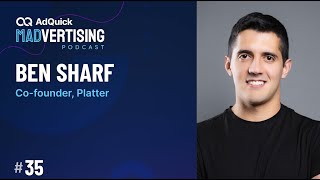
Ben Sharf, co-founder of Platter, a Shopify app bundle, explains how to build high-converting e-commerce stores. He emphasizes information hierarchy, cart drawers, and mega-menus to reduce friction. Sharf also shares his "Barrels and Ammunition" hiring framework: strategic visionaries paired with execution-focused staff.
Chapters
Welcome listeners to the latest episode of the AdQuick Madvertising Podcast, a podcast that discusses the intersection of advertising, technology, culture, all of the things that you care about. Today we have special guest, we have Ben Sharf. He is the co-founder of an ad tech startup, Platter. Ben is a really cool guy. I took a look at his socials and his work history and came up with a lot of good questions for him. He's also a podcaster, so we're gonna get his perspective on what it's been like becoming a voice in the tech sector. Ben, welcome to the show.
Thanks for having me, Adam. I appreciate it.
And so I was gonna go through and like, your website content is great, but I found learning about a company is so much better from the mouth of a founder. So instead of just me going through the bullet points, I'd love to hear an intro of, of both yourself and Platter, because I think those two things are going to be connected.
Yeah, so quick background about myself. I, uh, was formerly a Division I hockey player, had plans to go into the corporate world and join one of the Big Four consulting firms. I told them 12 hours before my first day that I wasn't coming, uh, which is, I think, an important detail in my story. I ended up joining an early-stage COVID testing startup that scaled to $50 million in revenue in 5 months and 800 employees from inception. I was there for a little under a year. And then after that, I spent a year at a company called GoPuff. If you're familiar, for those who aren't, it's an instant delivery platform, uh, for convenient goods. And, uh, during my time there, I was building out a business unit called Powered By, which was essentially unlocking instant delivery for.com websites. So we could enable you to go make a purchase at a.com website and get delivery in under 30 minutes, which was pretty revolutionary for the ecosystem. And that was my first entry point into the world of e-commerce and direct-to-consumer. After about a year there, I left and started what is now known as Platter, which is my, my current company. For those who aren't familiar, Platter is a theme and app bundle for Shopify brands. So what we do is natively build a lot of the most popular app functionality around marketing and conversion into one solution to unify your app stack, your support teams, and your costs. And then provide best practices on how to increase your conversion rate so we can quantify making you money and saving you money at the same time.
Awesome. That's a great intro, and we'll get into your product more at the end, but I'd love to start high level for, you know, all of our listeners so they can understand your perspectives as an entrepreneur and learn from you whether they decide to use you one day or not. Um, but can you talk about some of, I guess, the main tenets of what you see as a high-converting e-commerce store, whether on Shopify or whether you build it yourself or use a different tool. Some of the things that, that you see are just like the must-haves if I'm like a small business just starting out.
Yeah, I think the first most important thing, number one, is understanding information hierarchy. I think when you put yourself in the shoes of a consumer, if you've ever landed on a website and your first thought is, I have no idea how to navigate this, I They're throwing information at me that I don't necessarily want right now. It's thinking about how you structure your website in a way that tells a story and you guide your consumer through the journey that you want them to go through, right? So that's first and foremost. That starts at the top of your website with your menu. If we're getting a little bit technical here, a great example would be incorporating a mega menu, which has visuals of different products and allows you to guide the consumer, like I said, down the path that you want them to go. And then beyond that, another thing that's worth noting is in the back of your mind when building out an e-commerce storefront, if you remember the idea that every incremental click that you add to a consumer's journey is going to result in a decrease in conversion. And in layman's terms, what I mean by that is the harder you make it to purchase, less people are going to purchase. So understanding that when building out the core tenets of your website in terms of the flow of getting someone through the website is first and foremost the most important. The second piece to it is thinking about opportunities to increase your conversion rate and your average order value. I think high level, a great way to look at it is through the concept of gamification. We strongly believe in gamifying shopping experiences because psychologically you make consumers feel like they're earning something. Or there's a reward, right? So examples of that would be offering discounts when you achieve certain thresholds, uh, rewarding consumers for certain behaviors, like I said, to guide them through the journey that you want them to go through. And then the last piece that I'll add here without, uh, information overload, talking about high-level different components of a website, is thinking about ways that you can just reduce friction points and reduce the number of clicks in a conversion funnel. So a great example would be when someone is ready to buy and they want to go to the checkout page, we offer something called a cart drawer, which is where you can offer a slide-out cart to make a purchase versus forcing someone to go to a new page, which is a checkout page. It's very nuanced, but essentially what you're able to do with that feature is allow someone to check out with one less click in the conversion funnel. So that is called a card drawer. I'll pause there because I know it's a lot of information.
But yeah, I, I think talking about simplicity with, um, any web design, I think has been a core tenet, uh, for a number of years of at least the, the favorite sites and apps that I use is probably like the number one way I would describe them is it's simple, it's beautiful. Um, that's one of the reasons I'm a big fan of— and I got back into blogging again from Substack because I felt that both the creating experience and also the consumption experience in their app. It felt like they had brought Google Reader back, which was kind of, you know, a product a lot of us loved a long time ago. And I've had like this beautiful experience with long form in a simplified application. I use their app and I use their website. And so I think like simplicity in design isn't just for e-commerce, it's for all types of websites. I think we're gone are the days of creating like some big enterprise brands still do it where like I'm on their site and it seems like they're trying to speak to like 10 different buyer personas at once and I have no idea where to go on their product offerings. And I don't like that as well. I almost feel like even big enterprise B2B brands could think through, well, how do I get the right person in the right part of the site and rethink the information architecture. But for e-commerce brands, I've noticed that the experience on the whole has been a lot better since 10 or 15 years ago when I started my marketing career. There were a lot of really bad, like kind of hacky websites in a sort of long tail of content management systems or just hacked together with HTML. And I almost feel like it's stranger for me to get a bad SMB e-commerce experience than a good one these days. I don't know if you felt similar.
I mean, I think it's just access to information and tools, and the barrier to entry is, is way lower now than it's ever been, right? Like, Shopify is a great example of that. You can start an online store for, I think it's like less than $100. Yeah, uh, if you're, you know, really at like the bare bones of what's possible. And so I think there is value in having access to tools. Now, what you actually run into on the flip side of that is information overload. Right? Because when you're a new person starting out, you don't know who to listen to, you don't know what to trust, how much you should be paying, what is considered best practice versus something that you maybe just read one time that you decided to implement. And so that's where I think the first challenge is there was no tools to be able to build successful stores. And now that there's tools available, it becomes what tools should I be using and who should I be trusting?
Yeah, there's certainly a long tail of tools. Um, we'll get to tools in a second. I want to take a step back and talk about D2C more broadly. Um, so I use a lot of D2C products because I'm friends with a lot of entrepreneurs. Um, I, and I find the quality of, you know, things like, like deodorant or things like, you know, different CPG goods that I was buying from, you know, Target or from Amazon. Is just better quality from a small business. The entrepreneur's probably super passionate. I buy from Eric Bandholz who started Beardbrand. I don't know if you've heard of him. I buy his beard oils and his face wash and stuff. But do you think, for a while it seemed like after Dollar Shave Club, there were just a ton of D2C brands. Do you think that that bubble has sort of reached, um, I guess saturation point where it's like, are people kind of getting tired of finding these smaller boutique sellers? Um, do they prefer the Walmart and the Target? Um, or do you think there's like more meat that can be bit off that bone if you're like a super passionate entrepreneur with a cool product idea?
I think a lot of it is, uh, how the macroeconomic trends serve as a forcing function to weed out the nice-to-haves versus the need-to-haves in terms of businesses, right? In 2021, capital was available everywhere. People were starting businesses left and right, raising millions of dollars off of pitch decks with no real product or concept. And now that we've shifted, at least in, um, regards to D2C, into a world of profitability where you really have to figure out, is your product something that the market wants? Do you have the ability to sustain yourself in a market downturn? And by proxy, you'll end up seeing lots of businesses who go out of business or those who stay afloat and actually flourish in the midst of it. But look, in the, in the midst of an attention economy, it's very hard for consumer brands to stick out because there's just so many options and people don't have attention spans as is when they're scrolling TikTok and whatnot. And so I think all of those serve as signals for you to figure out really quickly Is there any longevity to the product you're building? And do you actually solve a real problem?
Yeah, I have such a bias because I see like the roll-ups of all the big CPG brands and I just innately have to root for like the little guy, like the small entrepreneur who created, you know, whatever the thing that I use every day that I can get from someone who, you know, they're sweating every single step of that supply chain, the product quality, all of that stuff. And I always, for a while, I'm like, well, all the big CPGs could be like, there's all these big chunks that could get taken out of them. And then I realized that I'm probably the weird one and most people just want like the most convenient thing that they can grab off the shelf at Target. But like you said, you know, who can survive tougher economic climate and, you know, provide value beyond ZERP, right? I think we'll see, we'll see like what, what, what pans out and how much time people have to shop new brands. Um, so you produce a lot of content and host your own podcast, which is so cool for a founder. You know, I'm part of a marketing team, so I have more bandwidth to do things like talk to founders like yourself and talk to other marketers. Um, but can you share some of the benefits, I guess, as a founder, not just a marketer, but like as someone running a business that you've received from running a podcast?
Yeah, I mean, I think first and foremost, I love talking to interesting people. I'm a curious person, and I think Conversations are definitely one of the mediums through which I learn the most effectively, right? I think there are a lot of big creators and successful entrepreneurs talk about this, where you have to figure out what it is that you actually enjoy and learn from. Are you someone who likes to read books? Are you someone who likes to listen to podcasts? Do you read articles? So on and so forth. For me, I enjoy having interesting conversations as is. I think that's a way that I learn. And so In my mind, it was just turn a camera on and record these conversations that you're already having and figure out a way to redistribute that content. So in a lot of ways, I feel like I actually wasn't veering that far off from my normal life. I was just productizing it in a way that I could actually capture these conversations and redistribute them for other people to listen to them.
Yeah, I've, I've been a blogger since like 2003, 2004. So the notion of creating online measure twice, cut once, where I could, for a company, I could write a guide on how to do something. So whenever anyone Googles that problem, they'll find it. They'll be like, oh, and then they'll use our software for it. And we can basically do that thing once and have it replicate and have it shared with infinite people via search and social. I actually haven't had the meta discussion of why having a podcast. I think this is probably the 33rd or 34th episode that we've had. So we haven't really gotten too metacognitive. I haven't talked about podcasts on the podcast on purpose because I didn't want to do that. But now that we're at this point, um, I agree with you. I think the benefits, first of all, are you getting to have these interesting conversations, but then sharing interesting people as well with your audience and letting them see What the people that are your customers are doing, what they can learn from, what your partners are doing. You guys are an AdQuick partner. What we can learn from you, how we can start using your software. So I'm super bullish for people oversharing. I know that there's the build in public narrative that a lot of, some people are tired of, but I think if you're really passionate about an industry or sector, that's like you look past all the people who are just cynical about everything and don't like the idea of sharing in public. So, um, you're super optimistic too on your, on your social feeds. You're posting about one thing that you said is to start your day with something really hard. And so one example was you ran 12 miles before you started your day. And I, that was so cool to me. It's like, you're like a good healthy dose of optimism. I feel like there's just a lot of doomerism in tech lately. Uh, maybe it's just the AI narrative, but like reading your feed was super refreshing.
I appreciate that. I mean, look, I think there's a couple components that stand out to me in terms of creators that I aspire to be like, or ones that I just really envy. And there's a couple aspects. The first one is being a content creator for these individuals does not require additional work in their day. They're just documenting the day that's already happening, right? Like, one of my, one of my friends who's got 2 million followers across his socials I said to him, I go, how do you block out time every day to like write your content? He goes, oh no, I don't. I just, when it comes to me, I rip it. And I was like, oh, interesting. So when you reframe your lens into thinking about how can you capture different things that are happening in real time, it becomes way easier to be a creator. And then the second piece of it as well is that we're now in a day and age where people crave authenticity. No one cares about you if all you do is go online and talk about all your success stories. Without giving them any sort of visibility into the fact that, like, building a company is not linear. There are a lot of bad things that happen. You need to share those because people resonate with the things that bring them back down to reality instead of following someone who tries to force them into this psychological game of chasing the unattainable because you're only painting half the picture online. And so they're not getting the full story of what you actually go through.
Yeah, you're embracing— and I think as a small team, you probably have to do this— you're embracing, like, actual hands-on tactical marketing work. And when you say, oh, this is easy to bake into your day, I've tried to get teams at any number of companies, especially people not in marketing, to create and engage, and usually they won't do it on their own. I have to pin down time in their calendar and do something like interview them for 30 minutes. You can't get away from me. I'm gonna do this interview and I'll extract What I think is interesting from your brain, and then I will put it into a blog post or a guide or a white paper or whatnot. And so I think as a founder, you kind of have the David versus Goliath thing where you can just move faster than a lot of the larger brands in your category. I'm not sure how many billion-dollar companies with teams that have layers of approval there are for your type of brand, but But for other areas, that certainly exists. And so if you can be more agile, you can sort of do things that they can and react faster to trends and news and have a voice. So another thing I was going to ask you is, let's talk about building a team. So you mentioned specifically you're a fan of Barrels and Ammunition framework for hiring. And so can you explain what that means? Um, I, I didn't exactly know what you meant, and it sounded super interesting.
Yeah, I think, uh, for us, like, hiring is a very, very important part of our business. Um, and so I think it's also one of those areas that I've always been curious about myself. And so when I start to dig into it to, like, figure out ways that we want to go about hiring, how can we actually unpack that and help others. And so what I mean by the barrels and ammunition framework— and just for context, like, this is something that I learned from a guest that actually came on my podcast, uh, so it's a great example of me learning an anecdote from someone and actually wanting to like apply that into my everyday. But basically the way that that works is the barrels are those that are helping like point the— as it's described, like, point the ammo in the direction that you want to go. And so it's those who are making more of the strategic decisions, helping bring ideas to life. And then the ammo itself are referred to as those who are doing the actual execution, right? So the barrels are the ones that are pointing them and the ammo is the one that's actually executing it. And so when you think about constructing a team within each department of your organization, you can only have so many idea people and you could— You could only make sure that you have enough ammunition to help support those ideas, because if you over-index on one versus the other, that's when you start to bring inefficiencies into the organization. And so I think it was a really interesting framework that a friend of mine who's the founder of a company called Pietra brought to me just when I think about scaling and hiring a team.
Okay, well, that makes sense. That was less gun analogy than I thought. That one was fine. Um, in terms of, so in terms of tactics for brands, um, to ensure traffic they generate from either out-of-home through AdQuick or any other, um, traditional or online advertising, um, what are, what are a few ways that you're advising your users to ensure that that best translates to sales?
Yeah, I mean, I think the, the easiest way to describe it in our opinion is if you're driving a top of funnel to something that doesn't convert, then you're just wasting money on the top of funnel, right? Like if you don't have a— let's just say you're driving them to your e-commerce website, but your e-commerce website doesn't have an effective conversion flow and people are not converting for whatever reason. Maybe they don't understand how to navigate your website. Maybe the descriptions on your products are very unclear. Maybe it's just very challenging. It has really negative downstream effects because spending more money to generate top of funnel is not the solution if the bottom of funnel is broken, right? So when we think about working with partners like AdQuick, it's helping support brands who are wanting to spend money on out-of-home and other ways to bring eyeballs to their website, ensuring that those are actually converting. Because I always say, don't throw more money at a problem if you're not actually identifying the root cause of the problem.
Totally. And yeah, in terms of our product, we are, you know, out of home is inherently a brand channel with opportunities for performance to happen. I think it's those opportunities could be something like if you have a restaurant and you're running out of home, like an Exit Before, that out of home billboard that's encouraging people to get off and go to your restaurant. That's like out-of-home is a performance channel for that location, right? And then something like an offer with, if you have in a city that you're running a 20% off sale on either your website or your physical location for the next month, you're creating that time constraint that is also turning the brand channel into a performance channel. And then there's just overall branding like you would see the The Coke billboard, which used to exist when you went into San Francisco, I think they actually took that down, which is sad, but that was like one of the first things you would see when you enter San Francisco. The fact that I remember that as like a thing that I saw when I entered the city shows the importance of that branding. And it's interesting because billion-dollar brands, or in Coke's case, $100 billion brands invest so much in brand. Because they're literally selling sugar water, right? Or Diet Coke, which is, I call Diet Coke God's water. There's no sugar in it. But the point is they're doing things where it definitely is like, there's no direct marketing involved. And so I think it's interesting because there's probably push and pull of what companies need to do to meet their quarterly and short-term goals and make enough money so they can do the sort of larger than life, sexier brand stuff where it's not so thirsty to purchase now. And I think in terms of for you guys, you guys are really helping ensure that sort of both the people who come in through brand and also the people who come in through performance are trying, are converting as best they can, correct?
Yeah, it's basically about when you're trying to drive people to your website, you want to have an optimal experience for them to transact. I think part of it is understanding as a brand, like, what is your objective in any sort of campaign that you're running? Is it awareness? Just so, like you said, when Adam drives into San Francisco, he knows there's going to be a Coke sign. Like, the fact that you're talking about Coke shows that they did their job. I don't think they were putting up that billboard so you would go to, you know, coke.com to buy Coke. It was, it was top of mind for you. But For some brands that are maybe digital first, as an example, odds are they're driving you to their website because they want you to make a purchase. And if they're not driving you to the website, that's okay. But for them, it's about just identifying what is the ROI or what is the goal you're trying to achieve out of any sort of campaign. If that goal happens to be land on our website and make a purchase, that is the part of the funnel where we assist you.
Yeah. See, you guys are— really focused on, I guess, it's about 40% of marketing spend that is bottom of funnel demand capture oriented. I do think healthy companies have a mix of both because whatever percent of the market at any given point is in market for your product. And then for example, if you're selling mattresses, it's like a 10-year purchase cycle, it's like worth it for a mattress company to spend a bunch of money to make sure that you're primed to buy it when you're ready. And so I think, you know, one risk probably for a lot of smaller e-commerce shops is to always just be, you know, I think they— I think you could pigeonhole yourself pretty fast to only, you know, being able to get sales when you have a 20% off coupon. You always have to run that deal. So you definitely would probably wanna do both if you had aspirations to grow larger and not always need to nudge people to your site. I say this as someone who works on an ads product. I think the goal of ads is to create all of this organic brand awareness and people who already have you in your head. And so once you do that, you're sort of defensible. You don't always have to be running ads all the time. You don't have to worry about, outbidding people for the first search slot because now you've built that premium brand in people's mind, however you would do that. And I think just a mix of brand and performance is even how you get there.
100%. I think there's a lot of brands who could use a lot more education around how they should think about delineating between the two. I think as it relates to our business, it's really just however and whenever your goal is to drive someone to the website, let's just make sure that website is optimal to convert that person to be whatever you want it to be, whether it's a subscriber to your newsletter or, you know, just buying the products, uh, whatever that touchpoint is in the journey that they land on your e-commerce store. Awesome.
And so how have you seen, like, I, I guess the sophistication level of, I guess, smaller businesses? Because I feel like, like, larger brands inherently get what you're doing. They understand A/B and multivariate testing. They understand upsells. You know, how have you, um, how have you felt like, I guess, just the average retailer online who's not as tech savvy as you, um, how are you helping them? Um, what do they need to know to make sure their store is performing well?
Yeah, I think one great Anecdote here, and one of the value points from a lot of the brands we work with is recognizing what their strengths are, right? So a lot of times we work with people who are brand builders. They are not e-com nerds. And so I always joke, we're not brand builders, but we're conversion nerds. So we can tell you what features and what functionality you should be using to increase your average order value or your conversion rate before maybe you knew it even existed. And you could focus on being a brand builder instead of stressing yourself out trying to learn another part of the business that maybe you is, you know, to be honest, below your pay grade if you're a solo founder with so many other things to be worried about. And so part of it is education, right? You don't know what you don't know. It's on you to find resources of people who can maybe support you in that learning curve. And so for us, it's understanding where in that life cycle are the brands when we start engaging with them and recognizing like how high level or how nuanced should we be with them to actually serve them value? Because the conversation that I have with a solo founder who's doing $3 million a year in revenue on their e-commerce store is very different than the conversation I have with an e-com director of a $20 million brand.
Totally. It's night and day different. And there's definitely— I actually think that there's a case to be made that a lot of the people who work in-house at a company would benefit from creating some project on their own, whether it's a small app or game, whether it's a Beehive newsletter, whether it's a podcast and going through the effort of creating, publishing the thing, whether it's on a site or app store or whatnot, and then promoting it. And I think this gets that e-commerce director maybe a little out of their super specialized area and now they can have empathy. For a lot of other founders or a lot of companies or different areas of the business. That's something I saw when I was on the analytics team at Google is the really, the best digital analysts weren't the people with the Ivy League diploma. It was the guy who built an app in his free time that got to a few million users. And that guy was, he was just ended up being, or that girl ended up being a better operator and a better entrepreneur than the sort of ivory tower person who was just always specialized.
Yeah. I mean, we always talk— I always talk about this with people on my team of like, would you rather bet on the person who read about building companies for 10 years or the person who actually was building companies for 10 years? Like you need doers, especially in a startup environment.
Yeah. And I actually had a loss sometimes with how to advise young people, if only because the really specialized person got paid a lot of money for a long time. Again, some of that might be ZIRP phenomenon, but if you are a really good data scientist, for example, there was such thirst for you, you could charge whatever you wanted for a number of years. I think we may have overtrained and had too many data scientists because now it's like a lot of people have that skill and AI can do that. I think we're almost going back to wanting more generalists and people who can think through problems from first principles and maybe stop overthinking a lot of things that people who are so specialized just overthink about to the point where they're testing button colors in an A/B test instead of anything that would make sense for a rational person.
Yeah, I think part of that also is understanding what you want for yourself as an individual. And then on the other side of it, as a business builder, what kind of culture or strategy do you want to take? Um, I think I, I actually listened to a podcast earlier today, or yesterday, sorry, with the CEO of— or the president, excuse me, of Shopify. And one of the things he talked about was having rewards for people who maybe don't want to become managers. Because we live in a world where like this natural progression is you get promoted and now you should start managing people. Yeah. But if you're really good at something, there's nothing wrong with knowing that you just want to continue to be an executor. and you should get rewarded for that. And then on the other side of it, you should know, do you want to build a team of executors or do you want to build a team that has some visionaries with a handful of executors under them? I don't think there's a right or wrong answer. It's just about finding what's right for you.
I mean, Zuck is going back to basically taking the axe to middle management and trying to go back to ICs and having, you know, doers and not just infinite layers of management where you have to go through a bunch of people for an idea. And I understand why they do that at billion-user companies. Every small change has a ton of effects and they're not testing their way to growth. They're testing their way to not annoy their users and not annoy their advertisers. So I think it's pretty hard for larger companies, but I still think too many layers of management ultimately gets you to maybe what happened at Google with their AI launch last week where it's clear there were just too many people worried about things. And ultimately I think that's what made Gemini less usable, at least to me, than ChatGPT.
Yeah, I were a huge proponent of speed, like shit, ship things and then fix them. And when you get stuck in these hierarchies, it's like I, I left Gopuff, for example, when I started having meetings about meetings. Yeah, that's what, that's when I knew it was time to go somewhere where I could just build and move.
I think the attitude at the startup I was at over the pandemic that's now acquired, our founder's motto was, pardon my French, but fuck it, ship it. Basically. I love that. Yeah. I mean, he was a cool guy and we got to the point of working together where he's just like, Adam, you've worked on marketing way longer than me. I trust you with everything. Just ship it. If you have a question, let me know. And I'm like, this is great. This is when I was new here. I create a lot of content. I'm a writer. And so I was starting to annoy him with how much I was creating. He's like, "Adam, you could just ship everything." I'm like, "But I don't really know this industry." He's like, "Well, don't worry. Well, you'll figure it out. If something's really that wrong, someone will let you know." And he wasn't wrong. So the bias to shipping is certainly something that I look for when I build a team as well. So you mentioned in another post, I don't know if you've turned 28 already or you're turning 28 and shared some reflections. What advice would you give, I guess, to your younger self right out of college if you could do this now and maybe apply that for other young people out of college into the new world?
Yeah. I mean, I've gone back to this quote so many times. I think it's become just like a core pillar of my own beliefs, but I always say that regret hurts a lot more than failure. Like, nothing, nothing seems scarier to me at this point than living a life wondering what it could have been like if you actually followed your passions. Um, and so like, the advice I would have is if you have an itch, scratch it. Like, if you're ultimately confident enough to bet on yourself, trust that you'll figure things out. Um, and that is something that I really do stand by. I think, uh, I don't, I don't want to butcher it, I don't remember the exact wording of it, but I remember Sahil Bloom put out a post one time where he had interviewed a, a number of people that were like over the age of 90 that were like basically on, on their deathbed. And the common denominator between all of them was like, what was your biggest regret? And it was like that I didn't— I lived a life for others and not for myself, right? So it's stop listening to the social constructs and being pressured by judgment and really just do the thing that you can't stop thinking about at night. I think if I could go back to graduating college, I would do it even faster than I did. And I hope that someone listening to this can take that message and actually enact it.
Awesome. I love that. And I feel like you're Gen Z. I feel like Gen Z gets too much slack for a lot of them being doomers. And I feel like that's a stereotype because I talk to so many Zoomers who are super passionate. They love what they're doing. They're probably underestimated, right? I mean, I think that that's— it seems to me that might be a little bit of a media narrative. I know at any given point we have however many doomers are in the population because of Zero Hedge and, you know, other things happening in the macroecon climate. But like, you can't really do anything about that. So there's like no upside for people. So it's really refreshing to talk to you where you're like not at all succumbing to a lot of the doomer narrative that we see out there.
Yeah, I mean, look, it's— you do have to go against the grain a little bit. I think the uncomfortable unknown period of time is usually the thing that prevents people from pursuing whatever it might be. Um, but I don't know, if you operate with integrity and trust that you're doing the right thing and working hard, I— it's very rare that someone goes down the path and, and, you know, comes back to you 10 years later and says they truly regret taking a chance on following their passions.
100%. I agree with you there. So let's wrap up, and can you give us a few takeaways on, um, how we can find out about Platter and what we should know about the platform? Your sort of 60-second sales pitch to those who don't know you.
Yeah, so you could find us at platter.co. It's P-L-A-T-T-E-R dot co. Um, you could— my email is ben@platter.co, and then You can find my socials on all platforms at Ben Sharf, B-E-N-S-H-A-R-F, where I'm constantly posting about Platter. I would say, uh, for those listening, we work specifically with Shopify brands that are building online to help improve their profitability, so increase their average order value and conversion, and to consolidate their costs, uh, to ultimately help you make more money. And yeah, that's, that's kind of the, the main pitch.
I love it. Super concise. I get what you do. Um, sometimes I talk to startup founders and they'll talk for like 3 minutes. They'll be like, but you didn't say what you do. They're like, well, we did with, you know, the jargon used in that industry. And I'm like, we gotta work on this. But, um, I love it. I think it's a super cool product. Um, definitely check it out and connect with Ben online. He's easy to find. We'll put some links in the, uh, show description if you didn't catch that on audio. So don't worry. And thank you everyone for listening to this week's episode. We will see you next week.
More from Ben









Episode 3-From Boarding School to Building Platter: Ben Sharf on Betting on Yourself

