A Field Trip To A Cutting-Edge Biohacking Facility | JYZEN Labs (Part 1)
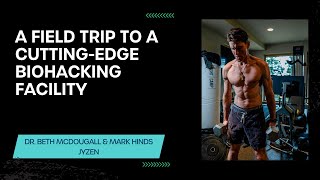
Ben Greenfield tours JYZEN Labs with Dr. Beth McDougall and Mark Hines to explore biohacking technologies including structured water, red light therapy, and hyperbaric chambers. They discuss how coherent space and structured water might affect cellular electrical conductivity, and Mark presents theories on resonant communications as an alternative to Wi-Fi and electrogravitics.
Chapters
You know, Nissim is known for saying this, but within a cubic centimeter of space, you have the energy of 30 million stars, like right here, all over in space. We are living in a field of energy. And so if the, the mitochondria are in resonance, they're like, they're like little free energy factories. These mitochondria, not light, they are, they have rotors that spin at the speed of a jet engine. You know, and then we have, we have thousands and sometimes tens of thousands mitochondria per individual cell. We have 37 trillion cells. And they are, they have these routers in multiple of them per individual mitochondria, speeding like jet engine speeds, producing ATP. They're like these little free energy like factories, basically. And of course, yes, there's some substrates, there's the oxygen, there's the glucose, but. But they're producing far more energy than we're actually consuming with those basic substrates.
All right, folks, this is a fun one. I'm back in my hotel room after a crazy day. I have literally spent about the past eight hours or so in this cutting edge biohacking facility called Jyzen J Y Z E n in Mill Valley. There was an episode I recorded some time ago about the future of biohacking technologies, so called resonance technology, longevity recovery, and a lot more, with a doctor named Dr. Beth McDougall. And later I came down and visited Beth's facility, which is Jaizen, which we talked about in that episode. And I'll link to it in the show notes. All the shownotes for this podcast are at BenGreenfieldLife.com Jyzen J Y Z E n and I had a chance to kind of walk through this complete wellness destination service where integrative medicine and quantum physics and technology all come together in this really unique way, all overseen by doctors and medical professionals. And they've curated this biometrics lab and a sound wave and electromagnetic medical technology room and hot and cold plunge pools and biomechanical movement assessments, hyperbaric red light beds, methylene blue neurological and brain assessments, and vasper and arx, minimal effective dose exercise machines. This massive warehouse of medical and longevity and biohacking technologies and services. And I thought when I was down there last time, gosh, we should do a podcast on this. So we did. We spent the entire day down there filming all sorts of crazy, sexy, cool new technologies, many of which I've never discussed on this podcast. And we kicked it all off with me interviewing, which is the first part of this episode that you'll hear Dr. Beth McDougall and Mark Hynes. So Beth is a real pioneer in what's called complementary alternative medicine. So she's a formally trained md she had an internal medicine residency and then she went through functional medicine training.
She was one of the first groups.
Of physicians to go through functional medicine training in the US So she's been doing this for a while and she's kind of known as a medical detective. She unravels these really complex multifactorial conditions like mold and Lyme and chronic illness and neurodegenerative diseases. But she doesn't just use pills. She uses crazy electrical technologies and as you'll hear in this podcast, these so called resonance frequencies and energy balancing and all these light and water and electrical treatments to heal the body. And then her partner is a science and technology investment accelerator kind of operator. His name's Mark Hines. He's super smart. I had dinner with him after the adventure at the labs as well. And the guy is just super plugged into how to get things like more free power, defy gravity, as he'll talk about in this episode, and solve a lot of big, big problems. This dude thinks on a big level for health, for energy, for agriculture, for the environment. So you'll also get a chance to hear about him and his company, Kenobi, their portfolio, what they do, and why he partnered up with Beth to start Jaizen. So this is a very video intensive podcast. You're gonna wanna watch the video cause we demonstrate a lot of different things. So again, all of it's gonna be on YouTube or wherever you like your podcast players. But the show notes are at BenGreenfieldLife.com Jyzen BenGreenfieldLife.com J Y Z E N All right, let's jump in.
So, dude, Mark, what's this water bottle? This has ARC on it. It's by this giant crystal.
Yeah, yeah. So what's it about? Yeah, yeah. So ARC stands for advanced resonant kinetics, meaning.
You know, crystals. It's interesting. Most in, let's say in the esoteric community, people like crystals. They think they're kind of cool.
Yeah, magical.
Yeah, magical. Well, there's actually some really serious data behind how crystals affect space, how they affect water. And so in this technology, there's actually a little, a little crystal right in the bottom here.
Oh, okay. Okay. By the way, there's a video version of this. Who might be listening. You guys are going to want to watch the video for this episode. So go to BenGreenfieldLife.com Jyzen J Y Z and watch the video. Okay, so you got.
Awesome. Yes. There's this little crystal here. Yeah. And actually creates like a little vortex. And so when that. When the bottle was designed for it. And so now this is actually structuring the water.
Oh, so it's structured.
Yep.
Okay, got it. But the water doesn't have to pass through the crystal first. It can just sit on top of it and it structures it by being exposed to it.
Exactly.
Yeah. And the crystal was designed by Nassim Harriman, the physicist, and in the exact dimensional characteristics that resonates with the quantum vacuum interest.
What's a quantum vacuum?
So it's like the. At the quantum level, the space that we live within is highly structured. So if you look at Plancks and how they're arranged, for example, which is one of the smallest subatomic particles that in our known universe, how it's arranged is in a tetrahedral geometry. So the dimensions of the crystal is in resonance with the fundamental structure of space time, basically.
Do you think that's the best way to structure water, or is that kind of like what you use when you're on the go?
It's a great way to structure it. There's multiple ways to do it. It's passive, so it's very easy to do. Anybody can do it simply by just putting water in a container. I don't know if we could say it's the best way. It's a very good way. I've done some studies showing how it affects plants. Plants grow bigger, they grow faster. The phytochemical profile of the plants is increased. They live longer.
And it's not even just structured, but it's actually adding energy to it so that there's more vitality to the water. So. Yeah.
What's that mean? More. More vitality.
So, you know, water can conduct electricity. Everybody pretty much knows that.
Yeah.
You know, you sit in the bathtub, you get the blow dryer in there.
Yeah. So, yeah.
So if, if you can, you can increase many times. We do that all the time.
Yeah, yeah.
That's just to kind of play with it. Yeah, yeah, yeah, yeah. True biohacking. Yeah, yeah. Toasters work better than blow dryers.
The Westinghouse 1200 watt. Yeah, yeah, that's right.
No D here at all, folks.
Exactly.
Okay. So the water can serve as an electrical conductive agent. Why is that important?
Well, because the body basically 37 trillion cells, and each of them, if they were like, perfect charge, would have about 2, 10 of a volt of electricity. And viruses can't penetrate the cell. So the greater electrical potential that the cells have and the body has, the greater vitality we have, the greater health we have.
Longevity. Many, many things are affected by the electrical potential of the cell.
So if you drink water that's in more of like a crystalline structured state like that, and it enters into your body, do you think that that actually increases electrical conductivity in the body somehow?
When water structured, it takes energy to structure it. So when it's structured, it has greater communication with the energy in the field that we exist within. And so it's taken energy to structure the water. So then when you drink structured water, it communicates the energy to your system. When you drink unstructured water, it almost robs your body of energy because then your body has to use its own energy to structure it.
Interesting. What about the idea that the body can structure its own water? Like, I think the first time I came across this concept was in a book called Cosmic Heart, Human Heart, I believe is what it was called. This idea that the heart is not a pump by Dr. Thomas Cowan, where he discusses how the heart actually sits in. You use the word tetrahedral. The heart sits in a tetrahedral shape within the chest. And when it pumps, it's more of a spiraling action. And that vortices the blood and causes a similar structuring effect on the blood as something like a structured water device or a vortex or crystal in water or would cause in a bottle of water. So do you think, based on the idea that maybe if the body's able to structure its own blood, that even if you weren't drinking structured water, you would still be getting some type of effect?
Yeah, for sure. So two things on that I'll mention. One, then you discuss the detail. But yeah, they've now actually done some pretty cool imaging where they can actually see in the artery that the inside of the artery is rifled. So like the rifling of a gun.
Yeah, so you know, cause spiraling.
Exactly. And so the blood is actually rifling. Actually, the middle of it is empty. Right. So the blood is all on the.
Interior wall, the middle of the arteries. Empty.
You can actually see through it. So you're actually creating a vortex, like.
The volcano that you saw in, like those high school science experiments, you know, with the water. I forget how we did it, but you caused the water to vortex, and it creates like this empty area, this funnel inside.
It's like a tornado, like the eye of the Hurricane.
Yeah, like that.
Exactly. It's the same dynamic. And that explains why the amount of energy that the heart actually produces is really not enough to pump all the blood.
There's a significant physical impossibility for it to reach every tiny capillary.
Yeah, the math doesn't add up.
So.
But this understanding then if it's rifling through and then vortexing back and forth every time it answers how that happens.
Yeah.
And the body is structuring water all the time because that's the primary state water exists within the body. It's not just loose H2O molecules, but it's actually lining up along all the surfaces in the body, such as the inside of the arteries, around your cell membranes, around your intracellular organelles. And the water is organizing itself in like a honeycomb matrix.
Yeah.
And it actually has a different.
It's like a gel. Yeah, yeah, it's. There's a book called Quench. It's about how water that's consumed in a more gel like format from things like fruits or say like a chia seed gel or CMOS gel or any of these type of like gel lubricating type of fluids that you find in nature can be more hydrating than water in its liquid form. And then what you were just explaining about in terms of organs and cells relates to Dr. Gerald Pollack's book. The researcher from University of Washington wrote a book called Cells, Gels and the Engines of Life. And it basically.
Almost defies the whole idea of a sodium potassium pump being necessary to cause electrical transfer from the inside to the outside of the cell. And that it's instead the gel like nature of the cell that allows for electrons to move throughout the cell efficiently.
I think both contribute to, let's say the cell membrane potential. You need both the sodium pump and the gel like nature of the water. But when the water is structured like that, it actually creates a battery. So when it lines up in that honeycomb matrix, it's actually H3O2 as opposed to H2O. And so it pumps the proton, the extra proton outside of the structured zone. The structured zone is a net negative charge. And then right alongside of that is this proton rich zone that's net positive charge. It's a charge separation that actually creates a battery. That battery is fueling a lot of the chemical reactions and a lot of so many things in the body actually the water will line up along the helical DNA structure, for example, in a structured form. Form. And some of the energy from the water is imparted to the DNA tool to allow for it to expand in certain areas so it can express certain genes. The water will form these structured sheaths around our proteins. And in order for a protein to have an effect in the body, it has to change configuration, and that requires energy. So the water imparts that.
Have you guys ever heard of the ability to be able to actually measure the potential electrical conductivity of the body using something like a phase angle measurement? You familiar with that at all?
Yeah.
Do you think that if you were to test before and after, say, like, drinking structured water or doing some of these electrical modalities we'll be doing later on, you would notice a difference? Or have you ever had an experience with that?
I have wanted to do that with patients and myself, and I plan to do it, but I've never done it yet.
Dr. Mercola is big on that. He has this little bag, he travels around with a phase angle measurement in it, and he's always, like, laying different biohackers and health influencers who he's with out on the table to see if they're really healthy based on their phase angle measurements. I think it's. I think it's slightly higher is better. I don't remember right off the top of my head, but it's this little, like, alligator clip that he attaches to you.
It correlates with the cell membrane potential. So, you know, the more negative the cell membrane potential is, the. That I think the greater the phase angle.
Yeah, yeah. You would want a slightly more negative cellular potential, meaning that a lot of.
People rich with electrons, and it has that structured water zone. It has, you know, that, like, enough charge separation to really give, like, a negative cell membrane potential. And that the more negative the cell membrane potential is, the healthier the cell is.
That's one of the reasons why people say that a lot of wi fi and dirty electricity and even Bluetooth to a certain extent, can be problematic because it causes a calcium influx, the influx of a positively charged ion into the cell. And if you look at, like, rigor mortis, like when I go hunting, if an animal is being chased and knows it's going to be shot, or you have an unethical shot and you wound it and you got to track it down, there's a big release of cortisol, and eventually, when the animal finally does die, a larger influx of calcium into the cell. That's where you get rigor mortis. And you also get a very tough, sinewy, fibrous type of taste to the meat. And it Requires a lot more tenderizing. And I've always thought it's kind of interesting how humans who are exposed to high, high amounts of dirty electricity on a regular basis with a constant calcium influx might be experiencing the type of things like joint pain and fibromyalgia and tight and stiff tendons as a result of the constant state of calcium influx that they're in. And also the poor phase angle that results in the type of energy deficits and poor sleep and other things that people experience. But it's interesting to think about how all that is related to the body being a battery.
So I think that the calcium part is.
An exhibit of a deeper phenomena, which is that the body's an analog system. All of nature is analog. If you look at a wave in the ocean makes an analog wave, right?
Yeah.
If we hook up technology to the body, everything, all the instruments will show an analog wave, WI fi, all these things. It's a square wave, it's a digital wave, Right?
Right. So now what, you've got to draw that path. So the square wave would be more like that.
Exactly. So now you've got a square wave, a digital wave, going through an analog system, significantly interrupting all of that intracellular, all of that communication. And that's really the fundamental challenge of WI fi and these non resonant systems. Because that's not how nature functions. Right.
Why can't they just make electrical technology with, with more like, like that sinusoidal waveform, more of an analog waveform?
Well, we could, but we'd have to. That's a.
It's gonna take some time.
So, so filming will come, come back. But first I'm thinking sip of this.
Coffee that you gave me.
Yeah, yeah, yeah.
And I want to come back to the wavelengths. But you told me like right before we started recording about something I didn't know about coffee. I know a lot about coffee. I was telling you my dad was a coffee roaster growing up, but I've been sucking down espresso since I was 13 years old. But you said that coffee even, even if it's like nitrogen flushed and in super good packaging, starts to lose a ton of its phytochemical content after something crazy like 10 days.
Yeah. So the data shows like after, after about 14 days. 10 to 14 days. So the, the phytochemical profile, like after that, let's say 10 to 14 days, starts sliding down significantly. So yeah, I guess we really can't call it alive in those first 10 to 14 days. But the.
Fatty acid profile all of the things that make coffee sort of like a superfood are really present mostly in that 10 to 14 days of roasting.
That's interesting. Kind of makes me wonder if some of the studies that have been done on coffee have used super fresh coffee or stale coffee or if they even differentiate.
They're just starting to.
Yeah. And I think that you still see good results even in some of those studies. But I just, if, I mean, I.
Know I drink old coffee and I.
Feel great on it past post. 10 day coffee versus the, you know, within the first 10 days, I think the results will be so much better.
That's true. Do you guys roast your own coffee?
Yes.
How do you do it?
So it's the. I think it's give a plug for somebody. The SR800. It's a crack up, you know, you think like that's some made up thing, but yeah. So it's just a little device put in about anywhere from about 6 to 8 ounces of coffee which will last a few days. And the whole roasting process is about 14 to 18 minutes.
Is it just like push button, set it and forget it? Like countertop type of coffee roasting?
You can, but it's best to monitor it depending on the kind of roast you want. If I want light roast, medium roast, dark roast.
Huh?
Yeah, it's pretty cool. So if you get to me now see that the ultimate in coffee of being in a true superfood.
Yeah.
Is you get an organic green bean.
Right.
Okay. Super fresh.
Of course it's still alive green. For people who aren't familiar with that term being unroasted.
Yeah, unroasted. Yep. And then, then you roast it, you give it about two days because actually it's producing a lot of carbon dioxide. It's actually you can, if you seal the, let's say a jar.
Yeah.
Immediately after roasting, you open it up. After about two days, you know, pop.
Oh really?
Yeah. Builds up a little bit of pressure.
Interesting.
Yeah, it's really fascinating. So it's off gassing for about two, two to three days and then that's the optimal time to consume is about the 3rd to 10th to 14th day. So it's the, it's the ultimate in the, the health benefits, the experience of like the neurotropic effect. People have a pretty significant difference in experiencing it. Let's say stimulating may be the same, but from a neurotropic perspective, it's a pretty big difference on that first like 4 to 14 days.
Last time I was here, one of you guys was telling me about how you like to put shilajit in your coffee. Do you still do that?
That's my morning routine.
Now, for people who didn't hear that episode, explain your reasoning behind this.
Well, we have a product named Mana, and it's shilajit and water from the Dead Sea that are vortexed together. And shilajit, you've probably talked about it a lot on the show, but it's.
A resin that's not that much like. Like, I talked about that Mana stuff briefly because you sent me some up to try, but I haven't talked about it that much. It's really interesting.
So shilajit is a resin that seeps out of the ground in a narrow chasm of the Himalayas at certain times of the year. And it was once a rainforest that's been petrified and now kind of seeps up from the ground. And it has the highest concentration of fulvic acid and humic acid. It's full of easily absorbable minerals and amino acids and even essential fatty acids and probiotics. And to me, it is the ultimate superfood. Ultimate superfood. And then we mix it with water from the Dead Sea and vortex it in such a way that it creates these ormus precipitants that also do amazing things for the electrical system.
What's ormus?
Ormus are orbitally rearranged elements or really rearranged monoatomic. Monoatomic elements. And they are elements in kind of a spin state that allows the electrical. Really turns on the electrical system of your body. So what I've. I mean, everyone pretty much who takes it feels the difference that it just lights up their brain and everything seems to be working in a more coherent, effect, efficient manner in the body.
The. The idea behind putting the shilajit in the coffee is that just purely for flavor, for the effects, or. And the reason I'm asking this, I've heard some people say they'll put like, sea salt in their coffee because coffee is sympathetically stimulating and might deplete the adrenals more quickly if you don't re. Electrolyte your body when taking it. Is there some of that reasoning behind putting the shilajit in it?
Yeah, and shilajit is just a really grounding supplement. And it's so good for your hormone balance.
It's from the ground.
It's so good for hormone balance. And, you know, one thing that coffee can do is it is stimulating. And so if you have depleted adrenals and you're drinking too much Coffee you can further deplete your adrenals. It's like, okay, it's a superfood and so good for you. But it is a stress to be overstimulated. So then you need the adrenal strength to be able to ground that.
Yeah, yeah, that makes sense. Reishi and theanine I think are also really good with coffee for that same reason. Yeah, but those don't have as many minerals as that shilajit stuff. And that, that's, that's ma m a n n a. Right, right. And by the way, I'll put all this, the mana in the SR800,000 coffee roaster. I'll put all this into the show notes for people. So. Okay, so now, now that we've talked about the everybody's favorite drug, let's get back to, to smoke come out of our ears with this sinusoidal versus digital waveform idea. So I asked you if you could somehow propagate an electrical signal like a WI FI signal, but not use a square waveform and you said that you had thoughts on that.
So. More than thoughts. Yeah. So the technology developed and hopefully it'll be coming to market in about six to eight months. So it's going to be really important because it has the opportunity to replace all WI FI cellular or even be let's say complementary to it. But we can send the information further longer. And the structure of let's say that wave is resonant to human beings. So yeah, it's coming.
Are we talking like the equivalent of like the old school 28.8k modem though as far as connectivity, like could this still be used like on scale for high speed Internet transmission?
So let's see here. So it's approximately 10 times faster than 5G.
What?
It goes 10 times further than 5G. We're already exhibiting it up to 15 kilometers.
Oh, Elon, Musk is going to shut you down, dude.
Actually not. It'll be very complimentary. Still needs land based transmission, right? Yeah. So even Starlink's amazing. You know, we were on a private island in the South Pacific and great to have. Yeah, right. And it's serving a lot of purposes and actually I would even have that as a complimentary thing to some places like when you're out hunting. Yeah, great to have that. But for the amount of communication that we're going to be able to have to have. And the other thing is that this type of communication becomes non terrestrial. So as we're moving into the idea that we're not bound by the surface of the planet. When we start looking like gravity control and these type of things that are coming in 2024, there's very significant physics that are going to be introduced in 2024 that really start to change our perspective that we have to be attached to the surface of the planet. Now we're using rockets and things, but using this type of communication technology.
We can go at vast distances at almost unlimited speed. It's going to be really important because that's how nature functions. We talked earlier, before we started today, about resonance.
Once we start looking at everything of how nature functions, which means the, you know, the universe is transmitting almost an infinite amount of data at almost an infinite baud rate, right? That like 800 million times faster than the speed of light. And so if we could work in resonance with that same structure, we could send infinite information at very fast speeds, and that's what's coming.
I don't understand what you just said about gravity. Did you come here today in a hovercraft? Like, what's. What's that mean, not connected to the planet?
Oh, well. So let's say currently we use a rocket, right. To get off the surface of the planet. But a rocket, you have to use a lot of energy to push against gravity.
Right?
So an example. So if I take a magnet and something that's magnetic, and I do that, boom. I just showed that the magnet will pull up the object. Right. So I was able to easily exhibit that. Electromagnetism overcomes gravity. Right.
Okay.
So again, if we worked in resin.
Do you mean there's like, the two opposing surfaces of a magnet like that?
No. So if I have a magnet, like a little ball bearing here. Yeah. I just showed up.
Boom.
The ball bearing will go up.
Right.
So we just showed that a magnet, Electromagnetism. A magnet can overcome gravity as the little ball bearing goes up. Right?
Right.
So if we could work with that same principle, which the science of this is called electrogravitics, meaning using electromagnetism to overcome gravity, then the whole idea of having to have a rocket to having to use massive amounts of energy to propel things or for thrust starts to go away. So that means that we're no longer bound by gravity. And that's being done in a couple labs around the world today. Very small scale, like a pound and a half, five pounds of thrust is being created using this phenomena of electrogravitics.
Where do you envision this being applied on scale for consumers like cars or vehicles or spaceships or something? Like that.
Everything. Yeah.
Really?
Yeah. And the physics of it.
Shoes. That would be fun.
It'd be a little hard to control, I guess.
Something to control. But now the physics of it has already been written. It'll be coming, made public sometime in 2024 of an engineering solution of how to access actually this phenomena of gravity control.
And then this will be open sourced to the public. And it'll probably take people a few years to start understanding, but yeah, rockets will go away. We'll be able to have vessels that overcome gravity by using electrogravitics.
What's the name of your company?
Kenobi.
Kenobi.
Yeah.
And you guys do a lot of work with these type of what you call resonance technologies. Yeah, the whole even mean resonance.
So the whole idea of resonance is that being. It's pretty simple. So just being in resonance with how nature functions. So we would say that pretty much most everything being done today that humanity does is dissonant to how nature functions. You know, we, we blow up a hydrocarbon, you know, we split atoms. We use, you know, drugs on humans, we use chemicals to grow plants.
Right.
Nature doesn't do any of that.
But if we could create tumors. Yeah. I mean, there's so much in medicine that's dissonant.
Okay.
Most everything is in medicine.
Dissonant would be the opposite of resonance.
Yeah. So dissonant would be opposite of resonance. Dissonance would be forcing or manipulating nature to try to do what we want it to do. Resonance would be saying, okay, nature's obviously functioning really well at an infinite scale. Right. Past just terrestrial, past Earth, solar, galactic, universal scale. If we could understand that phenomena of. Where's for instance, a couple of really easy questions. If I ask any physicist, scientist, engineer on planet Earth, for instance, if I have a little piece of paper and I put it on my refrigerator and I have a little magnet, and that magnet holds up that little piece of paper for 10 years. Like, if my arm had to hold up that piece of paper for 10 years, that'd be a lot of energy expanded. Where does the energy of that magnet come from? So the magnet is producing more work than energy it's consuming. There's no physics to explain that. Actually, some of the greatest physicists, like Feynman, there's a great video on YouTube, one of the greatest physicists in modern history, where somebody asks him that, he kind of loses his mind. He goes, what do you mean? Like if my aunt Ida fell by walking on ice in Minnesota in the winter, how does that happen? What does that have to do with a magnet. But since they can't explain it, it's very perplexing.
Nobody's been able to explain how magnets produce energy.
The standard model of physics cannot. However, others are clear, like Nassim Haramein, and others are clearly explaining that the magnet is working in resonance with nature. There's a lot of energy in the field, a lot of energy, and that's where the energy of the magnet is coming from. Or an atom. Where is the energy of the nuclei of the atom that's spinning it near the speed of light forever. If you release that energy, kaboom. There's a lot of energy there. Where does that come from? The standard model of physics cannot explain that. So this understanding of resonance explains everything that the atoms in resonance with this field of energy and information we live in. That's where the energy of every atom is coming from in the magnet and the human body and everything. So if we could just tap into that same source, very interesting things start to happen.
Huh. What could you do with that in terms of tapping into that source? Are we talking about, like, free power or something like that?
Yeah. So the word free is interesting. But so what is this? You know, so 2023. So if we go back almost 80 years in the 1940s. So they had a little radio about this big.
Yeah.
And a little piece of wire that came out. You put it in your ear, and they called that a crystal radio.
Okay.
I think the. The material was.
Galena. I can't remember the actual crystal, the construct of the crystal. But you turn it on, and it would produce enough energy to extract an RF signal out of the field and enough to produce a few electrons to send down into you. No battery, no charger. If you go into an antique store today and you buy one of those radios. Yeah. You turn on. Still works.
It's just all run by a crystal.
So that crystal is like a little oscillator, meaning it's extracting, just like the magnet, just like the atomic, it's extracting a really, really small amount of energy out of this field of energy we live in. It's in resonance with that, and it's producing enough electricity to power a radio.
And that's what's structuring the water in. In the arc crystal bottle here.
Yeah.
Could you power larger objects, though, than just a radio? Theoretically. Or would you just have to have massively huge crystals?
No.
So it seems like there might be some transportability issues.
No. So that. So. So degrees, let's say, of efficiency. So that crystal was not very efficient. But so now imagine in a very small space, you could have, like, let's say the base of the crystal would be 5 to 10 microns, and you had them all in the tetrahedral geometry, and you're able to deposit these crystals in a very specific manner.
And I can share with you. That's been done.
Okay.
And so now we have basically a perpetual energy cell. So instead of a battery that has to be recharged, now we have an energy cell that's producing electricity 24 hours a day, seven days a week.
And what could you do with something like that?
Well, so imagine your phone, if you had an energy cell in there that never had to be recharged, or your computer or your car or a plane. Okay. Because you're, you know, a Tesla car. I don't know what, it's like 24,000 or something. Little batteries, right?
Yeah, or little.
So it's not one huge battery. It's multiples of them linked together in packs. Right. So you could have many of these little energy cells in the same way. Now you have a car that goes forever, never needs to be retargeted.
Perspective of planned obsolescence on the part of folks like Apple and Tesla, wouldn't that kind of be shooting yourself at the foot from a business standpoint?
No, actually, I think it'd be the best thing they ever had. I mean, if you had a.
If you had a computer, if you had a phone that just never needed to be recharged. Yeah.
What I mean is, like, you'd have no reason to buy another phone.
Oh, yeah, for sure. I mean, the batteries have to be replaced.
Okay.
But what's going to happen? It's always. It's interesting that that's the first thing that humanity always goes to. Right. Is that we're going to have a very significant innovation that, oh, it's going to shut down these other things.
Right. But we don't realize AI and all the businesses that's going to put out a business and the people who are going to be wandering the streets with nothing to do.
Exactly. But what this is going to do.
Which I don't think is the case, by the way.
No, but once we start moving into resonance, it's going to foster a level of innovation that has really never been seen before, like the. The expansive amount of things that are going to start being created. It's going to be like when we were an analog system, then all the way up to the late 1950s, 1960s, the first computers. Look at the innovation that's happened from the digital revolution. Then before that we had the industrial revolution where we were making things by hand and we started making things by machine. So let's say that was the first revolution. The analog to Digital was the second. And there's a third revolution that's coming and it's starting this year in 2024. It's going to be bigger. Is the revolution from dissonance to resonance. And many people, it's not even a technology revolution, but to us, one of the most important things, it's a revolution of hope. Because so many people I think today are in despair of.
Let'S say, the difference of beliefs and how do we solve the problems and whether it's climate or this or everything. Right. Well, once we move to resonance, most every problem we're facing today, whether it's organic food or the climate, they're all going to be solved health. So there's so much that's going to come from this.
This is interesting. I haven't heard many people talk about this as much as you. What about this, this guy you mentioned earlier about Nassim and you said Nassim Harriman is the same person in. And is this like the father of resonance technology or something like that? Or who is this guy?
Yeah, well, I don't know if I'd say he's the father of it because Tesla probably didn't use the word resonance.
Okay.
But definitely 100%. I mean he was powering Colorado Springs, Colorado. The Tesla Museum is still there from these ideas of resonance. Right. And much of the things we're using today, you know, still were invented by him. But I would say what Nassim is, is Nassim is the first modern day human that has been able to take these understandings and first quantify them and say, okay, it's not just an esoteric idea, here's the data. And then be able to explain it in a layman manner, which he's done so beautifully. So his nonprofit, the Resident Science foundation, there's I don't know, like 100 something thousand people enrolled in their academy, but all the way from like kids, you know, 7, 8, 9 year old to I think there's a 90 something year old because it's made available to the layman. And Beth and Nassim have been working very closely on how to begin explaining how do we really move health into the whole next level by the same understanding of resonance physics.
What are the applications of this to health, Beth, in terms of like how to get into medical practice or what you're doing at Jaizen?
Yeah, I mean, so many. Because the body really, when you, it comes right down to it, we're a field of energy and information. Our body is really intersecting waves, energy. And the proper functioning of our physiology depends on the proper information transfer in the body. And when we're conceived.
There'S a field of energy and information that's created that actually becomes like a template along which our body develops as an embryo and contains the operating instructions that d. That dictates our, and orchestrates our complex physiology. I mean, when we talk about complexity, we have 37 trillion cells, each with millions to billions of chemical reactions happening every second in a coordinated manner. And that level of complexity cannot be explained by current science. And there's not any quantum computer, there's no supercomputer in the world that could approach that level of orchestration. So how is it that we are, you know, these functioning beings? And not only that, we're not even static like we are literally. And all of material reality is flickering in and out of existence, you know, trillions of times a second.
What do you mean flickering in and out of existence?
So we are here and then we're gone. We're going like, we're going into, into a different. Like if you almost think about the toroid and you have like the, the outflow of information from the event horizon and then you have the inflow, you know, it, it disappears for a moment. Like the, the, the, they call it the lighthouse for frequency. It's like trillions of times per second the material reality is flickering in and out of existence. And so we have this complex physiology that's flickering in and out of existence. And how is it we are repatterning ourselves, reorchestrating our physiology every second we have a field of information that is doing that. So as we go through life, that field becomes contaminated. We experience trauma, we have exposures to toxins, we get infections and things like that. And each of those things has a simple or complex field associated with it. And if we begin collecting the information signatures of things that are not harmonious with our body. And even if we're exposing ourselves to non harmonious, non beneficial energies like 5G and WiFi and all of that, you begin to disrupt the patterning of the physiology, okay. And very much disrupt the flow of energy from the field into our physiology to fuel all of the chemical, you know, multi trillions of chemical reactions happening every, every second.
So sort of like this is your pristine blueprint of that moment of creation, of conception. And this is where we are today. And all of these events of life, whether it's, you know, diet, stress, WI fi, whatever it is, create coffee, bad coffee. 16 day old past the 14 day.
Old.
It'S all over. Yeah. But anyway, it creates static.
Just an inhibition of the communication between the two. So really the data is starting to show that aging, disease, everything really starts just to be a result of one thing. The degree of resonance or dissonance that the pristine blueprint has with the body itself. That's it.
And so these resonant technologies, like the ultimate technologies that are going to be coming forward are create coherent ultimate. That's like a brand, no meaning, like, like the best.
Okay, okay, gotcha.
The highest level of energetic technologies that we have, that we will, we have now and that we will see coming out in, you know, greater forms are create coherent fields. So you know, like, like you can, you can drink regular water, you can drink structured water, you can be in regular space or you can be in highly structured space. If you put the body into a coherent field created by.
Let'S say a scalar technology.
The structured space becomes an amplifying conduit of energy from the field itself into the physiology.
Let me break that down into layman.
Thank you, I would appreciate that.
Yeah. Okay, so.
We'Re having this feed, we know that the biology is having this feedback with the field. Okay. And so.
We'Re saying is we live in a field of information that allows us feedback that to happen. But the space is the structuring of the space, just like water. So when the water structured, we know that there's more energy and information exchange. Right. The water can conduct information, it can conduct electricity. So the space, since it's highly structured, it seems empty to us. Right. But it's actually highly fluid, it's highly dynamic. They've actually, you know the double slit experiment, have you ever heard of that?
Yeah.
Okay, so the idea of that, it's. It's flawed because the idea was that depending on the observer would see if. Okay, it's either a particle or a wave.
Right, Right. The nature of something will change once it's been observed.
Exactly. Physically, that's what they're, that's what has been stated. Right. But here's a different perspective on it. So imagine that we live in this field of energy and information and super fluid, and it's super dynamic. And the fluidity of it is something called plasma.
Okay, okay.
So we live in a field of plasma. Actually we see this all the time with something called lightning. Lightning is plasma. All lightning is doing is lighting the plasma of space so that you can see it. But if I had a device here, I could have a little bit of voltage here in the ground and I could create lightning between us. All it is is lighting the plasma of space.
Okay.
Like a neon light. Right, right. If there's no voltage to the neon light, the tube seems empty.
Right, Right.
Okay. Just like with us, the space seems empty. I give the, I give the neon light a little voltage. Boom, it lights up.
Okay.
If I could do that to the space, this would all. Okay, so now, so now imagine the double slit experiment. Like if I'm in a swimming pool, I don't know if you've ever seen a video. And they shoot a gun.
Yeah.
It creates a wave.
Okay, Right.
So imagine that I just shot a.
Lot of underwater guns, but I believe.
Yeah, yeah, there's good videos on YouTube.
Okay.
People doing it. It creates pretty cool wave.
Okay.
So imagine if I'm shooting a photon through a slit and, and the field is fluid, it's going to create a wave. So the double slit experiment is just to actually, you're just actually witnessing the fluidity of space. You're seeing that as the photon goes through, it's creating a wave in space.
Okay, interesting. And so based on the double split slit experiment, how does that influence somebody seeing a different phenomenon under observation versus non?
They're not seeing a different observation, they're just. They're trying to explain what's creating the wave.
Okay, I gotcha.
Right. And now we can now break it down to very quantitative phenomena. And then, so what Dr. Beth is sharing then is that the space, this fluidity of space, just like with water, we can structure that, we can structure space.
Got it.
And so if the space is more structured, it can conduct more energy and information.
That's right.
So let's say I come into you and I'm not very electrically conductive and maybe flickering in and out of my existence improperly. And I'm living a typical industrial lifestyle and am under a lot of stress, especially from the perspective of my cells being a battery. I know that we're going to be going through your facility and we're going to be showing on video a lot of the cool tools that you would use to restore somebod. But what are some examples of what you would use in a situation like that when it comes to these kind of scalar technologies, or drinking structured water, standing on giant crystals, or whatever else that you would implement?
One of the things that you're going to do today is that we have a room where we have very beautiful scalar technology in there that is structuring the space of the rim, creating a coherent field. And then we're able to measure different information signatures in your body that are, let's call them aberrant, like off, you know, so signatures of toxins or pathogens or even disease cells or things like that. And then we're able to send back corrective information signatures that cancel those out through a plasma device. And that's actually how Royal Rife used to send corrective signatures through. Interesting, plasma. And anyway, then we check again. So it's this constant biofeedback process that removes dissonance signatures out of your body.
Just to mention that because most people aren't aware of plasma, and it's amazing because we live in plasma, the whole, our whole existence is based on living in plasma. But plasma is the great conductor. Right, so plasma is what conducts energy and information. It transmutes things from one state to another.
Okay, so for instance, similar to like the gel state of water. Well, but instead in our environmental spaces.
Yeah, somewhat. Okay, let's say fire. Most people aren't aware, but fire is plasma.
Okay.
It's not a solid, not a liquid, not a gas. Yeah, so fire is plasma. They call it the fourth state of matter. Actually everything emerges out of plasma. But so if I light a piece of wood on fire, we show that fire is the transmutator. It's transmutating that stored energy of wood into a higher state called heat.
Right.
Okay, so we can now use plasma devices to transmute biological systems from one state into another.
Like what?
So would you like to address that.
Or what are you exactly.
Okay, it's like a healing device. Okay. So I could, in a glass tube we can conduct plasma. Okay. And let's say I had a torn rotator cuff. Torn rotator cuff. So normally we would have to go through many iterations to heal that tissue. If I could touch the plasma device to that torn rotator cuff, what it would do is it highly accelerate this energy and information exchange phenomena. And the healing would happen very, very, very. At a degree of magnitude. Of magnitude that most people would say is almost impossible.
And you guys have technology like that? It dries in. Yes, Interesting. So you've got scalar technologies, which is like this field that you go into that tests and then applies a frequency and then you can retest to see what changes that it made in the body. You have things like these plasma Technologies. What would be another example of something that implements this type of resonance in medicine or longevity?
I mean really? Yeah, there's so much to talk about. But we are these, we're going to.
Show people a lot of this stuff too, so we'll get a chance.
Or these energetic beings that are derived from this field of energy and information. So let's let the field be our medicine and the individual components of the field. So a lot of the health technologies nowadays that really help us resonate better with the field are geared toward upregulating mitochondrial function. One way to do that is something a lot of people are familiar with, is red light and near infrared light wavelengths. We do a lot with these wavelengths of light because they've been shown to improve energy production in the mitochondria. The little energy factors, boundaries within the cell. And there is an interesting almost. You can almost think of the mitochondria of our cells as like plugging in to the field of energy that we live within.
Actually, that's a really good example because they, the amount of energy that they produce is not linear. Meaning that the math doesn't add up.
Right. So it's like we think that it's all coming from the food we eat, right. And the energy we breathe.
Right.
Food and subsequent production of ATP.
You have so many examples that absolutely defies that. You know, people that are Breatharians and don't eat, you know, how are they surviving? Or people that are running like triathlons, you know, they're, they're, what are they producing like a few times their body weight and ATP, like during the triathlon, you know.
Yeah, they're also eating a lot during the triathlon, right? Yeah, but I don't know a lot of long lived Breatharian populations, but you.
Would have to consume about a hundred thousand calories to equal if it was linear for like the triathlon, that's about how many calories, meaning if they're producing that much energy, they're not consuming 100,000 calories, right?
No, no. I mean typically it's a maximum like 400, 600 calories per hour. And the rest theoretically is coming from fat, from beta oxidation.
That math does not add up.
A lot of these people do not have a lot of.
And so where's the energy coming from the mind?
So my sense is that it's coming from the resonance with the field of. Basically, you know, Nissim is known for saying this, but within a cubic centimeter of space, you have the energy of 30 million stars right here all over in space, we are living in a field of energy. And so if the mitochondria are in resonance, they're like little free energy factories. These mitochondria, not light. They are. They have rotors that spin at the speed of a jet engine. And then we have thousands and sometimes tens of thousands mitochondria per individual cell. We have 37 trillion cells. And they have these routers in multiple, multiple of them per individual mitochondria speeding like jet engine speeds, like, you know, like, producing ATP. They're like these little free energy like factories, basically. And of course, yes, there's some substrates, there's the oxygen, there's the glucose, but they're producing far more energy than we're actually consuming with those basic substrates. So anyway.
All of our technologies almost are geared toward improving mitochondrial function because mitochondria are vulnerable to damage. Unfortunately, we have this, you know, like, problem with dietary intake of, you know, too many omega 6 fatty acids and damaged fats, and they are very much damaging our mitochondria. And then, you know, we have these diets that are kind of poor in terms of not having a lot of, like, high life force quotient foods that have, like, antioxidants and whatnot. And that's leading to damage to the mitochondria. You have people that are no longer spending time outside.
You know, and it's actually the wavelengths of light in the sun are absolutely beneficial to the mitochondria. Like, you know, the practice of getting up in the morning and going outside and allowing, like, the wavelengths of light that predominate in the early morning hours to kind of enter your eyes absolutely affects the health of your mitochondria.
You sound like one of those irresponsible physicians who's going to be giving everybody skin cancer.
I was reading an article yesterday in the Rolling Stone. It was like, all those freaks that are telling you to eat liver and go into saunas and get sunlight, and we're going to see huge amounts of damage from that. These type of irresponsible messages. But it's. I mean, I don't burn in the sun. And I just got back from two weeks of cycling in Italy, and I was wearing sunscreen, especially in the middle of the day. But, yeah, I mean, you're right. The sun is. And infrared and red light in general is a perfect example of something that would charge up the body with this type of energy. You briefly mentioned V cells. Why'd you bring up V cells?
Well, I think Mark was bringing it up because you have These pristine cells that are embryonic in age, very small.
Embryonic like, embryonic like cells. Okay.
And they're naturally found in the human bloodstream and the tissues, and they are, they, they exist throughout your lifespan primarily in a dormant state. And so they've only been newly discovered because of that like you know, in the last like 16 years or so. Because when they're dormant, they don't express all of the surface proteins that kind of identify something as a stem cell.
But it was discovered at one point that they are dormant and they can be activated. And then when they are activated, they then quickly express these surface proteins that are involved in, in chemotaxis, which is them migrating to an area in need of healing and engraftment, which allows them to adhere when they get there. And so when that was discovered, then people have been exploring different technologies for activating B cells. And we've been using a technology that's been working beautifully and we use it both to activate the B cells and then once they're just put back in the arm, we can non invasively guide their migration to an area in need of healing.
Is that that protocol I think I've mentioned before on podcasts where you use like lasers or light to activate the B cells?
I've seen you get this, this procedure. Yeah, yeah.
And I think you, I think Harry Adelson did that when I did the full body stem cell makeover up at his clinic.
I think he uses like lit up.
Laser activated V cells.
Cool. Yeah, yeah, we do that as well. And they enhance resonance with the field because they are these pristine cells that have not really suffered the ravages of aging and environmental toxins and whatnot. In fact, some early studies on these cells where they expose them to like chemotherapeutic drugs, extremes of acid, extremes of base, a lot of chemical insults. And then looked at them to see did they show epigenetic changes, did they show free radical damage? And they don't when they're dormant because they're almost like ensconced in like this very tightly packed double membrane that creates almost like a spore that protects them from damage. So you have these embryonic age pristine, naturally pluripotent, which means that the cells can become any one of the types of cell types in your body. Cells that can be just extracted from like a peripheral blood draw and then activated and put back in the arm and then non invasively guided to an area in need of healing. So to me, this is like the only stem cell that I think is Worth working with, huh?
No. Mark, in addition to partnering up with Beth on a lot of these resonance based technologies that are using and medicine and longevity and health, from what I understand, you've got like basically your, your whole portfolio, your whole interest in terms of the companies that you invest in and work with. It's all companies based on these resonance technologies.
Correct.
And that's what, that's what Kenobi is.
Yes.
Okay. So if people want to like view the portfolio of all the different companies that you have or start to look into these things, like I know Jaizen, where we're at right now is one. Manashi Legit is another. Like where can. What's the best way for, for people to actually stay tuned to what you're doing with resonance?
Yeah. So they can go to website Kenobi IO.
How do you spell that?
K E, N O B IO.
Okay.
And the interesting thing is really none of these, of the 15 companies that we have, none of them we invest in. We've actually started them all from the.
Oh really?
Yeah, we started them all from the beginning because.
Most people really don't understand resonance. And so we've kind of collected a group of humans that get this.
Yeah.
And you know, they've. A lot of them have had a kind of a challenging time and being able to work with the regular world in regards to finance and structure and all that. So we've created a structure that allows these really extraordinary minds to be able to start manifesting their understanding of these technologies in a really, in a protected and coherent way.
Is there any particular technology you're most excited about right now that is based with one of these companies?
Wow. I'd say there's really.
Four vectors, but it's hard to say because they're also complementary. So energy, the communication one that we talked a little bit about earlier about.
Being able to resonant waveform.
Exactly. The implications of that are huge, especially with all the concerns that with 5G to be able to introduce something that not only replaces that, but excels at that, then three new types of energy technologies that are coming out that will be the whole next level of let's say green, but whatever is the next step past green technologies and then a suite of technologies that to me are very important for the extraction of metals and minerals that will really radically. Because we're getting concerned like with rhodium and lithium and nickel and zinc and copper and all these things. And so there's some new technologies that will be coming out later this year and first of next year. That will really completely change that whole landscape where we don't have to extract anything new out of the planet. We can use all the old tailings. It's going to go back and remediate all of the challenges, whether it's from cyanide and these type of things, and be able to extract massive amounts of these metals and minerals, even from the leftovers.
Wow.
So we don't live in a world of assures like rare earth to me, is a complete oxymoron. They're not rare. They're just in a state that most people don't understand. Okay. So we just have to work in resonance with that state, and it's going to really change most everything that we understand. So now we can deal with health, energy, natural resources, and communication.
And that's Kenobi IO.
Correct.
All right, cool. You guys want to do a field trip? I did there. Film it?
Yeah.
All right. So now, folks, you're going get to see a lot of this stuff in action. Time to have fun.
Okay. Thanks, Ben.
Thanks, you guys.
More from Ben




The Solution to Aging Might Be Closer Than Anyone Realizes - With Ben Goertzel



