Ben Greenfield's Top Tips For A Long, Healthy Life
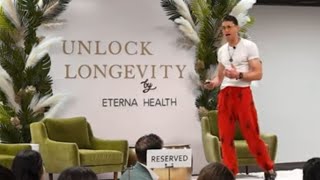
Ben Greenfield breaks longevity into five areas: movement combining strength, power, and conditioning work; fuel through glucose management and mineral balance; environment by controlling EMF and optimizing light and air; weekly detox with sauna and binders; and recovery that prioritizes God, family, and spouse over health optimization itself.
Chapters
Movement is one of the first key principles. And, you know, my. I don't know if a lot of you know this, but my formal background, my education is a master's degree in physiology and biomechanics from University of Idaho. So when I look at somebody or I look at a program, I kind of. I kind of tend to chunk it into a few different departments, so to speak, from a physiological, full body standpoint. And so what you see on the slide here is when I look at movement, when I look at someone's weekly movement protocol, I like to see that all of the boxes are getting checked to hit specific physiological parameters. So one is strength. Right. And one great doctor who's kind of making the rounds, Gabriel Lyon. She's fantastic. I just interviewed her on my show. She has this concept of muscle centric medicine. And it's so true that muscle is a metabolic sink. It is the body's largest organ. She actually alerted me to the fact that it's not skin, it's the muscle. And. And so the idea of maintaining muscle and strength into age is very important. As a matter of fact, certain things are correlated with age. Does anybody know some of the specific movement or fitness parameters that are associated with defying aging more slowly? Even though step count is important, I encourage people to get 8 to 10,000 plus a day. It's actually walking speed. I'll talk to you a little bit about this. But the idea is I like to think when I walk about walking just a little bit faster than my brain wants me to walk out, that's actually correlated with longevity, which is interesting. The grip strength is big. They actually found that the type of muscle that's most correlated to longevity is your fast twitch type 2 muscle fibers. And the interesting thing is that one of the ways that super slow training works is you're gradually exhausting both the fast twitch and the slow twitch muscle fibers, but you're not really moving quickly or you're not moving explosively. It turns out that moving quickly and explosively is also correlated with longevity. So if you were going to do super slow training, let's say twice a week, you would also want to do some form of explosive calisthenics. Or in my own training routine, I like to use kettlebells for this. But basically twice a week, super slow training, and then twice a week, some form of powerful, more fast switch training allows you to target both of the muscle groups that are correlated with longevity, because you're getting a lot of the grip strength and the strength, the brute strength with the super slow training and then for the power you're moving with body weight or explosive style training. So we've got strength and power. The next key component of living a long time based on fitness is your ability to be able to buffer lactic acid. So the next one you see there is for the mitochondria. I don't think it's any secret that mitochondrial density is very important, right? Mitochondrial biogenesis, the health of the mitochondria, your ability to create ATP, your ability to be able to use calories to shuttle electrons through the electron transport chain and make the body's energy currency, that's important. And mitochondrial health is very important. Another guest speaker here, Dave Asprey, he's written an entire book about the importance of mitochondria. And there's good reason for that because it's so important for health and for longevity. But it's different than lactic acid. Basically. Long, luxurious rest periods. If you're wanting to work your mitochondria with brief like 20 to 30 second all out bouts. And again, this is like once a week. So as you're sitting there kind of mapping out your week, you can say, okay, so a couple times a week I'm doing super slow and that's like 20, 25 minutes. Couple times a week I'm doing something powerful like kettlebells or body weight. One or two times a week I'm doing some kind of a tabata set to build up my lactic acid buffering cabinet capacity. And then once a week I'm doing something where I'm doing just about four, maybe a couple more if you want to. If you're a Glutton for punishment, 30 second efforts with a 1 to 4 work to rest ratio, I encourage you to do walking a major part of your, of your daily routine. Principle number two is fuel. So fuel obviously is important. Everybody loves to eat, no matter what diet that you look at, right? From an epidemiological standpoint, if you look at the blue zones and areas where people are living in disproportionately long period of time. I'm wearing a CGM right now. Anybody else in here experimented with or used a cgm? They're way more convenient than the cheapo blood glucose monitors you can get from Walgreens or cvs, which also work by the way. But what gets measured gets managed. And even though I don't wear a CGM year round, it lasts for a couple of weeks, most of these sensors, and I'll slap it on once every couple of months. To keep track of how my lifestyle and my diet and my exercise factors are affecting my blood glucose, how long my glucose stays elevated after I have a meal, how much a meal elevates it acutely, what kind of things lower it. And I found that certain lifestyle factors tend to really do a good job controlling glycemic variability. I have one of them, the most powerful. What do you guys think is the number one way to keep blood glucose stabilized throughout the entire day? Cold, right? Some type of cold. As a matter of fact, I've done cold plunges in the morning that keep my blood glucose levels in the 70 to 80 range the rest of the day and compared that to days in which I'm not doing cold. And there's a distinct difference. So I think cold is underrated as a way to control blood glucose. GDAs. Anybody know what a GDA is? It's a glucose disposal agent. These are type of things that you can eat or consume that would increase the ability of the muscles to express what are called GLUT4Transporters and Pulse More glucose in the muscle tissue and out of the bloodstream, which is where you don't want it if you're trying to control glycemic variability. And then I talked about eating in a parasympathetic state and chewing your food mindfully. And that's not only important because it can assist with reducing the incidence of leaky gut and poor digestion and poor intake of nutrients, but it can also help you to control blood glucose. So glycemic variability is one thing to think about. The other newer, very potent antioxidant that I've been using quite a bit recently is C60. Anybody here ever used C60? I would place C60 also to the category of a very, very powerful anti inflammatory. I'd rank it up there with some other things that are like 100 times more powerful than resveratrol, which would be like pterostilbene. That's another very potent antioxidant. It's a good one to have around PQQ, that's also a very good one. But then C60 is a fantastic antioxidant, especially if you're trying to control. Another interesting antioxidant that I think flies under the radar a little bit is not necessarily vitamin the topo triangles that you find from vitamin E. Another thing that flies under the radar is your copper to iron ratios. Anybody in here familiar with the root cause protocol by Morley Robbins? He makes a pretty good case that a lot of times low intake of copper. Low viability of copper is something also that can contribute to inflammation. So that's another thing to think about is your mineral balance and specifically your copper intake when it comes to inflammation. So those are good things to think about when it comes to inflammation. Environment awareness of electricity, air, light and water as environmental variables. This is one that's really important. I mean, even right now, right? So as far as electricity is concerned, I don't think I need to tell many of you in this room about the concept of your body being a battery. Each cell operating with a very precise electrochemical gradient across the cell. Slight negative charge on the inside, positive charge on the outside. And exposure to large amounts of non native EMF can cause an influx of calcium into the cell, can cause improper depolarization. If you want to read more about this, check out a book by Jerry Tennant called Healing is Voltage. There's another one by Robert Becker called Body Electric. But treating the body as a battery, as an electrical machine is really important. That would include making sure that you're doing things that restore property polarization to the cell membrane, while avoiding the things that will cause your body's battery to become drained. And then pmf. Anybody here ever use PMF technologies? Pulsed electromagnetic field. This is like grounding on steroids. You're concentrating that signal, amplifying that signal. And I sleep on top of a PEMF mat that's on top of the grounding sheets and the grounding pillow. I got a PEMF mat and the Zen den in my basement. But pulsed on electromagnetic field technology is fantastic to restore the body's proper electrical function. It opens and closes cell membranes. It's some of the best electrical medicine out there. The key things, lighting is important. So make sure that you review the slide when it comes to the things you want to think about when it comes to light and home lighting. And again, you guys have access to all these slides. See some of you taking pictures of it with your phone. But don't worry, you can just download these. I've got them all available. The air is important in terms of your body air oxygenation is important. I talk a little bit about water filtration. Ofora has some great information about the idea of not just filtering using double carbon block or reverse osmosis, but also thinking about oxygenating and structuring the water, even the vessels that you drink out of. This is another hidden variable that's super important that I'm very adamant about. And then detoxification. This would be the fourth principle I Have one day of the week that I set aside. Don't laugh. I do the coffee enema, I do the binder, like the charcoal. I use the glutathione and the other things to upregulate the liver's antioxidant pathways. I jump up and down on a trampoline. I'm a big fan of doing daily movement and then some type of weekly detoxification protocol so you don't reach January 1st and have to do your like 30 day fancy $3000 juice cleanse. Right? This idea of giving your body a chance to detox and keep calendaring it and scheduling it every week. For me, it's Wednesday morning. I just basically have an extra 45 minutes carved out every Wednesday morning to just flush out my body and do all the things that help out with that. And then I finish up with an infrared sauna to sweat everything out, drink some good minerals, move on, have my smoothie and get going with the rest of the day. But weekly detoxification is something that I think is underrated in the same way that daily mobility and deep tissue work is something that's underrated. Okay, recovery, I'll finish with this. You know, I was very honed into business and health all the way up until like nine years ago. I was traveling all over the planet. I was speaking on stages, I was racing. But my marriage was falling apart. My connection to my sons, my presence as a father and a husband was really beginning to fall through the cracks and I was losing my happiness. And a big part of that is I wasn't training my spirit with the spiritual disciplines in the same way that I was training my body with physical disciplines or the same way that I was working on my business with key business principles and disciplines. And I turned all that around. I'm happier than ever. My wife and I are more connected than ever. My relationship with my kids is better than ever. And a big reason for that is I really began to focus on the spiritual disciplines, many of which I have listed there for you. There are great resources like Donald Whitby, Deal with Alan, and I'll put some of my favorite books on the resources page for this presentation. But I got my priorities in order. This is the last slide, by the way. My priorities now in life are as follows. Number one is God. I wake up in the morning and it starts with prayer, meditation, gratitude, time and scripture. Basically strapping on my spiritual armor first. The next is my spouse. My wife and I pray together every night. We have weekly marriage meetings. We where we Go over gratitude for each other, upcoming chores in the household, challenges and blockers that we're experiencing, and go over the family calendar. And then we carve out four times a year where we'll just go off on our own for two to three days to plan out life. And family number three is kids. We all meet for a wonderful morning huddle every morning, where I connect with my children deeply. I take them through a book every day. We spend two hours every single night playing dinner games, singing songs, hanging out in their bedroom, reading stories. And this all comes before health and before business. And I operated for a very long time with the idea that if I take care of my body so that I'm nice and healthy as I age, and if I'm a good provider for the family and I build up wealth for the family, that there will come a time when I'm able to be that fully present father and husband that I want to be. I was dead wrong. And I've seen, and this is the reason I'm talking with you, you about it right now, right here, that in our world, pursuing health, pursuing anti aging, biohacking, longevity, it can turn into a very selfish pursuit that often tends to isolate us from our friends who might not be into biohacking, even though human connectivity and social life is so much more important than any of this. And it can isolate us from our family because we're off doing all these things, and our spouse and our kids become almost like folks who are like ships passing at night as we interact with them. And so think about these priorities, right? If you have a spouse, the spouse comes after your spiritual life, and then come your children, and then comes your health, and then comes your business. And this is a key, key factor in my happiness now, because even though I've got less time to work on my business, I'm building more slowly than I want to. I'm happier than ever. So as you think about all these other things that I shared with you, just remember what's most important. Your relationship with a higher power, your relationship with your friends, with your family, with your community, your health, and then your business. And so these priorities have really transformed my own happiness.
More from Ben




The Solution to Aging Might Be Closer Than Anyone Realizes - With Ben Goertzel



