Fascial Counterstrain Demonstration
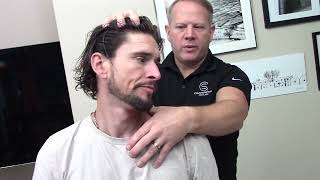
Ben Greenfield gets scanned and treated using fascial counterstrain, a system that maps tender points across the body to find restrictions. The practitioner uses low-force positional releases to decompress lymphatics and fix spinal reflexes, with immediate improvements shown in his cervical spine and a complex left knee issue involving the meniscus and lateral structures.
Questions this video answers
Brian Tuckey
About 1,500
Chapters
So what do you want to do? You want to just do like a full body scan, check everything? Do you want to do like a little five minute kind of like, I.
Tend to go into. Aside from the little bit of information that I got during the podcast I did with Tony, where Counter Strain came up and what I read about counterstrain in his book, aside from that, I tend to like to go into this kind of stuff. Just blind, open book.
What do you do? You show me. And I'm just basically here to soak it all up. Sure.
So the way we don't normally do this standard intake, you get any primary complaints, we'll address how that area scans. The way we scan it is through your head, which is through my head.
Okay.
This is the primary diagnostic and it's a motion assessment. So I'm actually specifically addressing, like, very detailed analysis of motion through these various locations. So it's all broken down in system. So you can see here we've got nerves, dura, organs, visceral mesentery, which is a specific subset within the visceral system.
Who developed this map?
Brian Tuckey, and he's my business partner.
And it's. He, like the founder of Counter Strain.
He's the founder of fascial.
Okay.
Yeah.
Okay, gotcha.
So arteries, cardiac arteries, cardiac lymphatics, pericardium, musculoskeletal. So this is myo, chains and ligaments, secondary ligamentum flavum dysfunctions. And then periosteum, bones, cartilage, superficial fascia. And there's some things that are not on.
Wow.
So this is the general. And then in here is a lot of stuff that we're currently developing for the cerebral cortex. So you can scan each of the primary cortices within the brain.
So each of these spots on this, on the skull. Yeah, that I see in this map. These correspond to those spots that are listed on the body.
Yes.
From. From a. From a pressure standpoint, you know, almost like similar to foot reflexology, where there's similarities. A certain point of foot where you push and, you know, associates with the gallbladder, the liver. Are you saying like these points on the skull? Like, let's say, you know, if I were to look at something like.
Like this is knee. This is like.
Yeah, yeah, the back of the head, like the occipital area here or down here. So if I were to apply pressure here, you're saying that it would influence the knee?
Well, it's. It's a little bit like that. We use this as a diagnostic. So this is a quick way for me to assess every system in your body.
Okay.
It's kind of weird, I admit, but if you had, you know, 1500 things that you did and you had 5000 diagnostic locations, it's a time consuming thing to scan those. This I can do in a matter of seconds.
Oh, wow.
So there's a surface texture to the bone. So each one of these locations will have a normal sensation or an abnormal sensation.
Each one of these locations on the skull.
Yeah, yeah. It'll draw my attention. It's palpatory, It'll feel wrong. And if I assess it in a specific direction, it'll tell me if there's actually a problem because it's painful, that one of these little locations will actually hurt.
Okay.
And then I'll get into kind of a more detailed analysis and figure out is it a cartilage, is it a myofascial chain, is it a lymphatic problem? And when I get the right direction, you know, they'll actually be a very sharp sensation of being alright. That's the primary thing. And then I'll go down in the, in the limb, you know, you could have, you know, 50 points in the knee. This will tell me which, you know, cluster of them are actually problematic. So, so this is our primary. And then we obviously correlate it with motion loss or pain or complaints in the body as well.
That's got to take some practice or some study to be. Because this is very precise. It is like these seems. It seems like you were off by like 1 or 2 centimeters. You'd be in the wrong spot.
Or millimeters.
Or millimeters.
Yeah, yeah. Because we want to know like where all these sutures are. So, you know, we establish bony landmarks and then we know like where we're going. So this is the diagnostic. And then what I want to show you over here. I'll bring it over. This is the, the tenderpoint map. So each one of these again is color coordinated to one of the scans over here. So all these purple dots here are organ dysfunctions. You'll see yellow dots, which are nerve. You see a lot, a lot of these guys here on the top of the head. These are all cranial nerves. Green here are lymphatics. Wow. Red or arteries actually projected from the spinal cord. So this arterial supply coming from the cord or going into the cord, I should say. And then there are locations you can see in these kind of tan color. These are bone deformities of the skull. And the bone deformities of the skull Are unique in that they can create what we call a central pattern. So let's say you had a concussion. Blunt force trauma to the head. It can cause peripheral problems in the body that feel extremely real and usually are like the primary complaint for people following concussions. And these would relate primarily to a bone deformity that affects the cortex, affects the dura, and creates, again, a local issue of the head. But it manifests very commonly as a peripheral complaint in the body.
Ligaments here around the ear, there's like, ear ligaments.
So would all of these be considered points that. Tender points?
Okay, tender points utilize diagnostic locations in the body as a way of understanding what we're going to do. What's unique about this is that every one of these tender points has a painless release. So I can turn off painless release. So that's what makes our work, I think, different in terms of how we approach what we do. A lot of people look at the thing that hurts as the problem. These are projected into the surface of the body from very deep things. It's very hard for me to actually touch a cortex without surgery. Right. So if I was going to release some venous problem in the brain, like we have tender points in these sutures that relate to veins of the brain. I don't have to actually go all the way in. I can just go right through the head. I can stack tissue, which means I just gently contact and use compression until I access that tissue layer and I perform a glide. And then these points just disadvantage. Geez. So then this kind of brings up the next layer, which.
Which is.
How does that work? So for us, this is an inflammatory thing. So if you imagine, like any injury like an ankle sprain or you strain your knee or something, there's an initial inflammatory response.
Right.
So your body dumps a bunch of inflammatory cytokines, the immune system is called into action. You may even, like, you know, stem the drainage so you get swelling.
Yeah.
Which is beneficial initially because it keeps you off of it. And it allows the immune system to hang out in that area, do its work. In 10 to 14 days, it starts to go down. And by two or three weeks later, it's better. And then maybe about a month, you're back doing your normal thing. In most cases, that's how things happen. In the case where it becomes dysfunctional, our thought is that the inflammatory response becomes chronic. And there is a portion of it, when the body lays down scar tissue, that it literally encapsulates inflammation. And then these inflammatory cytokines trigger Spinal cord reflexes that then cause muscle spasm or guarding. These guarding reflexes then keep this area in a locked down state well beyond the normal, you know, four week healing.
Yeah, yeah. Which can kind of create an interesting feedback loop because it does, you know, you get lack of mobility, hypoxia, you get inflammation, all that tender tissue and then that, that area just becomes more.
And more as it gets up to the point. So what we do is we go in and we mechanically unload the exact thing that our scan and our tender points tell us is problematic. When we mechanically unload it, it causes internally relaxation. That relaxation alone will decompress the intrinsic lymphatics and the interstitial vessels. And then all the crap starts coming out. So it starts to drain it. And this takes, you know, 20, 30 seconds sometimes per point. But as it drains, right, it's allowing normalcy to occur. So the spinal cord reflexes drop. So now your guarding mechanism goes back down. Does it make sense? So that's how we can do this painlessly. Because we're not going in a direction where I'm trying to physically make something long, actually make it short.
Right.
So we go in the direct, exact opposite direction. So it's all in the direction of ease, which classifies this as an indirect treatment. So that's the mechanism that we utilize, which means that there really isn't anything that I can't get to because I'm going indirect.
I, I think if we're gonna, we're gonna do this, let's do it. Let's do like the full scan and, and figure out. I mean, I can tell you I got a little bit of a buggy knee and that's about the only real thing.
Okay. So there is an element of this that I would put into the performance enhancement side, which is removing things that keep your body from functioning at a normal level or at a high level and therefore can translate into poor performance on the field or maybe more prone to injury. So things that can be sub threshold.
So everything I do now is just about feeling good.
Feeling good, yeah. All right, well then you're right. I'm in the right place then for you. That's good. All right, well, let's see. Do you have any movement that is.
Challenging for you with the knee or.
Anybody, any part of your body?
It's pretty much just the knee and it would probably just be a squat. Just squat?
Yeah, just do a squat.
About right there. I start to get some pain and discomfort and persist until I get to about there.
And you Offload it a little bit.
Yeah, I feel like offload to my right side. See that shift?
Yeah.
Yeah. But, yeah, it's right around in there. I get. Get pain right there.
Okay. And are you at all able to do, like, a single leg, or is that really jack it up?
I mean, I. I could do a single leg range of motion wise, but pain wise, it hurts.
How far can you go before you feel it?
Yeah. Okay. So, like, if I do the right side, I can just basically drop, drop, drop, drop, drop, drop, drop, drop, drop. No issues.
Yep. All the way down, like a p.
Up on the left side.
Don't do it to the point where you're. You don't go all the way. Just where it begins to hurt.
I'll show you.
Right there.
Okay, so that's like about 35 degrees. 35. Okay, well, that's good.
We.
I want to see that. So have a seat here.
Yeah.
Now we're going to do maybe this initial scan here and just feel for where you might have some issues with any kind of neck rotation. We've got some nerve irritation, potentially some ligamentous irritation, some bone irritation.
And I can already feel that this is a cervical bone, so you might feel a little tenderness. When I do that, versus this side has not as much.
Yeah.
Okay. And I can feel it right there when I come up in that direction. You feel that little hang right there?
Yeah, yeah.
So there is a bony component to that.
Yeah.
One more time, since I'm right behind you, can you do that rotation just to the left? Just the head.
Oh, just the head. Good.
And then to the right.
Yes. That's about 8 to 10 degrees. Better to the right. Yeah.
And when I go to the left, like, when I get to it right there.
Yeah.
Actually feel like an anatomical kind of like pinching. Right, Right.
Body saying. Okay, that's enough. Don't go any further. So we'll come down here to about a C6 level. Now, this is the type 2 presentation. Mm. So let's go ahead and give a little compression there and turn left. You just tell me what you feel now.
Feels like even more range of motion.
Even more range of motion. And then let's see if there's a lymphatic problem. Not too bad. Spinal cord lymphatics. We actually scan those on the top of the head kind of midway between this.
It's crazy how fast you find your way around up there. It's like the worst braille of the skull.
It is. It is the braille of the skull. These are spinal Vein extensions. And that one is not good either. So that one might be. Oh, that's really good. So this guy. Let's see.
That is actually good because every time. I mean, people are watching or listening, like, every time you say it's really good, like, the. The discomfort of the pressure, like, corresponds exactly when you. When you say, like, I can. I can feel discomfort on the spots where you're commenting.
So this one might be up underneath your trachea here.
It's a little bit there. Oh, it's a C6. Sounds a little off there. C6. Yep. Let's go down here. Maybe it's T1, which is right in between.
Oh, that might be the one. Yeah, that's.
That's probably.
That's a T1 right there. Check it on the other side. Nope, that's it right there. And that would get you right here. Right. And it is treated like that. Right. And actually drain the segment.
Yeah.
So when we drain that segment, it basically takes pressure out of the cord, which you would be closing and compressing with that. With that rotation. So let's just do this one right here. Let's just turn it right there. I can just usually go right on that first rib.
There it goes. Now it's draining. So now I push on that thing pretty hard.
Literally draining. Lymphatically.
It's going right now. You feel the whole shoulder moving.
Oh, yeah. Yes.
So this one is a lymphatic. It's a spinal cord lymphatic. And so it's involving the deep drainage pathways that are actually inside of the cord. Yeah. Okay. So that's gone.
It's interesting. It's very light touch, though. Like, it's not as though you're applying.
A great deal of pressure compressed. So the body's like. There's no empty space in the body. So if I apply a contact and a compression, I can stack, stack, stack, stack, stack. And I can go deeper, deeper, deeper in the body. Right?
Yeah.
So now that's all gone. Feel how loose that is. Now I'd say that whole thing dropped out. And I'd say these are still here, but they're higher up. That probably 5, 6 level is better. Let's just see what the. What the bone and ligamentous scan has done. Now. I'd say a dropped bone and ligament are better. And then you have a higher bone right there.
Yeah.
So let's see what the rotation is like just with that one. Turn your head to the left as far as you can see what your sensation is like now. Definitely Improves. Improve. All right. So that's kind of the, the general diagnostic that we would do. So we found a limitation. The other part I noticed was your lateral flexion was a little restricted. And that could be, you know, scaling tone. If you're looking at it from a purely mechanical, like why is that happening? Like these muscles are too tight. The question from for us is why are they tight? So we don't look at the. You can feel like that middle scalings, a little something.
People always comment me on me having nice scalenes, nice scalings. Yeah, I get that a lot.
They're well developed. That's what we look at.
So then we have to ask what is the cause? Why are they like that? Is it a myofascial problem? There are neurological things that relate to the sympathetic nerves that show up within the anterior portion. Like where those scalenes would attach on that tubercle there is a row of points that occurs. You have a little bit right there.
Yeah, right there, yeah.
So then we'll go in here and we'll ask is it a postganglionic neuron in the neck? And that drops it. Feel that tension drop out of there?
Yeah.
So then I'm like, alright, that's a sympathetic, that's creating that tension and within five to 10 seconds it'll just come right back. So the contact inhibition is just a short term kind of. We just short circuit the protective response. So it's just, it's a type of inhibition through mechanoreceptors, but it doesn't, doesn't treat the problem. So we'll see if these are sympathetic as well. They do feel like they are dropping like mad. So if I just contact these locations.
And just gently pull on them a little bit of an inferior direction. I'll do it this way. Go ahead and I'll follow you. Turn your head to the left. See if we get even more red range on there. For sure. See that?
Oh yeah.
So that's our, that might be the primary one. So let's have you lie down. So feet here.
Okay.
Handed this in, face up. Okay.
And these are again, these are postganglionic nerves come out of the neck. They go down to the heart. So it's possible, you know, that this would have a secondary.
Effect on the function. That organ.
We're gonna find the word. That's probably the worst one. Was that C5? Yeah, right there. So we'll just put you up in a little bit of a rotation like that. And then take this arm. I'm gonna bring it right up here across your head. So all the way across this way. Leave it about right there for me. Okay. And then. I got it. Now let it kind of go loose and relax all the way. We utilize the arm to just lift the heart and lung up.
And that shortens the sympathetic nerve fibers.
Yeah, it feels like very little pressure.
Or strain at all.
You're just kind of holding my arm.
In that position with your hand there. That's much better. Now, so we'll go to the opposite side here. And that's the six right there. You can feel a little knot right there. I'm curious. You want to feel this with your other hand? Maybe put your finger. Oh, I can.
I mean, I can feel it when you're there, too.
How do you feel that thing right there?
Oh, yeah.
Now bring this arm up. Bring the arm up here. Okay. Right all the way across here. Okay. And then just lighten up the pressure.
There a little bit.
There we go. And you'll just feel, as I bring your arm up and across that, the tension melts. There it goes. Yeah.
That was crazy. And then just give it a little poke and see if it's still painful.
Mildly.
Okay, so we'll just take a little more. Oop, there it went. Now you can feel the drainage.
Oh, yeah, that's super interesting. Just peel a little bit.
Yeah, that. The theory of the precise. It is precise. Yeah. Because all you're really doing is putting a structure that has on it all kinds of proprioceptive nerve endings. Right. If you think of a nerve, the outer covering of nerve, the epineurium and the perineurium have all types of proprioceptors in it. So there are pain receptors in it. There are mechanoreceptors, there are chemoreceptors in the outer covering of a nerve, and they're all there for protection. So in the presence of irritating chemicals, it would produce a protective response. In the presence of an abnormal strain or stretch, it would produce a protective response.
And so the way that this method of treatment works has to do with precision and lining up a portion of the body in a way that takes away one of those irritating things, which is mechanical strain. So if I can remove the mechanical strain, I can un.
Pressurize or I can unkink or unload the vascular tissues, these little tiny vessels, like these interstitial vessels, in such a way that they start draining again, and when they drain, that's what we call the counter strain. Yeah, yeah. The opposite of straightening. Yeah. Makes sense now. Yeah, it's all squishy there. Yeah, yeah. Feel how loose those are now. Oh, yeah.
I could feel it softening as soon as we start bringing it onto that range of motion.
So then we go back.
It's almost like a combination of a touch plus a position.
The touch is like feedback. Right. So that we feel like when the position is correct.
Right.
But it would work without touching it. It's just not as precise. So we utilize that tactile response to really tune in the release precisely so that we get the maximum drainage.
All right, so that's. Sympathetics are gone. Let's see. I think we still have like a bony thing in this upper cervical. Yeah. So now if I just motion test you, it's kind of free feeling.
Right.
And then here you get a little block right there. It doesn't close very well. So I would say that is slightly flexed. So I put you just a little bit in flexion. Freeze. And let's just see what direction it wants to go. Nope, freeze.
There. Now we're getting normal right in that position right there in the bone. Go right here through this anterior deltoid. And it's really kind of prying this thing off. Which tests the sharpie's fibers, which anchor the bone and the muscle. Right. The myofascial kind of glues into that. So that's the one I'm going to do right there. So we put you into that position we just identified. And then we utilize a gentle compression. So this is actually a vertebral body compression deformity.
Could have happened 20 years ago. Just stay in there. Did you play football?
No, I. Well, I did for four years. Every Sunday afternoon, no pad, full tackle football. That was like our post church activity. So I think over that string had about five different concussions.
Okay. So we.
I remember I'd just be out playing, and then I'd find myself sitting about 50 yards from the field, not knowing how I got over there.
Oh, man. So just tell me now what you feel when I move that segment.
Versus where it was before.
It feels more range of motion.
So now we'll probably find a stack, as we call them. There's the stack, which is. It's down one segment. There it goes. Now, if you're. If you're paying attention to the neck, you might feel a very odd.
Some people describe it as like a wave of deep relaxation. Yeah, there it goes right there.
Yeah, something like that. Yeah.
Come back now.
That's better.
Come all the way down to like the C67.
And I'm picking Up a little bit.
Yeah, on that right side.
Yep, Yep. So then I'm gonna figure out what that is. If it's a bone or if it's a ligamentous myo chain.
That might be a myo chain.
That's a myo chain.
So the way we treat muscle is in functional chains. So.
For instance, like a sprinter might injure a posterior chain. And this would be toes, bottom of the foot, calf, hamstrings, glutes, all the way back up into the spine, and then part of the thoracic dorsal fascia. So we would line all that up in one position to affect the release of the entire chain. Yeah.
Okay.
So this one is likely a C6 or 7 myo chain. I feel it right there. There's a secondary location here.
Yep, that's it right there. So this is an anterior myo chain.
Of the deltoid, bicep, thumb extension, or portion of the pack.
Wow.
And depending on how it really manifests in the scan, I might have to do some local drainage.
Oh, yeah. See, it's not that way.
Feel it right there. So this one has potentially a little area of inflammation stuck in one of these muscles. There's a little bit in the bicep right there. So I'm pushing these guys back towards the midline and where it hangs right there.
Right.
So that bicep peck's fine, delts fine. But that's it right there.
Yep.
So I'm going to take that. I'm actually just going to drain it the opposite way. There it goes.
There it go.
It's crazy how fast the response.
You can feel that draining. Oh, yeah, yeah.
Yeah. The process of draining is. It's almost like a. The softening and a lightning. Well said.
And now I've just kind of stopped slow. So then we'll just ease that one back and we'll test it. So now it doesn't grab.
And we'll go back here to the seven tender point.
That's better. And then the best test will be if that C7 now moves on back. Oh, yeah. So now it's got a wiggle to it.
So. Yeah. See how free that is now?
Yep.
So we might want to check the six on the other side just to make sure. Yeah, Right there.
Soft. And right there. Feel that little gun. So that's the C6. And we're gonna also see if this is in the.
Standard myo chain.
It is.
So I've got a pull right there. There's a little tenderness right there. And if I just gently nudge into that. The six, freeze, let go of it. Usually five to ten seconds, starts to firm back up again. Yep. So that's the one. It involves the trap. So it's like trap or middle of the deltoid and then the extensors of the wrist.
No, it's kind of funny because I, I did a lot of spear throwing, doing all the spartan racing and I feel like I would have loved javelin.
Oh yeah.
Took a brief stint in bodybuilding and volleyball. Scott all explosive and then backed into triathlon. And then probably my favorite though is off course racing.
Oh yeah? Yeah.
Now I pretty much do some breath work, some sauna, some cold pool and swing kettlebells with my kids.
Yeah, that's awesome.
Play family tennis every now and again.
So the other thing we'll do is we'll just go through like a motion test and just looking for like. Here's another one right here.
Yeah, okay.
Yeah. So this is probably about a T4,5. Yeah, there's 4,5,6. I like 5. So I'm going to pop in and we're going to feel, you know, is it a Costo transverse joint? Is it a segment? So it's almost like right in that segment.
Yeah, right there.
So now I'm on the transverse process. Okay. And that's the bottom of the transverse process? Yeah, the top. And then this is middle. Yeah, you got a bunch in there. So then we'll go in here to the rib. That's going to check the tubercle. It's got something too, but it's not. It doesn't compare. So it'll go right on the side. Nope. At the base. Nope. So it is. It's kind of over the transverse process. And I don't think it's middle. Feels like it's right on the bottom edge right there. Which would be a ligamentous problem in our world. And this would be a posterior longitudinal ligament. So we go in here. That little gap is your coronal suture. So I'll pop behind that a little bit and down underneath the temporal line. And then we should find a posterior to anterior problem. Oh, might have been it.
Right there.
Right there. So now if I gently touch that, pull gently forward, not causing local pain. There I go back in. That did calm that down. Yeah, so that's something. After this we'll test your range of motion again.
Okay.
Side bending and yeah.
Rotation.
See if that's freed up. Then I'd love to get down here and see if we can.
Yeah, I'd love to check out what's Going on the lower body. Yeah.
You've had that kind of diagnosed or looked at medically?
Yeah, I actually just had some stem cells thrown in a few days ago.
Okay.
Yeah, I think I got a little bit of a cartilage breakdown.
Okay.
I'm seeing if we can just fix.
The articular cartilage or meniscus or do.
You know, it's kind of the. The head of the femur and a bit. Little bit of the backside of the patella.
Okay.
Yeah.
Yeah.
Too many miles, basically. Yeah.
Yeah.
With all the. All the cutting and running and stuff from tennis before that.
Yeah.
I would say the other. I always feel like I've got a little bit of limited pelvic mobility, too.
Okay.
And I don't know if that affects the knee, but I feel like you probably did a little bit. Tight hips, tight pelvis.
Yeah, I do this really. It's kind of a silly thing I do, but it really drives home the point because sometimes people are like, I'm not sure if it's connected.
I'll just.
Usually just take a leg, you know, give it a little tug. I mean, it seems like it's attached.
Yeah, yeah.
So, yeah, there is absolute. Absolutely. Connections.
Yeah.
That would affect that. And I can already tell you, you know, there's some. You have conduct deformities.
Yeah, yeah.
So let's go back up here. This should be relatively soft. Now.
Go to the other side. Make sure we don't leave a stack in there.
What does that mean? Leave a stack in there?
So the body likes balance. So let's say the primary side of an injury. Pretty soon after that injury, I mean, within minutes or even seconds, your body will attempt to balance it to keep you in the middle. So it creates. It's like a neurological response. It's like a writing reflex. So the other side will be offset by a segment. It'll be above or below, and it'll be pretty much the same thing. It just sits in there as a balancing dysfunction.
Yours is, I think, on the three right there. So let's get this one. It's like leaving a little ember in a forest fire. Yeah.
It doesn't feel as limited on that side.
No, no. It. Yeah, the primary one typically shows up, and then you go look for the stack. What's strange is they occur in every single system. So you have organs that do this. Yeah, various parts of the spinal cord, of course. I mean, that makes sense. But even in the extremities, you have a foot problem on one side, and if it sits There long enough to become chronic, you're going to get something on the other side. It may not necessarily cause you to be aware of it, but it's a tether. Right. It's like a neurological pull.
Yeah.
You unload one side. If you don't go to the other side, people will often come back and they say, yeah, you know, the side you worked on, it's great. I have no idea what happened, but the other foot now bothers me.
Yeah, that's way better. All right, straighten out there.
Okay.
Let's see if we can figure out what's going on with the knee. Okay, now unloaded, you have full range.
Yeah.
Okay.
So unloaded feels pretty good.
No.
Fibular heads.
All right.
They do visually look a little different, I suppose, maybe, like there's a little knees.
Yeah, they had left knees. Got not only some swelling, but as you noted, some.
Almost like either bony deposition or some kind of, like a condyle type of deficit or a deformity.
Yeah, you can see that.
I've kind of been able to watch my knee over the past couple of years, like, change shape.
Sure.
Not in a good way.
You see in the camera shot there, but you've got.
Oh, yeah, the camera could probably totally.
Pick up the differences. Yeah, you can see, like, the angle there is different. Yeah, your return here is nice. This one's not exactly right. Yeah. So you do have some bony deposits there. I also see maybe you lack a little terminal extension.
Looks like maybe it doesn't quite go all the way through any atrophy. Have you noticed that over the.
Oh, well, I mean, probably, you know, just. Just the lack of the ability to be able to use the musculature on the left side quite as much. I would be shocked if I didn't have some atrophy, Even though I haven't paid too much attention. But I'm pretty sure the legs are a little bit weaker than they used to be due to that limited left knee range of motion.
So I'm picking up this guy right here. You feel that little.
Oh, yeah, sure.
So this is an inplate deformity. So it's literally the. I don't know if you know, like, I'm sure you do, but the blood supply into the end of a bone is slightly different than the blood supply into the shaft. So near the epiphyseal plate, you know, we have two different kind of merging blood supplies. And a lot of what we do with bone has to do with physical tension within the bone, but it's related to A vascular tension irritation. So blood supply in and out of the bone can become irritated if you torsion it. You know, like you land strangely and you twist or you land hard. Yeah, bones have flexible. They're quite flexible. And you can strain them to the point that they internally will tighten. And it creates a shape deformity, like along the shaft, or in this case, you've got an end plate. So this end plate is slightly flexed, which would remove that terminal extension. Extension. Right.
So just with me, kind of going through gentle range of motion, you know, that's probably zero. And then you got probably a good 4 or 5 degrees, which is normal. Right. Beyond zero, this one will hit zero. And then it just lifts off the pillow.
Right.
So this one lacks that same terminal extension, which would drive this nuts.
Yeah, right.
Because if you can't attain normal extension, you know, when you're walking, that's going to drive it nuts, stairs, anything.
Kind of. It just disturbs the normal mechanics there. So if this end is irritated, blood supply into the condyles is going to be compromised. That's exactly how you could get a degenerative process. And they don't, you know, happen overnight. These things typically take months or years or whatever to manifest. All right, so that's it. So we're going to take your distal femur right through the patella there, and we're going to give it a little flexion. Now, this will be a little more force than one of the other ones, But I am stacking in and trying to shift the bone there.
There it goes. Now you can feel the bone slowly kind of unwinding there. Okay.
Honk on that thing a little bit with straightener back down there. Yeah, that's better.
Now already feel that terminal extension starting to come back. I guess.
So. I'd say that helped that distal in the femur. But your condyles here are still relatively firm. Yeah. So there are condylar deformities that we treat.
Okay, now that's the floor flared out one right there. Yeah, that's the one I think he got right there.
So this is, if you can imagine looking down, like kneecap here. Condyles like this. Yeah, one of them bent out like that. Okay. So that causes the patella to kind of get squished away. So then you start shredding the underside of it because. Yeah, stop tracking where it should.
Yeah.
So we'll go into the back. We'll just take that con down gently.
Bend.
It's very slight. Not a lot of pressure.
Yeah, there it goes. Right there. The harder you push, the more the body just pushes back. That's one thing we found. It's like it just recognizes the threat, you know?
Yeah, I'm accustomed to a lot of work like this being like teeth grittingly uncomfortable due to the pressure trigger points. But this is like. Was very, very subtle.
There went. So that's it, 30 seconds.
Yeah, better there.
Now what you feel is I can bend that in. You feel that? And then this one now shows up, says, hey, can you do me? Because it doesn't feel exactly right.
And there's a little pocket of fluid back there. Although maybe that's from the injection, I don't know.
No, I've definitely had a little baker's cyst.
Ah, okay.
Back there, like.
There it goes.
So you've had like three of the four of these. You have in flares and out flares.
I believe it.
And he's been to hell and back.
What are you able to do now that alleviates it? Or do you. Are you just.
Most of the knees over toes, guys, stuff helps, like ATG split squats, tib anterior raises.
Knees over toes, calf raises, sled drags, sled pushes ironically, you know, backwards walking, really, like, most activities actually make it feel pretty good. But, you know, descending steady, deep terrain, stopping and cutting and deep squatting. All three of those are just.
Increasing.
Yeah. So now I'm doing a little drainage here. This is the distal femoral vein.
And then a lot of popliteal swellings like that. We've got myofascial things that we would do, which are myo chains, sometimes the old 4, 4L5 ones. And then we go right into the papa till space. And this, this is the AR6, which is kind of a weird one. I can't even get to that without going through all that joint fluid. But right there, that's the six. And then the 12's not bad. So strangely, you're six repair.
Oh, really?
I know that's the one that refers.
Down that six point.
Well, it's part of the chain. Yeah, yeah. So the mod chains. So this is number six right here. Seven is this angular one. We'll pop in here. We'll get on the inferior aspect of that six should super tight right there. Right there. So let's bend you to the side. Right there is good. And this arm, if you don't mind, I'm gonna put it right across. Okay. And then take that hand and just kind of hold on to the O right here, Right here on the elbow. Just do 11 mild pressure right there. Yep. This one's gonna hang over here. Bring this up for me.
Drop this one down. Let me just take you into a little plantar flexion. Okay, so we're kind of. Oh, there it went. Have you had that thing drained? They go in there and drain the cyst out or no?
Oh, yeah.
Oh, gee.
I probably have that cyst drain like 10 times, like five years ago. What initiated it? Got stung by a scorpion in the knee.
You feel how that.
And that knee's never been engines.
Do you feel how the pressure is almost gone now? Yeah, the 12s there, not there.
So I think the scorpion sting initiated just like a cast. Inflammatory reactions that change musculature and the movement patterns are just like never the.
Same after that scorpion bite, man. Yeah.
Just double check that this is going. These are menisci dysfunctions here.
Yeah, still. Still got one right there.
The ones that are hard to get to are in the back where you've still got some effusion in there. Oh, there's one.
By the way, that book right there that you showed me, what is that entire book like? Kind of like your guys's training manual.
That is one system. That is spine, spinal ligaments and myofascia. Yeah. So each one of the systems has its own. So we've got three different books for the musculoskeletal system. One that's bone, one that's myofascia and ligaments, and one that's superficial fascia, skin and cartilage. The nervous system we break into two. We have an upper and a lower half of the nervous system. Lymphatics is its own arteries, its own. The organs has its own book.
And then we have these central pattern.
Series of courses coming out that address the bones of the head.
Some rather deep pathways of the vagal nerve into the various organs that it innervates. That has to do with the inflammatory process. So people a lot of times have just systemic levels of inflammation. And without addressing the vagus anti inflammatory element, you're constantly battling inflammation. And it comes from a central or a gut mediated reflex. So that's in there. We've got adipose, the fat tissues, a whole course on that. Then there's the vascular tissues of the brain. That'll be its own course, maybe two, depending on how much we end up discovering. There's an endocrine section of the brain, vascular work. So that's about 100 different things that we do for the endocrine system.
And how many practitioners do you guys have kind of Trained up to do this.
I would say globally, it's probably around 1500.
And growing a lot all the time. You know, we have.
Even a little pez Anserine versa there.
Go way up here and grab the.
Pudendal vein here.
Seems like it's the type of work that would be very beneficial for a. Like a massage therapist or, you know, art practitioner. Oh, yeah, physical therapist. To know. To be able to weave some of those skills and what they do.
I would say that's the mainstay of the people that take our courses. That's the three that I would say 90% of our students are within those licenses. We do have a few physicians, a few chiropractors, some nurse practitioners, even, that have taken the stuff.
So now there's a spring in the condyle, which I don't know if you.
Can feel that.
The tibial plateau is not hard. I feel like the patella may be the.
You know, the place where a lot of this force has been applied, But I'm not sure it's the one that's doing it, you know. Yeah, it's the victim here more than it's the. I do feel there's a capsular tension.
I'm gonna capture that one ray. So normally you have a nice float, you know, back and forth. This one's in extension, and it doesn't really float very well. So this is one of the strangest things that we do up underneath the patella. If I dig into the side, you feel a little thing right there. Little snappy thing more on the lateral. We relate this to a ligament in the spine on the back of the spine. So the ligamentum flavum. So it's in the canal. And when these things irritate certain segments, they freeze up joint capsules. So for instance, you've probably heard of frozen shoulder. Frozen shoulders come out of T3. And if you unlock the T3, you will instantly remove capsules. It just drains the capsule.
Just out of curiosity, is the knee isn't related to like the T10 to 12? Ish.
Yes.
7 and 12 are the retinacula.
Yeah. The thing is, what do you got at 12? You know, whenever I go get Cairo done, even when I've gotten spinal X rays and everything, they always say, I think it's thing. It's T11.
That's hip.
Is. Is. It's. It's. It's. I Forget if it's T10 or T11, but it's like. Right. You could. You could probably feel it if you were checking Out. But, like, that part of the thoracic spine is like, the one kind of like kryptonite in my back.
Yeah.
So I haven't had a session where I was having, like, a bunch of, like, gut discomfort for a while, and somebody adjusted me right there, and it was like. It just melted away. It was crazy.
Yeah. So you can get multiple things, you know, from a segment that's stuck, but specifically, if it's a ligamentous problem, and in this case, it would be ligamentum flavum, not an all or PLL. Yeah, the knee has multiple ones. L3 and 4 will also be related. Related to the knee. They're more like the actual knee capsule.
Yeah.
As opposed to the retinacula of the patella. So the patella is mid and lower thoracic. So, you know, we'll just look right in here and just see if you've got that one. Yeah. So that's what it is right there. Yeah. So I'm gonna go in here and we're gonna see if it's connected.
Yeah. I can feel it wiggle. That's the crazy thing. Put your finger in here and super light, like right there, and flatten your hand. Kind of just like, take the tension out of it. So I'll be really light here. I'm going to wiggle this thing. And you're going to feel that side of your head moving right there.
That is nuts. I can feel it all over my.
Head, but it won't be here. Yeah, it is literally, like, right underneath those.
That's pretty crazy.
So that specific location is ligament inflamed in the head. So the way we do this is we just twist you, and it's not even that big of a twist. You know, we're going to side bend you a little bit, and then take the time.
Top half.
Follow me this way a little bit. This arm's going to go across and then take that hand and just kind of rest it there. Again, this just kind of anchors the top half. So when I pull on your leg here, we're going to get a ringing of the spine.
Okay.
And ligament deflavum, generally, you know, when you look at it, is involved in that twist or extension twist. So when you lie on your back, typically you're in mostly an extended state. So then we just tune this right there. Whole side of the knee just went. And we'll just drain it up. And then that retinacula will relax.
The fluid will come out of it. And technically, what we're doing here is adjusting like a Sympathetic response, probably to a thickened ligamentum platinum T3T.
I'm forgetting from my anatomy days the ligamentum flavum.
It's in the canal. It's in the canal and it goes from lamina to lamina. So it's on the back, but.
But it's running. Is running anterior, posterior.
Oh, superior, inferior. So it's a. From one laminate. Okay.
Oh, so it's traveling laminally. Superior, inferior.
Yes.
Okay, that's right.
So it's on the back of the canal. Yeah, yeah, yeah, yeah. That's gone. Now.
I can even move that patella feeling.
Yeah. Oh, it's definitely.
So now patella is free. So we'll put that down.
And let's.
See if we've got any. Yeah, Feel that now.
Yeah.
So now. Now it's. Patella floats.
Yeah.
Which that would have. You know, the patella was not the.
Issue, but that camera. That difference.
Yeah, yeah. So that. Yeah, you can actually slide that thing back and forth. And before it was. It was so glued down tight that there was almost no movement from lateral to medial. So that would be a tight lateral retinacula, which then would tip the patella. Right. And it would just grind the lateral facet of the patella up against the lateral femoral condyle.
Yeah.
It's kind of how you described the sensation with the squat.
Now that you've been laying here after all that stuff has been turned off, you feel the effusion. Now here is at least 40, 50% reduced. Relax the arms there.
Okay.
Let's see if we can find anything else in the knee.
Do you have any? You feel like you can recruit the quad well? Like, it tightens when you want to.
Yeah, I mean, I feel.
Yeah, I feel like you can. Okay, but is it equal to the other one?
Gosh, no, it's not. It's not quite as good.
Like, it hesitates a little bit.
I'd say, like, this one's like 95%.
Maybe.
Maybe 80.
Okay. Feels like you've got that one right there. Go ahead and tighten it for me. Let me just feel.
Let me feel this one.
Yeah, So I can't push through that one. Do this one again. I feel like I can kind of.
Push through that one.
See what you got here.
Tighten it up again. There you go. Size of the cord, and it's right about that same, like, T12 level.
All right, let's see what else is in here. Was it a middle GI thing that would tighten up, like, a small intestine?
I think it Was more like large intestines.
Large intestine, okay. Yeah, yeah.
External torsion.
That's a little tibial torsion.
There it goes.
And if you had your hand on the bone here, you'd feel the whole thing. Oh, you probably can sense it, but.
Yeah, I could feel it. Yeah.
So now you can feel there's a little resistance. You feel that?
Yeah.
And I'll come from the inside out. And there's a little bow right there. So now there's a what we call like a femoral varus.
That's going to be this. This critter right here.
So we'll take this one out. These would just create long chain myofascial tension. They just can't stretch a weight. So this could probably put a little bit of a stretch into the outside of the leg. So the it band could feel like it's a little snug. Maybe the vastus lateralis.
Now I feel like maybe you've got a.
Yep. So this is a flexed femur.
Which will again load. It'll put a pre stretch into the quad which, you know, if it's not in that optimal cross bridge, it won't behave strong, you know, behave a little weak.
So there's its tender point right there. Feel a little knot right there. Yep.
And you'd think, oh, you're gonna bend a femur? Well, yes. So I just block it, you know, come in here, right into the bone, we sink and then we just nudge.
It.
And there it goes.
Yep, there.
I feel that whole thing shifting there. So probably a little different than the book may have alluded to in terms of like how this stuff works.
Yeah, yeah. Well, yeah, it's. It's always going to be. Be different, feeling it, hands on versus reading about it.
But.
It'S super intriguing, especially the head mapping component.
Yeah. Isn't that wild?
Yeah. They really talk about that much in the book.
No, we felt like it was a concept that would have taken away from somebody's.
Yeah.
What would they really want to know? Yeah, that it's effective in like helping people with what People. Pain and dysfunction. Yeah.
That it has a broad application.
Yeah.
So feeling like it's.
Got way more mobility now. Bones feeling better. Myo chains. The only thing I'm feeling now is maybe you've got like a.
LAL5 LAL4 mild chain. Yeah, let's get that. So for that I will have you flip over, if you don't mind, and just, you know, prop yourself up here. Did take the face cradle off.
Oh, it's all Good.
Let's see what we got here.
Yeah, so it's the four. Yeah, L4.
All right, flip back over.
Well, it does look like the extension has improved.
Yeah.
Feel like there's still, like. Feel this little band right here. You still got.
Yeah.
A little bit in the.
Medial hamstring right there.
Yeah.
You know that right there we go all the way down.
We're really close to an organ, which would take us right back into the pelvis. Yeah, right there.
Yep.
I don't want to scan these yet. So this was an interesting find. Find that the medial posterior aspect of the knee has an organ tender point that relates to the sigmoid colon on the left and cecum on the right.
That's kind of interesting because, like, if there's one anatomical issue I have, it's the knee, and if there's one, like, organ type of issue I have, it's like large intestine, colon, bowel.
So they're connected.
That's super interesting.
So here's its tender part point on the head right there. So feel that thing right there. Okay, so this is the sigmoid. And what the sigmoid colon does.
In terms of musculoskeletal complaints is it will almost always generate a stuck si. And then through neurological convergence. So if you look at how is that region innervated? And you've got gray rami communicants that leave the sympathetic chain into the sciatic nerve. And you've got a pelvic plexus that's, you know, informed from above, coming out of L1 and 2. That's sympathetic. You've got a pelvic plexus that is S2, S3, S4. That's parasympathetic and somatic. So you have all that stuff converging in the pelvis, and so you get retrograde inflammation coming from an organ, and it lands in the same levels of the sciatic nerve. And so then that starts messing up the leg. So you end up with straight leg raise. Limitations. Hamstring tension, hip pain.
Now that's all free. And you feel the joint open now.
Yeah. Now that tension on the back of the femoral condom, it's freed up.
Still feel something right in the middle there? Yeah, that actually could just be a local lymphatic. That's right in the mid belly of that hamstring.
Drain that.
So we drain these through the.
Massive venous plexi that.
Occupy the hamstring mass. That's the profunda from olva, the deep fumaliva Vein. Yeah, there it goes. Well, that's good.
That's.
I think you've gotten a pretty good. Oh. Do any brain work on you? Brain work?
No.
You know, drain the brain and fix any post concussive things that have perhaps. I. I did scan the bones and the bones don't seem too bad, you know.
But there's like a little ventricle pressure right there.
There. Yeah.
Let me double check and make sure I got that organ knocked out. Yep, it's all gone now. Wow. Y. Just make sure you don't have a stack.
It's a type 2 on the other side. We get this one real quick. Yeah.
So very similar right there. Check this one. Oh, that's worse.
Hamstrings are good. Very nice. And I think so.
And so it's a stack from the. From the sigmoid column work on the other side.
Yes.
Yeah, yeah.
Slightly different. This one is just a little bit less lower.
Yeah.
So. And probably not a symptomatic side.
Yeah.
Yeah. All right, Have a seat.
Okay.
Facing that way.
Okay.
So we had, you know, a little sympathetic work in the neck. You had some visceral work in the pelvis. A lot of neck, upper back bone, ligamentous and spinal cord work in there. But I'm really curious to see if the knee moves any better. Okay. So, Ray, you want to come around here to the side and let's just. Let's do it this way.
Okay. Let's try to squat.
Get out of the way there. Yeah, let's do. Let's see what happens when you squat and what your sensation is. Wow.
It's all subjected, though. You're gonna have to tell us.
I still feel a little bit of a catch, you know, but there's definitely more range of motion. It's definitely freed up.
Okay.
Yeah. I mean, I don't know if I can do a single leg squat, but while that's just kind of.
It's a muscular weakness too, that you want to try it over time, see if it goes more than 35 or 40.
Popping and stuff too. But I feel like maybe if I work some stuff out of there.
Yeah, so what I would do.
It definitely improves some range of motion, though.
Yeah. So what I would do is your normal stuff. You got a pmf?
Yeah, I do.
You know, because what happens after we do this is your body still has to process garbage that's living in the area. So if I turn something off and it drains the inflammation out, the cells now go through their second stage healing. It's like they've been trapped in this chronic inflammatory state. So you could have a day or two of what we call, like, soreness reaction, which is just like. You worked out.
Yeah.
Not bad. It's just like, okay, yeah, something happened, and then your body's gonna work through that inflammation. So increased water just to help flush things out. Anything you do kind of increases that drainage.
Yeah.
Would be good. And then after a couple days, if the soreness drops off, then I think that's it. That's the point where, you know, like, what you're. What you're doing. And if it's like 25, 30% better, you know, there are things that we would do to finish this off. Yeah.
Cool.
The sympathetics have a huge impact here too.
Yeah.
So the lower sympathetics in the, you know, T11, T12, L1, L2. And the post canyon fibers, they. They run the vasculature of the leg, too.
Too. Yeah.
So you could have a central pattern. There's a little bit of stuff in there.
Yeah.
It was just going to get a little strange demonstration.
Just go through a bunch of synthetic.
But you could use that. And then the visceral system, not too bad, except for the lower gi. The mesentery, that's also scanned in the same place as bones. So there's potentially something in that range. Yeah. But overall, you look like a standard.
I don't know how long you are, but I'm 40.
40, so, you know, typical stuff for someone who uses their body.
Yeah.
Cool. Cool. Oh.
Oh, yeah.
The neck, that's better for sure. You definitely have.
I feel like the neck brain, way better.
Yeah. Even the lower flexion, remarkably better.
Yeah. Yeah.
Sweet. Cool. Thank you so much.
Thanks for showing all that to me.
Oh, my pleasure, man.
I'm intrigued, and I think. I think it's cool. I'm excited to let my audience know about this. All right. That's awesome. Thank you for saying so much. Yeah.
More from Ben




The Solution to Aging Might Be Closer Than Anyone Realizes - With Ben Goertzel



