🟣 LIFE Lounge Voices – Live Q&A with Ben Greenfield
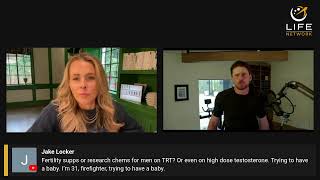
Ben Greenfield answers audience questions on biohacking, supplements, and therapies. He discusses peptides like BPC-157 and TB-500 for injury recovery, warns that psychiatric medications like lithium and Abilify need medical supervision, and addresses male fertility concerns for men on testosterone replacement therapy.
Chapters
You know.
Technology.
All right, you guys. We are live with Ben Greenfield today. Ben, thank you for being here. You're a busy man. Appreciate you.
I think everybody's busy.
That is very true. So. Well, we're just so grateful that you are here because we always have so many questions. And I was just telling Ava and Michael right before this that you're pretty much a, you know, walking chat GPT and, like, I'm just always just so blown away with the depth of your knowledge on every single subject.
So I don't know, Chad. GPT makes a lot of errors and lies to people.
Yeah.
And has no real world practical experience. I'm just saying. I think. I think. Yeah, we're. We're. It can. It can still largely replace a real human, but there's. There's a few little gaps that still need to be filled in. I think.
100. Yes. So thank goodness we have you.
Well, we have a lot of questions that have come through already on our Life Network forums, so we have people joining us live as well. So I'm super excited to dive in for people who have not joined us before. You can pop a question in the chat, let us know where you're coming tuning in from. We always love to hear that as well. We have people who come in from all over the world, which is fantastic, and, you know, hit Ben up with any type of question that might be on your mind. Faith, family, fitness, biohacking, longevity, you name it. We've gotten a lot of great comments and questions before. So. All right, so I'm going to be pulling one first from our Life Network chat just because we have a lot of those. So if you are not a part of Life Network yet, make sure you download the free app. It is very. It's totally free. And you can ask questions of Ben there, but we always try to reserve these for his time just to make sure we're making the best use of his time. So without further ado, I have a question here. Let's see. All right, this is from Sylvania. Paz. Paz. And she is saying, as I know, Ben has tried lots of nootropics and mushrooms. I wonder if he had tried bufo, if I'm saying that right. Ufo?
No. Okay, well, are you specifically referring to, like, DMT derived from, like, the Sonoran Desert toad, like that Bufo?
I do not know because that's all they said.
Might need a clarification. I mean, I've done a lot of DMT in my previous heavy or drug use days, but I don't know if that's the BUFO she's specifically referring to.
Right. Yeah. Okay, well, we'll see if we can get some more clarity from, from her.
Yeah, it's, I mean for those of you listening, I mean DMT is kind of like a rocket ship to the moon as far as completely, you know, down regulating your default mode network. But you lose like it, it's, it's an out of body experience. You don't know who you are, you have no concept of time or space. Typically you're dropped in for anywhere from five to 15 minutes. But for all you know, it's a lifetime. And many people, you know, there's like a joke like a lot of atheists will walk into a BUFO or a DMT experience and you know, and no atheists walk out. Like you definitely have an immediate knowledge of the existence of a spirit world, but it can also be very psychologically shattering to a lot of people. And, and it's one of those sledgehammers you would want to proceed with great caution with. If we're talking about a standard dose of something like dmt.
Okay, all right, well, thank you, thank you for that. This is also coming in from Life Network and some of this is cutting off. It's a little lengthy. I will.
Go through this a little quickly. So this is deeply personal, but I have bipolar disorder. I take lithium and a vilify to avoid destructive manic episodes. So I won't stop taking these medications. However, these medications also have a lot of side effects. These medications are destroying my thyroid. I have hypothyroid, hypothyroidism, it's affecting my kidneys and I often have to urinate at night, which is extremely disruptive to my sleep. I've gained about 35 pounds and have brain fog and extreme fatigue during. It's just cut off during the day. How can I reverse these problems?
This is something that someone should speak with a medical professional about. Proper use of the drugs such as lithium and Abilify, when overseen by a doctor and prescribed in standard dosages should not cause the issues that this person is describing. I'm not quite sure who is medically managing the scenario, but I am really not comfortable without any more knowledge because.
Yeah, that should not be happening with those medications. You should speak to your doctor immediately.
100%. They did say, I read somewhere CoQ10 supplementation could help with brain fog, et cetera. Any other supplements that could help with that?
Well, I mean this is also where just for everybody.
Personalization is Certainly key. Some people can't even convert CoQ10 into bioactive ubiquinol in the body, so they would need to take bioactive forms such as ubiquinol. Whereas other people don't need to waste their money buying a more expensive version of CoQ10 because they do that conversion just fine. And that's based on genetics. Most genetic tests, whether you're looking at self decode or 3 by 4 or 10x or any of these, you can figure out which forms of which supplements are going to be best for you, not just which supplements. And CoQ10 is an example of that. Some people will be told they need to take it and they can't convert it, similar to statins. A lot of doctors will put people on statins and I think there's a time and a place for that, especially in men with cardiovascular disease history in the family and a high risk themselves based on plaque development. But up to 20% of men are static non responders based on their genetics. So even if it is a wise thing to do in the right use case, it's like if you don't respond to it based on pharmacogenetics, it's not going to help you. So we live in an era where if you ask your doctor, let's say your doctor wants to put you on statin, and you say, but how do you know if I'm a genetic responder or non responder? And if they look at you quizzically, you should ask them about maybe working with a physician who's more open minded to taking a deeper dive.
Yeah, okay, that's good advice there. Thank you. And always disclaimers check with your doctor. That's good. Okay, so this comes in from Instagram, from Kinders United. Methylene blue and its reduction of. No thoughts?
Well, methylene blue can reduce.
Inducible nitric oxide synthase, which is basically the type of nitric oxide the that is released, or the type of nitric oxide enzyme that is released during periods of stress, immune system dysfunction, inflammation, et cetera. And it can actually cause things like vascular damage if there's too much of it. And then you have endothelial nitric oxide synthase, which is something that would be released, say for example, when you go out in the sunshine or you eat foods rich in nitrates like watermelon.
Or what would be another good example, like beets, for example. And so we're talking about two different forms of the upstream enzyme for producing nitric oxide, Inos and Enos. So methylene blue does appear to reduce, no, a little bit via its interaction with Inos. And then it also kicks both forms of nitric oxide synthase off of what's called cytochrome C oxidase, which is a protein in the electron transport chain. When that happens, what happens is you actually get oxygen that's able to bind and increase activity in the electron transport chain based on that effect. So yes, it reduces ionos, which is good. And yes, it can even cause a slight reduction in nitric oxide production, which is potentially problematic. But if you're doing something like red light therapy in conjunction with methylene blue, which I really think is one of the only really good ways to use methylene blue anyways, then the vasodilatory nitric oxide synthase enhancing effects of red light will actually really make it. So the decrease in nitric oxide isn't an issue. So I would say you have way bigger fish to fry. But I also think unless you're out in the sunlight or using red light therapy, beds, panels.
Lights, whatever, that you're not going to get as much out of methylene blue as you need to, nor are you going to have that interaction with nitric oxide synthase you're looking for.
Okay, that's really good. Is there a timeframe on the red light therapy usage? Like before, after, during?
Well, delivery mechanism? Depends. If you're using a methylene blue trochee and dissolving it in your mouth, it's near instant, but that gives you smurf mouth. If you're consuming it orally, then typically it's about 60 to 90 minutes. So that's the sweet spot. So if you're planning on doing, I don't know, red light therapy in the morning, you know, let's say you're somebody gets up at 5:30am I think it's better to not do it right off. If you're taking methylene blue but wait till like 6:30 or 7:00am and then do it.
Okay, and then what about combine combining it with sauna as well. Thoughts on that?
I mean there's no research that I know showing that methylene blue is going to like increase detox pathways or heat shock protein or any of the stuff that you're looking for from a sauna? Unless you have red light in your sauna, which a lot of people do now, in which you know.
That's a good point. Yeah, yeah. Okay. Awesome. Good. Okay, so this is from Kathy from Florida and any, anybody who wants to come on, let us know where you're coming in from. I'd love to hear that. So, Ben, trying to heal left hip arthritis and cysts and UTI can't seem to heal and wondered if stem cells would help. Just sick of the pelvis pain and going around and, and in circles.
Well, it depends.
So if you were to get a stem cell infusion, probably not. A lot of doctors will hook you up to a stem cell IV and you would see a little bit of an effect on say, DNA repair or some of the effects you might be looking for from an anti aging standpoint, like reduction of senescent cells or increased availability of stem cells overall. But for something like urinary tract infection.
Arguably you'd have to have stem cells and some type of antifungal or even methylene blue or something like that actually coming into contact with the ureter or the urethra. Another example would be like left hip arthritis. That's a joint. On joint issue, you literally would need stem cells to somehow penetrate the surface, whether the cartilaginous or non cartilaginous surface of the joints in order for them to help. And there are protocols that could do that. For example, one of the newer stem cell protocols that seems to have pretty good effects on arthritis is called interosseous needling, where you go in and you drill little holes, almost like aerating a lawn into the two articulating surfaces of the joint. And then you plug up those holes with basically a bone marrow matrix comprised of stem cells. And that seems to have good effects on essentially regrowing cartilage, which hasn't really been something you could successfully do in the past. It depends on where you go and the procedure that you get. The three things you listed, hip, arthritis, cyst and uti are three different conditions. And unfortunately you. You're going to have a difference in terms of sports medicine or orthopod versus like an infectious disease expert when it comes to.
Who'S going to specialize in which of those conditions. So the short answer is yes. The long answer is you need to make sure you're working with a practitioner who's treating your specific condition. Don't just go somewhere where they're like, yeah, we're going to give you an IV bag of stem cells and charge you $12,000 or whatever.
Yikes. Yeah, that's good advice for sure. Okay, so this is coming in from girl on the South Coast. What do you think of creatine for energy? Lots of talk about creatine right now.
It depends. I mean, you know, creatine is basically, it's bound to a phosphate. And so a lot of people, you know, think back to high school biology. You're going to split an ATP adenosine triphosphate molecule when you're producing energy in, into free phosphate, NADP adenosine diphosphate. And that's what produces energy when that splitting is what actually creates the heat to produce the energy. So when you have ADP then left over, you can rephosphorylate it if you have bioavailable phosphate compounds and extras floating around, which is what creatine phosphate would give to you. So if we're looking at an energy depletion scenario that's based upon low levels of available phosphate, then yes, sleep deprivation can cause low levels of phosphate.
So can exercising very intensely, like a lot of strength, a lot of power type of work. So two scenarios in which creatine seems to be very effective is to combat the mental effects of sleep deprivation or to enhance the effects of a speed or power or strength workout. Women tend to store a little bit less than men in many cases, so they might benefit just a little bit more from some extra creatine. But again, if you're not sleep deprived and you're not lifting weights and stuff, it's possible that you might not need extra creatine unless you, you are eating a plant based diet because you really can't get creatine from plants. So it depends. Most people, probably the average person listening in, like lifts weights, works out and has some issues with sleep now and again. So painting with a broad brush, I think, you know, very simple, like 5 grams of creatine a day is actually a pretty good idea, right?
Yeah, that's, that's what I take myself. And for me it doesn't matter if I take it morning or at night because it doesn't seem to. I keep me awake, thank goodness. I have heard very few people it does, but I think that's very, very rare. I think it kind of depends on the person.
But yeah, yeah, I don't think it would keep you up. I mean, the only mechanism of action I could think of thinking out loud is like ATP, you know, part of it is adenosine as the name implies. And so adenosine is what increases sleep drive. And if somehow getting more creatine into your system allowed you to have more or break less ATP down, you'd have less free floating adenosine and so then your sleep drive wouldn't be as high. But that's the only mechanism of action I could think of that would cause something like that to happen.
Okay. And then for women specifically, like, I have noticed at least when I gone off of it before. And for me, I don't go off it anymore. Like 5 grams every single day. But I know notice if I do go back on, if I go straight to five, I do get bloated. So it's that water tension. So for people just starting out, just slowly work your way up.
Yeah. And there's a little bit of evidence that a form of creatine called creatine HMB might cause a little bit less of the bloating. It's pretty small body of research, but it's worth trying. Like, if creatine causes serious bloating for you, you can try creatine hmb. And like you were saying, Kerry, you really don't need a loading phase because it just gradually builds up in the system over time. So back when I was bodybuilding, you do like 20 grams per week and then taper off and do 5 grams. That causes serious bloating and diarrhea, all sorts of crap, literally. But now just five grams a day, unless you're looking for the mental benefits. And then we're seeing values of like 10 to 20. Although more than 5 grams at a time can cause a little bit of digestive distress. So if you were doing 20 grams, you'd be better served by splitting it up into four five gram portions during.
The day, Right, Exactly. And I know you've talked about how it helps you with recovery with travel too. Just adding it in. Right. Like, if you're like sleep deprived.
Yeah, yeah. If you're sleep deprived when traveling. Yeah.
Okay. All right. And that's a whole nother. We could just keep going on creatine, but let's pull up another one. So we have Stevie Obrizi peptide recommendations for a fracture.
Yeah, I don't know of a peptide that would specifically. Like, you'd be looking for something that would increase osteoblastic activity. Right. Or creation new bone cells or decrease osteoclastic activity. Off the top of my head, even though there might be a peptide that does that, because there's hundreds of them now. I don't know. I mean, if you're looking at something like angiogenesis, this is why a lot of times something like BPC157 is recommended for injury recovery because it can allow for better blood flow, which is directly going to contribute to faster healing. Even if we are Talking about bone TB500, very similar. Seems to cause a collagenous effect that would probably also influence Ligaments and maybe even bone. There's another one called KPV that could be useful for the pain and the inflammation piece. And a lot of doctors, after people have had a serious surgery, they will use growth hormone to enhance the healing effects. I'm not a huge fan of that just because it makes you irritable and high heart rate and sweaty palms and the amount that's necessary to actually accelerate healing. But there are some peptides that are growth hormone precursors or that upregulate synthesis of your own growth hormone. And the cool thing is that they can help you heal faster, but they can also help you build muscle. They satiate the appetite or lower the appetite. They can assist with fat burning and we use at night, can assist with deep sleep. So that would be a stack, like one stack that I like for that is a dose of Tessamorelin, like tsa Tessamorelin in the morning. And then there's one called CJC with ipamorelin that you can take in the evening. And anytime we're talking growth hormone, we're talking better healing and a little bit more of an anabolic effect. Now those are better used in what's called a cycle. Not to get too into the weeds here, but for example, a lot of people who want to use it for healing will just take it during the injury phase, five days on, two days off. Or people who aren't injured and want the muscle building effects. They'll do a couple of 8 to 12 week cycles each year, taking Tessa in the morning and Ipamorelin with CJC in the evening and do that five days on, two days off for eight to 12 weeks. So this is something you don't do every day, but you kind of cycle it.
Okay. BPC 157 at all or not so much for.
Yeah, that one is the one I mentioned about angiogenesis and increased blood flow. So whether it's a soft tissue injury or you know, a bony injury, it would help with that, but. But you know, it would still need to be the injectable, not the oral version.
Gotcha. Yes. All right, so we have Jake saying fertility supplements or research chems for men on TRT or even high dose testosterone trying have a baby. I'm 31. Firefighter.
Yeah. So first of all, just real quick back to the bone question. Also make sure you're doing like collagen, bone broth, all your minerals, bone marrow, kind of using doctrine of signatures in nature. I mean there's even pemf can help to heal bone faster. So make sure you get stuff beyond peptides.
That's a great point.
Yeah, I've got a big podcast about it somewhere. So Jake, first of all, I question why a 31 year old man is on TRT or high dose testosterone. Unless you have some type of head injury or concussion or something in the past that would have caused primary hypogonadism and caused you to not even create the signal for LH or FSH or testosterone production. That's a really early age to start on testosterone and you are going to be fighting an uphill battle for fertility on testosterone at that young of an age. My recommendation for most men is do all the natural things. Lift weight, sunlight, sleep, vitamin D, zinc, boron, creatine, fish oil, magnesium, and maybe some of these herbal anabolic agents like Tribulus terrestis or fenugreek or Tongkat Ali. And then once you get to the point where you're done having children, then consider trt. Now some things, if you take them with TRT can help to keep the sperm count up, but it's still going to be lower than it would normally be. So.
An example that would be like enclomiphene or another example would be gonadotropin or a human chorionic gonadotropin, hcg. Those are typically co prescribed with testosterone to help to maintain fertility. When you're on testosterone.
Those would be like the biggest things beyond just the basics. Don't use the sauna and do cold thermogenesis for the balls and keep them cool and those type of things. But yeah, it's going to be an uphill battle. I won't lie, if you're on TRT and trying to conceive. But I would say the biggest tools in the arsenal would be enclomaphene and HCG and then just backing off the testosterone as much as you can use like a home sperm testing kit to see, you know, if your levels are going up or where they're at. So you kind of know if it's working, you know, every three to four weeks. And yeah, you could do it, but just, you know, be careful, especially with testosterone at that early of an age when you're not done having children. Because it's. Yeah, it's going to be an uphill battle no matter what.
That's good advice. We had a follow up question about testosterone. Oddball question. He said, does a man getting snipped affect testosterone at all or anything negative?
There's a theory that if you look at the duct that testosterone will Pass. Or basically the duct that sperm will travel through or semen, that there's a chemical signal to slightly increase testosterone and that when you've had a vasectomy that doesn't happen. I haven't seen much research on that. I think the effect would be pretty slight if there were an effect. And considering there are some herbal agents that can give you a bump up, like I mentioned, like Tonkatalie or Tribulus, I should give a head nod, by the way, to one of the companies who's friends with Life Network, Level Up Health. Probably the best formulated natural herbal testosterone product I've seen they have. It's called botanybolic. It's actually really great for both erectile quality libido testosterone. So that's kind of like a shotgun formula that I think is a pretty good idea. But no, I don't think vasectomy is going to decrease testosterone significantly. Even though there's a proposed mechanism of action of how it might.
Right, okay, that's good. And Level Up Health products are in life market, so people can find them there too. And Kyle does a great job, especially for people who don't want to take them as an injection. So that's super helpful. Okay, so to kind of get the women's side of it right here from Bella Fit. Are you a fan of HRT for perimenopausal women?
Oh, yeah, absolutely. Absolutely. Still, you know, overseeing with a doctor who's monitoring, you know, estrogen, progesterone, testosterone, et cetera. Yeah. Bioidentical hormone replacement therapy is a godsend for women. Basically, as soon as perimenopause begins to onset, work with a good practitioner like Karen Martell is who my wife works with. There's a lot of other good practitioners out there, but yeah, bioidenticals for women for maintaining libido, decreasing hot flashes, maintaining bone density, muscle. I mean, it's super important, but you still have to test.
Yeah, 100%.
I met one doctor who's like, yes, every woman goes through perimenopause needs to be on testosterone, period. I'm like, really? You don't test for her? She's like, no, you don't need to. So I tested my wife and her testosterone level's like through the roof.
Wow.
I'm like, so if she got on it, I could theoretically increase cancer risk. So just be careful that everything is double checked with actual lab testing, preferably salivary or urine. But yeah, I'm a huge fan of natural hrt.
Yes. Test, don't guess. Bottom line, always. And I know we are already at time. Ben and I want to be very mindful of your time. You're absolutely incredible. We had a ton more questions come in, so if we didn't get to them, please head to the Life Network forum. Drop your question there. And then when we can, we'll get to answering those. But we will also have the recording of this live on our Life Network platform. Make sure to download the app. It is free. We would love to have you in the platform. And then we have an incredible community happening in there. So we would love to see you all inside. Ben, thank you. You're amazing.
Thanks. See you later. Great questions, you guys.
All right, see you guys later. By.
More from Ben




The Solution to Aging Might Be Closer Than Anyone Realizes - With Ben Goertzel



