Pedrome Scan Comprehensive Blood Test | Follow Up Results
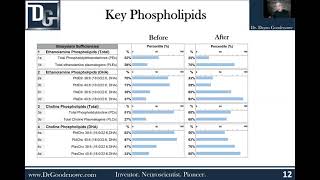
Dr. Dan Goodnow reviews Ben Greenfield's blood work before and after a month of targeted supplements. Plasmalogens jumped from 29% to 75%, CRP dropped from 7.8 to 0.5, and triglycerides fell to 76 mg/dL. The Prodrome Scan tracks early disease markers most doctors miss.
Questions this video answers
29% before → 75% after.
Approximately 7.8 (before) → 0.5 (after).
76 mg/dL (after).
About 6 (before) → 9 (after); values under 10 considered acceptable.
1,262 people.
Chapters
Hello, My name is Dr. Dan Goodnow. Today we're going to look at the blood results prodrome scan blood results for Ben Greenfield before and after taking a round of supplementation that included the plasmaogen precursor supplement called Prodrome Neuro. So very, very exciting stuff. But before we get into the overall blood work, let's take a look at a reminder of what protome scan is all about. Give you a little bit of a background on the philosophical basis of protome scan. We're talking about immortality, science versus mortality science.
Health versus disease.
And typically we forget about disease until it's upon us. But disease does not happen randomly. There's always a precursor to disease and that precursor to disease is the prodrome of that disease. We see biochemical changes in our body before we actually get a disease. So at some point in time we're healthy, and most of us are healthy for many, many years before we get sick. That healthy state will transition into an at risk state. Like people with type 2 diabetes or early stage cardiovascular disease. We acquire these biochemical dysfunctions as we get older and randomly somewhat we acquire a biochemical deficiency and this creates a disease risk. It doesn't mean we have a disease right now, but it means that we are at risk for a disease in the future. Sooner or later, if that risk is not modified, that risk will eventually result in the pathological manifestation of a disease. And now you actually have a disease.
If that disease is not treated effectively, that disease will ultimately end in death. None of us live forever. So this is typically the cascade of how we go from the healthy, vibrant state to death. And this can happen very quickly or it can happen very slowly.
Now the current medical practice focuses on treating the pathological manifestation of a disease. We're here to prevent you from dying. And this just resets the biological clock and puts you back in the risk category, but not yet in the pathological disease state. And I call this mortality science. So mortality science is a science of treating disease symptoms to delay your death.
The next best thing is basically preventative medicine. So disease science is a science of treating disease prodromes to delay disease. So if we correct the biochemical prodrome of a disease, okay, we can restore you back to the healthy low risk category. So if you're a type 2 diabetic and you take diet and lifestyle modifications to restore your glucose sensitivity, okay, you remove your risks that are complications arising from type 2 diabetes. So this obviously is a good thing and that's focusing on diseases. How do we identify disease and bring you back to Normal from the disease.
Immortality science is really the science of iterative functional maintenance and optimization. It's the science of not waiting for disease to occur. Immortality science is ignorant of disease, death and time. It's entirely focused on function. Are our biochemical systems functioning, yes or no? And if no, how do we make them optimal? Pretty simple and straightforward stuff. So protome scan is basically designed in that manner. It's not designed to diagnose a disease. It's designed to evaluate the operational systems of your body. What are the key biochemical systems? And it's designed to help create biochemical reserves in terms of your fuel tanks, make sure your biochemical reserves are sufficient. When that's the biochemical, that's the biosystem sufficiency categories. And the second one is biosystem function reserve capacity, that is are your biochemical systems, do they have excess capacity for when you need them for a rainy day? And that's what this is all about. So it's kind of a hand selected.
Mix of biomarkers that, that help us identify how your biochemical systems are all balanced.
The key point then is that every biosystem described in protome scan can be optimized by targeted environmental interventions. Your diet, your lifestyle, your supplements. So the time to optimize your biochemistry is now. So we're going to look at how Ben's biochemistry changed from his original blood work to his future blood work following dietary supplement regimen. I haven't talked to Ben, so I don't know all the other aspects of his lifestyle that have changed before and after. So the key phospholipids, if you remember the first blood work and we have a video on his first blood.
Test results as well. So just to make it simple, I just put the percentiles in his before and after. So this is his first blood test that was done.
Late last year in 2020. And then this is one that we just received about a month ago.
Before this was his blood work. And then he took protome neuro supplementation, some mitochondrial support and acetylcysteine, carnitine.
Some creatine into his diet and some serifos and alpha gpc. So a few supplements to.
Basically enrich his underlying biochemistry. So his baseline results are here. So at baseline he had low levels of plasma. So this is talking about all of our phospholipids, the key membrane phospholipids that make up the cellular boundaries of all of our cells in the body. And the two main classes are the ethanolamine phospholipids and the choline phospholipids, those make up the bulk of all the membranes of your body. And within each of these classes, the ethanolamine class and the choline class, there are the phosphatidyl, which is the traditional phospholipid, 100% obtainable from the diet. And then there is the plasmalogen. And the plasmalogen is a unique phospholipid that has a special bond called a vinyl ether bond. And also what's special about it, it's fundamentally not available dietarily. Your body must make it, your body makes a lot of it and your body uses a lot of it. So 20% of your brain, high levels in your heart, your lungs, your kidney have this plasmaogen molecule in it. The very last step in their biosynthesis creates a bond called a vinyl ether bond and is designed specifically to be sensitive to acids, specifically peroxides. And so your body consumes plasmaogens when they neutralize reactive oxygen species. But they're also critical for membrane fluidity, protein function within membranes, and really very important in your neuromuscular junction and the neuronal synapses of your brain. Those things are described much greater detail in other locations. The point here is how the protome scan test is designed to be really, really personal. You're compared to a reference population. But what's more important is how your individual systems are behaving in relationship to each other. In his baseline blood work, his plasmalogen levels were low relative to his phosphatidyl levels. This could be due to impaired manufacturing of plasmalogens, or it could be due to excessive consumption of plasmalogens. So it's a mass balance equation. He's a young guy, very healthy guy, and so this is probably due to over consumption. So he was somehow consuming a lot of plasma allergens, probably from his extreme sports activities. And you'll notice that the choline and the ethanolamines typically follow each other.
To a certain degree.
And then also his DHA levels are. The DHA is your very long chain polyunsaturates that give you, your membrane's a lot of fluidity. So one of the things with the low levels of plasmaogen was taking the prodrome neuro supplement, which is a plasmaogen precursor, and it actually has DHA in it. So the molecules that are in prodrome Neuro are actually 2C and 2D and 4C and 4D. So these are the precursor, these are the, these are the Metabolic byproducts of taking proteome neuro. You can see that those two molecules went dramatically improved. And his total pool of plasmaogens went from 29% to 75%. That's extremely good. Now his plasmalogy pool is high relative to his ethanolamines. He was taking some seriphos to maintain his ethanolamine pool, but that's still low. So you'll actually need more seriphos and to maintain that head group of the ethanolamine. But his choline pool remained very nice. It still went from 81 to 68. So his choline pool went down a little bit, but his plasmaogen choline pool went up a lot. I'll show you that in the next part. When we talk about methyltransferase activity, take home message here is we definitely have him on the right track. We want him in this, this space.
And so the plasmalogen precursor supplement is doing exactly what it was intended to do.
Now, the next section in the prodrome scan report deals with your dietary fatty acids and your dietary fatty acid ratios. There's three essential fatty acids in our diet supply the omega 9, which is like our oleic acid. So 18:1 is oleic acid comes from our olive oil. 18:2 is your omega 6. It's called linoleic acid. It comes from corn, soy, canola oil. And.
That molecule gets used for multiple purposes. It's critical for cholesterol transport. But it's also used as a precursor to, to create your polyunsaturated fatty acid called arachidonic acid. And the third essential fatty acid in our diet is the omega 3 dietarily from plants. It's an alpha linolenic acid, something like flax oil. But that doesn't stay in that form very long. It gets converted. And the purpose of those omega 3s is to make this final molecule called DHA. DHA is a long chain polyunsaturated fatty acid. And it gives our membranes fluidity.
22, 6 is 22 carbons, 6 double bonds. There's two pools of phospholipids here, the ethanolamine pool. And you'll see 18, 0 is the same in all of these. So we can look just at the fatty acid changes. And in the phosphylcholine pool, this 16,0 stays the same. So we're just looking at the changes in the fatty acid on the phospholipid. This gives us a very accurate representation of what is going on in Ben's body.
At baseline, he had a fair bit of his arachidonic acid and DHA levels were.
Balanced, but not what we want. We want the DHA levels high, arachidonic acid low. And same thing here with the phosphol choline. The body will make arachidonic acid when it doesn't have enough dha. So DHA is the preferred membrane molecule for fluidity. Your elf, your linoleic acid is kind of your Inspector Gadget fatty acid. It can kind of you, it can be used for oleic acid type purposes and it can be used for omega 3 like purposes. But this is exactly what happens when you take Omega 3 supplements. So Prodrome Neuro is an Omega 3 supplement. It provides very bioavailable DHA. And this is what you should see. You should see the DHA portion of this pool go up and it'll push the arachidonic acid pool down. Because the reason this acroachidonic acid was high is because his body was making it because he didn't have enough Omega 3. And that'll also result in your Omega 6 being preserved. And same thing here. So Omega 3 went up, Omega 6 went down, the arachidonic went down, and his short chain.
Linoleic acid is preserved. And then also his oleic acid. Preserved. Gets preserved. This is perfect. This profile right now is almost textbook. Okay, so he should just keep doing exactly what he's doing and maintain that level. When you have DHA in your membranes, it's a, it's a, it's a low inflammatory state. And you'll see the difference in the next page.
Now the other things we look at is iron levels and his GTAs. That's. Now we had normal levels of GTAs and they decreased from last year to this year. I have no idea why that happened. This is not exactly really common. Your GTAs are made by your gut microbiome and then they're absorbed into your blood supply. They're very potent anti inflammatories and they're also potent anti cancer molecules. And typically they're pretty stable over long periods of time. And so he want to follow up on this in terms of his gut health. So I don't know anything else more than that. We do have.
A supplement called Prodrome gta and it's not the exact human equivalent of gta. It's a memetic curcumin, has turmeric, has a class of bioactive molecules called curcuminoids. There's three of them. Curcuminoid, 1, 2 and 3 the third one is called BDMC. It has some very potent properties. The biological activity of that third curcumin is very similar to the endogenous GTAs. We found a supplier and we provide a supplement called Prodrome gta which has high levels of this bdmc. It's a very potent anti inflammatory that people can look into. His iron was borderline. His iron is perfect now, so I'm very happy with that.
So next we move on to the second page of the Prodrome scan report and we move from overall sufficiencies to functional reserve capacity. So in the previous page the. Everything looks really good. He should probably take some more ethanolamine, more serifos and maintain his choline levels and that will continue to.
Stay in their healthy range.
Now we're going to look at three, four systems here simultaneously. The first one is the methyltransferase system. Typically the biomarker is homocysteine. Homocysteine is a measure of your methyltransferase activity in the body. Your body has hundreds of enzymes that have to methylate things. The two main ones is making creatine for your muscles and making choline for your membranes.
When your methyl transfer system gets overactive, it has negative feedback and it shuts methyltransferase activities down which you don't want to have. You want to preserve capacity. So he starts at 6, he's at 9, so he's still in that good space. Basically anything under 10. And we see this sometimes when we're supplementing with the.
Plasma algine supplements because the choline plasmalogen is primarily manufactured by methyltransferase of the ethanolamine. I know this is gobbledygook stuff, you want to make sure you maintain that. But overall you can see that his phosphol choline levels are elevated relative to his ethanolamine. And this is a methyltransferase system. He's taken some alpha gpc, which is great. He's supplementing his choline, but he's still consuming ethanolamines. So look at his ethanolamines went from 52 to 25. So this is being, he's, he's, he's consuming them. He's making.
He'S making choline and that's also being observed. So his phosphol choline levels are being preserved because he's taking alpha gpc, which is excellent. But his finger myelins have come down because again he's, he's consuming a lot, which is fine. He's still got Capacity. This would just mean keep up on.
The food, basically the ethanolamine, the serifos and the alpha gpc. And this should normalize itself over time. Now, mitochondrial function. This is really nice.
Here. Quite a bit of oxidative stress going on. So his C reactive proteins was really, really high. It was around 7.8. So something was going on back then. This is indicative of his mitochondrial function. His mitochondrial function. This is a very simple, crude mitochondrial function test. Your mitochondria are your energy burning cells, organelles of every cell. Their purpose is to take a little molecule called acetyl coa and convert it into carbon dioxide and water. Just like your car engine burns hydrocarbons. And it takes the energy from that burning process to make your energy molecule called ATP. I tell people the human body is essentially the same as a hybrid electric car. We basically have a hydrocarbon burning engine that we use to charge a battery. And the battery recharge is the electron transport chain. So we actually, it's physically, it's a battery. We have a proton gradient that your body creates just like a battery. And it uses that battery energy to drive a pump called the ATP pump, adenosine triphosphate pump. And ATP is the energy molecule that your body uses for everything. And you make a lot of it. Like you make about 170 pounds of ATP every single day, your whole body weight of ATP. So this is an incredibly active biological process in the human body. And so that's what we do. And so the mitochondria is both the hydrocarbon burning engine and it is linked, if you will, to the battery, which is the electron transport chain and the proton gradient. And that's what it does. And if it gets overheated, it starts leaking out acetyl COA and this is what happens. So now he had, so he had some adrenic acid leakage. He had conversion of linoleic to arachidonic acid. This is fatty acid elongation. And now we have a beautiful product like this is perfect. This is textbook right now. This is, this is perfect mitochondrial function. His mitochondria are just tight. Acetyl COA is coming in, carbon dioxide and water is coming out. And look at the C reactor. Protein levels went from 8 to 0.5. So he's perfectly where he wants to be on the inflammation state. Protome neuro seems to do this like clockwork. If you have high C reactive protein levels, the DHA plasmaogen just knocks C reactive protein back into normal. So everything here is very, very happy. He's, he needs ethanolamine he needs more ethanolamine because he's consuming a lot of ethanolamine. And so we want to give him probably even more Seripos than he was taken previously to keep these levels up. And his alpha GPC sees alpha GPC is doing the job. His choline levels are nice, but his ethanolamine levels are still too low. So that's it. Elongase looks great. So the next thing we look at is the peroxis normal function and his cholesterol transport system.
In the past, previously he had this. These first four lines are reproduced from the first page of the report.
In his previous blood work, these plasmaogen levels were low relative to the phosphatidyl. But the second part of this test deals with.
Peroxis on beta oxidation. And it looks at the relative ratio of dha, which your body still makes, but your body converts DHA to EPA through a process called peroxis normal beta oxidation. And that's an indicator of how well your proxims are working. And peroxisomes are really one of the biggest things that we deal with for health diet. When we're fasting or we do resistance training, we're stimulating peroxis normal function and that's really burns our triglycerides. When you exercise to lower your triglycerides, fundamentally what you're doing is you're stimulating peroxis on function because that picks up the extra slack of fatty acid metabolism. Previously you had these low plasma allergen levels. His beta oxidation was balanced a bit here, but his triglycerides were high.
This meant.
He was overheated. This high triglyceride level here was fundamentally due to his mitochondrial function problems that I showed you in the previous slide. There's two organelles that burn your fat. One is your mitochondria. And the mitochondria burn pure saturated fat, like palmitic acid is what comes like. We store that in our adipose tissue and it's pure fuel. But your peroxisomes are usually making they process the very long chain fatty acids like DHA and other more garbagey fatty acids. And if your mitochondrial function is impaired, then your peroxomes end up doing part of the job of the mitochondria. They're supposed to be both working together to metabolize your fatty acids. So now his plasmaogen levels are up.
His DHA plasmalogy are excellent.
And his EPA levels are up. So he's making it. And here on the phosphatidyl pool side, you can see the balance is a little Bit different, but the relative ratios are here. But his triglycerides have come way down to 76. This is perfect right now, other than his low ethanolamine pool.
We'Re pretty happy with this part. Which leads us to the whole cholesterol regulatory system. Okay. And so his cholesterol has come down a little bit. His profile before was still pretty good. I don't mind 250. Like anything over 200 is good. HDL in the 60s. His HDL is creeping up to a little bit high for a man. He's kind of overheated a little bit here.
When he's proxosomal function is good.
When you have high hdl, that's the cholesterol export from your cells and low ldl. Let me back up a second. So when you look at cholesterol regulation, there's really two or three things to focus on. One is total cholesterol. And the first thing we really look for is low total cholesterol. And if you have low total cholesterol, you want to know why? Because there are really two reasons. Because that's the unhealthy part of cholesterol. Having low cholesterol is either your liver function is impaired and you're having a difficult time making.
Cholesterol and transporting it onto the LDL particles, or your cells are hungry for cholesterol and are recycling cholesterol a lot. And so you're, it's consuming a lot of cholesterol and sucking it out of your blood supply.
So he's now lowering cholesterol. The question is, is it from his liver or is it from his cells? Chances are his cells, because his cholesterol levels, his phospho alcholine levels are great. His HDL level has gone up and his proxyomal function has gone up. This is indicating that he's actually recycling cholesterol quite effectively. He's making it because his proximal function is good and, and he's getting rid of it and that's causing recycling. So nothing really to worry about here based upon his profiles. And then finally.
We will look at his kidney function, but basically it's creatinine, blood urea nitrogen, uric acid. And his creatine, creatinine is going up. I know he's taking more creatine supplements, so that would contribute a little bit to that. Uric acid is fine. Blood urea nitrogen is still fine. Here we keep an eye on this. This is not uncommon if you're exercising a lot, because if you're breaking down Muscle material or your muscle.
Fibers are being recycled a lot. You can get high levels of creatinine. So we'll keep an eye on this. I'd like to see this come back down. Ideally for a man, we want to be in that one to one point to range. Ish. Okay, so that's where we are. So overall pretty cool. So the carnitine is what really and the N acetylcysteine is probably what gave him his mitochondrial function back. That's what fixed that mitochondrial function like clockwork. Typically the prodrome neuro restored his DHA levels and his plasmaogen levels as well as the reduction in its oxidative stress. So that's what caused the C reactive protein levels that come down. That's primarily what we see over and over again in individuals. And so from here forward we're saying these, we're close, we're going to optimize them a bit more with some ethanolamine supplements and let's make sure we keep an eye on this creatinine. So that's kind of how it works. So that's been greenfields before and after. I hope you enjoy that. Before I leave you, I'll give you a couple teasers of some things that are happening on the horizon. I have a book coming out called Breaking Alzheimer's and this is my crusade for the last 15 years looking at Alzheimer's disease. And so I'll tease you with two figures. The first one here is and so it's about plasmaogens but plasma allergies aren't the only thing. It's really if you have a loved one, if you're worried about mental health and understanding Alzheimer's, what the biochemistry of Alzheimer's is, where it comes from, what people are at risk, what factors influence it. This is a book that explains that to you in very thorough language. It's scientifically dense but hopefully it's explainable and understandable to each other. Here's an example. So we talked about. This is the molecule that we just doubled or more in Ben's blood. This is the DHA Plasmaogen levels. This is a large population, is 1,262 people for the study. It's not a trivial study. This is the probability of having dementia. This basically says a 90 year old that has high blood plasmas, DHA plasmologies in their blood has less than a 10% like a 7% chance of having dementia. But if that same 90 year old had low plasma allergens in their blood, it's about a 40% chance that that person has dementia. That's a big, big difference. These are 95% confidence intervals. From a scientific perspective, this is a very, very powerful finding. It indicates that people who have sustained high levels of plasmaogens in their blood have a very low risk of getting dementia. Then the next thing that was interesting, because we're interesting obviously in longevity and mortality, is that above and beyond the role of plasmaogens in preventing dementia is the role they have in all cause mortality. This is probability of dying in 5.3 years from the blood test.
This is individuals with high blood plasmaogens at their visit.
And this is with low blood plasmogens. Again, for 5.3 years, a 90 year old with high blood plasmalogens had about a 75% chance of living till age 95. But a 90 year old with low blood plasma allergens had just about a 20% chance of making it almost an 80% chance of dying in the next five years. And so these are very extreme numbers. So we're looking at more and more understanding the health of our population and obviously of our parents. These are things that things that most people want to know. So if you're interested, let me know. It's on our website, drgoodnow.com and this book should be launched within the next month. I think that's my last slide. So thank you very, very much for your attention and thank you Ben, for testing and kicking the tires and being interested in your health and sharing your blood work with the world. I think it's exciting and it's fun. You can actually move these biomarkers where you want them.
With that. Thank you very much for your time. Bye. By.
More from Ben




The Solution to Aging Might Be Closer Than Anyone Realizes - With Ben Goertzel



