Private Chef Teaches Biohacker How To Cook 3 Italian Dishes! (With The World's Best Beef?!)
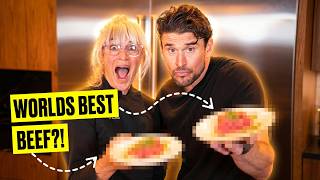
Ben Greenfield cooks three Italian dishes with private chef Cara Mia using Piedmontese Fasana beef: raw tartare, polpettone in tomato-Chianti sauce, and a beef-Chianti stew. They cover cuts, techniques like mincing with a mezzaluna, seasoning choices, and fundamentals like sofrito and roux.
Chapters
Here in the Greenfield family kitchen with Chef Cara Mia, we are about to blow your minds on Italian cooking. Piedmontese Fasano, Fasana, Fasane?
Fasana.
I don't speak Italian. Fasana. Let's do this.
We are here with some incredible product. His label is Monzo, I believe, now. We're gonna do 3 different preparations. We have a raw preparation. We're gonna make a tartare. In Italian, they call that buttata. And we're gonna do a meatball, and that's called the polpettone. We're gonna cook it in tomato sauce, which is kind of a different way of cooking meatballs. And this is super lean meat. It's so healthy.
3 podcasts about this meat on my show. So you can, if you go to bengreenfieldlife.com and search for manzo, there's a bunch of shows that dig deep into the history of these cows, steers, bulls.
All of it.
All of it. But now you get to see how it's cooked.
Yeah.
Or not cooked.
Yeah, or not. And then we're going to finish. I did an Italian take on a French dish and it's mostly going to be the timing, this cook is so, meat is so lean, it cooks really quickly. And so I kind of came up with a beef bourguignon, but now it's gonna be beef Chianti for the Italian meat. And it's a really shortened cook time so that if you do come across this meat, you can see it's easy to work with. It just makes a couple of tweaks in the cooking. All right, so we're going to start by breaking down these bad boys. So these are going to go— okay, awesome. Yep. So I go right in and then I'm going to put it on there like that.
And what cut is this that we just took out of these packages? This big preview of that. Yeah, good, good texture, good jiggle.
This is the chuck roll.
Chuck roll.
Chuck roll. Chuck roll.
Okay.
And we're gonna cube it up. Are you gonna help me cube it up?
I'm gonna help you with whatever you want help with. Okay, great.
So we're gonna kind of take this like this and we're gonna bring it over here.
Now this is a chuck. Chuck is generally known to be like not a super tender meat.
Correct.
When I interviewed farmer Justin of Owens Farms, he was describing to me how this breed, even like the chuck is a little more tender.
Yes.
Than average.
Yes. And again, since it has that tight fiber, it's also gonna cook quickly. If there's anything really nasty in here, we're gonna cut it off, but yeah.
So any silver skin you're gonna wanna get off or?
Yeah, like nothing, this nothing really bothers me.
This is really not too bad.
Yeah, I agree. So I'm gonna, I break mine down into like manageable, manageable. I always try to think when I'm doing these, like I'm eating this. So do I want a big piece? Am I gonna cut it? Do I want a bite-sized piece? What do I want? This meat cooks really quickly. So if we make a smaller piece, it's gonna cook quicker.
Greater surface area.
So I like to think it's a two-biter.
Okay.
So I'm gonna say like that size.
Two-biter.
Two-biter.
Depends who's biting.
Right. And if it's a little smaller, fine. Let's not go bigger than that.
Okay.
Okay, I'm leaving that little bit of fat on 'cause that'll be good. All right, I'm gonna get, 'cause you're doing amazing, I'm gonna get a plate so we can offload some. You can put it right there. Perfect. And it can just be in a pile. Also, what's important is that they're all similarly sized.
Can you really tartare it though? That's pretty tender.
Super tender. How do you like your steak cooked?
Depends on the steak, but usually I'm a rare plus to medium rare. What about you?
I'm rare, 100%.
If I'm going rare, I usually like to have like good sauce, good salt.
Yeah, season well.
Just 'cause, yeah, when you don't have quite as much of the maillard or the caramelization. I feel like I just need something, something else.
Yeah.
Extra.
Okay.
Look at this. Beautiful. Yeah, yeah.
You did an amazing job.
Thank you.
Awesome.
Practicing this for all my life.
There we go. Okay, so I guess we could get that going and then we can make the meatballs. They won't take that long to cook. And I've got my sauce already for the meatballs.
Great.
So I said this was like the beef bourguignon French style, which uses the regular meat. So it starts with butter like that, what I'm doing. And then we do our onions, but I've added in today, guanciale, into—
guanciale.
Yeah, so it's a pork, like pork belly.
Okay.
It's a very fatty part of the pig. And because what we're trying to do is, as we do a slow braise on our meat, we have to make sure we don't lose flavor and moisture and it stays juicy.
Okay.
So that's the challenge for me with this meat, that it cooks really quickly and then it dries up and gets tough. And nothing else is ready. The carrots aren't cooked.
You know, I've used tallow a lot when I've cooked with this meat.
Yeah.
It seems to work pretty well.
We're on the same page.
Yeah.
I'm just doing it in an Italian way. Yeah.
Italian, non-kosher, using all the pork fat. Unbelievable. Little butter, little onion. Little butter onion. Butter onion soup.
And we're going to add in our— ready? Here it comes. Sorry. Coming in over— I try to be organized, but it never really works.
Oh, what do we have here?
Okay, so ready for this? You're going to like this, I think. So in French, they say the mise en place.
The mise en place.
Right. Okay, so Italian?
Yeah, Italian, they say it like that.
Correct. Mesa in scena.
Mesa in scena.
Yes. So what I like— so in French is—
scène. Yeah.
So French is put it in place, mise en place, but in Italian it's put it in the scene.
Oh, the plaina, the scene.
It's a shayna scene.
Shayna. Shayna. I like it.
I love it. So this is our Maison Shayna here. Okay, so we're gonna give that a stir. Hey, I know we're so, we're super exciting, I know that. Do you guys have a pepe grinder? Pepe, pepe.
We not only have a pepper grinder, we have the Greenfield family logo pepper grinder.
So always, always, always, always, always, always, diamond crystal kosher salt.
Diamond crystal kosher salt?
Yeah. All right, it's the—
you say so.
For seasoning, uh, it's the only way to go.
What do you think about Celtic salt?
Celtic salt is fantastic, but that's after for flavoring.
Oh, okay.
Can you just go out, go to town there?
I'll show you.
Okay, so that is now going to go in here. Do you want to do that, or— yeah, I can do it. Okay, and I'll stirry stirry.
All righty.
Oh, you did a really nice job of seasoning.
Good job. We just want to kind of brown these.
Yes, we're going to just brown them. They're going to be rare on the inside, so we're going to really just get this brown, but I want it to be rare.
Yeah, I can see you're trying to get a little bit more even distribution of the meat spreading across the pan, browning surfaces. Correct.
Yep, I'm happy like that. I'm good with that. This one probably could already come out. So in Italy, the, uh, mirepoix mirepoix. So the mirepoix is like the flavor, the flavor packet, right? So that's in French cooking, it's always onions, carrots, and celery. In Italian cooking, it's kind of whatever the hell you want as long as you're adding flavor. Okay, so we're adding our sofrito.
We've already got the onions, we got the pork belly.
Yes. Okay, so that is considered a sofrito. Awesome, you're amazing. And we're going to add in this Okay, uh, all of these items here, we're going to get— wait 2 more minutes because I want to get rid of just like that rare part right there.
You're just looking for a little bit of— a little bit of the purple not being present. Yes, on the exterior.
Yes, but we're going to be so careful not to overcook this. Yeah, because notice my pan is back up to temperature, so I'm happy because now we're adding— stop it, it's not cold. So we're going to add in everything here. There you go, all goes in except for these garlics. Can you not put the garlic in? Great, everything else can go in.
I can coordinate.
Plus the mushrooms. So this is like in French the bouquet garni, but it's pretty Italian.
I've got rosemary, green onion wrapped in twine. Oh, you have new stuff in here. Oh, you wrapped rosemary and leek.
Uh, rosemary and parsley. That's my Italian sofrito. And I throw in a couple— these are going to come out— a little bit of celery. Again, you can kind of see that French influence.
It's my understanding the vegetables aren't just for flavor, but also there's a texture component, yeah?
100%, but okay, carrots are adding in sweetness, right? I feel like—
Right, natural sugar.
Natural sugars, yeah. And the celery and the onions and the mushrooms are the umami. All right, so now we're gonna put the lid on this and we're gonna let it go for 10 minutes. 10 minutes. Yep.
Okay, 10 minutes at still this same temp. Oh, it looks delicious. You wanna bring it down to more like a 6? Simmer?
Uh, let's bring it down to, um, we'll check it in a minute because it's going right now. All right, and then when that's done, we're gonna take the meat out and we're gonna make our sauce, put the meat back in, and let it go for a little while, and it'll be, and it'll be done. So we're gonna make our meatballs.
It's more, more of the pork belly.
That was just leftover. Okay. One chale.
Chale.
One chale. All right, so we're gonna do 4 ounces. Okay, so this comes together so fast. This is something Jessa can make any night of the week. Mince this up. Okay, so I'm just leaving you to have the fun.
I know what's about to happen. You're gonna want me to mix all this up together, right?
All right, so then we're gonna add in— this is just the yolk.
Mm-hmm. Shell, shell transfer.
Always organic whenever possible, local if possible. It's always, if it's traveled less, great.
You mean the chicken or just everything?
Everything if you can.
Yeah.
You know, that's my— Free range. All right, I'm coming in with some pepper.
Pepper.
And sometimes what I'll put in this super Italian in a meatball is nutmeg, ground, fresh ground nutmeg. But sorry, I'm getting that on your hand. Just keep going there. I just tasted that to make sure the seasoning was correct, because once we make those into meatballs and we stick it into the sauce, we can't— there's no going back. We're seasoning before we cook. You can always add salt. Yeah, but you want to make sure the salt is really important at this stage to bring up any flavor that's in there. And one more really important thing, which I skipped over as you were doing an incredible job mixing, the onion is in there for moisture. So that is going to melt, but the meat is going to stay moist. So this is a thing that I changed a little bit. I added a little bit more onion than I would normally in a regular meatball to help keep the moisture in our cassone.
Right, so onions are not just for color and for texture and for flavor. They're for the actual moisture.
Moisture. Remember, because when we're cooking, we're taking all the moisture out. So we're going to cook these not in grease or in the oven. Which you can do. You could certainly cook these, put these on a sheet tray, a cookie tray, and put them in the oven.
No problem at all.
That one, that would probably take— we are not going to do that. No, we're going to cook these in the tomato sauce, which I started. I'm going to keep meatballing. Do you want to go throw those in? Throw these into the sauce?
Oh, throw the meatballs in?
Yeah.
Heck yeah.
How about that?
Plate?
Yep, take the plate and then come back and I'll have a few more.
Okay.
What's the temp of those meatballs?
Right now?
Yeah.
I mean, close to room temp.
Yes, and two reasons I ask you that. One is we didn't lower the temp. The sauce is a little bit warmer than room temperature because it was boiling, and but we just put a bunch of meat in there. That did not lower the temperature, so we're good. And I think that's enough for everybody.
Do we need to do anything with this guy?
Oh, it's been 10 minutes.
It has been 10 minutes.
I love that. Let's take off the lid and see what's going on. Okay, so now we're going to take out that meat. So we're going to take out the meat, and if you can, if you see any of the guanciale, take that out. If you don't, it's not like the end of the world. Okay, good job. It all goes out, cuz now we're going to make the sauce, and we're going to put in approximately— this looks more like a teaspoon to me, so there's usually 3 teaspoons in a tablespoon. So this We're just gonna— this is the 001.
001.
Which probably only people who speak Italian are gonna know what 00 means. 00 flour. I'm counting. So that was 1 tablespoon. We want to cook the flour a little bit so it doesn't taste like flour. So this would be hard to do with the meat in there. Could you see that?
Yep, exactly.
Can you turn that on just a pinch down? I want it— yes, like I want a hard simmer but not a rolling boil. Rolling boil. Yes, yes. Ready? This teamwork makes dreamwork. You're going to slowly pour it in. So like, say this is 4 glasses, 1 glass at a time, and I'm going to stir so it doesn't get clumpy.
Perfect.
Okay. All right, so give me 1 glass.
1 glass.
Perfect. Give me a minute. So this is just to make sure that We don't— that the sauce is not— who likes lumpy sauce? Okay, go for it.
Glasses.
Beautiful. Uh, can you smell that?
These are not like fishbowl-sized stepboard wife glasses. These are—
okay, go for it.
Italian. 3.
Notice what happened. Yeah, temperature came down.
Yep.
So tempted to lift it, but don't let me.
Okay.
Okay, let's go. I feel good. Oh yeah, the whole thing.
The whole thing, like the rest of the wine?
Yep.
All right, here we go. Yeah, bottom's up.
Okay, now you're gonna add the meat back in.
Okay, if you don't mind, do it.
I put that back in, and we're gonna put in our tomato paste, and then we're gonna stir.
Very similar, just like making a braised stew, right?
Correct. This is a stove Just a stovetop. Yep.
Got it.
Notice too, like, our meat is still pink. Can you see that?
Yeah, that's what we want.
That is what we want.
Good.
Yep. You just, you know, you gotta—
Oh, mamma mia, it's good.
It's good stuff, huh?
Yeah.
So bring it back up to a boil. So we're gonna, we're gonna—
no, no, not that one.
We will, we will. Since we had a roux in here, while we're heating this back up, we're gonna stir it so we don't burn the flour on the bottom. I feel like we did a good job, but that's just for people at home, you know, just think something to think about if they didn't quite get it done. You want to just, while you're bringing it back up to a boil, make sure you stir the bottom just to grab some pieces that might have adhered. Exactly, because that could potentially burn. Yeah. And then you'll have that like sort of burnt thing on the bottom. Doesn't that smell good? Yeah. Yeah, you gotta love that. All right, I think we got them all turned. All right, so what I like to do—
what's that portion?
This. So each one is like a— probably about 3 to 4 ounces.
Now which cut is this? This is the—
this is the top round.
This is the top round.
This is the baby. And a lot of times people will say it looks like tuna.
It does look like tuna. Yeah.
And really, I mean, it doesn't taste like tuna, but the— all the qualities are there.
Big tuna.
Yeah.
Okay, ready? Mezzaluna.
Mezzaluna.
Half moon.
Oh, look at this device.
Okay, so we're gonna go like that. So we're gonna take— I'm just gonna do one and you can bang it out if you want.
Whatever, I'm happy to help.
You just tell me.
Oh, I'm down.
So this is how they do it. Super sharp. Kind of go like that. You just get it started.
Oh.
But then—
Oh, you're full-on mincing it.
Yeah.
Going to town.
It should be minced.
Okay. Never used one of these devices before.
It's gonna, um, it's just a little bit, a little bit too cold in this moment. It's gonna obviously warm right up, so no big deal. But you want it somewhat like hamburger meat. Mm-hmm. You know, ground. This is the butata part.
Yeah.
In Italy.
And you'd do this instead of just like straight up using a ground beef that gone through like a sausage maker, because there's a difference in mincing and spiraling.
Yeah, and also like when you do go through a grinder, it's like combines, you know, it grinds and combines. So that makes a totally different texture than what we're doing.
Yeah.
So this is a very different texture that you're going for, in my opinion. And but remember, our grandmothers ate hamburger and So that's from me.
Yeah. So, you know.
Okay, it's coming together. Here we go. So I'm going to do the first— I'll plate the first one. And I think if you want, we can tag team this.
Yeah.
And you can butata.
Let's factory line it.
And I will finish. But we can switch if you want to do some of the other as well. Yeah. Like, I'm totally— whatever, whatever you want to do. Okay. Uh, okay, so we're super close in my opinion. I'm good with that. Okay, so what I'm gonna do is I'm gonna find my cleaver that we had so much fun with.
I think it's in here.
Here we go. I'm gonna use this one.
It's okay.
So we're gonna take this. Also, I'm annoying, so I like it to be pretty. Okay, so I'm going to kind of make a little pile like that.
It's not annoying.
Okay.
All right, sign of every good chef.
Okay.
Scored on plating.
Okay, so then we go in with a couple of things. We're going to go lemon zest, and then we're going to go a couple capers. This is super salty, and then this is— this is for Justin.
What is this?
This is the mild.
Oh, the mild.
They call it fruity. Okay, so we'll just go, and then we're gonna do this. I'll get some more of this for you because we always finish with this. This is, uh, part— yeah, some people don't like parsley. I love parsley.
What's that herb you used on top?
Italian parsley.
Italian parsley.
Italian.
Did you say Italian?
I did.
They don't call it Italy.
I couldn't help myself. Okay, because they're supposed to have fun when we're cooking, right?
Idly and sissily.
Idly and sissily. What you don't know But you can smell.
Mm-hmm.
I'm going to put this in the sauce. That's my basil.
Basil.
We're going to have a taste test here. I can't help myself.
All right.
You know what we have to do?
What's that?
We always have to do this. Manja.
Let's go. Let's go. Mm. Mangia, mangia.
Mm. The flavor is so good.
Amazing.
Amazing. You are a buttata master.
Buttata.
You handled that mezzaluna like nobody's business.
She's gonna eat her words as soon as I cut a pinky off here.
Isn't that a cool tool?
This is pretty cool, yeah.
Okay, so I also brought like a salad. Would you guys like me to make that?
Let's do it.
I'm making you a super simple salad. Look at you. You are amazing. Did you put your capers on? That's what I think. Did you put capers on?
I didn't put anything on. I'm just factoring.
No, on the one that you did, did you do capers?
On the one that I did, I did.
Okay, good.
Awesome.
Okay, perfect. So this is, they're from Sicily. And see that they're not in a brine. But they're salty as heck.
Wow.
Yeah, the caper's in salt but not brine.
So you have to soak them. But I find these so much better. These you can get on Amazon.
Okay.
Well, it's amazing what you can find on Amazon. But, uh, this is— and this is how it comes, like a big thing of it. And so, you know, you don't go through them that fast, and they don't go bad. Yeah. So, but those, I have to say, are really, really good.
Tell me the bread story.
So this is Puglian focaccia.
Focaccia.
Yeah. And did you make this? I did this morning for you.
It's so pretty.
Thank you. Uh, wow. It's a little funky like that, but what the heck. Anyway, what's super cool about it is regular focaccia is so much thinner and it's like really crunchy on the outside, but this is like super moist.
Oh, it's like sponge cake.
Wow. Yeah. And the flavor is like, yeah, it's— I don't know. Well, you let me know what you think.
Amazing. Wow.
You let me know.
What an evening. What have we got here? What have we made?
We busted out some serious good eats today. So this is our bottata. That's the raw tartare, if you will.
Tartare.
We've got some capers, lemon zest, some spicy peppery olive oil to bring up the flavor, and, uh, Italian, little Italian flat leaf parsley, flat leaf parsley. Yeah, Sicilian capers. This is our Puglian focaccia that we did not make.
Beautiful salad, fantastic salad. And over here, here's this, here's the secret sauce, here's where the magic really happens, where it really happened.
We have our meatballs with the tomato sauce And those are fresh pasta noodles, which, you know, there's nothing better.
What style of pasta do you call that?
Uh, that's egg and semolina, so it's a little bit of a mix.
The, the style.
Fettuccine.
Fettuccine. So it's not spaghetti meatballs, it's fettuccine meatballs in a Chianti style.
Exactly. Look at this.
Beef stew. Oh man, the caramelization. Oh my goodness.
The carrots and the onions and the meat is cooked perfectly and not overcooked.
Incredible. I'll drink to that.
I'll drink that. Thank you so much, Ben. I really appreciate it.
Thank you for teaching.
Thank you for your time.
Well, you guys, now's the fun part. Now we eat. Big thanks to Karamiya for making the magic happen, Justin for basically making the pro— every protein point portion of today's evening happen. If you are vegan, I am sorry. We have salad and some olive oil and some bread. Well, let's celebrate and eat this beautiful meal made of the fasano.
Fasana.
Fasana. Let's celebrate and eat this beautiful meal made of the fasana beef. Just some of the most incredible stuff I've ever tasted. Have a good time tonight.
More from Ben




The Solution to Aging Might Be Closer Than Anyone Realizes - With Ben Goertzel



