Reacting to Popular Nutrition Advice: PROTEIN MYTHS
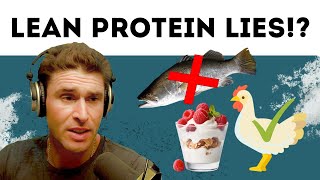
Ben Greenfield reacts to a Healthline video that lists common 'lean' protein sources (white-fleshed fish, Greek yogurt, pulses, skinless poultry, low-fat cottage cheese). Ben agrees with some practical points (legumes are satiating; Greek yogurt has more protein than regular yogurt) but pushes back against a lean-only philosophy, arguing for nutrient density in fattier options (salmon, dark meat, full-fat dairy), attention to contaminants (mercury in white fish), and proper preparation of plant proteins. He cites studies and cookbooks to support claims about full-fat dairy and offers practical cooking/preparation advice.
Chapters
It's reaction video time. If you like this video, be sure to comment because I might do more of these. I have been a personal trainer for a while and used to tell everyone to eat your lean protein, your broccoli, your white rice, your chicken. Well, I found a video recently where a guy saying something very similar. Let's hear what he has to say. This is from Healthline, by the way. Here we go.
Protein is an essential part of a balanced diet, but sometimes it's accompanied by more calories and fat than you want. Fortunately, there is a variety of lean animal and plant protein that, that can help you meet your quota.
All right, lean protein. I'm going to caution you about that phrase. Kind of like the phrase fruits and vegetables. They're different. They aren't necessarily meant to be thrown around in the same phrase. So lean and protein is something that doesn't occur too much in nature. We get the bones, we get the gristle, we get the skin, we get the fat. And lean protein itself is simply very high in methionine, an amino acid that unless balanced out with glycine, which you honestly get from more like the bone marrow, bone broth, gelatin, things like that, can actually accelerate the aging processes. Maybe we're getting too deep into the weeds here before he's even gotten started with his. With his first protein. So here we go. That's pretty.
Number one, white fleshed fish. Most fish varieties with white flesh are super lean and an excellent source of protein. For example, the common types like cod, haddock, pollock, flounder, and tilapia provide under 3 grams of fat, around 20 to 25 grams of protein, and 85 to 130 calories per 3 1/2 ounce or 100 gram plain serving. A convenient way to buy this fish is just in the frozen section of the supermarket. So if you move the fillets from the freezer to the fridge in the morning, then when you get home at the end of the day, they will be thawed and ready.
These are all white fish, and yet white fish is lower in calories. It's not all about calories, though. See, let's take something like salmon, not a white fish. Also considered to be far more nutrient dense than white fleshed fish because it's classified as an oily fish. You've heard of omega 3 fatty acids. Maybe you've used fish oil. Well, you get that not as much from the white fleshed fish, but from the darker fleshed fish. It does have a higher fat count, which can contribute to a higher calorie count. But I would rather eat a smaller amount of a nutrient dense, slightly more calorie dense food than I would a nutrient poor, more calorie poor food. Now, the amount of mercury in seafood also varies. Sometimes it depends on how high up in the fish chain of fish is. But if you look at salmon, it's got a mercury concentration mean parts per million of.014. Fresh salmon is 0.022 compared to canned salmon at 0.014. White fish is 0.089.
Right.
So white fish also tends to be higher in metals. So you got to think a little bit more than just about the calories. Let's go on and see what else he has to say. We got yogurt here. Here we go.
Two plain Greek yogurt. The 6 ounce or 170 gram serving of Greek yogurt packs 15 to 20 grams of protein, compared to only 9 grams in a serving of regular yogurt. Now this is due to how Greek yogurt is made. It's strange to remove the liquid whey, leaving a more concentrated product with, with more protein that's also thicker.
Makes me hungry.
Jason, number three beans.
Yogurt, one of my favorite desserts. I have yogurt with a little dark chocolate and blueberries and sometimes a little spoonful of honey for dessert. A lot of nights rather than Ben and Jerry's. Now here's the issue though, with yogurt. Now, he didn't say this. This is just something I want you to be cautious about. Low fat dairy is actually not as healthy as full fat dairy. There was a November 2018 article in the Lancet Journal in which they reported that eating full fat dairy products like milk, cheese and yogurt, you know, you could eat. Full fat Greek yogurt, of course, is linked to a lower risk of stroke, heart disease and early death. That's based on three servings of full fat dairy a day. Now, low fat alternatives to full fat yogurt are based on the assumption that the saturated fats in the full fat yogurt can increase your cholesterol. But unless there are other elements present, like a high amount of sugar, inflammation, elevated triglycerides, et cetera, that could make that cholesterol atherosclerotic, it's not that big of a deal. Full fat dairy also has a lot of elements that are very good for your body, like magnesium, vitamin K, amino acids and calcium, all more than low fat yogurt, which are good for strong teeth and bones. So the, the deal with Yogurt is. I'm actually on the same page as him. Just don't buy the low fat fat free stuff with the rotten, sugary fruit in the bottom, you know what I'm saying?
Peas and lentils, dry beans, peas and lentils, also called pulses, are a subgroup of legumes. They average 8 grams of protein per half a cup or 100 gram cooked serving and are also low in fat and high in fiber. Both the high fiber and protein contents impulses help make them more filling.
So he's right, they're rich in fiber, they're a slow carb, they're relatively dense in protein as far as a plant protein goes. Even though all animal proteins are going to be more complete sources of protein. But the thing that you have to understand is when you hear that you should go out and eat legumes or pulses, you need to be ready to prepare them properly. Some people go buy a big bag of quinoa at Costco after seeing a video like this. And they take the quinoa out of the bag and they pour it in the pot and they put the water in, they boil it and they eat it. And the next day they have quinoa in their crap and bloating and gas and they're painting the back of the toilet seat and they can't figure out what was wrong with those darn pulses. Well, these type of compounds, these plant based compounds, these legumes, they can contribute to things like gas and bloating and gastric distress. Especially when you first start eating them. It goes away after you've been eating them for a while, interestingly, as your microbiome changes. But you must slow prepare them right? Soaking, sprouting, fermentation. In my cookbooks, Boundless Kitchen and Boundless Cookbook, I give you all of the instructions on how to slowly prepare legumes. Like if I'm making quinoa, I take it out the night before, I put it in a pot, I soak it with a little bit of vinegar in there. The next morning I get up, I rinse it through a colander or a strainer and then I put it back in the pot and I soak it again. Then I rinse it and strain it one more time before I cook it. And that's what removes all, all these saponins and soap like irritants on the outside of the quinoa. That's just one example. But soaking, sprouting, fermentation, it's a much, much healthier way to eat your legumes, especially if they give you gastric distress. But as far as plant proteins go, they are satiating and they can be a healthy addition.
4. Skinless white meat poultry. A 3.5 ounce or 100 gram serving of cooked chicken or turkey contains about 25 grams of protein. Now skip dark meat cuts like drumsticks and thighs to get the leanest meat. Now white meat includes the breasts, breast tenderloins or tenders and wings. Also, don't eat the skin 3 1/2 ounces or 100 grams of roast chicken.
You want your chicken to taste good.
Has 200 calories and 8 grams of fat. While same amount for skinless roast chicken breast has 165 calories and 3.5 grams of fat. You can remove the skin either before or after cooking. Just note that cooking poultry with the skin on, that means the meat will be a lot more moist. Number five.
Oh my gosh. At least once a week I piece a whole chicken and I smear it in olive oil. I keep the skin on. I put a little buffalo sauce on there, some salt, some pepper, some cayenne, some paprika, some rosemary, and then I just lay it out on a baking sheet and bake it and it's fantastic. And I often eat the wings and the lower portions of the legs and chew the knuckles off the bones. Need a lot of the dark parts, including the so called gizzards. Dark meat is very rich in iron, zinc and B vitamins, which are important for energy production, for your brain health, for your immune system. Dark meat also has a lot of unsaturated fats which can help metabolize protein and carbs and fats. Dark meat is actually more nutrient dense in the same way that salmon is more nutrient dense than white fish. A dark meat, especially dark meat with the skin on and the oils and everything, it's so much tastier too. It's higher in fat, so it contains about twice as much omega 3 fatty acids as a white meat. And the higher myoglobin content, which is what makes the meat dark, packs more iron and zinc into it. So I remember back when I was a bodybuilder like lean proteins, like boneless skinless chicken breast and non fat milk and whey protein powder shakes that could basically pale paint off the wall of an elevator. These were all very popular. But it turns out that eating lean protein is not that great. See, what most people don't know is that we need fat soluble vitamins, especially vitamin A, to absorb the protein that we eat. And fat soluble vitamins are Found exclusively in animal fats. Just about so. Lean protein has very little fat and very little fat soluble vitamins. So when you exclusively eat lean protein, your body needs to withdraw fat soluble vitamins stored in your liver in order to absorb those proteins. Over time, you can build up deficiencies of fatty acids and fat soluble vitamins. Eating fat with your protein allows you to get a full nutritional spectrum and it tastes a lot better. Even skin. Chicken skin. Chicken skin has protein. Chicken skin has essential amino acids. It's got monounsaturated and polyunsaturated fats, many heart healthy fats. It's got collagen protein that helps keep your skin and your hair and your joints healthy. It adds a lot of flavor to dishes. It's a crunchy snack. It makes the chicken taste so much better. It's got oleic acid, which is the same type of fatty acid you find in olive oil. That can help to reduce inflammation. It's also a little bit higher in fat and calories. He's right. But in the same way that I'm not a fan of low fat or fat free yogurt because it's very similar to an egg without the yolk. Right. The fat package with the protein is going to give you a better nutritional bang for your buck. Yes, it's higher in calories, but simply focusing exclusively or myopically on the calories, well, not only does it drastically affect the flavor of the food, but it also can keep you at a nutrient deficit. So let's, let's look at his last one here. Low fat.
I have low fat cottage cheese. I love cottage cheese. It's just a real simple, low fuss, high protein food. A half cup or four ounce or 113 gram serving of low fat cottage cheese has 97 calories, two and a half grams of fat and 13 grams of protein. Now, besides protein, you get around 10 to 15% of the recommended daily intake for calcium in half a cup of cottage cheese as well. If there's one drawback to cottage cheese, it's that a half cup has around 15 to 20% of the daily limit for sodium or salt. So if you're watching your salt intake, one study suggests that rinsing cottage cheese for three minutes could reduce its sodium by around 60%.
Including sodium that you find in foods is not the type of sodium you need to be that cautious about. You need to be careful about the process. And ultra processed foods that contain high amounts of sodium chloride, the same type of sodium that you might get in the average table salt versus rich and full spectrum minerals that have sodium, potassium, calcium, magnesium, et cetera. And you find those in whole foods. So here's why low fat dairy might not be optimal. I already told you that fat in the dairy can help your body absorb essential vitamins like fat soluble vitamins A, D, E and K. It can also help you to feel fuller for longer when you have the fuller fat dairy. Often in the low fat or the fat free dairy, they add extra flavorings and sugars which can negate some of the health benefits you might be looking for in low fat dairy. And they've actually studied full fat dairy and low fat dairy. There was one study that was published in the journal Circulation on 3,333 adults. And this was in the Nurses Health Study of Health Professionals Follow up study taken over about 15 years. They found that people who had higher levels of full fat dairy compared to low fat dairy on average had a 46% lower risk of getting diabetes. Another study that was published in the American Journal of Nutrition analyzed the effects of full fat and low fat dairy on obesity. They found that among over 18,400 women in the Women's Health Study, those who consumed high fat dairy products lowered their risk of being overweight or obese by 8%. For the most part, proteins and fats combined are pretty good 1, 2 combination for nutrient density. And of course you do need to be aware not to eat too many calories. But let's see what he says towards the end of this video.
As you can see from this small list, you certainly don't need to exceed your fat or calorie limits to meet your protein goals. Lean, animal and plant protein sources are plentiful and inexpensive. Thanks for watching.
All right, so.
Overall, if, if you want to be satiated and you sit down to two chicken breasts for lunch, good luck getting through like the first one before you're bored of chicken breasts and you're full and you're ready to push yourself away from the table. You keep doing that for a few weeks or months and you are going to start to build up deficits. Add a little olive oil to the chicken, maybe even have some of the skin with the chicken, right? Have a little bit of that Greek yogurt, but make sure it's the full fat kind. You know, you work in some salmon along with your cod and nasty white fish. I just like salmon, what can I say? So you just need to understand that fats are not evil. And often fats combined with proteins are going to give you better nutrient density. And better health. Don't just myopically focus on calories or lean protein. I, I, I try to keep the word lean protein out of the vernacular. All right. Let's just say healthy, nutrient dense protein sources. So thank you for watching. Leave your comments or your questions. Right. Wherever you're watching this video, thanks for watching.
More from Ben




The Solution to Aging Might Be Closer Than Anyone Realizes - With Ben Goertzel



