Resonance Breathing Explained: How to Improve HRV, Vagal Tone & Stress Resilience
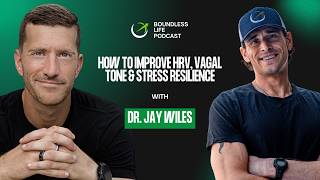
Performance psychologist Dr. Jay Wiles explains resonance breathing, a technique that syncs your breath with your heart's natural rhythms to boost heart-rate variability and stress resilience. Breathing at your personalized frequency (typically 4.5 to 6.5 breaths per minute) can spike HRV by 100-300% in a session, and consistent practice yields baseline improvements of 10-25% within 6-8 weeks. The OHM device uses a vibrating stone with a heart-rate sensor to personalize your breathing pace in real time.
Chapters
Okay, so this stone is not just like vibrating and just doing its thing on its own. It's actually reading me.
It's reading you. It maps your nervous system and it watches your breathing pattern. The algorithm basically, Ben, is looking to say, how can we amplify that nervous system response to get you into a state where we're training your nervous system to make those adaptations to make you more resilient?
Reset your nervous system. Them in about 3 minutes flat. And this new science called resonance breathing. Well, it's not new, it's been around since humans have been around, but now we're discovering the power of it and how to do it. We even talk about this cool technology, this little lamp called the Ohm, which is kind of taking the biohacking world by storm. All this and more with Dr. Jay Wiles. The show notes are at bengreenfieldlife.com/OHMpodcast. That's OM podcast, BenGreenfieldLife.com/OMPodcast. Here we go. This is going to be fun, especially for those of you who have been a podcast listener for, I don't know, more than what, 6 years, Jay?
Yeah, I'd say we probably started, we did it together what the Q&As for what about 2 or 3 years and then it's probably been about 2 or 3 years since then.
Yeah. Yeah. So, for those of you listening, Dr. Jay Wiles was my podcast sidekick providing witty banter whose job was just basically to play stupid and ask me questions from listeners. And then, I wound up not having any podcast sidekick and now I mostly interview people and record Q&A episodes all by my lonesome. But, Jay and I just got the band back together for this episode because as a performance psychologist and a psychophysiology expert, that's a mouthful, who specializes in nervous system optimization. Jay has been up to some pretty cool things behind the scenes when it comes to methods to increase your heart rate variability, decrease stress, recover faster, all using some of the latest science around what I guess is technically called resonance breathing. So, there you go, Jay. How's that for an intro?
That was a great tee up, man. Dude, this is good. You're right. We got the band back together here. Feels like the good old days.
Yeah. Is it weird to be back on the show as a guest instead of as a partner or a sidekick?
You know, it's interesting. It feels almost like, again, it's like the good old days. I feel like I've arrived back at a family reunion where all we do is trade health and wellness trend stories and we're eating grass-fed steaks and organic sweet potatoes and drinking creatine-infused smoothies. So yeah, it's a good time because I know everybody's family is just like what I just described.
We never actually did that on a podcast, but we should. We didn't? Yeah. What are you up to?
Oh man, things have been wild in the last few. So, okay, on a personal note, I guess since the last time I was like, no, it was not, I guess, I know because this happened 4 months or so ago, added a new little one to my family. So I have 3 boys now. So I've got another baby.
You mean like legally and through the, through the standard traditional means, or you just like grab someone up from the local mall?
Yeah.
Yeah.
No. So I had a baby legally, fully legally, biologically as well. So I just throw that in there. So yeah, man. So it's weird because, you know, I have that age gap between my middle child now and my baby, which is not big, but it's 5 years. And so you forget a lot, like you forget a lot of what it's like, but then you remember really quickly. It's kind of like riding a bike all in one. And so now a lot of the personal side is just like, hey, I'm trying to get back my sleep, trying to make sure that my head's on straight. So that's good. And then in the more like, I guess, professional realm, a lot of stuff has been going on since the last time I saw you. So a lot to catch you up on, but I'll try to truncate it as much as possible.
Okay. Okay. God, that, that, that 5-year gap, uh, is pretty good, but I'd be careful with that riding the bike analogy because I think it could be to your advantage to say, hey, I've just completely forgotten how to change a diaper. I don't know. I've lost I've lost it.
My wife is not letting me get away with that. She's not letting me get away with that one at all. But it's a good thought. Yeah. Yeah. Okay. Yeah. So, in the professional world, doing a lot, man. I mean, a lot of technology consultation. So, kind of going back to my bread and butter in the health and wellness space. So, the wearable HRV, autonomic nervous system space. Also, just doing a lot of work with a lot of pro athletes and executives. So, I ventured a lot into the Formula 1 space, which was really great. And then into, into sports, which is fun because those are like, I'm talking about when you think about the most mentally acute individuals from like a mental performance perspective, like Formula 1 is crazy. And they're also like super data-centric. So that's been a lot of fun to be able to, to talk data and try to get to, to trade stories there. And then also kind of, you mentioned before in a lot of resonance breathing spaces now. So looking at a lot of the interventions for helping people to regulate their nervous system. So, you know, so much of my work and background has been on data analytics and how we can leverage biometric data, specifically heart rate variability. But I've really kind of taken more of a turn to interventions. And I think the reason being is here, I feel like it's almost out of necessity, man. I've been working so diligently to try to piece together and build tools for helping people who are battling with things like significant life stress and transitions and also problems related to emotional wellness. Uh, because I truly do feel, Ben, like we are on a really unsustainable path as a society because we're so overstimulated, we're under-recovered. I feel like we are constantly bombarded with like this cognitive engagement and being like enmeshed with our smartphones and almost like never physiologically regulating ourselves. And so I've just come to the conclusion that like, we can't think our way out of this. Uh, we can't think our way out of a dysregulated nervous system, so Now I'm just kind of trying to answer that question of like, how do we go back to like the roots of training, like our underlying physiology, um, so that we can create a nervous system that's less chaotic, become less emotionally reactive, and then also improve things like sleep and recovery. So that, that really was like the impetus for getting me back into like the studying of interventions for nervous system functioning and got me connected to what I'm doing now, which is working at Om Health. When building some really cool technology.
Yeah, it seems like a good life goal, save society from their phones. You've got enough to feel bad.
Feel the enemy. Yeah.
So, I want to double-click on that whole resonance breathing thing because as you know, I've done podcasts about heart rate variability and different measurement tools. And, I know you've got some of your own thoughts on that which we can get into, but the resonance breathing thing, I'm going to tell you what I know about it, Jay, which is going to take considerably less than 60 seconds. And then, I want to know what you know about it. I got a book, I think it was called "Resonance Breathing" 4 years ago, and it went into how when you breathe in for a certain count and out for a certain count, and it seemed like it was relatively consistent from human to human like 5.5 seconds or so that you see some pretty good Adaptations from a nervous system resilience standpoint. And the book had a URL where you could go download an audio. It was a bell that would chime every 5.5 seconds. And I used to play that in the background while I'd check emails just to remind me to breathe in, breathe out, breathe in, breathe out, keeping my fingers crossed that there actually was something to this idea. I found it relaxing. And that's everything I know about resonance breathing.
Okay. So you're, you're on the right path. I would say one thing, that's an interesting book, by the way. I don't know if I've come across just a book called Resonance Breathing. Uh, you'll have to like send me at some point.
I may have made up that title, but, but I will tell, I, I do know, tell you what, you start to explain it and then I'm just going to rudely interrupt you at some point and, and tell you the book. Cause I, I think I might know what it is. Go ahead.
Okay. So what the one, one thing that I will say is that yes, and I'll explain why, like we kind of all hug around the same resonance breathing rate. At first, I should explain exactly what resonance breathing is. The only thing that I kind of would say is right and both wrong in that is that it is right that we all hover around a same rate. And I'll break out the nuances to that in here in a second.
We all hover around the same rate. Okay. By the, by the way, yeah. Before we get coherent breathing by Stephen Elliott. Yeah.
Got it. Okay. No Stephen. And I know coherent breathing.
Got it.
Excellent. So, uh, so that was the part that I think you got right. The part that might be a little bit more nuanced is that all of us actually have an individualized resonance breathing rate. So it's not this, this standard breathing rate that everybody breathes at. I wish it was that simple, but it's only just like slightly more complex. The stuff that lives under the hood that I'm gonna speak about here in a second is indeed more complex. But you kind of were on the right path, we'll say. Let's just start with like simple definition. So put simply, resonance breathing is breathing at a rate that makes your internal regulation system, also called your nervous system, more powerful, or I should say most powerful and responsive. So let me get a little bit more nuance because even though that definition is quite simple, again, there's a lot that like resides under the hood from a scientific perspective. So a lot of people when they get into this space and they hear about resonance breathing, they think that this whole thing works kind of similar to other breathwork because it relaxes you. And I think that's probably because their mental heuristic is that, you know, the intention behind a lot, if not most breathwork practices, is to kickstart that relaxation response. And I do think that the intention of many breathwork practices is to kickstart that relaxation response, but that's actually not why resonance breathing is working, or even the intent behind resonance breathing. It actually works. It actually works because it's mechanically driving your cardiovascular control system, and it's doing so in a way that is uniquely and markedly different than traditional, let's say, breathwork practices. So one thing that I would say here is, so instead of intending to put you into a state of relaxation, it's about matching the timing of your breath to the timing of your cardiovascular reflexes. And matching the timing of your breathing to the natural reflex of your cardiovascular system, it's been shown time and time again to improve things like the efficiency of that cardiovascular reflex. And we know that this has a slew of mental health and physical health benefits that I'm sure we're going to get into at some point, but that's, but that's it. Yeah.
Okay. What's a cardiovascular reflex?
Yeah, this is a, this is a good question. Maybe it would make sense to, to unpack that word resonance because it very much directly ties into the cardiovascular reflex. And I think we'll make sense of what we mean. Shortly, to answer your question very pointedly, we have a natural feedback loop that helps to maintain the homeostasis of blood pressure called the baroreflex response. And the baroreflex's response is intention is just to make sure that blood pressure doesn't get too high and it doesn't get too low. And when we're able to amplify kind of that response or actually set that response, it typically goes through a process of establishing what we call resonance. So would it make sense, Ben, for me to like explain the concept of resonance so that we can get back to like what that, how it stimulates that cardiovascular reflex?
You mean the concept of resonance beyond this idea that when you breathe in and out at a certain pace, you, you activate this cardiovascular reflex?
Yeah. And I think that what I, what I tend to like to do in explaining resonance breathing is help people understand what it means to establish resonance because as biological systems, we are physiologically resonant.
Okay. I've got my Post-it note. I've got my pencil. Go.
Okay.
Sweet. All right.
Resonance is kind of just put very simply. Resonance happens when you apply a force at exactly the right rhythm and that system becomes more powerful without needing much more effort. It is a fundamental property of what we refer to as oscillating systems, and our bodies are actually just natural oscillating systems. And an oscillating system, put simply, is just any system that moves back and forth around a set point.
We are all grandfather clocks. Got it.
Yeah, you got it. Basically, like, you think about heart rate, right? It accelerates and it decelerates. The intention? Get back to a set point. Blood pressure does the same thing. And what we want to do to kind of drive home the point is that we want to make sure that our body's natural oscillating systems, like the grandfather clock, is the most efficient that it possibly could be. Just like if you're pushing a kid on a swing, you want to push at the right point. Because if I try to push a kid when he's not at the apex of his backswing, I have to use way too much force to get him going in the right direction. And that in and of itself can cause a whole slew of problems because now I'm just wasting all this energy when I could just time it correctly.
Okay. Okay, got it. So, like, even like I'm walking on the treadmill while we're talking, and an example of that would be for every 5 steps I might inhale and every 5 steps I might exhale. Let's say while I'm on a walk, like in 2, 3, 4, 5, out 2, 3, 4, 5. And, if I were just doing that while I was walking, I would be activating that baroreflex response in such a way that I would induce some kind of nervous system— I don't know, is relaxation the right word?
It's almost like nervous system training. It's entraining the nervous system. Yeah. And, I would say that the answer to that, Ben, is yes. It just kind of is an uphill battle, if you will. It's hard to do while you're kind of moving or exerting a lot of energy just because you have a lot of systems that are being fired from a cardiovascular perspective. So when we think about resonance breathing, you can do it while you're walking, but if you want to make the true adaptations that come from resonance breathing, a lot of the times you're gonna do it in a very controlled, almost kind of like quiet, tranquil environment, if you will.
Okay. Okay. You, you kind of briefly touched on this, but, and you know, like, like my memory was from that coherent breathing book, it was something like 5.5 seconds in. 5.5 seconds out, and it was— it's kind of like consistent from person to person. Is there something to that?
Yeah, there is. So the reason— there's a couple of things to kind of think through here. Like, when we think about the human cardiovascular system, like, what resonance breathing is doing is it is just simply breathing at a rate where your heart, your blood pressure, and your brainstem are amplifying each other instead of dampening them. And the result of this is that all of these oscillations that are occurring, because again, we're oscillatory systems, start to increase. So where might people start to make the connection here? Think about heart rate variability. Heart rate variability tends to become much larger. I mean, we'll see when with resonance breathing, people increasing HRV by a factor of 100, 200, 300%.
Wait, wait, like, like like while they're doing it, or is this— or is there like a chronic adaptation?
There is. I think we have to break those two up. The 100, 200, 300%, that is much more while someone is doing it because they're actively like working within the constraints of that reflex. So they're training the reflex and it's responding. We're kind of organizing all those systems— breathing, heart rate, and blood pressure all in one. So we see these really big amplifications of heart rate variability. Now, across time, that's more of like state change of the nervous system. Trait change or the longer-term adaptations, they start to really happen when we're doing it consistently week over week, day over— well, day over day, week over week. And then we see that anywhere from around 6 to 8 weeks of consistent training, we start to see more of the adaptations happening. Now, this can look more of like 10% increases, 20, 25% increases in baseline HRV. So it is indeed something that we will see people change that baseline reading. But what I think is most interesting is when someone's doing, let's say, resonance or heart rate variability biofeedback, and they see HRV in the moment, real, like live, like actually amplified by 100, 200, 300%, it's pretty eye-opening that, oh my gosh, like this is actually affecting the nervous system. And so, it tends to be more sticky.
Real quick, since we live in an era of claims, 200%, 300%, these are big numbers. And when you say we see, is this research in general? Is this internal data that you've collected from people who use the type of devices that you make or something else?
We'll start academic first because I think starting within the scientific literature is the most important thing to do, and then I'll speak anecdotally. So from the scientific literature, you know, these are things that we see over and over and over again. I mean, with resonance biofeedback especially, that's coming out of Dr. Paul Lehrer, um, his, his research lab over in Rutgers Medical. He's the one who coined that term resonance frequency breathing or biofeedback. What he has seen is, uh, is something very comparable to what I, what I shared with you. Now what I should kind of make clear to people is that a 100 or 200 or 300% increase in HRV during a session doesn't mean that after that session that it persists for any appreciable amount of time. So, for instance, if you have someone who has, let's say, 20 milliseconds as their HRV when they start a session, and throughout the session, you know, they go up to 40, it's 100% increase, or they go up to, you know, 60, 200% increase, that you might see a continued elevated HRV for some amount of time after a session, but that's not really kind of what we're looking for or what we're aiming to do. So, I don't expect people to think, "Oh, I do a session of resonance breathing, I increase HRV by 100% during that time, and then it persists throughout the day or throughout the week." These are very transient changes that occur to the nervous system that are more state changes, But, over time, that's where we start to see the compounding adaptation effects.
Ben Greenfield: Okay. So, if I'm doing resonance breathing, I, like a lot of other people, have a standard HRV measurement tool. Right now, I'm wearing the Whoop. I was using the UltraHuman for a while before that, before that, the Oura. Would any of these devices be somewhat accurate? I know you're kind of an expert in the HRV measurement realm. So, I'm just kind of curious. What your thoughts are on the standard devices out there and if any of them are decent for measuring HRV. Yeah.
So much actually has happened, Ben, since the last time you and I talked because I know we've done some podcasts on HRV and wearables and the fidelity of data. And actually, a lot has changed because technology advances so quickly that we actually do have just a lot better tech out there right now. So, I will certainly speak to that. I just wanted to really, really quickly double-click on one of the questions you asked that I remembered that I didn't answer, which is why are— or why does breathing rates like hold around the same, um, pace like you were talking about, 5 or 6 breaths per minute? So just real quickly, uh, one thing to remember is that most humans, we share very similar heart-to-brain timing constraints, and our baroreflex, which is that blood pressure mechanism that I was talking about there that keeps things set and stable, it oscillates which means that it, it cycles typically at around a rate of, um, uh, of, of 1 cycle every 10 seconds. So that means 6 cycles every single minute. So that's 6 breaths per minute. So breathing at the same rate as your baroreflex response is around 6. So we, but, but there's nuances there. Resonance frequency is very individual. So not everybody has it at 6. Not everybody has it at 5. It's a range of typically 4.5 breaths per minute. Up to 6.5 breaths per minute. So, we can speak more to that here in the technology side of things, but I just wanted to make sure that I answered that question because I did not forget that you asked it.
Yeah. It is kind of cool that it's a little bit consistent.
Yeah, it's really cool.
That's not all over the map and you got your super tired and wired CEO executive running a million miles an hour and their value is 2 and then some yogi monk a 10, like we're all between, what'd you say, 4.5 and 6.5?
Yeah. So for adults, uh, the, the research has been, been very clear that it's around 4.5 is the low, um, end and then 6.5 is the higher end. But then for kids, it actually goes as high as 9.5 breaths per minute.
Oh, wow. I don't know many kids who breathe in for 9.5 seconds and out for 9.5 seconds.
Well, it wouldn't be 9.5 seconds. Um, yeah, it, it would actually be shorter because it's 9.5 breaths per minute. So it would be actually a shorter duration inhale.
Oh, oh, oh, yeah, yeah, yeah. Okay. I got you.
I'm tracking. Yeah. Yeah. All right.
So back to the HRV measurements.
Yeah. So obviously like with wearable data, HRV, it's quite ubiquitous. I mean, we like, we all have it. I mean, I have multiple devices now. It's my regular watch. It's not really tracking my HRV right now. Uh, but we all have, we all have it. And I think that there still just lies so much confusion around a couple of things, the data fidelity and the quality of the data. But probably more so the thing that I get nowadays is just like, what do I do with it? There's not a lot of closed loop systems that wearable like companies have been really good at. I think they're really good as like data repositories and telling you, hey, we see something off, like your sleep maybe was really poor or your nervous system doesn't like it, like it's repaired or you're not recovered or whatever it may be. But closing that loop and actually getting you something actionable, still like a major pitfall. Like, there's no intervention to like, what can I do about this? Like, you have to have, let's say, like your knowledge, Ben, or like a trainer's knowledge, or someone who has pretty extensive knowledge to know like how to assimilate that data into something actionable. But the— but as far as like HRV goes, you just need to know like what you're comparing. For instance, I tell people this all the time, let's say you have a Whoop or an Oura. Both of those are using the same exact metric, but they're collecting the data in a very different way. And if, let's say, then you kind of have guy number 3 who's got an Apple Watch, he's collecting HRV data randomly, which is kind of another whole nother topic, but it's a completely different metric. It's not even the same algorithm that's used for Whoop and Oura. So if you try to compare those numbers, it's apples and oranges. So a lot of it is just like, knowing what to do with that data and how to interpret it. But for the most part, like, especially while you're asleep, a lot of the wearables nowadays are like phenomenal at like actually giving pretty clear data. And this is not like meant to be a pitch for another company because I will be clear that I, I do work as a scientific advisor for them. But Ben, have you ever heard of Bison? Have you, have you ever come across Bison technology by chance?
I mean, I've, I've had bison, like a bison burger. Is that good enough? Okay.
Close. So this is Pison, P-I-S-O-N. It's a unique wearable because they use some technology that's called neuroelectromyography. And what it's intended to do is really it's meant for like athletic mental performance, but they'll train things like mental acuity through like reaction go/no-go times, which is like opening and closing the wrists with different like light stimuli. So like if it's like a white light, you're supposed to open your hand as quickly as you can. If it's a yellow light, you close. I say all that just to say it's a really cool wearable that people should know about, but also like their HRV data collection is insanely good.
And does it do like what a lot of these other ones do? Your heart rate, step count, sleep metrics, et cetera.
All of it. All of it. Yeah. Yeah.
Huh.
Yeah. It's really good.
Interesting.
Yeah. They're, they're, they're a well-funded company. And again, a little bit biased because I am a scientific advisor for them, but I think like from a mental performance and mental acuity perspective, like for athletes especially and or executives, super cool wearable.
Okay. Alright, cool. So, I want to get into the weeds of making resonance breathing something that people can do on a regular basis. You mentioned some of the adaptations you see over, I think, 4 to 6 weeks. Is that daily? And if so, how long?
Yeah, great question. Resonance breathing. So, the first studies that ever came out that looked at more of the longitudinal, like, trait change, so adaptations that that would occur from resonance breathing were scary in one sense, because it's like, oh shoot, when I say it, you'll see what I'm saying. Like, I have to do this protocol. It used to be thought that, oh man, you have to do 25 minutes of resonance breathing twice a day. So it's like 50 minutes of practice, and, and this was over the course of like 10 to 12 weeks in order to get the results.
Yeah, not gonna happen.
Yeah. What ended up happening, and this is interesting to look back on those studies now, those studies were really just looking at individuals with clinical anxiety. So these were clinical populations that they were studying. However, when they started to further the research, and that was one of the most like first, like preliminary research that they did on this, they started to begin to find that when you are practicing resonance breathing, especially when you get to around minutes 6 to 10, but really 8 to 12. So we split the difference and we say minute 10, that is when the nervous system starts to make large-scale adaptations.. So we start to see the nervous system really begin to entrain around that pattern over the course of around 6 to 8 weeks, practicing 10 minutes a day, 4 times a week. That is when we start to see significant adaptations of the nervous system. So things like baroreflex gain or increasing the sensitivity of the body's ability to maintain blood pressure homeostasis that occurs around that time. So what does that mean kind of like from a practical application? That means that when people practice this breathing pattern over the course of anywhere from about 6 to 8 weeks, 10 minutes a day, 4 times a week, we start to see that there— that the engine is more finely tuned. It becomes more efficient at receiving information from the environment. We'll call that stress and experiencing physiological stress and being able to adapt to it much more quickly. And the ultimate result of that is better emotional regulation, better recovery, better stress resiliency. And that can happen, again, just in about 40 minutes of practice a week, something that I build in more like 7 days a week.
To 10, 8 to 10, 4 times a week. And then, does it matter if it's in the morning, evening, afternoon, in the bathtub, on the toilet?
Yeah, it's the time of day doesn't really matter. I tell so many people battle with sleep issues nowadays that I say that actually, doing this about 30 to 45 minutes prior to sleep can be immensely effective in helping to downregulate the nervous system. And we even see in like overnight sleep studies that fragmentation, which is looking at overall sympathetic arousal that occurs at night, will drop significantly when people do like HRV biofeedback or resonance biofeedback prior to bed. But the timing doesn't matter. The one thing that does matter is like the, the length of practice. Like I'm really kind of, I will say that you can gain benefits, state change benefits from doing short sessions, a minute to 3 minutes. Like you can gain benefit from that. But if you want to gain adaptations from this training, doing the solid 10 minutes, not a compounding amount of 10 minutes over a day is really the way to go. Because if you recall what I mentioned earlier, at around minute 8 or so is when your body starts to make adaptations. So you don't want to cut that short and just do like a 3-minute session if you're trying to make longer-term adaptations.
What if you wake up at night to pee, let's say, and you want to get back to sleep? Could it work for that? Yeah.
Oh, I have— I've had so many clients of mine that have used this because they'll wake up and they'll go to pee, and the next thing they know, they'll get back in the bed, and then they have that cognitive wheel going. It's that rumination over and over and over. Yeah.
Is this hit—
is this hitting home, Ben?
Yeah. Yeah. Okay. So, so check this out. So, there's this thing, this little device. Okay, you see that? That's pretty. Oh, this is a lamp and I take this stone off the top and I put it in my hand. I breathe out as the light goes down and then breathe in as the light comes up and this little stone is vibrating in my hand. Now, what I've actually been trying when I wake up at night to and this works, is I just grab the rock and I start breathing because the rock vibrates. I don't even need to be looking at the lamp. I'm technically, I'm wearing a sleep mask and it lulls me back to sleep with pretty incredible efficiency. I'm showing this and obviously, you know what it is, Jay, because you sent it to me. And, it's called an OHM. An OHM. By the way, those of you watching who want to see the video, go to bengreenfieldlife.com/ohmpodcast, O-H-M podcast. So, let's unpack this bad boy. So, it's a rock and it's a light that kind of goes up and down as our residents breathe. And you obviously can't feel this because as of right now, podcast listening devices don't come with cool haptic technology that allows you to feel what I'm feeling. It will come someday. It'll probably come from the porn industry. But this thing is vibrating as it's in my palm, this little stone.. And so, I can breathe in correspondence to the vibration or I can breathe in correspondence to the light. That's Ben and I, the science guys, show and tell. Tell me about this thing, Jay, because as I understand, you're like the inventor. Yeah.
Well, I'm one of them, so I'm a part of the team. What's amazing about— because I need to give credit to where credit's due. The thing about— so, I wanted to kind of like double-click on something you said, which is that you've been using it and it's worked like with incredible efficiency to help like get you back to sleep. Like, I think that what we're going to find, like the next wave of therapeutics— and again, completely biased answer, so I don't mind like just owning it— the next wave of therapeutics that I think is going to make its way into mainstream is resonance breathing. Now, like, if we truly want to make like an efficient change of the nervous system really quickly, um, I think like things like the physiological sigh that gets like purported as being like this magical breathwork technique is truly the way to go. I think resonance breathing—
you mean like the— yeah, that thing. That thing. I mean, I kind of exaggerated, but yeah.
Yeah, that thing. And the reason, and the reason being, and again, I don't want to get on, you know, too much of a tangent, is that that might be effective. But the reason I think that the sigh is effective is because it's just slow-paced breathing. It slows you down. I don't know if that that last inhalation or sip of air is actually physiologically changing you to the point of, or to the extent as something like resonance breathing is. And so I think like with this next wave of resonance breathing, it's like the thing that you just showed, which again is OM, which I'm a part of, uh, OM is a way to do resonance breathing that is low friction. It's human. It's something that's pretty. It lives in your environment. It kind of like calls to you. And is a dedicated device. And it has nothing to do other than the app that you can use, but it's not focused on the app. It has nothing to do with your phone. So remember, I tried to position the phone as the enemy at the beginning of this podcast, even though we do have an app.
And just, just so you know, and maybe this is not great for your own advertising or marketing or whatever, but I think I've opened the app twice. And because, yeah, I kind of like that I don't have to use the app.
Right. But every training session that you have on there, Ben, is, is personalized to you. It's looking at your own nervous system footprint and nobody else's. So for instance, if your wife or your boys like picked up the stone, the session would be completely tailored to them. And this is something that's pretty unique, right? Because if you wanted to do biofeedback in the past, I mean, it was really expensive to go into a clinic. You had to wear, you know, a chest strap or do, you know, open up an app. Whereas for this one, it's like you pick up that stone and what is happening is that you hold that stone in your hand. It's a PPG sensor. Yeah.
Oh, I was wondering how it knows. Okay. So this stone is not just like vibrating and just doing its thing on its own. It's actually reading me.
It's reading you. It maps your nervous system. As soon as you hold that thing, Ben, it maps your nervous system and it watches your breathing pattern and it says, Basically, the, the out— well, the algorithm. Yeah, it's kind of creepy. The algorithm basically, Ben, is looking to say, how can we amplify that nervous system response to get you into a state where we're training your nervous system to make those adaptations to make you more resilient? Uh, the whole goal behind this is to give you a personalized biofeedback session. So when you hold that stone in your hand, it's looking at your heart rate and your heart rate variability., and it is modifying the pacer of that, uh, of your breathing, of that lamp to oscillate up and down in a pattern that helps get you into a state of resonance. So this is not just as simple as saying like, okay, Ben's pattern is 6 breaths per minute. We're gonna do a 5-second inhale and a 5-second exhale. No, it, it looks at it and says, okay, Ben needs to breathe at a rate of 4.27 seconds on the inhale and 6.315 seconds on the exhale. And what happens is, is it's trying to slowly get you in, or actually I should say quickly get you into that state of resonance. And that's why when it gets you there, it turns blue. And when the lamp turns blue, it goes from that like really kind of orange, deep orange color to blue. That actually indicates that you are in a state of physiological resonance.
Wait, what's, what's that mean? Like, if I'm in a state, I know you kind of explained what resonance is. What's that mean that I'm in a state of physiological resonance?
Is it something the heart's doing now? Yeah. So, when you are in resonance, when that lamp goes blue, it means that the oscillations of your heart rate, so kind of like those big swings in your heart rate or what we call peak-to-trough differences in your heart rate, that is matching the same rhythm of your breathing and your blood pressure mechanism, your baroreflex. And, when all of those are in alignment, We call that resonance. The light goes blue. And the whole goal is to hold yourself because the longer and the more you can keep yourself in that state, your thermostat of your nervous system starts to dial in that direction. That's when adaptations happen, especially when you start to creep up into that 10-minute time.
Ben Greenfield: How long does it take on average for someone to reach a state of physiological resonance holding that stone and breathing in correspondence to the light?
Or the vibration? Yeah, it all depends on how well their nervous system is trained. So like, for instance, for me, it will take me, uh, generally around maybe 3 or 4 breaths max until this, this thing has gone blue. Oh, that's super quick. Yeah, and I can hold myself in that for 6 to 10 minutes without coming out of it pretty consistently. But however, like, you know, I've, I've had my kids use this, I have my wife use this, because anybody can can use it. This is kind of the great thing about the technology we built is that you pick up the stone and it gives anyone who's holding it, a kid, you know, an adult, a personalized session. Is that with individuals who are not trained, their nervous system just doesn't want to make that adaptation very quickly because it doesn't understand it. Why are we breathing slow? Like, why am I trying to match these rhythms? Like, it's just, it's basically kind of like going to, uh, you know, try to, try to run like a mile. Like, if you're not very, like, cardiovascularly fit or training for it, then like the, the ability to run a quick mile is probably pretty, pretty low. You gotta train your way up into it. It's just like going to the gym. And I even tell people that like, this feels kind of like my nervous system gym. And every time like I do a session, I'm basically putting in reps. I'm getting in a nervous system workout every time I, I do this. So it really just depends on how adapted they are. I mean, I've had elite athletes who have done this type of practice. And it takes them a few minutes to get into a state of resonance. And then, when they get in, they can only hold it for a few seconds. But after they train over and over and over again, then they become much more efficient in getting into it. And then, also too, the significance of how long they can spend in that time goes way up.
So, it's the hand. It's measuring me through the hand.
Can you actually get—
is it like HRV data that it's getting or is it just measuring my breath or heart rate?
Yeah. So you're getting really high fidelity HRV data. Really? From the palm of the hand? Wow. From the palm of the hand. Yeah. And that was one of the things that we wanted to do is that, you know, every other strap that was out there is a wrist-based wearable, arm-based wearable, you know, like the Polar, you know, H10, like an EKG. And it's just like, it's so cumbersome, right? It's like, I got to put on another thing. I got to connect it to my phone. I've got to fumble through all of this. Whereas with us, it's like, Pick up the stone, hold it in your palm, or you can even put your finger on it like, like this right here if you want to. Uh, but that's, but that's it. And what we know is, is that right through here, we're able to get immensely high quality data. So what we've done is we've compared the data between like a gold standard EKG and what we're getting. And it's, it's basically 1 to 1, like the fidelity is really high. And again, most people who like have followed my work know I'm not gonna put my stamp of approval on something that's collecting HRV data. If I don't think that the fidelity and granularity that we can get from that data is good enough to provide like accurate calculations, because you really need that for HRV. But, but this does it. So it's a really impressive piece of technology, if I don't say so myself, on being able to get good data.
Have you heard of people doing kind of like I do and just grabbing the stone and putting the sleep mask on so you can't even see the lamp and just kind of like laying there kind of clutching it like a teddy bear to the chest? 'Cause that, I mean, that's, it works really well for just lulling you to sleep.
Yeah. We wanted it to be very multisensory and we also wanted it to be able to be used basically at any time. And the one thing that I love about it, have you noticed that like the stone is really warm as well? Like we intended to make it warm because it feels really good in the hand. And actually we know that when we're experiencing like sympathetic arousal, so that fight or flight response, blood is shunted from our extremities down to like our heart and our lungs and our brain. So we actually will get cold, you know, clammy palms. So this actually helps to warm up the palm. What you're describing is actually, so I've got my lamp here, so I'll describe it to the podcast listeners and I'll, and I'll show it on, on YouTube. So I think that's the best way to do it. So what's great about it, we thought about a lot of the little things, right? Which is like if when the stone's on top, if you just rotate it. So if you turn the stone, like you can see I'm dialing the lamp down and when I turn it the other way, I can dial the lamp up. And then if you go all the way down and I'm going to put it on the— put it on the microphone so people can hear. I don't know if it's coming through, but it makes white noise. And so you can put it in like sleep mode. Now then, when it's in sleep mode and you take the stone off, the light will not start, or at least, you know, within our mass production units, the light will not start. The only, the stone will vibrate. So it'll be just like what you are mentioning there, Ben. And what we have found is that so many of our users are doing the exact same thing that you're doing. So they put it in like that night mode. This is on the, let's say, a nightstand next to their, next to their bed, middle of the night, they'll pick it up and do a session. And within just a few minutes, they're like, okay, I feel like I am so sleepy. And that's because their parasympathetic nervous system is firing on all cylinders. You're lowering your resting heart rate, and it's that bottom-up approach to the nervous system that can be so helpful to getting you back to sleep. Because we know from the literature too, that like trying to change the mind with the mind is incredibly challenging at times. So if you wake up in the middle of the night and your thoughts are racing and going crazy, trying to kind of like mentally battle it and play tug of war is like one that you're probably gonna lose most of the time. So, this is just much more of a physiological bottom-up approach. So, I love the idea and I use this all the time in the bed too even though I'm a pretty good sleeper. If I do wake up in the middle of the night and I want to just do a session, it's nice.
Yeah. Is the stone dependent on the lamp? I haven't tried this, but if I'm 30 feet away from the lamp holding the stone, is it still going to vibrate?
Well, so you've got one of the pre-production units right now. Oh, okay.
So yeah, yeah, you're part of the cool kids club, Ben. So wait, so you can't buy this like on Amazon or whatever yet?
Well, you definitely can't buy it on Amazon. You can preorder it from ohm.health, which I'm sure we'll get into. But you've got one of the pre-production units. So we made a few hundred units prior to making mass production to send them to really cool people like you. So consider yourself a friend of the family there, Ben. But In the mass production unit, you'll be able to kind of go normal Bluetooth range. This one kind of maxes out at around 10 feet because it doesn't have as strong of a signal, but ultimately you'll be able to use it. Like if you're sitting across the room and watching, let's say, whatever, a documentary or a movie with your kids, like there you go, grab it, do a 30-minute, hour-long session if you want, if you want to.
Dude, I didn't even think, I didn't think about just like holding it while I'm doing something. This is the first time I've actually used it while recording a podcast walking on a treadmill and talking to a friend. So, I couldn't get it to go into zone, too much going on. Okay. So, let's say I like this thing, I become dependent on it for my very existence and happiness, and then I take a trip somewhere and I got to leave it at home because it's a lamp and it wants a break., couldn't you potentially do like a travel version of this?
Well, we, well, we've done a lot of like pro, you guess you could call 'em the user studies and what the probably number one request is, how can I make this thing portable? Because, uh, the, the one thing, again, just to kind of show, show off, it's a single piece of molded glass. Like you don't want to travel with this thing because it is not intended. Like it, it's a piece of art. Like it's beautiful. Like you don't. Want to risk it breaking. It will break. I've already broken mine by, you know, being a little bit dumb and just letting it slip out of my hands. But people have asked, well, what if, what if I just threw the stone in the backpack and I could just connect it to my phone? Because it does have phone connectability. Like, you can look at all your HRV data. Like, you can track all the stuff for data nerds like me. So I made sure that I could put all the cool stuff in the app. But we're like, well, what if this could just connect to the phone and I do my session at any time I want? And the answer to that is, is that right now, Ben, like, you can't because again, this is pre-production. But when we get the units out there to people, it is going to be tra—
the stone you will be traveling with. I could like theoretically, like I could set my phone up on a stand. You could have a setting on the app where the phone is making the light instead of the lamp, right?
And be that easy. That's right. Yep. That's what we're doing. So then you can still track all your data. You can still train because we have a lot of like pro athletes are using this right now and they're like, dude, I like, I, I love this thing. I love it at my home. I use it all the time. "But I can't go international with this lamp. It's going to ultimately break." And I'm like, "You're right." So, we are making the stone travel compatible so that when you're not at home and you don't have your beautiful Ohm lamp, you just throw it into a bag, you go, and you can continue to train, continue to make those nervous system adaptations.
Ben Greenfield: Okay. So, what's the timeline for people besides your insider VIP club being able to get one of these things?
Yeah. So we, we are doing like order pre-orders right now. So if you go on to ohm.health, you can pre-order and use code Ben, by the way, you'll get 10% off. So ohm.health, use code Ben, you'll get 10% off. We are going to be shipping in August of this year. And we are pretty— I know that a lot of companies do this and they'll do pre-orders and they'll say a timeline and then it gets extended back and back and back. Like we're really committed to getting this thing out in August. Now it doesn't mean that like something Nothing random can't happen or we get hit by 4,000% tariffs or whatever it may be, but we're really committed to get it out in August of this year.
Okay. All right. Got it. Depending on Trump and tariffs and all that jazz. By the way, 2026 is when we are recording this, 2026. Yeah, correct. Cool. So, beyond OM, and this is fascinating, is this kind of like the main baby for you, this and consulting now with some of these athletes like the F1 folks?
Yeah, I mean, all, almost all my time now is devoted towards Ohm. And then, and then those connections that I do have that I continue to, to have, like in the F1 space and, you know, MLB, NFL, NBA, I, I, I'm having everybody use Ohm. And because they were all using biofeedback anyway, but they were having to do it the, I guess you could call it archaic way, which was throw on a chest strap, open up another app, use something that like isn't dedicated to stress resiliency and isn't dedicated to mental wellness, which is your phone. It's a crazy overstimulating thing. Now, they're all using Ohm. But again, for them, getting the travel companion kind of component of that stone is going to be huge.
It's definitely the next one. Ben Greenfield: Okay. Alright. I promise I won't make smoke come out your ears for too much longer, but since I got you on and you're working with all these kind of top performers beyond OM, kiss that baby goodbye, not allowed in the answer. What are the top, I would say, 2 to 3 tactics that you're using with your athletes for either enhancing alpha zone focus, performance, sleep, anything else?
Yeah. I mean, I mentioned PYSON before, so I know I'm doing a little bit of a callback, but PYSON is actually a part of the routine that everybody's using. So, everybody's doing more of mental readiness tests. Are you familiar, Ben, with psychomotor vigilance tests? Yeah, which is basically— yeah, so like that was used originally with NASA for like mental acuity to make sure that people weren't overly sleepy and then, you know, piloting. So I do a lot of that work. And then, you know, it's, it's so interesting because most who are working in my space, which is the mental performance space as performance psychologists, take a much more like top-down focused approach, uh, which is more of like, okay, how do we incorporate these mindset skills? And I think that they can be really helpful, but I think that they have to come secondary to bottom-up approaches. So a lot of the work that I do with these, with these athletes is very much gonna be, well, like, how can we just regulate the nervous system in like all the best ways? And a lot of it, man, it just comes down to the foundational, like the most foundational stuff, which is making sure that we're living in accordance, in accordance with our own circadian rhythm, getting really good light exposure, making sure that like our diet is in check, our nutrition, I'm sorry, our exercise is also in check. Like we know that one of the best ways to enhance, uh, our, our nervous system reflexes and adaptations is to improve things like cardiorespiratory fitness. So just making sure that that's a part of the routine. Now with these athletes, that's kind of like a given, like they have, you know, multimillion dollar coaches that are helping them with this. Uh, but, but it's still a focus. And then we ultimately do lead more towards kind of the cognitive or mental performance side, which I think is, is, is important to talk about. Like the, the top-down stuff, because a lot of times they'll get in their own way. And a lot of my strategies there tend to revolve around this whole idea of just enhancing awareness. So again, another word for that: mindfulness. I think so often athletes can get stuck in their own world and they overanalyze. They're kind of like over-indexing on things that they've done or didn't do. So helping them just to become more aware and drop or relinquish control around kind of those cognitive frameworks is one of the biggest levers that I'll pull on. But, a lot of them aren't ready for it until they learn how to regulate the nervous system.
Yeah. Well, for those of you who want an even deeper dive into HRV than Jay and I went today, definitely listen to the other podcast I did with him where we just geeked out hard on HRV. I'll link to that if you go to BenGreenfieldLife.com/OHMpodcast. It's O-H-M. I think OM, not to be crass, but I believe it's some kind of organization that teaches people how to partner orgasm or something like that.
Is it? Oh, but not Om Health.
Please don't go to that. I was at some health conference and walked past a booth and it was called like Om.
Yeah.
There's something out there like that, but spell it correctly. Ohm. Ohm.health. Ohm.health. 10% discount code Ben, but then for the show notes, which promise to be juicy. And, I'll even put that coherent breathing book in there for those of you who are just fascinated by this. Go to BenGreenfieldLife.com/OhmPodcast. Jay, I think that I will probably be the first person to break the Ohm lamp by flying off the back of a treadmill attempting to do resonant breathing while recording a podcast. But, if so, I'll attempt duct tape before reaching out to you for a replacement.
I mean, you know, you know a guy, but yeah, duct tape first. All right.
All right, man.
Hey, good to talk to you. Yeah, good talking to you too, man.
All right, folks, have an incredible week. Hit subscribe, leave a ranking, leave a review if you got a little extra time. It means way more than you might think.
Thank you so much.
More from Ben




The Solution to Aging Might Be Closer Than Anyone Realizes - With Ben Goertzel



