Why You Need FAR Less Carbs Than You Think Especially During Exercise & Ketones As An Alternate Fuel
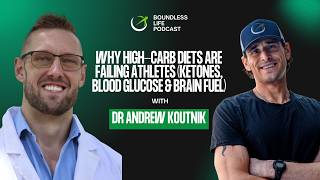
Dr. Andrew Kutnik, a type-1 diabetes researcher, discusses a 100-year meta-analysis of 600+ studies showing sustained blood glucose matters more for athletic performance than total carb loading. You need as little as 10 grams of glucose per hour during exercise. The conversation covers exogenous ketones as an alternative fuel and their effects on cognition and sleep.
Chapters
When the body consumes carbohydrates, Ben, and you actually release insulin in response to the elevation in blood glucose. The first place that insulin goes, Ben, is not to the muscle.
In today's show, I chop it up good with Dr. Andrew Kudnick. This is the second interview I've done with him. Wealth of knowledge on metabolism and nutrition and we talk everything from you need fewer carbohydrates than you think you might need both on an average a and during exercise, and the benefits of ketones, how to pick which ones to use and what they do for you as an alternate fuel. Here we go with Dr. Andrew Kutnik. Round two with Andrew Kutnik. The first podcast that we did was very, very well received, if I don't say so myself. Dr. Andrew, we talked about your history with type 1 diabetes and your research on ketones and glucose and I'll link to it. So if you're listening, go to BenGreenfieldLife.com DrAndrew2 Like Dr. Andrew, the number two. What happened, Andrew, you probably remember this is I asked you maybe like a third of the questions that I actually wanted to because we just deep dive. So I'm like, well, you have to have a part two and, and you have a black eye. I hope the other guy looks worse than you. What happens?
So, yeah, as we were talking about a little earlier, I competed in jiu Jitsu tournament. It's really the place where you find out what your real gaps in your, your martial arts game is. Either way. I took a head to the face and it was pretty swollen actually. The whole eye was completely purple and black for a little bit. But it's part of the deal, man. It's a learning experience and that's, that's why we do it. So.
Yeah, yeah. How long have you been doing jiu jitsu?
A little over a year now. I've started and, and kind of immediately got hooked. Super hooked to the point where I was doing five and a half, six days a week for basically a year straight and, and competed four, four times now. And so, and it's went well. I mean 10, 10 and 2. And then this last tournament took second place. And I compete in a ultra heavyweight division. So the, you never know who you're getting. You could get a 300 pounder or you could get someone like my size who's like 225 to 230, you know, right on the dot who could kind of fit between two weight classes. So.
Yeah, yeah. Well, obviously jiu jitsu is partly hard work. And there's a little bit of mental chess that's involved with it, or physical chess, however you would say it. But as a research scientist in nutrition and metabolism, I'm curious if you've applied any of that to jiu jitsu in terms of competition or practice.
Oh, 100, actually. So you're 100. I actually think the way you describe it could not be better described. Jiu jitsu is essentially like chess on a mat. You have a new competitor who has a different skill set. So it's almost like you go to a new chess board and you have the same kind of set of options in chess, but you go to a new chessboard every single time. And it's, it's really a brilliant, brilliant game. It's, it's amazing. It's very, it's also very violent. But you find that if you can find a really, really great gym and a really, really great place to practice, what you'll find is that it's really more so an art. And an art that can be very violent, but if put into the right environment, can be one of the most stimulating experiences that there are. And that's what I immediately started and I almost, I instantly got hooked, actually. You essentially expect to get your ass kicked for a few months straight. And that's definitely what happened to me. I had, you know, I'm 225 pounds. I at the time was squatting around 500 pounds, deadlifting over 500 pounds. And I'd go in there and 160 pounders would rip my neck and, and still sometimes do. It's amazing what this, what this skill set can do for people. And I was, I was just blown away. I thought it was one of those beautiful things I'd experienced. And I thought, okay, yeah, I'm gonna do this and commit myself to it. So I'm in love with it. I'm gonna go as far as I can possibly go with it. But yeah, when you come to nutrition, metabolism, it's actually super important for me because of having type 1 diabetes. So people can listen to the prior episode that we did, which is part one. You know, the intricacies of exercise, nutrition, how it affects blood sugar levels and insulin is actually never more important than in a sport like jiu jitsu, where you have mixed intensity levels for periods of time. And sometimes the intensity level can really almost be like a 5 minute all out effort, or sometimes it can be
meaning like you're, you're kind of surging back and forth between say, like glucose utilization or what we'd call glycolytic activity. And, and then lower intensity.
Yeah, and, and, and it really depends on how you approach it too. So this is also a mental game as well. So if you approach it with extreme exertion, almost like I, I, one of my matches I went into, which is one of the bigger ones in Atlanta. It was, it was called an ibjjf. It's like an international federation. There was a few thousand people there and I just wanted to win so bad. I had, you know, what they call death grips. I was going a hundred percent. And, and at the end of it, it was probably one of the most grueling experiences. Only thing I can compare it to is when I did do a warmup and I did a rogue Echo challenge and I went to 100%. And afterwards I was about to throw up and I had a surgery.
What's a rogue Echo challenge?
So they, they give away a free rogue echo bike. These things are like a thousand bucks. And if you hit a record time on a 50k cow challenge and I had done so I, I, I'm a bigger guy, so obviously the advantages for the bigger hoop.
Wait, wait, wait. Did you, did you say 50k or cow?
50k. Cow.
Okay. All right.
Actually, I probably would have done better if it was 50k, to be honest with you, because, but yeah, you, if you go up against a strongman style competitor who has enough cardio, they're going to blow the Watts out of the park. So they're obviously going to win. But anyway, so you'll give it a shot. And, and the fact that I didn't really give it much of a warm up was a stupid move. And either way, so I basically got super nauseous afterwards and had a blistering headache for half a day. And the other way I could have done better, it wasn't smart. But you learn the same things when you actually compete because you're in an environment where you're doing something completely unnatural. You know, you're, you're, it's not natural to go into an environment and actually think, wow, I'm going to fight someone. You know, all, all human instinct would tell you to leave that environment, as you should in real world if you can. But you go in with the set purpose of actually engaging in the fight and applying techniques and in skill sets in a legit battle and where you can get legitimately hurt. And so it's, I find it just one of the most stimulating experiences. So much more so than honestly any other sport or Physical activity endeavors that I've gone into, but all the, all the principles of, of metabolism, all the principles nutrition, all the principles of applying the techniques to understand how to leverage getting glucose control while administering leveraging insulin. Both its risks you mitigate and its benefits you maxim as someone with type 1 diabetes in these environments. So you apply it all. And actually a lot of unique tools as well. Something we didn't get to talk about last podcast. But I actually do apply. I'm not a big supplement guy, to be totally frank with you. I do apply things like ketone bodies. I will have coffee if you want to even call that a supplement for caffeine. But there are some times where I
will apply things like I think caffeine is now officially a food group.
Ah, yeah, for me it might actually be. Even if it isn't for me personally. Yeah, probably would be. But I actually do apply things like exogenous ketones. And I more so do that because it for me personally gives an opportunity to provide an alternative brain source because you never, here's the thing, you never know the intensity, how, how much it can get ramped up. And so having an alternative brain energy metabolite on board, one it, it, I found that it mitigates the drop in blood glucose levels, which I find actually to a lot of what we discussed before is quite critical to sustaining exercise performance, but also cognitive performance. And there's also data for someone like me who has type 1 diabetes. And there's the risk of low blood sugar levels and low blood sugar levels reliably impair performance not only in people with diabetes like myself, but also every person who's got a prolonged strenuous exercise bout. And so I also apply it there.
That's it. That was the most part, I think, what we talked about last time, how it's less about like eating as many carbohydrates as you're burning and more about just like keeping the blood glucose a little bit elevated, which is interesting because you can only get a little bit of blood glucose or you only need a little bit of glucose to keep blood glucose elevated.
Right, exactly. So actually we just. The, the review we were speaking about literally got published a couple weeks ago, so it's now officially public. It's open access for people to see. And what you're referring to, and we talked about this a bit more on the prior podcast, so I'll just make the cliff notes, is that we reviewed a hundred years of evidence, over 600 pieces of scientific literature, and found that when looking at Exercise performance. The strongest, most reliable predictor of exercise performance was actually the sustainment of blood glucose levels in, in the maintenance of brain energy metabolism, not necessarily how much glycogen you had, meaning carb loaded also so that you stored as much glucose as possible, not necessarily the amount of sugar or carbohydrates you're burning. It was actually the sustained level of circulating brain energy metabolites within the normal range that ensured predominantly that athletes could sustain exercise performance over time. In fact, over 160 sports performance trials with carbohydrates had been done. We had reviewed all of them and what it was showing was that 88% of the trials that showed carbohydrates induced a performance benefit band. It was 88% of those studies illustrated that the, the, it wasn't so much that was happening in the carbohydrate group, meaning those who were administering glucose in the carbohydrate treatment group. It was actually what was happening in the controller placebo group that found that the vast majority of studies saw a drop in blood glucose levels, which is why those with the carbohydrate group were seeing improvements in performance.
So, so just, just real quick to contextualize this for people, what you're saying is it's not necessarily about you eating 400, let's say, calories per hour of carbohydrates, which might be one recommendation that you'd run into in the literature, and it's instead about eating just enough carbohydrates to keep blood glucose elevated.
Correct. That is, that is, that addresses the most important biomarker of performance, which is the maintenance of blood glucose levels. In fact, most of the research that had focused on muscle glycogen levels and, or the amount of sugar your body metabolizes, which is called carbohydrate oxidation. All those studies, originally done in the 1960s and 1970s, all showed that, you know, more glycogen or more sugar burning or carb burning was associated with greater performance. But it was always associated, Ben. It was never actually proving a causal link.
In fact, interesting.
Every single one of those studies, Ben, that actually pivoted the entire field towards focusing on the amount of glycogen you could store in the muscle and the amount of sugar you could burn. Every one of those pivotal studies, I'm just also saw that the group without carbohydrates saw a drop in blood glucose levels. So, but the researchers didn't focus on the drop in blood glucose levels, which we've known since the 1920s directly impair cognitive and physical performance. We've known this for a hundred years, but instead, the researchers focus on the amount of stored glucose in the muscle and the amount of sugar and carbohydrates that the athletes were burning, even though we'd known for over a half a century at that point that drops in blood glucose levels impair brain energy metabolism, impair not only physical performance, but cognitive performance. And what our analysis really showed when looking at a hundred years of evidence and actually analyzing over 160 different sports nutrition studies is that the most reliable predictor was again, the sustainment of brain energy metabolism and not necessarily loading up what can be. For men, which is 500 plus grams of glucose can be stored in the muscle as glycogen, and women, 300 plus grams of glyco or glucose can be
stored as glycogen grams, not calories. So for men, 500 grams, like 2,000 calories worth.
Correct. And if you're an athlete and you train at at high volumes, you might even be able to score more than that because all the focus over time had been around reloading muscle glycogen as much as possible. Ben, people were recommended, and still are recommended by sports nutrition guidelines to consume anywhere between 5 to 12 grams per kilogram of body weight. So to put that in context, an average body weight woman, okay, would need to consume somewhere between 350 to over 900 grams of carbohydrates per day. A male, average body weight male would need to consume somewhere between 450 to over a thousand grams of carbohydrates a day to just satisfy the sports nutrition guideline recommendations.
Yeah. So you're saying like, if my neighbor Mary was going to train for a marathon and she looked up the average advice, she would be staring at 3,500 calories of pasta a day as the recommended dose of carbohydrates if she was
busy doing at the higher end of the amount of exercise volume, which she might need to if she's trying to do a prolonged, strenuous form of exercise.
Yeah. So let me ask you this. So let's say I'm going to run a marathon and I want to maintain enough blood glucose for this brain metabolism that you talked about, meaning that if glucose drops too low, I'm going to have sacrifice performance. How much carbohydrate would I need to, let's say, eat during a marathon, like in terms of, like, intake per hour?
So what we found is that athletes going over two hours in duration of strenuous Prolonged forms of exercise if you give just 10 grams per hour. So actually what we did in our study is we split three point.
Wait, that, that's like, that's like half an energy gel.
I honestly, it's, it's like a, a tablespoon of sugar or a third of a banana or I think extremely small volume over the entire, each hour. So it's not like you're doing these all at once. You, you know, you do like 3.3 grams, which is less than a teaspoon or, you know, per of sugar every 20 minutes. And so you can imagine that this is a much lower volume of carbohydrates required to just sustain brain energy metabolism. And that has pretty critical implications for the sports nutrition industry here, Ben, because if the entire mindset behind the guidelines from the American College of Sports Medicine, the Academy of Dietetics, from within America and also Canada, the National Society of Sports Nutrition, the Gatorade Sports Science Institute, although no surprise there, they're all recommending very high volumes of carbohydrates because this has been the kind of focus since the 1960s when we discovered that glucose was stored in the muscle as glycogen has pivoted towards these higher carbohydrate loads. Because the, the thing then is we need to load up the large pool of muscle, the mar. The large pool of glucose, and the largest pool of it is in the muscle as much as we can. The idea behind carb loading, eating your pasta the night before exercise. But the kicker is that, well, we've done a number of random or rigorous randomized control trials where we dramatically lowered the amount of carbohydrates, which we know reliably reduces muscle glycogen levels, reduces the amount of carbohydrates and sugar the body burns. And yet we were seeing identical levels of performance when the diet was sustained for long enough. So at least four weeks in duration. And the implications of that are quite important. They're showing that athletes actually have a choice in their nutrition instead of believing that there's only one path to success, which is, if you read sports nutrition guidelines, would illustrate that carbs are essentially essential to performance, when in reality, when we look at the most rigorous randomized control trials, actually answering this question, controlling all the confounding variables like calories, body weight, physical activity throughout the entire intervention, and they sustain the diet for long enough to adapt to it, which is at least four weeks, we find that there is no meaningful difference in performance in things like 600 by 800 meter sprints, max effort, one mile time trials or a two to four hour prolonged, 70% of their maximal aerobic capacity, sustained effort, we don't see a difference. And that has important implications for many individuals when they're considering how they fuel their body. Because we also saw, Ben, which we talked a bit before, is that in some of these athletes, we saw that in one of our studies that up to 30% of runners who are lean, high VO2 maxes and were exercising at very high volumes, especially compared to the general population, that these athletes, 30% of them, were developing glucose levels on the high carb diets consistent with pre diabetes. And after this study, which, which might
not be an issue while you're in the throes of training, but maybe once you hang up the hat and you keep eating that way, or are dealing with maybe the pancreatic stress from having eaten that way for a long time, there might be chronic health implications to following the standard recommendations for carb intake.
Well, I would actually contend that any athlete who's living in pre diabetic glucose levels should probably reevaluate what they're doing. Because the reality is that yes, the question is, are they actually achieving peak performance by living at glucose levels that we know can be potentially problematic?
Okay.
And so that's the question, because what we also saw here Ben, is that the people or these athletes with the highest average blood glucose levels, the ones who were in the pre diabetic glucose range when they were fasted over multiple days, so up to 30 days in duration, their average blood glucose levels throughout the entire fasted window, seven hour fasted window, which was obviously their overnight fast, was in the pre diabetic glucose range the entire time. But those individuals who reduced their carbohydrate intake to less than 50 grams of total net carbohydrates per day, not only did they not have seen an impairment in performance, not only did their body weight, their age and their physical activity fitness level not predict their performance from this, it was actually that these athletes, the ones who had the highest blood glucose levels, actually were the, the hyper responders to carbohydrate restriction. Meaning the individuals with the highest starting blood glucose levels saw the most profound drops in blood glucose in re response to therapeutic carbohydrate reduction.
By the way you met, you said 50 grams just so people can keep up. That's 200 calories of carbs a day.
And those 50 grams of net carbohydrates or less are coming from things like fibrous vegetables, like spinach cauliflower, things like that. You're not just having, you know, an apple or one and a half apples to make up to 50 grams. You're actually consuming that from fibrous vegetables to keep glucose and insulin load low. But what we also saw is that the athletes who had the greatest drop in blood glucose levels been again, the hyper responders to the carbohydrate restriction were also the athletes that had the highest levels of fat oxidation reported in the scientific literature, which illustrates that some individuals are actually not only potentially predisposed for some reason, we don't know yet, to pre diabetes. Levels of glucose at high carbohydrate diets are also the ones that are going to be the greatest responders, at least metabolically speaking, to a carbohydrate restriction, while also earning highest levels of fat ever reported in the scientific literature at over 1.8 grams of fat per minute.
Yeah, interesting. And yeah, that's, that's, it's got a great implications for people who might struggle with blood glucose levels who are exercising as far as a really proven way to stabilize that. But what about during, let's say you were coaching me for a marathon or an, or an ironman, like anything longer than, let's say three hours. Andrew and I had followed this diet, let's say for like 12 plus weeks of eating fewer than 50 grams of carbs a day. So I'm somewhat fat adapted. What would you be recommending that I eat during the race? Like, like, you know, during an average hour. What, what would I take in?
Yeah, so that's a, that's a great question. Typically you'd be consuming similar types of carbohydrates as high carbohydrate athletes, but you'd be doing it at much lower dosages. Um, and this actually applies for both high carbohydrate athletes and it's in carbohydrate athletes. We've seen that even athletes on high carbohydrate and low carbohydrate diets can see up to a 22% improvement by just including up to 10 grams of glucose per hour. So what's 10 grams of glucose per hour? That might be one of these smaller honey sticks for out throughout the entire hour. It might be a very small fraction of a gel. It might be something like, you know, if it's one of these Gatorade bottles that are 22 grams, it would be half of that per, per hour.
I might, I might interrupt you a few times as you go through this scenario. Let's say it's a honey stick. Would I need to like dose that little honey stick like every 15 minutes? Would 1 per hour still keep the blood glucose kind of where you want it? Like, like do. I didn't need to break it into smaller doses.
Strategically, it would make sense to try to do this at, at some more frequent interval, something around 20, 20 minute increments. That seems to be because it seems
like if someone were to invent like, kind of just like a slow release lozenge that you could dissolve in your mouth or something, that'd be the best
way to do it if, if that was achievable. There are also some marketed slower carbohydrate releasing products on the market. Although in my personal experience, having tested these, because I can with the glucose and insulin monitoring that I do on my own body with type 1 diabetes, they still go in pretty fast and they sit in the stomach a little bit more even, despite elevating things pretty quickly. So what I would typically say to someone is, look, I would strategically actually consider, number one, not everyone seemed to need 10 grams per hour, Ben. The majority of people did because the majority of people got hypoglycemia. But there was a small fraction around 20 to 30% that didn't. So the question is, would they have eventually got it at our 3, 4, 5, so at some longer duration on the exercise, or are they uniquely metabolically immune to hypoglycemia and in which case maybe they don't need it. So this is what I would actually say to you. Let's say I was coaching you, Ben. I would say, okay, Ben, let's start by actually getting into a simulation of something resembling what your race will look like. Probably not the whole duration by any means, but let's resemble that. Now. Let's see how you respond on your standard diet, which is zero grams of carbohydrates. And let's do that a couple times. Just get a litmus for how you're performing. Then let's incorporate it. 10 grams per hour. Okay. It's probably split around 3 or so grams every 20 minutes. Let's see if that makes a difference for you. Okay. If it does make a difference, then it makes sense for us to go a little bit higher. Maybe let's try 30 grams per hour. Okay. Let's see if that makes an incremental improvement in your performance. If we're controlling all these other confounding variables, if that improves it, let's try 60. Okay. It's very unlikely that you're going to see much more improvement beyond that point. In fact, they've done a number of dose response studies here, Ben, and actually have found that typically, at some level of carbohydrates do improve performance if the exercise bout is sufficiently strenuous for sufficiently long. In an aerobic exercise, that's typically two hours or more in duration, which might
kind of make sense because then you're reaching the level of pretty significant glycogen depletion.
Well, and actually, here's a kicker here, Ben, not muscle glycogen depletion, we're focused more so on liver glycogen depletion.
Yeah.
And the reason for that, Ben, is because liver glycogen is what replenishes blood glucose levels to ensure the brain is getting sufficient energy. So if you're bolusing or giving small increments of glucose from an exogenous source, like a gel, sugar drink, honey stick, or whatever it might be, that's helping maintain blood glucose levels so that the liver glycogen isn't having to completely restore blood glucose levels on its own.
So are you telling me that that muscle glycogen doesn't really play a role in maintaining blood glucose levels specific to the brain during exercise?
This is a really interesting question. Not directly, Ben. So keep in mind that when the muscle takes in and stores blood glucose levels, unlike the liver, which is the other major compartment that stores blood glucose levels, the muscle stores it and keeps it. It has no way of releasing the glucose out of the muscle. So it. It's trapped in the muscle. Okay, so you can't actually break down glucose in the muscle and release it to restore blood glucose levels. And this is important evolutionary context. When the body consumes carbohydrates bin, and you actually release insulin in response to the elevation in blood glucose, the first place that insulin goes, Ben, is not to the muscle. It goes straight into here, the liver hepatic vein, meaning the hepatic portal vein. It goes straight to the liver. Why does it go there first, Ben? Why doesn't it go to the muscle? It goes to the liver because it needs to restore glucose in that compartment to ensure that the most important organ in the body, which I would contain is the brain, is always maintaining sufficient amounts of glucose. You know, we have around an average of around 5 grams of glucose circulating around the blood. So let's take a little over a teaspoon of sugar. Just a little over a teaspoon of sugar. Is all this floating around in the blood? But subtle Changes outside of that 5 grams below that can actually lead to profound neurological and endocrine counter regulatory responses inducing fight or flight adrenaline, causing glucagon to elevate, actually changing the perception of fatigue and then ultimately shutting down the body to prevent it from exerting itself anymore. Why? Because it's trying to protect the brain from other tissues stealing critical blood glucose to maintain brain energy metabolism.
Such a fine tuned machine is. Is there? I guess, and pardon me if this is a stupid anatomical question, a more direct line to the brain from liver glycogen compared to muscle glycogen.
Well that's a, that's a really interesting point as well. So no, when your body is releasing glucose from the liver go straight to the bloodstream, the bloodstream obviously reaches all tissues but the brain. What's interesting about the brain is that obviously it needs to maintain a steady amount of energy 24,7 meaning its energy demands remain pretty static throughout the day. The only time where it seems to dip, or sorry, not dip, but actually potentially increase is only subtly during exercise and not always. So it means that throughout the day the brain is pretty consistent in its glucose demand. Unless there is the exception. As you know Ben, and many in your audience are probably familiar, you're on something like a ketogenic diet and the elevated production of ketone bodies start making up a. A substantial amount of energy that can also supplement the brain.
Yeah, yeah. Or not. Not the rabbit hole. Too much or lactate. Right. Lactate can also serve as a fuel.
Exactly.
Crossing the blood brain barrier and after something like intense exercise.
Exactly Ben. And to prove this point we actually conducted a study where we did a comparison an Ironman completers. Okay. We had them go for at least two to four hours in duration. And what we did is we asked them, okay, we want you to either do a very high carbohydrate diet on a keto. Ketogenic diet. The reason we were doing that was not necessarily primarily to compare performance in Ironman Completers on ketogenic versus high carb. Although you can obviously look at the results of that and see that there was no difference. At least if they adapted to the diet for at least four weeks. The goal of that actual experiment was physiologic. We were trying to induce an environment that reliably reduces the amount of sugar you burn and increases fat oxidation and also reliably reduces muscle glycogen levels. At least in any study with ketogenic diet less than three weeks or sorry three months in duration. So what we were really trying to compare here is if you have two distinct environments induced by diet that reduce glycogen versus high glycogen and have low carboxidation versus high carboxidation, do we actually see, when we control all these other variables, a difference in performance? And we didn't Ben. And we're not the only ones to have observed this, which obviously illustrates and opens the question is muscle glycogen and carboxidation actually the most important derivatives of this performance and they're not the most reliable predictors. But the more important part about this study, which gets to your point is we also did something else. We asked athletes to just trickle in enough glucose levels to not change the amount of muscle glycogen, not change the amount of sugar the body was burning, but just maintain flood glucose levels in the normal range, which again as we spoke about was 10 grams per hour or around 3.3 grams every 20 minutes. And the reason we wanted to do that is to see if we just maintain brain energy metabolism throughout exercise, do we see any meaningful differences in both high carb and low carbohydrate diets? And what we found, as we spoke about before, is a 22% improvement in performance and a complete resolution of hypoglycemia. The vast majority of athletes on both diets been actually got to hypoglycemia. All athletes saw a drop in blood glucose. However, here was the kicker which gets exactly to your point around alternative brain energy metabolites in the form of ketones and lactate is that I got curious after our work was published cuz all these people were asking about brain energy metabolism. Our big review, actually looking at over a hundred years of evidence was not yet published. And I thought okay, it'll be very interesting to see if because the very low carbohydrate diet group in actually saw a higher incidence of hypoglycemia. Now that might not be surprising to folks because you think, okay, well yeah, they start with lower glucose levels, but despite having higher hypoglycemia then they achieved the same level of performance. So I thought, okay, hold on. If brain energy metabolism was truly the key driver performance, let's calculate the total amount of circulating calories in the form of glucose ketones and lactate on both diets. And this has not been published yet, but I will speak to it here. Starting the diet in.
Wait, wait, wait, wait. I want to guess, I want to guess. So the, the hypoglycemic low carb athletes potentially had Compared to control group, a higher amount of calories circulating in the bloodstream from lactate and ketones.
They both had the same amount of circulating brain energy metabolites. If you equated four glucose ketones and lactate. Because the ketogenic diet group had lower glucose levels but had higher lactate production and obviously higher ketone production, they were
making up for it from something else. Let, let me ask you this. So let's say I am going to go out, run my marathon or my Ironman. Anything longer than say three hours, I'm taking like this much lower amount of carbohydrate in 10 grams or so. When I used to race Ironman the last few years, I was kind of on the keto bandwagon and I was eating a lot fewer carbohydrates than were recommended. I was, I was not quite as low as 10, but I was around anywhere from 20 to 40 grams per hour. But I was also using exogenous ketones, electrolytes and amino acids, particularly because of my theory that amino acids might actually assist with reduced rating of perceived exertion and help with the central governor, the brain, not down regulating performance. If you were to put together a fuel for athletes, would you keep it at just the equivalent of a honey stick an hour or would you be putting other things in there?
It. That's a, that's a very interesting question. So this is where we're speaking beyond what we know in the evidence and more so hypothetical and real world example.
Yeah, it's kind of hypothetical.
So in your particular case and also examples of individuals like Zach Bitter, at least what they publicly have spoken about is they are usually more at the grams of carbohydrates that you're talking about. Is that necessary? We really don't know because the actual randomized control trials that actually control the variables in a laboratory setting say that they might not be necessary to push higher. Okay. However, in the real world people are, are traditionally going around 30ish grams, give or take of carbohydrates, even though they're on a ketogenic diet. And those are the athletes that are performing at an extremely high level. I have known of a many, I've coached elite athletes myself. I've actually heard from many elite athlete coaches who actually saw this, present our most recent data and like hey, yeah, we had some athletes that did pretty good. They saw kind of like a, a 2% decrease in performance, but they never did this carbohydrate loading or this carbohydrate intake during the exercise itself, we just didn't do anything because we thought, oh, fat can produce all the, the fuel. And now that we know that the brain energy metabolism is such a critical factor in exercise performance, and this is not new information, but it is new information in the context of low carbohydrate diets, where this idea that you don't ever bonk is not actually true. Ketogenic athletes do bonk and carbohydrates do seem to actually improve them. But the dose is what matters here. But in a real world scenario. Ben, exactly what you're asking. I, I will, I will give the example, the template of what athletes should consider and what we were speaking about before you. You slowly escalate the amount of carbohydrates you're administering during the exercise bout over time until you see no meaningful and continued improvements in performance. But we also know that cuscos are not the only brain energy metabolites. We know that exogenous ketone bodies can rapidly either immediately induce elevations in ketosis or allow for liver conversion to increase ketone production and as a result also supplement brain energy metabolism. And based on our evidence from our randomized control trial and the evidence from over a hundred years of evidence in our review from Endocrine Reviews, which is now publicly available for anyone to read, if the focus is brain energy metabolism, which we show is such a primary impact on performance, then it won't just be glucose that matters, it would also be ketone bodies as well. And as a result, it makes sense that when we actually compared the total amount of circulating brain energy metabolites, despite lower glucose ketones and lactates were also able to supplement brain energy metabolism and maintain performance despite lower glucose levels. So it's completely logical that APIs could administer exogenous ketone bodies, although there's a pick of the litter, so to speak, because there is a ton that are out there that all serve kind of unique purposes in different contexts and modalities.
You, you mean, you mean when, when you said that, are you referring to like different kinds of ketone bodies, like beta hydroxybutyrate versus 1,3 butane dial or something like that?
Exactly. So there. And to. For the audience to give a little bit more breath on this. So I've studied exogenous ketone bodies and developed novel formulations for well over a decade. It and what we see is there's kind of a few categories of exogenous ketones.
And by the way, before you describe these, you know, a while ago, towards the beginning of the podcast, when I asked about Jiu Jitsu, you said well I don't take a lot of supplements, but I do take ketones. So we're talking about the same thing now.
Correct? We're talking about these exogenous ketone bodies that provide a fuel for the brain and also tissues as well. Other tissues as well. Uh, so why would someone even consider this one? We're largely talking about its ability to provide brain energy metabolism. But we've also done a lot of research, our group, group, others included, looking at some of the other effects it may have beyond just brain energy. We've studied this. So we studied a, a molecule called 1,3 butane dial which has actually been studied since the 1960s for aerospace use. It was once believed.
Yeah, that's the one that's in ketone iq.
Correct. So exactly. So ketone IQ is a great example here where it is, it's one through butane. It's actually the longest studied true form of exogenous ketone bodies. Cuz some people think about medium train triglycerides and some people don't categorize medium train triglycerides as exogenous ketone bodies just because of the natural fat. However, MCTs which are in breast milk and coconut and butter when isolated out rapidly convert to ketone bodies in the liver. Now 1, 3 Butane Diol has been studied in rodent animal models since the 1960s as a potential fuel for long duration space flight. The reason was we knew that 1,3 butane dial was incredibly shelf stable but also when consumed could also provide a very energy dense form of nutrient. So that has been studied for quite a long period of time and actually emergent evidence has started to show that 1, 3 butane dial or other components that have a backbone attached to to beta hydroxybutyrate, which is something called the mono ester, is something that has been studied for about two decades now. It was actually originally funded by one of the most high risk, high reward defense U.S. department of Defense funding agencies called DARPA. They funded something called metabolic Dominance program which actually looked at the novel formulation from Oxford as well as the NIH to develop a, a ketone body that when consumed would rapidly elevate ketone bodies both through directly elevating ketone bodies, but also converting 1,3 butane dial which we know goes to the liver and converts over to, to ketone bodies. So it was this double a dual way of increasing ketone bodies. And what they had found in lat study is that in, in high level cyclists that these exogenous ketone bodies had profound shifts in overall metabolism. I mean, profound shifts in, in various pathways of amino acid, fatty acid and glucose based metabolism, but actually produced a performance improvement. And multiple subsequent studies by that same group also went on to show that it could help maybe resynthesize glycogen stores at greater levels, although that hasn't been as consistent. But what a lot of research has shown in the training performance realm is that chronic administration of these molecules seems to improve ben things like attenuating overtraining. So they've administered these molecules post training for up to three weeks and saw.
Yeah, the recovery implications are something that I think people are just now starting to learn about. I want to interrupt you real quick though, because with 1, 3 butanediol there's been chatter recently on the Internet for us, those in the geeky metabolic health space, that it may raise liver enzymes, which is concerning to people, especially when they see the OL at the end. They draw the equivalence to alcohol and get concerned about potential liver damage. I think I even heard Dominique d' Agostino talking about this. Now, I'll share my take briefly. It's twofold. One, I do know that in everything I've seen cited on 13 butane dial Elevating liver enzymes, it's been with very high doses and then secondarily, it's my understanding that those liver enzymes like ALT and AST can get elevated through the breakdown of acetaldehyde, the so called toxic byproduct of alcohol, but can also be utilized for the breakdown of 1, 3 Butane Diol and the like. They serve as a marker for potential toxicity when being used for the breakdown of acetaldehyde, but don't necessarily serve as the same marker for toxicity when they're being used to break down something other than acetaldehyde. So I know that's kind of a mouthful, but what's your take on the whole 13 butane dial Liver toxicity piece?
Sure. So I've actually studied this. So we have. When you actually look at chronic administration of these molecules, which is the best way to actually determine concern around something like this or overall safety. Right. You would take these molecules and administer them over a chronic period of time and actually look to see if there's any change in things like liver enzymes or other biomarkers of of health and safety. Well, one of the original research studies that did this was Adrian Satomoto, who was working with Kieran Clark at the time, and they administered 75 grams of a compound that had 13 butane diol in it and also 75 grams.
Just to contextualize how many grams would be in like a shot of ketone IQ TIM.
So, and they, they provide 75 grams of this composite molecule with both 13 butanediol and beta hydroxybutyrate. And they sell negative, no negative consequences to 75 grams over 28 days in, in human beings of various ages and male and female. They, but they did see, which was interesting, a drop in HbA1c. So it's a marker of glycation or the, the propensity for glucose to bind to various tissues, which we know is linked to various health consequences. If it's elevated, however, it's all, it actually dropped despite no changes, at least in this report of any other change in diet or lifestyle. So that's the first point, data point to consider. The second data points consider something that we are about to publish here soon, which was we actually took a molecule that had both 1 through B10 diol and made a hydroxybutyrate and we administered the highest dose ever administered in humans, which was around 100 grams per day for 30 days straight. And what we found is one, there was no adverse side effects from administering these doses is humans.
That's like 10 bottles of ketone IQ.
Well, so it's 10 bottles of ketone IQ plus also 50 grams of beta hydroxybutyrate on top of that. And so what we were talking about here is a pretty hefty dose. And what we saw again was no adverse side effects. What we did see here though is an improvement in cognition in already healthy young individuals. And we also saw that even after you stopped administering the exogenous ketone bodies for 30 days. So they're done, you stopped administering them. They're not in the body anymore. We saw an improvement in the, the, the oxygen uptake in these athletes during a graded exercise test, meaning there seemed to be some improvements in how the body was handling oxygen. And we have actually shown this in a project that was actually studied or funded by Special Operations Command where we looked at the administration of what was hvmn. You know, that company is now known as Deuteronomy Q. They administered a 1,3 butanediol based product that also had 1,3 butanediol plus beta hydroxybutyrate into military environments. We actually induced laboratory levels of hypoxia up to 20,000 foot altitude. So think not quite Everest, but around Kilimanjaro, slightly above, around Kilimanjaro So instantly go to it. And we know that reduction in oxygen in this hypoxia environment rapidly deteriorates cognitive function. And we observed a reduction in cognitive function. But when we administer Eggman exogenous ketone body, not only did we see an improvement in cognition, so we it showed that it provided resilience against high altitude and hypoxic environments. What we also observed is that there was an increase in the amount of oxygen uptake in the individuals who could consume ketone bodies. They had higher circulating levels of oxygen in these hypoxic environments. And when we dug down this rabbit hole even further, and this was alongside a number of other prominent researchers and a lot of credit to Tyler McClure, who was a graduate student now who works in Ohio State University, what we were seeing is that the level of oxygen circulating in the blood was higher. And when we started digging into the plausible mechanisms by how this was happening, it appeared that because 1, 3 butane dial causes a slight shift in ph, a slight shift in PH is what is the mechanism by how diamonds, the, the mountain sickness drug that's given to virtually everyone actually works. It changes PH levels just subtly to actually cause a slight level of acid change. That slight level of acid change is known to increase the lung's ability to uptake oxygen with each breath. And so what we were seeing is that ketone bodies modeled how mountain sickness drugs appeared to work.
Hey, so that you're, you're talking about 13 butane diet with beta hydroxybutyrate. Is that like a product people can buy right now or do you just need to finagle together your own mix of, you know, mixing ketone IQ with some other product that has the beta hydroxybutyrate in it?
Sure. So that product is on the market by, by a number of. So you can actually go buy all forms of these products. You can go buy one through Butane dial with Q10IQ. You can go buy ketone salts. Actually, there's a ton of companies that sell pure ketone salts, either in pure D or R or L. So you're
just basically mixing together your own kind of concoction?
Well, you can, or you can just buy the, the composite molecule, which is not cheap. Typically those run pretty expensive. So I think around.
Are you talking about like going to Sigma Aldrich website or something like that?
And no, there's other companies that have sold this. So the original product used to be sold by hvmn. They no longer sell it. There's other companies that, that actually take this product and are currently selling it. I think they're manufactured overseas, that I could be wrong about that. But I don't want to speak out of China.
I mean, one thing you could do is not to toot my own horn. The boundless bar has 5050L and D beta hydroxybutyrate in it. You could just eat one of those and wash it down with the ketone iq.
Hey, that was, that was a nice segue there, Ben, by the way. You sent me one right now. And they, they do taste great, so props to you. I know it's not easy to make a good tasting bar, but. Yeah, so there's, there's various forms that are out there for people to use and to kind of give the, the array of them. There's the pure salt forms, which is the R or L bhb. We know that R rapidly elevates quickly into the blood, but usually requires either sodium, calcium, magnesium or potassium to be co administered.
And by the way, when you're saying R, that's synonymous with D, right? You have R or D, B, H, B. And then you have lbhb.
That's correct. And then there's the other form which is the S or L B, H, B. Which was used to be believed to not occur naturally in physiologic environments, but now actually we know it does. In fact, we're running studies now where we're seeing that some individuals actually produce high natural levels of L bhb. And so it actually is endogenously and naturally produced. And that's something that requires a lot more investigation. But historically speaking, when you administer them through an exogenous ketone product, the LBHB form lingers for much longer and also appears to metabolize much slower, which may be important in some contexts. Right. We know that D and L BHB both increase cardiac output in the heart. So if you wanted a more sustained elevation over time, maybe you would preference something. Something like an LBHB versus a dbhb. Or if you want a specific signal in the body that both L and DBHB elicit, but you want it to be elicited for longer, maybe you would go for a D versus, sorry, an L versus a DBHB. If you want to do something like a 1, 3B 10 DIO that doesn't carry any mineral load whatsoever. So if mineral load's a problem, like for some people who are salt sensitive and have hypertension, or salt sensitive hypertension, maybe they want to avoid a salt based ketone product and Maybe they want to instead preference something that doesn't have any mineral load, which is one of these molecules that converts through the liver production of into beta hydroxybutyrate like 1,3 butane dial does. Maybe you want to have really like huge. You want to acetoacetate because we know that acetoacetate is a molecule that doesn't go up into super high levels with most exogenous ketones. But there's a acetoacetate diester that actually reliably elevates acetoacetate to pretty high levels, has been shown to inhibit oxygen toxicity, seizures and hyperbaric oxygen via acids. We also know that acetoacetate, unlike beta hydroxybutyrate, actually induces breakdown or a lipolytic effect in the adipose tissue. In fact, there's a number of studies out of Eric Playance group at University of Alabama, Birmingham. We did some collaboration with him actually showing that this particular molecule and I believe it's because of the acetoacetate and not the per se. Beta doxybutyrate appeared to reduce body fat disproportionate to the calories consumed, meaning the calories alone could not explain the weight loss. And we have also seen this, that acetoacetate based products seem to potentially elicit even greater levels of fat breakdown. And the only paper that has ever looked at this is in PNAS that was published I think in early 2020s that actually showed that acetoacetate, unlike beta hydroxybutyrate appears to facilitate mechanisms of fat breakdown. Whereas beta hydroxybutyrate acutely actually to a specific G protein coupled receptor, a short term blocks fat breakdown for, for short windows of time. Now for the the grand scheme of things, that has really no meaningful impact on fat loss or gain. But it seems like acetoacetate based products at very high levels do actually induce a level of fat breakdown that's meaningful in these early models.
Two quick questions. How does acetoacetate tastes, you know, compared to kind of like the bitterness of beta hydroxybutyrate, for example. And is there a company out there right now that sells acetoacetate as a ketone?
I don't think anyone is doing that right now as far as selling it. And as far as actually ensuring these products actually are taste and flavorful. It's not an easy job, right?
Most people who've tried these products, it took us a while. Even with the balance bar, I mean there's only a gram in there, it took a while. So a little insider thing Though I'm actually helping a company in Austin right now. They're like a. Well, it's the, well, the restaurant down there. It's like this seed oil free restaurant. I'm helping them design a smoothie bowl that has about 10 grams of L and D BHB in it with the working title right now called the Boundless Bowl. So that should, it might be out by the time this.
That's fascinating. Good play on words here Ben. Good play on words.
Yeah, exactly. Yep, yep. Now I have another question about the ketones. You ever looked into the effects on sleep architecture? Like, like my theory is that they would kind of help because of stabilizing blood sugar levels and offering an alternate metabolite for the brain. But you know, some people say maybe not because they're stimulatory for some folks. Have you looked into that at all?
Quite extensively. We actually wrote a major NIH grant that would have been awarded if they didn't kind of shut down the funding mechanisms for an advanced clinical trial looking at these in sleep. So I'm very, very familiar with this topic. So we in fact I've done some studies actually looking at sleep architecture. Even in NASA astronauts living under underwater and understanding the physiology of sleep, sleep duration, sleep architecture meaning more so a measure of sleep quality. Ketone bodies have some emergent evidence that shows that they may able to improve sleep quality. So the architecture of sleep for a set given period of time. Now it's not entirely clear why that would happen. Maybe it's due to GABA or glutamate ratios. Maybe it's due to the normalization of brain energy metabolism. Maybe it's due to one of the anti inflammatory antioxidant mechanisms. We don't really know. But you bring up a great point as well that one of the criticism or concern of providing it during sleep is that we know that at very high levels of ketone bodies it can cause vasodilation, stimulate the adenosine receptor, which is why it appears it's helping with cognition at and various different exercise in non exercise based environments which we have also shown. So in a number of studies, actually we've had maybe four or five different studies in females, males, military environments versus regular environments where ketone bodies have improved cognitive function. So if you were to cause any type of stimulatory effect on the brain right before sleep, that would logically impair sleep quality or potentially even quantity. However, we actually were very interested in this because we had done some clinical trials in individuals with obesity, pre diabetes and Fatty liver disease, which is now called metabolically associated steatonic liver disease. Either way, the whole point is that these individuals reliably had a higher high propensity of sleep apnea, the excess adipose tissue. What happens is when the body is sleeping and there's excess adipose tissue, the body is still trying to breathe, but because of the blockage due to excess, excess excess weight on the, the actual, the parts of the body that allow for oxygen to get into the lungs actually inhibits the ability to actually breathe in. And as a result, the body is actually attempting to breathe. We actually see the muscles trying to expand, but the oxygen's not getting in, which causes a drop in, in oxygen levels. And what we see is that when oxygen levels get, you know, below the 90 percentile level, which again, shouldn't happen during sleep at all unless you have sleep apnea, the body immediately goes into awake mode and says, oh no, this is not good. Wake up and start breathing more. Which is why people who have sleep apnea chronically are sleep deprived, because they're waking up all the time when their body is basically going into a partial hypoxic state all throughout various intervals in the night.
I've even, I've even seen some, some whoop data because whoop will try and guess what you're doing and it will show that someone like meditated 10 times between like 10pm and 6am and didn't sleep at all.
Yeah, and that would make total sense because we actually, what we were doing is we hooked up EEGs, ECGs, we put up pressure monitors on the lung muscles, the abdominal muscles. We did. It's basically the equivalent of looking like a giant lab experiment. And we did that throughout an entire sleep architecture, the most advanced levels of polys, methography. So looking at sleep quality and architecture, and we reliably see, you can look at these readings, the most fascinating thing of all time. You'll see that all the patterns of breathing are still present, all the mechanical patterns of breathing are present, but the oxygen level begins to dip. And what we're seeing is obviously there's a blockage in the, the ability to actually consume oxygen when attempting to still breathe. And of course, this is when the brain activity restimulates and you see that they break their actual sleep cycle every time they're doing it. And so the reason we were interested in looking at this from exogenous ketones is actually something we spoke about, about before Ben, is that we know that in some, some of our special operations command work actually in concert with ketone IQ and, and that group who was working with the Special Operations Command project, we saw that ketone bodies can actually increase oxygen uptake. So that would seem logical that if someone could increase the amount of oxygen consumed for each breath they're consuming, maybe it would offset this hypoxic induced wakefulness that's induced by the brain protecting itself from potential hypoxia during sleep apnea. But we have also done studies Ben, where when you have low oxygen, what happens? CO2 accumulates. And we've also done studies in CO2 retention study where we asked people to breath hold for extended periods of time and provided an exogenous ketone bodies. And we actually saw that it also reduced carbon dioxide production. So for, for two different reasons it made sense to evaluate this during sleep, both for the potential that it could increase oxygen uptake but also to reduce carbon dioxide production. And so that that work is, is under underway. So we don't have the answers to this question yet, but there are some study in healthy individuals that can improve sleep quality.
Yeah, interesting. Well, if you're listening and you experiment with ketones pre sleep and you're someone who struggles with sleep apnea, I'd be curious to hear your take on this. You can leave your questions, your comments and your feedback about this or anything else that Andrew and I talked about if you go to BenGreenfieldLife.com DrAndrew2 Like Dr. Andrew, the number two. Once again, Andrew, I maybe asked you like one third of the questions that I wanted to but as usual this is fascinating and that means that there will have to be a part three now at some point. But it just, it's so much fun geeking out with you and you like you study the kind of stuff that if I were a researcher I would probably really want to study. So I just, I love chatting about this stuff. So thanks for doing it.
It's honorable and I have to tell you this is selfishly is why I got into research in the first place is I actually wanted to understand how do I maximize my health, maximize my performance. It just so happened that trying to do that for my own personal inclinations happened to have implications in other areas which is it's been a kind of a cool surreal experience. But yeah, that's it was all kind of selfish to begin with.
Yeah. And all you have to show for now is a black eye. That's hilarious. All right folks. BenGreenfieldLife.com DrAndrew2 Check it out. Leave your questions, comments, feedback, leave the show a ranking wherever you're listening in. Thanks so much for tuning in. Hit subscribe, leave a ranking, leave a review. If you got a little extra time, it means way more than you might think. Thank you so much.
More from Ben




The Solution to Aging Might Be Closer Than Anyone Realizes - With Ben Goertzel



