INBOUND19: A New Species of Disruptor | Brian Halligan Spotlight
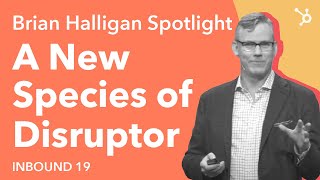
In this keynote, HubSpot CEO Brian Halligan argues that the classic notion of "disruption"—focused on deep‑technology innovators like Google or Tesla—is being eclipsed by a new class of companies he calls "experience disruptors." Drawing on a deep dive into eight high‑growth firms (Carvana, Atlassian, Netflix, Glossier, Warby Parker, Chewy, Stitch Fix, Spotify, among others), Halligan identifies five genetic adaptations that enable these firms to outpace incumbents: (1) prioritizing "experience market fit" over pure product‑market fit; (2) engineering friction‑free flywheels that spin faster; (3) leveraging massive data to deliver hyper‑personalized experiences; (4) selling through customers rather than just to them; and (5) rewriting business‑model fundamentals—pricing, packaging, and terms—to break oligopolistic equilibria. He illustrates each adaptation with vivid anecdotes (e.g., Carvana’s car‑vending‑machine, Atlassian’s no‑discount, no‑negotiation sales model, Netflix’s fingerprint‑level personalization, Glossier’s user‑generated content, Chewy’s generous return policy). Halligan concludes with a concise playbook urging the audience to replace routine thinking with these five tactics, positioning the approach as accessible to any organization without reliance on AI or blockchain.
Chapters
Thanks, everybody. It's a real honor to be able to present to you today, and I'm super excited about my topic. I'm going to tell you about a new species of disruptor in the economy. But before I get to that, I want to tell you about my nightly routine. You see, every night, Romeo and I, we come home from work and we take a lift and we cruise up to our apartment. And the first thing we do is we put on our favorite band. Sorry. First thing we do is we put on our favorite band on Spotify. And of course, that band. You all know it, you all love it. Cranking the music, we boogie over to the do dog area. And Romeo's chicken toys are everywhere. We gotta clean out those chicken toys and make room because he got a new package in the mail from chewy.com. he loves those chicken lollipops. He just loves the chicken lollipop. We finish up our snack. The two of us head down to SoulCycle and we get a good workout in. Then we come home, shower up, we get our new package from Dollar Shave Club. So we both shave up, and then we come downstairs and we order a little chicken a la King from Doordash. Then we're a little tired. We want to put our toes up and watch Romeo's favorite movie on Netflix. Like a lot of you, the two of us are trying to avoid screen time before bed. So we read our favorite comic, we lie down on our Casper mattress, we get a good night's sleep. I think we have a fascinating evening routine. You don't. I think it's fascinating. All these companies. I just ripped through all eight vendors. We swapped out the incumbents for a whole new set of vendors in our lives. And it's not just our evening routine. It's our daily routine. It's all of our daily routines, isn't it? There's been a massive wave of disruption happening. Frankly, when we started HubSpot back in 2006, I thought disruption was at an absolute peak. Couldn't get higher. But disruption is at an absolute peak. Now. All these companies, terrific companies, are all worth more than a billion dollars. Disruption speeding up, not slowing down. Now, did any of you notice anything funny about me in those pictures? Broke my arm. I'm going to tell you how I broke my arm. We caught it on video. It. If you're squeamish, I'd like you to look the other way. In the video, I'm the guy in the orange pants. Boom. Works every time. Okay, B to C, everything seems to Be changing in our consumer lives. Massive waves of disruption going on in the consumer world. What about the business world? What about at HubSpot? What about at all your companies? Is there change afoot? Is there disruption happening? I'll let you guys be the judge. See, a typical day for me, a typical morning. I might be out on the west coast and I cruise into our WeWork office over there. I got a big important meeting that day. So I get in my cubicle and I want to collaborate with Dharmesh to prepare on Slack. And then I run over to the conference room. I don't want to be late. Cause I wanna scarf down a sandwich from Ezcator. And then the meeting's about to start. So I fire up Zoom, make sure everything's perfect on Zoom. And then we have a great conversation with our new partners from aws. Fascinating. I think my morning is fascinating. And again, just a wholesale swap out in vendors we do business with that morning. And it's not just that morning. It's every day for me. It's every day for HubSpot. It's every day for all your companies. Disruption speeding up. It's not slowing down. Really interesting. These companies are fabulous companies. They're all worth over a billion dollars. Okay, did anyone notice anything funny about me in those pictures? That's right. I had an ice pack on my back. Okay. Last time I said, if you're squeamish, look away. I was kidding about it this time. I'm serious. If you're squeamish, I'm looking out at you. Everyone's looking at the screen. If you're squeamish, I'm dead serious. Look away. I'm going to tell you what happened with my back. I told you to look away. I was bit by a brown recluse spider. Hell of a summer I had. Put me in the hospital. Jarndous side effects. I keep talking about this word disruption. That's a word first used in this context back in 1995 by a guy named Clay Christiansen. He's a Harvard Business School professor, and he talked about it in this context in a terrific book called the Innovator's Dilemma. Highly recommend that book to everyone. Since then, though, this word's been heavily overused and heavily understood. And it's on my top five list of words that are most overused and most understood. It's number three on the list, right behind artificial intelligence and blockchain. Now, what's so confusing about this word? Why so under understood? I have a theory My theory is, when most of us think about disruption, we think about companies like these. They're technology disruptors. The browser, the Google, the Intel, the iPhone, maybe the Tesla someday. Big, deep technology companies. You add up all the patents across these five companies, 50,000 patents. These are technology disruptors. What about our friends? Are they technology disruptors? I'm not so sure. I'm not so sure. So I like this list a lot. And about four months ago, I started preparing for this presentation and I went very deep on this list with two of my colleagues at HubSpot. And we talked to almost all the founders. We purchased pretty much all the products. We read all their terms and conditions. We talked to their big investors, we went deep on them in my thesis here is they're not technology disruptors. They're a new species of disruptor that's emerged in the economy. And I call that species an experience disruptor. Okay? Now, when I look at the genetic code of these experience disruptors and I look at the adaptations, there's five of them. There's five things, modern adaptations that they have that have allowed them to really run over the incumbents in their industry. And so today, what I plan to do is unpack those five genetic adaptations. And what I want to do is leave you all with a playbook that you can take back to your company so you all can become experienced disruptors too. How's that sound? Sweet. Let's get started. The first adaptation, if I talk to the incumbents, the incumbents, you see, they focus on product market fit. The experienced disruptors work on experience market fit. Here's how they think about product market fit. They think of it as necessary but insufficient to get the disruption that they're really after. So, necessary but insufficient. Let me give you an example of what I'm talking about. We started this project four months ago, and at the time, I had never heard of this company, Carvana, but a bunch of my colleagues had purchased cars from them and were raving about them. So I did some research, and they are an awesome company. It's a startup. It was founded five years ago, and within five years, it started the largest car dealer in the United States. It went public last year. It's got a market cap of $12 billion. This is a killer experience disruptor. How'd they do it? Now, you might think they did it with inventory. Typically, a car dealer, cars all over the parking lots. These guys do it differently. They build a giant car vending machine. Now, that's necessary but insufficient to get that crazy growth They've had. The reason they get that crazy growth is their focus on the experienced market fit. What they're really focused on is they've set out to create a whole new way to buy a car. So you don't just buy the car from them. They do all the crappy paperwork. They deal with the dmv, they deal with the taxes, registration, all that crapola that none of us want to do. Then you tell them, hey, I bought the car. I want to deliver it at my house on Tuesday. You give them the address. The car shows up at 2 o' clock on Tuesday for you. Pick a time and a place. Awesome. You drive the car around for a week, for whatever reason, you're not happy with the car, return it, no questions asked. Experience, market fit. They've taken the cringeworthy process of buying a car, automated it, institutionalized it, and made it awesome. When I look at these experience disruptors, they all have great products, but they have even better experiences. Here's. Here's how I think about all of them, how they sell. That's why they win. Okay, let's talk about the second one. Let me sit down for this one. So to unpack this one, this adaptation, we had to take some DNA from the experience disruptors, and we studied it under a microscope. DNA under there. And what we expected to see when we looked under the microscope was a double helix shape for their DNA. Focus in on it. Very surprising. Really focused. Had to focus in on it. It wasn't shaped like double helix at all. It had a very different shape. Their DNA was round and spinning. It was a perfect flywheel. Sh. Okay, if you were here last year when we talked about the 5o, could you clap for me? Oh, boy, oh, boy, oh, boy. Thank you for coming back. For those of you who weren't there, we Collectively here at Inbound 18, we retired Ye Olde funnel. The funnel just doesn't understand us like it used to. See the funnel, it gave us credit for our marketing channel, gives us credit for our sales channel, but it gives us no credit for our most important channel, our customer channel. No credit for that. I also like that the flywheel spins. The faster it spins, the faster you grow. And you want to get friction out of that flywheel in a modern company, and you want to track that. So I'm a big fly flywheel fan. And that brings me to the second adaptation. If I look at all the incumbents, their flywheels are full of friction. The experience disruptors, very different. They're very good at pulling the friction out of their flywheel and getting that thing to really spin. Let me give you an example of what I'm talking about. It's a company called Atlassian. If you haven't heard of Atlassian, it's a great company. They make B2B collaboration software like Jira, Confluence, Trello, terrific products, really great products. We had a chance. Oh, by the way, this company is not a small experience disruptor. It's not a startup. It's been around a while. It's a large company growing very fast, very profitable. Its market cap's $32 billion. These guys are friction fighting superheroes. Really good at it. And we had a chance to sit down with Jay Simons, their longtime president, and he schooled us on fighting friction. The first thing he started talking about is he like in the process of buying B2B software to the process of buying a car, he actually called it cringeworthy. It kind of hurt anyway when he started talking about his marketing department and he talked about his sales department and then he talked about his contracts and he talked about pulling friction out of these three things and super valuable. So I'm just gonna walk you through what he talked about. So his marketing department looks less like a traditional B2B marketing department. He's a B2B company, but his marketing department looks just like a B2C marketing department. His marketing department looks less like, let's say, SAP's marketing department and more like Stitch Fix's marketing department. They focus less on generating leads and more on generating active users. They focus less on trying to sell the CIO and more on trying to get that CIO to buy from them. All of the B2B experience disruptors are playing this new playbook. When you look at the marketing departments, they're B2B companies, but they're B2C marketing departments. And they're all getting really good at this. What's interesting, interesting to me about this is the whole B2B marketing world, this world itself is going through another major interesting disruption. Jay and his crew is really good at pulling friction out in marketing. Now, most of the other B2B experience disruptors, they do a really nice job of marrying their B2C style marketing that's very low friction with a slightly heavier friction traditional enterprise sales model. They're really good at getting that going. And I said most of them because Jay doesn't do this. What impresses me about Jay and Atlassian, they do multi million million dollar deals. No sales rep, no sales force at all, no commission based Salesforce. Now, just a few years ago, you'd buy a toothbrush or a comb online. Now people are buying multimillion dollar pieces of software. Really, really interesting to me. One more. Jay talked about the contracting process. Fascinating to me how he thought about it. And what I want to do is kind of role play with all of you. Let's pretend that I'm a potential buyer of your company's products. Okay, You're a salesperson for your company. We're gonna do a little role play. I go to your website, I Google you, find you on your website. I love your website, by the way. It's terrific. Nice job. The design's great. SEO is great. I subscribe to your blog. I follow you on social. I dig deep. I do the same thing with your competitors. I'm coming along. I'm pretty interested, and I say I'd like to talk to a salesperson and learn more. So you do a fabulous job. You engage me, you, solutions sell me. You really understand my pain. You do a fabulous job. And over the course of a couple of months, I'm building up trust in you. I'm building up goodwill in you over time. And you're doing such a good job. Congratulations. I'm ready to buy. Tell you I'm ready to buy. All that trust, all that goodwill, all of that goodness goes down the tubes when we go through a brutal negotiation over the course of weeks and months. Really don't like this. Really don't like this. Jay doesn't like this either. So what Jay said was, basta enough. No more negotiations. We're not giving discounts to anyone. I don't care if it's my sister. No discounts. What Jay wants to do is, is for us. He wants to keep the goodwill between us. He doesn't want to destroy it. He wants to keep that trust between us. He doesn't want to destroy it. He doesn't want an adversarial relationship while we negotiate. He wants to keep that partnership going. Really clever stuff. Now, Atlassian's kind of here on the friction side. I'm going to guess your companies are closer to here. It's going to be hard to get all the way there, but I think you can get partway there. One more thing I love about Atlassian, I pulled down the investor deck that they did, so the slides they use for investors, and this is one of the slides in it. You know what I like about that slide? So flywheel radon there, right? They're a flywheel business. They're a low Friction flywheel model. They get terrific products. Great products are necessary, but insufficient for that $32 billion market. How they sell, that's why they win. It's a terrific company. Okay, what's the third? Genetic adaptation. The incumbents. When you're a prospect and a customer's relatively anonymous experience with them. The experience disruptors. It's a very personalized flywheel experience. Now, one of the things that surprised me in our research project when we talked to the founders of these companies, they didn't sound like tech people. I'm sort of a tech person. They didn't sound like they came from Oracle or Cisco. When you talk to them, the language they use, they sounded more like executives from the Ritz Carlton or the Four Seasons. They sounded like they're in the hospitality business. Very different mindset. All these companies, I wouldn't describe them as tech companies. I describe them as ultra modern hospitality companies. Really good at this stuff. Now, it shouldn't surprise me because a lot of the founders came through the hospitality industry. They worked in the hospitality industry at some point in their career. One in particular caught my fancy, and that's Jeff Bezos. Jeff Bezos. I don't know if you know this, but he started his career as a line cook at McDonald's. Kind of interesting to think about what would have happened if Jeff stayed at McDonald's? He went from line cook, store manager, regional manager. What if Jeff were CEO of McDonald's today? What features might we have? I'm not sure. But for $119 a year, I bet we could get all the burgers. We can eat. Prime beef only at the press of a button in less than two seconds. Okay, the granddaddy of personalization isn't Jeff Bezos. It's actually this guy, Reed Hastings. He's the founder of. Oh, boy. Of Netflix. He's the founder of Netflix. And we tried to get a meeting with him. We had a hard time getting a meeting, but we wanted to do some work on him. So we deep, deep research on Netflix. Deep research. Some people might call it binge watching. He used this funny expression. He said, we avoid psychographics. He's a really smart guy. And I was listening to a podcast with him. I had to Google, like, 20 things. This is one of the things I Googled. Psychographics is a very fancy word for Persona. Many of you are familiar with Personas in this room. And what he talked about was, we're replacing the Persona with a segment of one. See, inside of Netflix's database. Every one of Us, we have a fingerprint inside of there. The more we use their product, the better that personalization gets. This is one of the real secrets of success. How they sell is why they win. Now, Netflix isn't the only company moving away from Personas and using data to be much more prescriptive about personalization. This is also happening at Stitch Fix. Katrina Lake, a really great entrepreneur, she dropped a handful of handcrafted Personas in favor of dozens of data crafted clusters. Same type of idea. Same thing with Daniel Ek, the CEO of Spotify. He's talking about moving away from Personas to use cases. Honestly, this one kind of bummed me out. I've craft, I've done handcrafted Personas. Clap. If you've done handcrafted Personas, you made a Persona, right? They're hard. They're really hard. These guys, they had only had two Personas and they were perfect. They captured sort of the energy of so many consumers. I thought they were really good first one, the second one I thought captured the other half of you because obviously this didn't connect with you. The second one was he did replace them with use cases or mixes. And some of the mixes were pretty good. I listened of course to the Deadhead dance mix. But the really good one is they have a new mix out there. When I play it, Romeo goes nuts. It's the Doodle Dance mix. Love the Doodle Dance mix. All these folks, it's kind of the same game they're playing. They use data, lots and lots of data to highly personalize your experience with them. Very interesting. How they do it, how they sell is why they win. Now you can't over personalize. I want to tell you a little bit of a story from my summer vacation. In between the arm break and the spider bite, I was on tour with the Grateful Dead. People still do that. And I got, and I. Any John Mayer fans out there? Yeah, me too. I'm a John Mayer fan. And I got an opportunity to meet him backstage. I had three minutes with him. So very quick thing and I was super nervous. I was really nervous to meet him. I thought, what are we going to talk? What am I going to talk to him about? I got it. I'm going to tell him the spider story. Tell him the spider story. He's super interested. Tell him about the spider. He likes spiders. And I walk out and we finish the thing. He goes on stage. I walk to the concert, I look at my phone and the first thing I see my phone is an ad for Spider away. Was it listening to me. What the flock clap if this ever happens to you. Okay. With great data comes great power, and with great power comes great responsibility. Be careful with your data. You can over personalize. Okay, let's do number four. It's a good one. It's the fourth genetic adaptation we've noticed about our species. The Incumbents, well, they're very good at selling to their customers. The experienced Disruptors, well, they're very good at selling through their customers. One of my favorite entrepreneurs. I'm going to give a couple examples of this. One of my favorites is Emily Weiss of Glossier. Emily came to Inbound last year and spoke. We got to know her, she was terrific and she told her story. In case you missed it, she started Glossier as a blog. She's a fabulous content creator and the blog is called into the Gloss into and it was blowing up with beauty tips. And then she started developing beauty products. Did a fantastic job with beauty products. And she's a bonafide experience disruptor. Now. Where she's next level is she's really good at not just creating her own content, but encouraging and enabling her customers to create content too. So there's hundreds of thousands of pieces of content out there about her products created by her customers. This one in particular, it actually wasn't that rare. It's a video. This is not a Glossier employee. This is one of her customers. Got over a million views on it. She's not just selling to her customers, she's selling through her customers. I'll give you another one. We met Neil, the founder of Warby Parker, also at Inbound, a couple years ago. He's a classic experience disruptor. He thinks of the process of buying glasses as also super cringeworthy. And it is the. The old process of buying glasses was a pain. You had to schedule going down to the store. The scheduling was a bear because you had to bring your most judgy friend with you. So he said, I'm going to rethink that. What I'm going to do is I'm going to mail you the glasses. You try them on, you post them on Instagram and you ask all your judgy friends for their opinion. I like number one. How they sell is why they win, of course. What's the last one? I like this one a lot. The incumbents, their business model followers, the Experience Disruptors, their business model busters. You see what's going on inside most of our businesses is we all live inside an oligopoly. Each of our companies probably has between five and 10 competitors. When you unpack the business models, you look at the pricing and the packaging and the warranty and all the terms and conditions, they're nearly identical within this oligopoly. One of the things that really surprised me about these experience disruptors is they rethought those terms and conditions in ways that were much more customer friendly. I was surprised at how powerful this play was. By rewriting those terms, they were able to bust through those oligopolies in really effective ways. Most of them are dominating their industry. I'm not sure if you noticed, but almost all these industries, they're kind of winner take all, and they're starting to really beat up on the competition. Now, I want to give you an example of one of these. The example I talked about earlier is Romeo's favorite experience disruptor. And I ordered a medium shirt for Romeo. He's always taken a medium. And I put the shirt on, and the poor dog could barely breathe. It was too tight. Too many chicken lollipops. So I called Chewy and I said, I'd like to return my medium for a large. The woman said, no, no, no, no. That's not how we do it. Okay, how do you do it? She said, give your medium to a friend of yours and we'll send you a large for free. Really? This worked out great for me. I didn't have to do the return, didn't have to do any paperwork. Fantastic. Worked out great for Romeo. It worked out really well for his friend, Woodford. What I like about this is their cost to acquire Woodford was very low. Right. I got Woodford for them. They didn't have to really spend any money to do it. Their total lifetime value of Romeo is very high. Why is that? Well, they have such a great return policy that Romeo is just buying all kinds of stuff now. Now, these experience disruptors really are a different species. They think differently, learn a lot in this project. The founders have a healthy disdain for conventional wisdom. They all embrace unconventional wisdom. The founders, they don't spend nearly any of their energy extracting value from their customers. They spend all their energy thinking, how do I add value to my customers? They're really good at this stuff. Really impressed with these companies. Help me out here. How they sell is. You got it. Okay, now, while we're on the topic of returns, I want to tell you about a trip I had after college. After college, I went to Europe with five of my good buddies. We had one of those Trips. It was 16 countries in eight weeks. We had a ball. About halfway through the trip, we were in Prague. And I walked into this great little shop in Prague and I saw these two beautiful vases. I thought to myself, I'm going to be a good son. I'm going to buy those vases for my mom. That would be a nice present. Go back to my youth hostel. I show it to my friends. My friends are like, wow. Son of the year. Amazing. I thought I was absolutely brilliant until the next morning when I was packing. I walked around Europe with these two things clanking on my back. Eight countries with those things clanking back there. Anyway, I get home, I'm excited to see my mom. I haven't seen her in two months. I had a nice present for her. Mom, great to see you. I have these beautiful vases for you. Those are nice. Underwhelming response. I forgot about it. She did rear me. A couple weeks go by, I had to come home. Laundry day. I walk into the laundry room. The damn vases are in the laundry room. Mom. They look great in the family room. How about the kitchen? The colors match perfectly. That's a good idea. Let me think about that. For 30 years, those damn vases stayed in the laundry room. Christmas comes along this year, and under the tree, there's two beautifully wrapped big boxes from mom to Brian. I open the boxes, mom, return the vases. With all Due respect to Chewy.com, i got one hell of a return policy. Okay, enough about me. Let's talk about you. Talk about your superpowers. We started this presentation out today talking about my nightly routine. Routines can be good. Routines can hold you back, though. All of you probably have routines. And on Monday, you're going to go back to the office. You've got a choice. You can get back to your office and do your normal routine. Drag the spreadsheet on your career. Drag the spreadsheet on your company. Or you can embrace these new five experience Disruptor plays and harness your inner superhero. If you want to harness your superhero, and if you like these plays, I'm going to summarize them for you. Okay? She's going to go through all of them for you. The first one is don't obsess completely about product market fit. Somebody in your company is obsessed with that. This is a sales marketing service type conference. It's probably not you. You probably you should expect should obsess about experience market fit. Okay? Embrace your inner Carvana. $2 flow where the friction is low. Dollars flow where the friction is low. Maniacally remove friction. Automate Automate. Automate. Like the Superheroes at Atlassian. 3. Automation without personalization. That's what people call spam. Personalized. Personalized. Personalized. Think like Netflix in fingerprints. 4. Don't just sell to your customers, sell through your customers like our friends at Glossier. Really effective tool. 5. Rethink ye olde business model. Rethink it from scratch. Look at your terms and conditions. Look at your pricing, packaging. Look at your competitors. Rethink that whole thing. Now, my favorite thing about this list, nowhere on here does it say blockchain. Right? Nowhere on here does it say artificial intelligence. Mere mortals like me, we can do this. Mere mortals like you, you can do this. When you get back to your office on Monday, try to get out of your routine and embrace these plays. And if you do that, how you sell is how you'll win. I want to thank you all for being a fabulous audience today. I really appreciate you. Thank you very much. Thank you.
More from Brian
How to be a CEO when AI breaks all the old playbooks | Sequoia CEO Coach Brian Halligan

Goldman Sachs CEO David Solomon: What Startup Founders Get Wrong About the CEO Job
Scaling AI Rocketships: ElevenLabs’ Mati Staniszewski & Lovable’s Anton Osika


HubSpot Co-Founder Brian Halligan: How Culture Scales Faster Than Code and Built a $20B Company