Why AI Won’t Fix a Broken Business | Chris Maresca | EP16
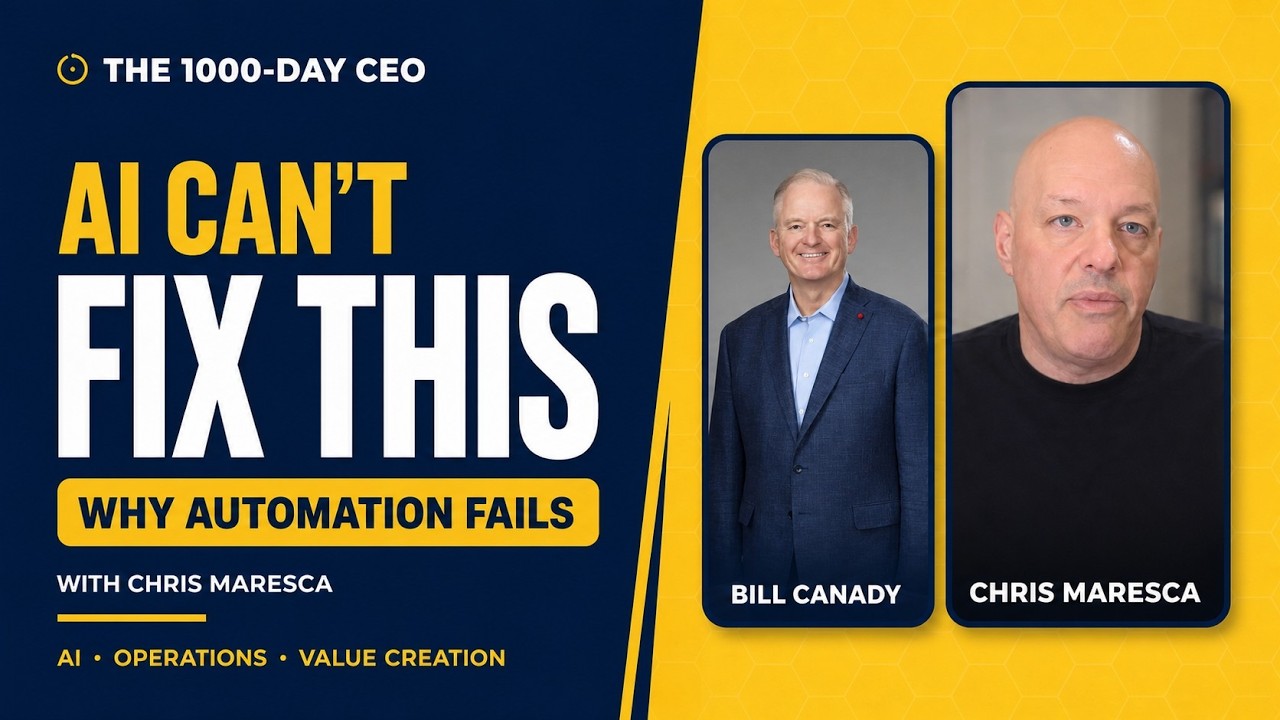
Chris Maresca argues AI won't save a broken business. You need centralized data, documented procedures, and an orchestration layer first. Private equity firms often mistake AI theater for real value and miss the hidden costs of data leakage to third-party LLMs.
Chapters
1,000 days. That's enough time to transform a company, but not enough time to waste. Welcome to The 1,000 Day CEO, the podcast about decisive leadership, sustainable growth, and building a business that thrives beyond any one leader. Your host is Bill Canady. Let's make every day count.
Hello everyone. It's great to be with you today. Today we are gonna be talking about how companies Treat technology, especially AI, as a shortcut to growth, efficiency, and higher valuation. We've got Chris Mariska. He's gonna explain why technology cannot repair a weak operating model, what private equity investors routinely miss during diligence, and how leaders can separate genuine capabilities from expensive technology stories. He's a Silicon Valley veteran, entrepreneur, technology strategist, and advisor to executive team and investors. He started and guided businesses across several generations of technology and has helped more than 80 organizations from venture-backed startups to some of the world's largest companies. He's gonna help us navigate growth, transformation, and turnaround situations. Today, he is often brought in into private equity environments where the technology story begins to fall apart under scrutiny. Chris, welcome to the show.
No, thanks for having me on.
I tell you, it's exciting times. We had a long time in the green room, if you will, talking about what we wanted to talk about. Man, this is going to be an exciting one today. One of the things that stuck out to me was you describe yourself as a technology pathfinder. What does that mean in practice?
Yeah, that's right. I mean, I think technology is interesting because it's always changing and the needs of organizations are often changing at the same time. The problem is that in most organizations, the leadership is not necessarily deep technology experts. And so, there's trouble understanding what the right incantation of technology, how it's going to help with companies, what vendors, how to be choosing vendors, and so on and so forth. And on top of that, you're getting a lot of, right now, a lot of propaganda about AI and everything else, and a lot of vendors coming along and saying, we can make everything perfect. And that doesn't help anything because at the end of the day, nothing will fix a company that fundamentally has broken processes or incomplete anything. And this is part of the problem. I mean, if you look at most companies, you know, a lot of companies can have a pretty well-defined process for how they're doing things, but fundamentally, companies, all companies operate in the same way. At one end, things are coming in, whether it's information or resources or raw materials, and they process that. And then out the other end comes something of higher value that they sell, whether it's a service, it's software, it's a piece of consumer goods, it's machinery, whatever it is. And those processes that transform the raw materials into something of value is effectively the valuation of the company. And you get companies that have pretty well-defined processes, but what you often find is Between the well-defined processes, there are undefined areas, and those undefined areas are filled by skilled humans. And skilled humans, by definition, have all of the things that they need to do in their head. And so when you start introducing technology, getting that knowledge out of the skilled humans and into the technology is quite difficult to do. It's especially visible in the trades. Where, you know, getting, you know, decades of knowledge out of a skilled tradesman into some automated piece of equipment has proven to be nearly impossible. And so that problem replicates itself across organizations, you know, top to bottom, you know, from one side of the organization to the other. And, and then people start throwing in tech, whether it's AI or more traditional forms of technology. Sometimes you can increase throughput at a point in time, but it doesn't help if the other bits are not keeping up.
So, you know, I, at this point in your career, you've seen so much and you've lived through several technology revolutions. What has that experience taught you about distinguishing between a genuine transformation, which you were just talking about, from more of a fashionable narrative? Like, I think AI is here to stay, but what do you think?
Well, I think AI is here to stay, but one of the problems with AI is that in order to really make it effective, you need to be an AI-first organization. And for most organizations, that actually requires ripping apart the way they work right now and basically starting over again. And that's, you know, you can't, it's hard to build an airplane when you're flying it. And that's kind of what you're trying to do. And it becomes very, very difficult. And When people talk about disruption, they talk about this sort of inflection point where the companies that are able to do this are going to be the ones that survive and the other ones are just going to get replaced. I think I was having a discussion the other day about CRM systems and I pointed out that really CRM systems are something from last decade and modern— in the modern world, if you were starting from scratch, you'd never buy a CRM system because a CRM system casts your sales process or your customer service process into a set workflow that's been set up by the vendor, or that is sort of the industry standard or whatever it is, right? You have your sales funnel and you have, you know, you're, you're trying to figure out what stage a customer is in and so on and so forth. But that's not the way, you know, AI-driven systems work. They're basically individual intelligent things that are feeding data to another thing. And so if you think about that, another thing that's going to do something with it. And if you think about that, like, how does that change your view of this sort of customer funnel? You know, all of a sudden you can, you can use signaling data, like has somebody changed a job recently? And, but, but you can do this on a 24/7 basis. So you can have AI agents that go and And get data about a prospect or an inbound or whatever it is, or even set up entire marketing campaigns to target specific market segments and then manage the entire process of sales up until, you know, you get a human in the loop who comes in to finally close the final details of the deal. And so when you think about that, like, what is your CRM system now? Actually, what you do is you're building a set of custom tools. to meet your specific process, not some preordained way of doing things that's been set up by a vendor. And so that kind of trend, and that's just one segment of an organization. If you look across the entire organization, then you, you, you have thousands of inflection points where you, where you, you need to be thinking about this. And that's, that's honestly is extremely hard to do because you're, you're flipping the idea of how you do things upside down. Right. It's more analogous to hiring a very specialized workforce than it is to using a technology. And I think that that's the fundamental difference. I joked with somebody the other day. I have a friend and she's building some software and she has 10 AI agents that are doing various tasks for her. And they are always fighting with each other about, you know, who's responsible for what bit of tasks. I mean, this is the AI agents are fighting with each other. And so I said, you're going to need HR for AI, which was pretty funny because, you know, and it's kind of like that. And if you think about that, it sounds nuts, but of course these things are pretty intelligent. I mean, they're very stupid at the same time, but they're pretty intelligent. And so they're very capable of doing things, I think. And this is the revolution, if you will. It's kind of like I always joke that computers have been promising us you know, more ease of life for, you know, 50 years. And they've only made our lives more complicated as far as I can tell. And I think AI has finally reached the point where the computers can kind of sort of understand us. And that is going to make our life easier finally. It's finally the promise is being achieved, you know, after 50 years, we've finally gotten to the point where these things are doing what they claim they're going to do, kind of, as long as they don't hallucinate. But yeah, I think, I think— I think there is a revolution here, but again, if your internal processes are undefined, if there are holes in your processes that are being filled by humans, if you don't understand where the value is in your company, I have to tell you, I'm always shocked. I go to a company, and this doesn't matter the size of the company. It could be 2 people, it could be 100,000 people. And you go to a company and you say, what do you do? I mean, what do you do that makes a difference for your customers? And, you know, there's some trite marketing answer, but I'm like, no, no, what do you actually do? And the number of people that can't answer that, where you ask people, you'll get a different answer every single time, right? So a lot of times companies don't even know what they're doing. And so how are they going to define a process that takes that raw input and outputs value if The people in the company don't even understand what the company is doing. It's not, it's not rocket science to know that if you can't define it, then you can't possibly automate this thing. So, yeah, and that's the way I feel. And so we talked about, you know, when, when you look at private equity and you look at people buying, or, you know, organizations of various kinds, these problems are all over the place. They're all over the place because companies are built by humans and humans are imperfect. They, they have, they like to build fiefdoms. They want to claim credit for everything or whatever. All these human traits that are kind of corrosive exist in companies. And every single one of those things creates ancillary problems for trying to understand how value is delivered. And so if you take that and you say, oh, we're just going to apply some technology magic. IBM back in the day used to have these commercials about The magic pixie dust that could be sprinkled on things to make a company work better. And of course, everybody knows that doesn't work. And so, and that exists all over the place. Of course, with AI, it's even easier to claim these kinds of things. And the question is, how do you prove out that this is actually working? Was it just the cynical exercise to get rid of the people in the company who actually know how things are working and reduce your costs before a sale? Who knows, right?
You bring up, you bring up a lot of great points. You know, we're both in private equity and the ultimate outcome for private equity is the company's going to be sold, right? People, you know, it's just people pool their resources, make a bet on a company and looking to get back $2, $3, $4 for every dollar they put in.
Mm-hmm.
And when you're getting ready to sell that, an investor comes in and I've been on both sides of that table and I'll hear just what you just said. Our technology is proprietary and highly scalable. So we're gonna use a CRM. I don't need HubSpot or Salesforce, man. That stuff's $1,000 a seat per month in some cases, right?
Mm-hmm.
Depending what you get to it. What questions should we be asking so it's just not so someone's got 10 AI agents that won't actually talk to each other, fighting with each other and surfing? What should we be asking to know that this is scalable? How do you know? And what does that look and feel like?
Yeah, I mean, the long and the short of it is that there's no single question you can ask that's going to answer that question. I mean, unfortunately, there's no magic bullet here. I think there's some key things, you know, is there, is, is the data all centralized and normalized in a single database? Because AI works on data. It doesn't work without data.
It can't work without data. Garbage in, garbage out. The old GUI, right?
Yeah. But most companies have, you know, 10 different systems in the company, each one of which is responsible for a different area, functional area of the business. And oftentimes that data is spread across all these different systems. So it's all fine and good to say, oh, we have AI and blah, blah, blah. But you know, is all that data centralized in a single place? Is it normalized? So is the data that it's pulling from the accounting system the same as the data that marketing is using to drive marketing campaigns?
Yeah.
Is the, are the, are the, the, you know, the, the, the metrics measured in the same fashion? Because if they aren't, then you have to make sense of this. The AI has to make sense of this, right?
Mm-hmm.
And so you can't just say, we're going to throw some AI. It works. AI works pretty well at sort of, you know, as a point solution, for example, you know, you know, it can, it can clean up a lot of stuff. It can pull a a lot of conclusions or, or, or some kind of meaning out of abstract data. It's quite good at these things, but if it, if it, if it's going to work together, it needs a common data store, which is normalized. It needs references to standard operating procedures. It needs an orchestration layer so that you orchestrate all of the bits of AI that you have working. You know, it needs all these things. You can think of it as literally the AI needs its own company organization, right? It is, if you think about it, a friend of mine describes it as a bunch of brains. If you think about it as a bunch of brains, they need to work together. For that, they need to be organized. They need to know who gets what data. They need to understand what standard operating procedures are. They need to understand what your brand identity is. You know, these things all coexist There's no easy way around this. If you don't have all of this, what you have is a kind of AI, you know? And, and that's what I was saying earlier, when you talk about sort of AI-native organizations, they are organized around the idea that you have this, all these agents that are acting as a workforce.
Mm-hmm.
And most companies are implementing it as if it's technology. Which is kind of a critical difference. You wouldn't, you wouldn't tell a human, describe a human as technology, as a technology you've implemented, right? And a human is a technology effectively.
I mean, you know, by and large, a lot of digital assets for the company, they just happen to walk out the door every day, right?
Well, but also there's a different way that you, you engage with a, a human employee. Versus a desktop computer, right? And the problem with AI is people treat it as if it's another kind of Microsoft Windows or whatever, or Excel spreadsheet or whatever. And that's not really a great way to think about it because you're actually reducing the capabilities to a one-dimensionality. And I think AI is much more like your coworker than it is like another piece of software. And you have to engage with it like that. I mean, not just interactively. We've all done that with the chatbots of various kinds. We've all done that, but also in the way you implement it. That said, AI is not a magic bullet. I mean, it's another tool in the toolbox you can use to solve problems. And I think as we've seen in a lot of areas, There are issues with people finding enough qualified people to work in, in various industries, and maybe AI is one of the solutions to that worker shortage.
Good. You know, you bring up a really good point. What are they, what are you going to be looking at to say that this is either, A, this is real and this is a game changer, how they're deploying it and it's defensible, or it's just theater. They're just dressing themselves up. How do you tell the difference and how does a business owner get real value? Because this stuff is not cheap.
You have a limited amount of time to judge what's going on in a company and a limited amount of data. I think there are key things you can do as a business owner. Like, do you understand key concepts like orchestration? And do you have, you know, a Can you express how orchestration is changing the way your company is working with AI?
Right?
Like you're orchestrating a bunch of AI workers in the same way that you'd have a management structure to manage people. Orchestration is that management structure of your AI tools. And do you have centralized data, which is all normalized so all of the AI can judge that? Do you have standard operating procedures that are documented? Do you have these things ready to go when you put together your VDR? Can you put all that stuff in your VDR and show that, you know, this is real? This isn't just vaporware. You know, I think that that's important. You can also show metrics like, you know, you've been able to process n number of whatever it is faster, you know, quadruple your production without increasing your headcount. For example, there's metrics you can use to show that this is really optimal, or, you know, higher close rates for sales or whatever it is, right? There's a lot of metrics that show the, you know, the time From when you implemented this thing to now, how has it changed the fundamental KPIs in your organization? But those only tell part of the story. I mean, the other question is, talk to the people on the ground. When I did a lot of consulting, I used to go several hours before my meetings, I would go and stand with all the smokers and I would ask, I would introduce myself. I would tell 'em who I was and what I was doing there and who I was meeting with. And I would— I would ask them questions about what they were doing. Like, you know, these are the people at the coalface. Do they— what do they say? I mean, that's always been my trick because I don't want to talk to the executives because 9 times out of 10, they actually don't know anything. They just have, you know, a line to tell you about what they're doing. But if you talk to the people, you know, in the factory, you know, at the loading dock or whatever, you know, in the cafeteria, then those people can tell you what's actually going on. And I find that much more useful. So if you're in PE, That's what you need to do. You need to actually go and talk to the employees, either, you know, through a conference call or whatever, or in person, and understand like, where are they? Where is the company? They will tell you if AI is being implemented, they will tell you how they feel about it. I guarantee you it's inevitable. And whether it's good or bad.
Yeah, it's for sure the object of conversations a lot. Yeah, you're, I mean, you're really nailing it there, right? Like get to the people on the floor who are being directly affected in implementing it. Have your KPIs you're looking at. When you look and you're going through your, your technology diligence on these companies, what, what are some of the more conventional processes that people are constantly overlooking that says this is real for this company and it's making a difference?
Hiring. Sounds crazy. Sounds crazy. But, you know, even in today, companies are built on people. Right. And finding the absolute best people is very, very non-trivial. I mean, in my last company, that was one of the first things I did when I joined is I set up a hiring pipeline and I set up a methodology for hiring employees. This was even before I needed to. I set this all up. I set up interview templates. I set up a specific pipeline for finding people. I set up tools. that we could go out and we could identify people that we were interested in hiring even before we contacted them. Right. And I think you need to do that. There's, you know, unfortunately there's no loyalty in companies to employees, but it goes the other way around as well. So because of that, people leave their jobs constantly. Every couple of years, it seems people seem to move around. That's pretty common. And so you have to anticipate that. And when you lose somebody, it's you're losing all the knowledge that they have is walking out the door. No matter how hard you've tried to document that, it is leaving. And it doesn't matter if they're a junior or they're the most senior person in the company. In fact, a junior walking out the door is probably worse than an executive.
Mm-hmm.
And so, because they have a tendency to be doing all kinds of things that you don't even know and that are undocumented. And so I think that having a really strong hiring pipeline is really important, having standards and, and sort of a process for doing that. And for me, it really came to the fore when our lead software developer left. He left because somebody offered him his dream job, which you can't stop somebody from leaving in that circumstance. He wasn't unhappy with us. It was just somebody offered him his dream job. And one of my staff said to me, I would be really worried, but I saw what happened the last time somebody left. And because I'd set up a hiring pipeline, they knew it was no problem. We went from the day he left to hiring somebody in 3 weeks.
Wow. That's unheard of.
Right?
That is amazing.
She was brilliant. Still one of the best software engineers I've ever worked with. And it was completely random because we hired— she did not have the skills we were looking for, by the way, but she had the personality that we needed. Like, so we hired her.
I think I've heard other people make the statement, I can teach you the skills. It's the fit I'm looking for, the capability, right?
She was—
every company does it differently. Yeah.
And the fundamental thing was she was curious. She was curious and she was engaged. And so she was, She was willing to learn and do whatever it took to make things happen. It was the kind of person you can throw in at the deep end and say, swim, and they would be just fine. And she was 25.
Amazing.
Yeah. And our senior developer was— that's who she was replacing. And she was no way a senior, right? I mean, she didn't have the experience. You know, again, that your hiring process is so important. It gets even worse with AI, right? Because now you've got other tools that can come into the mix, but also you've got a smaller number of people, presumably. So each person counts even more. So, so yeah, uh, I look at that because I think that tells me a lot about an organization. Like, how much do you care? People pay lip service. People are our most important asset. You know, you can hear that a lot. I mean, come on, what a line. It's just, I mean, we're all family.
You fire your family? I'd like to fire them sometimes, but yeah, right.
But, but I think, I think, you know, it translates through that sort of, I heard something ridiculous the other day, which was actually this morning, which was a company that couldn't find any candidates for a particular position. So the hiring manager submitted his own resume underneath a false name and then got rejected within 5 minutes.
That's a great line.
And, and, and what they found was that the HR team had put in there as a requirement that you needed to know this particular software development stack called React, except that they had specific— specified React.js, which is the formal name. And on his resume, it just said React. And for whatever reason, their hiring system was too stupid to understand that they were one and the same thing. And so they were losing a lot of candidates due to Pennedy, like, amazing.
So switching gears a little bit, you've argued AI cannot take an unproductive company and make it productive. Why not? If it's this powerful, why can't it fix it all?
Well, because AI is like a toddler. It needs to be taught everything that needs to be done. So, you know, you need a couple of different things. It needs training typically on the workflow and the process that's going to, or, you know, a defined list of standard operating procedures. It needs a set of data to work on. AI works on data. And typically, if your company's unproductive, then chances are you don't have either one of those 2 things, right? You don't have a standard set of operating procedures, or they're incomplete, or they're wrong, right? Or, you know, or they're just lip service. Oh yeah, we have SOPs, you know, whatever. Or, However you want to define it, doesn't have to be standard operating procedures, but whatever, however you define it, whatever terminology you use. And so you can imagine you point an AI at something which is incomplete with a lack of data or with no training, what is it going to do? Well, it's just going to make things up. That's not going to help. It's never going to— the thing about AI is it will not say, I can't do this. It's like a human. A human won't say, oh, I can't do— well, they may, but you know, a lot of humans will just try to do it and they'll do it wrong. And then you wonder why they're doing it wrong. Well, AI is no different. Same deal, you know, same thing, right? So you don't, you can't train them. You don't have operating procedures. You don't have data for them to work on. What do you think the result is going to be?
Yeah, it'll make it up.
Yeah.
Training is so important and getting the data vetted. So the data silos are frequently blamed, as we were just doing, for AI failures. Are they primarily a technical problem or are they evidence more of a deeper organizational problem?
Yes and no. So the data silos exist because organizations are functional silos. So if you think about most organizations, they have these sort of vertical organizational areas, usually under some kind of executive leadership, a VP or whatever, marketing, finance, sales, IT, HR, whatever, production, if they're doing production, whatever it is. They're their own little fiefdoms, right? With their own sets of software, which don't exist in cohesion with anything else often. The cohesion exists at the executive level, right? And that's where all the aggregation happens, which is incredibly stupid because of course marketing and sales need to talk to each other, but so does finance because sales and finance are tied at the hip, right? And so you have this sort of disjoint because humans being humans, you have this disjointed tribal nature of corporate organization.
Yeah.
It's a problem. My view is I like to take a holistic view of things because each one of these things is pushing and pulling in a certain direction and everything needs to pull in the same direction for a company to be successful. And oftentimes they're at odds with each other, not on purpose, but just over time, you know, oh yeah, the accounting system doesn't talk to the e-commerce system. And we have to buy this expensive translator to import all this stuff or whatever it is, you know, we've all heard those stories. And of course, the result of that is you get those data silos, right? Is it solvable? Sure. And it winds up costing a lot of money because now you have to extract the data out of all these systems, put it into a single data store, and then you have to make that normalized. In other words, all the data has got to be relatable to all the other data. And then, and then you have to, then you can point your AI at it and hopefully you can make heads or tails of it. But of course now training, standard operating procedures, all that stuff. How do you apply it now to this big data store? Well, you, you, you need to process. Well, so the first thing is you need to process the data in situ if you can, which is very difficult to do because we just talked about all the data silos with different data formats and all kinds of mess there. You need to process the data in situ, but you need to also process the data in streaming, in a streaming basis. So instead of saying, you know, I'm trying to think of a really good example, but effectively instead of building a report at the end of the week, you need the report to be constructed throughout the week as things are happening, right? And so now you don't need this giant data store of stuff. You can just have the report be generated as the data that it's based on is moving through the system. But that, again, this is a different mindset. This is not the mindset we all grew up with of Yeah. And that's, that's a hard shift, right? I mean, in your own companies, you probably see this, like trying to shift from one mindset to another is a nightmare.
For all the reasons that we know, people don't like change. There's comfort. They gotta go learn new stuff. They're already busy. They're fully occupied. They may be occupied doing the wrong things. It's just, you know, it's now I gotta do 2 jobs. And there's also, it creates a sense of of fear or they don't feel safe because maybe this robot's going to replace me. When you look at middle market companies today that you're through the lens of what you're doing, what do you see companies currently spending money on with AI that, that really has no defensible return? There's a lot being wasted today.
I think my biggest worry with most companies these days is that they're sending all of their data to the OpenAIs and the Claudes of the world.
We booked LM, which is a Gemini product.
Yeah.
You can ring fence it. So if I've got something and they can take massive amounts of data. So if I'm looking at something, I can dump it in and within a second they can go through a spreadsheet. Uh, and because you can keep it off the internet and everything else, I actually think it's a great product for, uh, for safety.
Yeah, I do too. And, but there's a lot of people that are using it, especially in sort of non-tech industries. There's a lot of people that are just using all this stuff, even, you know, at the middle management level that, you know, they're, they're kind of unaware and they, they've got, They're overloaded with work and they're turning to these tools to make their lives easier, which is completely sensible, but it's kind of an uncontrolled leak, if you will, often. And so I think, I think that the, I think that that's an existential risk to these middle market companies because especially if you're a kind of a SaaS software company, the AI tools are learning about how you do stuff. Maybe not explicitly, but implicitly. And then you will get your customers replicating your software using AI tools internally. I've already seen this happen once, you know, where a healthcare company replaced a revenue cycle management tool that they were, that was costing them $120,000 a month. And in 3 months, they replaced that specific tool, you know, and, and so, and I think that's going to be more and more common. And so that's a risk. If you're a middle market software company of some sort, then you have that risk, you know, and, and then, and that, that, that leakage problem exists, you know, writ large. I think the big trend is going to be more local AI. And by the way, I think Apple's going to be the big winner there. They already have been. So if you, if you, if you want to run local AI, you typically will buy an NVIDIA graphics processing unit, a GPU. And the card, the AI can use all of that memory. Now it can't really use any of the memory on, in your computer if you're using an Intel machine because they're separate. The memory is separate, right? The Macs, Apple has engineered their chips and their hardware so that the system memory and the GPU memory are one and the same. And so you can buy a Mac mini. With like, you know, 64 gigs of RAM and all of that memory can be used for AI. And, and the performance is like 90% of an NVIDIA GPU.
For a fraction of the cost.
Apple's created an architecture which is absolutely tailor fit for AI. And they did this before AI. I don't think they even realized it, but People have realized it and they're like, oh my God, I can run this thing on my desktop, you know, literally. And but, you know, the point is you can use a system like that for local AI, which will rival whatever you're getting from Claude and so on and so forth. Right. And, and then you won't leak any data. View. I, I, and so I think if you look at the middle market, you know, there are companies that are going to be disrupted by AI. There are going to be companies that are not going to be disrupted by AI. I'm a partner in a PE firm and we buy lower middle market companies. Most of the companies we're buying have nothing to do with tech. We have a, we have 12 in the pipeline right now. Healthcare, food distribution, metalworking, you know, nothing to do with—
That's the same type we buy. We have a good, one of our other groups does technology, but man, that's hard. We're industrial. I'm, all my stuff's industrial. I buy widgets, things made out of hunks of metal.
Well, that's your, that's your business. So yeah, I'm not surprised.
Yeah, yeah, that's right. But that's, you know, look, uh, I want to own businesses that other people need to run their business with. So, right. Like, like, like, and I want it to be like, like, you're making a car. I wanna help you paint that, right? And if my stuff goes down, you can't make your car. And, and guess what? There's a huge market for cars. So, so, imagine you acquired a company tomorrow. your PE firm, what should happen during the first 30 days that you're gonna go through with your technology assessment amongst other things?
Well, the, I mean, the thing is that, and I'm sure you've seen this, most of the companies that we acquire are small enough that they're technology light. And so the first thing to do is to look at what technology we can easily and immediately implement in order to bring them up to speed, so to speak. I think the first benchmark for us is because our goal is to buy somewhere between 3,000 and 5,000 companies.
You talked about that. That's the most I've ever heard of anyone doing it. It's a really novel model you've got.
Yeah, there's a company in Canada called Constellation Software, which you might have heard of, which has bought 1,500 software companies. And so they're, I know some people there and we talk a lot about it, but And one of the things that they do, which we've replicated, is they— the key output from those companies for the mothership is a standardized PMO with standardized KPIs. And so that for us in the first 30 days, that's really the goal is to get that in place, right? So then we can understand what's going on with the organization and make whatever changes we need. But we have a little bit of a different model because we have 50 operating partners that work in 15 countries and they are responsible for their pool of local companies. We don't, at the, at the level, at the partner level, we don't really look at that too much. We look at the rollup of what's going on in each regio. So yeah, it's an interesting challenge. Okay.
What's the most overrated technology trend today?
I mean, probably AI, honestly. And the reason is because, and it's a very simple reason. Silicon Valley, and I got to remember, I spent 13 years and I spent 30 years in Silicon Valley and did 14 startups, including 7 exits and an IPO. Silicon Valley has an operating model that most of the rest of the world doesn't really understand. And the operating model is to invest enough money to grow explosively and then have a lot of propaganda explaining how great all this is, and then to try and get out from that before it explodes. And And that's kind of what's going on with AI right now. AI works writ large. It does work and it does do a lot of cool things and it is pretty smart and can consume a lot of data quickly. I mean, I use it for 300-page CDDs and trying to figure out what the hell they say. But there are, like every tech, there's limitations and, and you have to be aware of that. And like every tech, it's not free. It's not free both in dollars, but it's also not free in time. And so, and time's usually a bigger component than dollars. So yeah.
What's a metric you distrust?
I kind of distrust all metrics because I think that they're easily manipulable. I don't, I understand why people do it because it's very reductionist. But there's a guy named Rory Sutherland who used to be the chairman of Ogilvy, who has this thing he talks about called the doorman fallacy. And doorman fallacy is basically like you have a doorman in a hotel and you get rid of him in favor of an automatic door And it immediately saves you 80 grand a year or whatever. And then what happens is that nobody's unloading people's luggage. The recurring guests are not greeted by anybody. Homeless people start sleeping in your doorway. Nobody's hailing cabs. And pretty soon your booking rates are down 30% and you're wondering why. And I think a lot of metrics are the Doorman fallacy, right? They're measuring something. That is ostensibly tangible, but there's a lot of humanist bits that get lost in the KPIs or the metrics or whatever. I'll tell you what I do believe in. I do believe in financials. I always talk about how the secrets are buried in the financials. If you want to know what's going on with the company, go look at the financials.
True.
It doesn't matter whatever else, it's going to be in there. You know, hopefully in a P&L or something like that that you can actually read cogently rather than, you know, some crazy chart of accounts that you can never understand.
But you've got to figure out all the add-backs and the— right, what really is the SDE.
So, well, the— and the thing is that AI is really good at unraveling all that stuff nowadays. But, and, and, and that's the real data, right? Assuming people aren't cooking the books, that's really where the buck stops, right?
So, well, you have ways of dealing with that doing— well, yeah.
So, but you know, you know what I mean?
I mean, it is, I know, I know people, people, they do a lot of theater. I don't want to say they lie, cheat, and steal. I just think they, they try to put a spin on it sometimes.
All right.
Final question.
Go ahead.
All right. What failure did you have that taught you something indispensable?
Oh, I got a good one actually. I have a good spectacular one. So, and I could talk about this now because it's no longer under NDA, but Many, many eons ago, I ran a consulting firm and we were hired by Adobe to figure out what to do with Flash on mobile. And, and this was before the iPhone was released. So you can imagine how long ago that was. And, and I, I had a pretty decent idea of what they should be doing based on some experience I, experiences I had with Flash running CNC machines, believe it or not. Because I know you're an industrial guy, you're going to go, what?
Yeah.
And so I had come up with a strategy, and this was me and my team, and I had talked to all the C-level people and everything else, and we'd all gotten an agreement and everybody was aligned and everything, and they all thought it was a great idea and so on. And then I went to an executive meeting, which was mostly all the C-level people, not the CEO, but pretty much everybody else. And It was a spectacular disaster. It was complete failure. They hated it. And I was like, how did this happen? And what I realized was there was a performative aspect to this that I didn't understand because not only were all the C-level people in the room, but all their assistants were there too. And I'm not entirely sure of the dynamic, But there was a performance that needed to be done about this that I kind of was unaware of, a political dimension that I didn't understand. And even though every, every one of those people had agreed in advance that this was a great strategy, when it came to sort of agreeing in public, it was a different story. And, and that was, that was a really valuable lesson. And now I'm much more careful about that sort of thing.
Thank you for sharing that with us. So Chris, thank you today for helping us look beyond the technology narrative and focus on operating reality underneath it. You really brought some great insights. I think, you know, people who run businesses, whether you're buying them or selling them or just, you know, getting them going, I think this brings a lot. AI and technology in general is for the future. It allows us to multiply ourselves and you're right in the heart of it. But the central lesson, I think it's clear. It can amplify a strong business, but it cannot rescue an organization that has not confronted, you know, its priorities, processes, and data. If they're just doing it for performative, if they're just making it theater, it shows once you dig in on it. So where should listeners go to learn more about you and your work?
So they can visit my consulting company's website, c32.co. That's c32.co. And, uh, they can reach me at ckm@c32.co. And yeah, if you, if you need some help trying to figure this out, just reach out. Happy to help.
All right. Well, thank you so much for joining us. This has been the 1,000 Day CEO. I'm Bill Canady. See you all soon.
Thank you. Thanks for having me.
You've been listening to the 1,000 Day CEO with Bill Canady. Follow the show for more decisive leadership, sustainable growth, and strategies that build enduring businesses. Until next time, make every day count.









