In this solo presentation, Blackford Middleton recounts his long‑standing interest in linking national health information resources with clinical decision support, a vision that began during his third‑year medical school in 1984. He describes his Stanford fellowship and Master’s in Health Services Research, where he embraced the principle that a brain plus a computer outperforms the unaided brain. Middleton then details an AHRQ‑funded project that placed decades of Partners Healthcare knowledge assets into the cloud for remote EMR systems (NextGen, GE, Epic, Regenstrief, and Partners’ own EMR) before modern standards existed. Building on that experience, he introduces Apravita (spelled Aprovita earlier), a trusted cloud platform that enables payers, providers, and stakeholders to collaborate on clinical quality measurement, quality improvement, and value‑based contracting. The core of the talk focuses on agile knowledge‑engineering work with the C19 Healthcare Coalition and the C19 Consortium Digital Guidelines Working Group, converting rapidly evolving COVID‑19 point‑of‑care guidance into open‑source, standards‑based computable artifacts executable on Apravita. Middleton concludes with a vision of a synchronized national knowledge ecosystem that eliminates isolated “islands” and creates a seamless supply chain from knowledge discovery through implementation and feedback, delivering new insights to point‑of‑care swiftly and efficiently.
Chapters
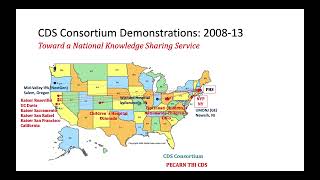
The case may be, my name's Blackford Middleton, and I'm pleased to talk to you briefly about Aprovita and our interest in mobilizing computable biomedical knowledge. My interest in this topic began actually as a medical student back in 1984, third-year medical student. I thought it'd be useful to hook up a variety of the national information systems and resources and practice databases and hospital mainframes and the like to allow us to look at all the clinical data and make inferences about them. I drew that diagram on my new model, leading-edge Model D at the time, and I've redrawn it here in PowerPoint to make it easier to see. It seems to me that then that we should make available the knowledge assets at the National Library of Medicine and any and all other libraries, as well as clinical data from hospital mainframes and practice databases, epidemiologic data from the CDC, and knowledge from electronic textbooks, to combine those with decision support algorithms delivered via this integrated decision support system to allow providers and patients to make more informed clinical decisions, and even to allow the patient to access this resource at home. This interest prompted me to attend Stanford for fellowship and my terminal Master of Science degree in Health Services Research, where I focused on clinical informatics. And I learned the fundamental theorem that was later articulated by Chuck Friedman, that a brain plus a computer is greater than the unaided brain alone. And I think that's increasingly true in healthcare today with the explosion of our knowledge base. I pursued this research idea during my time at Partners Healthcare System and Harvard Medical School. We were funded by the AHRQ to take knowledge assets from the many decades of research and development at Partners, put them into the cloud, and make them available to remote EMRs, including NextGen and GE and Epic, the Regenstrief EMR, and Partners' own homegrown EMR at the time. This was a terrific project, a multi-institutional collaboration, and It actually worked. It was before a lot of the existing standards we have today, but it gave us a lot of information about how to do this kind of thing. Those ideas were one of the seeds of the idea behind Apravita, now a company focused on creating a trusted cloud-based platform for collaboration. We empower payers and providers and their stakeholders to more efficiently and effectively transact at scale. Clinically, operationally, and financially. What that means is we have products and solutions for clinical quality measurement and reporting, for quality improvement, engaging with doctors and, and clinical staff, and of course rewarding with value-based contract design and administration. The work I'd like to focus on here very briefly though is the agile knowledge engineering work we're doing with the C19 Healthcare Coalition and a broad stakeholder group in something we call the C19 Consortium Digital Guidelines Working Group. We're taking knowledge assets from the point of care being developed daily and revised almost daily on the fly at hotspots in COVID care settings across the country and converting those in rapid knowledge translation and specification into computable knowledge artifacts that we can share and execute on the Apravita platform. But we're creating them in an open source standards-based way so that anyone with the capability could similarly execute them on whatever computing environment they might have. This is extremely exciting work, and we believe that it's a step toward what I've had in mind for a long, long time, a vision of the national knowledge ecosystem where all of the folks collaborating in knowledge discovery and engineering and development and implementation all the way through local implementation and, and then evaluation and feedback, that all of this large ecosystem and its supply chain can work much more effectively together. Right now there are many islands isolated one from the other, and the goal is to actually make this a more synchronized supply chain that can more effectively and efficiently and rapidly deliver new insights to the point of care as needed. Thank you for your time and attention, and during the Q&A, I'm happy to address any questions that might be crossing your mind. Thank you.