Bradley Kohn a Self Mastery Coach helps individuals identify their core values
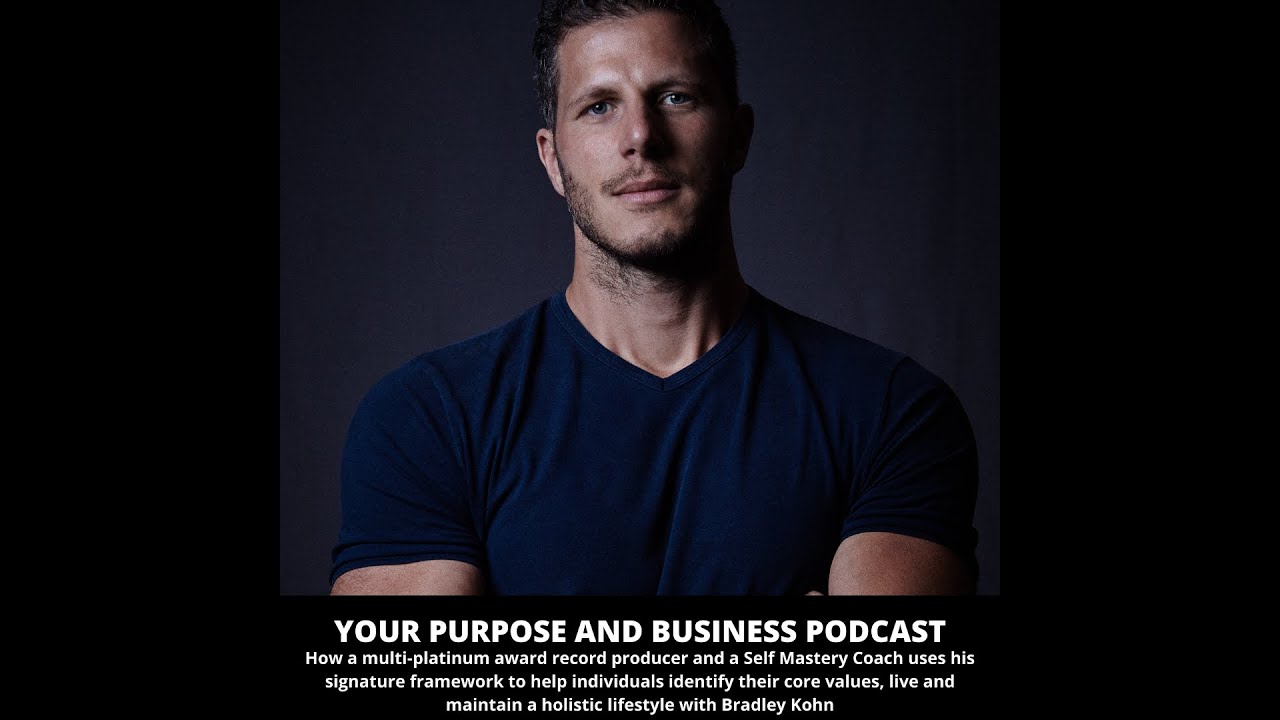
Bradley Kohn, a self-mastery coach with a background in music, martial arts, and meditation, walks through how to identify your core values and use them to shape decisions and habits. He outlines a seven-step coaching framework and explains why internal motivation matters more than external validation.
Chapters
You're listening to Your Purpose and Business Podcast, where we connect you to possibilities. I'm your host, Raquel Walters, a 2-time bestselling author, millennial speaker, corporate trainer, advocate, and clinical social worker at heart. Your Purpose and Business Podcast will connect you with everyday successful people who will share their impactful stories, insights, challenges, failures, and triumphs on how they're navigating the working world, whether by climbing the 9-to-5 corporate ladder or starting, growing, and scaling their business. So grab your pen and notebook because you'll want to implement the nuggets and tools, strategies shared in every episode. Class is in session. Hello everyone, and welcome to another episode of Your Purpose and Business Podcast. I am here with Bradley Kohn, a personal development coach. Guys, you're in for a treat today because with Bradley, Bradley's bio is so expansive, it's so colorful and so diverse that I know that with this podcast, that, um, you're going to be learning so many tools and strategies and how it is that you can apply to elevate your own lives as well as your business as well. So Bradley Kohn is a modern British Renaissance man. He is a published poet and writer, multi-platinum award record producer, engineer and songwriter, stuntman, extreme sports athlete, British martial arts medalist, and longtime meditator. He currently lives in Los Angeles and works as a self-mastery and transformation coach. And, um, back in 2019, he found Neurohacker, a complete and full-service approach to wellness that augments his coaching with a best-in-class network of doctors, practitioners, and therapists collectively operating under his wellness framework of physical health, mental health, nutrition, hydration, recovery, personal and lifestyle design. His unique approach and genuine depth of care enables people to live their best lives through physical, mental, financial, and spiritual well-being. Bradley, it is an honor and a pleasure to have you on the Your Purpose and Business Podcast. How are you today?
Thank you, I'm great. That was a lovely intro. Thanks very much, Rukar.
You're very welcome. So Bradley, I always ask my guests this, so tell us Something about yourself that is not included in this wonderful bio of yours?
Well, what's not included is that I love to travel. So I've been fortunate to do that at different periods of my life. And I just think that we develop so much when traveling and when on the road. That's something that wasn't included there, but it's definitely part of my story and my journey.
Awesome. That sounds good. I love to travel as well. Um, but Bradley, I know, um, the audience is thinking, oh my goodness, what a diverse man. I mean, you know, from being a poet to a songwriter to a multi-platinum award record producer to being a stuntman to, you know, um, to be involved in martial arts. I mean, your bio is so colorful, and I use that in a positive way because it just shows that you have been living out your multi-passions, if I may say so, right? Yeah.
And there is a through line. There is a through line.
Yeah.
And the way I would describe it is I have been very much drawn to flow state experiences, which I think all of those things offer the opportunity for. So music, martial arts, extreme sports, even travel for that matter, or I've found even dining, you know, with interesting people and having in-depth conversation. These, for me at least, have all offered what Csikszentmihalyi, you know, refers to as, yeah, flow state experiences. So where you are where you are tapped into a sense of awareness where you are kind of operating at your optimum capacity. And it's a, it's a balance of support from ability and kind of striving for to achieve something.
Yeah, yeah, that's, that's, that's impressive. And You know, for a lot of our audience probably don't even know what a flow state is. I'm happy that you were able to describe what that means. Um, for—
that makes sense.
Yeah, it does. It does make sense. Yeah, it absolutely does. And I kind of want to tie this all into this big question of, you know, because it's a podcast about your purpose and business. And so, um, for you, Bradley, um, what do you believe in, in your lifetime is your purpose? Have you found it? Are you still going through it? I mean, whatever comes to mind, please share with us.
I think for me, my purpose has always been to try and be better than I was yesterday. And what I'm now doing as a coach is sharing the tools and the processes that I've learned and adopted along the way, having explored many different areas, and giving them to people in a way that helps them ascend in their own lives. So You know, when I was in music, which I did for a large part of my career, my professional life, I wasn't necessarily trying to be, you know, the best musician or the best pop songwriter, you know, or, you know, some of the things that were perhaps being pursued by other of my peers. But I wanted to create something that meant meaningful to me, and it was a more internally driven expression than necessarily some of the outward markers that people are perhaps remunerated for. So that's, yeah, that's what it's always been for me. And I, and again, it's, you know, it's, it's, it— there's a, there's a line from a poem that I love. He says, the race is long, in the end it's only with yourself. Love
that.
And that kind of summarizes, I think, what I'm saying there.
Yeah, I love that. The race is long, but in the end, could you finish it?
In the end, it's only with yourself.
Only with yourself. Well, that is so brilliant because you know why? Because, you know, as a millennial, and, um, this, this podcast not only targets millennials, but we have multi-generations that listen in because I believe that everybody can take away, um, from our interviews is that especially though, let me just speak a little bit on the millennial generation. I mean, For many of the millennials, we believe— I don't subscribe to that mindset, but a lot of millennials believe in this sort of microwave society and doing things just because of the metrics, how many likes, how many views. I mean, you know, you want to monetize things because I teach on that. But what is the purpose behind all of that? It can't only just be for money, right? It's supposed to be for love, for passion, for interest, for all these things that you just spoke about that, you know, you were in the music industry producing over all these years, and it was really for the love of it, right?
Yeah.
I'm so happy that you brought that up and you touched on that because I think that that should be highlighted, especially in the society that we're living in now where for some reason we're losing that— the word I wanted to say is, you know, that sort of value, that true meaning behind why you do what you're doing instead instead of for public recognition because you want to be popular or a celebrity, or for a lot of money. Not to say that money is not important, but that should not only be the goal, right?
Sure, sure. Yeah, so a big part of my philosophy as a coach is to be internally driven, and we live in a society where many of the narratives that exist are false. And we're also being bombarded with more information than ever before. So how do you make sense and how do you find true north, so to speak, in an environment where you can find completely conflicting points of view, right? All you need to do is type into Google, is sugar good for me or is sugar bad for me? And you get 2 different sets of results.
Right.
And the other thing is, is that most people are unaware of their own biases. And so when they receive information, they are filtering it through these biases and often don't question where the information comes from or what their biases are, etc., etc. So I try to give people tools that allow them to navigate this. And one of the one of the early tools or one of the early processes I do with my clients is go through highlighting and identifying what their core values are. So we all have a set of core values that determine how we see the world, where we spend our energy, how we, you know, what we spend our money on, what we focus on, how we make decisions, who we choose as friends. All of these things are naturally filtered through our values. And what often happens is When people are not aware of what their values are, they will get in conflict with themselves where their values are trying to push them into a certain area or behavior or whatever it might be. And yet the narratives that they're adopting, whether it's from society or it's from their family or their school or environment, whatever it might be, is pushing them in a different situation. And then what you get is people saying, oh, well, I should be doing this or that or whatever, you know, because there's this resistance or there's this dissonance. So just being aware of that can in itself create a lot more ease of motion in people's lives. I just started with a client recently and we did this process and I spoke to him a few days later. We were catching up and he said, you know, it's been so powerful for me. It was really lovely to hear this. He said, it's been so powerful for me. He said, I used to feel guilty for wanting to make money or liking nice things. One of the things we identified in his list of values was he really values aesthetics. So, you know, he has a couple of vintage cars, he has this old Harley, he likes nice jewelry, he likes pretty girls. This all constitutes to his sense of well-being in life. And he's not doing it for materialistic reasons. He's not like you know, defining himself by these things or even trying to, you know, accumulate unnecessary belongings. But it's like the things that he has, he likes to be nice and he likes things to look nice and keeps his home very neat and orderly. And it all ties into this value around aesthetic. And also he had other values around making money, being successful, and being a good man. And these all kind of tie together. tied in together. And he said, realizing this has taken away that sense of guilt or shame around some of these things. And now I realize that's kind of who I am, and I realize why I'm doing it, and I don't have that negative self-talk about it. So that's an example of what I'm talking about there. Yeah. And it's these kinds of things— and there are numerous processes that I do with people— but it's these kinds of things that make people more self-deterministic. So you start to realize, okay, there's a narrative here that, you know, I shouldn't be doing ABC, but I know what my internal values are. I know what's really true for me, and I'm going to pursue this course of action, and I'm going to take with it, you know, the positive and negative. Some people are going to applaud me for it, some people are going to dislike me for it, but I know, you know, what's true for me and I'm going to pursue that path. And again, it's very important when we do this to not be deluded by our own cognitive biases. So how do you get through that? So yeah, so that's a whole nother wormhole we can go down. But that's— I think that answers your question to a degree.
Yeah. Yes, you definitely did. And I'm happy that you were able to draw that awareness from your client as well. A lot of time, like you said, you know, we have to be true to our internal values because, you know, in the world of social media, you know, your distractions, you know, it comes from all over the place, you know. So it is important to have your values at the forefront of your mind and staying grounded, you know, and being constantly reminded of why it is that you're doing certain things. Why is it that you're behaving a certain way? And, you know, what it is that you want and hoping that you're not just looking around and saying, oh, that crystal ball looks nice over there, let me go there. Or, oh, over there looks nicer, let me just pivot and go over there. Because then ultimately what you'll find is that you're not really living authentically and you're not going to be truly happy, you know? Because at the end of the day, I mean, we all want to be happy and we all want to live a life that's fulfilled to the best of our abilities, right?
100%. Yeah.
Yeah.
Absolutely. That's, that's really where I focus as a coach, is how do I help people live their most fulfilled lives? And I think a big part of it is knowledge of self. And again, I keep coming back to this term of being self-deterministic. But if you, like you just said, if you are constantly not only influenced but kind of led by these external cues, these external stimulators, whether it's, you know, attractive people on Facebook or advertisers marketing to you, and you don't know what is truly, you know, what is true for you, then you're going with the winds to a degree. And I like to empower people to have their own internal compass.
Yeah, definitely, definitely. Um, I wanted to shift gears a little bit, Bradley. I wanted— I'm a little bit curious, and I'm sure the audience is too as well. Um, You know, when you were growing up, think back, you know, in teenage years, um, what were some of the interests that you had that led you into your adult years to try on new things? I mean, did you always want to be an entrepreneur in some capacity? I know that music has been a good part of your life, a songwriter. Um, just share a little bit about that experience and what led you into your current, um, profession right now. As a transformational coach?
Yeah, well, it's a long story if you want me to go back to my childhood. But if you, you know, I was, I was always entrepreneurial. I came from a family of entrepreneurs and, you know, refugees as well. My grandparents were all diaspora refugees from around Europe. So there was that spirit in us. And, you know, I wanted pocket money. When I was a teenager, so I would sell knickknacks to my friends, I would wash my dad's car, you know, little things to get money. And when I was giving— I used to give music lessons when I was 15 or 16 to younger kids, and there was this guitar that I wanted which was a lot of money for me at the time. It seemed almost impossible. And I thought what I would do is put on a club night for kids my age, so 15, 16-year-olds. But what I did was, because I was— because I've always been tall and looked older, I went to a nightclub in London and I said I wanted to put on a night, and the guy just assumed I was over age, I was 18. So I put on this night in an over-18s club but for 16-year-olds. chords, basically. And we had a hit, you know, it was a hit and afforded me enough money to then buy the guitar. So that was the start of it. And I was in the music industry. I basically set up a studio after I left music school and was running that for about 10 years or so. I had some success in the UK, which allowed me to come out to the United States. I was hopping around for a couple of years, eventually settled in Los Angeles where I had a manager and I was producing largely indie acts here in Los Angeles. But it was, it was, it was a great run. And around the time I moved out here, my father was diagnosed with cancer and he was my best friend and the person I was closest to. So it was a real shock. And because I had that background in martial arts and extreme sports, and we were quite an athletic family, I started researching like, how could this even happen to him and how can I help? And 2 of the things I found, one was how diet plays a massive influence on our health. And I started learning about factory farming and not just the environmental impacts of these practices, but also the immediate health impacts of eating certain foods and, you know, processed foods, what have you. And the other thing was the mind-body connection. And so I'd already started meditating at that point and was really looking at ways that I could help my dad and went further and further into that field of discovery. So in 2015, he, he actually succumbed to the cancer and it was pretty devastating. And though my career was going really well and I felt like I was in a really good headspace, everything kind of started to unravel for me. And I guess I hit rock bottom about 4 years later where I had tried a few different business ventures. I'd been taken advantage a number of times by people I chose to partner with and found myself kind of, yeah, as I said, at rock bottom, kind of broke, not really knowing where I was going next and thinking like, what can I, you know, how do I put my life back together, basically? And what I started doing was just focusing on the things that I could control, which was quite limited at the time, right? And so I focused a lot on my physical health and my mental health, and that expressed itself in exercise and meditation. primarily. So I, I started running to the gym instead of driving or running to the Pilates class or workout class instead of driving. I've never been a runner. And just doing that like mile pre and post workout started not only making me fitter, I could feel myself get fitter, which would— which is already transformational. But then it expands your state of mind. Okay, I can do more now. now what's possible, you know? And the same with meditation. I would sit for longer. I mean, I made it a non-negotiable start to my day. You know, I had to start with 20 minutes meditation or more every morning, and that just sets the tone. You know, even if it's a session where your mind is just wandering and, you know, you lack focus, it's still— you're doing the practice. It's accountability. You've achieved something at the beginning of the day. It's giving your mind that reset, you know, in that time. And so in doing that, I started to— as I said, I was in pretty good shape anyway, but it improved my quality of health both mentally and physically. And people started reaching out to me just without me asking, saying, listen, would you train me? Would you be my personal trainer? And I had never studied that per se, just, you know, as I said, been an athlete and experimented on myself. So I started helping a few friends and realized very quickly I didn't want to be a personal trainer, but I wanted to help people with their lives holistically. And that's how it started. And I started working on the frameworks and, you know, what works and noticing the challenges that come along. You know, invariably when you're helping people develop new habits and new ways of being. There are challenges that come up. Sometimes they fall off the wagon. You know, how do you help people who have maybe done great in the first month and then, you know, gone on a bender and it all goes out the window? How do you help them get back, realign, and back on track and all of that kind of stuff? So yeah, so the journey started and I really love it. I love how I get to help people. I love how, you know, I'm my own boss. I'm not answering to anyone else necessarily. As you said in that introduction, I do have a network of trusted professionals that I work with. I basically vet them at what they do and make sure that they're, you know, really top of their field and they can work, you know, with me in helping people get to where they need to get to.
Yeah, yeah, yeah. I mean, I love that and I love your story. You know why? Because it's a story of triumph, grief, sadness. It's about resiliency at the end of the day. And how does one person pick themselves up off the floor, so to speak, from dealing with whatever sort of defeat? That could look like the loss of a loved one. For you, the loss of probably bad business, the loss of so many different issues. I mean, just year 2020 alone, we're still going through the pandemic. So many persons have lost so much, you know, from their homes to their jobs. Some— so many persons are in financial distress. And so, um, your work, Bradley, is, um, even the more important right now, because how do you get someone out of the funk, so to speak, and how do you allow them to see, okay, You make— you may not be able to control the pandemic or what's going on outside, but how can you control your mind, body, spirit? And you were able to do so for yourself and also your clients, right?
Yeah.
Um, you know, I think that's so impressive, and I think that it's, um, it's valuable even now, um, and to be an ongoing, you know, ritual and routine. Um, I would love for you, um, Bradley, to dive deeper into, you know, um, Neurohacker, your company, and, um, you know, um, overall, what does Neurohacker provide, um, for your clients? And, um, how it is that the programs or courses, or how it is that persons can connect to you, um, if they are needing help with, um, you know, getting back, um, in optimized shape, not only physically but on a mental level as well, so that you can, um, live a, a holistic lifestyle?
Sure. So maybe what I'll do is talk you through the framework that ultimately people can apply to any area of their lives, whether it's, you know, financial, health, relationships, what have you.
Yes.
So the first step is to assess the situation, right? You have to be really honest with yourself. What's going on? How are things in your life? What's working? What's not working? And really, you know, get an assessment of the situation. What's interesting here is your feelings are signposts to your beliefs. So how you feel about something indicates, you know, the lower-level belief system or belief structure and the values that we were talking about before. And it's a good way to kind of access that. at a deeper level. So first step would be assess the situation. Then you want to define the desired outcome. So what would you like to experience more of or less of? What do you want your life to look like? What are the attributes you will embody as, as you move in that direction and you realize that vision? And define what a win would be, right? So now we have a picture of of where you are, where you want to go. And then the third step would be create a timeline for each of your goals. So let's say you want to lose weight, right? You say, I want to lose 50 pounds. Okay, but by when? You want to do this in a month? You want to do this in 6 months? You want to do this in a year? Because they're both— they're all going to have different approaches to reach that timeline or to reach the goal in that timeline. timescale. Same, you know, if you want to, you know, making money, you want to make $1 million, you want to do that, you know, in 1 month, again, 6 months, a year, 10 years, like what's the timeline? And then start working backwards and creating milestones that you can use as markers to, you know, to assess your progress. The 4th step would be define the challenges and prepare for them. So what are your weaknesses? What distracts you? How can you maximize your efficiency? And how can you prepare for things that may go wrong? Can you put systems in place? Can you put support network around you? You know, anything that's going to maximize your effectiveness and your chances of success. There's a great quote that plays into the 5th stage, which says you will not achieve your grandest vision, you will achieve the lowest standards you are willing to accept. That's awesome. Yeah, it's powerful, it's powerful. So what are the lowest standards that you're willing to accept? And if you are, you know, determined to hit your goals, your grandest goals, then they have become your lowest standards. That's quite profound. It's quite profound. So start as you mean to continue and employ robust systems that are going to keep you accountable to those standards and stay committed. The next step is integrate your learnings and adapt. So I'm sure you've heard of growth mindset.
Yes. But for our audience, please explain.
Yeah, absolutely. So the growth mindset rather than a fixed mindset is where you shoot for a goal, you, you know, you output the energy that you feel is necessary. Maybe you hit the goal, maybe you don't, maybe you partially hit it, right? You're on the board, but you're not in the bullseye. So what worked? What didn't work? You would, again, you'd assess Yes. Assess the situation, refine your process, refine your methodology for hitting the goal, and then get ready, reload, and repeat, and shoot again. And so you're kind of in this spiral upwards, and that's kind of what a growth mindset is. So rather than having a binary outcome where either you hit the target or you didn't, now you're in a constant process of growing and getting better and better as you achieve your goal. Does that make sense?
It does. It absolutely does.
Great. So, and then the final part would be celebrate your wins while maintaining momentum. So like in the last section, we talked about integrate your learnings and adapt. If you are hitting the bullseye, that's fantastic. But recognize that, you know, life is a journey and It's ongoing. So when you're at the top of one mountain, you're at the— you're at the bottom of the next one, right? And so, you, you know, it's good to recognize where you have done well, where things are working, but also to recognize that, you know, you're only as hot as your last hit, or you're only as strong as your last punch. So tomorrow is a new day, essentially.
Right, right, right. I mean, I love your framework. Yes. What is the specific name of your framework? Do you have one, Bradley?
I have. So funny you said that. My marketing team said to me today, I need a name for it. And I've been so busy, I haven't even put one to it yet. But essentially, you know, what I'm doing is I'm doing self-development training and I'm helping people with their mindset. Right. So this is a method methodology that helps people approach life in a very structured, pragmatic, results-oriented way. And so, yeah, I should have a name, but I don't at the moment.
Yeah, I'm sure you'll come up with a brilliant name for it. But I love the framework. You're welcome. Because I love the framework because it walks you through every single aspect that you need to be aware of and focus and zoom in on. So it's starts with awareness and then it ends with, you know, celebrating the wins. And at the end of the day, it's all a part of the journey. And,
um, I just like to— I just like to interject that it starts with awareness and it ends with awareness.
And it ends with awareness.
Yeah. And hopefully there's an expanded awareness. And that's really— yeah, that's really key to the way I see growth and life.
Yeah, yeah, absolutely. I mean, I mean, that, that, that's amazing. And so guys, if you're listening in, I hope that you're taking notes because Bradley, um, just dropped specific tools that you can use today to start implementing in your lives, whether it is, um, in your career, in your business, and in your life overall, right? And so, um, Bradley, is there, um, you know, any upcoming courses or projects that you're working on? And, and how can clients, um, reach you to connect with you, um, to work with you in, in transforming, helping?
Sure. So a good way to, to connect with me is just through Instagram. So my Instagram handle is Creative Ninja. I'm pretty easy to find. I am running a few different courses. I teach meditation aside from just one-on-one coaching, which is the main business that I do at the moment. I also have an accountability group that I run where people are asked to every day declare their 5 most non-habitual tasks for the day. So it can be in any area You know, whether it's wellness, your career, your family, whatever it is, but not the things that you already do habitually anyway. So if you're somebody who meditates every day or works out every day, that shouldn't be on your list. But if that's something that you're trying to start and integrate, then of course it can be. And if you achieve the 5 most important things for your day, you've won the day. You know that, you know, even if I don't achieve anything else today, I've already done great. If you get 6, 7, 10, whatever, that's icing on the cake, you know. And so people declare these things and then they declare whether or not they won or lost the day. And again, if you lose the day, it's, you know, it's not a defeat, it's just a signpost for you to, okay, maybe I overreached. overextended myself. I put 10 things on the list where really, you know, I should have only put 6, or whatever it is. Or, you know, maybe you just managed your time badly, but it's an indicator of how you can move forward powerfully the next day. And that's been really great for people. But again, the best thing is really just to reach out to me on Instagram. I'm very approachable. I'm very happy to jump on the phone with people and kind of have a chat and figure out where they are. And then, you know, if they are interested in coaching, I can put together a proposal for them and we can go from there.
Awesome, awesome. I love it. And, um, in closing, Bradley, is there, um, something in the morning that you do consistently, you know, um, that, that helps you to set the tone for your day? Could you share it with us?
Yeah, the first thing I do every Every morning is meditation, usually half an hour. I practice mindfulness meditation. I used to practice transcendental meditation, but I switched a couple of years ago, and I find mindfulness very helpful for understanding how the mind works and recognizing— I say to people that the biggest takeaway I've got from the mindfulness practice has been differentiating between the way the world is and the way we wish it to be. Yeah. You know, when you intimately observe your experience and you really focus on the details of what you're experiencing, it highlights the dissonance between perhaps the idealized version of of life and what's really going on in that moment. And I think that's very powerful to, to recognize and to learn and to integrate.
Yes, absolutely. Because I also believe that it keeps you grounded, you know, um, and it helps you to, to stay true to yourself. I know I said that at the top of our interview, but it, it, it rings true still, and it will forever be true. Um, so Bradley, it's been an honor and a pleasure to have you on the Your Purpose and Business Podcast. Um, you have taken us on a journey, um, Thank you for sharing your life experiences. And thank you for sharing your framework with us because I believe that it's powerful and it's going to help so many persons. And I want to let you guys know, I'm here over on the Your Purpose and Business Podcast. Definitely go out and contact Bradley. His information will be in the show notes. So feel free to reach out and book your call with him so that he can connect with you and learn how it is that he can assist you in your own life. So Bradley, it's been a pleasure. Thank you. Um, you're very welcome. And as always, guys, thank you for listening to another episode of Your Purpose and Business Podcast. And as always, I'll catch you in the next episode. And remember, be good to yourself always. Bye for now.
Thanks, Raquel. Thank you.
You're welcome.
Thank you for listening. If you've loved this episode, let's stay in touch. Head over to raquelwalters.com and And subscribe to my email list so that I can send you updates on new episodes, exclusive motivational nuggets, and insider knowledge that's only shared when you join our community. Please don't forget to subscribe to this podcast and leave a review, as I want to know your thoughts about every episode. Follow me on Instagram @yourpurposeandbusinesspodcast. And remember, your life is beautiful, and this is a part of your journey, so embrace it. Speak to you soon. Bye.