Everything changed when I figured this out
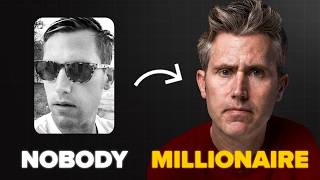
Brendan Kane went from making coffee as a production assistant to building a multimillion-dollar business by realizing attention matters more than talent. He got YouTube creators to promote the 2006 film Crank for free, built influencer-payment tech on MySpace, and proved his methods work by gaining one million followers in 30 days.
Chapters
If you've ever felt invisible in a room full of talented people, trust me, I really know what that's like. This is a story that transformed me from a nobody in Hollywood into a millionaire. Over the past 20 years, I've learned lessons that were completely game-changing for my success. So today I'm going to save you two decades and share them all with you. Now, these strategies will help you stand out, attract the right opportunities, and fast-track your success no matter what field you're in. Now, I started out like everyone else. I was making coffee runs, doing deliveries, bouncing from set to set to set, hoping for that one shot to stand out. But every time someone at the top asked, why did I move to LA? Well, their interest completely vanished the moment that I shared that I moved there to produce movies. They just simply ignored me because I sounded like everyone else with the same pipe dream, and Until I realized that I was just focusing on the wrong game. You see, it wasn't about talent, intelligence, or charisma. It was about attention. Now, one of my first big gigs was the movie Crank with Jason Statham. Now, the studio I was working for spent tens of millions making it and then straight up panicked because they only had a few months to get hundreds of millions of people around the world to notice it. The stakes were completely wild. And that is when I spotted something that nobody else did. You see, this was back in 2006. And at the time, there was a few random people on YouTube pulling in blockbuster-level views from their bedrooms while Hollywood still thought that YouTube was for karaoke videos and silly cat videos. Now again, remember, YouTube was only 2 years old at the time. So I pitched an idea that nobody expected. Well, let's engage a few of those creators to promote the movie for free. Now, They looked at me like I completely lost my mind. Work with kids? On the internet? No chance. And honestly, I started to doubt myself too. I was just an assistant with no track record, no budget, and no experience. But the president of the studio told me straight up, "Make this work or you're back to making coffee." So I went all in, staying up 3 AM every night, scrolling YouTube, cold DMing creators one by one. And most ignored me, some said no, and then finally, a yes, then another and another. Lisa Nova, who would later co-found Maker Studios. Judson Lightblade, who created the Evolution of Dance video. At the time, it was the number one viewed video on the platform. And then Pedro Flores, an early platform powerhouse. Each yes felt like oxygen after days of being underwater. And when their videos went live, it worked. That small $12 million movie blew up, earning more than 3 times its budget worldwide. And that was even before the DVD sales kicked in. Yes, DVDs still mattered back then. And that moment changed everything. I went from making coffee runs to building the studio's first ever social media division. And even Jason Statham invited me to his house to talk about his social media strategy, which honestly was pretty cool. So what's the actual point of this story? Why am I telling you all this? Well, the takeaway here is that my credentials didn't matter. What I could actually deliver is what mattered. And it launched my career to the next level. And this taught me a really valuable lesson. Always look for the wins that nobody else can see. Now, the first breakthrough was attention, but I knew it wouldn't be enough to make me a millionaire just yet. Attention is powerful, but without monetization, it's just noise. Because the last time I checked, you can't deposit likes and views into a bank account. But hey, let me know in the comments if you have found a bank that accepts engagement as a legal tender. Now, at the same time, Fox News Corp bought MySpace for $580 million. Now, back in 2005, that was an astronomical number. Today we talk about WhatsApp going for $20 billion or Instagram going for $1 billion, but back then, half a billion for a social network was massive. So I did a deep dive into why MySpace was worth that much, and more importantly, how are they actually going to make money? The truth, they weren't. It was kind of like buying a Ferrari and realizing it doesn't come with an engine. Now, MySpace did have the traffic, but they had no way to monetize it. Banner ads were microscopic and native ad tech didn't exist. In today's term, they were leaving billions upon billions of dollars on the table. But again, I noticed something that everyone else missed. People weren't just scrolling MySpace, they were turning it into a billboard for their identity. Filling their profiles with Nike ads, product posters, and movie trailers. And then it hit me. The real power wasn't banner ads at all. It was people influencing people. When a friend put a trailer or a product on their profile, it was the digital version of them saying, "I like this. You should check it out too." But the biggest problem was that neither MySpace nor the users were making a dime from it. So I built a solution, a system that let users share their favorite content and get paid for it while MySpace could earn a cut too. This was essentially the first ever influencer technology, years before the word influencer even existed. But then I made one of the greatest mistakes of my career. I had a chance to sell my tech to a startup called Facebook, and at the time they had less than 400 employees and they were in a single building in Silicon Valley. I actually flew out there. I had lunch with the team, but I ended up walking away and licensing it to MTV instead. Now, through MTV, we tested the technology with brands like Vice magazine, Rock Band, Yahoo!, Lionsgate, MGM, Country Music Television, Comedy Central, and a lot more amazing companies. And the engagement metrics were off the charts. And that became my first big entrepreneurial win. MTV cut me a substantial licensing check, my first major deal with a Fortune 500 company, and it validated me as an entrepreneur. This opened up doors through MTV. I built even more technology and partnered with even bigger brands. I also got introduced to Taylor Swift. Sometimes I do wonder what my life would have been like if I actually signed the deal with Facebook. But everything in life happens for a reason, and it teaches you valuable lessons. Now, by seizing an opportunity early, I learned that capturing attention was only step one. The real skill was turning that into money. And I figured out how to make money with my skill set. But there was a problem. The work was fulfilling, but it wasn't scalable. It was like building a house brick by brick with a high-quality outcome, but no way to finish fast enough for the world to notice. If I wanted to build something bigger, I needed a system where the opportunities came to me instead of me chasing them down. And then there was even a bigger challenge. Whenever people heard about my work with MTV or Taylor Swift, they assumed it was just luck, or it was because I had celebrity access. If I wanted to scale what I was doing, I had to prove that my system could work for anyone, Even someone starting from zero. That's when I decided to put my strategies to the test on myself. Could I take them from theory to reality? The goal: 1 million followers in 30 days. Measurable, clear, and impossible to fake. I wasn't going to test this on a celebrity or some client. I was going to risk my own credibility. Failure meant that I was just lucky and that I needed celebrities to have success. But if the experiment worked, It meant that people from all around the world would want to learn how I did it. It was a method built around 3 repeatable levers: pattern disruption, psychological triggers, and data-driven testing. And 30 days later, it worked. And the results, they spoke for themselves. The experiment became the foundation for 1 Million Followers, a book with a system that has since helped clients generate billions of views and millions in revenue. It definitely wasn't luck. I engineered an irresistible hook and packaged my credibility so effectively that no one could scroll past me. Most people already have valuable skills or stories worth sharing, but they hide them behind self-doubt, weak positioning, or flat messaging. If you can communicate your value in a way that resonates, plus create a hook that makes people stop, pay attention, and engage, then the opportunities will start coming to you, whether it's followers, clients, or media attention. Getting attention and scaling myself are only part of the equation. Turning it into something that lasts, well, that's the real challenge. Most people chase virality once. They get that hit and then they fade away. I wanted consistency. I wanted results that magnified because attention without a system is a dead end. When 1 million followers took off, I made a choice that most people wouldn't. I didn't spend the money on status symbols. I reinvested every dollar into building a system that could repeat success. That meant promoting the book to sustain awareness, developing frameworks to make results predictable, and building infrastructure to support more clients without losing quality. That process became the foundation of the Hook Point Viral Content Model. We built creative frameworks based on data and psychology. Not trends or opinions. Every failure was a test. Every test made the system stronger. There were no shortcuts. There were no luxury moments, just refinement and repetition. That's what turns short-term spikes into long-term credibility and consistent growth. But there's another trap that no one talks about: trying to do everything by yourself. I almost burned out doing it all—closing clients, creating strategies, delivering the work. There is a limit to progress if the business depends on you doing everything. And I learned that the hard way, that the quality of your team determines the scale of your success. You don't need to be the smartest person in the room. You need the right people in the room with you. So I started hiring first people who deliver for clients so that I could focus on growth, then on marketing to support and expand our message. And next, operations and project management to keep everything running. Each step freed up more time for what mattered most: innovation, strategy, and impact. Building a team around a proven system turned Hookpoint from a one-person operation into a scalable company. Now, we weren't just helping clients go viral, we were helping them sustain success. And that is what separated us from everyone else. Anyone can capture attention once. The real question is whether you can do it again and again and again, and then turn that attention into lasting business results. You see, attention makes you visible, systems make you reliable, and teams, they make you unstoppable. That's the shift that most people never make. They chase moments while I built mechanisms. And that's the key difference between being remembered for a moment and building a legacy that lasts and makes you a millionaire. So if you want to put these ideas into action, as a big thank you for watching this video, I'm going to give you a free copy of my book, Hook Point: How to Stand Out in a 3-Second World. It's packed with the exact strategies that I have helped entrepreneurs generate billions of views and millions of dollars in revenue. So if you click the link down below, you can grab your free copy. And if you want to dig in even deeper into our Hook Point viral content model, watch this video next.







