Jordan Made HOW Much Selling Shoes?
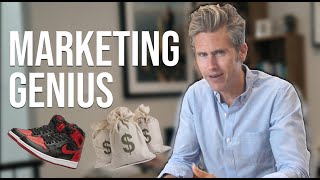
Michael Jordan's Air Jordan brand became a cultural phenomenon partly because the NBA banned the shoes, creating controversy that drove sales. The video breaks down how Jordan made hundreds of millions through endorsements and explains the marketing
Imagine a battery that can change the way we all think about driving. Now imagine a bookstore that can reshape a global economy. And imagine a shoe that can propel a sport into the global mainstream. They all may seem completely impossible if not for the fact that they were all brands that exist in the real world today. Now each did more than just outsell their competitors. They change the way that we think about an entire industry. And in this three second world where we have more brands, content influencers competing for our attention than ever before, there is something that you can take away from their stories no matter what you are trying to say, sell or do on social media. Which is why today I am going to talk about one of them and and what you can take away from the greatest endorsement of all time. Now you may think that honoring Michael Jordan with the title of the greatest endorsement deal of all time is just an exaggeration. And if you do think that, I invite you to actually look at the numbers Open Endorse a company that works to help athletes manage their PR and social media presence. Ranked the top earning athletes of 2019 on according to income generated specifically from their endorsement deals. At the top of the list with $86 million in endorsement earnings. You may not believe it, and honestly I didn't believe it, but it's actually a tennis player. Yeah, that's right. Roger Federer made $33 million more in endorsements than LeBron James. But before you start trading your basketball for a tennis racket, rest assured that Michael Jordan still remains king. Over a decade after retirement last year, his own individual take from his ongoing partnership with Nike netted him a cool $130 million, making him $44 million more than Roger Federer, almost two and a half times his nearest direct competition and the only member of the Nine figure club. Now that's not to say that money is the only metric to success. It's not. But if you're still more than doubling your direct competition and you've been out of the game for almost a decade and a half, there's got to be some kind of magic happening there. Besides all that, money is a byproduct of an influence that's so strong that it compels millions of people to drop $100 or more of their hard earned dollars for a pair of sneakers. AKA the things that most of us just slip on our feet every single day without even a second thought. Now I sure a lot of you are thinking, well of course these shoes sell well. They're being endorsed by the greatest basketball Player of all time. First off, be careful who you say that around, because there are a ton of people out there that feel strongly about who's actually the greatest basketball player of all time. Second, MJ and his Air Jordans have been making an impact from the jump. Get it? Because he's a basketball player and he's good at jumping. Back in September 1985, when the first Air Jordans released, they sold over $70 million worth in the first month. And you're not going to believe it, over 126 million by the end of the first year. And those first year sales came even though that Jordan spent a good portion of that season on the bench with a broken foot. That could have very well ended his entire career. Of course, those familiar with the Jordan one know that they were in the spotlight for another reason. You see, in Those days, the NBA had something called the 51% rule, which stated that all players sneakers had to be predominantly white and match that of their teammates. So when these red and black beauties hit the court, the league, they weren't having it. They even sent a now infamous letter to Nike that that sounded like a passive aggressive note your neighbor tapes to your front door after you play loud music. According to sources, Jordan was subsequently fined, get this, $5,000 for every single time he just stepped onto the court in his iconic kicks. But rather than let that deter them, the story goes that Nike happily paid for those fines for him. And they even made an entire ad campaign talking about the ban. Fortunately, the NBA can't stop you from wearing them Air Jordans. Suddenly, the new Air Jordan was more than a shoe. It was a symbol of rebellion, a way to stick it to the man. And there was a customer base that was hungry for it. Now this was a culture that came from the inner cities and was powered by art forms like hip hop, African inspired streetwear, and even independent film. Now, if you want to see all these put on display, look no further than Spike Lee's joint Do the Right Thing. More specifically, it's the scene where the dude who got blown up in Breaking Bad gets his pristine new Jordan scuffed by a dude passing on the street. That demand helped Nike deploy their final secret weapon in the arsenal. Scarcity. Nike only made a limited quantity of the Jordan One, as opposed to the other shoe companies that focused on volume. So now these shoes, they weren't just rebellious, they were actually collector's items. And Nike made sure to capitalize on this, releasing a new iteration of the Air Jordan every season and making sure that MJ was rocking them on the court. Now, they also made sure that their marketing reflected the very community that was buying their products. Even even using some of the tastemakers that helped elevate their product in the first place. Now see if this guy looks familiar to you. Money's gotta be the shoes. Shoes. Shoes, Shoes, shoes. You sure it's not the shoes? I'm sure. Mars. What about the shoes? No, Mars, money's gotta be the shoes. Over time, this entire business model gave birth to a community that became known as sneakerhead culture. It's one that's only gotten bigger since its early days in the late 80s and 90s. In fact, it's now a $2 billion retail market as well as a 6 billion dollar resale market. It's also why a new addition of a sneaker that used to cost $100 now sells upwards of $600. Since then, there have been plenty of other brands that have joined the mix, even going so as far as to throw in the Air Jordan just a period of time. But these days, MJ still outsells the competition literally without breaking a sweat. Because, like, he doesn't play anymore. So what is it about MJ and his AJ's that has been often imitated but never duplicated? And when I say imitated, I mean even by Nike, who has released his signature basketball shoe with 19 other athletes since then. Now a lot of people see Jordan's excellence on the court and use it to explain the success of of his product. Except Mike has endorsed a whole lot more than just sneakers. He's hacked everything from wheaties to McDonald's to Chevy's Coke. And not to mention this. Are these your hands? There a reason why you wear them? Definitely. Hanes. They'll get your dad laid. Well, maybe an endorsement can only be good if the product is cutting edge. While the Air Jordan was designed using the latest tech and materials and it wasn't the first basketball shoe to do so. Hell, it wasn't even the first Nike shoe to do so. Hell, it wasn't even the first Nike basketball shoe to do that. Even better, when Nike introduced its first cutting edge basketball shoe, the Air Force One, they were banking on the star power of not one, but six different players. Maybe it's the limited release business model. Except Nike had made limited quantities of all their basketball shoes at the time. And since the materials they needed to make all these shoes was harder to come by in those days. No, you're shouting. It has to be the ban. That whole fiasco with The NBA trying to ban MJ sneakers ended up making them super popular. Underdog wins again. Except hold onto your kicks because I have some news for you. There isn't any photo evidence of MJ rocking the infamous band Colorway during a league game. Yes, the NBA did send Nike a letter about MJ shoes, but sneaker historians, and yes, that is a real job, say that it's likely Jordan wasn't wearing his own sneakers after all. Instead, they assert that he was actually wearing a non signature shoe called the Nike Airship, which was finally re released this year. The only time he definitely wore his own merch around on the court was for the 1985 Slam Dunk Contest. So wait, did we just get punked? Well, not quite. Instead, when it came time to market the new Air Jordan, Nike and Jordan used the letter to create what I call a hook point. Put simply, a hook point is an intersection between a brand and its target audience where the potential appeal is communicated so succinctly and so effectively, it creates an instant bond that can only be described as the marketing equivalent of love it first sight. And this love story was absolutely one for the ages. You had a community of sports fans that was tragically underserved. You had new technology emerging that was built around the player and not the other way around. You had a truly exceptional player who was putting up groundbreaking numbers. You had a business model that enhanced demand. Add to this the story of a lone rebel player standing, standing defiant against the system, willing to do whatever it took to stay true to himself and play the game he wanted to. This was a narrative that spoke to this demographic that had been cast aside by the power brokering, coke sniffing, Gordon Gekkos of the world. Better yet, this was a legacy that they got to own a piece of, which is why they scraped and set saved and are still lining up to this day. That's because Jordan the man and Jordan the shoe became more than just a great athlete wearing fancy shoes. They quite literally became a symbol. One that became synonymous with rising above adversity and shutting up critics with sheer excellence. And that symbol would empower street kids to become style and cultural pioneers. Some of those street kids also became some of the top athletes in the world today that wanted to be a part of Jordan's brand instead of creating their own. So you may be asking yourself, what does this have to do with me? And what does this have to do with your brand? Simply put, it doesn't matter if you have the most groundbreaking idea, the most innovative tech, or the best athlete in the world. Repping your brand at the end of the day, what connects people to your brand is a compelling narrative. In this case, it was Nike leveraging the story of Michael Jordan, sticking it to the NBA and rebelling against the ban of the Jordan one. But in today's world, where there's a shorter attention span than ever, you get less than three seconds to try and get your narrative across. That's where the hook point comes in. Not only does a compelling and succinct story help you stand out, the connection it creates is made that much more powerful by its simplicity. And that's the idea that top notch marketers use to sell everything from athletic wear to computers to phones to car insurance. So now that you know the secret of hook points, figure out what your brand is all about and what your target audience truly wants. Then find a way to communicate your appeal in the cleanest, simplest way possible. That way, no matter what game it is, you too can be like Mike. Now, if you like this video and you want to get more tips on how to stand out in crowded markets and increase your overall success of your business, hit the thumbs up, subscribe to the channel and turn on notifications. And if you want to dive in further and learn more about hook points, check out my book, how to Stand out in a 3 second world because I can definitively tell you that hook points are the biggest determining factor between a struggling business and reaching the level of a Fortune 500 company. And in the book, we break down all the secrets of how to effectively create hook points for your brand and your business to thrive in any competitive market. So thanks again for watching and hit the subscribe button now.







