002 Consistent Profits Podcast with Adrian Reid of Enlightened Stock Trading
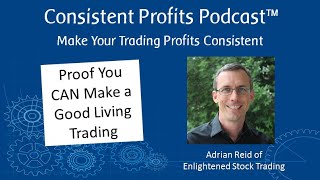
Adrian Reid discusses how traders can build confidence and consistency by matching their trading system to their personality. He covers mechanical versus discretionary trading, common pitfalls in trading education, and why self-awareness matters more than following someone else's method.
Hello and welcome to the Consistent Profits podcast brought to you by Inside out trading and Brian McAvoy, where the focus is on consistency because when you have the consistent part down, profits become easy. Hello everybody and welcome to Inside Out Trading podcast. And today with me I've got Adrian Reed of Enlightened Stock Trading. Adrian and I have known each other for a while. He's a good guy, he's smart, and he's living proof that you can't make a living at trading. He's been doing it for a while and doing well with it and teaching other traders how to do the same thing. Enjoying the traders lifestyle, traveling the world with his family and getting to, you know, just enjoy life the way it's meant to be enjoyed on your terms, which is cool. So if you got, if you got anything else to add to, you know, your introduction, fine. Otherwise, you know, how about we start off with your origin story, how you got started in all this and how you're able to actually make it as like a full time trader living life on your terms.
Sure, absolutely. First of all, thanks for having me on the show. Super excited to be here. I'm so thrilled that you've launched the podcast and we're keen to have me on. So this is really great. Look, most of the other things about my story will probably come out as we're talking, so why don't we just jump straight into what happened and know where I let, let's start with where I am now and then let's go back 25 odd years and then I can kind of bring you up to speed of how I got here. So as of now, it's 2023. I, I left the corporate world to trade full time in 2012. In 2012 I had a corporate finance job. Not in trading, nothing to do with markets, just like finance, accounting, business planning, strategy, that sort of thing. And that year I, I worked must have been six days a week on average, between 12 and 14 hours a day.
Wow.
And it was brutal. Like it was probably the worst, the worst corporate job that I had in terms of work, life, balance. And I earned a couple hundred thousand dollars that year. I think it ended up being about 230, something like that. And so that was okay, right? I was on it. I had a good career and everything. But that same year my trading made me more money working just 30 minutes a day. And that was the first time where my trading made more money than my, than my job in a consistent fashion. And we'll talk about consistency. I think during this conversation? Oh yeah, when that, when that happened, I looked at my life, my lifestyle and the work hours and my stress and how I looked and realized that something had to change and that it was time for the job to go. So since then I basically walked out of the corporate world. I've been trading full time, but for me, full time is not really very much work effort. I trade systematically and that means and on daily charts. So once a day for about 30 minutes, I run my systems, I find my signals, I place my trades and then I'm done. So that was great, right? I was living the dream. I had all of this spare time, but then I discovered six months later or within the next six months that I had no one to talk to and I was bored, lonely and depressed, which is just killer, right? Because I'd like achieved this dream that I've been dreaming of for 20 odd years. It's like, man, this sucks because no one is around to talk to, let alone having someone to talk to about my trading. Soon after that I started teaching and so enlightened stock trading was born. And actually most of my time since then has been on teaching what I did to achieve the outcome that I got. And trading is still 30 minutes a day. It's, it's very straightforward and we'll go into the nitty gritty of how I do it later. But yes. So I've been, I've been teaching now for a bunch of years. I, I keep trading every day now as we speak. Most of my trading, in fact all of it as of this week is, is fully automated so I don't even have to place a trade manually. Now all I do is check the executions and make sure the systems are running well and monitor them. So it's now monitoring oversight, development role as opposed to a placing trades role, which is super cool. And yeah, that's where I am now. But 25 years ago was a very different story. I just started in the corporate world, had about seven and a half thousand dollars to my name and after a couple of weeks, probably a couple of months working, I said to my dad, I don't think I want to do this forever. How can I, how could I retire? And he kind of laughed at me of course, because, you know, I'm 20 something barely and got a couple of thousand bucks to my name and that's it. But we started talking about investments and I'd never really done anything with investments as a kid. I didn't even have a job until I left university. I literally had no Employment all the way through and so seriously? Yeah, absolutely. So in high school my parents were like, no, I don't work. Just, just, just to school, do your activities, do your extracurricular and do your sport, that's fine. And then I got a scholarship to you to university. So that sort of paid me enough to survive. It wasn't lavish, but I survived. And, and then yeah, I graduated and started working. So it was a bit of a shock, right?
Yeah.
And yeah, just basically a couple of months in really, really wanted to form an exit plan and I started looking around at all the different styles of investments and shares appear appealed to me. They appealed because a, I didn't have much money so I couldn't go buy a property and I didn't have any entrepreneurial kind of influences in my life so I couldn't start a business or I could, but I like that wasn't on my radar. And the only other thing I knew about was stocks. So I was like, okay, cool, I'm smart, I can figure out stocks. And I started reading the newspaper and choosing companies that I thought were awesome and buying shares and losing money. And so I did that and a couple of, couple of years went by and I tried all sorts of different methods. I tried, you know, what's big in the shops right now. I tried what's the latest fad with kids. I tried fundamentally sound solid companies that pay good dividends and I tried mining spec stocks and I tried technical analysis and charts and indicators and signal services and all sorts of things. Newsletters, tried all of that. And eventually I read market wizards and all this time I was reading books, but I was exploring randomly, right haphazard like oh, there's a trading book, oh there's a stock market book. Oh there's a long term investing book. I read all of these things but I stumbled across market wizards and that was the tipping point. And I'm, I'm sure a lot of people would will say that as well. And I'm sure Jack is sick of people messaging him saying oh, you changed my life. Those books are amazing. But it did, it really did because I read all of those interviews and I could immediately cross off 90% of them and say I don't want to do that, I'm not interested in that. I can't do that. That sounds really boring. That sounds really stressful. And I found systematic trading in one of those interviews and I trained as an engineer and I saw that and I was like that's it. Like that's it, that's What I want, that is my approach. And from then on, and I'll show up and let you speak. From then on, I did nothing but learn systematic trading. And, and that, that was, that was the tipping point because I went on to build my first system, I launched my first system, my equity curve went from that to that on a dime. And you can see it on a spreadsheet. I recorded my equity every day for the first a bunch of years. And you can see the day that system turned on, on the equity curve without a joke. And that was the, that was the tipping point. And from then on it was just a matter of saving, compounding, getting better at building systems and patience.
Yeah, very cool. Yeah, it's trading I found definitely appeals to engineers. I've had a lot of engineers for clients and it's, it's cool because it must just be the math that has part of the appeal. But unfortunately though, yeah, engineers also, with the right help make it traders too, though.
Yes, yes. Provided they get through that. The, the tendency to over complicate and try and find exactly the right answer.
True.
You know, one of the big challenges I think is when people come in saying, what's the best system? What's the best set of rules? What's the best indicator? Which one should I. Those sorts of questions are so restrictive and perfectionist that it really holds people back in trading, I feel.
Well, part of it's also just the way, the way we're taught to think as we go through the school system. You know, there's one right answer on a test or whatever, and we're not really taught how to handle it when you might have a choice of say 50 choices and 10 of them are right answers. We're not taught how to deal with that mentally. And so, yeah, you know, people get into trading and it's like, well, that, you know, that would work. And it's like they got all these possibilities and it's like, what? Yeah, which is the best? And it's like, well, it depends. There's not one right answer. And so people hate that because it's like, no, there's one right answer. No, there's five right answers.
There's a whole lot of counterintuitive things about trading and things that are different to what we're trained and prepared for by school and by life. And I think being right and one right answer is the big one. Dealing with ambiguity is, is just such a challenge for most people. And you know, how long till I make a new equity high? Or how long till I get a, a winning trade or how long till this trade closes out? Like, we don't know the answers to those things, but as a trader, we've got to be okay with that because it's dealing with that uncertainty that gets us paid.
Oh, yeah, yeah. Indeed. Well, that's one aspect of uncertainty. And a little side note, had this book, had it as a part of my nightly routine to read a chapter out of it, each book, each night a little short book by Deepak Chopra. And one of my favorite chapters in there was When Welcoming Uncertainty. And when I first looked at it, it was like, okay. And he said, no, the reason you want to embrace uncertainty is because that's where all possibilities lie. If you don't like uncertainty, it's because you're clinging to the known and the past for that security. But it's all known. There's no new possibilities there. It's when you embrace the uncertain and the unknown, that's where all your possibilities lie. And it's like, that's a cool way to look at it.
Yeah, absolutely. Love that. Love that.
So now, speaking of which, one thing that we've talked about in the past that I think is worthwhile bringing up now is the path to getting to, you know, being a decent trader and where, especially, you know, us geekier types where, you know, we might start off on the wrong path. And I know that I've had a number of conversations with people where they come and ask, you know, should I be a discretionary trader or a mechanical trader? You know, what are your, what are your thoughts on that?
Yeah, solid question. And it's, it's something that so many traders struggle with, I think. And the natural choice that, the natural choice based on all of our life conditioning, I think is the, is the wrong choice or the more difficult choice, let's say, because the, when you come to trading and you look at the markets, you go, okay, cool, stocks. And they move up and down. People buy and sell and there's charts and oh, look, I can see the trend of the chart. And I'll look this sort of support, a resistance and support. And oh, there's indicators and we can put those on the charts, too. And if I put five indicators, these ones say buy and these ones say sell. So on average, I should buy and wait, but wait, there's divergences and this is diverging from that. So should I buy or should I sell? And so on and so on and so on. So I'm going to put it to you, and I think we we're probably aligned on this. That discretionary trading is incredibly difficult to get right because there is so many different information flows, so many conflicting signals, so much ambiguity, that it takes a very, very special, unique type of person to just be able to look at the market and be profitable in a discretionary way. But what's interesting is after most traders discover discretionary trading and they bang their head against that brick wall for a little while or a long while, eventually many come to this realization of, oh, some of these rules that I've been using actually make a difference, and some of them are significant and others are not. And if I combine those significant rules into a complete set of rules, let's call that the trading system, I can all of a sudden make consistent decisions. I can crank out the same type of trades over and over again. It's like, oh, right, okay. So the ambiguity disappears, the consistency comes in. But then the next step is, oh, I've got rules. They're objective all of a sudden, now I can test them. And so you can take those rules and you can test them over 20, 30, 40, 50, 70 years of history and see do they actually work over time? Is that edge stable? That journey takes most traders who end up as systematic, like five plus years, I would say. It took me three to discover systematic, and then I just went all in. I actually took three months off work to develop my first system. I just leave without pay. It's like, no, I'm doing this. This is the most important thing in my life right now. And I did that. I developed that system. But most people don't, you know, may not have that luxury. So it takes longer, let's say five years, sometimes 10. I've spoken to people 15, 20 years trading and still haven't gone systematic. And we make them, we introduce systematic trading into their life and all of a sudden profitable. So that journey is one that so many traders take. But what so few traders do is go, oh, stops trading, huh? I need a set of rules that work. Let's find myself a set of rules. A system that is actually profitable, has actually made money in the past and that I can follow. And let's learn how to follow those rules, and let's learn how to build confidence in those rules, and let's apply those rules and get consistent in year one. Like that happens so seldomly true now.
And I absolutely agree with everything you just said. 1. One of the big pitfalls for traders, though, sadly, and you may have experienced, maybe not. But I know in my early days, you get all these, all these jokers out there, a lot of them are pure marketers, never traded in a place to trade in their lives, screaming about the great system they've got and here's your consistent results and they're selling crap.
Yeah, absolutely true.
They took their system and, and they curve fit it to the, you know, this, this time period and look at these results. Oh yeah, this works. And it's like, yeah, if I could just trade that time period for the rest of my life. But you know, today and tomorrow. No, it doesn't quite work that well.
Yeah, absolutely. I mean it is one of the big pitfalls and it does take quite some learning experience to see the good be able to distinguish the good from the bad.
Oh yeah, well, and the patience like you were talking about, you know, everybody, they'll put in their time. I mean, they're going to pay for their education one way or the other. So you know, do you want to pay for it with time or do you, you know, invest a little bit in some help so that you know how to protect yourself from this stuff? And like, you know, like you teach traders, it's like, okay, here's a system and here's how you, here's how you confirm that it works, right?
And that's the trick. Yeah, that's the trick. Because what most people go do is they say, okay, I need rules, I need a system. Where can I buy a system from that's going to make me rich? And when you approach it with that mindset, of course you're going to get scammed by a marketer, right? Because that's exactly who they're looking for. And it's. So the trouble is, it's. And these marketers are good, right, because they make a lot of money, they've refined their craft. So I think that's the trap is don't look for a fish, look for someone or a source that will teach you to fish. Okay, So I don't, I, I mean, I, I haven't sold individual systems like here, here's the system, knock yourself out, you'll be rich. Like that's not the way I do things, right? What I do, like you said, is I, I grow, I build systematic traders, which means this is how and why systems work. Here's some examples of systems. Here's how you test and validate systems to make sure that those systems and any other systems you come across are actually profitable and consistent and will work in real time. But that's the skill that most people leave to last after They've blown a few accounts on dodgy curve fit systems.
Yeah. Well, if they ever, if they ever get to that point. No. One of the toughest things, and this for me has been like a big theme over the last several months, is trying to impress upon people, it's like, you're smart, obviously, you know, most traders are above average and you've got the characteristics that it takes to be successful here. Otherwise you wouldn't be in a position to trade. But the problem is, if you're trying to learn this by yourself, you're your own limitation. You don't know what you don't know and you can't see what you can't see. And so if you don't know how to test, or even that you should test until you learn that skill, until somebody points it out to you and teaches you how to do it, that you're going to keep struggling with the same problem. So getting the outside help is, is huge in trading. Because otherwise. Because this is not an occupation that lends itself to being figured out.
No, because it's so different than everything else we do.
Yeah, right. And the markets don't give you feedback. All they do is take your money. The markets never, you know, talk through the screen and say, oh, there's where you're screwed up. No, it's just cha ching, cha ching, cha ching is, you know, it empties your account and it'll go on for years. Yeah. And so that outside perspective is huge. So, yeah, run across somebody like you, that's the game changer because it's like, wow, I didn't know this. Right.
Yeah. I think the challenge, the challenge that comes up then is, okay, great, I need someone who knows. Right. But there's all these gurus. Who do I, who do I choose? Like, how do I know what a good one from a bad one and who's a scammer and who actually trades and, and all of that. And that, like, that actually is quite tough as a newbie to distinguish from one to the other who you know, who can really help and who. And who, who can't. So I think that warrants digging into a little bit as well.
Oh, yeah, Agree, agree.
And I think my approach for that is, is primarily you've got to look for someone who's, who's teaching you to evaluate the strategies. Yes, learn strategies, but you've got to learn how to evaluate them for yourself because you've got to become independent. No one should be beholden to some guru to tell them how to trade. Or to tell them what signals to take or what rules to use. You should be able to always validate what you get, what you're getting told.
Yeah, no, that's, that's really good. That's really good. Because yeah, it, yeah, I mean, well it can, it comes down to a choice. I mean sadly one of the great things about trading and again it's one of the, the double edged sword with trading. You get however you want to be involved. You can be like totally hands off where it's like, here, here's my money, you go trade it for me. And just give me, you know, a statement once a month all the way to, hey, I'm going to be around the clock six days a week, Forex trader, you know, trading all three markets and I'm just losing my mind, getting three hours of sleep a day and everything in between. And so like what you're talking about though, it's if you actually want to do this and be successful with it and have some control over your fate, you have to say, well, I'm going to learn how to do this.
Yes.
And become the person that knows how to do this. Like you said, not beholden to somebody else. Yeah, that's really where that's, that I find it's like the biggest thing is, you know, are you going to become the trader that you need to become? Because otherwise if you're just wanting to throw money at it and let somebody else figure it out or you know, make the decisions for you and stuff, you're just setting yourself up to get ripped off or, and, or even if you're working with somebody who's legit, if they have a bad year, they got a personal issue, you know, somebody, you know, family member dies or whatever and their trading takes a dive. If they're your whole brain and you're trading, you're screwed. And actually this one, so I got to share it. I had this one guy, had worked with him for years, he had tried all kinds of stuff including like, you know, yeah, he lost over 100 grand handed to somebody else to manage it. Took my course, tried his hand at it and still, you know, managed to screw it up. And he hooked him up with another guy, a friend of mine who had just been killing us back in 2020, crushing it all year. I mean he's pulling at least 25% a month ROI. I sent this guy over to him, he had something happen. I don't remember what it was, but a personal thing in his life and his training took a dive as soon as he doubled him, it's like, dude, you're just cursed. You need to quit trading. Because like everything you've tried, it's like it works up until you get, you get involved with it.
Yeah, it's almost like his curfews life somehow. I don't know what that is.
Yeah, that was so funny. But yeah, I mean, yeah, just you, I mean, yeah, really looking at it, it's like, okay, I'm doing this because I want some independence and I want some control over my life. But you got to take that control.
And say, and I think something you said earlier, I, I really, I want to circle back to. Because for me, I think it's really, really important is you, you're not. If you're going to be successful in trading, you have to become a trader. And traders think differently to everyone else and we make decisions differently to everyone else and our feedback mechanism is different to everything else. And so within someone's, someone new coming to the market, their experience set is completely useless when it comes to making money in the market. Almost without exaggeration, completely useless. And so what you said, which I really love was this is not something that lends itself to being figured out on your own.
Oh yeah.
Because our experience when we come to the markets is not helpful. In fact, it hurts. It's hurtful. And so to learn the craft, you're either gonna have to go through a whole lot of pain figuring out that your experience is before trading is not helpful, or go to a source and kind of learn the lessons more in a, in a, in a student manner as a, as a, as a, just like, as a follower of some, someone else's approach until you can master it and become, you know, independent on your own. Oh yeah, but you really, I think trying to figure it out is the cause of more account blow ups than, than anything else because most people just think, oh, I can do it, I'm smart. And most people are smart, but that doesn't make them good traders.
True, true. Yeah, absolutely. Very good point. Well, and the other thing that you were talking about as far as, you know, discretionary versus mechanical traders, when the way, the way I answer that question usually when people come to me is, you know, should I be a mechanical or discretionary trader? What I'll tell them is you need to be a mechanical trader for a while just because if you try to be discretionary trader, you don't have the processing wired into your head yet. Yes, you got to be a mechanical conscious and conscious processing is, is, is What? It's wired right before you. I mean, you can be a discretionary trader, but don't go straight to it. You want to come over here and establish the success and the thought process and the perceptions and, and being able to look at the markets correctly. And once you've, then you, once you've developed the skills with that, then you can come over here and take your hand at discretionary trade because at least you got that wiring in your head to process things properly.
But otherwise most people do it the wrong way around.
Yeah, well, yeah, if you're going to be a discretionary trader, every time you've got those undefined decision points, those are just invitations for your emotions to come in and mess with it. Yes, it's a wide open door and it's subject to all depending on how you're feeling at the moment. If it's been a rough day, you're going to be more skeptical, you're going to interpret things differently than if it's a good day and you're feeling optimistic. But since you haven't defined it as part of your system with the rules, yeah, it's wide open. And as far as getting consistent results, it's the opposite. That's like you're, that's like you're trying to ruin your consistency because all you're doing is introducing intentionally variability. Yeah.
And in fact, look, I'm, I'm pretty happy to admit I can't be a discretionary trader. I just don't do it well. But I can design systems that work. I can test them and validate them and I can follow them. And that's, that's all you need. I mean, I've made millions of dollars trading and, you know, built a really good life and I'm pretty happy. And it's no stress.
Right.
Because I can follow my own rules. But if I tried to go discretionary, you know, that wouldn't work for me.
Yeah, you hit on another good point right there.
Good enough, good enough.
No, that's huge. And that's one because some, some of these, some of these people that I talk to, guys, usually they're just so amped up and they're seeing, you know, all the different opportunities, all the different trade setups and all the different market moves. And it's like one of the main things to get across them is if your system works and we're going to make it work, accept that there is other money being made over there and that's okay, what you're doing is good enough. You don't have to try to have it all.
And yeah, my approach. Yeah, sorry, you go, yeah. My approach to that is one, one thing at a time. And so like let's, let's get one system in place and let's start following it. Let's get good at following it. Let's get consistent, let's get confident.
Yep, absolutely.
And one system won't make money all the time. Like let's, let's talk about long trend following in stocks.
Right.
Great strategy to start. It's very forgiving. It's hugely profitable in the long run. It's psychologically a little bit difficult because you've got to have a high tolerance for losing trades and a lot of patience. But it's very forgiving as, as a new trader. So I, I like to start people there, but it doesn't make money all the time. So. But once you've got that system in place, you can go, okay, well maybe I need a short side strategy now because when I combine long side trend following and short side stocks, then I make money more of the time. But I, I don't try and do both at once because there's too much to learn. One thing, do it well, then go to the next edge or the next set of rules or the next system and then the next one and then the next one and then the next one. And you know, a lot of people say trading is like, okay, this is just one of the next hundred trades or the next thousand trades or whatever it is. And that's a good way to think about it because each trade shouldn't matter as long as you've got a consistent approach. I think of systems in a similar way. This is one system in my portfolio. So this one system doesn't have to be perfect. It just has to play a part, let's say alongside stock trend following. It has to make money in stock bull markets. Has to let me ride the whole bull market. It has to get me out to safety when that's done, that's its job. But then there's another job I need a different set of rules to do. That's when the market's collapsing. I want to make money from that. And then there's another job that I need a system to do, which is when there's dips and rallies and the market is volatile, I want to catch some of the dips and sell in the rallies. So it's a different job. None of those have to be perfect. But when you combine them together, there's lots of different systems doing different jobs and, you know, the portfolio does well and you don't have any. You don't have 100% reliance on any of those ultimately. So none of them have to be perfect. They just have to be profitable.
Yeah. Okay, well, and like, like you said earlier, you know, if they work for you. Yeah. And yeah. So long as you got a system that works and you're comfortable with it and you can execute on it consistently. That's exactly why we're all here. Okay.
Yes, Very cool. So then the trick is, how does one get comfortable, confident with a system to execute it consistently? That's another challenge that many struggle with because a lot of people get a systems like trading and it's great when it's making money, but then it goes into drawdown. All of a sudden the emotions come in and they start doubling down or averaging down or sizing big to try and recover or sizing small because they're scared or stopping taking signals altogether until the drawdown's finished and they're at new equity highs and they've missed the whole recovery. There's all of this crazy behavior that happens because people don't have the confidence to follow the rules once they've got them. And I think that's building that confidence is a whole, you know, it's a whole thing in itself.
Oh, yeah, yeah, indeed. Very true. That was a really good description of the situation, though. Very true. Well, so you meant. Okay, so you've been teaching for how many years now?
Since 2014. I started formally teaching 2013. I took my first one on one coaching student for free because I just wanted someone to talk to about trading that I. It took me a little while to realize that teaching for free doesn't work because they didn't have skin in the game. Like I would. I was living in the suburbs. I would trek all the way into the city to meet this guy right at his lunch break so that I could talk to him about trading so that I could have some stimulation and I could help someone. And he wouldn't turn up because his meeting went over. So it took me a little while to. And a few times for that happening, for me to go, you know what? I think I might make this a business so people actually show up.
Yeah, well, so you got your, your. Now did you start with your enlightened stock trader? Was that your first sight or did you know?
I started, I started off with. With a website called Trading System Life. And because I traded with systems and that was my life and that trading system life was Kind of what I aspired to. For me it's like, cool, I'll share that with people. And I, I started doing that, but I realized after a little while that people were choosing the wrong systems and then were struggling with it emotionally. And this is back to our if it fits me, if it fits you kind of discussion that we already had. And I, I pondered that for, for a long while. I was building the site for a couple of years. I wasn't, I mean, I was sort of coaching one on one. I didn't have a course or anything. It was just sort of bespoke coaching. And I, I realized that the personality, the objectives, the lifestyle, the person and their thinking was still quite important in, in systematic trading. And I had discounted it for me because I, I built a system I was comfortable with. So why can't you just follow the system? You know, as my, I was comfortable with it, you should just follow the system. But people weren't doing it right. And that's how enlightened stock trading was born. Because it, I realized that it requires an awareness of self and it's more than just being a technical system trader. You know, you've got to be aware of yourself. You know, what are your objectives, what's your personality, what's your lifestyle, what are you comfortable with, what are you not, what's your drawdown tolerance, what's your tolerance for loss, what's your tolerance for, for waiting, for doing nothing and lots of things like this. And what's your tolerance for letting profits run versus taking them off the table and how big your losses can be? All of that is personality driven. And so I came up with enlightened stock trading because I figured if people could become aware of themselves, awareness of what they're comfortable with, and marry that with a system that matched, then it would be very easy to win as a trader or certainly much easier. And I actually still believe that's true. When you match the trader and a strategy and you, and you build the confidence in that strategy. Following the strategy of the system is not hard, it's just natural. Just click, click, click. That's all you got to do.
Agree. Yeah, it's good wisdom. You share that. That's very true, very true. And the right kind of personal lessons to walk out of trading with. Yeah, right.
So enlightened stock trading is what I'm sticking with because that, that's the right message for me. And, and out of enlightened stock trading, you know, I've coached hundreds of traders now and I've Got a great mentoring course and lots of systems strategies that they can choose from and match to their personality and all of those things and they walk out. A trader not reliant on me. I say to all of, to all of my students when they come in, my outcome is not for me, you know, for you to be reliant on me. My outcome is for you to not need me anymore. Because I want them to build that awareness, build that understanding of themselves, build that understanding of systems and build the confidence and the processes to evaluate strategies for themselves. So that's the big focus of what I teach, is the evaluation of the strategies. So then when they walk away and leave, they can pick up a strategy from a book or the Internet or from some other course and actually test it properly themselves and be confident that they've done it right so they know whether that strategy fits them or not.
Yeah. Yeah, that's good. And that's a good service that you provide for people. So. Very cool, Very cool. Well, I'll tell you what, man, I've thoroughly enjoyed this conversation with. This has been really good. And for anybody, if you're now, well, as far as trading, do you stick primarily stocks or have you been actually you started trading or coaching crypto trading, right?
I do, I trade stocks and crypto and I have programs for both. So that's my scope right now. That will probably expand in future as my own trading grows and expands. But, but those things, those are my, those are my focus in enlightened stock trading right now. So.
All right, so for everybody listening, you know, if, if you're trading either stocks or crypto and you want to do it right, you want to kind of shorten the learning curve and avoid some painful experiences and life lessons, definitely swing by enlightened stock traders. Adrian's a good guy. I've known him for a long time and if you're looking for the right help, he's a really good guy to talk to and reach out to him. And if you want to check him out ahead of time, he's got lots of YouTube videos, he's on lots of podcasts so you can get a good feel for him for you initiate contact with him, but he's definitely somebody who's going to take good care of you and do his best by it. Again, make you a self sufficient trader. So, Adrian, I totally have enjoyed this conversation, man. I appreciate you taking the time and having the conversation with me and look forward to future conversations where we can cover some of the other topics. Our last one, I Think we were kind of having a debate on the system versus psychology and that was a fun conversation. We can have some fun ones again in the future.
That's great.
Final words you want to share with everybody?
Yeah, look, thanks so much for having me on. I really love sharing this stuff and I appreciate your, your kind of input and, and questions as well. Really well done. If anyone wants to just get some free materials to help them get started, I put something together for your listeners. That's at enlightenedstocktrading.com forward/inside out Trading. So there's a free bundle, of course in there. There's some cheat sheets to help you kind of get started, repair your portfolio if you need that, eliminate some mistakes and so on. So it's great resources just for free, just to help people get on the right path. So. Enlightenstocktrading.com forward/insideout trading.
Wow. Excellent. Thank you for doing that. Yeah, absolutely. Thanks again, man. It's great, Great chatting with you and look forward to doing it again.
Likewise. Thanks so much. See you next time.
Talk to you soon, man.
Bye.
Thank you for joining us today on the Consistent Profits podcast brought to you by Inside Out Trading. If you enjoyed the show, make sure to subscribe on your favorite channel and we'll see you on the next episode. Cheers.
Kind of discussion that we already had. And I, I pondered that for, for a long while. I was building the site for a couple of years. I wasn't, I mean, I was sort of coaching one on one. I didn't have a course or anything. It was just sort of bespoke coaching. And I, I realized that the personality, the objectives, the lifestyle, the person and their thinking was still quite important in, in systematic trading. And I had discounted it for me because I, I built a system I was comfortable with. So why can't you just follow the system? You know, it was my, I was comfortable with it. You should just follow the system. But people weren't doing it. And that's how enlightened stock trading was born because it, I realized that it requires an awareness of self and it's more than just being a technical system trader. You know, you've got to be aware of yourself. You know, what are your objectives? What's your personality? What's your lifestyle? What are you comfortable with? What are you not? What's your drawdown? Tolerance? What's your tolerance for loss? What's your tolerance for? For waiting, for doing nothing and, and, and lots of things like this. And what's your tolerance for letting profits Run versus taking them off the table and how big your losses can be. All of that is personality driven. And so I came up with enlightened stock trading because I figured if people could become aware of themselves, awareness of what they're comfortable with, and marry that with a system that matched, then it would be very easy to win as a trader or certainly much easier. And I actually still believe that's true. When you match the trader and a strategy and you, and you build the confidence in that strategy, following the strategy or the system is not hard, it's just natural. Just click, click, click. That's all you got to do.
Agree. Yeah. It's good wisdom. You share that. That's very true, very true. And, and the right kind of personal lessons to walk out of trading with. Yeah, right.
So enlighten stock trading is what I'm sticking with because that I, that's the right message for me. And, and out of enlightened stock trading, you know, I've, I've coached hundreds of traders now and I've got a great mentoring course and, and lots of systems, strategies that they can choose from and match to their personality and all of those things. And they walk out. A trader. Not reliant on me. I say to all of, to all of my students when they come in, my outcome is not for me, you know, for you to be reliant on me. My outcome is for you to not need me anymore because I want them to build that awareness, build that understanding of themselves, build that understanding of systems and build the confidence and the processes to evaluate strategies for themselves. So that's the big, the big focus of what I teach is the evaluation of the strategies. So then when they walk away and leave, they can pick up strategy from a book or the Internet or from some other course and actually test it properly themselves and be confident that they've done it right so they know whether that strategy fits them or not.
Yeah, yeah, that's good. And that's a good service that you provide for people. So. Very cool, very cool. Well, I'll tell you what, man, I've thoroughly enjoyed this conversation with this. It's been really good. And for anybody, if you're now, well, as far as trading, do you stick primarily stocks or have you been actually you started trading or coaching crypto trading? Right?
I do. I trade stocks and crypto and I have programs for both. So that's my scope right now. That will probably expand in future as my own trading grows and expands. But, but those things, those are my, those are my focus in enlightened stock trading right now. So.
All right, so for everybody listening, you know, if you're trading either stocks or crypto and you want to do it right, you want to kind of shorten the learning curve and avoid some painful experiences and life lessons, definitely swing by. Enlightened stock trader. Adrian's a good guy. I've known him for a long time and if you're looking for the right help, he's a really good guy to talk to and reach out to him. And if you want to check him out ahead of time, he's got lots of YouTube videos, he's on lots of podcasts, so you can get a good feel for him before you, you know, initiate contact with him. But he's, yeah, definitely somebody who's going to, you know, take good care of you and do his best by it. Again, make you a self sufficient trader. So, Adrian, I totally have enjoyed this conversation, man. I appreciate you taking the time and, you know, having a conversation with me and look forward to future conversations where we can cover some of the other topics. Our last one, I think we're kind of having a debate on the system versus psychology, and that was a fun conversation. We can have some fun ones again in the future.
Sounds great.
Final words you want to share with everybody?
Yeah, look, thanks so much for having me on. I really love sharing this stuff and I appreciate your kind of input and.









