010 Interview with Etienne Crete of DesireToTrade.com
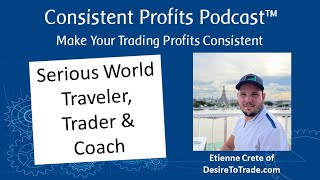
This is a YouTube video titled "010 Interview with Etienne Crete of DesireToTrade.com" containing an English podcast interview recorded in April 2023. The episode features Brian McAboy hosting a detailed conversation with Etienne Crete, a seasoned Forex trader and creator of Desire2Trade. They discuss topics including trading while traveling, prop trading firms, trading psychology, AI's impact on trading, and strategies for consistent profits. The content is an in-depth interview focused on trading education and lifestyle.
Hello and welcome to the Consistent Profits podcast brought to you by Inside out trading and Brian McAvoy, where the focus is on consistency because when you have the consistent part down, profits become easy. Hello, everyone, this is Brian McAvoy with a new episode of the Consistent Profits podcast brought to you by Inside Out Trading.
I'm.
I'm really excited today to be interviewing Etienne Kret, creator of Desire2Trade. Thanks so much for being on the podcast today.
Yeah, pleasure to be here. Looking forward to talk with you and see what they come up with here. Interesting.
Yeah, indeed.
Now, so everybody knows Etienne is a seasoned trading veteran. He looks young, but he's been at this game for a while and he focuses on forex and he travels the world while trading full time. He's not one who just talks the game. He actually does travel the world and does his thing all over the place, which is pretty cool.
Cool.
His preferred method is swing trading and his stated goal is to help traders quit their nine to five jobs to help them scale their trading and live on their own terms. Over the last several years, he's interviewed hundreds of other traders on his own podcast, Desire to Trade, where he learns from them and shares lessons with traders of the world. His site even got listed as one of the best trading blogs here not too long ago, which I thought was really cool, along with being a great networker and trader. Etrans. Just a pretty cool guy and very down to earth again, thanks for being here.
Yeah, pleasure. Good intro. You got all the fact right, so. Sounds very good. I appreciate it.
Well, I gotta ask you, I mean, just, I mean, you know, since you are a traveling trader and you're wanting to help others, you know, live that life which most people haven't yet, what's it like being a traveling trader and, you know, as far as, you know, just managing your time and the change in time zones and that kind of.
Stuff, I'd say it's a pretty fun thing. Like I wouldn't do things any other way. I think traveling and trading is one of the best things I've done and the things I'm really the most happy about. It kind of gives me energy a lot, but it kind of brings some challenges to trading, which is like you said, the time zone. You cannot just like trade at eight hours a day. If you travel, you have to limit your hours of trading. You gotta kind of provide things a little bit and hopefully automate also a few things. So for me, it's all about kind of having a similar routine every day. So I Check the charts usually a couple times a day because I swing trade and if I can fit this to my schedule, if I'm on a plane, of course I won't do it. But if I'm in a place where I can check the chart, I'll do it. And I have other ways like automations our goals to help me manage my trading and kind of make things more efficient. So yeah, it's a lot of fun because you can be in different places all you want and trade at the same time and still make you living. But travel the world. But it brings some challenges and some things to be aware of and kind of work on. We can talk about those more if you want.
Sure.
Well, where are you right now?
I'm in Bangkok in Thailand. I've been here for a few weeks now. I was in Vietnam last month for a couple of weeks in Cambodia as well.
Wow.
So how do you wind up choosing that area to be in for this time of year?
Well, so I've got a apartment in Bangkok now. For me, this was a place that I kind of came to before COVID to be able to travel mostly around Asia. So I got this nice apartment here and then Covid hit. I couldn't really travel too much outside of Bangkok. Stayed in Thailand for the past two years. Went out a few times in the past two years. Went to Canada, I went to other countries around. And now I'm kind of getting back to traveling more and more this year with COVID being pretty much over. It's kind of a good place to be to be able to travel around and see the countries around Asia.
Very cool.
So as far as, you know, the jet lag and everything when you travel, are you like making significant time zone changes or is it not too bad, just a couple hours?
Yeah, I could make big changes, but I won't do it. Like all like also often it's going to happen maybe every three months or so while go, let's say between Asia and Canada, for example. I'm not doing this every week for sure because that would be way too draining and like hard on the routine.
Yeah, yeah.
Hard on the body.
Very cool.
Well, since you do, you know, like you're not just traveling around Canada or whatever, you're actually spanning the globe when. And you're trading forex. So do you ever change what you're trading, like as far as, you know, which exchange you're working off of, like Hong Kong versus London versus, you know, the US or do you stick with the same, same time frame for Your trading hours?
Yeah, for me it's always the same. It's the forward chart and the one hour charts that I trade. So these are very easy trade in like any kind of time zone you could be in. The sessions might vary a little bit, but that to me doesn't matter too much. Most of my trades still happen during like the London session and the New York session. Asia is definitely more quiet, which is like my morning here. So I don't take too many trades there, but they happen more like in the afternoon here, mostly in the evening. And then I have now go take straights basically when I'm asleep at night. So I don't have to worry too much about that time zone. So yeah, it doesn't matter. I follow the same time frames and kind of look at them whenever I can, ideally a couple of times a day to kind of spot itself correctly. But yeah, that's the routine I follow.
Okay, well.
You being kind of a busy guy, I mean, you know, because you're traveling, you're running your own podcast and YouTube channel, plus you know, you got your business desire to trade where you're coaching others. How do you manage your time and still have a life?
That's a very good question. So first things first is I don't do everything myself. I have a big team behind, well, not so big team, but a good team behind my company who can help me to manage other stuff. So for me, recording videos take about like an hour a week, maybe an hour and a half for the, the plans and everything. Have a team to edit these videos, post them on YouTube and everything is done after the podcast. Take yeah, like a few hours a week sometimes, but that's, that's about it. Then it's really kind of trading for me is a way to, I try to keep it more hands off where I take trades when I need to take trades, then I'm away when I don't have to do anything on the side. So I don't like my, I don't micromanage my trades. I don't tend to like review them or like change different things in my trade. That makes it a lot easier and I have a set of goals to help me kind of take trades when I'm not at the chart and kind of make things more efficient. So overall it's all about not doing everything. You cannot just do all the stuff and expect to have time. Other things I need to be doing and the other stuff is kind of delegated or just done at all. If it's not Useful for me.
Okay, all right, that makes sense.
Yeah. And having some hands to help take care of matters because I know from personal experience as far as, you know, running a business and the podcast and you've also published Quite a few YouTube videos, all that stuff takes time. A lot of people don't appreciate the amount of work that can go into doing stuff like this. So yeah, it's cool that you got a good team backing you up there. Now one thing I did want to ask you about. In the last few years prop trading has become real popular and there are prop firms all over the place and I mean you've even got your own funded trading. But what do you like about this as far as prop firms where know people can get into trading and they don't even need the capital now to really get started, they can trade with the prop firms accounts. You know what is he like about that and what should a person be looking for in a firm that they decide to work with?
Yeah, to me proffers is a good way to kind of scale up your trading faster to go full time back a few years ago, maybe like a decade ago, so you had to kind of gather your own capital to put in your account then trade with to be able to go full time. And that can take some multiple years for some people. The way I kind of went full time SF and I kind of speed up my process was getting capital from private investors back in Canada. So it was like a private investor, nothing too big for sure, but kind of helped me to kick start things and kind of make some profits in the account. And what should a profit? I'll get some part of the profit, reinvest my own account after and kind of move forward. So profit, these diseases are similar to that. Now there are some challenges, there are some problems that are not so good, some problems that are better in terms of picking the right platform. I would say trying to stay away from the ones that have a very tight or limited evaluation. So a lot of these problems out there, they have like a 30 day challenge or 30 day evaluation which in 30 days is really hard to kind of get the targets. So yes you could be lucky, you could take some more risk. But it doesn't really encourage any trader to kind of be risk averse, at least protect their risk, like have decent rules out there to kind of make sure don't roll the account and the traders take more risk, pass a challenge but then they kind of increase drawdown as well on that account. So the way you pass a challenge like this is different than the way you're going to trade after the challenge. And people don't really realize that too much. Then they blow up the account or lose the funding after. So if you take a profit that has no limit or at least encourage good trading habits, like good trading rules, then it makes a lot more sense.
Okay, now you said 30 days is kind of short. So what would you recommend as far as a reasonable evaluation period? What do you think is reasonable for that?
I think as long as you can. So our accounts, we don't have any time limits. You can take as long as you want to do it. You can take six months, a year if you want to. It doesn't matter. We don't pressure on a trader, it doesn't work too well for them. It's never going to be a good thing to put pressure on someone to perform or like pass a challenge. Some problems are six months, I've seen, others with three months, I've seen two months. It really depends like also your training style if you're day trading or like scalping is different than if you're a long term trader. So you might want to kind of fix something depending on your style, how many trades a month you take and what makes sense for you for your mindset also.
Okay, so, so what are you looking for when you say evaluate a trader? What are you, what are you looking for? What are the specific things that you look for as far as you know, when what you consider, you know, successful trading or you know, somebody who's doing the right things and they're heading the right direction, what are the things that you look at?
Yeah, so the main thing is we don't want to give capital to people who would be losing it after, especially live capital. So they begin the evaluation on a demo account. They have to prove us they can do at least 10% on this account without losing more than 5% of the account. So it's like a 2 to 1. Of course you can manage your risk size, kind of fit in those criteria no matter how much you risk or how much you expect to gain. So if you can make 10%, not lose more than five in any given period, then to us it shows us you can trade at least profitable or somewhat well. Now we've got some rules around like you got to place at least a trade every 30 days. Rules around like the drawing you can reach also when you kind of hit your target. But overall it's pretty much just that just being able to hit a target by keeping the risk low is what we were looking for there.
Okay, okay.
And, yeah, that's. That makes sense now as far as helping to instill the habits so that, you know, once they're done with the evaluation period, how do you. How do you go about it as far as helping the traders develop those right habits and how do you know if they're keeping on track?
Well, we don't know. The only, the only way to know is kind of like with the P L and things we do, we try to keep in touch with our traders who are funded. We kind of check with them sometimes. We might have calls with them and we're going to support them along the way because, you know, trading is, first of all lonely sometimes and it can be tough to maintain the same stuff you've done for a long time. So we are there to support them, help them along the way. But it's also a thing where they're free to trade whatever they want. They don't have to reach target every time. So they don't have to have the pressure to reach a certain target when they're funded. They can do whatever they want. They can take their time, they can reduce risk. We ask them to reduce the risk as much as they can to be comfortable with it and just kind of go with that. So it's really about making what they've done and kind of staying on track with the habits.
Now, as far as the people coming to you, are you finding that most of them are fairly new traders or traders who've been at it for a while and just really haven't been able to get things turned around on their own? And so they're coming to you for kind of the help with that and working in the funded account.
Since my YouTube channel has grown a bit more in the past few years, I feel like it's a lot more of beginning traders coming in, especially the bigger audience, more newbies, apparently, which is not a bad thing. People want to get the right hybrids in the start. They want to build the right skills from the beginning, which is a good thing. But there's also a big portion of people who have been training for a while and want to get kind of profitable. They are looking for what they're missing, what they've been trying to learn but didn't work for them. And it's kind of a mix of both, but a lot of beginners, a lot of intermediate, a few advanced, but not too many overall.
Okay.
Well, one thing I got to.
Ask you, just because.
I find it funny and not to bash Reddit but it kills me how many traders especially, it seems like some of the younger people that I've talked to lately who want to get into trading, they're trying to learn how to trade over here on Reddit and with cash apps. And I'm looking at what they're doing and their mentality, and it's like, oh, my gosh. So if you got somebody that comes to you and they're saying, yeah, I'm all in on GameStop and Robinhood the whole night, and they're spouting all that kind of stuff, how would you kind of respond to that if they want to come on board with you? If that's been their background and experience so far?
You know, I found that these kinds of people don't like to buy courses or don't like to educate themselves because they know they can do it easily or they feel, actually they feel they can do it easily by their own, with themselves only. So they only need a course for that. But I think everyone needs kind of in training, everyone needs to go through a certain learning curve. And that goes with, like, you feel good about, about your training. First, if you're confident, then you lose some money, then you kind of lose your confidence, then you got to go back and rebuild it after. So these guys are just maybe in the beginning of their learning curve, they have to kind of feel the pain of the market, then get back and learn the right stuff. So there's always a time for everyone to kind of learn and kind of become better at trading. Might not be the time for the guys who are looking to make big gains, like looking to get rich with cryptos or these kinds of things. So it's just about a certain time frame to go for.
Okay, fair enough. Fair enough.
I. I had to ask because I've been. I've been in that situation a few times where I got somebody in there. Oh, man. I mean, they're just all excited and they're amped up and, oh, you know, you help. You know, you help traders. Yeah, because, you know, I'm like, oh, my God.
These are the people that. That might drop off on the course eventually, too. So you want to make sure if you get people in the program that, that you have them with, like, you have them on something, whatever, they work with you. You want people who get results because that's good for your marketing, of course, good for your image. It's important. So you don't want them to drop off after a month and be done with it and move to a different market. A different thing that they look for now.
True, true.
Now with your funded accounts, do you have everybody restricted to Forex or do you trade the other arenas as well?
With the broker we work with now, which is acap, we have everything we have available on the broker. So MT4 or MT5, that includes in MT5 you have forex, of course, you have commodities, you have index, you've got a few stocks now and a few cryptos as well.
Okay, cool, cool.
Now, kind of shifting gears here a little bit with AI being the big buzz this year and so many in the business world looking to take advantage of AI and the different tools that are there. How do you see AI affecting trading and some of the stuff that's going on in the AI world when it comes to trading and for individual traders, what do you see on the horizon for that?
Yeah, it's a fun question. I think you can get far, far more advanced than it is now, for sure. That's definitely a possibility. I think now it's way too early to do anything with trading. AI is good from what I've said. Of course, I'm not an expert in AI or anything of the sort of. But from what I've tested, it's good to get answers to questions you have or issues you have. But it's not going to replace your whole trading job or anything. It's not going to create your strategy by itself. I think you still got to put in the work and I think you still got to maybe use it. Learn how to use AI to see what it can do. But don't get too happy because you see, I can create strategies or whatever for trading and get you profitable. That's not going to happen for him very soon. I don't think so.
Okay.
Yeah, I've been, I've been curious about it myself just because, you know, I mean, robots, you know, came around several years ago and we know we're all the rage for quite a while and they've got their place for sure, you know, expert advisors, robots, whatever you want to call them. But with the new AI, where it actually is, you know, learning software, I'm kind of curious to see where that's going to go. I mean, we got other stuff going on. It kills me how this whole trading universe, it just continues to evolve over the last like 20 years. You know, going from phone call based, you know, trading where you had to call a broker and place your trades and that kind of stuff and actually people down on the pit floors and a lot of it's all automated move to the offline or the online world. You know, we've got AI, but we've got other stuff potentially coming. I mean, do you, have you given any thought or, you know, what do you think about as far as the government's lately, you know, talking about changing the financial systems, like going to, you know, digital coins and stuff like that. You got any thoughts on that as far as how it might affect, like, particularly the foreign exchange market?
I think that might be interesting for Forex or that might be a good change. Maybe more volatility, more people coming in to trade, at least be interested in the digital currencies. Could be interesting to see. I'm not sure how soon it's going to happen. I think it will take a lot of time, but yeah, something to maybe monitor, keep an eye on, for sure.
Do you see the cryptocurrencies actually ever getting merged into the foreign exchange markets as they exist now? Because right now they're kind of standalone. Have you ever seen the merge of the two?
I think that would be a stretch. Now we have many, many brokers, like Forex, brokers who have cryptos as a thing you can trade on the platform. But as far as saying that these will be merged with Forex, I think that's going to take a long time. The government's still not ready to, I think, give in and have this available for everyone everywhere else. I think it's also limited in terms like not everyone's going to buy crypto because it's tough to buy. It's a complicated process. I cannot imagine the aunt or the grandmas buying cryptos anytime soon. So I think it will take a long time before this gets next to real currencies.
Yeah, we'll see. Yeah, it's going to take more than just a subtle shift. Although I am still curious just because bitcoin, I mean, bitcoin's been around for a while, over 10 years. But with the other currencies and particularly blockchain technology and how some of these other currencies operate, I think it's going to be interesting, especially with the decentralization. You see decentralization affecting the foreign exchange markets or do you think they're still always going to be pretty well grounded with the exchanges as they are now?
Well, Forex is already sort of decentralized anyway. It's not just one place. So it's kind of similar in some ways to crypto. Each broker have their own exchange and stuff, and that could be kind of similar to there, but I think it's going to stay pretty much the same. I don't think it's going to be any different.
Okay, cool. Okay.
Well, kind of switching things more back to the here and now with one, one thing. It's. It's always kind of a fun thing. Well, and also again, when traders come to you for their funded account, do you have any recommendations or requirements with them as far as being discretionary versus a mechanical trader? And what are your thoughts on, on that?
I think those are possible. I think it's more like a personality thing. So I'm more, I'm very much more systematic. I have a bit of discussion in my trading, but to me that's what works best for me because I'm very analytical. I like to look at things in a very clear manner and objective manner. Some people are different. Some people like their discretionary. I think we should not stay with discretionary traders just because we're new and we don't want to have a strategy that's fixed. We want to have flexibility. I think that's a bad way to do it. But if you know your discretionary has, if you know your discretionary has an edge and helps you to make better decisions, then yeah, why not? It's totally fine to trade that way. No requirement there.
Yeah.
As long as you're actually getting something out of it. Being discretionary and not just systematic, basically.
Okay, fair enough.
Well, the other, the other one that's always kind of a. I find it interesting to get a person's take on it. So as far as which do you feel is more important that a, that a person focus on system or psychology? And why do you feel that way?
I love that one. It's definitely a fun question because people are always looking for that one answer, that one thing to work on, that one thing that will change everything. But training, it just doesn't work that way. Many things in life don't work that way. You got to have multiple series of things to be able to get good results. So can you just focus on psychology? No. Can you just focus on strategy?
No, probably not.
But if you put both things together, then that's where you get results. So I'd say it's a matter of finding out which ones you're bet your, your worst at and working on that on that thing first and then you kind of go and work on the other stuff. So if you see a need for strategy, then work on strategy first. But then as you see, you don't get good results on the strategy for any reason, then Work on that mindset. So yeah, both you gotta focus on. It's just a matter of which one, when, depending on, on what you need. And yeah, both things need to be in place to have good results of trading.
Okay, fair enough.
Yeah, that one's always. I just like that asking that question because sometimes the debates get a little heated about it.
Huh.
Now again, kind of more back to the here and now. So I know one of your videos that you did not too long ago, you were talking about the five elements for successful trading. And that was really, that was an excellent video, but one that if you don't mind expanding on it a little bit. What I and I really liked it was you said, you know, number five is like the most important one. And you were talking about having an implementation plan, which I thought was really cool. And I haven't heard it really expressed anywhere else the way you did you mind sharing your thoughts on that for our listeners today? Because again, I think it was really worthwhile what you had to say with that as far as having an implementation plan.
Yeah, I'm not sure that was about like going live with your strategy or was it about improving your mistakes? I'm not sure which one, which one I was. But the key point here is most people have like, they have a strategy and then they doing something else. They'll go like search them on YouTube and stuff, but they never have a plan on how they're gonna. They're going to implement it to go to the live account. So sure, yeah, you could go have like pick a strategy, go live with it and trade it. But then the results probably won't be as good as if you just like go progressively step by step. So I like to have people which like they go through first they get the strategy, then they backtest it. And backtesting is that to kind of like be too fancy about the stats and the trade is more to get an idea of like what the stats look like. And can you actually kind of spot the trades in the past data for that strategy you have and then they go demo after that they kind of take a step back, then they go and trade for a while. They see can you take these trades live in the market? And some strategies that I've kind of used in the past, I've actually tried the results in the. I just couldn't take the trading demo. It was too hard to figure out because it was like a few bananas and tools that didn't send too well. And taking this trades demo didn't work out too well, for me, so then I drop it there. So then once you've been demo for a while, the results are decent, then you can go live. Then you kind of make a plan to how you're going to grow this account. Because yeah, sure, you can start with like a thousand dollar account, but then how are you going to grow that account? You expect or hope one day you have some money dropping on your account and making like $50,000 probably not. So finding a way to grow that account over time either by like having a plan where you're going to save X amount of money from your job, put a new account, are you going to get investors for this amount of money by this date to then work on growing that account? So having a plan of this week, how you're going to grow, how you're going to get to your goals is definitely better than having no plan, expecting things to work out well and just train on your account, expecting it to go really fast in the future. I found that most traders who go full time don't do it because they grow the account from 1,000 to 10,000 or 50,000 or 100,000 beyond. They do it because they have a plan to put money in their account faster. And they do it as the strategy works well and they profit with it. They add more and more capital to the account over time. Not all big chunks like all at once, but over time, small amounts to make it where they get comfortable with it. Then they can trade bigger amounts of money and then go full time eventually with it. So that's kind of the point of the implementation plan overall.
Yeah, excellent.
That actually is really good. And like I said, I haven't heard that discussed, hardly really anywhere else you had brought it up. So yeah, thank you for that. That was good advice for sure. Now, I mean, this being the Consistent Profits podcast, I have to ask, what do you see as the primary obstacles or mistakes that traders make that keep them from realizing consistent profits?
I say the biggest thing is not tracking anything or like taking trades, taking trades and more trades, but then not kind of seeing what these trades are like. So you might feel like you take trades and you have more losses than you win, but that doesn't really tell us anything about your consistency. So if you track your trades, you know which trades to take, you know which trades are good trades, which are bad trades, not just based on the pnl, but based on how good you follow your plan. I think that's a big step people miss. So what I do is I kind of check my trades into different categories. I look at the good trades or bad trades, then they're either winning or losing in those two categories. So that gives me a list of like the trades I've done mistakes on because I didn't follow my plan. Whether they made money or lost money. I know if I trade, if I, if I get like really stupid trade, but I make money on it, if I do, they're gonna end over again. I'll probably lose money more in the future. So I don't want to kind of be making mistakes again of that battery I took and then made money. But I'll lose in the future. So for me, it's all about kind of understanding what I trade and what these trades are like, are they good trades, bad trades, do they follow my plan or not? And based on that, I make decisions to cut things, cut the mistakes I make. You're kind of reviewing it to figure out how to get better from there. So I think that's something people don't do because it's hard. Takes a bit of time. And it takes like some self analysis. And you have to be honest with yourself because then you see your losses, you see the trades you've taken that were stupid or you didn't follow your plan or you made a small mistake on. So you got to be honest with yourself and just go through it and do it.
Oh, yeah, yeah.
Being honest with yourself, definitely. Definitely. Key. It can be challenging for traders sometimes. I know they've given, wrestled with the same thing. Things aren't going out well. It's like, no, no, no, no, no, everything's fine.
Then the thing is, like, when things are going well, then you want to keep that journal again. Because some people are going to drop that journal when things go well because they feel, oh, I don't need this thing anymore, it's not needed. I'm good now. I'm profitable. So get the journal and I'll just leave it there. So it has to be a habit of doing it when you feel good, when things are really well and when things are not going well at all also like both sides.
True, true. Cool.
Now, of course, everybody wants to be, you know, a successful trader, but in your opinion, how would you say a person can know that they've made it as far as, you know, like I said, you know, from your perspective, how would you say a person can say, yeah, I've made it as a trader?
I don't think you feel like you've made it like forever. I think you always feel like, personally, I always Feel like I still have things to work on. And yes, I have some profits, like most months, but I always have things to kind of work on and develop. I think if you feel like you've made it, you're like, on top of the world. That's probably a sign of something bad coming. So it's all about, like, small steps. So maybe first thing, you have your first profitable month. To me, that was a very big win in the beginning of my first month of profitable trading. Then you've got maybe first three months or six months, then six months, like a year and so on. Then you can start to think it's then things, right? But then it's about, how can you do this the second year, same thing. Can you actually replicate this next year? If you can do that, then you're pretty much good to go. I think you've been doing something that most people were not able to do before, which is like, two years of profitability. Of course, everyone between. It's gonna be ups and downs, gonna be things that you have to go through. People don't expect that when they get profitable, they still have ups and downs and things to go through and tough times. They expect things to be all fun and good and big from them and everything. But that's not how it works so well. So I think you never feel like you made it. But all these steps you go through kind of help build the confidence and help you kind of get back into feeling like you probably made it. But it's definitely hard to answer.
That's a good answer. Good perspective. I've gotten some different ones. Probably my favorite was one where I was talking with this one gal because she was saying that she got to where she'd been profitable for several months and. But she was still nervous going to the markets every day. And when I talked with her a few months later and we're kind of revisiting the topic, she goes, yeah, you know, here's the cool thing. She goes, I'm not necessarily profitable every week, but I'm comfortable now going to the markets. I'm not anxious all the time now. And for her, that was kind of the milestone that she'd been looking for.
Is where.
She has the confidence to go to the markets and know that she'll be okay. And it's like, that was. That's a really cool perspective on it, But I like yours because it's true. You can't really get to the point where you get overconfident and say, yeah, I've got it. And Stop pursuing growth. So yeah, good perspective you got there well. So now when somebody comes and they come to you and they want to work with you, what's it like as far as the process? When they're coming on board with you and as they're developing either in your funded account or with your training, either one will take you back. What's it like when somebody comes to work with you?
So I'm a big believer in supporting people like giving them enough support for them to succeed. Personally all the training courses I bought in the past I've had a really tough time with because I didn't have enough support with. So I make sure whenever I get some, whenever I need help with some training aspect, I'll get some coaching either through like a psychologist, like a coach, someone to guide me like one on one. And that's what works best for me. So I want to be able to provide this with, for other people as well. So most of my programs, almost all the programs include one on one support. They include a lot of like coaching and like getting, getting on calls together. I think that's a way to kind of get a lot better because people won't have any kind of talk or conversation with other traders. They do everything on their own. They want to have some help to kind of break through and get results. I feel like the support one on one or like either on calls helps with that. So I want to make sure I include plenty of that with my programs. And then we kind of go at, we kind of look at what they are not, whether they have a strategy or not, what their personality is like. I like to, first thing first is like give them a personality test to complete. Then we can figure out what kind of trader they're more of. Are they like more a swing trader, a day trader, a scalper? Are they more discretionary or systematic based on that personality test? Then you can kind of like adapt this to them. So. So it's important for me to not just copy strategies but have something that works for them, that's personalized to them and then we can kind of work on it together and get results with it.
Excellent. Very cool.
Well Etan, thank you so much for taking the time today for this. I thoroughly enjoyed it. It's really cool what you got going on and I know you're a busy guy, but even with the team and everything, you still got a pretty full life. So Etienne, thanks for sharing all you have today. It's very worthwhile. I love your perspectives and I think they're very Helpful. Definitely got some new perspectives today, which is cool and, you know, for everybody listening, if you know any of what Etienne was sharing with you resonates with you. Definitely, you know, go ahead and reach out to him over desire to trade so you can realize the benefits of his help. One of the main things that I've learned in my own journey and with the traders that I've worked with, if you're going to try to do it all by yourself, that's really the hard and expensive road and usually with a much lower percentage of success. If you, if you really are serious about, you know, making it as a trader, get good help. Because if you're going by yourself, you're your own limitation. You don't know what you don't know and you don't. You can't see what you can't see. And so the outside perspective from somebody like Etienne can be invaluable as far as helping you, you know, shortcut that learning curve and getting on with where you want to be. And so like I said, you know, he shared with you and his personality and everything. If it resonates with you, yeah, go ahead and reach out to him and get the help. You'll be glad that you did. Now, again, Etienne, thanks for being here today and taking the time out of your day for this. I appreciate it.
My pleasure, as always. Good to answer your questions and good to catch up and see how you're doing.
Well, everyone, thanks again for coming and I hope this has been helpful. And we'll see you on the next episode of the Consistent Profits podcast.
Cheers.
Thank you for joining us today on the Consistent Profits podcast, brought to you by Inside Out Trading. If you enjoyed the show, make sure to subscribe on your favorite channel and we'll see you on the next episode.
Cheers.









