013 Interview w Marc Walton of ForexMentorPro
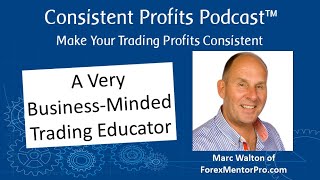
Brian McAboy interviews Marc Walton, a Forex trader and mentor, about trading psychology, strategies, and the discipline required for consistent profits. They discuss his entrepreneurial background and how mindset shapes success in trading as a business.
Hello and welcome to the Consistent Profits podcast brought to you by Inside out trading and Brian McAvoy, where the focus is on consistency because when you have the consistent part down, profits become easy. Hello everyone, this is Brian McAvoy with the New episode of the Consistent Profits podcast brought to you by Inside Out Trading. I'm excited today to be interviewing Mark Walton, who's the creator of Forex Mentor Pro. Thank you so much for being on the podcast today, Mark.
Hi, Brian. Pleasure to be here. Thank you very much.
Glad to have you, man. So everybody knows Mark is a professional Forex trader and mentor who started trading back in 2002. So he's, he's got some good years of experience under his belt and he's been mentoring new and struggling traders since 2008. He retired from full time trading in spring 2020 to focus on running Forex Metro Pro, a mentor program designed to teach people about Forex trading. Mark has a five star reputation and has trained over 10,000 people from all walks of life. Again, thanks for being here and being game for this interview, Mark. And that's it. Well, let's go and just jump into this. I mean, since you're a traveling trader, I have to ask. I mean, before COVID you were doing a fair amount of traveling, but then I understood, you know, you had to take a little bit of a break and so you're back to traveling now. We were just talking. You said that you're in Portugal. Where else, you know, do you have that's still on the, on the horizon in front of you as far as places to travel to.
We plan to go to Asia, Australia and New Zealand later this year. And because the distance is so far, then we will go for three months and then we're going to go around Europe a bit more this summer because lots of places we haven't been and we thought, well, we'd take a few months doing that as well. So as I was just explaining, before we met, I used to live in the Canary Islands. We were living on a tiny island that was 40 miles deep by 20 miles wide. And when Covid came along, it was draconian. In Spain, we literally were not allowed to leave the house for seven weeks on penance or €300 fine the first time, 3,000 the second, and possibly jail the third. It was insane. So we've got out of that. And now being on the peninsula of Europe, we can drive wherever we want or. And flights are really cheap still in Europe as well. So the plan is to do as much as Possible. We've taken a year kind of to settle in here and sort out all the paperwork and everything so that we're now resident in Portugal as well. So. Yep, travel, travel, travel. That's the plan.
Nice, nice. Now, one thing I definitely wanted to talk with you about. I was kind of interested when I started looking into your, your history and everything back before trading. I mean, you, you've kind of been an entrepreneur pretty much your whole adult life, right? I mean, because you've had several successful businesses before you got into trading. What, what were the businesses that you had and how did you get into each other?
I very one minute quick blitz of my life. I. I hitchhiked around Europe with a guitar on my back, busking for a few years when I left school. And I started then in sales when I was 20, working for a couple of guys. And they could have made so much more money and they weren't interested. They thought me at 20 was earning too much. So I started my own business and that was business equipment and cash registers and that was a tough, tough business. And we'd no family money, no experience. And my parents thought I was mad because I was leaving a good job and. But I think one of the things kind of to tie into the narrative of what I have done is I get asked a lot, you know, what would you do to be a successful trader? And I can talk through that later. But the first thing out of all of this is that going back to the Napoleon Hill book, the Think and Grow Rich, which I recommend to everybody, I mean, it's a hard read these days, it's 100 years old. But the big point you take away from that book is that you have to have a burning desire. And if you don't have a burning desire or a passion, you will never be successful at anything. And I. It took me nine months probably to start up that kind of business. Normally even then, 40 years ago would have cost 50,000 and I didn't have two pennies to rub together. But I managed to persuade a company to let me have stuff on, on sale or return. And we got the thing off the ground and did it for five years, learned a hell of a lot, sailed close to the wind quite often. And then I opened a pizzeria. I had that for five years. Then a very expensive divorce nearly bankrupt me getting custody of my children, which thankfully I did in the end, and remarried, started from minus and then started a food business. And we managed to take that from $200 a week in the first week to 60,000 a week within three or four years, partly by acquis. So I've always kind of had this fire in my belly and each time I think about success in my lifetime has been when I am passionate and I have the burning desire. So then coming up to 40 and I was making a lot of money and a lot of cash and anybody that knew me thought was mad, I sold up and we sold the house that we'd built and we bought some properties for rental income and we took the kids and we emigrated to the Canary Islands, 2,000 miles away. Desert island. You must be mad. But I got to 40 and I'm so glad that I had the cojones to do it because I swear I would be dead by now if I'd stayed in the uk. The pressure and the stress of employing people and the hassle and the government, it just wasn't worth it. So then I wanted to go back to my roots. So I was thinking it was semi retirement at 40, but I had four kids in private school, so that doesn't equate. And I actually went to Canary island singing and playing guitar in a band. And again, that was a burning desire. I spent a year beforehand practicing every day and pushed my way into it and, and had four or five really good years doing that. So again, I think they say the main thing before anything about anything. If I think a lot of people that come into Forex, unfortunately a lot of people come into it that are not suitable because they think they're going to get rich quick. But equally there are a lot of people come in who do have a passion and a desire to get somewhere and if you don't have it, you won't get anywhere in life, in my experience. And it was the same with fx. I mean, two and a half years I lost consistently and lost a fair slice of money. 20 odd thousand and 10,000 I spent on every shiny toy and indicator and guru. But the second part of to be successful, in my opinion, is perseverance. And I don't quit. I mean, I had a vested interest. I dragged my young kids to live in a different country and the youngest was 6. Didn't want to go, didn't want to leave his mates. And I would have had to go back to the UK if we hadn't finally succeeded. And at that point I sought some help because like most people, when they start, it's like, this is not too difficult, this is easy, I'm a smart fella, I've succeeded in the past, I can crack this and two and a half years in, and I was. It was making me ill. I mean, I was spending eight hours a day in the basement doing this, living in a beautiful part of the world with 300 days of sunshine. And it was insane. So for me, I. I actually got some psychology training from Rich Friesen. You will know Rich. He worked in the pit in the Chicago exchange in the 80s for Merrill Lynch. So he had seen both sides of the equation. For me, it was the psychology. There was the issue. I kept repeating the same mistakes over and over again. I kept blowing up accounts. And as I was getting better, I just went longer periods of time before I would go into meltdown. And so my first week that I hit My target 20 years ago was to make $2,000 a week. And the first week I did it, I was on a high all weekend. I told everybody and anybody. I finally cracked this, and by the following Wednesday, I'd given 1500 of it back. So at that point I needed some help. But as say to me, if you don't have the passion for it, and you haven't, you know, if you don't have the, the persistence to be able to say, once you've got through all the marketing bs, and there's so much of it now, and there's so much nonsense on YouTube with, you know, you know, kids stood next to somebody else's Porsche making, I made 20 grand this morning or so, and people get sucked in. And people, I think now with the current environment are getting more and more desperate, and it's not how it is, as you know. I mean, you. It's a profession and it's a skill, and you're up against some of the sharpest minds on the planet. And therefore you've got to bring your A game to it. And, and it's not easy. You've got to put the work in. So for me, those are the, the starting points is, is a burning desire to succeed at anything and, and persistence, you know, don't quit. But the third thing is don't just blindly carry on doing what you're doing if it's not working.
So true, true.
So then by 2005, 6, I was trading for a fund in New York, wouldn't be allowed nowadays, possibly wasn't allowed then, but the senior trader had had a heart attack and, and Richard recommended me. I worked for them for a few years, and then 2008, I started Twitter. On Twitter. And Twitter in the early days was genuinely people helping each other. And I was just giving tips out because I was bored during the day. I'd kind of found a solution to trading and my solution to trading was to trade a lot less. Don't be have skin in the game all day every day because it was counterproductive. So I was on Twitter, I was giving tips out and I might say, you know, I'm going to short the euro today at X amount. And people started to realize that, well, this guy seems to know he's talking about and they asked me to teach them. So from there we carried on and in the last few years we, we were very fortunate to catch crypto in 2020. So the same skills and technical and fundamental analysis I use for FX is transportable for crypto, for stocks, for everything we bought. First bought Bitcoin February 2020 at 8,000 and three weeks later Covid came along and it dropped to 4, which that was a baptism of fire. And then we started buying again after the COVID thing and managed to ride it all the way up to 60 grand, taking profits along the way. So eventful. Eventful. But the good thing of course with this I was living on an island where the average wage was probably twelve hundred dollars a month and yet so I was able to live where I chose and yet still earn a substantial income. And it's the same thing now with the traveling I can turn it on and off as and when I want to do because if I, I was telling somebody recently we went to Australia, the first long haul trip we did and I said to my miss, it's right, I'm going to pay for this as we go around just from the trading. And the deal was if we had a good week we'd stay in a five star that weekend and if we had a bad week we'd be in a three star. And we had a few weeks in a three star, but we had a few weeks in the five star as well. So I wanted to prove that you could do it whilst traveling and learned a lot as well. I learned quite a few things from that. So I went over the minute, but that's a potted history for me up to present day.
Well that's, that's cool. Yeah, you got a pretty good story there. Well, and the fact that you had some good success with several different businesses. Yeah. The reason I wanted to ask you about it is I know that a lot of the people that I've run across since I've been, since I've been helping other traders, a lot of the people that are coming to trading have either been an employee Working for somebody else their entire life maybe they've been kind of self employed like a lot of doctors if you're looking to retire or looking to get into trading so they can supplement their income. And so there are different mentalities though. And you sure? I'm sure you heard it, you know, rich dad, poor dad. Robert Kiyosaki.
Yeah.
In his Cash Flow Quadrant book he talks about the four different mentalities where you have like employees, self employed business owners and investors. Yeah And I find it really interesting when I'm first working with somebody one of my favorite questions to ask him is have you ever started and run your own business? Because if they haven't, if they've always been an employee then I know that they've got that mindset and that experience behind them and they've never been on their own, they've never started their own business, they've never been self employed and so they've got two learning curves. They have to learn trading and they have to learn how to start up their own business. And the fact that you've got some good experience, you know, starting up and running other businesses, I mean besides the passion and the persistence, what are some other things that you found useful from your business experiences? What else have you found of that experience has been useful in your trading?
Well, I say I think I don't know where it came from because my father worked in a factory and my mum was a secretary. So I don't know where it came from, the entrepreneurial thing. But I think there are positive and negatives with people coming straight from employment in some ways because they're used to operating in an environment where whichever level there's an element of doing what you're told. You know, you work within a structure, within rules and you are less likely to have bad habits. My average age of private client prior to Covid was 55 male, middle management or self employed and they were motivated by a combination of things. One is generally most people, especially self employed don't have a big enough pension potential. And then the other thing that people are interested now is well is to be mentally active in retirement because you know the old adage, my, my father, a lot of his friends retired at 65 and were dead within 18 months because they just vegetated. So there's elements of both of that I think sometimes, I mean I have a student at the moment who's struggling, who's been his own boss for a long time and he's like me when I started trading the last business I had Part of the business was we were supplying the prison service in the UK with food. So we came under so many government departments, including security, and they could literally turn up now, knock on the door and they would want to do a security audit because we've got people going into prisons to deliver food.
Sure.
And so it was such a strictly well controlled environment that when I started trading it was like, woohoo. There's no rules now, it's my money, I can do what the hell I like. And that was a big part of my issue, that I didn't apply the same discipline and structure that I did from the business background that I'd come from. And then the gentleman I've got at the moment is a tech guy. I have a lot of tech guys as clients and I think as they get older they're finding it more difficult to keep up with the new stuff than the kids are coming out of college now. But for him, again, because he's a, he's an entrepreneur by nature and because he's sat there all day and now it's because he's got bad habits, it's difficult to unlearn the bad habits. So in some ways people coming from, from a bit from a non business environment, there are positives to it. As you say though the downside is, is the business side and that's the other thing. I mean, I mean one of the main things I say to people like this is a business, this is not a get rich quick scheme. You will not get rich quick. If you need to make a load of money to get out of debt within the next three minutes, go find something else because you're not going to do it with this and you need to, to treat it like a business. Write out a business plan, what you're going to do, what times a day you're going to operate, what strategies you're going to use and all those and set yourself some goals and set realistic goals because again, the marketers are very clever. If you buy this shiny object, this is. And you also get this thing with people who've been trying for a while. I have a young guy that I spoke to the other day, he said lots of coaching, he's gone through things, he's reasonably successful, but he just thinks there's that little bit missing. And of course the marketers are waving in the background the shiny toy that's saying, hey, you just need this. And of course then the six months later they go off and buy something else. And I did all that as well. So I think that the lack of business experience, yes, is a challenge. But many people, I mean, I've been self employed since I was 21. You forget when you've been self employed all your life, you forget how passionate a lot of people are to get out of it and passionate to start their own business. And this is one of the cheapest businesses to start. You're not having to take on staff, which is great. You're not having to rent property or put money in leases and fixes and fittings and everything. So it's one, it is one of the best businesses. But there's a learning curve and psychology is part of it. Psychology is a big part of it. I think the reason why most people fail is the psych is what's between your ears and whether that's irrespective of what your background is. I don't know if I answered the question in the end, but does that answer the question or you want to ask it a bit deeper?
No, that was a really good answer because yeah, a lot of it does have to do with the mindset and the perspectives that a person brings, the psychological parts of it. And yeah, you spoke to that really well. Now what are you, what do you consider some of the other psychological aspects of trading? Because you mentioned psychology being like a key thing. Aside from just learning how to be disciplined. What are the other psychological aspects of trading that you see as critical and kind of tough? The tougher change, I mean the easy.
The simple answer is everybody will throw out is fear and greed and that it is a big part of it and fear of missing out, etc. But it's the. I mean when I teach somebody, they don't realize that within this journey, I mean, I explained at the beginning, it's two steps forward, it's one step back. But what they don't realize is that actually becoming successful presents its own levels of psychological problems. Because as I explained earlier with me, I thought I cracked it and now you get cocky and you get overconfident and that can be as bad as not knowing what you're doing. So I think all the way along it's. And you really need mentally to try to tune yourself up. About six weeks ago I had some new clients came along and they were getting frustrated because the markets were tricky and I traded them longer time frames so there wasn't much happening. So to me it's fine, you just walk away and leave it. But they wanted to trade and they wanted to trade. So I started teaching people for one week on how to trade on smaller time frames and 30 minutes. And I haven't done that for 12 years. And yet the demons came back to me in that week I over traded, I took two trades, I took seven trades when I normally might take two in a week. Two of them I shouldn't have taken because I just sat and watched them for hours and I, I reacted and I shouldn't have done. And therefore the demons are there in the background. Even though I've had the training and I've got all the experience now, my way of dealing with it is from a discipline point of view where I trade from weekly and daily charts and once I placed an order in general I don't touch it. So I resist the temptation to just have a look and just interfere with it because I found over the years the ones that you leave and stick to the plan and plan the exit before you start and plan when to move stops and where to. And I have a little bit of software that does that for me. Then I want to take me out of the equation as much as is possible. So for me that's the solution. My issue initially I was trading 15 minute charts and I was a junkie, I was in it and I would sit there for five or six hours and by the fifth hour and you're tired and mentally stressed, you start to make stupid decisions. So as I say, for me that was a solution. But there are, there are steps along the way that people don't realize. And then another one. Of course, if you start off on a ten thousand dollar account and now you, you're getting better and you move up to 50,000, just the lot size alone can scare you for a while. And then the other side is if you're trading for clients, some people struggle trading for clients because of the extra stress it brings others and go the other way and hey, it's somebody else's money. And I, you know, I'm the alpha male and from my point of view, when I've paid people, employed people in the past to trade mine and my clients money, I don't want the alpha male who's cocky because he's the sort could lose me a lot of money. I would rather have the slow and steady wins the race. So for me, I mean you're obviously more psychology side of things than I am, but the combination of the discipline distance has been good for me. But from, from your point of view, you obviously see all sides of the coin. What, what's your take on that?
Well again you brought up some, some really good aspects and, and one of the key ones really especially for people who are just getting into a bit. Yeah. Again you got to keep, you got to keep it with you throughout your entire trading career is just maintaining a good self awareness.
Yes.
Of okay, yeah, this is where I'm at. Do I still have things to learn? Am I really that good? You know, and just being aware of, you know, what you're doing, where you're at, what you still have to work on and just kind of being aware of your whole journey through the, through the growth and development cycle.
Yes.
You know, it's natural part. You know, for every, every skill based activity that you get into there's, there's going to be a growth to it and you know, certain kind of like a product life cycle where certain stages that you're going to go through and just kind of having a decent feel for where you are on that, on that path to mastery where yeah, you're just playing. You're one of the legends and you're doing everything right subconsciously and all that. There's going to be a path there and everybody's different and there are different stages along that path. So the way you're talking about self awareness and how you maintain it yourself and also how it is with other people, that's one of the biggest things really is just playing the self awareness because like you said and I mean you did it. I did it. It's like, yeah. You look at trading and it's like yeah, easy enough. I'm a smart guy, I get it. I can figure it out. And that's one of the curses for people who are a little brighter than average. Yeah, it does look easy. And it's we. It's easy to have that false overconfidence.
Yeah.
And the smart, the smart ones though, the really smart people are yeah, I'm smart and it looks easy but I'm new at it so I'm not going to. Before I just dive in and take.
The be that was. Yeah. So that they used to be few and far between. I think people are getting smarter nowadays. I say I was silly, I was stupid. I mean to show you how stupid I was, I used to trade. I used to do well in London and I used to lose it in New York. So you have to put this in context. I'm in my basement eight hours a day. I have nobody to talk to about this and you know, I should. I just needed somebody to say to me, what are you doing? So what I would do is I make the money in London and then I would lose it in New York. So I spent six months trying to crack New York. And it's like I just needed somebody to say to me, what are you doing? You just focus on London. And again, it's this thing that you're in a bubble. And I didn't tell people what I was doing where I lived. I didn't want people to know what I was doing. Some of the family members, distant family members, always gambling online. So you didn't say anything to them as well. And it is, it's a lonely and an insular pastime and you know, you end up billy, no mate. Sat there on your own and not realizing your own stupidity. So I have the thing now with, with people that come to me and ask questions and try to get them to analyze where they've gone wrong on the trades rather than for the first few weeks, okay, I will critique them and it's quite obvious to them after a few weeks when they start to self analyze what's going on. Well, I shouldn't have taken that one. I broke the rules on that one or I didn't check the news was coming on this one or whatever, whatever. So yeah, I agree being self aware is a big part of it. And as I just said, I had a meltdown week after doing this for 20 years because I slipped and it's, it was quite embarrassing and. But that it is what it is, you know, and hopefully I've learned from it and gone back to it. And as I said earlier, we did really well with crypto by being very disciplined. Take the profits. What I kept saying to clients is the first thing we do is get the initial stake out and then when it goes on a run, we take some profit and we buy the dips. And buying the dips on bitcoin, for example, for a year, 15 months was easy. It was actually easier than trading FX. And so for me, I'd like to mentally keep myself stimulated by doing other things as well as not just doing forex. And now at the moment I do a lot more with metals and I've been accumulating gold and silver and particularly mining stocks because I think that we're in for a major crash. And those are the things that historically do well in a crisis. And I actually think bitcoin will come back as well. Partly because of the banking situation and partly because the CBDC that's on its way that I don't think people realize the implications of a central bank digital currency, you know, the lack of freedom and the amount of accountability that people are going to have is really quite terrifying. And Joe Public doesn't realize what's coming, so. But yeah, that's for me, keeps me mentally stimulated and really that's why I teach. I mean, thank God I was teaching during COVID because imagine, stuck in a house for seven weeks and not even allowed to go out and exercise. And my wife and I used, used to go to the gym and swim every day. I could get to talk to people from all over the world. And that came miss that kept me sane and if I retired completely, I would drive my, my wife nuts because I can't, I can't just not do anything. So I just, I just have one a day maximum now and I work around that and that's great. I get something out of it as well.
So there you go. Cool. Well, so what, what was it that happened along the way that you decided to start Forex Mentor Pro and like actually making business out of helping other traders?
I started when I, when I started trading from longer time frames. I was doing well and I was doing it for the fun and I had the discipline. The fund was good for me because I had the discipline. I couldn't break the rules, otherwise you were out. But the problem I had is that I then when I was bored, I was dangerous and I was also trading my own account as well. So when I started teaching people on Twitter and giving some feedback, I had a few people who actually one guy flew over from Ireland for a week and sat next to me and I taught him how to trade. And I actually quite. I didn't enjoy that experience too much. That was too much. But I actually enjoyed the feedback and working with people and it was good for me because I was having to do the work anyway and therefore teaching somebody else how to do it. I actually found that I, I got something out of it. I got pleasure in doing it and therefore. And it kept me away from doing something stupid. So for me it was a win, win. And after about a year on Twitter I was getting hounded by that many people. I started with a well known marketer. He contacted me and said, look, why don't we create a website you teach and I'll market it. And we did and it did extremely well. And then a few years ago I was toying with the idea of retiring and thankfully I didn't. So now gives me pleasure still to do it and I say I have to do the analysis anyway. So on a weekend I do my own analysis and create A plan and then I share it with, with members and, and students. So I'm doing them, I'm doing the work anyway, I might as well do that. And I have a team of younger guys now who I've trained, who train people as well. So it, I'm not, I'm not doing that every day. So. But yeah, life's good. I, I enjoy it, I don't over tax myself with it. So I, I'm kind of at that stage in life now where you want the, the, the life, work balance rather than the work life balance.
Yeah, good way to put that too. So.
Yeah.
Huh. Well, so when somebody comes to work with your, your company, what's generally the, the experience for somebody who likes, I mean because you have courses and you also do like one on one coaching or live coaching, right?
Yeah.
So why don't you tell our listeners a little bit about what you, what you, what all you have offered at your site as far as the first.
The first thing, whether they join as a monthly member or they come as a private student is I just, we have it all laid out in the courses. But the first thing is treat it like a business. You need a business part. You need to write it down. You need to think thoroughly about what you're trying to achieve. You need realistic goals. And then after that the next thing is you need trading rules. And you have to go into great detail for trading rules. But the starting point from all of it is just treat it like a business. We get a lot of people come to us who have been battered and bruised elsewhere and have bought the BS and kind of come to us as a last resort. And the feedback we get is like, wow, this is not, this is not easy. But finally we've found somebody that talks sense and it, and, and they understand it. And so people can come to us with their own trading strategy, but they just need the discipline and the structure. I mean, I even taught a guy a few years ago, he had, he was a partner in a fifty million dollar fund run out. I think it was either Lichtenstein or Luxembourg, but he was trading 16 hours a day scalping. And when he was 30 he could do it, but when he got to 50 it was killing him. And so he came to me to teach him how to do from longer time frames.
Right.
So, and I think with most people as well, you, you ultimately I, I've used the same strategy for 20 years, but I tweak it and I adjust it and I used to trade a London breakout strategy. Everybody had a London breakout strategy. It used to be easy. London used to go to sleep, the pound would go to sleep in the Asian session. 30 pips overnight. The average daily range was 150 pips. So when London opens, it's got to go up or down, it's going to go somewhere. And then that stopped working and Asia got busier and the daily range came down. But it's in, in essence, it's the same thing I've been doing for 20 years, but I do adjust it and I tweak it and as the years have gone by, I've taken more and more things off. Now I work with the Bear chart. I have a 200 EMA and a 55 EMA. And I just work support resistance in all its forms. So it's EMAs, it's Fibonacci, it's trend lines and then all I work on and try again, explain to people it's just probability that you're trading. It's just repeatable patterns that we are looking for. There's supposedly a Nobel Prize winner of maths has proved that nobody can predict what is going to happen next on any chart. But I would discount that because I've been doing this for 15 years, sharing advance what I'm going to do. And the joke in Mentor Pro is I am spookily accurate. I can pick somewhere from 200 pips away and I can get it often within four or five. So I was a buyer of gold at 1820 and it came back from 2000-18, 1809. But it wasn't that I'm brilliant, it was just a repeatable pattern for multiple reasons. Why, if it was going to bounce anywhere, that was where it was going to bounce. So it's, it's getting through to people. It is a business. There's no definite outcome and they always say that lawyers and doctors are the worst potential traders and, and accountants, especially accountants, I find struggle because they're used to. I sit and look for you. Two plus two always equals four. But in trading, two plus two can equal three or six or seven or nine. It's just random. And then of course, if you get the risk reward right, it doesn't matter because then it's just a math scale. So it, it's not as complicated as lots of people would have you believe. You don't need loads and loads of tools in indicator. Believe me, I've tried them all and throw most of them in the bin. But you do need structure, rules, discipline and a plan. And plan everything. I plan it Everything is based on the entry has got to have multiple reasons for the entry. The stop has got to have multiple reasons. So I, I wanted to hide the stock behind a 78.6 fib and a whole number and a 200 EMA and a trend line because probably there's more probability is going to bounce off than not. And that's all, that's all we do all the time. It's just probability, looking for where things are going to. And yeah, you mix in some fundamentals. You have to pay attention to news. So this week that we're recording, this is a tricky one. We've just had FOMC yesterday and again, you know, Powell says the banking system sound in America. And an hour later PacWest has gone. So, you know, don't believe anything anybody ever tells you, particularly in the financial world. There's a, there's a guy on Twitter that's the not Jim Cramer, and he says that basically if you just do the opposite, you'll be fine. And you know, I say to clients, if a bank tells you what they're doing, oh, you know, Goldman say we're selling the euro at such and such, don't believe a word because, you know, they've got their own agenda. So you've got to, you've got to understand more about what's going on around the world and how money flows in and out of the dollar, how it flows into risky assets and the stocks and then how it will flow into gold. And everything is cyclical. And if you can catch the right part of the cycle, it's not difficult. And FX last year was fairly easy last year because if you follow the dollar index, the dollar index just kept going up. So every time it pulled back, you buy the dollar or you sell the other majors.
Yeah, true. Yes. Well, when you were talking about, you know, listening to anybody from the government, one thing. Well, and it just cracks me up, especially with COVID because, you know, everybody's looking to the government for guidance, right? Supposedly. And you're, you're old enough, you probably remember, I remember when I was a kid, one of the famous jokes was, what are the three most common lies? It's a dirty joke. We won't get to the punchline. Three most common lies. You remember the joke?
No.
Well, the first, Tell me later, is the checks in the mail.
Okay. Oh, I do know it. Ronald Reagan. Ronald Reagan. Well, the clean version is Ronald Reagan. The third one is, what's the worst news? If somebody knocks at your door and says, I'm here from the government to help you. Is it that one?
Yeah, that one from the government. And I'm here to help you.
Yeah, yeah, go on, you tell me the joke. I stole your punchline.
No, that's. I mean, that's the thing is that used to be like part of a really common joke is, yeah, government and I'm here to help you. And a lot of people, it seems like in recent years have forgotten that. Yeah, it even, you know, a couple like a generation ago, it was a joke to listen to the government because they've got their own agenda, like you said. And your agenda.
Yeah, I think, I think what's going on at the minute is quite terrifying. You know, you've got the Western world looking at the navals worrying about the WOKE issues, and there's a war going on in Ukraine and really it's a world war by proxy because the Americans, the British, the Europeans are all pumping weapons in there and equipment and the rest of it and then standing back and saying, hey, we're not fighting, we're just sending. So all this is going on at the same time. The west is tearing itself around. I bet the part from nonsense. And you look at the polarization in America now, you're either pro Trump or pro. There's no middle ground anymore for discussion about anything. And Covid, the more that. I mean, I had to take the job to get off the island we were living on because you were not allowed to get on an airplane. And the night before I had the jab, one of my clients used to work from a drug company rang me up and said, do not take this drug. This lot a crooks this is. There is an agenda. And you know, my family going, oh, he's a conspiracy theorist. And I think, well, I've got to get off this island. So I had the damn thing. But you look at what's going on now, and if. I mean Twitter, Twitter can be a depressing place to be. But equally, there are a lot of intelligent people on there, very well qualified people, saying at the very least, hey, we ought to look into this. And I've never known a situation in my lifetime other than a war where the press are fully on board with the government because they normally spend all day, every day trying to catch them out. And so the whole thing, and I say this thing with, with the Ukrainian situation, you know, we're one, one button push away from some lunatic. And it doesn't bear thinking about. It really doesn't bear thinking about. So the moral of it all is to kind of wrap up is you've got to learn to look after yourself. You've got to look. Learn to be financially savvy and financially independent because if not you're going to get screwed. Don't believe a word that any of them tell you, unfortunately. I mean it makes you more and more cynical. But it's a rigged game that we're playing, you know, and the rules, their rules are not what you're playing by. So for me it's education. You know, I think Kiyosaki hit the nail on the head years ago when he said that there's no financial education in schools and it's quite deliberate and I agree with that. I mean I don't agree with the direction and perhaps he's gone of late, but it's quite deliberate. The ones at the top of the food chain don't want people to know how the world works. There's a famous quote from Henry Ford from 100 years ago, said that if people realized how the banking system worked there'd be a revolution tomorrow. And there's still as much ignorance today as there was 100 years ago.
Well, I'm trying to remember when you were just mentioning that quote because I was surprised and this was only like maybe a month ago I heard this. A real famous business person leader basically said that yeah with the school system and like decades ago they didn't want to be educating people and creating people that could think they were.
Yeah, yeah there was, there's a couple of quotes years ago I had. One was from an American school board and one was from a UK school board and I can't find them for my life of me, if anybody can find them and they're legit, please send them to Brian because I would love to dig these out. And what it was is when, when the, the world went from agriculture to the industrial revolution so now the workers have to use machinery. They needed maths and English basic but it actually says from the school boards, as you've just quite rightly said, teach them the basics, teach them the things that they need to know, but don't teach them too much and do not teach them to think.
Yeah, well and as that, as you were going through some of the other stuff you were talking about, you know, being, you know, financially independent and that kind of stuff. One of the biggest things and, and this is in general, but especially in trading is always, you know, make sure that you are thinking and not just following.
Yes.
Don't just listen to somebody's advice and follow it blindly. Always no critical thinking to things. And yes, this actually makes sense.
Yeah. And again, say to me, to me, trading is 95 planning. The, the sexy bit, the, the place it tries and things for me is minimal. It's the planning plan, the whole thing all the way through from before middle and end. Where are you going to get out? You know, it's like most people that start a business don't have an exit plan. What is the plan with that? Starting this business, you, you know, if you start something now, I'm going to be thinking in five years time, I can sell this out for 10 million. Not that, hey, I'm just going to keep doing this till the day I die. And most people start a business don't ever get an exit plan, but traders do need an exit plan because then it stop, it stops you getting sucked into the emotion of it, of the fear and the greed that we spoke about right at the beginning of this.
Yeah, true, true. Well, Mark, this is, this has been an enjoyable conversation with you today, man. It's a lot of fun. And I have to ask this question just because it's, I call it the Consistent Profits podcast. But when it comes to consistent profits, what would you say are probably like the top one or two mistakes that most traders make and how can they address them?
Most people in my experience come into this industry with insufficient capital. And so if they throw a thousand dollars into an account and they make three, let's say they make 5% in a month, that's only 50 bucks. So after a few months of that, they get fed up. So now they start risking a bit more and a bit more and a bit more. And as soon as they start to do that, that means that they're going to lose, they'll lose a lot in general. I mean, you, you will know the 90, 90, 90 rule. 90% of new traders lose 90 of their account within the first 90 days, which is why the brokers are all so friendly and helpful. Hey, come to me because now the money is going to be mine. So, yeah, realistic expectations if what the goal is. The goal is to trade other people's money. And with these funded accounts that are around at the moment, I mean, a lot of them are Ponzi schemes, but there are one or two mixed in there where you can at the very least have the experience of trading funded. And then at the end of it all, there are a lot of people around the world with a lot of cash who are interested in traders, but they want to see steady, consistent gains. So my thing to People is, look, when you start, start on a demo account or start, if you, if you want to have, feel the emotion of being on the real account, do an evaluation account at 10,000 bucks and it might cost you 100, $200. And that will give you the discipline and the structure and the realization if you break the rules, you're out. Which is exactly the same as if you go to a fund. So the way to make money at this is to be trading other people's money. And if at the end of the day, all I aim for is 3 to 5% per month, and at 3 to 5% per month, I risk a half a percent per trade. And if I can make 3% in a month on a million dollars, that's 30 grand. I get a substantial cut of that for doing the work. The client's happy, I'm happy. So then, so if you can start on a 50 grand evaluation account and you go to 100, and you go to 200, focus on scaling up the amount that you trade, not the amount that you're trying to win. Because if you're trying to replace a job that, say, earns you 5,000, 10,000amonth, you ain't going to do it with a $1,000 forex account. So realistic expectations. Focus on the education. At the end of the day, the first six months needs to be education. Prove that you can do it. Tell your wife. I didn't tell my wife. I kept losing and losing, just putting more money in. But tell somebody, be accountable to somebody that can say to you, like me with a New York stupidity, what are you doing? Stick to the rules, etc. Etc. So it's. The scalability is when it gets sexy at the beginning, it's not. I initially had 100 grand to trade, and then after I'd lost 20 of it and frittered away another 10, my wife said, look, you know, let's not be silly here. So I was trading 50,000 account, but I needed to earn at least 5,000amonth, which means I'm aiming for 10% a month. And you're not going to make 10 every month. Or if you do, you're risking too much. But then when you have a bad month, it hurts. So go for scalability. Start small. Prove you can do it on a small account and there are people out there who will finance you if you can be consistently profitable and control the drawdown. And investors are more interested a lot of the time in the drawdown than the top line. Because I always used to invest, interview Investors before they started. And I'd say, how aggressive do you want me to be? How comfortable will you feel if, say, we're down 10%? Yeah, don't worry about 10%. I'm fine. Are you sure? Yeah. Okay. Believe me, when it gets to 7 or 8%, the phone calls start. Are you sure that you know what you're doing with it? You know, so keep it below 5%. Everybody's happy and you're making money. That's the key.
Well, cool. Yeah, that. Yeah, that was really good. Well, yeah, we do need to go and wrap things up, but again, Mark, thanks for taking the time for this, man. I appreciate it. And this was. This was a lot of fun. I think so. Also, some helpful, helpful things for our listeners today. And yeah, yeah, thanks again for being here, and it was enjoyable.
Hopefully we don't come across as being a couple of conspiracy theorists, but.
Call me a conspiracy theorist. Sure, fine. All right.
Yeah, yeah. No, there's things that I, I used to completely think, no, no, that's. That's. That's too silly. And I. The more I look at things now, I just think, well, there's more than a grain of truth in that. So it might be partly age, my friend. So.
As we get older, we do get a little bit more attitude about it.
Yeah, yeah, we. You become more cynical. But then again, I find the younger, a lot of them include into my share, my youngest daughter and their friends are like, oh, it'll sort itself out.
You know, they.
They don't seem to be politically interested at all. So, yeah.
Right.
It was a pleasure to meet you again and get. Best of luck with your podcast and talk again. Maybe in the future.
Yeah, yeah. And, yeah, and for everybody listening, if, you know, if you like what Mark had to say and you know what he's saying, it makes sense, especially his approach and, you know, how he works with people and everything. If, if you're, you know, if it resonates with you at all, don't just sit there and have a listen, say, yeah, it was, you know, it was fun. And then go about your day and keep doing what you've been doing. Go ahead and check out Forex Mentor Pro. Mark's good guy. He's. He's smart. He's been at this for a long time, worked with a lot of people, and he can definitely help you. And, you know, if you want to trade Forex or crypto, a good resource for you, and I know it'd be definitely worth your while. And the main thing is you Know, keep in mind, if you're trying to teach yourself via the YouTube videos and stuff like that, that's the hard way to go about it. You want to be somebody because if you're trained, if you're training yourself, you're your own limitation. You don't know what you don't know when you can't see what you can't see. And so getting the, you know, the input from somebody like Mark, who's got a lot of years at this, can be invaluable. And so, yeah, definitely, definitely reach out.
Yeah. I think the thing is, I mean, even just following a basic course, we have things in a sequence that makes sense, gives people some things. You know, it's like almost a university curriculum, let's face it. Everything you need to know about anything is available on the Internet and a huge chunk of it is on YouTube. But it's. It. Somebody likened it to me years ago. It's like drinking from a fire hose. There's just so much coming at you and there's so many of them that you and I will look at some of these videos and think, well, at least that's BS and that's bs. But to the innocent who've not gone down that rabbit hole yet and parted with money for people who don't know what they're talking about, they're just good marketers. So, yeah, it's, it's just, you know, but our, our thing, we have a thing, an entry level is 69 bucks a month and if, if somebody doesn't like it, we'll give them the money back. The end of the day, if it's not what they're looking for, then fine. We, we're not there to trick people private client wise, generally. I have a waiting list, limited time as far as that goes, but yep, that's, that's the main, the main things for me anyway. Right, I must get off. It's pub night and my wife's ready to go. We're off for dinner and a beer. So.
Yeah, the light's changing. Yeah, the daylights.
Yeah, yeah. I did say it was going to start getting a bit dark now, so it's, it's 8 o' clock at night here, so it's been, it's been a nice day again.
Yeah, again, thanks again for being here and everybody. We'll see on the next episode of the Consistent Profits podcast. Cheers.
Cheers. Bye bye.
Thank you for joining us today on the Consistent Profits podcast, brought to you by Inside Out Trading. Make sure to swing by Inside out trading and pick up your copy of the proven formula for consistent monthly profits. If you enjoyed the show, make sure to subscribe on your favorite channel and we'll see you on the next episode. Cheers.









