021 Interview w Casey Stubbs, Author of "The Complete Trading System"
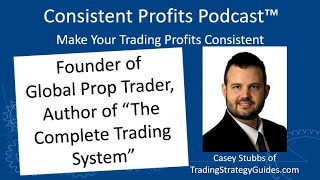
Casey Stubbs, author of The Complete Trading System, talks with Andy about trading consistency and mindset. He covers how prop trading firms work and what separates profitable traders from the rest.
Hello and welcome to the Consistent Profits podcast brought to you by Inside out trading and Brian McAvoy where the focus is on consistency because when you have the consistent part down, profits become easy. Well, hello everybody, this is Brian McAvoy with Inside Out Trading and welcome to the Consistent Profits podcast. I'm really excited today to be interviewing a good, good friend and colleague of mine, Casey Stubbs, the creator of Trading Strategy Guides. Thanks so much for being on the podcast today.
Thanks for having me, Brian. Really appreciate it.
Oh yeah, great to have you here, man. Just so everybody knows, if you're not already familiar with Casey, he is the founder and creator of Trading Strategy Guides along with several other trading related businesses which include Learn to trade for Profit, Finance and Markets, Price Action and income. Since 2009, Casey has helped thousands of traders by providing excellent free education and trading strategies at his site. Casey and his team's mission is to simplify trading strategies by giving traders a detailed plan with step by step rules to follow. Most recently, Casey published a new book, the Complete Trading System. How to develop a mindset, maximize profitability and own your market success. Casey has been in the trading space for a number of years and brings substantial experience traders of the world. He's also down Earth. Pretty cool guy, as you'll soon see. Again, Casey, thanks for being here, man.
You're welcome.
Now speaking of your, you know, your new book that just released like last week, so the Complete Trading System and now you cover your system and you know, mindset. But go ahead, you know, enlighten us. I have not, I mean, I got to apologize, I've been off of LinkedIn so I didn't catch your, your, you know, your notice of the book going live. I still got to get a copy of it, which I can't wait to get. But give us a little bit of an insight into your book as far as. Yeah. What to expect with it.
Yeah, so I, I hit the it's the Complete Trading System. But I talk a lot about the person as the system and I know that your specialty and I did not quote you in the book and now that I'm looking at you face to face, I'm like, I should have quoted Brian because I like to quote a lot of people. But I remember when you were on my show, which is the how to Trade it podc, you were talking about consistency. Right. And that is just so important. And so I hit that a lot because traders are so excited about a system. The name of my book is Complete Trading System but everybody wants the new System, they want a new strategy and because they think that that's the thing that's going to make them money, but really the thing that's going to make the money is consistency and knowing how to trade their strategy. What strategy you use is important, but it's just, it's way down the list of things that people need to know. So that's what I start with is like, look, this isn't a get rich quick scheme. It's not gambling. You got to be consistent. And once you build that consistency, then you work on scaling.
Oh yeah, yeah, indeed. And actually you mentioned something that I think is absolutely fantastic for raising everybody's awareness too, is trading with your trading operation. Yeah, you are the, you are the system. You're the one making things happen as the trader. And so you can't just kind of focus just on the strategy or just on your charts or indicators, whatever. It's like you got to be paying attention to yourself and who you are and how you show up in your trading because that's going to be the main dictator of your results. It's not the charts or the markets or the indicators or your strategy that you. So yeah, very cool that you brought that up. So now you, you have in there, you know, you say how to develop a mindset. So how do you, how do you approach that matter? Because you know mindset and psychology, that's, that's, that covers a lot of ground. So how do you approach in the book.
Well, the very first thing I in mindset is you have to understand what it's really exactly what you just said. You have to understand that you are the thing that you got to monitor, the thing that you got it to control for success that you, you know, so having a good mindset is understanding what you need to monitor and measure what metrics you need to track and how. Because again, that mindset is like, okay, if I can only get the right system, I have a financial problem and I need to solve that problem right away. And trading is the answer. It's almost like they're going into the casino, casino to pull the one arm bandit. They think that it's going to solve all their problems, but really when they get in there and they start trading like a weirdo, it makes their problems a lot worse.
Oh yeah, yeah. No, as soon, as soon as you started into that, a flashback to a conversation I had years ago. It's still one of my favorites. I mean a horror story of trait of trading to be sure. But this guy calls me up and you were saying, you know, yeah, I got this financial problem. This guy calls me up, and early in the conversation he's like, you know, hey, Brian, can I borrow a couple of grand? You know, I'm really in a hole, and I know I can trade my way out of it. And it proceeds to tell me how big of a hole he's dug. He had wiped out their savings, he'd wiped out their accounts, wiped out their 401k, lost their house, and had lost his wife's inheritance and hadn't told her about any of them.
And all he needs is two grand and he's good.
Well, and I'm like, dude, you need to, like, forget trading. You need to get off the phone and go hide everything that can be used as a weapon. And you better have a sit down and talk with your wife because you're gonna die.
Wow.
Wow.
Yeah. Yeah. That's a red flag. Yeah. That's a great. That's a great illustration. I could have used that in the book.
That was so.
I mean, names have been changed.
You know, I'm talking with a guy and it's like, I mean, I'm having a hard time believing, but I could tell by his tone of voice and everything, it's like he wasn't kidding. And I'm like, good God, dude, you're. You're in a heap of hurt.
Yes. So, Brian, mindset's so important because if people only realized, if they only realized, if they're going, if they're risking a hundred dollars and they're targeting a hundred dollars, all they got to do is win 55% to be profitable. That is a 5% edge because you flip a coin, you're 50%. All they have to do is get a 5% edge in the market. And so you throw in a trend, you throw in some support and resistance, and you're there. Right. It's not difficult if you understand that all you need is a 5% edge. But you really just got to do it day in and day out, and the numbers will work in your favor. But we self sabotage ourselves. We're trying to make money. We want to win every single trade. And we don't have the right mindset and understand that it's really about playing your numbers, playing your edge, and just being consistent. Once you, if you can make a hundred bucks a week, great. And then you just scale that, you slowly increase it there. You're not in any hurry. Just take one step at a time. Just like learning to walk. You just take one step at A time. And traders get in such a big hurry to do things.
Oh, yeah. Well, because, yeah, it looks so straightforward and just uber simple, which it can be now as far as. Okay, so that's what the mindset now you're part of your, part of your subtitle on your book is maximizing profitability. So now how do you approach that matter? Because there are different ways to go about that.
Well, first you take it one step at a time. So first you get profitable, right? You, you have to be able to prove to yourself that you are profitable. And then once you do that, you can scale by slowly increasing your size. I recommend taking a plan, right, and, and really saying, okay, if I can use watermarks, right, if I can grow by 10%, then I'm going to increase my risk by 1%, right? And then see how that goes. And then if I can get to another and just keep, keep slowly walking up the steps, it's not a hurry, it's not a rush. It will go by much faster than what you realize. But you have to approach it in a consistent manner. And the way that you scale your profit, maximize your profitability is you slowly increase and you also focus on how you can improve your system. And the way that you do that is. I'm just going to sound like a broken record. It's, it's, again, you got to be consistent with trading your system. And when you adjust it, you just adjust one thing at a time, right? You're like, okay, I'm, this is what I know I can perform at. But now if I just change this one thing, what happens? Do some back testing, do some forward testing, trade it, and then you'll, you'll know. Because again, what happens is traders will change five things at that point. It's a whole new system. They don't know which one worked, which one didn't work, why they're doing good, why they're doing bad, they're not following the rules of the system. They're trading anyway. So they're saying their strategy doesn't work, but how do they know it doesn't work? Because they're not even following what they're actually supposed to be following.
So true. Very true. Well, now, and I got to admit, I mean, I've been guilty of that myself, you know, early on in my trading days too. And that's just because I was. Well, first of all, I didn't know what I was doing. And so when what I was doing wasn't working or it seemed like it stopped working, I was Eager to fix it. And that's where you know, a lot of traders are that, you know, they just want to fix things. So you know, some happens with appliance in their house, they're going to, they're going to jump on and then they're going to live with a broken appliance. But same thing with their trading systems. But yeah, having that self control to not just constantly be messing with things and, and patience. Well, the other thing you mentioned that I absolutely love the trader that a lot of traders skipped sadly because, you know, everybody's talking about, you know, discipline and being able to stick to your system and all that kind of stuff. You talk about, you know, proof and taking things a step at a time and proving it as you scale up every step of the way. That's huge. That is so huge. And of course, you know, yeah, with the back testing and forward testing like you're talking about, excellent. So very cool. Now as far as scaling and maximizing profitability, the other thing that's becoming more and more popular, that wouldn't really hardly even, you know, in everybody's awareness. I'm not even sure when it started. But a lot of people are looking to prop trading as far as being able to maximize and scale up faster than they might with their own account. Now what, how long ago did you get them involved with it?
I offer prop trading to traders and My website is globalproptrader.com if you're interested in prop trading. But the way that it works is we'll give a trader an account up to a million dollars. They pay a fee to prove. It's like a test. They, they take a test, they pay a fee to prove that they can trade, right? And what they have to do is they have to earn 10% before losing 5%. And it's definitely not as easy as it sounds. You gotta be disciplined. But that's very popular right now because. Here's why, Brian, this is why I recommend it so much. There's a couple big benefits, but one of the big ones is you don't have to worry about scaling, right? So if you're in a financial pinch and you need to generate $20,000 a month in revenue or whatever the number is, I just say I don't care what it is, just for your lifestyle. What is that number? Right. A lot of times they start out and then they have to focus so hard on trading really good to scale and to grow their account to hit the level that they need. With a prop firm you just buy into the level that you need and then you just focus on your consistency. So it takes a lot of pressure off because you don't have to scale. You just focus on being consistent.
Yeah, yeah. Now, with your firm, you said they can get an account up to a million dollars if they're starting small. What are the different levels?
The first level is 25,000. And so to take the $25,000 test, it's $250. And so if any of you that are listening are interested, don't do it unless you know you can pass it. Right. I don't understand the mindset. It's just that whole mindset thing we just talked about. Most people do this test. It's like, why are you doing this if you can't? So my son, I'll throw my son into the mix. You know, he's learning to drive and we've taken a few driver's tests and I practice with him and he's doing pretty good. But it's like, okay, are you sure you're ready? Are you sure you're ready? Are you 100% sure you're ready? You're going to pass this test? No, but I just want to take it. Well, he ended up failing the test. Right. Make sure you're ready. It's easy to get a practice account, a demo account and do the requirements ahead of time. Make sure you're ready before you spend the 250.
Yeah. Oh, yeah. Good advice. Well, and also at your site, trading strategy guides, you, you have a free report. This. What is the six steps to. For. For prop trading, right?
We do, yeah, yeah, we have.
Yeah.
Yep.
Yeah. So as far as. Now that. That guide everybody and the links, the links will be down in the description in the show notes, but that's@tradingstrategyguides.com right? Not your prop firm. They also have it there as well there.
You can get access to my prop firm from my website. There's links over to it. But my props firm is global prop trader.com.
Right. Well, no, I was, I was referring.
And the report is at. Is@my.tradingstrategyguides.com because I have lots of trading education there. So I just threw it right there.
Yeah, you do. You've created quite a bit over the years. It's actually really cool. You got like a whole library there. So. Very cool. Well, now as far as the prop trading firm and the test, actually, it's funny when you're talking about knowing ahead of time that you're going to pass the test that actually is great advice. And one thing, you talk about your son. With my kids, and especially my youngest son, I would always have fun with them. Especially like with the math related subjects or whatever, where it's not, you know, essay kind of scoring. When they would be getting ready to go take a test in school and, you know, they go take the test or whatever, I'd say, so what would you get on your test? Like, I don't know, we haven't gotten it, we haven't gotten the, you know, gotten it back from the teacher yet. Said you should know what you got. When you're walking out of a test, you should know what you knew and what you didn't know. Not that you're, you're guessing and you're hoping to find out from the teacher what, what you got. Right. And you didn't. You should know.
And you know, trading can be like taking that multiple choice test, guessing all the way through. You don't want to trade like that.
Yeah, true. So, but yeah, as far as signing up for a prop firm, I mean, I mean that's just, it sounds like, you know, so it's so common sense. But you're right, a lot of people don't do it. They just kind of jump into it, just like with trading and they think they can just figure it out as they go. It's like, no, prepare for it so that when you're walking in the door, you know how you're going to do. I mean, of course, you know, you'll find it when you get there, but at least you'll know whether you're ready or not. Yeah, that's cool. So. Wow, that's cool. Yeah, I mean, man, you're just, you're always a busy guy. I mean, you got, you got, you said you got nine kids, you got your business, you're doing a regular podcast, you're writing books. How do you manage your time and still have a life? Man, that's one thing that's always blown me away. I mean, three kids got me way busy. How do you manage it with nines?
Well, so this is the secret, okay? This is the secret. And it's called get help, Build a team and get help. Right? Because I've got great people that help me with my content, like my trading strategy guides, articles and stuff. They're amazing. I love all that content, but I didn't write any of it. I got an amazing world class trader to write the content for me, right? So with my podcast, all I do is show up jabber jaw A little bit. And then I pass it off and let my team handle it. And you know, with the kids, I have to be involved. I can't delegate my fatherly duties. That's the one thing I can't delegate. But time management is important, just like with trading, you know, I guess trading is the one thing that applies to every other part of your life. Right. Like in real life and in trading, it's all true, but preparation, right? Plan your days, your minutes matter, your life is short. Plan your days. Take the time to create a space so that you can think and plan and write. Because if you're just go, go, go, go, go, especially us Americans, we're so busy. If you're just go, go, go, go, go, you're not going to get anything done.
Yeah, that's some really good advice. Yeah, just clearing some time just to think and review what you got going on and to look ahead instead of yet just always being running. So, yeah, that's very, very true. So now one thing you mentioned earlier from your book, you said that you also talk about, you know, the different metrics to track. Now, were you talking about trading metrics or other metrics, like, you know, some of your, you know, like kind of management metrics. So what, what do you, what do you recommend for traders to pay attention to? You know, what are like some key, key things for them to, to stay focused on as far as metrics.
Well, metrics, one of the best metrics is, one of the ones that I talked about is I'll go through, there's quite a few, but. And I'll try to keep it brief, but analyze your day ahead of time, okay? Like, sit down and get away. I, I am a big person. I don't want to be on my phone, I don't want to be electronics. I try not to do that. I like to use real paper. And it's not just because I'm old. I grew up in the electronic generation, but I know that I want to get off of that stuff. So I write down on paper like, okay, here's what I'm thinking about today. Here's my week. This is trade idea. I'm thinking about doing this trade idea. And what I, what I want to measure is how well did I follow my plan? What's important to me is not, not how much money did I make today. Did I follow my plan? Did I trade it according to the setup and did I follow the rules and then go back and review it? And that's the metrics that matters is how well, did I execute the way I was supposed to execute as well.
As.
You know, did I self sabotage myself? You know, like, because a lot of times, you know, self sabotage is big. I. Human beings, we love to be our own worst enemy. And so I just sit down and I'm like, I'm not going to be my own worst enemy today. And I plan that out ahead of time. And then as far as trading metrics, I like to look at the winning percentage, the risk to reward ratio, you know, how many trades I'm taking, things like that, those are important to track as well. But really, like, did I follow through my process? Like I have a daily process, okay, sit down, think things through, go over my mindset, I'm positive, I, I'm believing that I'm going to be successful. I'm not going to self sabotage myself. I'm a high performing person, right. And these are metrics, you know, okay, I'm gonna make sure I get exercise and not eat a bunch of junk food. Right. I'm taking care of this body. This body is a trading machine. It's a, it's part of the system. You know, I'm measuring and marking all of those things.
Huh, Very cool, huh? So do you have like a paper checklist you work with or you just kind of have it committed to memory and you can, you can follow it through every day?
Well, it's a laminated paper that I can check off and then wipe off.
Well, there you go. Very cool. Now thank you for sharing that because I noticed, I think it was a month before last. For whatever reason, that was like one of the most popular questions I was getting from people is what, you know, what's, what are some of your daily routines that are helpful with trading? And so yeah, that's very cool that you got that. Now when do you, when do you usually do that? Is that like first thing in the day or you know, after you're up and around for a bit or when do you usually attend to that routine?
Well, I start as soon as I get up with my daily routine. I don't get into the trading part until around 9 o' clock in the morning. And I don't spend a ton of time trading. I mean, I get in and I spend a few minutes going over the charts. Do my process first. My process comes first, usually around 9 o', clock, take one or two trades and then at the end of the day I'll review. And then Friday I like to take weekly charts. Right. I love to take weekly trades based off of weekly charts. So I like to trade at the end, at the market close or right as the market's closing on Friday. And sometimes I'll just check that one specific trade once a week because with everything I got going on, I don't, I have to. Everybody's got to maximize their trading so that fits their schedule. But I've got a lot going on, so I can't spend all of my time trading.
Right. Well now one thing you'd mentioned when we were talking earlier and I think it's worthwhile, especially as far as like just staying aware of things when we're talking about prop firms. You were talking about what happened in the Forex industry as far as some of the rule changes affecting like the brokerages and availability and all that kind of stuff. If you want to expand on that just a little bit because I mean that's something that's been happening recently. And I mean, just with that, but also kind of, what do you see ahead for the second half of 2023, now that we're heading into the second half of the year?
Well, there was some big regulatory moves in 2010. It was called the Dodd Frank act and it was enacted primarily because of the recession that we had in 2008 and 2009. And without getting too boring, it put a lot of limitations on retail traders and it raised the capital requirements of brokers. And so two things happened is most of the United States brokers went out of business. So that was number one. And so then they couldn't go to an account. And the other thing that happened that I thought was really strange and I'm is if you were, if, if an American had an account, a currency trading account with an overseas broker, they would make you close that account. So the United States went after all these brokers all over the world. Like if, because I had an account in the UK and they told the UK hey, he's an American citizens, you can't offer him an account. By the way, my personal opinion is that that is not in their jurisdiction, but we'll save that conversation for the legal department. But anyway, so, so they, we had all these forex traders that couldn't trade now because they're the, the amount of reduction in trading was huge. So that's one of the reasons I believe that the prop firms got so excited because now here's. It's the same thing, but it's a loophole. Right? Regulations. There's always a loophole.
Right.
So here's how a prop firm works is the prop firm doesn't have to be based in the United States because you don't actually own that trading account. You're just trading for someone else. So you're like a contractor. Right? So that's the loophole. Right. So, so these prop firms, all these US Traders are using them because they don't have to actually take possession of the account. But it's, but it's also just created a tremendous opportunity because it saved the brokers and the prop firms a lot of money because they'd have to train these traders and they'd have to go through a big recruiting process and they spend a lot of money on these traders. So finding a successful trader was very expensive for a prop firm, but now they just say, hey, come to me. They sell the test and they're recruiting prop traders, which are actually, they're basically hiring traders to make them money and they don't have all the expenses on the front end with it. And it's a benefit for the prop trader because they get access to funds they would have never had before. So it's a really good situation.
Yeah, very cool. And actually as far as that aspect of it, how it works, besides just being able to get more people into, you know, the trading space, that aspect of it where, yeah, they're kind of recruiting traders to trade for them. That's actually a pretty cool notion that I hadn't heard brought up before. So now as far as with. So if somebody's, you know, just starting out, how do you, how do you decide which way to direct them? Whether it would be looking to a prop firm or trading their own money. How do you, what are some of the decision, you know, thought processes on that as far as how you might advise somebody?
Well, I come across this a lot and the way that I, I try to direct everybody to a prop firm because even if you have money, why not trade somebody else's money if you get access to it? Right. If I've got, you know, if I've got enough money to deposit into account and trade it, I could still put that money into something else. You know, I'll go invest in dividend stocks or real estate or something, generate more money, and then use the prop firm's money on top of it. So I tell everybody, get into the prop firm and the best way to do it is you just practice on a demo. You don't even need a live account or a small live account if you're more comfortable doing that. And so, and it doesn't even matter how much you are Making it's all based off of the consistency because you just got to learn how to slowly grow your account. You got to hit 10% before you draw down 5%. And that's all about managing your risk and being consistent.
So when somebody's looking for a prop firm, what should they look for in the prop firm? As far as, you know, just different, different differences between the different prop firms. What, what are some of the pros and cons with different, different aspects of the prop firm?
There's a lot of them out there, so you got to do your research. There's some that have not been reputable and haven't paid out. So you want to make sure that you're getting into, you know, read some reviews and sometimes even aspects of the problem. There's a lot of them out there, so you got to do your research. There's some that have not been reputable and haven't paid out. So you want to make sure that you're getting into, you know, read some reviews. And sometimes even reviews can be a challenge because people fake reviews unfortunately. But yeah, so you got to do your research there. As far as the thing I like about ours, that is pretty cool. We don't give traders a time limit. So a lot of the traders, a lot of the prop account says you got to make 10% in 30 days. If you don't do it, you crash and you got to start over. I think that's forcing traders to trade a little bit too aggressively and I would rather have them take as long as they need to make the 10% because look to be totally real, if you can do 10 to 12% trading a year, you're doing fine. Right. So to try to force somebody to do that in a month I think is too aggressive. So that's one benefit. So you just want to be careful about time limits. And then the other, the other thing that is really important is just making sure that their software is good, that it works, that it's got a good connection to the market, that you get good fills and things like that. You know, you just want to check things like that.
Okay.
And then there's the payout ratio too. I mean we could talk about props. There is a lot of little details, but the payout ratio. So once you pass, you split the profits with the prop firm company.
Right, right.
So a trader. So the better of a payout ratio that you can get is obviously advantageous to the trader.
Okay, well with, with prop firm that you, you represent. What, what do you, what's. What's your payout?
We do 75%.
Yeah, that's pretty respectable.
Yeah, it's good. It's not the best. It's good. Well, we're going to work on adjusting it, but I've seen it as low as like 30%, so. Yeah.
Oh, okay. Well, 75% is not bad, especially since you're not putting a time limit on it because you have the pressure that can mess up the whole game and being able to take their time with it and manage correctly and succeed. Yeah, very cool.
So, yeah, because it's hard to be consistent if you're trying to trade like a. Like it's a video game.
True, true. Now, so as far as your, your free ebook, do you just talk primarily about the strategy with that or do you also have some advice regarding prop firms?
We talk about all of that. You know, how to set up your consistency, what to look for in a prop account, what the different ones, what, you know, how do you prepare yourself to take the test, all of that good stuff.
Excellent. Well, so, yeah, anybody that, if you're thinking about, you know, looking into a prop firm, definitely swing by. It's a free report. And yeah, it sounds like a pretty good resource for somebody that's looking at getting into it because, yeah, of course, in the trading world, you always got to be real careful, you know, where you're getting your information. There's so much bad information out there. I know. With Casey. Casey's been around. I mean, how long you been in the trading space? You've been in it quite a while now.
14 years.
Yeah. So, yeah, Casey's been around for a while. Got a. Got a good reputation for good reason. He's a good guy and he'll take good care of you. So.
Thanks, Brian.
Well, yeah, you know, I appreciate you being here today. I do try to, you know, keep the time to about half an hour. I mean, we could go all over the place of trading. There's so many different topics within the world of trading. We'll have to. Have to do this again and hit some of the other topics. But yeah, I was thrilled you're able to come on today, especially with your new book launch and everything. Any. Oh, one question. I can't believe I almost forgot. I gotta ask. So since this is the Consistent Profits podcast, what do you see as the main obstacles that people have to achieving consistent profits?
I think the biggest obstacle from being consistent is not having the right goals and trying to get rich quick.
Oh, that's.
I mean, I. So I am with coaching. Wow. Coaching. Coaching is great because as a coach, because you really understand. I understand some of the. My old bad mindset because earlier in the show, you said, hey, I'm guilty of this. I. I want to make sure anytime you hear me say anything, I'm guilty of everything. Right? Like, I'm like the biggest. The poster child for the bad people because I've done everything. It's just my personality. So just take that when I'm talking about, oh, these traders are doing this, this traders are doing that. I've literally been the worst of the worst. So please always remember that. But, but, man, I was just working with this student of mine and, oh, I'm gonna throw this system out because it was. I got. I did six months of back testing and I only got 12%. I was about ready to scream through the screen, like, what are you talking about? That's amazing. Like, what do you. Well, I wanted to do that every week. What? Stop.
Well, yeah, yeah, no, your notion. And actually, and I'm glad you brought it up because that's one that I love hitting on, but I hadn't talked about it in a while. Yeah, just setting the right goals from. From the start, that's huge because that, that provides your framework and reference for so many other things going on. So, yeah, excellent suggestion. Very cool. Well, any other, you know, final words of wisdom or advice for our listeners today?
No, no, not really. Just, you know, if you need help with anything, go ask Brian, send him an email out.
Yeah, getting help. Getting helps, a big thing. And I'm glad, I'm glad you brought it up because that's one that I love hitting on, but I hadn't talked about it in a while. Yeah, just setting the right goals from. From the start, that's huge because that, that provides your framework and reference for me. And as far as you know, of course, you know, I've got my, My area of expertise. So many other. So, yeah, excellent suggestion. Casey has a ton of free education and really good resources and his podcast and YouTube channel and everything. So if you, you know, you like what you've been hearing today with Casey, definitely check him out. He's. He's a good guy. He's. He's got his heart in the right place. He's had some great experience. He's pretty. Pretty smart guy. He's very humble, as you can see. But he's. He's pretty sharp guy and he'll take good care of you. So, yeah, excellent. Well, thanks for being here, Casey. This has been excellent today. And, yeah, we got to do this again, so.
Yeah, I'll come back anytime. It was a lot of fun. Thank you, Andy.
Well, everybody, that about wraps things up. Make sure you definitely swing by Casey's website, tradingstrategyguides.com and also swing by Amazon and pick up a copy of his latest book just came out, the Complete trading system, how to develop a mindset, maximize profitability, and own your market success. I'm sure you'll enjoy it. And as far as getting good help, Casey's been around for a long time. Again, he's a good guy. And go and get his book. You'll be glad you did. Swing by his site. You'll also be glad you did that as well. Oh, yeah, definitely check out his prop firm if you're inclined that way. Cool. Well, any other, you know, final words of wisdom or advice for our listeners today?
No, no, not really. Just, you know, if you need help with anything, go ask Brian. Send him an email.
Get a copy of your free copy of his ebook, the Six Step. Yeah, yeah, Getting helps a big strategy for, you know, prop firm trading. Again, thanks, everybody for being here. We'll see you on the next episode of the Consistent Profits podcast. Cheers. Thank you for joining us today on the Consistent Profits podcast brought to you by Inside Out Trading. Make sure to swing by Inside Out Trading and pick up your copy of the proven formula for consistent monthly profits. If you enjoyed the show, make sure to subscribe on your favorite channel and we'll see you on the next episode. Cheers. And as far as you know, of course, you know, I've got my. My area of expertise. Casey has a ton of free education and really good resources, and it's his podcast and YouTube channel and everything. So if you, you know, you like what you've been hearing today with Casey, definitely check him out. He's. He's a good guy. He's. He's got his heart in the right place. He's had some great experience. He's pretty, Pretty smart guy. He's very humble, as you can see, but he's. He's a pretty sharp guy and he'll take good care of you. So. Yeah, excellent. Well, thanks again for being here, Casey. This has been excellent today. And, yeah, we got to do this again.
So, yeah, I'll come back anytime. It was a lot of fun. Thank you, Andy.
Well, everybody, that about wraps things up. Make sure you definitely swing by Casey's website, tradingstrategyguides.com and also swing by Amazon and pick up a copy of his latest book just came out the complete trading system. How to develop a mindset, maximize profitability and own your market success. I'm sure you'll enjoy it. And as far as getting good help, Casey's been around for a long time. Again, He's a good guy. And go ahead and get his book. You'll be glad you did. Swing by his site. You'll also be glad you did that as well. Oh yeah, definitely. Check out his prop firm if you're inclined that way. Get a copy get your free copy of his ebook the Six Step Strategy for, you know, Prop Firm Trading. Again, thanks everybody for being here. We'll see you on the next episode of the Consistent Profits Podcast. Cheers. Thank you for joining us today on the Consistent Profits podcast brought to you by Inside Out Trading. Make sure to swing by Inside Out Trading and pick up your copy of the proven formula for consistent monthly profits. If you enjoyed the show, make sure to subscribe on your favorite channel and we'll see you on the next episode. Cheers.









