026 Interview w Ran Aroussi of Tradologics
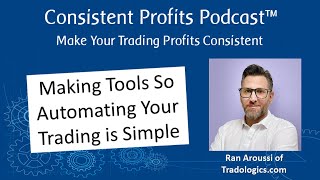
This is a YouTube video titled "026 Interview w Ran Aroussi of Tradologics" published on August 17, 2023. It features an English interview conducted by Brian McAboy on the Consistent Profits podcast, where he discusses with Ran Aroussi the development and features of TradeLogix, a cloud platform for algorithmic traders. The conversation covers topics such as the evolution of technology in trading, open source software, coding requirements for traders, supported markets, and the challenges traders face in achieving consistent profits.
Hello and welcome to the Consistent Profits Podcast brought to you by Inside out trading and Brian McAvoy, where the focus is on consistency because when you have the consistent part down, profits become easy. Hello everybody, this is Brian McAvoy with a new episode of the Consistent Profits podcast. I'm excited today to be interviewing ran Arousi of TradeLogix. Thanks so much for being on the podcast today.
Thank you for having me. Good to be here.
Yeah, glad to have you here, man, this is going to be cool. So everybody knows Ran is The founder of TradeLogix, a cloud platform that allows programmatic traders to focus on trading logic instead of the boring stuff. By offering a suite of tools to address every part of the algorithmic trading business cycle. Rand enjoys using his decades of software development and data science experience to study the financial markets and find anomalies worth exploring for both fun and profit. And he also released several popular open source financial libraries for Python developers and algorithmic traders. Again, thanks for being here and taking time for this interview.
It is a pleasure.
Now, in looking at your history and everything, I thought it was pretty cool how you really got your start way back when with an IBM PC as a bar mitzvah present. At that present you were probably about like high school age. Random, right?
So yeah, I got my first computer for actually as a bar mitzvah present. Yeah, When I was 13 years old, my first programming. There was, there wasn't a lot to do back then with computers so you had to know how to program it in order to make it do something. It didn't even have a hard drive. So I had to learn some, some basic to start coding my own Space Invader, clone games, stuff like that. And then we, we had a lot of fun, a bunch of friends with, with ASCII art and because you couldn't, you couldn't have real photographic, real photos on the computer. So it kind of evolved from there. And I really like that. I really liked, for me, it makes sense. I like the predictability of how computers operate. So maybe, I know, maybe it says something about my character, but I like knowing what's going to happen. And yeah, that's why I've been having fun with computers ever since.
Well, one thing in particular that I think is really cool because it's something that I've watched and you've got a technical background. My background is engineering, but just watching the evolution of technology over the last 30 years and the trading space, they've both evolved quite a lot since the mid-90s. And you've had kind of an inside look at both of them, but especially on the tech side. So how's that been as far as being able to watch things evolve, both of them as you've been going along, especially on the tech side?
Yeah, I'll start with the tech side because it's easier for me it's a non linear progress what we're seeing. It's really exponential. Just the progress in the past few months compared to the past year and the past year compared to the past 10 years. So it's really been been extraordinary to watch this. So as I mentioned, when I started out, didn't even have a hard drive. I had 8 bits, 8 kilobytes of memory and 8 bit screen. So it was really not a fun experience. And by the time we got to high school we were kind of developing with more advanced languages like C and Pascal. I don't know if anyone remembers that language. We used to program kind of mischievous viruses to get some time off school just to make sure that nothing works in the school. So, you know, nothing really sinister but just more of a playful type of viruses. No actual damage, just make sure that they don't turn on during these hours when we have class. But then around the early 90s, yes, so early to mid-90s when Internet really start to. Started to become a thing. I remember that that was the point where I was really sucked in. The first time I surfed the web was horrible websites back then. But the first time I served the web was in 93 and I was just blown away. I knew that this is going to be the path for the future, it's going to revolutionize communicating, is that some of them cost money, most of them don't. But the really good benefit is that they help advance technology at large. Because even if you found a great tool that is not open for commercials as you can learn more a lot about it, about how it was developed just by looking at the code and maybe just develop an alternative for yourself. And it really is what moves most of the Internet today. So starting to talk about databases, we talk about cloud services that are using open source tools. All of the, or I shouldn't say all, almost all of the programming languages are open source and you can contribute to. So it's essentially everything that happens right now is I think that it's a lot due to open source technologies and that's exactly what we're going to see in AI as well. So right now the leading AI is a proprietary one. It's OpenAI with ChatGPT but I think that we're going to see more and more open source alternative coming about real soon, which will give it a good run for its money. And then you'll see this field explodes even more than you see it now. Yeah, well, yeah, it's definitely been an exciting journey. I can see, I can't wait to see what we'll have thought about that.
Yeah, that could be really nice.
Yeah, It's. It's the 2000s all over again, just on a. In a different field. Slightly different field in terms of the business logic. That's what Google said. There was a leak. I don't know if it was intended or not, that they said we have no moat in AI and neither do OpenAI because already we have almost an open source alternative that's almost as good. So 90 something percent as good as ChatGPT and it's going to take weeks to be on par with it and then surpass it. You can't compete with hundreds of thousands of people working and collaborating on code. Regardless of how much money you have invested in your company, at the end the people will be the last to say what they have.
Yeah. As far as group think, I mean, AI in itself is pretty cool as far as an advancement, technology and kind of thought power, so to speak, from the digital side. I was reading an article a while back and I found it to be very true when I was kind of researching it because I found it interesting. But they were talking about how groupthink with humans has been used in several situations and has been extremely powerful. And they were talking about things like one of the first examples the guy used was a ship had gone down in the, in the Atlantic somewhere. And so they were trying to figure out where, you know, where it went down and where they would likely be able to find the remains of the ship. And so, you know, they called in some experts and they did their best and not finding anything. And so they kind of put it out to a larger group of people and it was like several hundred. And then they took the average, average answers for everybody. And then based on the average as far as the locations on the map, they said, okay, this is kind of what the group consensus is. If we average everything out, the group answer was within 200 yards of where it actually was.
Oh, that's extremely close.
Yeah, I mean it was amazing. And the other examples he cited, he was saying that yes, group think, maybe it's the collective unconscious or whatever, but it can be amazingly accurate for coming up with some really difficult solutions. And it was like. And so what you're saying, like with the open source and the contributions of thousands. Yeah, same thing there. Because you're putting so much mental energy and resources into it. And so that's really exciting. Well, especially. And again, looking at the next evolution as AI becomes a contributor to that, and now you got open source, thousands of AIs contributing in addition to humans. Yeah, things can get crazy in a hurry.
Things will get crazy real fast.
Now you started off with the web development firm which. So what does that mean? I'm basically just set up websites or were you on the infrastructure side of it?
Yeah, so I started with a web design and development firm back in 97. Wasn't a great time because I had to explain to customers what Internet is. Once we started getting a few customers, things kind of rolled from there and maybe a year or two later customers started to ask, okay, you've built the website, can you help me get traffic? So I had to kind of go and learn to do Internet advertising, Internet marketing. And I gotten quite good at it and I realized that, okay, so I don't need the customers anymore. I can just use affiliate marketing and build my own stuff. Because if I have the content, I have the revenue stream and I have the means of getting traffic, then I'm all set. And that's what I've been doing for a long period of time. I even started a school back in the day to teach people how to do Internet marketing and E commerce back when nobody was doing that. And I worked a lot with ClickBank and did a lot of email marketing and advertising. But gradually I drifted back into the tech industry and I found a way to make both work together. And I got into the edtech space, kind of where all the programmatic ad buying and selling happens. And. And yeah, I joined forces with a few friends who started a company and I joined as the expert. And gradually we built an ad network with capabilities for real time bidding and arbitrage between different exchanges. And at the high point before I left, they're probably doing a lot better now. But when I left there about 10 years ago, we were doing about 3 billion ads every day. So that's no small number. And the way that it works, not a lot of people know this, but the way that bidding on advertising online works is a lot very similar to what's happening in stock exchanges. So every time you go into a website and there's an ad to be displayed, there are thousands of advertising bidding to get your eyeballs essentially. And this all happens Programmatically and very fast, obviously. But there's a lot of data points that are taking into place where the banner is, who is watching it, what time is it in the day, what's the weather in the country where you're watching. So there's so many data points, but at some point I kind of started to. Started to feel that there's. Yeah, I know that money makes the world go round, but there was so much brain power there at the end to how to lose some click on a banner on how to lose your belly fat. So I didn't feel that was a very good roi. Although company made a lot of money and everyone did great, but again, the geek in me kind of rose up and wanted to do. To do something else that's more mentally challenging. And that's where I got into trading essentially about 10 years ago. So that, that kind of was my journey from, from pure tech to, to trading and then back to trading using tech. So it's kind of a, kind of a journey.
Well, so what prompted you to, prompted you to start TradeLogix, where now you're providing it as a service for other traders? What. How did that come about?
Yeah, so when I started. Maybe you should have mentioned, when I started trading, I realized very quickly that discretionary trading is not, is not for me. You really need to know who you are and what works for you. I couldn't stand sitting in front of the charts all day and just waiting for the action because a lot of time there isn't any, there isn't any action. And then I decided to, you know, you start to imagine action and that's where you're gonna lose money. So I realized very early on that that's just not for me. I have, I need to, to create my own, you know, matrix agents that will be ready to pounce whenever something happens and be ready to bounce whenever something bad happens. So. And I created a bunch of algorithms to trade with, but I couldn't find any real tools other than metatrader, which don't get me started. I didn't want to trade Forex and I didn't want to trade on a Windows machine. I'm not so adamant against it now, but back in the day it was a huge debate between open source versus Windows. So anyway, so I had to create my own stuff, my own tools to connect to different brokers, APIs and be able to execute the trading. Everything that I've created, aside from the actual trading logic, I released as an open source. Just because I'm a Great believer in that and kind of took on fire. A lot of people started to use my tools. They're on GitHub right now to this day. I get about 600,000 installs every month, which is, which is insane. Yeah, I've got to make a buck for each one. That would be great. But anyways, I released as an open source. A lot of people started using it and I started to get a lot of feedback and I kind of gotten the impression that a lot of people suffer from not knowing how to get their ideas into production. Because it's one thing to tell yourself, okay, I have a system, I have my rules base. I know, at least in theory, when to get in and when to get out. You have your rules. But that's not the same as programming an entire system that listens to market data and tracks your position and measuring risk levels. It's not the same writing the I know if Apple goes up by Apple, if Apple goes down, sell Apple. It's not as, it's not as easy. There's a lot of moving parts in the trading system. So I decided, you know what, let's, let's, let's build a project called the TraderLogix that will provide all of that. So it will give you everything you need aside from the trading logic that's on you and has the name of the company. So when you sign up for an account, we'll take care of the market data, we will take care of monitoring position, of allowing you to talk to pretty much any broker out there with the same API, the same command, so you don't have to rewrite your program when you switch brokers having a unified interface to monitor your position across different sectors and different venues. Have your own real time screeners to send you alerts when something happens. So obviously provide you with detailed reports as to everything that goes on, including we're also providing you with the actual virtual servers to actually run your code on. So it's really, it's the entire package of everything you need. You just need to be to know how to trade, essentially be a trader, be okay programmer. Again, it's one thing to be able to log into for example for a WordPress website and change the font to bold font. It's a completely different game to write a plugin or develop a website from scratch. So that's the levels of programming that you need. You need to be able to kind of change the font. You need to be able to write a few lines of code to have your algo running because you don't have to write any code to monitor the position or to check whether or not you're in position even, or you don't have to write the code to send the order to receive and digest the market data and to filter out the tens of thousands of data points that we receive every minute. So yeah, that was kind of the idea and people seem to like it.
Well, so you said. So just for clarification, you said that when somebody does come to work with, with the trader logics, how much do.
They need to know?
They need to have, they need to be a trader, they need to understand, they need to be a trading method or strategy.
Yeah.
So beyond that, when they, when they come to work with you, like what else do they need to know to be able to work with trade logics and. Well, we'll start with that one.
Yeah.
Coding or do they just need to know how to like plug, you know, connect the, connect your platform and their broker.
So right now they do need to do, they do need to know coding, but they need to know coding at a much higher level than actually doing the systems training. So you need to be able to write the if then rules. Essentially you need to be as good as a programmer as writing a simple easy language script in the programming language of your choice. We don't tell you which one you want to use. You want to use Python, that's fine. You Want to use JavaScript, PHP, Ruby, Go, whatever you want, we facilitate it. So right now you have to do some coding. Our plans is to introduce a no code solution that will allow you to just use building blocks. However, the road to that is still long because that will also seriously limit your abilities to express yourself. There's a limit to how complex your algorithm can be using a drag and drop interface and how many rules you need to put there. So if you want to put in your own math, you have to do some coding. So yeah, instead of being able, instead of having to know how to develop entire trading systems or trading operating system, you need to know just how to program your rules inside this big machine that we've created for you. I hope that makes sense. So it's about 5% of the overall code that you would have had to, to write otherwise.
Okay, well just so because a lot of traders are, you know, we're not, we're not afraid of a challenge. But as far as learning what we would need to learn to work with your system, about how long would you figure that it take for somebody who's, you know, they got a Reasonable aptitude to learn that basic coding that you're talking about. About how long would that take?
Probably five, ten hours if you're a non programmer at all.
Right?
Yeah, probably about that. About 20, 30 hours. Starting using Python, you'll be able to write a simple yet robust enough algo. Yeah, something like that.
That's not bad. That's not bad.
Yeah, because you're not going to learn Python. You're going to learn Python for that very specific use case.
Right.
So there's a million things in Python yet that you wouldn't need to learn, essentially. So you're only focusing on something very specific.
Very cool. Now, do you have any kind of tutorials available for people who maybe have, I mean, like way back when I took Basic and Fortran and Pascal, but I'm not familiar with Python. So if I've got, you know, kind of an understanding of, you know, writing out a basic algorithm on paper and then translating into programming, if I've got that kind of an understanding, I mean, do you have any tutorials or like tutorial videos that can get somebody up to speed fairly quickly?
Actually, no. We are working on a free course that will release on the website that's Python for Traders. We already have some sort of a resource that is math for coders. So a lot of coders, myself included, we understand very complex math, but in intuitive way, when it's written as a program, we understand the math. When it's written as a formula. It's very hard for me to intuitively look at it and say, okay, I understand what's going on here, but if you rewrite it as, I don't know, as a. For loop, as a program. Yeah, I read it like plain English. So we created like a tutorial that explains, okay, this function does this shape of when you see formulas. So this shape right here, this is actually that formula that you all already know. So don't be too scared of math formulas. It's kind of help coders read more scientific papers about trading. But yeah, we're gonna do. We're working on something that is still in the kind of the planning stages, but we're working on something like Python for Traders, which is to say to teach you the kind of the really small subset of the language that you need for the ACCL trading.
Yeah, very cool, very cool. How far away do you figure that is? When do you figure you might be releasing that? Got an estimate on the timeline?
We actually don't have estimate. We just started planning it. Planning it? Probably a couple of Months.
Cool. Well, as you get that sorted out what your target release date is, let me know because yeah, I'd be thrilled.
Sure, I'd be happy to. Yeah, of course.
But also, you know, it's going to.
Be part of the. And we're going to launch an entire revamped and much more informative and beautiful website with lots more resources. So that, that's still, still in the works. So it's, it's all going to come out together in the, in the next few months.
Very cool. Now, as far as tradelogix, do you, do you work with all the different markets or do you focus mostly on stocks or currencies or crypto? What platforms do you work?
Yeah, so right now we focus on US equities, forex and crypto. So these are the market that we currently support. We work with. I can't remember close to 30 different brokers and exchanges using the same interface. So as I mentioned, you don't have to rewrite your program just because you wanted to switch from interactive to Binance for some reason. But let's say that that's what you decided to do in Today's world without tradeologics, they have different APIs, so you essentially have to rewrite everything. So we're saving you from that. We're doing everything behind the scenes for you. So yeah, that's. That tend to answer your question. These are the market that we support, the next market that we're going to support, and it's been on hold for about a year just because we are kind of focusing more on the actual usage of user making that they've fully embraced the logics into their workflow and their businesses as well. But the next market is going to be futures and more international markets for stocks.
Cool. Now, do you guys work with options at all or pretty much just the underlying instruments?
So we work with the underlying. With options we have. We have a bit of a challenge, which is not the actual trading. If you send an order, we'll pass the order along, you'll get filled. The problem with option is backtesting. It's just mountains of data and we need to figure out how to do this properly and that the same code that you've used for backtesting can be used for live trading. So we need to really think this through because we don't want to come and say, you know what, for backtesting, this is how your code should work, but for live trading it's a completely different thing. So we were really careful not to do this with the markets that we currently support. But options, these are completely different ballgame. So we'll see. We'll see.
Oh yeah, yeah, Options. One thing that cracks me up about options, we talked about the evolution of things is how options is presented by so many. It wasn't that long. Yeah, like the binary options and it's like, oh my God, you guys have oversimplified it to a great selling point. But options are way more so.
But that's gambling. Yeah, that's literal gambling. The binary options, you may get the direction right, but they needed to be right at the, at the second level.
So.
And yeah, so to nail both the price and the second that it's going to happen. And this is casino, this is not trading. But yeah, you talk about the evolution. You have daily expired options now, which is just crazy.
True. Yeah.
And just crazy. I thought weeklies were insane. But you have dailies now. Yeah.
Well, okay, so now just because it's getting popular, would your service be applicable for prop traders? People trading through prop traders?
Yes, yes. That's kind of actually the main, the main demographic, that target audience that we're going for. So the profile that we're working with right now is we call it the prosumer. So it's kind of the in betweeners, the people who are either trading their own money for a living or are part of a bigger business. But they, they want to, I don't know, friends and family, money manager, stuff like that. So either like the smaller, the lower tier money under management wise, the lower tier professional traders or the higher tier retail traders. So these are kind of the middle ground that we're currently targeting. And as we'll grow, we'll start expanding more to the business use case side and later on more to the retail side. So that's kind of our marketing, our growth strategy. So we're first going to expand more to the pro side and then more to the retail side.
Yeah. Now when you say the business side in the trade, how do you mean in comparison to or contrast to, you know, individual retail traders? Talking about firms.
I'm talking about firms, obviously small firms. We won't get any, you know, renaissance technologies using TraderLogix anytime soon. But. Or at all. But. Which is fine and expected. But yeah, I'm talking about smaller funds. People see, you know, billions and they see really large hedge funds. So that there's a lot of hedge funds with under $100 million under management, which are one or two guys, that's the entire personnel. So these are absolutely perfect. We're a perfect match with the these types of funds. Money managers, we have quite a few that are managing friends and family, five to 10 customers accounts that they're managing. So yeah, these are the types of audience. Obviously we have plans to provide more business tools. Like we already integrated a marketplace where businesses can actually start develop their. And they have an SDK so they can develop their own customizable solutions to integrate with TraderLogix. You'll be able to using the marketplace, you can subscribe to auditing services and accounting services automatically because once you give the permission we can give your trading history, not your trading logic. Again, not the why you went into a trade, but the actual trade. We can share this with auditors, with accountants, so. Or everything will happen while you trade. So yeah, the idea is to build an entire ecosystem from that and it's going to be a long journey. We are very well aware of that. But yeah, that's kind of the broader vision of what we want to achieve is providing you with entire ecosystem and an operating system for your trading.
Very cool. Well, so when somebody, let's say I'm working with Interactive Brokers right now on their platform.
Yeah.
So if I want to use tradelogix, can I still use and trade through Interactive Brokers and.
Yeah.
And advantage of it or do you have your own kind of user interface?
No, no, no.
You do not trade on TradeLogix.
Nope. You'd never trade through Trader Logics. That's not the business model. We don't do that. We don't want to touch your money, both for regulatory reasons and for just our peace of mind. So you just connect your broker with. Sign in with Google type of button. You're going to connect your Interactive Broker account and then every order that you're going to send with that account ID you're going to get. Okay, this account ID is ABC123. So every time you send an order with that account ID it will be routed to that account in Interactive Broker. So yeah, we're not, you're not depositing money in Trader Logic. You know, don't do anything like that. We're a service service based fee. We're a fee usage based fee service.
Right. Okay. So, so I can still for, for lack of a better way to describe it, I can still do my trading the way I have been using the tools that I have been. You're simply tradelogics is providing.
Yeah.
The, the tool to automate what I'm doing and now and well essentially creating my own bot. Right. I can Build it over here, Logix, and then I plug it in and it runs over here on my existing platform.
Exactly.
Okay.
Exactly.
Wow. That's pretty cool. Very cool indeed.
Yeah, we didn't want to go around where we start our own brokerage or do anything like that. First we don't think it's an interesting business model in today's market. Yeah, it's not, it's not. It's a type of a commodity which I'm sure in 10, 15 years trade logic would be as well. That's just, that's just the game of tech. I still remember buying a DVD player for $2,000. So you know, things are losing, are becoming more and more of a commodity as we, as we progress. So the real benefit is not whether or not the real challenge is not whether or not we can build the best product because we sure can be. Is that, can we do that and be first to market with that type of offering? Yeah, so that's kind of the main challenge that we're facing. But yeah, we didn't want to build the creative brokerage. We didn't want to live off commissions or sell your data or anything like that. We're a platform, we're defining ourselves as a cloud based platform platform for traders. Not a trading platform but a platform for traders like a trading operating system. And we've put in a lot of effort to make sure that we support any programming languages and any broker just because we don't want for you to relearn how to do things so you come with your own knowledge. So let's say you know a little bit Of Python or JavaScript, whatever it is that you've used and you're using interactive brokers because you like it and so keep using the same tools you know you should do you. We'll just take care of everything and try to cater to make your life a lot easier.
Very cool. Very cool indeed. Well, yeah, this has been really excellent. Discovered some things I didn't realize were going on before. Very cool. What you have going on now I've got to ask just because this is the shifting gears a little bit here because this, this is the Consistent Profits podcast. What do you see as one or more of the primary obstacles for traders to keep them from realizing consistent profits?
Oh, the easy answer is lack of patience. That's the main thing. Both patients and I knew that I don't have that patient so that's why I went the algo way. Both patience of being able to sit there until something actually happens that you need to react to and both patience for leaving the money there a lot of especially people starting out. I see that. And again I went exactly the same route. It's not like I'm dissing anyone. Everybody's going through that. You start with a nice strategy and then you just because of greed and you're looking for action. You try to see if it works on a daily level or maybe an hourly level, maybe in a minute level just because you want to do a lot of trades because you think this will equate to more money. But no, just know who you are and if you're not gonna sit every day in front of the computer to trade, just find some nice swing trading strategies. If you're all pumped of adrenaline, maybe go the day trading route. But yeah, but have patience. Have patience and you need to integrate it into your lifestyle. That's essentially my two goals. This has to be integrated to your lifestyle.
Very cool. Well, yeah, I'll tell you what, it's been really excellent today. I appreciate again appreciate you taking the time now if somebody wants to connect with you just as tradelogix.com best way to, to find out more about.
Yeah traderlogix.com or just look me up on Twitter. My. I'm sorry X my, my handle is my. My last names Arusi. Yeah I'm there. I'm always doing something excellent.
Well for all our listeners and I'm glad everybody's here today. I applaud you for taking time to learn more as a trader. Develop yourself, expand your knowledge base and everything. And if what Rand has going on here sounds like it would be of interest to you and something that would benefit you in your trading, definitely head over to TraderLogix and check them out. Connect with them there and take advantage of it. Don't just listen to this and say that was cool and then tomorrow it's forgotten and it's been time consumed. But like I said, if it resonates with you and it sounds like something that would be worthwhile, go ahead and connect with him and pursue it. He's got some really good stuff going on here. And the fact that you're doing open source I love because that is so cool. Just if nothing else for the transparency of it so that everybody knows yeah what you're doing is all legit and you're not playing games. No adware, spyware, garbage, bs, all that. It's like you're right out there and so everybody can see it's straightforward. So yeah, really. Again, thanks for being here everybody. Thanks for being here, Rand. Thank you for taking the time and I'd love to have you back on again.
Thank you very much for having me. I had a great time indeed.
Well, let's go and wrap it up. And everybody, again, thanks for being here on the Consistent Profits podcast. We'll talk to you soon. Cheers thank you for joining us today on the Consistent Profits podcast, brought to you by Inside Out Trading. Make sure to swing by Inside Out Trading and pick up your copy of the proven formula for consistent monthly profits. If you enjoyed the show, make sure to subscribe on your favorite channel and we'll see you on the next episode. Cheers.









