028 – Interview w Simon Severino of Strategy Sprints
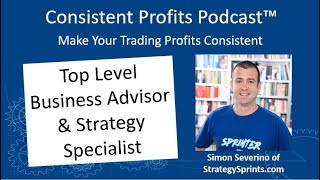
This is a YouTube video titled "028 – Interview w Simon Severino of Strategy Sprints" published on August 31, 2023. It features an in-depth interview conducted by Brian McAboy on the Consistent Profits podcast, where Brian and Simon Severino discuss business strategy, sales acceleration, and applying business principles to trading and investing. The conversation covers Simon's background, his Strategy Sprints methodology, portfolio management, and advice for traders and entrepreneurs on consistency and growth.
Hello and welcome to the Consistent Profits podcast brought to you by Inside out trading and Brian McAvoy, where the focus is on consistency because when you have the consistent part down, profits become easy. Hello, everybody. This is Brian McAvoy with another episode of the Consistent Profits podcast. I'm really excited today to be interviewing Simon Severino is creator of Strategy Sprints. And I really, you know. Hey, Simon, thanks so much for being on the podcast today. This is gonna be fun.
Thank you for having me, Brian. So happy to be here. Hello, everyone.
Excellent. Now for the listeners today who are not familiar with Simon, he is an expert on business strategy, supercharging sales processes, and most notably, accelerating the achievement of goals and general efficiency. As a shrink turned CEO, he had to learn the importance of working on the business more than in it. And now he helps business owners overcome sales and other obstacles and reclaim 12 hours per week through his Strategy Sprints method. As the author of Strategy Sprints, he teaches certified coaches how to supercharge sales and also help businesses in other areas. He's a member of the Silicon Valley Blockchain society, he's a TEDx speaker, very cool Forbes contributor, and he's appeared on over 1300 podcasts. That's a lot. When he's not supercharging sales, you'll find him swimming, mountain biking, running, or tricking his three kids into outdoor activities so they can't escape his annoying shrinky questions. I thought that was hilarious.
They don't find it hilarious at all.
No. Part of the reason I laugh, because I do the same thing with my kids ever since I've been around.
I tell you, having kids is a marketing problem. If I want to do mountain bike on a Saturday, I have to start Tuesday with marketing and then Thursday is the campaign and then if, if by Thursday, if I don't sell it, then, oh my God, there is no Saturday mountain biking.
Funny. Well, again, Simon, again, I'm really glad that you're here and, you know, so everybody knows. Like I said, it's critical. And I'm excited about talking business today because it's so easy for traders to get caught up in the minutia of daily trading and lose sight of the fact that what you're doing with your trading, if you're expecting it to be any kind of a long term asset for you, you have to keep in mind that it is a real business. And Simon has business insights that I think will definitely benefit you as a trader. So now we got to start here, though. We already touched on it. You Know, since your history is mostly business and sales related, what's with the. I noticed in Your bio on LinkedIn says Shrink turn CEO. Were you like, your schooling was in psychology and philosophy, so were you ever like a practicing psychologist?
I were, yes. My first career was practicing psychotherapists. You know, the couch. And then they tell you their dreams. And I was so bored because I don't care about your dream of seven years ago. Come on, what are you doing today? And so I realized, wait a moment, that's not a shrinky question. That's a, that's a business coach question. What are you doing right now and how can we scale that? And I realized, okay, I'm in the wrong job here. What else is there? Where are my people doing stuff? And then I had the triathlon coach that weekend and he told me, simon, you are running too fast, you have to run slower and you are eating like an idiot. You have to change your diet. And I went like, hey, this guy talks like me. And I asked him, where did you learn coaching? And he goes, well, there's this coaching academy. And so I realized, hey, I'm a coach. And then I changed trajectory. That was 21 years ago. And now I'm still doing the same thing every day, business coaching. And I'm particularly into revenue systems, how to repeatable revenue that really generates income on multiple levels so that you de risk like a diversified portfolio. You have multiple revenue streams. And the psychology part actually came in pretty handy because sales is 90% psychology. You have to understand what they need. You have to de risk it, make it safe, make it easy, and then they buy. And funny enough, because after a decade of doing this, well, I had some pretty good revenue streams going on. And then for the first time in my life, I was confronted with, okay, how do I get this money to work? And then the Fed started doing stupid stuff by printing out of the thin air. So they started debasing my money by 14% every year without asking me. And so I said, I'm not going to let them do that. I'm going to learn investing. And so I'm also a passionate learner of investing and I have my investing system. That's the arc of the story from shrink to CEO to wannabe investor.
Huh. Well now, as far as in the business field though, I mean, so how did you make the transition? Because I noticed you, you've actually done some fairly high level work or work at a fairly high level. I mean, like, you bet, you're a contributor to Forbes, you've been entrepreneur, that group, the. And well, and right now, I mean you're like a business advisor for the Silicon Valley Blockchain Society and Consilience Ventures. And so I mean, how did you wind up, like I said, going on from a psychologist, I understand you got the interest in business, but how did you wind up like going just from being interested in business and understanding that you have a business to contributing at that kind of a level.
It'S probably a compounding effect or a flywheel. So if you think, you know, you put $1,000 into the S&P 500 at some point, let's say it grows at 6% every year, then you have that compounding effect over 20 years. Now I'm 21 years into this. So there is a compounding effect of flywheels. The first part is understanding. One sale, you have to close one deal. That's the beginning and that's the psychology part. As soon as you get that and you get your people and what they need, then it's about systemizing it. Okay, how can I write this down and make it repeatable? When it's repeatable, it's about, okay, who can I hand it over to? Maybe to a software, maybe to a freelancer, maybe to a full time employee. And from there you start freeing up your time. So I started delegating. I got back 40 hours per week of my time and now I have time to hang out with the Forbes people with you on podcasts, writing books. My book is getting translated in Chinese. We will probably talk later about the book. So now I have a ton of time to do that. In the mornings I watch my portfolios and maybe I have to study or research or rebalance. I hope not to rebalance. So often I'm trying to rebalance less but because I'm not good enough. But that's what I do in the mornings and in the afternoon I have growth related tasks like being the spokesperson of my method on podcasts, in on stages with affiliate partners. One of our affiliate partners is Google. So that's one flywheel, right? I help, I help them solve their problems, they help me get leads and together that's another flywheel, huh?
Very cool. Very cool. Now I checked out your TEDx talk, which was really excellent by the way. And one thing that I noticed about it that I thought was really cool and if you don't mind expanding on it just a little bit for our listeners to understanding of traders, what I thought was cool is how you focus on, first of all facing your fear of Success. When you're talking to a business owner and you sense that they have that fear in them, how do you generally approach that and help them understand that.
Love this question and Carl Gustav Jung said, where your fear is, this is where your work is. So what should you be doing today? The one thing that scares you, that's the psychological principle. If there's fear, it's telling you that's the work. Now in practice today, in the morning, as an investor, I had to design my portfolio and pick. Now you can pick a very diversified portfolio, like, you know, 60, 40, 40, 60, and all that old school boring stuff that people were doing before, that's not working anymore. But the point is there are still people who pick that, by the way, and they're doing terrible, but they still do it. Why? Because they think it's de risked. Hey, I have seven different ETFs in seven different categories and I have gold. So hey, I'm de risked, right? So that's the psychology. They have no clue that they are at the highest risk possible and imaginable because they don't do the research, they don't write down the assumption, they don't check, validate the assumption. And of course they don't look for volume, momentum, anything. So on the other side, you can go full into risk. For example, today I had to decide, do I buy a little bit of ADN because it's cheap or C limited because it's cheap? Yeah, you can do that. That's a temporary opportunity. You might do that and write that for two weeks, three weeks. Not financial advice. But I didn't. Instead I, I looked overall at overall portfolio design and it says, okay, my decision that I took, it's a system. So my decision is I am one third real estate, 1/3 equities, 1/3 digital assets. In those I go full in in one thing. So real estate, that's not risky. So doesn't matter what you do there. I looked at having very small apartments that are easily rentable because it's an asset. I don't live there. It should be easy to rent. Somebody else repairs it, then it's an asset, otherwise it's a liability if I live there. So it's small apartments, easy to rent. Then the equities part, I'm all in Tesla, right? Right Now I am 71% Tesla as we speak.
Wow.
So that's the opposite of a diversified portfolio. In equities, you can imagine I have a spreadsheet and every day I check the numbers. What's getting out of each gigafactory and if the costs are going down and what's the risk in China etc? I check that every day. Same thing with my digital asset portfolio. It's mainly one thing. It's right now Bitcoin, then Solana, then ethereum, but it's 86% Bitcoin. So the reason why I tell you this is we are afraid of winning more than we are afraid about losing. Those people who go into all ETF stuff, 60, 40 bonds, ETFs, they're afraid of winning because if you get in a position where you can win now you're in risk territory. And in risk territory you have to manage risk. So you have to study both fundamental analysis and technical analysis because you can buy Tesla at the wrong time.
True.
I have to have a minimum clue of technical analysis and it's on the weekly and it's on the daily, so it's not on a short time frame. I look at the daily, weekly and monthly. So it's very long time frame. But still the volatility on those two assets is such a high volume situation that if you're afraid of winning, you don't ever go there. So it's a game, it's the inner game of risk to reward decisions and most people are afraid of winning so they never risk. Now traders are different, they like it. But in business, in business that's always the decision, what's the risk to reward probability here and how much am I willing to be ready to win? That means taking risks.
Oh yeah, yeah. Now you mentioned a couple of things that I think are extremely worthwhile and I can see how it's just kind of how you operate. Like you'd start off saying, you know, I've got these little temporary quick opportunities to make a buck, but you're not going to do that because you want to step back and take a look at the bigger picture, which is excellent. And that's again part of why I wanted, I was thrilled to have you on today because that to me is more your business mindset and just way of approaching things. You're in it for the long game. You're not here to just make a quick buck today and do it again tomorrow. It's like, yeah, okay, I'm going to, you know, look at my overall portfolio where I am, play to my strengths and manage things on a regular basis and make sure that I understand what I'm getting into. Now from a, again, going back to the other things that you have going on as a business advisor to like The Blockchain Society and a couple others. Notice one of them appears to be, what is it? Consilience Ventures. They seem to be pretty much startup oriented, is that correct?
Yes, I work with high growth organizations because it ties back to what we were discussing. Right. So I like the highest opportunities for alpha. So that's my personality and that's why I attract teams that want to grow fast. Those teams are usually in the tech space. They are mostly in California and also in London, in Berlin, etc. But mostly it's tech, it's California. And they are asking Simon, there is a chance to disrupt here, specifically the financial sector. What the blockchain can do and will do in the next 20 years is what the Internet did. So they are saying, all right, there is opportunity, right? It's, it's unregulated, but there is opportunity. How can I tap into this opportunity? How can I de risk each step? How can I make it a system of entering that world? Be ready. And right now in the bear markets, we are all building, building, building, building, making sure that we are ready for the, for the bull markets when they come again in, in the crypto space, in the blockchain space. That will be intense. And then you don't have time to build the, the sales pipelines and etc, because then you will be just shipping, shipping, shipping and trying to survive 24 7.
Right.
So we are using the bear markets to go to inbox zero, train the salespeople, improve the product, improve the website, improve the, how they, how they invoice and how they deliver. Because now we have time, it will change soon.
Okay, well, so part of the reason I was particularly interested, that caught my attention. I mean, besides just kind of being a cool topic and area, of course, new tech and innovation, a whole new environment on the horizon with startups and businesses in general. And I think it's cool that you're in this space and you can help them think through these processes. It sounds like one of your strengths definitely is helping people take a look at the whole startup cycle, going from concept to sustainable business. And again, looking at businesses in general, not just the tech space, but businesses in general. There's various stages that a business goes through when you're going from, you know, startup to, you know, a mature business. And it's cool that you've got that perspective. What would you say again, generally speaking, not necessarily, you know, to the tech space, but just generally speaking, you know, for businesses, you know, when they're, when there's somebody wanting to start up a Business, what do you see as some of the like real critical factors that they should look at and be aware of as they're planning their business? You know, going from startup, you know, yeah, hey, I want to, you know, start my own trading operation. And this is kind of, you know, what I want at the end, you know, is I want, yeah, I want to have a long term asset that's generating wealth. So understanding. Okay, that's the business that we're talking about. But again, speaking from businesses in general, what do you see as some of the key requirements for, you know, getting through that startup phase?
Love the question. And let me try to answer it with an example. So what's a typical listener? Do they want to start like a trading academy or a trading platform or something like that?
No, no, just. And when I say a trading business, they're essentially starting their own trading firm just because they want to trade their own accounts. They're not necessarily dealing with any outside people, no outside customers, but they're wanting to manage. It's just like if somebody wanted to start like you with your real estate, you're not managing properties for somebody else. You just want to acquire real estate portfolio managers and grow it and you have an investment firm, but it's just you. So traders is kind of the same thing. They want to have their own stock trading accounts, forex trading accounts, and they want to grow this into a good investment firm. But they're just trading their own money and it's a one person self employed operation.
Okay, so it's just managing their portfolio or landing 10 clients who give them a million.
Just managing their own. Just managing their own.
Oh, their own. Okay. So to me the stages in a business are the first one is below 35k per month. I'm still in finding out what's going on. And then there is a line in the sand that says, okay, when I'm doing 35k per month, that's when I'm crossing the line. So I found something that works. Okay, so, and that is the point where we usually start coaching and scale that up into something that can become a global company. The last stage is going public. It's not a good idea for most companies and the most important line in the sand is hitting the first 35k per month. Now if I'm just managing my own portfolio so I don't have to win clients.
Right, right.
Okay. If I'm just managing my own portfolio, the, the first thing is to decide the, the level of excitement that I want to have per day. Do I want to check every minute, every hour, every day or every week?
Not laugh. Because first of all I've not heard that particular perspective. Yeah, but you're absolutely right. Yeah. What, what kind of level of excitement do I have or do I want to have?
Ray Daily.
Sorry to interrupt. I think.
Yes. So who was it? No. Michael Saylor said, hey, if you're checking every hour you are a bit overexposed. And if you are checking less than once a day, you are not exposed enough. So you have to. Because it's your life, right? It's your life. The risk as a trader is just to have a heart attack or to be too tired to burn out. That's the only risk as a trader, right. In terms of long term risk. The short term risk is of course you don't manage risk management when you don't have stop losses or you over leverage. But that I, I hope it's in the one on one of every trader to do risk management in the position itself. So let's look at the overall risk. The overall risk is that you burn out. So it has to be compatible with your life, right? Your, your friendships, your sports, your family. And so after you've decided that and also depends on the time zone. For me, for me I would be trading nights because the US market is for me open in the night. So you have also to check where are you in the world. It's different in Australia or where you are in the world and what markets you are trading. And then the next decision is okay, overall portfolio construction. Do you allow yourself specific areas and specific rules? This is super important because the next risk is emotion. We have to eliminate emotion from all your decisions. Average trading hit rate is below 30%. Most traders go broke and burnout. So we have to increase the hit rate in the decision making from to get it up to above 35% and ideally above 50%. Then you are in the Ray Dalio, Warren Buffett category. And how do we get there? You have to create your own set of rules and your system. First rule, which buckets do we allow yourselves? Do you do forex and equities or just forex or just commodities? Pick your fight. Then inside of that will you go for okay, 80% investing and 20% trading back or is it the other way around? 80% trading, 20% investing long term. So that's the next. These are all risk management systems.
Sure.
And the good thing about being a private trader investor, you have the luxury to not. You don't have to rebalance. So the Problem of Katie Wood, who is also a Tesla investors like I am. But Katie has to rebalance. She has rules, and that is Tesla can only be 15% of her overall portfolio. So whenever Tesla pumps, which is obviously telling you that it's a winner, she has to sell. As a private trader investor, you don't have to. So I say we have the luxury of concentration. So pick your risk. My risk is concentration. I go for concentration all in. Into. I wouldn't say risky position, I would say risk adjusted decision. So it's because you adjust them by risk and by reward.
Yeah, it's a calculated risk.
Calculated risk. Now you have to start with a trading journal. You have to write down, why did you buy? And you will realize at the beginning that you just bought because somebody on Twitter said that you should buy it. And then week later you get smarter. Then a week later it says, well, I bought it because Brian said it. Then, okay, third week you get smarter. You will get hit in the face. And month by month, you will get smarter.
Now, one thing you mentioned that I think is really cool, and that's kind of where I was going with the question. So when you're looking at a startup, you're saying, like, for you, the first Stage is below 35K, and so there you just, you really don't even know what you're doing yet. You're just kind of getting it figured out. Now, how long? If and assuming you're looking at a fairly unsophisticated, not super complex venture, just in general, how long would you allow for that first stage to last before you say, wait a minute, I'm wasting too much time here. Would you give it like three months, six months, a year while you're still getting it figured out? Or I mean, yeah, I mean, what would you generally say is a good timeframe to say? All right, we have to give it a little bit of time to figure it out, but beyond that, we're kind of wasting time. So just an initial time frame to get things sorted out. What do you figure is like a prudent kind of rule of thumb?
That is a great question and every context has a different answer. Oh, sure, if you're swing trading Tesla, you can know in a couple of weeks if your system is working or not, because that's the frequency of the swings outside the Bollinger bands.
Yeah, actually, no, I'm talking about like businesses in general. You know, how long would you allow for like that initial startup phase where you're just kind of getting things figured out?
The Shortest possible time to validate assumptions. So that's why the journal is important. My assumption is Bitcoin in 10 years will be worth 7x what it is now. That takes me 7 years to validate. I cannot make that shorter. But if my assumption is because we have to validate our own assumptions. But if the assumption is because, you know, past history doesn't tell me future history, so. But if the assumption is I can swing trade Tesla, that can probably, I can say, okay, whenever I pick my four indicators that have to fire at once and now I will do it. I, oh, I think I got the top out. I think I got the bottom in. I think I got the top out. Now I can already say stop validation or invalidation. I either picked the top or not. If I didn't, then I have to go back to my indicators. Wait a moment. Those are all four volume indicators or these are four momentum indicators or four strength indicators. So let me change the indicators or I have to go back to fundamental analysis. Well, the chart was saying it, but I didn't know that they were insider selling. So I have to go back to fundamentals or they have no moat or it's a highly manipulated market.
True. Yeah.
So you don't see that from the chart. And so let me go back, I have to look behind the curtains. Let me do some fundamental analysis and that changes your next decision. Your next decision will be 80% chart, 20% fundamental analysis or research, which you, you wouldn't do if it works just from the chart. So in that case, I don't know, three weeks before you invalidate is not working. And some other things you can do daily. So if you go to the 10 minutes time frame on trading view and, and do forex, you can validate it in a day. Can you make 300 bucks? Yes. No.
Okay, fair enough. Cool that you're sharing your perspectives on these things. I'm also kind of anxious to go ahead and get on talking about your strategy sprints book. If you don't mind, we can kind of maybe jump ahead a little bit to that. Because really, that's, to me, one of the exciting things about it. Because really with your book, I mean, one of your intentions is to accelerate, you know, business growth and improvement. Right? I mean, how'd you actually wind up, you know, starting strategy sprints and, you know, writing the book in the first place? How'd that wind up, you know, how did, yeah, how did you come to write the book in the first place?
It was the pandemic and I had finally time, because I wasn't sitting in planes all the time. And I had finally time to sit down. And so I thought, what's the highest leverage activity that I can find? And I found two. One was find the biggest affiliate partner that you can find. And so I made a dream list of my top 20 Dream affiliate partners. Google was on top of that. I landed that. The second one was how can I make my IP work for me? So IP lending, passive income.
Okay.
And I said if I write down the strategy sprints method and I have the book be sold by a publisher and then the IP be bought for itself, so people who want to use that method pay to use that method. And I said, okay, what's the first step? Write it down. And so I started writing. And then during the writing I started looking for a publisher. I found Coggan page in London who really resonated and they said, I'm in, let's do this, I'm going to promote this. And so that's why I started writing strategy sprints. And it's like a cookbook. Each chapter is. Chapter one is marketing. This is how you do marketing when you start a business. Chapter two is sales. This is how you do sales. And then it goes up. Client delivery, up to. And the last bits, 12 and 13 are the chapters around hiring because this is then how you scale globally. You start handing tasks over. So it's like a cookbook but for entrepreneurs. You know, today your marketing is not working. You open up chapter one. Oh, let me see. Oh, okay. This is the recipe. Oh, I forgot the onions here. This is what I forgot.
Well now as far as the strategy sprints, I mean generally you're working like with 12 week cycles, right? You know, a quarter. Correct?
Yes.
So where, you know, where along the way did you adopt that kind of approach? I mean, because I've heard the 90 day cycle, you know, 12 week year and stuff like, like that from, from others in different applications. And I think the one guy is, his thing is, you know, performance athletes. But how did you wind up choosing that cycle to base your methodology on?
Yeah, it's funny that you say performance at least because that was also in my 20s, my, my triathlon trainer, he would say, all right, you will do a triathlon per quarter. And I go, why quarter? Because I can train you for that and I can't at your level. I can't do a higher frequency and we cannot do a lower frequency. Why? Well, for the higher you are not ready and for the lower it wouldn't Work. It's not committed enough. Because if you say, yeah, I'm going to do a triathlon in 11 months, guess what? I'm going to eat schnitzel all day and drink beer and never sleep and trade Tesla all day. And then 11 months later, I forgot to train. But if I tell you that in 26 days, I have a marathon coming up, which is happening, and I'm doing it with my kids.
Oh, wow.
You bet. I didn't drink beer yesterday. I wanted to, but I didn't. And I didn't eat schnitzel. I ate rice with veggies. Why? Because 27 days, I have it right now in my body. I know in 27 days it's happening. And that's why 90 days, you know? 90 days, three goals every team can remember. Hi, guys. How are you doing? How your sprint going? Tell me your three goals, Simon. Goal one is land 15 people. Goal two is increase win rate by 13%. And goal three is to scale across North America. Everybody can remember three things. That's why. Three goals, 90 days. Because 90 days, you actually feel the consequence, you know, you are in a training situation for something that's happening now. Because 90 days is still now. Everything is all somewhere.
Yeah, that's excellent. And actually, that's. That's really cool just the way you're talking about it and everything, because as you're sharing that, it's. I can envision it and actually, when I'm. When I'm coaching people, yeah, it's. It's having that enough time to work on it, but it stays close enough. The horizon's close enough that it definitely stays top of mind. So. Yeah. Very cool. Well, the other thing that I totally appreciate about it, and it was funny because at the beginning of our talking, you mentioned that you want to get to where you're systemizing things and making them efficient and all that kind of stuff. I wanted to jump in and say, hey, you're preaching to the choir, man. I used to be a quality assurance manager, and that's all we did, so. But yeah. So your book, I mean, I know you focus on sales, specifically, and a lot of what. Like on your site you talk about sales, but in your book, I mean, you're certainly not limited to that at all. You're actually talking about going through the whole operation and applying this to improve efficiency and delegate and let people specialize, play to their strengths. Right?
Yes. The book, it's a full operating system. You can just take the book and use it as a full Operating system for how to run your company. So this is how you set up the marketing processes, the sales processes, the ops processes, and those are the three core processes. And then how do you make sure that there are quality loops in there so the quality people will go, oh yeah, oh yeah, that's, that's it, that's it. You need quality control loops. And so those are in seven days in our world. That's why 12 cycles, 12 weeks, 90 days. So every seven days we measure the marketing number, the sales number, the ops number, to see if we are actually working toward at the right pace, at the right, in the right direction because you can run too fast, too slow, etc. That's what I learned from my triathlon coach. Yeah, yeah, yeah. Hey Simon, have you been running? Yeah, yeah, yeah, I've been running five times. But he didn't tell me the pace. He didn't tell me if he was doing intervals properly, like 200 rest, 200 meter rest, 200 meter rest, or if he was doing something else. I don't know what he was eating. So that's a missing quality control loop right there. That's why every seven days and real time control. The Sprint Dashboard is a real time dashboard with these three things in a spreadsheet. I'm a spreadsheet guy. Very simple, but works. And so there is a daily habit. The strategy Sprints method is 3 habits. Daily habit, weekly habit, monthly habit. The daily habit is how did I allocate my time today? What will I delegate tomorrow? Or automate tomorrow? And if I would live more freely and more intentionally, what would I do tomorrow? So that's a daily loop of how am I allocating my time? How can I allocate it to even higher leverage, higher impact. And everybody does that in the team. I do it. Everybody on my team does it. So every day we learn how to get even more effective and efficient.
Yeah, excellent.
Because I realized, hey, I was doing the accounting. Okay, tomorrow I will delegate. Invoicing, accounting, tax preparation. Is it really the best task, best use of my time? Probably not. I can give it to a tax software.
Right.
Then the weekly habit. Sprint Dashboard. Are we moving in the right direction at the right pace? Quick, check the top three numbers. We measure them, are we moving towards those three goals? And then monthly is an overall check. Strategy and competitive analysis. Do I need to change anything or not? What to invest more in, what to invest less in. Because we are either winning, then I invest more in it, or we are not winning, then I invest less in it.
Excellent. Now, for everybody that's listening today, whether you're in business for yourself or not, or you're just trading and maybe working a job or you're just trading, I would really strongly recommend that you check out Simon's book Strategy Sprints and go by his site and check out his other resources there. And here's why I say this, because you already answered the question that I had next for you was since this is the Consistent Profits podcast, what do you usually see is obstacles to consistency and what to do about it? You just kind of answered that already with the regular cadence of reviewing what you're doing and taking that feedback and putting it to use moving forward. Just super, super good advice. And from treating your trading like a business. Yeah, that's one. I mean, exactly what he just said. That's what I recommend. At least as far as the frequent and scheduled reviews is just a super way to, you know, make sure that your business is always moving forward in a positive direction. That regular review is just huge. And so in addition to the other stuff that he shares in the book and like the metrics and everything, yeah, you definitely got to check it out. So, yeah, thank you for sharing it. That was really cool. Now, as far as at your, you know, on your site, you do have the book, but you also, you have other services available, right? I mean, what else do you do as far as helping business owners and stuff like that?
We have one program which is one to one helping you improve how you run your business and the efficiency and the profitability and the sales. That's a one on one coaching. And then we have a community called the Joint Venture Club where we share the journey. That's an annual membership. We come together. A friend of us is also a member of there and he's very active in the, in the trade, in the wealth channel, because this is where we discuss also trades and investments. So the JVC is, the JVC is the Joint Venture Club where entrepreneurs have weekly group coaching by me every Monday. But then also they have a peer group to ask, hey, how are you doing this? How you are doing this? So they're discussing from how you set up your trading view indicators to where do you find a virtual assistant to how do you fire somebody that maybe is a relative of yours, but it's not at the right place in the business that doesn't have the right role. So all the practical struggles that entrepreneurs have because running a firm is super hard, especially in these volatile conditions. And so they have each other, they support, they challenge each Other, we talk about business, health, wealth and relationships and are there for each other to become a better human being and a better, a better entrepreneur.
Excellent. Excellent. Very cool. Yeah. And as far as your. Oh, and yeah, on the weekly cadence, I get your prompts every week in my mailbox. As far as the weekly review, which I think is excellent. So, yeah, again, Everybody swing by strategy sprints.com and at the very least, if you don't do anything else, get signed up for the weekly review. It is an excellent, excellent prompt for you to take a look at what you're doing in your trading and other things that you have going on. But it's the weekly prompt to say, hey, sit down and review what the heck you got going on. And it doesn't take long, just a few minutes. Very, very quick. But it's a fantastic reminder. And as far as the book, I totally recommend it. I know you'll get good value out of it. And if the thing is what he talks about in there, you can apply it to your business, you can apply it to your trading, but you can also apply it in other areas of your life because the thought processes are very similar. They transfer very well. So. Well, yeah, we do need to go and wrap things up. Simon, any final words of wisdom for our audience today?
Just keep rolling. Don't give up. Keep rolling. It's a long thing. Build in the quality principles that Brian teaches, maybe enrich them with the strategies, prints, methods, but keep going. Don't give up too early. Keep going. Write down your decisions, make them better. And don't measure yourself against other traders or other investors. Don't measure yourself against Ray Dalios of the world. Measure yourself against you last week.
Yeah, very good. Yeah. And good advice. Very good advice. Well, yeah, Simon, thanks for being here today and taking the time and I really do appreciate it and I know it's been good for everybody. So, yeah, thanks for being here today, man.
Thank you, Brian. Thanks, everybody. Keep rolling.
And everybody, we're going to go and wrap things up. If you enjoyed today's podcast, go ahead and make sure you subscribe and we'll see you on the next episode of the Consistent Profits podcast. Cheers. Thank you for joining us today on the Consistent Profits podcast brought to you by Inside Out Trading. Make sure to swing by Inside Out Trading and pick up your copy of the Proven formula for consistent monthly profits. If you enjoyed the show, make sure to subscribe on your favorite channel and we'll see you on the next episode. Cheers.









