029 – Interview w Michael Katz of Trade the Pool
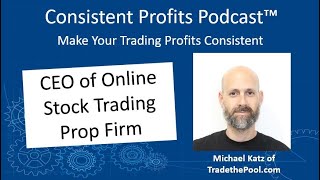
Michael Katz, CEO of Trade the Pool, talks about his trading background, how his prop firm evaluates traders, and what it takes to trade consistently profitably. He covers the evaluation process, the platforms Trade the Pool uses, and his advice for traders trying to build sustainable income.
Hello and welcome to the Consistent Profits podcast brought to you by Inside out trading and Brian McAvoy where the focus is on consistency because when you have the consistent part down, profits become easy. Hello everybody, this is Brian McAvoy with the consistent Profits podcast and welcome to another episode. Today I'm really excited to be interviewing Michael Katz. He's creator of Trade the Pool. Thanks so much for being here today, Michael.
Thanks so much, Brian. Happy to be here.
Now. So everybody knows Michael. He's the CEO of Trade the Pool. It's a well known prop firm that gives hundreds of stock traders access to unlimited trading capital in return for a share of the profits that they make. Now Michael's he's got 15 years of experience in day trading stocks and futures and developing tech tools for traders. He's developed many trading strategies with a focus on reading a naked chart, momentum trading and buying depths in the market. Before joining Trade the Pool, Michael was the head of traders of a large trading prop firm in Tel Aviv, Israel and he mentored thousands of traders worldwide. Along with being very technologically inclined person, Michael seems to be pretty cool and very down to earth again. Thanks for taking time with this interview today, Mike.
Yeah, happy to be here Brian. Yeah, good to have you.
Now one thing I always like to start with is, you know, how, how did you get started in trading in the first place? It's, it's an unusual field and I'm always curious to see how people wound up here.
Yeah, I mean it's been a long time since I started, right, 15, 16 years ago. Yeah, it was a little bit after I finished the army, the military service and you know, I always been into gaming. I used to play a lot of Counter Strike and a lot of first person shooters, stuff like that. So yeah, so I was on the keyboard anyway and you know, looking at the enemies, moving, making decisions very fast in real time. And my ex girlfriend bought me the book of Robert Kusaki. The rich dad, poor dad. Right. So that was my first introduction to the stock market basically. And from that it was a pretty smooth ride, let's say, at least for the beginning, you know, just to starting to learn from scratch on YouTube, other platforms, obviously all the books that out there, you know, the famous books and a lot of, yeah, a lot of trying, losing money, trying again, making money, you know, break even and finding my own niche within that market.
Oh well, so did you like jump into it like a lot of people do, where you just start off day trading or did you kind of ease into it a Little better.
A little better. I'm not the daisy. Yeah, I'm, I'm all in when I'm into something. So, you know, as a day, I started as a day trader. I took about two years to learn literally everything I could by myself. And after two years I took like a one on one with one of, one of the, the biggest traders, at least in Israel that we had at that time. And yeah, it was like six, seven lessons, one on one, three hours, you know, diving into all the small things, the nuances. And after that I started, I started really to trade basically, but it all focused on day trading until this day actually.
Huh.
No, that's very cool. And, and I just find it very cool in general that yeah, you went ahead and sought out a mentor, you know, no further than that into your trading career. Sadly, I find that a lot of people, they wait until they've been beating their head on the rock for five or more years before they go and get a mentor.
Right.
Yeah. Cool, you did that sounds like it was pretty intense too. You said it was seven sessions, like three hours each.
Yeah. And that was after two years that I literally set them at least like 80% of the day. Sitting, learning, looking at charts. Yeah, I fell in love with it. And again, it was pretty natural in, in a sense because I was all the time in front of a computer anyway since I was like 8 years old or something and the, you know, the type of guy that really likes to see the action in front of the eyes, like I said, with the gaming and all. So it makes sense for me to, it felt comfortable at least, you know, to start doing that.
Huh.
So at what point did you start mentoring other people and how did that come to be? I mean, you know, trade your own account is one thing and that's what a lot of traders, that's what they want to pursue. But you know, where you want to start mentoring other people? Like I said, how did that come about?
That's interesting because first of all, it took me a few years until I took the first student like a one on one that I did and later on obviously developed to many worldwide and I had a trading room, trading chat and all of those things.
Oh really?
Yeah, for, for a long time. So maybe five years. Mostly of them, most of them were Israeli, but we've been like I guess roughly 100 traders every day joining the same trading room, spitting, trading, analyzing guys that, you know, pursued trading as much as I did. So still am, I guess. And yeah, so it took me a few years Until I started to mentor. But I also seen, you know, as soon as I started to teach, I actually started to learn more about trading. Right. Because when you're teaching someone, you're actually learning a lot. Because he asked you a question that you wouldn't think of or, you know, you explain what is, I don't know, price action or what is the right volume for buy the deep. And once you do that, you automatically learn. So that was incredible move, just learning someone, teaching someone and learning by myself through that.
Huh.
Well, so were you just like doing this trading? You said you started, you know, it was a while, and then you like took one student on, so that was like just you and them. At what point did you decide to formalize it and make it into kind of, you know, like a business operation?
Roughly after at least nine years, I guess.
Oh, wow. Okay.
Yeah, because. Because I had this time, I had like four years that I sat at home, didn't do nothing besides trading full time. Just me and the cat, talking to the cat. My wife at the time, not at the time, still my wife, but my girlfriend at the time, that is now my wife. Yeah. So. So she went to work, I sat down, waited, she came back. I was in my trading. That was like four years that I took of my life and then started to move toward teaching and the other stuff as well.
Huh. Very cool.
Now, as far as, as far as being able to, you know, develop applications and stuff, that's again, it's, that's not something, you know, somebody can just decide to do. How do you, how do you get the background or the, the technical skill set to start developing fintech apps?
So I actually didn't learn. I didn't bring the stuff from the technical aspect of it. I just found a guy or two or three that developing, you know, programming, and basically I sat down with them, I did all the, the product, you know, just understanding what's the level, what actually every simple move needs to do. And they took that and actually developed it. Right.
Okay, so you're not doing programming yourself. You hired a programmer, you just.
Exactly. Okay, yeah, fair enough.
Huh.
Now, so you're currently at trade the pool as the CEO. Now that's. That's kind of a big leap from, you know, just mentoring some people, you know, through a trading room. How do you want to hooking up. What's his name, Gilt, is no guilt. Yeah. Yeah. How do you wind up hooking up with Gil and you know, get involved with trade the pool.
Yeah.
So, you know, like in trading It's a journal. Right. It's a journey, what we do in life. Right. So you do one thing that leads to another and so on and so on. And one of the guys that work here, Yaniv, he actually was a student of mine. Yeah. And we did also like a one on one session like few years ago, like four years ago I guess. And from here to there, the Gil decided you want to do like operate as a Trader Pool or open this operation. And Yaniv mentioned me, we hooked up and you know, I'm here now, so. Yeah.
Wow.
Well, I noticed that the organization has a pretty decent sized staff. We have like 15, 18 people on board right now.
23, yeah. Oh wow.
So it's even bigger than that. So huh. How do you wind up stepping in as CEO though? That's, you know, that's not usually an entry point.
So basically when Gil gave me a call, we sat down, he wanted to you know, build basically trade a pool. But Gil coming from the background of Forex trader and obviously build the fiverrs one of the largest prop for, for traders and he said okay, you are the guy. We had a great slick, you know, right from the get go and that's it. He said okay, take the wheel, do whatever you need to do. I came obviously with the background of operating my own business. Besides that, obviously I had the skill for, for the trading part. I was also the head of one of the largest prop in Tel Aviv, head of the traders. So I knew the business from the inside as well. So.
Yeah, yeah, I'd forgotten about that.
You believed in me.
Yeah, yeah. So.
Huh.
Yeah, I forgot. Yeah, you were one of the head traders there. So that was with. That was with a different organization though, right?
Yeah, yeah. Huh.
Now as far as with Trade the Pool, one thing I wanted to ask you about. So when Trade the pool started in 2016, right?
No, that's actually the fibers 2016 is the fibers trader pool we've been running for the last 12 months. So like literally a year in seven days.
Okay. So I was, I was thinking that Trade the Pool had been around longer than that. So that's what the whole deal was about with the Trade Revolution platform was that's what let you get Trade the Pool off the ground, correct?
Yeah. So we basically hooked up as soon as we started operating Trader Pool. We we needed a platform, you know, license from the, from the exchanges vendor LP to send the orders through all of the this big operation behind the scene. And Trader Evolution was one of the platforms we use and partner with in order to provide everything. So we have the risk management, like the, the behind the scene, the dealer where we can see all the orders and of all of our traders. Right. And manage it and, and add and put an edge on anything that is too risky. And besides that, we have the trading platform that we provide to our trader. So. Yeah.
Huh.
So as far as the, you know, establishing like the guidelines for just generally how, you know, how you're wanting to operate, who you're, you know, who you're looking to serve. So with the trade, the pool, like I said, because different, different prop firms operate differently, you know, as far as like the share requirements, the qualifications and that kind of stuff you guys get settled on, you know, the, the specification, so to speak, that you operate with. Now how do you guys get settled on that?
Yeah, so when I first started to think how to create the program, basically maybe for those that listen, they're not familiar with the prop firm, we basically have an evaluation phase or test and obviously the trader pay for it. Starting from like $97, you go through the process, trade on a simulator, stand within risk parameters. So we need to reach a certain X amount of money, like a profit and not going more than X maximum drawdown basically, or a daily loss. And once you reach that, then we give him funds to trade, he or she. And, and that's real money basically that we split afterwards. So this is how the operation works. We have four tiers. So you can start or she can start with $20,000 buying power all the way to $260,000 buying power. So that, that's incredible for any stock trader. You know, when, when I first started to trade, I just found like $10,000 that I, I took from my parents a little bit and some stuff that I had on the side, and it's nothing. When you're trading with $10,000 for stocks, for equities, you can't really do much. Even if you're a great trader, you can't really make progress. So the idea is kind of simple. You get enough capital to trade on, you have risk parameters. Something that a retail trader, when it sits by himself, usually won't have those boundaries. Right. Most traders will blow their account within six months when they trade in by yourself, by themselves. And in our case, since we have these risk parameters, we see a dramatically increase in the, in the success rate of the traders. And since you're not trading your own capital, you're not, you don't have this fear aspect of trading. Right. Because most of us, when we're trading our own capital, we are afraid of every cent or dollar that we're losing and that obviously damage our decision making. But once it's our capital, then you don't really care in a good way, right?
Huh?
Yeah.
Now so as far as you said you got four different tiers and during the evaluation period of course there's like a profit target you want people to hit and a drawdown but they can't exceed. So where, where do you guys have, have those set out as far as, is it standard across the tiers? As far as like the percent profit. Profit goal and a percent drawdown.
Yeah. So it's like you need to do two times your maximum drawdown. That's the profit, right? So you have a drawdown of 2100. You need to do 4200 in profit right now that we. At least for this video as we speak, you have 45 days to pass the evaluation. And if you didn't, then you can, let's say you made it halfway, right? You're in the money. You made half of what you need. You can pay another month, a full month and continue with the progress that you already made. And most of our traders will pass the evaluation within three attempts. That's the stats that we have. So. And that's super distance because again, let's say you pay $97 three times, right? Let's say $300 instead of putting it in your broker account. 300, that won't give you anything, right? In the real market, you take that 300, you spend it with us, get twenty thousand dollar buying power and actually can make profit and again increase your success rate dramatically comparing to retail traders. So these days I really don't see a point of trading with a broker. Little.
Yeah, well now, okay, so a couple of questions. You said that the, the profit goal is just, it has to be double whatever your drawdown is. So you're not necessarily looking for specific percentages because I know some prop firms, they want you to hit like a 10% profit goal and you know, maximum of 4% drawdown, stuff like that. You're not working on percentages, you're just saying so long as your profit is twice your drawdown. Is that correct?
Yeah. So you have a drawdown that we set from the beginning, like a default drawdown and all you need to do is double that. The account is, it's a bit different for maybe the guys that are already familiar with forex platform or future problems. We start at zero balance. So your account really trading your Buying power. So you start with zero balance, you can actually go negative for the, for the drawdown. And all you got to do is start from zero and go all the way up two times your default maximum drawdown.
Very cool. So now do you guys, are you focused specifically on just forex and futures or are you also doing stocks?
No. So trader pool doing only stocks, only equities and, and the fly versus doing futures and also and Forex obviously. But we have, we have 12000 symbols. So you can trade literally anything, any symbol, any stock, any etf, you can short any penny stocks. We have a lot of funded traders that trade in penny stocks and you know, they will trade a dollars, a dollar stock price and they will take like 25000 shares, 50, 000 shares, stuff like that. So they can easily make a nice chunk in one trade. So so a lot of the people that been doing that already with their own account, the, the beneficial, the benefits of trading with us because of the buying power because it's basically a risk free, you know, besides the fee that you pay to enter just makes sense.
Yeah, okay.
Yeah, that's very cool.
Huh.
So the fiber as you said has been around for a while trade the pool is just about a year old roughly.
Yeah.
And so do you, do you guys have plans for any further expansion or what kind of, what's, what's on the horizon in front of you?
Yeah, always, always expanding expansion. We're working with a lot of stuff from, you know, from the size of awareness. We do want to get to all of the stocks traders out there and there are many of those. So we just hooked up with Benzinga, chat with Trader, very famous podcast as well. And we brought some great partners like Trade Ideas, Transpider, Bookmap, Trader View, Trader Sync. You actually, when you sign into Trader Pool, you actually get for free one of those users, one of those partners, A user of those partners. Because the idea that I at least wanted as a trader is to bring value and more edge to my game. So that's the idea behind partnering with great companies that can actually provide you a free user for that evaluation space.
Oh yeah, very cool.
Now as far as.
Huh.
So are you guys limited geographically with who you can work with? Because I know like certain, certain things, you know, they're, they're kind of close to, you know, Americans, others, it's you know, limited just to Americans or are you guys pretty much anybody around the globe?
Literally anyone around the globe besides obviously the countries that we cannot work with, you know, Terror companies, terror countries and stuff like that. But we open to anyone. And we actually, we have traders all around the world, from east to the West. Obviously we have more coming from the US just because Americans, you know, more connected to stocks and, and Wall street because, you know, you learn about it just from day one. But besides that, we open to anyone and anyone that want to join and anyone that loves to trade stock definitely should check us out.
Huh?
Very cool. Well, now my question, and I have to ask this just because it's the name of the podcast is Consistent Profits Podcast. What do you see as, you know, a one or two, you know, obstacles the traders run into that keep them from making consistent profits? What, what do you see as some of the pro, you know, obstacles?
Yeah, so, so if I'm talking about retail traders, there are so many, right? So many obstacles for retail traders. Definitely. I mean, that's, that's fact. Most retail traders won't make it unless they are crazy and spend hours and hours, you know, on the chart learning technically and also mentally how to change their mind to a winner. State of mind. Right?
Yeah.
And it's, and it takes a lot of time to do so. So. Yeah. So regarding those obstacles, if I'm talking about the technical wise, you need to spend much more time on your playbook. That means that whenever you do any trade that you do, you gotta analyze it. You gotta agree on your Google Slide or record. The screen will be like a video recording, will be the perfect way. Gotta go through that recording, watch every second and every minute that the chart move. Learn it. See what you did, see what you could have done much better either by analyzing the specific chart or analyzing the market like the, the NASDAQ or the S P just to get a better understanding. And, and that's on the technical side. On the mental side, it will be definitely get rid of that fear of losing your money. Again. It's, it's a retail site, so it's kind of hard to do, but you gotta say, okay, this is, let's say you took $30,000, $5,000, doesn't matter. This is the money that I'm willing to lose in order to trade. Once you have that set of mind, it will be a little bit easier to work with. And one of the tricks that actually helped me a lot was to take out the P L from your chart. So as soon as I, as soon as I done that, it was a game changer because once you're not looking at the PNL and see that $20 loss, $100 loss, whatever it is, you automatically focus yourself on the trade and the execution and not the outcome, so to speak. So you're not focused on the fear of losing your money or not taking your partials too fast because you saw that you're in a positive $200, right?
Yeah, yeah, yeah, that's a, that's pretty good. That's an excellent suggestion. Good idea, very cool and wonderfully simple. So yeah, that's something you could do like in a minute.
Yeah. But a lot of the traders are getting a hard time to, to do that. You know, it's a click of a button, right? We just remove that pnl. But it's kind of hard because you want to see the money. That's the, that's the problem, I guess with trading. You want to see it move.
Huh.
Well, and, and you, you kind of alluded to it. Just kind of having the patience to, to, to learn and to get there. Yeah, yeah, very cool. Well, so when somebody comes, when somebody comes to work with you, trade the pool, I mean how does, how does that work? What's, what's the experience like as far as, like if somebody wanted to come sign up with you today, how's the process work as far as the onboarding and everything?
Yeah, so it's pretty straightforward. You find your tier, choose whatever you feel like, you know, from 97 all the way to 1200 and the twenty thousand dollar buying power all the way to 260. Obviously if you already have been an experienced trader, you will probably prefer to go to the extra buying power or the ultimate buying power. The bigger tiers, if you just started to trade, go with the mini BP, the mini buying power for $97. And you don't just get the feel of it right, because as I said, you need to give yourself that budget of at least three attempts. And once you did that, obviously read all the rules so you will have better understanding the FAQ terms, terms and conditions. You sign into the hub, we have a trader hub where you can see your dashboard and all the statistics of your account, download the platform, start trading. Pretty simple, very straightforward. We have a discord group that we always, you know, bring trade ideas and you can ask anything over there. There are guys that's been with us for literally a year, so they're happy to help and we're, we're going to, we have a nice community of traders there.
Very good.
Now as far as the platform, so you've got the trade revolution platform, but you said that you're partnering with these Other, these other platforms. So, so as far as trading within, within the trade the Pool account and everything, are they, do they have to use the Trade Revolution or can they use one of these others that you're partnering with?
Right, so they use Trader Evolution to execute the trade. Okay. But they can on the other side or simultaneously they will use trade ideas to find the right stock. Right. Like scanners or they will use Bookmap to find the liquidity level or, or Trader Sync in order to analyze their trades and give them more full statistics on their trade. So each one of the platforms that we brought focus on a different niche, basically.
Okay, so, so they're, they're going to use the trade, the Trade Revolution platform for executing the trades and then whatever tools in parallel with that as far as the, the other aspects of, you know, trading and analyzing and planning and all that kind of stuff. Is that correct?
Yeah, yeah.
Okay.
Very cool. Very cool. Well, yeah, this, I'll tell you what, it's been excellent. I'm, I'm really glad that you, you know, you took the time so we can find out more about what you got going on. Sounds pretty cool. And especially, yeah, trade with somebody else's money so you don't have that, that risk and the financial pressure hovering over you. Yeah, that makes total sense. So very cool now. And so if somebody does want to find out about, you know, your, what you got going on, it's just trade the pool.com, correct?
Yeah, simple as that. And obviously we are all over social media posting a lot of the good stuff, so you can definitely check that out as well.
Okay, yeah, I'll make sure that the link to your site and your social links are in the, the description show notes. So. Excellent. Well again, Michael, thanks for doing so. You got any last words of wisdom for our, for our listeners today?
Yeah, you know what, just go through that process, try it out and don't give up. If trading is something that you really like to do, you gotta pursue it like, like you said. I mean, anything we do in life, it doesn't come super easy right from the get go. It takes a bit time to get used to that stuff and learn more about it until you become an expert. So do that.
Excellent. Excellent. Well again, Michael, thank you for being here and everybody that joined us. Excellent applauded for being here to, you know, learn more and develop as a trader and you know, expand your knowledge base. So if what Michael's got, you know, trade the Pool sounds like it resonates with you, definitely swing by there and check it out. And again, you know, for everybody that's listening today, thank you for being here. Michael. Thank you for being here.
Thanks so much, Brian.
And we'll see everybody on the next episode of the Consistent Profits podcast. Cheers. Thank you for joining us today on the Consistent Profits podcast, brought to you by Inside Out Trading. Make sure to swing by Inside Out Trading and pick up your copy of the proven formula for consistent monthly profits. If you enjoyed the show, make sure to subscribe on your favorite channel and we'll see you on the next episode. Cheers.









