030 – Interview w Tony Greer of TG Macro
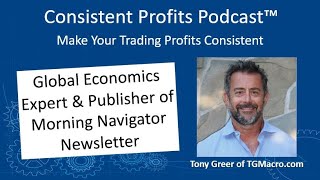
Tony Greer, founder of TG Macro, talks about his path through major financial institutions, his independent research firm, and how markets have evolved. He discusses trading strategies, market analysis, and the newsletter and Slack community he runs.
Hello and welcome to the Consistent Profits Podcast brought to you by Inside out trading and Brian McAvoy, where the focus is on consistency, because when you have the consistent part down, profits become easy. Hello, everybody. This is Brian McAvoy with a new episode of the Consistent Profits podcast. I'm excited today to be interviewing Tony Greer. He's the creator of TG Macro and publisher of the Morning Navigator newsletter. Hey, thanks for being on the podcast today, Tony.
Thank you so much for having me. Brian, how are you?
Doing good, man. Doing good.
Seriously glad you're here. Now, for those of you who are not already familiar with Tony, Tony is the founder of TG Macro. He founded it in 2016 to create an independent research firm where he could combine 25 years in trading and 15 years of writing a daily newsletter into one analytical platform. Tony provides fundamental, technical and behavioral analysis of global markets to a group of institutional clients and a personal subscriber base. Tony established himself as a Macro market analyst for what he believes to be the next iteration of the Wall street ecosystem, which we're going to touch on here. Pretty quick research. Market publications are likely to be paid for on an a la carte basis, and he intends for TG Macro to be on the recommended menu. I thought it was a pretty cool metaphor. He's taken.
Thank you.
Oh, yeah, no, very cool. Anyway, Tony's taken an entrepreneurial path to serving clients with custom analysis and a daily newsletter, among other publications. His style has led him to become a lot of contributor on Seeking Alpha and Real Vision. And Tony, he's just kind of a laid back kind of guy. Very down to earth again. Tony, thanks for being here today, man.
Absolutely, man. Love to love being on the show. Brian, thank you again.
Glad you're here. And one of the reasons I was jazzed to have you on, you got a pretty cool story. I mean, might as well just go ahead and start at the beginning. I mean, your father was a trader, right? He was under the desk for like 30 years.
Yeah, he had one seat pretty much on Wall street and he at. By the end of it, he ran over the counter trading for Morgan Stanley Dean Witter when He retired in 1999. And so sort of trading and bids and offers and things like that were dinner conversation from the time I was about five or six.
Yeah.
So you. So you grew up in trading? Like I said, just part of daily daily life. That's freaking cool. Now how did that influence you, you know, when you were growing up? Because obviously, you know, being a trader has a different mentality. Than a lot of other, you know, careers. How did that, you know, influence you growing up? And of course, you know, as your career as a trader.
Yeah, you know, that's exactly it. Brian was noticing that I, I felt that I had the mentality for it because I noticed, you know, when my dad came home every day, he was super energized about what went on at work and, and really, like, excited and animated about it. And it sounded very exciting and very competitive and fast moving to me. And, you know, coming. Growing up and enjoying sports and things like that, that was the sort of natural metaphor that, that it seemed like he was going and playing a game or playing a sport every day when he got home. And so that, that kind of directly led me to want to stick my nose in deeper and see what that. That life of that kind of a career would be like.
Huh.
And so, yeah, it was really.
Go ahead.
No, it's just cool you mentioned that because I. I love trying to relay to people that trading is a performance activity. And a lot of times, just as a little slip, I'll say it's a performance sport because. Yeah, man. Parallels to it.
Oh, yeah, absolutely.
Yeah.
No, now, obviously, your dad was, you know, fairly successful at it. He was able to send you to Cornell. Nice. Very, very classy school, you know, where he studied agricultural, business and management. So how'd you end up choosing that and, you know, how did that serve you as you moved into the trading industry?
Yeah, so, you know, I knew I wanted to have a career in business of some sort. And if you want to be a business major at Cornell, you wind up going to the College of Agriculture and Life Sciences. You know, they take. Yeah, they take the route of teaching you sort of business management almost via the. Via the study of farm management almost, you know, and how that entire ecosystem runs. And that's kind of where. Well, that's where, you know, all the business majors are. But that's the school that you wind up going to. And it was really, really interesting and a great, great, like, expansion of my education to be in that school.
Wow, that is totally cool, because. Yeah, and it makes perfect sense. But, yeah, I mean, you know, most business schools, they're over here, you know, talking finance and accounting and that kind of stuff, which has its place, no doubt, in business. But what you're talking about really is more like the nuts and bolts, like the actual, you know, business and op side of things. So that is cool, huh? Now, the other thing I noticed, though, because you graduated in, like, 1990, right? Yeah, I mean, it was only a few years later, you know, you were like the vice president, you know, in the company you were at. How in the heck did you move up that fast? That's. That's like a noteworthy accomplishment.
Well, I managed to get to that spot, I guess, at ubs. I earned the rank of vice president. And I think it was probably by virtue of having, you know, the responsibility of running a fairly major book on the FX desk at the time. You know, I started off at UBS and I was sort of the assistant Mark Yen trader, which was like, you know, a Mark Yen Cross trader, which is kind of a, you know, a smaller seat on the trading desk. And by the time I left there, I was the Dollar Swiss trader, which was one of the bigger jobs on the desk where you saw more flow than I could possibly describe to you as the center of a Swiss money center bank. And that's a really big job. So I guess having that responsibility was the reason I got my promotion. And they sent me to Zurich to work in the head office for six months along with that, which was really cool and a tremendous experience to work on a trading desk in the European time zone where you get to experience sort of the end of the Tokyo day and the beginning of the New York day. So it's really, really fulfilling now.
So you. Were you still here in the States or had you gone over to Europe.
For a little bit?
Well, I spent six months in Zurich, yeah. And before. Right before I joined Goldman, I guess, in 93.
Okay. Wow.
Yeah, man, that is cool.
So, all right, now, so you wind up working for Goldman Sachs and commodities. How was it working for them? Because, you know, they've got different reputations depending on who you talk to. Yeah, yeah. So how was it working for them? What was the atmosphere like, especially, you know, being in the commodities trading part of it?
It was very much like joining the New York Yankees. Right. And like joining a professional organization that is used to winning championships year in and year out and carries them with such swag, carries themselves with that type of swagger and confidence. But also because of the level of professionalism in the trading operations at Goldman Sachs were like nothing you've ever seen before. And they are truly, truly experts at risk management. And the people that do the jobs there are really good at what they do and work really hard and spend a lot of hours in the market managing the risk that they are tasked with managing and sort of learning that was learning the, you know, the real rigor of risk management, you know, and the discipline of, you know, just the basics of, you know, cutting your losses and letting your profits run and you know, the way to sort of handle yourself at a large institution that's got a lot of money and a lot of trades flying around on the trading desk and how to be responsible to the right people and things like that. So it was a really, really rewarding job and a great, great place to work and sort of if there was no dot com bubble I would still be working, sitting there, you know, probably working on the commodity desk doing the same thing.
Huh.
Now I would imagine because you mentioned, you know, their level of professionalism and everything, I would imagine that they probably had some pretty, pretty wicked training programs for you as well.
Yeah.
Or was it learning on the job and kind of in association with the people that you worked with?
Yeah, I kind of, I completed a training program before I joined the firm in the sense that I worked for a competitor and I ran into Goldman Sachs in the markets quite a bit like through the broker market where you know, you would quote them a price for a say forward, a forward Swiss position, you know, a one week rollover or something like that. And we were one of the banks at UBS that, that had a really good credit line with Goldman Sachs. So brokers would come to me directly and ask me for a price for a certain client. And you know, you got used to that to, to who that client might be or who one of those clients might be. And so you try to make super competitive price and by making competitive prices on large size trades. That was what sort of intrigued the, the management over there to say maybe we should meet this guy. You know, if he's making us great prices in, in volume and you know, trading out of it without, you know, losing his shirt and things like that, then maybe he knows what he's doing in this markets. And so we kind of developed a really good working relationship first. And then I would say that, you know, a spot opened up on the desk at Goldman Sachs and, and the head of the desk asked me if I was interested and jumped at the opportunity.
No kidding. Very cool. Very cool.
Yeah.
Yeah.
So one thing exciting. Yeah one thing I noticed or I saw that caught my attention of course and you put it there obviously for that, for that reason. But so how was it that day that you placed the, the, the 30000 gold futures contracts trade? Was that, that was scary day. Yeah, like you're stepping up to the plate and you know, you know the game's on the line but you want to be there.
Yeah, that was several years into my career at Goldman Sachs. But that was, you know, I was working on the floor as gold's, as Goldman Sachs options broker in gold because we had a lot of gold risk on and a lot of gold options risk. So it made sense to have our own broker in the ring. And so I got elected to do that job. And literally it was just a day that our cash gold broker was. I happened to be out sick like randomly and this guy is a warrior who never called in sick and he came down with something terrible and couldn't come in. And so it was like, well, it looks like you're going to be the futures broker today. And it happened to be one of those days that gold was rallying sharply and we had to sell as many futures contracts into that rally as we could to unwind in our position that we had on. We were long a lot of the exchange and short a lot of metal for a very specific reason. And on that day we were trying to unwind it by selling a lot of the exchange out and buying the metal back because that trade had gone our way.
Right.
And so by the end of the day, you know, I counted my totals and you know, it was a day that I started when the belt from bell to bell. I was, you know, trading futures contracts at a furious pace all day and going back and checking trades and making sure you didn't have any out trades. And I was there until 7 o' clock that night, you know, just making sure everything went okay. And thank God there were no out trades that could have been super expensive. Gold had a huge range that day. And I never, I remember never being so mentally drained and exhausted in my life. And I literally went right across the street and did a shot of Jack Daniels was the first thing that I did when I finished that day at work. Totally honest.
So did that one shot about put you on your butt or what?
Yeah, it was just, it was just kind of a recalibration with reality. I was like, what the hell just happened to me?
Oh yeah.
You know, on my way home and, and how to just stop off and take a minute and just breathe and know that everything was going to be okay.
Oh yeah, yeah, I know what you mean. Well, you know, with mental activities, that's one thing that's always cracked me up. Like going back to, you know, college days and stuff. But I wasn't, I wasn't in business, I was in engineering. And one thing that was cool was right before graduation we had to take what was called the EIT exam or engineering training exam. And it was, it was kind of like, kind of like an sat, but just for engineers. And it was two four hour sessions. And I remember walking out of there and so did everybody else, and we're walking out, it's like we felt drunk just because our brains were so fried.
That's what it is.
It was because. Yeah, just super intense. So, yeah, I can imagine what your day was like on that day.
So, yeah, I was, I was glad that was a one and done, that's for sure.
Yeah, but you got a lifestyle out of it, dude.
Yeah, that's true, that's true. I did get some incredible experience from it.
Huh.
Now, as far as, you know, with your, with your degree, I would imagine, you know, it just naturally has served you very well. I mean, did you find a lot of what you, you know, had studied that it's that you found it very useful and applicable when you got into trading commodities and stuff like that?
Yeah, I had an immediate interest in commodity trading. You know, coming from the, the farm, you know, farm management setting, I was really interested in the prices of those things and how the prices of those things like, you know, eggs, milk and things like that moved. And, you know, then you start getting into grains and livestock trading. And man, you know, from there you're, you know, if that's what you're into, then you're, you're a hardcore commodity futures trader. And that was my job essentially for my entire six years at Goldman Sachs was either trading on the gold desk or the Goldman Sachs commodities index, which is a basket of 22 commodities. So you really have your hands in everything. And so, yeah, that experience was really invaluable. I think the most, the most important thing I took away from Cornell was the network, though. You know, even, even more than the education is, there's still a lot of guys that are from that school that I still speak to every day that are fraternity brothers and potential, you know, you know, business colleagues and things like that. So that, that was really the big takeaway for me, man.
Okay. Oh, also.
So you played lacrosse while you were there too, huh?
Yeah, yeah, we lost two national championships while I was there. It was tremendous.
Wow.
But you got to the national championship.
That's cool, man.
Yeah, it was wild.
Yeah.
Lacrosse is a great sport. My son played all four years in high school and yeah, totally fun game. Excellent, excellent. You gotta, you gotta be a little bit for that game though. Just like with trading, though. Yeah, it's not a game for the, for the squeamish or weak at heart, it's like. No, it's brutal.
It's. It's warrior athlete sport, like hockey. It really is.
Oh, yeah, well, yeah, except you'd only get half the pads. The hockey players do.
True, true, true.
So.
Huh. Cool.
Okay, enough of the digression there. I just, I had to ask about that, but one thing, I love that you got on your site and I just think it's cool because I'm curious what your, what your actual perspective is on it. You got a quote up there. He says it's your golden rule in markets and in trading. Consistency is a moving target. So what do you mean by, what do you mean with that and you know, particularly from like a daily trading perspective?
Well, consistency is a moving target is kind of like my reminder that nothing stays the same in trading, right? Like, correlations don't stay the same. Trading relationships don't stay the same. Like, you know, you have to, it's kind of a reminder to have an open mind if you want to make money, right? If you want to make money over the course of time, you have to be able to reinvent yourself, right. And find different trades that work. Because the trades that worked, the trades that are working today, for example, are not the trades that were working last year, you know, as early as that. And the trades that were working last year were trades that hadn't worked in forever, right? Last year was the big year. We had tech sell off and natural resources exploded. Right? And that, that was trade that was just unheard of, you know, and so the consistency is a moving target is really just a nod to that, to, to remember that, you know, if you want to keep, continue to make money, understand that the world is changing around you. So your focus and your tactics have to change with that.
Okay, all right, fair enough.
Now right along with that, because that's a good, like, general, general look at things. Now. The, the name of the podcast is, you know, consistent Profits Podcast. So along, aside from or along with that, what would you say are probably one or two of the biggest obstacles that most traders have to being able to realize consistent profits?
You know, I think emotion is the biggest one. You know, I, I think that traders have to learn the reverse harnessing of emotion, you know, and I say the reverse harnessing of emotion because I think you have to learn over time to develop a process in trading so that your decision making isn't always emotionally driven. Right? It's. It's process driven. Right. I'm not getting into this trade because I like these particular companies. Right now I'm getting into this trade because I can tell by what just happened and what's happening with price action that this sector is going up. You know, so it's kind of like having that mental, you know, liberty or that mental freedom to be able to say, you know, whatever it is, I'm okay buying this because I don't have this like long standing agnostic view against or for certain securities that gets ingrained in your brain. Right. I'm the kind of guy that can be, you know, bearish technology for three months and then bullish technology for the next three months. You know, if that's where I think the monies can be made, I have no problem being sort of sector and security agnostic. You know, if your job as a trader is to make money, then that's, that's sort of kind of chasing volatility around, you know, chasing where the trades are and, and sort of being where the action is. And so, you know, once you learn that then, then you can really start to mount an attack on making money.
Yeah, that makes sense. Yeah, a lot of sense.
Now the other thing that you commented on that I think is worth exploring here you make the statement on your site says we have clearly entered a new era in financial markets. What did you mean by that? Because that could go a lot of different directions. What did you mean?
Yeah, yeah, you know, it has, it has to do with sort of the way Wall street has evolved and most especially in my opinion, the last 10 or 15 years or so. And the way that I see that evolution is right alongside the sort of, or sort of on the heels of the rise of electronic trading. You know, where we went from everything being open outcry and specialists at the post on the stock exchange to being more electronically electronic network driven, you know, across commodities and equities. Right. Less people involved, smaller trade sizes and things like that. So that is one part of the. Wait, get me back on track again. Brian, this was, this question was.
Well, when you were saying that we've entered a new era in financial.
Oh, that's it. Sorry, sorry. So alongside the, the sort of evolution of having less humans involved and more electronics involved in the trading technology, there's a sort of the old model of having your sell side firm have a set of analysts that disseminate information to a set of sales traders that then go and disseminate it to a set of clients that then pay the set, the, the, the traders back with order flow. That model seemed to be breaking and, and is totally broken, in my opinion, to the point that, you know, that just opened up the path for a lot of individual, either content creators or independent analysts to offer their opinions and to offer their opinions not necessarily from the hierarchy of a large organization, but rather from the privacy of the Internet to the clients that you developed over the years or from the clients that you picked up over Twitter and the relationships that you built in your DMs through people that have hit you up and said, hey, you seem to understand markets. What can you tell me? And you can say, well, I offer a publication and a consulting service and that's what I do. And people say, okay, let's start with the publication. Let's see what, you know, what you write about. And that's going to kind of, you know, a little bit part of the sales funnel. But that opportunity wouldn't have existed in 1990, right, for, for a guy to be sitting there making a living off the Internet, talking to institutional clients, talking to RIAs, talking to wealth managers and things like that. So I felt like the world, you know, around 2016 or even before that was ripe for more of that type of independent contractor, so I became one.
Yeah. Huh. Yeah.
Very cool that you, you touched on the, the evolution of things. That's one thing I found totally remarkable over the last 20 some years. It's just, just, you know, of course we've had the evolution of the Internet and that, that whole technology space, but the trading world as well has gone through a lot of evolution and development and new, you know, characteristics and considerations as far as being a retail trader. So. Yeah, yeah, that.
It's like a new front end every six months for the retail trader. Right. It's really getting exciting. You have over the day exploration options now. Right. And, and you know, financial products creeping up on every single thing that moves. So getting really exciting.
True. Yeah, it's. I mean, you know, with Forex, several years ago, that was considered like the wild, wild west, but now it's like there's a whole lot of trading world that's becoming the wild west. And yeah, things just getting crazy. So.
Huh.
From meme stocks to commodities to bonds. I mean, it's all wild west now.
Oh yeah.
Well, not even, not even talking like getting into the NFTs and all that, that craziness.
Oh man. Yeah. I don't, I don't usually I don't, I don't, I don't play in that, in that arena.
Yeah.
So.
Huh.
Well, very cool. Well, so. So you said that was kind of what prompted you to go ahead and start TG Macro and. And, you know, Public. Now. Is that when you started publishing your newsletter, or were you publishing a newsletter before you actually started up the. The company?
Yeah, good question. So I had a head start as a. I started taking notes about markets when I was at Goldman Sachs in The, you know, mid-90s, and, you know, literally kept a marble notebook for every year kind of thing. And that evolved into. When I got into equities, I figured out that the best way for me to keep in touch with people was to sort of give them an update on what I saw as the macro landscape, you know, into sort of, you know, the groundwork behind what might move equities. And so I started formalizing that into something that I wrote for one client that was on the west coast so that when he came in, he could say, okay, what do I got to know about in the macro world before I sit down and trade stocks today? And, you know, that one, that. The one newsletter that I wrote for one client, organically, it evolved into a little bit more of a character full type of publication, but it also evolved to have over a thousand subscribers totally organically and totally by word of mouth. By the time I. Yeah, by the time I broke. Broke off from, you know, the street and started my own Note, so it got really popular. I had a number of really, really talented and. And sort of really loyal mentors of mine that said that my content could stand on its own and that people would pay for it and you could teach them how to trade and make money. And so that's been sort of the. The agenda ever since, you know, election day 2016.
Huh? Very cool. Yeah.
Yeah.
Thank you.
Now, you've got a couple of different things that you offer in addition to the newsletter. You got a couple of different programs. But so what are some of the other services that you provide at TG Macro?
Well, I keep it really simple. I have my publication business right, where I write the Morning Navigator. I write it three days a week now. Plus I insert different bulletins on the days that I don't schedule to write when the market's volatile. So I keep everybody posted when it's busy, but I have the newsletter and then I have my Point Lookout package, which includes four quarterly reports, which is just my quarterly outlook on the targets that I'm going to be trading for that next quarter. And the most important thing is it includes the TG Macro Slack channel, which is a channel of about 148 completely crazy traders, portfolio managers, investors, private offices, family offices and things like that. And we stay in touch on a communication mechanism called Slack pretty much all day long and talk about markets mostly, you know, on the openings and closes, but we talk about markets 247 right through the weekend with, you know, news updates and interesting articles. And it's become quite a, quite a living product that I'm really proud of and has really gone a long way and I'm really enjoying that. So aside from that, my other services are just private consulting, you know, which is discussions with, like I said, portfolio managers, wealth managers and individual investors about managing risk.
Very cool. Very cool.
Yeah, it's fun.
Yeah.
So with your newsletters, your quarterly newsletter in particular, are you. Is the focus more on specific companies or more kind of industry and sector oriented?
Great question, Brian. I stay away from individual companies for a couple of reasons, mainly because it's updates and interesting articles and it's become quite a kind of an additional layer of compliance risk that, that I don't really care to deal with. And also because, you know, I also say I'm kind of a natural resources based, quite a living product that I'm really proud of and has really gone a long way and I'm really enjoying that. So aside from that, my other services are just private consumer consulting, you know, which is discussions with, like I said, portfolio managers, wealth managers and individual investors about managing risk. Equity trader. And so the sectors are divided up now in such a way that I can sort of just pick sectors to trade in. And the other reason is that I'm not that great of an individual stock trader unless the stock picks me, you know, and that's meaning where, you know, I discover a product that I love, like Yeti or Peloton, and go pull up the ticker and say, well, let's see what this thing looks like, you know, and let's see what this chart, you know, what kind of potential we have here. And then I kind of dig into trading a stock, but if it's not an, if it's not getting to know a stock like that, you know, then. Then it's just kind of a member of a big ETF to me.
Okay. Yeah, very cool.
Yeah, that's kind of how I look at it.
Yeah. Funny that you do that. I think, I think we all do that to a degree though. It's like, yeah, man, that, that I really like. That is so cool. I gotta go check out.
Well, it was, you know, it very cool.
Very cool.
Yeah, it's fun.
Yeah.
So with your Newsletters. Your quarterly newsletter particular are you. Is the focus more on specific companies or more kind of industry and sector oriented?
Great question. I was lucky enough, Brian, to be, you know, sitting here as a huge music fan on my desk at Goldman Sachs. I stay away from individual companies for a couple of reasons. Mainly because it's ax when Amazon, you know, made it available where you could buy CDs and have them delivered to your house, you know, and when you see, when you, when you latch onto that and you're asking people are you guys having all this music delivered to your house now? And everybody's like no, not at all. Why? What are you doing? You know, and you start to say like oh, I think, I think I'm onto something here. Let me look see what Amazon is up to, you know, and you find yourself opportunities like that. So it's really, really that that's the only way that I know how to pick stocks.
Yeah. How cool.
Yeah, it's super fun. How excellent when it works.
Yeah, well, yeah, of course now.
Yeah.
So do you, is your main point of connection with people, your site or through your social channels? Do you have like one in particular.
Kind of an additional layer of compliance risk that, that I don't really care to deal with. And also because, you know, I also say I'm kind of a natural resources.
Based what you like to focus on?
Well, you know, the, the closest form of communication with me is through my Slack channel. And I started that so that clients, if they wanted to, clients that were serious about trading and were in the game kind of every day with orders on their desk or, or their own money to manage to give people access to me 24 7, you know, and that, that's kind of what I, why I started that channel. And I, I was absolutely blown away at the response that I got for this product and the robustness of what goes on in there. You know, I have people, I mean I have guys that are on working on oil rigs in the Gulf of Thailand in my Slack channel. I have guys that manage funds in Singapore. I have portfolio managers in Toronto, Louisiana. Dallas, you know, and, and everybody is really genuine about their input to, you know, what they put in there. And they want it to be a value add. So when you have a community like that that's, that comes together as a value add. I mean, I'm proud to say that it's my number one source of information in the morning. Right. It's the first thing that I go to is see what people posted in my Slack channel. Overnight, because I know that'll be what's most relevant to the conversations that I'm having in the markets. And then I go out to the rest of the world.
Gotcha.
So, yeah, so that, that's the, that's the, that's the, the closest touch point. And the rest is my newsletter, which is just an email that I develop relationships with people that way too. Just going back and forth in the emails.
Okay.
So if somebody wants to find out more about you, best place just. It's TG macro.com, right?
Yep, yep. There's a bio on there. You can look me up on Twitter @TG Macro.
Okay.
Really simple. And I'm just starting a substack page which is all free video. So if you want to sign up for that, that's@tgmacro.substack.com okay. And you would put an email address in there. And it'll probably be more around Labor Day when I started all up again with a much more regular schedule. But there will be free videos on there where I do recaps of markets like what happened over the last week and what happened over the last month and sort of this event just happened today, let's talk about it and things like that. So people have found that really useful.
Oh, yeah. Very cool. Yeah. Huh. Excellent.
Well, that, I'll tell you what this is, this has been awesome visiting with you. I mean, it's our first time talking, so getting to know you a little bit and everything. Very cool what you have going on. And the fact that you take a macro view to things, I mean, and particularly in the natural resources space, that's kind of near and dear to my heart because that's where I started. And so, yeah, for me, it's just, it's like a lot of the instruments that are out there. It's like at least there's some real world supply and demand that's driving part of this that's going on here. And it's not just punching.
That's right. And those commodities trend. Right. Like, so there's real opportunities there.
Yeah, indeed. So. Well, very cool.
Well, any last words, words of wisdom? We'll go ahead and wrap things up. But any last words of wisdom for our listeners today?
No. You know, if you want to read and you know a publication that's very tuned into what's going on in the trading world and with markets and, and, and monitoring all four asset classes and looking for opportunities, then the Morning Navigator is a publication that you might like to try. I have plenty I have samples of it on my website. I run a view matrix at the end where I have people keep. Run actual positions and keep track of the P L. I measure it in just percentage points on each trade. So I don't do a portfolio sizing regime or anything like that. And so that's what I'm up to and that's what's been working for the last seven years and hopefully it'll work for the next 70. Brian, to be totally honest with you.
Yeah, well.
And also just very cool that you're doing in newsletter form. I think that's. That lends itself to being a bit more educational than some, some other types of information sources. So, yeah, very cool indeed. Well, Tony, thanks for being here and everybody that's listening. You know, I thank you and I applaud you for showing up today, you know, to learn and develop as a trader. If you like what Tony's got, you know what to say and, you know, and his offering sounds interesting to you. Definitely don't just listen and say, you know, that was cool, and then forget about it and go on about your day. If it, if it resonates with you, go ahead and swing by tgmacro.com and check out what he's got. Tony's good guy. I've heard good things about him. And talking with him today, it's like, yeah, I'm sure he'll take good care of you. And again, yeah, Tony, thanks for being here.
Thank you so much, Brian. If any of your clients want to reach me, they can email me@tonygmacroad.com if they have any questions about the, the publication or consulting or anything like that. So thank you for giving me a platform today. I'm totally flattered.
Yeah, indeed. Yeah.
Glad you're having here. And everybody, you know, thanks for attending the Consistent Profits podcast. We'll see you on the next episode.
Cheers.
Thank you for joining us today on the Consistent Profits podcast brought to you by Inside Out Trading. Make sure to swing by Inside Out Trading and pick up your copy of the proven formula for consistent monthly profits. If you enjoyed the show, make sure to subscribe on your favorite channel and we'll see you on the next episode. Cheers.









