032 – Interview w Marina “The Trader Chick”
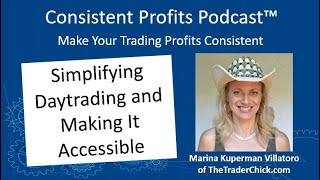
Marina Cooperman Villatoro, known as The Trader Chick, talks about how she got into trading, what beginners get wrong, and her approach to teaching trading basics. She also shares what it's like living in Central America and Barcelona.
Hello, and welcome to the Consistent Profits Podcast, brought to you by Inside out trading and Brian McAvoy, where the focus is on consistency, because when you have the consistent part down, profits become easy. Hello, everybody. This is Brian McAvoy with a new episode of the Consistent Profits podcast. I'm really excited today to be interviewing Marina Cooperman Villatoro. She's creator of the Trader Chick. Thanks so much for being on the podcast today.
Hi, everybody. Thank you so much, Brian. I'm super excited to be here. Thanks.
Yeah, Marina. Marina is a pretty cool person. I mean, she's got a great story. So, you know, if you're not familiar with her, she's an expat mama. She was born in the Soviet Union, but raised in the US at the age of 27, she put on a backpack and took off for a gap year from New York City and headed south with no real plan. But while she was in Mexico, her love for learning Spanish grew, and she was told in Guatemala she could take the cheapest private classes in the world to learn it. And while she was there, she met her husband, Federico, with whom she's had two sons, and they enjoy rock climbing, traveling, and all sorts of other cool stuff. Along with being a pretty sharp trader and one of the original travel bloggers, Marina is also, you know, just, again, very cool person, very down to earth. And again, thanks for being here today.
Thanks. That pretty much captures me in a nutshell. I like that quick intro, but to the point. Yes.
I mean, you know, we're here to talk about trading. You do have a cool personal story, but, you know, as far as trading, I mean, you've got kind of a unique Persona as a trading provider and, you know, just the way you go about what you do. But I mean, really, how did you end up getting started in trading in the. In the first place? I mean, because I always have to ask, because trading is not a common, you know, endeavor for people to pursue. So how do you wind up getting started with trading, period?
I've always had an interest in the financial markets. I mean, ever since I could remember, I always was fascinated by them. I was doing a lot of investing, managing my portfolios, more or less. And while we were living in Costa Rica, me and my husband and my oldest son at that point, my youngest wasn't born yet. We used to travel all of Costa Rica like that. Well, we traveled everywhere, obviously. I love to travel and I started a travel blog. I was like, I. Like you mentioned, I was one of the original travel bloggers. However, without knowing what it was or anything. I was just posting all our adventures and whatnot. And it became. And all of a sudden everybody was starting to contact me. Oh my goodness. A young family actually traveling in Costa Rica. We want, can you help us with our travel plans to Costa Rica? Because I was, you know, I really got to know the country and I was like, yeah, okay. And next thing I knew, without ever even considering it became a full time business for me was to plan trips for people to come to Costa Rica. And then we moved to Guatemala and I was considering Guatemala as well. But my business was really booming. And it got to the point where it was booming so much that I had to now come to the point where do I want to expand to other countries or do I want to do something else? And it was literally I was 39 years old and I was very burnt out. I was super burnt out. Like I could not do it anymore. I love the whole travel thing, but it didn't, it wasn't the travel anymore. It was more of a travel planning thing. And this was so strange because at this point we were living in Guatemala for about four or five years and I was really lost. I was like, what do I love to do? And I opened up a drawer in one of my desks and there was this thing that I wrote like three or four years ago saying, what do you love to do? What are you passionate about? And the first thing says to be in the financial markets, to day trade in the financial markets. It was so I was, I mean, I completely forgot about it and I was just so lost because I was burnt out on this business. I didn't want to grow it. And then I was like, okay, this is the time to do it. So for my 40th birthday I went and I bought myself a very expensive gift to join a day trading academy. And that's kind of how it began. Literally on my 40th birthday, I want to say that that's when I began the journey of it. But before that I was always investing and whatnot. I was doing pretty well investing, but I wanted to be much more active, which is day trading, right? Because you're in it daily investing. You could, you know, do some cool stuff and then leave it, come back in a week, in a month, in a year, you know, and then see what's going on. But I want it to be much more in it. And that's literally how it began. I became too burnt out on one business and I'm like, all right, let's do something that I always had a passion for. And it took me at least two years, if not longer, until I became was. Okay, well, I have to just back it up a little bit during that time or right before, I don't remember exactly now. This was like nine years ago. The whole thing started 11 years ago. I went and I spent another insane amount of money on this workshop work week. And it was in Colombia. I spent one week. I was one of the very few people. And one of the people there, one of the master traders or one of the guys was teaching, was like, you know, I only go for one point, and I'm pretty much done. I trade the E Minis, so we do by points. And he's like. And the others were like, teaching. You got to go for the five pointers, ten pointers, you know, like massive rewards, which looks nice on paper, but we all know that when you go for that big of a reward, you have to put up a big risk. And it's just really stressful. And that kind of was like an inception in my head. But it didn't hit me until that time that I was able to get away from that emotional spiral, which was I was technically on. And I started to realize, wait, it doesn't have to be that complicated. Also, I don't need to have all these indicators. I don't need to have all this stuff going on. And I just. And one thing I remember specifically, every time that I would ask really basic stuff, no one would explain the basics to me, right? I. I kind of feel like with day trading, like a good example of everybody want. The majority of these academies, you know, they're like five, $10,000. They're ridiculous, right? And they want. Because they're. You're paying that much, they want to look like they're such experts. So to me, the analogy I now use is imagine you want to learn how to play the flute, right? You've never played the flute. You get to the academy, the conservatory, and instead of being put in, all right, how to hold the flute, how to blow into the flute, how to, you know, manage the flute, you're thrown into the symphonic pit and expected to keep up. And I feel like that's what a lot of the academies do do. And I just wanted to learn how to hold that flute. And that's the basics. And that's when I decided to focus on the basics. And when I realized that no one actually talks about the basics and I started to teach myself the basics, that's when I just, I learned how to trade So I think it was such a. It was almost like a backtracking switch because I decided to go back to the basics, something that nobody really teaches. And that's how it just kind of took off for me personally, because now the other thing I always say is you can't put in windows if you don't have a wall put in. And a lot of times there are no walls being built. We're just trying to put in these windows and they keep on crashing. So that was what it is. I started to build my wall and the basics are really quite simple. And that's really what started to help me get.
That's actually.
Yeah.
Well, it's cool that you, you point that out because. Yeah, I've noticed the same thing is with so many traders because there isn't any, like, required education to get started with trading. So many traders try to jump to an intermediate, intermediate level so fast, and they don't get the good foundation underneath them and they wonder why they're struggling. And it's like you're. You're trying to do something that you're not ready to do yet. And. And that's why it's tough, because you don't have that foundation. You don't have the basics like you're talking about. And I mean, heck, it's funny, under this we talked about before when we were speaking, I thought. And it's still. It's something that I harp on with everybody is. If nothing else, just make sure you understand all the words that you're using. You understand the lingo of this job. It kills me talking with people, how so many people, they don't. I mean, they're using words and they really don't even know what they mean. No offense to anybody. It's easy to do. And a lot of words are used very sloppily in trading. Like, I mean, even, you know, like even such common words as support or resistance or Trend. You ask 10 people what a trend is, you might get 10 different answers. So.
Well, I think also the other problem is they might just be using them verbally, but a lot of people are going into the live markets and having. Don't even understand that vocabulary. You know, I'm getting some people that come to me and they're like, I bought this. I bought this. And they're sending me their chart. And I'm like, this was a short. You shorted it. Yeah. And they're like, what does that even mean? And I'm like, you just put in live money into the market. And you don't even understand. Like, this isn't even basic. It's like getting into a car and figuring out if you're going into drive or reverse, you know, and they're putting in their live money. Yeah. So not even only the vocabulary, which is essential, the basics, but then applying it properly. Yeah, it's. There's zero barrier to entry, unfortunately, with the financial markets. And it's the only industry where there's zero, you know, barrier to entry.
Oh, yeah, absolutely. I mean, it used to be about the only barrier to entry was you got to have money. And with prop firms and everything now and some of the, like Forex, you know, firms where you can start with, you know, 50 or $100. Yeah. Even that barrier is gone. I was like, yeah, you can be, you can be making minimum wage and start trading nowadays.
Oh, easily. It's crazy. Yeah, it's crazy. And you know, the brokers, the platforms, they know this and they're just banking on it. They don't care if you know what you're doing. On the contrary, they pre not to know. Yeah.
Sad but true. Sad but true.
Yeah, it's crazy.
Well, so. So you're able to get things to turn around. At what point did you start helping other traders, though?
So what happened was when I came back, didn't happen overnight. It took me about maybe another 18 months. When I was constantly back testing and just really, really learning, I just, I realized that it was a language, right. Like not only the words, but that the market, the charts, actually has its own language that speaks to us as well. And I just started to recognize it, maybe because I'm trilingual and I learned Spanish in my later years that I was able to recognize it, that it was like learning a new language, because it is a process anyways. So during that time period, I started to realize that it's nothing to do with your. The profits you're making, like the big profits. It's actually about the confidence building. And when you start to get those little profits, your confidence starts to grow. And without even realizing it, I became a scalper. I didn't even know such a word existed. And I remember this was in the time when Facebook groups just started to become a thing, like brand new. We're talking like, I don't know, eight years ago now, right? Seven years ago. And I remember there was this one group and it was called the Es Minis. That's it. And I'm like, yeah, I mean, this is what I trade. Let me join it. And it Just happened to be a very small group of like 20, 25 elderly men. Because usually men trade, especially the futures market. And they. All of them, I think they were like a group of friends, or maybe not like in person friends, but they knew each other. They all worked and have retired from a Chicago mercantile Exchange. And now they've just traded for themselves. And it was this amazing, amazing group. Like, these were the most humblest people ever. And they were just at home. These guys were trading hundreds of thousands of contracts. Like, this was like, you know, I guess they just looked at Facebook and wow, yeah, let's try it out for a little bit. They were all in their 60s and they were going for. So in the E Minis you go for, you could have a ticket or points, right? Each tick for one contract is $12 and 50 cents. One point is $50 per contract. These guys were going for three ticks with a hundred thousand contracts, right? We're talking. I can't even do the math right. Hundreds of thousands of dollars. And they were scalping. Their trades were between 30 seconds to three minutes. And when I was telling them my story, they're like, oh, yeah, this is what we do. And they kind of first of all explain to me that it's a scalper and reconfirmed what I was doing was the right thing. And then the group closed within like two, three months. They were super helpful. They taught. They taught me that I need to do meditation and mindfulness stuff that no other academy will ever teach you, basically because they were real, like, that's what they were doing. And then it just kind of dissipated. But at this point, I was already on track. And I remember, I think, oh, so then my goal was that I really wanted women to know, to be able to understand that they could do it as well. And because I simplified it so much and because I was going for such small profits, there wasn't that much risk. And I started to talk about it with different women and in groups and whatnot. And that's how I started. People like, oh, I want to learn your strategy without me even thinking that I have a strategy yet. And then because I was with Ninja Trader, which is a platform, back then there was only like two or three platforms. Today there's what, like 30 or 40? And somehow, because people are asking me to show them, and because I was with Ninja Trader, I wrote Ninja Trader saying, hey, I want to, you know, somehow be able to show what I'm doing with you guys with your platform. You know, is there a way? And at that point they had this series on YouTube about how to trade, use how to day trade pretty much. But the background would be on Ninja Trader, right? And they asked me because they saw that I teach very simple stuff that no one else talked about. And they started to put my short tutorials, like, what is divergence? What is reversal pattern? What is little things that no one talks about on their YouTube channel. And next thing I knew, men were writing to me saying, you know, I've been with all these academies. Everybody makes it so difficult. I've lost so much money. I feel like you're my last hope. Can you please show me? And I was like, wow, I guess I need to figure this out. I need to figure out what to. How to teach this or, like, even to explain it properly. And that was kind of the birth of the trader chick. And my courses before that, I was just talking in, like, Facebook groups or. Because, you know, it gets lonely. Trading is a very lonely activity, I guess you could say. And that's how it began without me ever wondering, just the same as my travel business. Never was even something that I considered very cool.
Very cool. So. So you kind of started on. On Facebook. That's. Yeah, that's cool. Yeah. Unfortunately, Facebook, yeah. Really changed the. Most of the Facebook groups now in trading are just a bunch of spammers. You're spamming, which is ridiculous. Well, so if somebody were to come to you now and, you know, they're like, hey, you know, I want to get started in trading. Haven't really done it before. What would be your. Your recommended starting point form?
First, you need to know what you want to trade. Definitely do not go and sign up with a broker, because if you eventually want to trade futures, you don't want to be with a broker. That's equities. So just start to understand what you want to trade, what you're pulled to. Right. Everybody has different ideas, and it's great. That's fine. Just figure out what. What aligns most with you, and then start to learn what the charts are doing and the vocabulary, like truly understanding that vocabulary and understanding what there is to do. Understanding risk management, profit targets. Just understanding the basics right before putting in the money. And then once you do start to learn, you need a strategy and you need to be in simulation. I cannot stress that enough. Simulation is the most important thing. Whoever is saying you need to do it with, you know, real money, that's a lie. It's kind of like telling a pilot to take his family or her family up into the air. Without ever having any hours clocked in, you know. Oh, just wing it. You know, you can't do that. There's, you know, you need to practice until you have a very solid strategy that you could rely on. And that's really what I recommend the most.
Yeah. Yeah. Well, you're kind of preaching to the choir on that. Yeah, yeah. But, yeah, I know what you mean. And what kills me is. Yeah, I mean, there are, there are people in it. Yeah. They're like, no, you need to be trained with real money because, you know, it's not the same if you don't have some skin in the game. And it's like, no, they're not real traders.
They're not real traders.
I mean, I, I understand, you know, their, their, their point to a degree. But yeah, you gotta, you gotta, you gotta know at least what you're doing a little bit because otherwise you start wiring some of the wrong stuff into your head if you, if you, if you're learning in the wrong manner.
And that's what it is.
Yes, well, so what would you say are some of the other beginner mistakes that people make when they're in the learning stage?
Oh, number one is no stop. Or a mental stop stop. Right. You gotta love those mental stops. I always say it's like putting a mental seat belt on your baby in a car and then thinking you're gonna save it during a car accident. Right. I mean, I've been there. Oh God, I've so been there. You know, that's how I lost all my money several times because I had these mental stops. Because the market is going to change. It's going to go my direction. Ego is always going to win. Or the other thing is no profit target. I believe the profit targets are just as important because greed is going to win. Oh, no, it's going in that direction. It's going to, I'm going to remove my profit. And of course it turns right where your profit is and stops you out. Right. And then there's no meant. And then you have a mental stop. So then you lose your account. And the other one is being, I call it trigger happy over trading. Right. Like we.
Oh my God.
I don't know about you, but I've been there. I remember sitting for two hours at a time and having like 40 to 50 trades. Who does that? You know, like professional traders. One, two at most. I don't even think they do three trades in a day. Right. Because they're smart, they're conservative. You go for the higher probabilities. So that's another thing that I had to completely overlook and overcome as well.
Well, one, one thing that I've noticed and, and had a lot of people as a common question when, when they come to me for help is, yeah, just having the patience, you know, sitting there waiting for a decent setup. And so they're sitting there looking at the charts and, and, and I mean, you know what I'm talking about where you're sitting here and it's like, you know, you just, you, you got that itch, you want to do something, you're tired of waiting, and so you're looking and you start looking at, and talking yourself into, yeah, that's a setup, right? So what, what do you recommend for traders who want to, you know, deal with patience or that's, you know, one thing they're struggling with is having the patience to wait for the decent setups. They keep talking themselves. They know they shouldn't do.
Well, the analogy I give is, first of all, you need a strategy, and you can't just be randomly taking trades. That's crazy. You need to have trade setups that you have back tested. And so the analogy I like to give on this one is when we learn to drive a car, we don't know what we're doing, right? We get in, and there is a strategy. A lot of people forget that it's an actual strategy when you drive a car. So when we're driving a car and we're seeing a red light, it's not about patience, it's not about discipline. We know we stop. Sometimes the traffic light is fast, sometimes it's slow. But we wait, right? Why? Because the consequences, we could be pulled over by a policeman. We could run over somebody accidentally, we could be hit by a car. There's so many other consequences. Maybe 10% of that is a chance that we'll skate through and be okay. Right? But that's the discipline of it. So when you have these setups that you have back tested, and if they're not there, you're just sitting at a red light. So it's not about patience or convincing yourself into something. It's like the same thing as, you know, convincing yourself that you could go through this red light. It's the same thing. So that's one thing that I have recognized is when you have that strategy, when you have really specific trade setups, there's no room for emotional convincing. That's really what it is, right? It becomes emotional. You're trying to convince yourself, and then you realize, wait, there's nothing. And it's okay if there's nothing just because you took a vacation week and you're going to Hawaii to surf, and that particular week Mother Nature doesn't give you any waves. What are you going to do? You're going to go and pretend that there's a wave there? No. You're going to admit it. You're going to say, you know what? It's just no waves. You're going to look at the market. You know what? There's just no trade. And that's okay. I'll come back another time. That's how I look at it. Right? So that negates all the impatience and the hastyness. Right. Because there's nothing going on.
Oh, yeah. I love some of your metaphors. No seatbelt for your baby. It's excellent. How'd you come up with that one anyway?
Because that's pretty much the same thing, right? I mean, it's the same mentality. I think we're going through the same stupidness.
No kidding.
I was living in Guatemala for. I was living in Central America for 20 years. They're still not understanding. And so the analogy I like to give on this one is when we learn to drive a car, we don't know what we're doing, right? We get in. And there is a strategy. A lot of people forget that it's an actual strategy when you drive a car. So when we're driving a car and we're seeing a red light, it's not about patience. It's not about discipline. We know we stop. Sometimes the traffic light is fast, sometimes it's slow. But we wait, right? Why? Because the consequences. We could be pulled over by a policeman. We could run over somebody accidentally, we could be hit by a car. We. There's so many other consequences. Maybe 10% of that is a chance that will skate through and be okay. Right? But that's the discipline of it. So when you have these setups that you have back tested, and if they're not there, you're just sitting at a red light. So it's not about patience or convincing yourself into something. It's like the same thing as, you know, convincing yourself that you could go through this red light. It's the same thing. So that's one thing that I have recognized is when you have that strategy, when you have really specific trade setups, there's no room for emotional convincing. That's really what it is, right? It becomes emotional. You're trying to convince yourself, and then you realize, wait, there's Nothing. And it's okay if there's nothing just because you took a vacation week and you go to Hawaii to surf and that particular week Mother Nature doesn't give you any waves. What are you going to do? You're going to go and pretend that there's a wave there? No. You're going to admit it, you're going to say, you know what, it's just no waves. You're going to look at the market. You know what, there's just no trade. And that's okay. I'll come back another time. That's how I look at it. Right. So that negates all the impatience and the hasty. Right. Because there's nothing going on.
Oh yeah, I love some of your metaphors. No seat belt for your baby is excellent. How'd you come up with that one anyway?
Because that's pretty much the same thing, right? I mean, it's the same mentality. I think we're going through the same stupidness. I was living in Guatemala for. I was living in Central America for 20 years. They're still not understanding the importance of seatbelts. There's been many times I get into those cars and you're like, are you kidding me? The baby is sitting on their lap in the highway. You know, you're like, what are you going to do? You can't save this baby. And you know, they're bad drivers. So accidents happen all the time there, you know. Well, and I've done the stupidity of mental stops.
So that's where A little digression. Speaking to, speaking of. Yes. Central America, I personally, the first time I went down there in Costa Rica, it was, it was really frustrating just getting used to how they drive. But I actually liked it after a while because it's like, you know, the, the lanes in the road are guidelines. They're not, you know, lanes.
Yes.
And what? No, one of my favorite things in San Jose was like those huge roundabouts and you know, roads are packed and you know, but things are flowing and it's like, you know, you come up to the roundabout and it's like a five lane roundabout and it's like you can't wait for an opening because there's not going to be one. It's like you just in, but everybody's cool. They're, you know, they're like, they're not all aggressive and nasty. Like here, you know, where it's like, oh no, you know, they'll cut you off. They're like, oh, you know, they'll let you in. It's like, yeah, come on in. There's room for everybody.
And I like that.
It was so cool because like, unlike the lanes, you know, it's like, okay, there's a lot of, lot of, you know, you know, traffic, traffic's heavy right now. Instead of four lanes, it's like they'll make it five.
Oh yeah.
Just making room.
It makes the traffic even heavier.
And the motorcycles, they have no rules. They're just going everywhere they want to against traffic, whatever. They don't care.
Oh, yeah. And in Guatemala, the motorcycles are ten times more than any other country I've been to. I haven't been to India in those countries, but I mean, I'm in Spain right now and I don't even really see any motorcycles versus Guatemala, it's 90 motorcycles. And then, you know, and they're like messenger bikes. They're not like the cool bikes that you see in the States. Right. They're like these rinky dink bikes and they think they're on a, they think they're driving BMWs, but you know, they're like 100 motor.
Well, the other one that I like to see is seeing like three or four people on a motorcycle.
Yeah. And, and furniture or something on top of that. Right. And their dog.
Yeah, it's, it's, it's like the minivan of motorcycles, right?
Yeah, yeah. Literally it's the family vehicle and their families are big.
Yeah. But anyway, yeah, as far as the Central America, I, I, at first I was really frustrated with trying to drive down there, but once I get used to it, I actually really liked it. It was because it, it wasn't aggressive. It was, it was much more of a friendly environment. Like I said, you know, there's a whole different attitude. It's like, yeah, sure, there's room, come on in, you know, no problem.
Not in Guatemala. Guatemala. There the traffic is so bad that I could actually understand why people are homicidal. Like, literally, you could be stuck. We lived in Antigua and without traffic, we're about 45 minutes from the city, Guatemala City. On a normal average day, it could be two to three hours each way. So imagine doing that on a daily basis. Like, people are it. Yeah, no, they're not very.
Well. I, I take, I take it driving in Barcelona is a little better.
Yeah, we don't have a car here. We just rent and I don't know, the public transportation here is phenomenal and the driving overall, I have to say is much cooler. Yeah, it's much smoother once you get out of the City there. I. We haven't been in any traffic yet ever and we rent a car weekly, so. Yeah, it's been great.
Well, and you said you're liking Barcelona, so. Yeah, I've heard, yeah, I've heard lots of good things about Barcelona. A buddy of mine, he's, he's a big surfer. He's wanting to go to Spain. He said that's one of the best surfing in the world, so.
Oh, okay. Well, it's some of the best climbing in the world. That's why we're here as well.
Oh, okay. Yeah. I was wondering why you moved. How are your kids doing? They're still doing the competitive climbing and all that.
Yeah. So here they're actually really doing it. They're on at the Rock and they're on a team, so. Yeah, it's phenomenal. It's been. And the gyms here are great. They're loving it. Absolutely loving it.
Very cool. Yeah.
Yeah.
Well, bringing it back to trading. So you still got, even though you're like moving around the world and got your got your other businesses going on, you're still running the, the trader check. So when, when somebody wants to come work with you, I mean, what's, what's it like when somebody wants to come work with you? I know you have like courses, but you also. Are you still doing like the live coaching with people or the course?
Yeah, well, I do, yeah, all my courses. Well, I have two main courses. One is the bootcamp where we just talk about understanding the charts and really understanding that because a lot of times people don't even know if they really want to do trading. And because the academy, the majority of these academies are so expensive, one thing I realized was, you know, it's nice to have an intro type of course to see if this is something that you even want to do without, you know, spending thousands of dollars. But even so, even with my intro course, we work together one on one for 30 days. So you, you have the one on one coaching mentorship. And then my main course is where the strategy is, where I have all the setups and we work with that together. And you have six months of one on one with me as well. And usually within six months a lot of people are able to go live and we're there together as well to do the transition to go live. And then I'm really with them along that way as well. So basically it's all about accountability. And in the meantime you're also learning the strategy. So be able to implement it and do it Together. Right. Because a lot of times we do it and we're like, am I even doing this right? Like, how do I know who's there to tell me if this is right or wrong? And that's what I do.
Yeah, gotcha now. So how's, how's that working with you being on Europe time? Because like we talked about earlier, I'm on the east coast and there's a six hour difference. There'll be like nine hours to somebody on the west coast. How do you, how do you deal with the time difference?
So a lot of it is one on one when they want to work with me and because it's pretty much the same time for market hours for me it's just evening. For them it's morning. So it's no big, it hasn't been any big deal whatsoever at all actually. Yeah, it's more convenient for me. I get to do it in the afternoon after enjoying a full day.
Okay, all right, that makes sense. Very cool, very cool. Now if somebody does want to connect with you, probably the best place to do that would be just at the trader check.com, right?
Yeah, just the trader chick.com. you can find everything there.
All right. Now are you still running, I mean where are you on social? Are you still running a Facebook group or. Pretty much just everything through.
Yeah, I have a couple of Facebook groups but the best place is really through. I love to the personal interaction. So just to email me. People could also email me at Marina the trader chick.com as well. I, yeah, I think the most that trading is very personal but I do have the groups. I also have a live chat. But the best way for us to, you know, really work together is through one on one.
Very cool, very cool. Well, I, I know it's evening there or late afternoon and it's Friday and you, so you want to go and get started on the weekend so we can go and wrap things up. I, I definitely appreciate you taking the time. It's good to catch up with you again. It's been, been a little stuff since we, since we talk and.
Yeah.
Well, any last wisdom for, for our listeners before we wrap up?
Just, you know, if you want to start trading, don't put your live money in the market. You worked really hard for that money. Learn, give it some time. There's absolutely not a single thing in this world that you can earn money with that you could, you'll decide and the next day actually do it. Everything takes time, so just give it that time and they can be very, very lucrative, but you need to give it that time. And that's really my number one advice.
Yeah, yeah. Good advice. Good advice. Well, again, yeah, thanks for taking the time for this excellent visit with you and, and everybody that's, you know, listening today. I applaud you for taking the time to, you know, learn and grow and develop as a trader. Not just, you know, busy throwing your money at the markets, but actually working on yourself. So, you know, kudos for that. And, you know, if you enjoy the podcast, definitely, you know, give us, you know, subscribe and share it with your friends. And other than that, Marina, again, thanks for being here and thank you so.
Much, Brian, and thanks, everybody for listening. And yeah, happy trading. Smart trading.
Yeah, There we go. All right. Well, again, thank you, everybody and we'll see you on the next episode of the Consistent Profits podcast. Cheers. Thank you for joining us today on the Consistent Profits podcast, brought to you by Inside Out Trading. Make sure to swing by Inside Out Trading and pick up your copy of the proven formula for consistent monthly profits. If you enjoyed the show, make sure to subscribe on your favorite channel and we'll see you on the next episode. Cheers.









