034 – Interview w Chaz Horn of B2BClientsNow.com
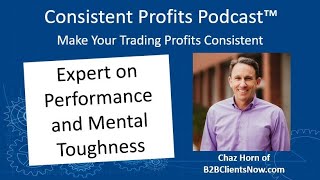
This is a YouTube video titled "034 – Interview w Chaz Horn of B2BClientsNow.com" published in October 2023. It features an English-language podcast-style interview hosted by Brian McAboy, who interviews Chaz Horn, a B2B sales specialist. The discussion covers topics such as sales challenges, mental toughness, overcoming rejection, personal routines for success, and parallels between sales and trading. Brian McAboy shares personal anecdotes and engages deeply with Chaz Horn's insights, making it a conversational exchange focused on professional development and mindset.
Hello and welcome to the Consistent Profits podcast brought to you by Inside out trading and Brian McAvoy, where the focus is on consistency because when you have the consistent part down, profits become easy. Hello, everybody. This is Brian McAvoy with a new episode of the Consistent Profits podcast. I'm excited today to be interviewing Chaz Horn. He's creator of B2B clients now.comchaz, thanks so much for being on the podcast today.
Ryan, it's great to be here. I look forward to our conversation today.
Yeah, indeed. Indeed. Now, for, you know, everybody listening, you probably, if, you know, if you're in a trading space, you may or may not be familiar with Chaz. And it might sound a little bit odd for me to have a B2B sales specialist on a show for traders, but when I ran across him, or actually we got introduced by a mutual friend of ours and I got to thinking about it, I was really, the more I thought about it, the more amped up I got about it because there are so many parallels between the occupations of sales and training or trading and they share a lot of similar challenges. And Chaz is an expert in sales, and so there are definitely some things that you can learn from him in his sales endeavors that you can immediately put to use in your trading for significant benefit. Like I said, you know, like, trading sales is a performance activity that operates in an ever changing environment. One that requires skills, structure and mental toughness. And again, that's one of the reasons I was really, you know, excited to get him on here and share some of his expertise and perspectives and again, you know, discuss how they can be applied in the trading realm. In his business, he's helped his clients schedule over 37,000 qualified meetings and he has a proven process to onboard over 7,500 new clients. His approach and his views are very effective. They're repeatable and broadly applicable. I mean, Chad, again, I was glad to, glad you're game for doing this and thanks for being here and being game for this interview, man.
Yeah, I look forward to a conversation. As you mentioned, no matter what industry you're in, there's things that are not just industry specific, but crossover from industry to industry to industry. And I look forward to our conversation today.
Oh, yeah, yeah. Well, now, the thing is, like, trading is a pretty challenging industry. Sales definitely a challenging occupation. How did you wind up in sales? I mean, because, you know, they're like thousands of other occupations. How do you wind up in sales?
Out of desperation? I, I, I was working for a contractor and they Let me go. And I was living in Northern California, like, what am I going to do? Saw ad in the paper and like, oh, okay. And I interviewed for this position. I got it. It was 100% commission. And so I started executing on things. I went into the process. I had to go into a small town in Northern California, and I was selling advertising at the time. And I'll never forget the in. In sales, we call it call reluctance. When you're afraid to make the call. And typically it's because you aren't competent or confident in yourself in the process. And so I had call reluctance. And when I would make calls, I didn't stick to the script. I wasn't in the process. I wasn't utilizing the system. I was failing badly. I was frustrated. I was getting kind of down and really, quite frankly, depressed. So with that, my boss had me over one night for dinner. And Ken Upton. That evening, my boss became my mentor. After dinner, he took me into his den and he said, chaz, you can be. Those three words really changed my life. He followed that with the top salesperson in the company. But you gotta follow the system. You gotta follow the process, because it's proven. We spent hundreds of hours of putting this together. So as I said that evening, he went from boss to mentor. And I started executing on the system and the process. I started scheduling meetings, and I'll never forget, I didn't get paid. If I don't walk out there with a check. It was. It was. It was. It was pretty high pressure sales. And this is. This is my first, first position. And I never forget I got a check for $2,500. Like, wow, this actually works. Following the system, following the process. And back then, it would be, like, equivalent to $7,500 today. So I got paid, and then I started scheduling more meetings and getting more sales and walking out with more checks. So 45 days later, I didn't become number one, but I was the number three person in the company. I was 119 out of 119. 0, zip, nada, sales. And then 45 days later, I was number three.
Wow.
Facing my fear, stepping out of my comfort zone, following a new system and a new process that was way outside my comfort zone. But with my mentor and his guidance and his encouragement and him. Him challenging me really helped me. Oh, okay. That makes sense.
I apologize if you saw me when you were telling your story. The. The roughness with the sales job, because I was laug. I've been there. I know exactly what you were talking about, and I remembered my experience and what it was like. And so I was mostly laughing at my own. My own history with it. But yeah, sales can definitely be challenging. And yeah, you gotta. You got a cool story with that now. So as far as overcoming the adversity, I mean, you know, it's one thing to have a little bit of a prompt, having the tools available to you, but what would you say was probably your biggest key as far as dealing with your own demonstration internally and, and yeah, just turn it around. Where you started believing in yourself.
That's a great question. It's. There's a great book out there that I, I just read recently that speaks directly to this. It's from Dr. Benjamin Hardy, your future self now. And it lays out we either act on our past or we act on how we see ourselves in the future. I don't know what the percentage is, but it's over 90% of US ACT on our past. And when we act out of our past, like I was doing with the fear and not making the calls and not following the script, I was shackled to how I thought those problems, those failures from my past were keeping me stuck in mediocrity. And 10, that definitely was a paradigm shift. It helped me shift my perspective and it helped me see myself is where I wanted to go. So I no longer was thinking, oh man, I, I did this. I'm a failure, I'm an imposter. You know, all these different things that go through our heads that we all struggle with. I started seeing myself. I can be the top salesperson in the company. And so I started in my mind going into the day where I wanted to go as opposed to where I'd been. And that was able to help me break those shackles from my past and start living on how I saw myself in the future. Does that make sense?
Yeah, yeah, definitely. Well, and it kind of actually plays into the next question that I had for you because again, sales. Sales can be a challenging position personally for people because, you know, you go in, you get the best intention for your prospect, assuming, you know, you're talking to a qualified prospect and you know that what you've got is valid and they would definitely benefit by doing business with you. And the fact that regardless, some people are just of the mindset no, and that's. It doesn't matter what you do or say, it's just going to be a no. And you know, personally, that can be pretty challenging. Just the flat out, you know, the rejection of it because you're going in there, you know, best intention, you know, you're a good person, you know, they're a good person. You've got, you know, good outlook on things and you're still getting shot down a certain percentage of the time. You know, that takes a lot of mental toughness, especially if you're going from, you know, where you were. Yeah. Where yeah, you were just, you know, hitting, batting zero. And I'm sure you didn't just immediately go to, you know, bat a thousand. And even with a good sales process, nobody's bad a thousand. A good high percentage. Sure. But there's still going to be a certain amount. So, you know, what were some of the things that you did as far as helping to develop that mental toughness for those situations when you're still doing everything right, you're looking forward and you're still having to deal with the people, you know, the like. So that rejection, that happens anyway.
Yeah, well, I find that the no's are much easier than the think it overs. The think it overs.
It's.
If you get no and there's a great book on the subject, go for no. And Chris Voss also has a book out there, it's called Never Split the Difference.
Yeah. Good book.
Yes. So, but to think it overs, that's the struggle because I want to think it over. So that is. But to the, the basic premise of your, of your question, rejection. And you know, typically when you have someone that's in sales that don't have, that doesn't have skills and they're not really operating within a process or system, typically even though they're terrible, they'll still close 10, 20% somewhere in there, you know, despite themselves. So have you thought in your mind, okay, tomorrow I'm going to blank. Tomorrow will be different. I'm going, I'm going to do this. And you don't follow through all those little things of not following through on those promises to yourself. And usually it's in our subconscious and it just happens really quick. When you don't follow through, that will destroy your self confidence. If you follow through and your self confidence will get strong, your mindset will shift. You have a different perspective. I always tell my clients and just content in general, you can have an anchor perspective that keeps you stuck in mediocrity, or you can have a springboard perspective that takes you into your potential. It's all how you see the situation. So if you get rejected, you get a no or you get to think it over and they leave the conversation and you didn't Handle it correctly. Then you think, okay, what did I do? Well, what was bad? What was just pure ugly. And in those situations, just because you miss something, it doesn't mean that you can't go back and correct it. So let's say for instance, I was talk. I'll tell you, one of my clients, she totally failed in the conversation. And her name's Holly. And, and the guy left, he was interested. And then all of a sudden she was being ghosted day after day for like over a week. She was texting, calling, all these different things. And then I, I talked with her, we had a one on one session. And I said, go throw yourself under the bus. So you fail, you got rejected, you, you're being ghosted. And so throwing yourself under the bus is basically in humility with sincerity. This is really powerful. It's it. People can manipulate people with this, but when you go with the intention, you said this earlier in your conversation, that intention is key. If you go with the right intention to serve and you throw yourself under the bus in situations like this. So she sent a Chris Voss message. We were talking about him earlier. Have you given up on moving forward with this project? 92% of the time they actually did ran stats on this. People will respond to that message within two to five minutes of seeing it. She sent the text message, the guy responded, she got and she said, would it be okay to. I realize you're probably not wanting to move forward. Is it okay we schedule a brief meeting so you can give me some feedback on the good, bad and the ugly. So because of that conversation and her sincerity, she had the rejection. But she didn't just sit there and, oh no, what was me? I mean, she struggled with that. Then I gave her some guidance. She got into the conversation and she said, I want to apologize. I think I handled this badly. I'm best at helping people with developing leaders, but I'm not really good at sales just by being that openness with that transparency, that's key. Acting out of humility is a superpower. Acting out of an ego will keep you stuck by her being open and transparent. She stepped out of her comfort zone. She talked to the gentleman and he paid her 5k at the end of 45 minutes because of that transparency. So to your question about rejection, she was being rejected, but instead of just weeping and mourning and sucking your thumb in the corner, and she took action and did something about it. So that's what I find, okay, I did something wrong. Let me go with sincerity and humility to talk to this person, get them into the conversation using a tactic with a technique. And it worked. So dealing with rejection is there, but rejection doesn't mean it's over. It gives you an opportunity to go back in a different way. And when you do that, that builds your self confidence and that helps you be more resilient to rejection.
Yeah. Yeah, very cool. Yeah, that makes a lot of sense. As you were talking about that came to mind. One of my, one of my favorite jobs back in college was door to door sales selling dry cleaning coupon books. And it would crack me the first time. First time I ran into this, it kind of rattled me, but knocked on us one door and we were always working neighborhoods around like, you know, local dry cleaners. And knock on the door and say, you know, I'm, I'm, you know, my name is Brian. I'm working with the so and so dry cleaner down the street. And we've got this promotion and this person just unloaded on me all crap, you know, these horrible experiences they'd had at this place. And I just stood there and. And it's like, okay. Wasn't me, but okay. And I let him vent and it, it just went off, went off for like five minutes, just venting. And then they looked at me and I'm just kind of standard. Just listen, didn't say anything. And they're like, wow, sorry about that, you know, it wasn't your fault. But, you know, I've really just, I really just wanted to get that off my chest. So what do you got? And it was funny because looking at it afterwards, it was like, I, I didn't, I didn't take it personally. And so I just, you know, looked at him as a person and it's like, okay, yeah, they just need to let, they need to have somebody listen to him and treat them with some, you know, integrity and respect. And it was so cool because. Yeah. And when I ran into that after that, that was the easiest way to handle it. And almost always they would wind up being a customer. Just.
I love that story.
Somebody treated them that way and it was hilarious.
Right. So that's, that's a perfect, perfect dovetail on what I just said. Can I add something? Because it just made me think of something.
Yeah.
That will help all of, all of your listeners out there. So Brian, was. You worked for a dry cleaner sales. Right. Is that what I'm hearing and understanding from that?
Well, yeah, essentially. Go ahead.
Okay. And they did something bad and they never knew it. So they lost a client until you Showed up and listened and, and by the way, most people in college, they would not have that demeanor. They're like, forget you, Mr. And just like I'm out of here, you know, and put their tail between the legs. So kudos to you for that. That says a lot about who you are as a person, your character and just your mental toughness even as a, a young, young man. So 30. This is how my clients increase sales. Sales 37% boom like this for established businesses is most companies don't have a formalized process to track where their client is from when they start to month by month, quarter by quarter, annually. And because of that, problems fall through the crack problems get ignored. And because of that they lose clients and they don't even know why. So by formal I have what I call blue pass that has a scorecard. They don't even know why. So by formula I, I have what I call blue pass that has a scorecard. And when you track here you are now, here's where you want to go. Here's your obstacles. This is how you rate yourself. And then a month from now, so here's your progress on scale of one to five, where are you as compared to 30 days ago? Oh, I'm making great progress. I'm a four or there's like I'm not making much. Then you can deal with that. But having a formalized process again, it it Even if you don't have a formalized process, you can use this to go back to your clients to get feedback, give them a the comfort to give you the good, bad and the ugly and it will increase sales quickly for and when you track here you are now, here's where you want to go. Here's your obstacles. This is how you rate yourself. And then a month from now, so here's your progress on scale of 1 to 5 where upsells and cross sell. So that formalized process so you don't have the salesperson walking out like you did and say in a person's like, ah. Because you're eliminating, eliminating that you're being proactive through the process. So it just made me think of that great story. And it just made me think, yeah, have a formalized process for communicating. Are you as compared to 30 days ago, oh, I'm making great progress. I'm a four or they're dating, not just a customer. Hey, how's things going? Good formalized process and get numbers. Here's where we are. This is how we rate you. Here's the good to hear bad and the ugly.
Yeah, yeah, indeed. Well, the other thing that definitely caught my attention when we first talked was how in, in most people wouldn't think.
About like I'm not making much, then you can deal with that. But having a formalized process this.
Unless they've been exposed to it. But you know, with sales a lot of people look at it as you know, kind of an ego driven. So usually, you know, you're dealing with extroverts and you know, they're just going to, you know, talk and build rapport and you know, try to sell you kind of say that's you know, common perception of salespeople. But one thing that impressed me about you is how you're really, you're very organized, you're very process and system focused and like you're like what you're just talking about. And not necessarily in the sales process but also operationally but as it relates to customers. Is that correct?
Yes, operations is my weakness, but I understand the importance of skills and process. So I, I make again it, it. Even if you don't have a formalized process, you can use this to go back to your clients to get feedback, give them. Sure. And I have other people that help me with that. But yes, you have to have the operation side and the sales side working together otherwise you'll be all over the place. So it's, it's something that I'm constantly trying to improve and improve and improve because it's, it's, it's one of my weaknesses and I know that. But it's essential for growing your business. A a the comfort to give you the good, bad and the ugly and it will increase sales quickly. For if you don't have operational processes, you're only going to get to a certain level and then you're going to hit that ceiling and you'll never be able to break through to the other side.
Oh yeah, yeah. And, and when I want to set operationally, I mean outside of the, the direct sales process itself, because you were talking about a feedback process.
Upsells and cross sells. So that formalized process so you don't have the salesperson walking out and being active about that.
And yeah, of course, you know, you have operations where it's the, you know, the you know, order fulfillment, customer fulfillment side of operations. But the, you have the sales interface with customers. You also have the customer support and relationship management that's ongoing and that's what you're speaking to there again which I think is totally cool. Now as far as some of the, you Know other things that help you, you know, be successful and maintain success, maintain good relationships. If you wouldn't mind sharing, you know, what are some of the, you know, routines or habits or rituals or processes, however we want to label them that you've been able to put in place that have been very helpful for you. Again, you know, in, in this occupation where yeah, it's, it's changing environment, dealing with people, a lot of variables, that kind of stuff. What, what kind of things do you have in place that have been helpful for you in.
In this context out like you did and say, you know, person's like ah. Because you're a limiting. Eliminating that you're being proactive through the process. So it just made me think of that great story. And it just made me think, yeah, have a formalized process for communication. So you're talking about customers, relationships, you know, following up and then you're talking. Are you talking about individually for me that for me to keep healthy mentally, physically or is there something else I want to make sure I understand so I could.
Well answer correctly actually, you know, personal, personal maintenance is part of it.
Right.
One's occupation. So sure, if you want to speak to that.
Yeah.
Like I said, you know, just like some of the, you know, routines, rituals, habits, regular practices that you have in place personally or professionally, not just a customer.
Hey, how's things going? Good formalized process but the contribute to.
Being effective as a professional.
Yeah. So in 2020, I. I got extremely sick. I was just working and working and working and working. And so that was a wake up call because at that point in time I didn't know if my business was going to survive because I was still at the place. If you remove me, my business not is not going to survive. You know, you always hear about the working on your business, not in your business, but I'm doing both right now and then and get numbers. Here's where we are. This is how we rate you. Here's the good to hear bad and the ugly.
Yeah, yeah, indeed. Well the other thing that definitely caught.
My attention when it was all in my business and so being sick in bed month after month after month, I'm like, I don't know if I'm going to be able to survive. You know, I was praying, I was asking for healing. I was doing everything possible going through that time. I was doing Wim Hof breathing, if you're familiar with that. Okay. And also with Wim Hof, you know, he's called the Iceman. There's ice bath. So I was really developing a morning routine. I literally back then I was sleeping 12 to 14 hours a day.
Wow.
And it was only after doing that.
Wim Hof first talk was how and, and most people wouldn't think about breathing.
That I had the energy to get out of bed. And I would get out of bed this.
Unless they've been exposed to it. But you know, with sales, a lot.
Of people look at, I like, I mean, this sounds ridiculous, but I just like flail my arms around, do something just to get my body going because I didn't have any strength. And then I would go into an ice bath. Okay. And that ice bath gave me the energy to work four to five hours a day. And then I would repeat that process day after day after day, week after week, month after month. It was like three months. Then I got better for the next three months. And then I had a cough still for another 12 months. I was, I was hacking all over.
My clients at it as, you know, kind of an ego driven. So usually, you know, you're dealing with extroverts and you know, they're just gonna, you know, talk and build rapport and, and you know, try to sell you kind of say, that's, you know, fortunately.
We'Re meeting through zoom. So that's how I started my, that's how I started my business. But getting back to the morning routine, I'm a person where it's real easy to get distracted. Focus is, is something I know I need to have in place. I was very challenged by Jim Collins book good to great when he talked about if you have more than three priorities, you have none. Like, what? How is that even possible? So, but through that I'm like, okay, he must know what he's talking about. So I got my life down to, to three priorities. And one of those priorities was mental and physical health and my morning routine. I wake up, I. I do devotion prayer, and then after that I do a meditation.
A common perception of salespeople. But, but one thing that impressed me about you is how you're really, you're very organized, you're very processed and system focused.
And like you, I do three meditations, 15 minutes a day, morning, noon, which is the most difficult time for me because you get busy. It's like, do you want to stop and meditate? But I'm typically pretty good. And then evening, and then after that I'm exercising and then I'm coming back. I do sauna and then I do an ice bath. And by doing that, it really helps me get my mind set on the day. So before, you know, having a single email or making a call or looking at my text messages, I get my mind totally focused through that morning routine. So after breakfast I'm ready to get going with clear direction. And before that I would kind of mean, oh, get an email. Oh, it's a bad email. You know, it's like, ah. And then my mind would be, and then I would take.
You're like what you're just talking about. And not necessarily in the sales process, but also operationally, but as it relates to customers. Is that correct?
Yes. Operations is my week. Make that thought throughout the day. So having that morning routine and doing that consistently has really helped me with my mental, emotional and physical health and has helped me be, have the resilience to be in business. Because sales is difficult. Having a business is difficult because you're going to get, you're going to have more stress than anyone else. I mean, there's exceptions, I think Pareto's principle, but typically 80% time, you're going to have more stress than anyone else. So you have to have a proactive plan to be able to encounter that stress and be able to deal with it so that you can break through that and not get stuck like I used to prior to that time in my life.
Excellent. Yeah. And, and yeah, thank you for sharing that. As far as like the Wim Hof breathing and everything. A little, a little, I think might be a little extreme for some people because it is pretty intense.
But I understand the importance of skills and process. So I, I make sure and I have other people that help me with that. But yes, you have to have the operation side and the sales side working together, otherwise you'll be all over the place. So it's, it's something that I'm constantly trying to improve and improve and improve because it's, it's especially the ice baths.
Cold showers are intense enough for, for anybody the first time you do it.
But yeah, yeah, most people like no way. Typically now, Typically now there's again Pareto's principle. Typically when I tell women about, hey, try nice bath. No way. Men are like, yeah, I don't think so. So. But it's the way you feel afterward. I mean it literally. It's the quickest way to shift the chemicals in your brain because it's the chemicals in your brain that determine how you feel and when you can change the chemicals in your brain. You learn how to do that in an ice bath is an easiest way to do that. I can Go from drilling down sad. Take an ice bath. 20 minutes later, I'm in a whole different place. I've done it. Sometimes a second ice bath in the middle of the day if I'm really, really struggling. I don't do that very often, but when I do, it's, boom, 20 minutes later, I'm a whole new person.
You're in the ice bath for 20 minutes?
No, no, no. 20 minutes after the ice bath. Typically about five to seven minutes in the ice bath.
Oh, okay.
How do you avoid 20 minutes after? That's the. That's for the chemicals in your brain to change. I'm glad you asked that question. No, five to seven minutes, typically.
Yeah. Well, he's. He's a trip of a guy, though, because. Yeah, I've seen his videos and stuff where. Yeah. I mean, there's no way you can be faking it because they're like, outside in a snowstorm.
You know, it's one of my weaknesses, and I know that, but it's essential for growing your business.
Some of the ice baths, they found ways to fake it. But, yeah, when you're just out there and nothing but, you know, like some short shorts and, you know, barefoot in a snowstorm, talking with the camera guy and the interviewer, they're all, you know, got their. Got their park on and all that kind of stuff, and he's like, you know, no big deal. It's like, man, this dude's. This dude's not.
Yeah, he's. He's like a professional athlete. He's actually. If you don't have operational processes, you're only going to get to a certain level, and then you're going to hiked up the Himalayas and shorts and a T shirt and bare feet.
Yeah.
So it's. That's. Talk about a mindset and whatnot. But. Yeah.
Well, he's just figured out some things about the human body that.
Exactly. Right.
Been lost over. Over the generations. So. Yeah, that is cool. That's. That's something that you've. You've made use of, and it's been effective for you. Very cool.
Hit that ceiling and you'll never be able to break through to the other side.
Oh, yeah. Yeah. And. And when I want to set operationally, I mean, outside of the. The direct sales process, most definitely. Yeah. Well, well, speaking of this kind of stuff, you. You were talking about, you know, dealing with stress and that kind of stuff. Uh, one thing that I know, my dad was a career salesman and sales trainer, and I know one thing that he dealt with from time to time. Some of the guys that he worked with and managed, we deal with it from time to time. And traders deal with is when you hit a. A decent windfall or period of success or like, you know, you hit a particular goal. Sabotaging yourself, what have you. Have you ever run into that? And how did you do?
Yeah, most definitely. And by the way, when you're talking about salespeople selling from ego and stuff, I put my hand up because I was there. I was, I was there. Like, why did he put his hand up when. When Brian was talking? That's why. Because I've been there and making the shift from trying to sell and making it about you to making it about them. That's why I put the number one step of my sales process. Intention. Intention to serve. It takes all the process itself.
Because you were talking about the feedback process.
Sure. Off. And when people know that you're sincere and serving them, trying to understand them, it changed the whole dynamics dynamic of the conversation. So circling back to your question, it was, what was it again? Specifically Because I just wanted to follow up on that.
Well, how do you avoid. Or when it does happen, deal with self sabotage.
Yeah. So let's say imposter syndrome, because that's a form of self sabotage that everyone can relate to. Okay. We all face it. I never thought, oh, I'm, I'm, you know, I'm different. I'm the only one facing this every. If you talk to billionaires, like, I was listening to Ed Mylett and being active about that.
And yeah, of course, you know, you have operations where it's the, you know, the, the, you know, order fulfillment, customer fulfillment side of operations. But the, you have the.
If you know who that is. And he's like, Yeah, I felt pace imposter syndrome consistently. So I have a 3D process. I picked this up from Garrett J. White. I want to give him kudos for this. And I think he picked it up from someone else.
So Bill's interface with customers also have the customer support and relationship management.
One day I had imposter syndrome. There were a lot of things that were just off. Someone canceled the meeting that I was expected and something else happened and something else. And then my mind started going back to my past. Oh, you're unworthy.
You know, that's ongoing and that's what you're speaking to there again, which I think is totally cool.
No, you have no value. You're an imposter. And my mind started going there. I know you hear people like Tony Robbins you know, say things like, you are where you are because of the story you tell yourself, but they don't get into. What does that mean? What's the story you're tell yourself? So in that moment, I was, I was starting to tell myself. It's like, oh, man, you're a fake, you're a fraud, you're an imposter. And so with the 3D process that I picked up, it's three dimensional, it helped me process my emotions. And prior to this, I just suppressed all my emotions. I suppressed them. And by the way, if you suppress your emotions, they're going to come back much uglier later in life. If you have any, like Walking Dead fans out there, that's what you, that's what they're gonna look like. Okay? So. And I did this when my mom died, my dad died, and I was, I, I could no longer suppress my emotions. This is like 20 years ago. But I learned an important thing through the process and going through that pain and the hardship in the morning and the bereavement. Take the thought imposter syndrome.
Now, as far as some of the, you know, other things that help you, you know, be successful and maintain success, maintain good relationships.
So you identify the story you're telling self. Oh, I'm telling myself I'm an imposter. Okay. Because this, this and this happened. Get the emotions out. Important, ah, you know, cry, scream, cuss, whatever it is that you do, get them out, don't keep them bottled in. So you identify the story. Then the second dimension, if you wouldn't.
Mind sharing, know what are some of the, you know, routines or is what.
Are the facts without emotion. So that's half the battle. I mean, 90% of the battle right there. So the facts are okay. I started my business in 2016. I've served hundreds of clients, I've helped hundreds of companies grow their business and scale. I've got a lot of testimonials, I.
Got a lot habits or rituals or processes, however we want to label them.
That you've got a client experiences I have good relationships with, with my clients who I've worked with. So those are the facts. And then the third D, that's the second dimension. Then the third dimension, the three D is what if the opposite story is true? So imposter getting out the emotions, identifying the story you're telling yourself. That was what I was telling myself to. The facts of that emotion to the third, third D is what if the opposite story is true? It's. Well, I've served All these clients. Yeah, there's some difficulties and things that happen there, but just part of life, it's part of being a business owner, it's part of sales. And I'm going to grow through this and I'm going to get better on the other side and become more resilient. So that's the story that, that I shifted from imposter to one of resilience. Does that make sense?
Yeah.
Yeah. So not every time, but when I do this and I do it pretty consistently, if I haven't been able to.
Put in place that have been very helpful for you. Again, you know, in this occupation where, yeah, it's, it's changing environment, dealing with people, a lot of variables, that kind of stuff. What, what, what kind of things do you have in place that have been helpful for you in this context?
That way I can deal with used to be, you know, years ago if something happened I would sometimes for days it would be bothering me and keeping me awake at night because I never learned how to process that, that emotion to deal with that negative story, that imposter syndrome. So this gives you a practical way to process your emotions so that you can shift your perspective from imposter syndrome to oh, I'm going to grow through this, I'm going to get better on the other side. And then you can deal with those things that keep you stuck sometimes for hours or days or weeks or months to overcoming it in a matter of minutes.
That's very cool.
So you're talking about customers, relationships, you know.
Yeah, I've not heard of the 3D process before, but yeah, that makes a lot of sense. Especially like you were talking about going ahead and expressing emotions and not stuffing them. Yeah, that's huge. But yeah, that's pretty cool. Just stepping back and looking at the situation from different perspectives and reframing it. Yeah, that makes a lot of sense. And from a self sabotage standpoint I could see how. Yeah, that would definitely be helpful because with traders, one of the things that is, is kind of unique to trading. You know, there, there are other occupations where you know, somebody might get in a, you know, a bad, you know, rough spell or you know, whatever is going on with them and they're sabotaging themselves and they kind of knock, knock them, knock knock down their level of where they're operating. But with traders, one thing that happens, and it happens more often than you might think, and I even went through it once where you actually completely blow up your account. You don't just lose half all the way down to destroyed coming up.
And then you're talking. Are you talking about individually for me that for me to keep healthy mentally, physically or is there something else? I want to make sure I understand so I could.
Well, and what, what's. That's. So that's one thing that's kind of unique about trading, but self sabotage is really common in trading. And so. Yes. First the 3D process you were talking about the. Well, the reason I was bringing up the, the account blow ups is one of the things that's challenging about it is while you're going through it, you're, you're, it's not like you're asleep, you're fully conscious of what you're doing. You just seem out of control.
Answer correctly.
Actually, you know, personal, personal maintenance is part of it. And so yeah, being able to step back and especially expressing emotions and reframing things and yeah, that I could see that could be pretty helpful. Now one of the other things that I think was key, you know, you've mentioned several, you know, people that you listen to or books that you've read and you know, you said that Ken Upton was your mentor. Correct. So would you say that, I mean, by the sounds of, you know, what you were saying, like getting his help really was probably one of the, one of the key things that happened along the way instead of you just continuing on your own.
Right.
One's occupation. So sure, if you want to speak to that. Like I said, you know, just like I said, some of the, you know, he pulled you aside but also you did go ahead and engage him for his help. I would say that was probably one of the, one of the most important things on your journey as far as. Yeah. Seeking the help and expertise and learning from others.
Yes. And this is. I have a value I live by now. You know, everyone here is you are the company you keep. You know, you are based on the five people you spend the most time with. And this has been scientific studies with that. So I, I've switched it and changed it a little bit from some of the different things and I've made my own quote. That's a value I live by today is you are where you are because of the expectations of the peer group, peer group that you surround yourself with. And if you're surrounding yourself like I have a mastermind. We have, we, we just met yesterday and I just started this the first time we, this was our second session after our first meeting. And this goes to the heart of.
Your, you know, routines and rituals, habits, regular practices that you have in place personally or professionally, but that contribute to being effective as a professional.
Yeah. Question. After our first meeting, it was, it was a. It was. I was picking up so much information and I'm the one hosting it and facilitating it. And at 12, I woke up. It was like an idea after idea after idea after idea. Solutions to problems I had been facing for. Some for like weeks, some for months. And it was one of those moments. So in 2020, I got extremely sick. Have you ever seen Jerry Maguire? That mission state when he, you know what I'm talking about. When he wakes up and he's like, I was just writing and writing and writing and I'm not even a writer. So I didn't, I wasn't typing on my laptop, but on my phone in the dark. I was doing speech to text, all these different things. You know how speech to text is. It doesn't always come. But I had, I was just working and working and working and working and 27 ideas between midnight and 3pm wow. So, yes, it's, it's something. I don't want to use the word magical there. There's something amazing when you spend time with people that are up here. The expectations of the people of your peer group, if your peer group is up here. That's the power of a mastermind. Why I started changes your perspective. You start to see things in a different light and because of that you'll be able to grow in your skills and process. Because what's the main thing that keeps us from growing? Our mindset. Our perspective. As I talked about the anchor perspective, mediocrity or springboard perspective. The quickest way to shape your perspective and help you get to the next level and break out of your comfort zone. Ken Upton. He became my mentor as I listened to him. And so I'm constantly, consistently, yearly, year after year, investing in myself with people who are at the next level. And every time I invest in myself, I always take away something and my mindset shifts. I pick up new skills and I improve my processes. And so yes, you get the right people in your life and asking for help. So that was a wake up call because at that point is a. Is. Is so, so important. I saw humility is a superpower. That's the other thing. I saw a interview with Elon Musk the other day and I thought about this after someone who didn't have the humility to ask for help. He connected with me on LinkedIn and Time. I didn't know if my business was going to survive because I was still at the place. If you remove me, my business not is not going to survive. You know, you always hear about the world. He was saying that Elon Musk is an idiot and Gary Vaynerchuk and Alex Hormozi and, and he says, I'm smarter than you, talking about me. And so I, I respond, I said, maybe you are, you know, but it just took me to this story of Elon Musk being interviewed by this YouTuber. And this is just having the humility to change, no matter who you're talking to, because it is a superpower. This YouTuber said to Elon Musk, he questioned him about the engineering. He goes, so you're only using this for the booster? I'm not a rocket engineer. Booster and not the ship. And Elon Musk said, hm, working on your business, not in your business. But I'm doing both right now. And then, you know, you have a point. You know what, we're going to make a change. Seven months later, that same YouTuber interviewed Elon Musk again. And Elon Musk said that was one of the best, most significant changes they made on the rocket in years. So learning from everybody, asking for help and being open with humility to learn from everyone you come in contact with is one of the things I, I, I shifted in my, one of my values is when I began to learn from the people I disagreed with, my whole universe expanded. That's another thing which a lot of people struggle with, I did for most of my life. But being in a place of humility, being asking questions, and when you ask questions, you're going to get answers. The quality of the questions will determine the, the output. And when you're around the right people, that will help shift and change your destination like nothing else. Hey, indeed, indeed was all in my business. And so being sick in bed month after month after month, I'm like, I don't know if I'm going to be able to survive. You know, I was praying, I was asking for healing, I was doing everything possible.
Lots of cool stuff you shared with us today, man. Again, I'm thrilled that you're, you're a game for doing this. I really am.
Yeah, I appreciate it. It's been a fun conversation, Brian, for sure. I know that there enjoyed this.
There are other, you know, topics that we could, we could dig into that I think would be really good for everybody to, to hear about. So, but I, I do respect your time. I know you got a lot going on and so we can go and wrap it up here. Any last words of wisdom for our traders? And I gotta ask, just because it's called the Consistent Profits podcast, you know what, what do you. As far as like with sales people when you're, when you're helping them out or you know, people with their sales, what do you see as one of the things that they run into as.
Far as being consistent as going through that time?
I challenge and. And you know, do you have any recommendations on how they can get past it and get more consistency in what they're doing?
Right. So I, I live by the acronym tabs, which is T T A B S. Yeah, I have this on my. I. I have this on my, my board. Because I do, I do. This is my studio. I do live events here. So ttabs. It's. If you're not now just think about this in, in trading. So I'm sure there's some formula or something they follow. TT abs. It's tactic what you do. Technique. That's how you do what you do. A is attitude, perspective, mindset, and B is the behaviors. If you do a certain amount of the tactics, that's the behaviors you should have. It should move the needle. You should have a certain amount of qualified meetings, a certain amount of clients and then s. This is what I missed most of my. My sales career. That's strategy, that's marketing. That's about speaking to your target audiences specific need and want in such a way that you build confidence in their mind. So I have this framework and if my clients are struggling and something happened and maybe they're not moving or they're afraid to move or they did something, it was flawed. They're focused on perfection, not progress. That's one thing I'll just Gold nugget right there. It's the simple things that make the big difference. Focus on progress, not perfection. And if there's a problem, if you think of a hub with four spokes, the hub is added. Was doing Wim Hof breathing, if you're familiar with that. Okay. And also with Wim Hof, you know, he's called the iceman. There's ice baths. So I was really developing a morning routine. I literally back then I was sleeping 12 to 14 hours a day.
Wow.
And it was only after doing that Wim Ho A. So that's usually at the heart of every everything that we have a problem with. Our perspective shifts. And if our. If we're like something happened, we're mad, we're angry, we're sad, we're depressed. It's Shifting that perspective, you know, that 3D process is one way to deal with that. But having something in place so when a problems happens, you can have some self reflection and think, okay, okay, I'm gonna own this. Great book, by the way. Extreme Ownership. Jocko Willing, we. You have to own your failure. You know, truth is the foundation for makeup breathing. That I had the energy to get out of bed and I would get out of bed and change it. So I'm owning this failure. What can I learn for this? What can I learn? How can I get better? What can I do to make sure this never happens again? And so that's core. The questions we ask ourselves determine the direction of our life. And so if we ask ourselves, why is this always. I like, I mean, this sounds ridiculous, but I just like flail my arm. Happened to me. Your brain's going to say, you're an idiot, you know, so if you say, okay, I own this, I failed. What can I learn from this? What can I make sure that I do so this never happens again? So that's kind of the process that I go through and I hope that's helpful for, for traders or. No matter what your background is or industry, you have to have a process to ask yourself questions, take ownership and then think, okay, what am I going to do now to make sure this never happens again? Because it's all a learning experience. Don't beat yourself up. Don't be so hard on yourself. Just, it's progress, perfection. And those bumps along the way, they're there to help grow you. They're not there to break you. They're there to make you into who God created you to be.
Indeed. Very cool. Yeah, good advice. Good advice. Yeah, very cool. And again, thanks for taking the time. And everybody, that's this listening turns around.
Do something just to get my body going because I didn't have any strength. And then I would go into an ice bath. Okay. And that ice bath, if you happen.
To be, you know, a business owner or running a business for somebody else, or you have to be involved in sales and you could use some help with that, that aspect of what you have going on, you had a chance to, you know, get to know Chaz a little bit here today. If it sounds like, you know, you could see, you know, use some help with your sales, more money for your company, make sure that you connect with them. And it's@b2b clients now.com, correct?
Yeah, that's for my live event that I have on LinkedIn every week. Okay. So that Would. There's. That's. Then you could join my live event and you can ask questions. I do audio events every week, but if you just go to LinkedIn gave me the energy to work four to five hours a day and then I would repeat that process. Chaz Horn and, and put Brian in the connection request. If you just day after day after day, week after week, month after month, is like, review my profile. I have someone that, that will connect with you, because I have, I have someone in place to do that for all the people that view my profile that are in my, in my, my target audience. So just reach out to me on LinkedIn and I'd be happy to connect with you.
Okay, so LinkedIn's the best place to catch up with you?
Yep, Most definitely.
Yeah. Excellent. Excellent. Well, again, thanks for doing, doing this today, man. I really appreciate it. Very worthwhile. And I'd love to have you back on again sometime. For all the listeners out there, applaud you for taking the time to, you know, learn and develop yourself as a professional and as a person and, and, you know, if you enjoyed the podcast, subscribe and we'll see you on the next episode of the Consistent Profits podcast. Cheers. Thank you for joining us today on the Consistent Profits podcast, brought to you by Inside Out Trading. Make sure to swing by Inside Out Trading and pick up your copy of the proven formula for consistent monthly profits. If you enjoyed the show three months.
Then I got better for the next three months. And then I had a cough still for another 12 months. I was, I was hacking all over my clients.
Sure. Subscribe on your favorite channel and we'll see you on the next episode. Cheers.
Fortunately, we're meeting through Zoom. So that's how I started my. That's how I started my business. But getting back to the morning routine, I'm a person where it's real easy to get distracted. Focus is. Is something I know I need to have in place. I was very challenged by Jim Collins book good to great when he talked about if you have more than three priorities, you have none. Like, what? How is that even possible? So, but through that, I'm like, okay, he must know what he's talking about. So I got my life down to. To three priorities. And one of those priorities was mental and physical health. And my morning routine. I wake up, I. I do devotion prayer, and then after that, I do a meditation. I do three meditations, 15 minutes a day, morning, noon, which is the most difficult time for me because you get busy. It's like, do you want to stop and meditate, but I'm typically pretty good. And then evening, and then after that I'm exercising, and then I'm coming back. I do sauna, and then I do an ice bath. And by doing that, it really helps me get my mind centered.









